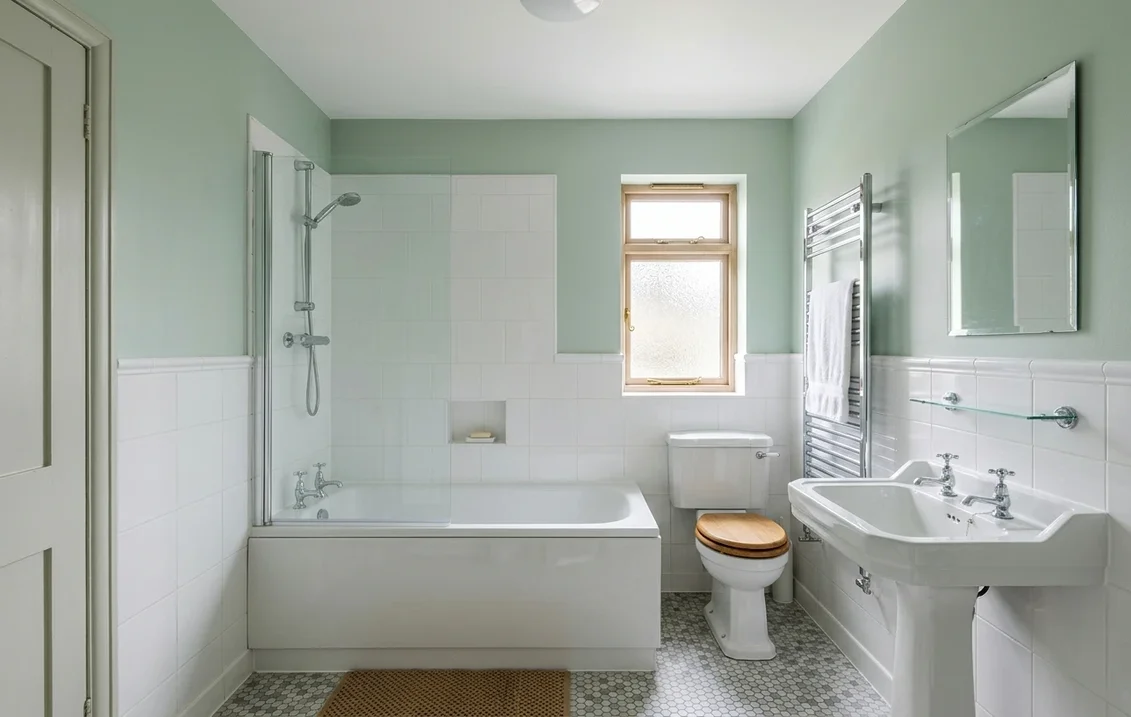
Try it on your room

Johnstone's Bathroom Paint, sold as Bathroom Mid Sheen, is Johnstone's water-based emulsion for bathroom walls. Johnstone's says it is "specially formulated to resist moisture and stains", is "protected against mould" and "provides durable protection in areas of high condensation". It covers up to 30 m² per 2.5 litre tin, is touch dry in 1 to 2 hours and can be recoated after 3 to 4 hours. On johnstonespaint.com in October 2026 it came in 2.5 litre tins only, in 16 ready-mixed colours, at £22.19 for Pure Brilliant White and £24.34 for the colours. Johnstone's does not put a number of years on its mould protection, and no paint removes the cause of bathroom mould: steam that the room cannot clear.
The figures below come from the Johnstone's product page and safety data sheet, read in October 2026, with the Dulux and Crown product pages for comparison and the UK government's ventilation and damp guidance. This is the Johnstone's counterpart to our Dulux Easycare Bathroom guide; if you have not settled on a brand, our bathroom paint colours guide works by room type and shade instead.
See a bathroom colour on your own walls first
Upload a photo of your bathroom and repaint the walls in a soft aqua, a pale green or a deep forest green before you buy a tester.
Try a colour on my bathroom photoWhat Johnstone's Bathroom Mid Sheen is
The Johnstone's Bathroom Mid Sheen product page gives the working figures, and the Bathroom Mid Sheen safety data sheet attached to it (PPG Architectural Coatings UK, version 1.08, 27 March 2019) adds the chemistry.
| Specification | What Johnstone's states |
|---|---|
| Type of paint | Water-based topcoat for interior walls; not classified as hazardous (safety data sheet, product code 17000DUR006) |
| Finish | Mid sheen, "wipeable"; low odour |
| Claims | Resists moisture, stains and grease; protected against mould; "specially formulated for use in moist and damp areas" |
| Coverage | Up to 30 m² per 2.5 litre tin, which is 12 m² per litre |
| Drying | Touch dry 1 to 2 hours; recoat after 3 to 4 hours |
| Application | Brush, roller or paint pad |
| Tins and johnstonespaint.com prices | 2.5 l only: £22.19 for Pure Brilliant White, £24.34 for the colours (including VAT, October 2026) |
| VOC content | A maximum of 10 g/l, against an EU limit of 30 g/l for its category (safety data sheet) |
| Preservatives | Contains 1,2-benzisothiazol-3(2H)-one, octhilinone and 2-methylisothiazol-3(2H)-one; "may produce an allergic reaction" |
Try it on your room
No photo? Try a sample
Four things are missing, and it is better to know than to guess. Johnstone's publishes no wet scrub class under BS EN 13300, no number of years for the mould protection, and no waiting time before the room can take a shower. And the product page lists walls as the surface, without mentioning ceilings, wood or metal. The safety data sheet files the paint under the EU category for interior matt walls and ceilings, which by definition covers finishes with a gloss below 25 at 60°, so "mid sheen" here means a low sheen, not a semi-gloss.
"Protected against mould": what the claim covers
A bathroom paint that is protected against mould carries a preservative in the dried film, which makes it harder for mould to grow on the paint. It does nothing about the reason mould grows, which in a bathroom is warm, wet air condensing on cold walls and ceilings faster than it is extracted.
The government guidance on understanding and addressing the health risks of damp and mould in the home (updated 1 April 2026, England) is direct about it: "Condensation is one of the most common causes of damp and mould in homes", and "simply removing surface mould will not prevent the damp and mould from reappearing". For cleaning off existing mould before you paint, it adds: "Mould and mildew products should be used in preference to bleach, for health and safety reasons." So the order is the same whichever brand you buy: ventilation first, then the existing mould, then the paint. If mould returns through new paint within a few months, our guide to condensation problems helps you tell condensation from rising or penetrating damp.
Johnstone's, Dulux and Crown bathroom paints compared
The three big UK brands each sell a dedicated bathroom emulsion. The figures are from each maker's product page in October 2026; where a maker publishes nothing, the table says so.
| Product | Finish | Mould claim | Drying | Surfaces | Price from |
|---|---|---|---|---|---|
| Johnstone's Bathroom Mid Sheen | Mid sheen | "Protected against mould"; no duration given | Touch dry 1 to 2 h; recoat 3 to 4 h | Walls | £22.19 (2.5 l) |
| Dulux Easycare Bathroom | Soft sheen | "Protects the paint against mould for five years" | 6 h between coats; 24 h before condensation | Not listed on the product page | £15.50 (1 l) |
| Crown easyclean Bathroom Mid Sheen | Mid sheen | Mouldguard+ "protects against mould growth"; no duration given | Touch dry 2 h; recoat 4 h | Walls, ceilings, suitably primed wood and metal | £17.50 |
Read across the rows and each product has a different strength. Johnstone's is the quickest to recoat, so two coats fit comfortably into one morning. Dulux is the only one of the three to put a figure on its mould claim and to state how long to wait before steam, 24 hours. Crown is the only one sold as a multi-surface bathroom paint for walls, ceilings and primed wood and metal, and it states a VOC content of "max 1g/l", against Johnstone's 10 g/l. Johnstone's is also the least flexible on size: one 2.5 litre tin per colour, where Dulux sells a 1 litre tin that suits a small en-suite. If you are weighing the two other brands more broadly, our Crown and Dulux interior comparison covers their wall paints room by room.
The 16 ready-mixed Johnstone's Bathroom colours
The colour selector on the product page listed 16 shades in October 2026, all in 2.5 litre tins. The grouping by family is ours, made from the names and the swatches on the page.
| Family | Ready-mixed Bathroom Mid Sheen shades |
|---|---|
| Whites and off-whites (6) | Pure Brilliant White, White Lace, Silver Feather, Botanical Pearl, Antique Cream, Magnolia |
| Greys (3) | Frosted Silver, Manhattan Grey, Summer Storm |
| Aquas and blues (3) | Silk Spa, Blue Shore, Island Breeze |
| Greens (2) | Jade (a pale green), Forest Stroll (a deep forest green) |
| Warm pinks and neutrals (2) | Ballet Slipper, Seashell |
That is a narrower range than Dulux's 36 ready-mixed Easycare Bathroom shades, and it leans pale: nine of the sixteen are whites, off-whites or greys. For a bathroom with white sanitaryware and white tiles, the shades that make the most visible change are the aquas, Island Breeze above all, and Forest Stroll, which turns a small room dark and enclosed in the way deep greens do. Silk Spa and Jade are the safe middle ground: colour that still reads as light in a room with one small frosted window.
Johnstone's warns on the page that its "online colour charts should be used as a guide only", because screens vary, and it sells colour testers from £2.21. Bathroom light makes that warning matter more than in any other room: a frosted window, one ceiling light and the bounce off white tiles can push a pale aqua towards grey or white. Paint a large sample on the wall you look at most, and check it in daylight and with the light on at night. Our guide to testing paint colours before you buy explains how to do this without wasting testers.
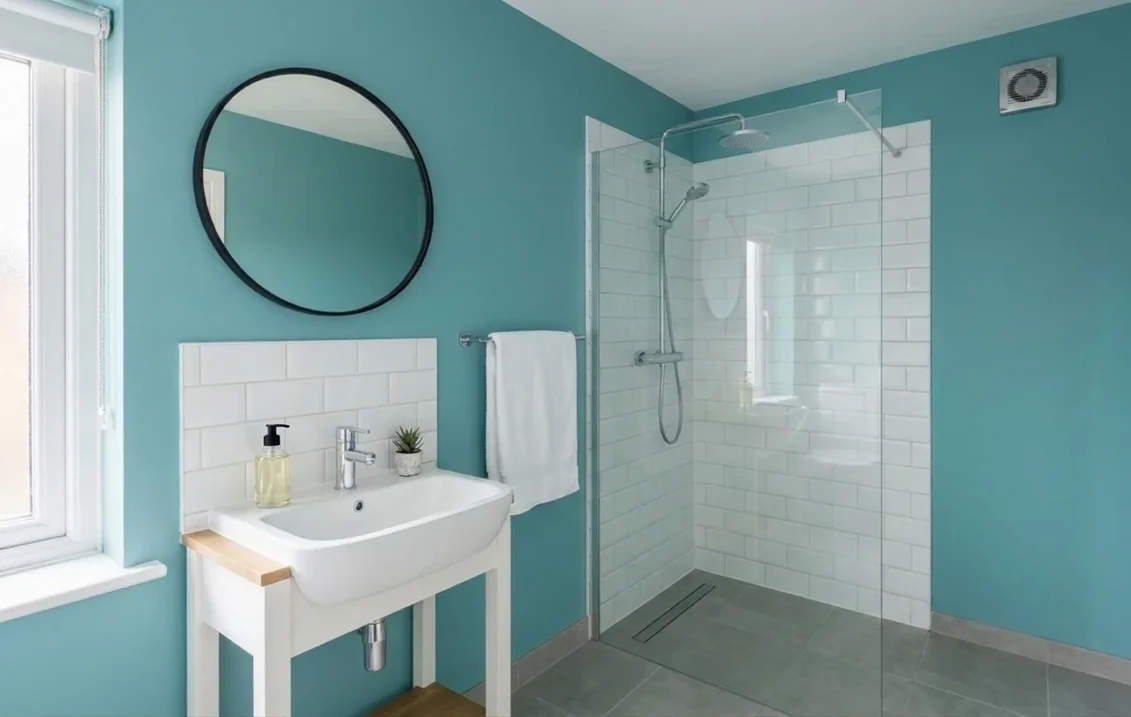
Ventilation first: what Approved Document F asks of a bathroom
In England, ventilation in homes is set by Approved Document F, Volume 1 (dwellings), 2021 edition. It is the yardstick for whether a bathroom can clear the steam a mould-resistant paint is meant to cope with:
- Bathrooms should have extract ventilation to the outside (paragraph 1.17), intermittent or continuous.
- Extract rates. Table 1.1 sets a minimum of 15 litres per second for an intermittent bathroom fan; Table 1.2 sets a high rate of 8 litres per second for a continuous system.
- Fan position. Fans go "as high as is practicable in the room" and "a maximum of 400mm below the ceiling" (paragraph 1.20).
- No openable window. The fan should keep running for at least 15 minutes after the room is vacated (paragraph 1.51), and humidity controls need a manual override (paragraph 1.50).
- Refurbishing. When building work is done in a bathroom, existing fans "should be retained or replaced" and checked (paragraph 3.30); replacing a fan on the existing cabling does not need to be notified to building control (paragraph 3.32).
A 2026 edition has been published; it takes effect on 24 March 2027 for most building work in England and keeps the 15 litres per second bathroom figure. Wales, Scotland and Northern Ireland have their own building regulations. A quick test before you paint: shut the door, run a hot shower for ten minutes with the fan on, then look at the mirror and the ceiling. If they are still streaming long after the shower stops, the fan is the job to do first.
Ceilings, woodwork and the rest of the room
The ceiling. Bathroom condensation usually starts on the ceiling, where the warmest, wettest air collects. Johnstone's lists walls as the surface for Bathroom Mid Sheen and says nothing about ceilings, while Crown sells its easyclean Bathroom for walls and ceilings. If the ceiling is where your mould starts, check the tin or ask Johnstone's before you use it overhead, or use a bathroom paint sold for ceilings up there. Our bathroom colours guide has a section on preventing ceiling mould.
Woodwork and pipes. Skirting, the door, the window frame and boxed-in pipes need a paint sold for wood, or Crown's multi-surface bathroom emulsion over a suitable primer. Johnstone's Bathroom Mid Sheen is not sold for them.
An en-suite off a bedroom. Johnstone's lists its Washable Matt as a related product: matt, "scrub and stain resistant", 30 m² per tin, from £22.19. Used in the same colour on the bedroom side, it keeps the colour continuous while the sheen changes at the doorway, which reads as a change of room rather than a mistake.
Tiles and old plaster. Bathroom Mid Sheen is a wall emulsion, not a tile paint. In a period house with original lime plaster, read our period property interior guide before choosing any modern washable emulsion.
How much Johnstone's Bathroom paint you need
Two worked examples at Johnstone's maximum of 30 m² per 2.5 litre tin, assuming two coats on the walls, which is the usual practice when you change colour. Measure your own room: tiling, the bath and the door change the paintable area a great deal.
| Room | Paintable wall area | Two coats | Tins of 2.5 l |
|---|---|---|---|
| En-suite, 2.0 x 1.5 m, 2.4 m high, shower fully tiled | About 8 m² | 16 m² | One tin (30 m²), with paint left for touch-ups |
| Family bathroom, 2.5 x 2.2 m, 2.4 m high, tiles to 1 m | About 11 m² | 22 m² | One tin; add the 5.5 m² ceiling at two coats and you need a second |
Thirty square metres per tin is a maximum. A strong change, from magnolia to Island Breeze or Forest Stroll, may need a third coat, and fresh filler patches soak up more paint than sound emulsion. If you would rather hand the job over, our interior decorator cost guide gives UK day rates and typical room prices.
Painting a bathroom with Johnstone's Bathroom Mid Sheen, step by step
- Check the fan against the Approved Document F figures above and fix it first if the room stays steamy.
- Treat any mould with a mould and mildew product rather than bleach, following its instructions, and let the wall dry completely.
- Prepare the walls. Fill and sand, then wash off soap residue and grease around the bath and basin, rinse and let dry. A sheen shows dents and filler more than a matt.
- Apply the first coat with a brush, roller or paint pad, cutting in around tiles and fittings first.
- Recoat after 3 to 4 hours, the window Johnstone's gives, so both coats fit into one day.
- Give it time before steam. Johnstone's publishes no waiting time before showers. Dulux asks 24 hours for its own bathroom paint, and leaving the room unused overnight and through the next morning is a sensible margin if your household can manage it.
- Ventilate while it dries, with the fan running and the window open if the weather allows.
If you rent, or let a property
The government damp and mould guidance was written for rented housing providers in England after two-year-old Awaab Ishak died in December 2020 from prolonged exposure to damp and mould in his home. It is clear that repainting is not the landlord's answer: "Tenant management of condensation and small amounts of mould should not be a substitute for assessing and addressing the underlying issue, which should always be the priority." It lists working bathroom extractor fans among the checks and asks landlords to revisit at least 6 weeks after remedial work. A tenant who repaints with a bathroom paint should report persistent mould at the same time, not instead.
Whoever pays for the work, the colour is the part you can try for free. The interior paint visualiser repaints your own photo, so you can see an aqua, a green or a warm white above your tiles before you open a tin.
Choose the colour before you choose the tin
Upload a photo of your bathroom and compare a pale aqua, a soft green or a deep green on the walls in seconds.
Try bathroom colours on my photoSources and references
- Johnstone's (PPG), Bathroom Mid Sheen product page: description and claims, coverage, touch dry and recoat times, application, surface, sizes, prices, the 16 ready-mixed colours, the colour chart warning and related products.
- PPG Architectural Coatings UK, Safety data sheet, Johnstones Retail Bathroom Mid Sheen (version 1.08, 27 March 2019): classification, preservatives, VOC category and content.
- Dulux UK, Dulux Easycare Bathroom Soft Sheen product page: finish, mould claim, drying and condensation times, price.
- Crown Paints, easyclean Bathroom Mid Sheen product page: Mouldguard+ claim, surfaces, touch dry and recoat times, VOC content, price.
- UK Government, Ventilation: Approved Document F, Volume 1 (dwellings), 2021 edition, paragraphs 1.17, 1.20, 1.50, 1.51 and 3.30 to 3.32 and Tables 1.1 and 1.2, plus the 2026 edition (takes effect 24 March 2027): bathroom extract rates, fan position and overrun, refurbishment.
- Office for Health Improvement and Disparities, MHCLG and UKHSA, Understanding and addressing the health risks of damp and mould in the home (updated 1 April 2026): condensation as a cause, mould removal products, landlord responsibilities.
Frequently asked questions
Is Johnstone's bathroom paint mould resistant?
How long does Johnstone's Bathroom Mid Sheen take to dry?
What sizes and colours does Johnstone's bathroom paint come in?
Can I use Johnstone's Bathroom Mid Sheen on a ceiling?
Is Johnstone's or Dulux bathroom paint better?
How much Johnstone's bathroom paint do I need?
Trademarks mentioned (Sherwin-Williams, Benjamin Moore, Behr, Caparol, Brillux, Sto, Alpina, Valspar, PPG, Glidden, Dulux, Crown Trade, Sandtex, Farrow & Ball, Johnstone's, Leyland) are property of their respective owners. FacadeColorizer is independent and not affiliated with any of them. Nominative fair use under Lanham Act §1125.