Try it on your room

In a British bathroom the colour is the easy part. What decides whether the walls still look clean in three years is the paint system and the air: a washable, mould-protected finish on a sound surface, and an extractor that actually removes the steam. This guide lists fifteen bathroom colours with the makers' own descriptions, sets out what the three bathroom-specific finishes from Farrow & Ball, Dulux and Zinsser promise on their data sheets, and quotes the ventilation rate the Building Regulations set for a bathroom, because no paint survives a room that never dries out.
The best bathroom paint in the UK: the short answer
Pick the product before the shade. For designer colours, Farrow & Ball Modern Emulsion is the maker's own bathroom finish: 7% sheen, washable, "protected against mould" and described as "particularly perfect for moisture-prone kitchens and bathrooms". For a dedicated bathroom paint from the high street, Dulux Easycare Bathroom Soft Sheen is sold with a five-year mould protection claim and is for walls and ceilings only. For a bathroom that has already grown mould, Zinsser Perma-White Interior carries a five-year guarantee against mould and mildew on the paint film, when two coats are applied. Then make sure the extractor meets the Building Regulations rate of 15 litres per second for a bathroom, and choose a colour from the list below that suits the light.
The 15 best bathroom paint colours UK 2026
The list leans on Farrow & Ball because the maker publishes a description and a complementary white for each colour, which makes the choice verifiable; every one of these colours is available in Modern Emulsion. Quoted words are from the colour pages.
| # | Colour | What the maker says | Best for |
|---|---|---|---|
| 1 | Skimming Stone No. 241 | "This stony off white", "warm light grey undertones" | Small bathrooms, any aspect |
| 2 | Dimity No. 2008 | A warm neutral "brimming with warmth" | North-facing bathrooms, period houses |
| 3 | Cornforth White No. 228 | "Totally understated and extremely versatile", "a hushed and calming retreat" | Walls with white sanitaryware and chrome |
| 4 | Wimborne White No. 239 | "Just a little softer than All White" | Ceilings, woodwork, a soft all-white scheme |
| 5 | Setting Plaster No. 231 | "A dusty plaster pink" | Warmth in a cold bathroom; brass taps |
| 6 | Cromarty No. 285 | "This very light green grey", "neither too green nor too grey" | Spa-style bathrooms, timber |
| 7 | Light Blue No. 22 | "This silvery blue", "peaceful and calming" in well lit rooms | Bright, south-facing bathrooms |
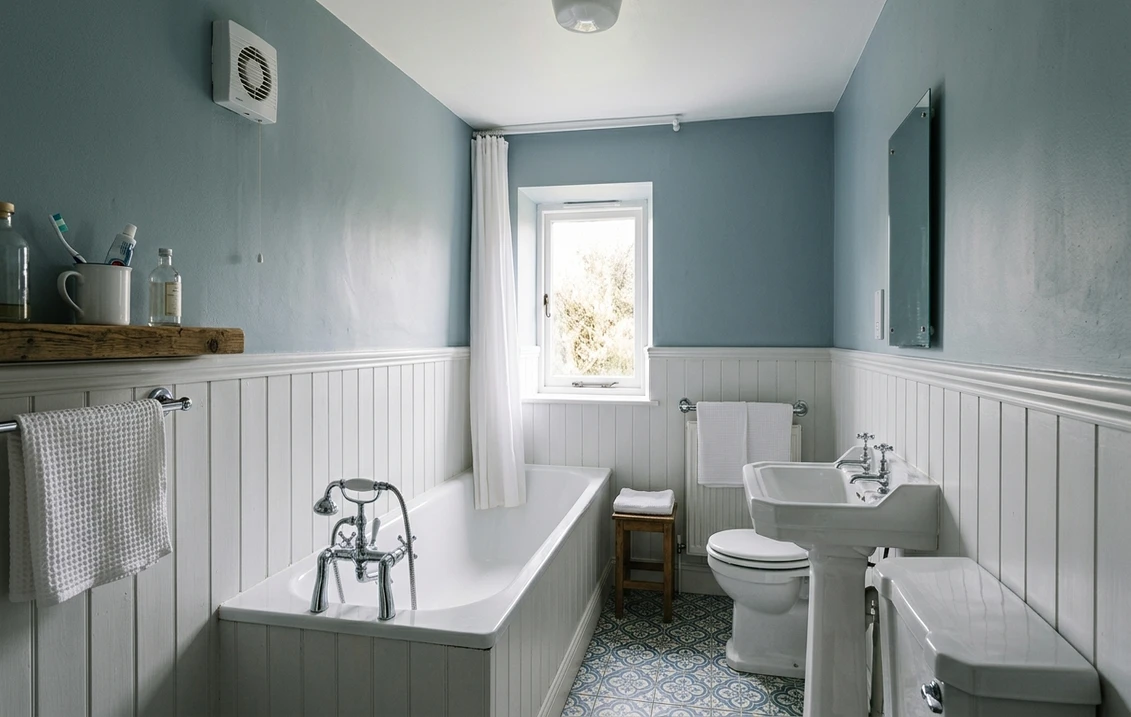
| 8 | Blue Gray No. 91 | "A cooler, more weathered version of French Gray", shifting between blue and grey | Walls or panelling; country bathrooms |
| 9 | Pavilion Gray No. 242 | "This classic mid grey", "subtle blue undertones" | Modern bathrooms, marble-effect tile |
| 10 | Pigeon No. 25 | "This cosy and nostalgic blue grey", suited to "cloakrooms or darker spaces" | Cloakrooms, vanity units, panelling |
| 11 | Green Smoke No. 47 | "A smoky green blue", a sense of tranquillity indoors | Panelling below a lighter wall |
| 12 | Hague Blue No. 30 | A deep, dark blue | Bath panel, vanity, a dramatic cloakroom |
| 13 | Shaded White No. 201 | Green Smoke's complementary white | Ceiling and woodwork with greens |
| 14 | School House White No. 291 | The complementary white of Cromarty, Light Blue, Blue Gray, Pigeon and Setting Plaster | Ceiling and woodwork with blues and greens |
| 15 | Dulux Pure Brilliant White | Dulux's standard white, in its bathroom range | Ceilings over a shower |
Try it on your house
No photo? Try a sample
A pattern in the list: School House White is the complementary white for five of the colours, which makes it the natural ceiling and woodwork colour for a bathroom built around soft blues, blue-greys and green-greys. With the warm neutrals (Skimming Stone, Dimity, Cornforth White) the maker suggests Strong White, Pointing and Wevet respectively.
Choosing by light and size
North-facing or windowless. A cool grey or blue looks colder still in north light. Warm neutrals with a yellow or pink base keep the room comfortable: Dimity, Skimming Stone or Setting Plaster. Pigeon is the exception the maker itself names for "darker spaces", because a blue-grey with enough depth reads cosy rather than chilly.
Bright, south-facing. This is where the blues work: Light Blue is "peaceful and calming" in well lit rooms, Blue Gray and Pavilion Gray read clean and modern against white tile.
Small bathrooms and en-suites. One colour on walls and ceiling, or a shade apart, blurs the edges and makes the room feel bigger than a white ceiling over a coloured wall. Put the depth below: Green Smoke, Pigeon or Hague Blue on a bath panel or below a dado, a light colour above.
Period bathrooms. Blue Gray, Pigeon and Cromarty belong to the same muted family as the woodwork colours of a Victorian or Edwardian house; our period property interior colours guide covers the rest of the house.
Anti-mould paint systems: what the data sheets say
"Bathroom paint" covers three different products, and the data sheets show how they differ.
| Product | Finish | Mould claim | Coverage | Drying |
|---|---|---|---|---|
| Farrow & Ball Modern Emulsion | 7% sheen, "washable and wipeable" | "Mould protected"; "particularly perfect for moisture-prone kitchens and bathrooms" | Up to 12 m² per litre per coat | Dry in 2 hours, recoat in 4 hours |
| Dulux Easycare Bathroom Soft Sheen (retailer listing) | Soft sheen; plastered walls and ceilings only | "5 year" protection against mould, "Mouldtec formulation" | Up to 13 m² per litre, 2 coats | 6 hours between coats; 24 hours before steam |
| Zinsser Perma-White Interior (TDS) | Eggshell, satin, semi-gloss; washable | Paint film guaranteed mould and mildew-proof for 5 years with 2 coats; passes ASTM 5590 and 3273 | About 10 m² per litre | Recoat after 2 hours; cure 7 to 10 days |
Read the limits as carefully as the claims. Zinsser's sheet says Perma-White "is not intended for application to floors or any surface subject to water immersion or prolonged contact with water including shower enclosures, saunas or steam rooms", and that where it is used above tile on shower walls you should "wait at least 24 hours before using shower". It also asks for all existing mould to be removed before painting and for bare plaster to be sealed with a primer first. The Dulux listing tells you to keep the room free of steam for 24 hours after the last coat. A mould-resistant paint protects its own film; it does not kill mould growing behind the surface, and it does not replace ventilation.
Ventilation first: what the Building Regulations require
Approved Document F, the statutory guidance on ventilation for dwellings in England, opens with the reason it exists: "Without adequate ventilation, mould and internal air pollution might become hazardous to health." It requires extract ventilation to the outside in kitchens, utility rooms, bathrooms and sanitary accommodation, and its Table 1.1 sets the minimum intermittent extract rate for a bathroom at 15 litres per second (30 for a utility room, 6 for a WC). Extract fans should be installed "as high as is practicable in the room" and at most 400 mm below the ceiling (HM Government, Approved Document F Volume 1, 2021 edition).
In practice that gives you a check before repainting. Hold a sheet of toilet paper to the fan grille while it runs: if it is not pulled firmly against it, the fan is not moving much air. A fan mounted low on the wall, or one whose duct runs a long way to the outside, often underperforms. If the ceiling corner above the shower is where the black spots keep coming back, the fault is airflow, and the right paint will only delay the return. When ventilation is sorted, a washable, mould-protected finish keeps the walls looking fresh between cleans.
Ceiling mould prevention: the zone most bathrooms fail
Steam rises and condenses on the coldest surface it meets, which in most bathrooms is the ceiling above the shower and the corner where the ceiling meets an outside wall. Three steps keep it clean: clean off any existing mould and let the surface dry fully; seal bare or patched plaster before painting, as the Zinsser sheet asks; and use the same mould-protected product on the ceiling as on the walls, in two full coats. A pure white ceiling shows the first spots quickly, which is useful as an early warning; a colour drenched across walls and ceiling hides them longer but makes the problem harder to spot.
Finish sheen: washable, not shiny
A bathroom wall needs to be wiped, not polished. Farrow & Ball's Modern Emulsion manages it at 7% sheen, which still reads as matt; Dulux's bathroom paint is a soft sheen; Zinsser offers eggshell, satin and semi-gloss. The higher the sheen, the easier the wipe and the more each dent and filler patch shows. Woodwork, bath panels and vanity units take an eggshell or satinwood suited to wood: the Dulux bathroom paint, for instance, is for plastered walls and ceilings only. The utility room colours guide and the conservatory paint guide apply the same logic to the other hard-working rooms.
Can you paint over bathroom tiles?
Painting tiles is a quick way to change a dated bathroom, but only away from direct water. Zinsser's data sheet says Perma-White "will adhere to gloss or semi-gloss paints, existing wallcoverings, ceramic tile and similar glossy surfaces without prior sanding", and asks that, where it is used above tile on shower walls, you "wait at least 24 hours before using shower" (Zinsser, Perma-White Interior TDS). The same sheet rules out "shower enclosures, saunas or steam rooms" and any surface "subject to water immersion or prolonged contact with water". In practice: tiles behind a basin or a toilet, or a tiled splashback, can be painted; the inside of a shower cubicle cannot, whatever the paint.
Preparation decides the result. Clean the tiles with a degreaser, rinse, let them dry fully, and repair any cracked grout first, because paint does not hold a loose joint. Two thin coats look better than one thick one, and a satin or semi-gloss finish is easier to keep clean on a tile surface than a matt one. Expect the grout lines to show through as a texture; that is the honest limit of painted tile.
Woodwork, bath panels and vanity units
The bathroom paints in this guide are for walls and ceilings: the Dulux listing says its Easycare Bathroom is "designed for plastered walls and ceilings only" and points to a different product for timber such as skirting boards. Wooden bath panels, boxing-in, window frames and vanity units take a wood finish, an eggshell or satinwood, which resists knocks and wipes clean. Painting the bath panel and vanity in a darker shade of the wall colour, such as Pigeon below Light Blue, or Green Smoke below Cromarty, ties the room together and hides scuffs at floor level. Let wood finishes harden fully before the room is used for showers, and keep the extractor running while they dry.
How much paint a bathroom needs
A typical family bathroom has 20 to 30 m² of paintable wall and ceiling once the tiles are subtracted. At up to 12 m² per litre (Modern Emulsion) or 13 m² per litre (Easycare Bathroom), two coats need 3.5 to 5 litres, so a 2.5 litre tin plus a second one, or a single 5 litre tin; Perma-White at about 10 m² per litre needs 4 to 6 litres for two coats. A small en-suite usually fits in one 2.5 litre tin. For what a decorator charges, see our interior decorator cost guide; for the room next door, the hallway paint colours guide uses the same washable finishes.
Sources and references
- HM Government, Approved Document F, Volume 1: Dwellings, 2021 edition: paragraph 1.1, extract ventilation spaces, Table 1.1 intermittent rates, fan position.
- Farrow & Ball, Modern Emulsion (sheen, washability, mould protection, coverage, drying) and colour pages for the fifteen shades listed.
- Tor Coatings for Zinsser, Perma-White Interior technical data sheet: guarantee, tests, coverage, drying, limitations.
- Wood Finishes Direct, Dulux Easycare Bathroom Soft Sheen: retailer listing of the mould protection claim, coverage, drying and surfaces.
Frequently asked questions
What is the best paint for a bathroom in the UK?
What colour is best for a small bathroom?
What colour suits a north-facing bathroom?
Does anti-mould paint stop mould?
What extractor fan rate does a bathroom need?
How much paint do I need for a bathroom?
Trademarks mentioned (Sherwin-Williams, Benjamin Moore, Behr, Caparol, Brillux, Sto, Alpina, Valspar, PPG, Glidden, Dulux, Crown Trade, Sandtex, Farrow & Ball, Johnstone's, Leyland) are property of their respective owners. FacadeColorizer is independent and not affiliated with any of them. Nominative fair use under Lanham Act §1125.