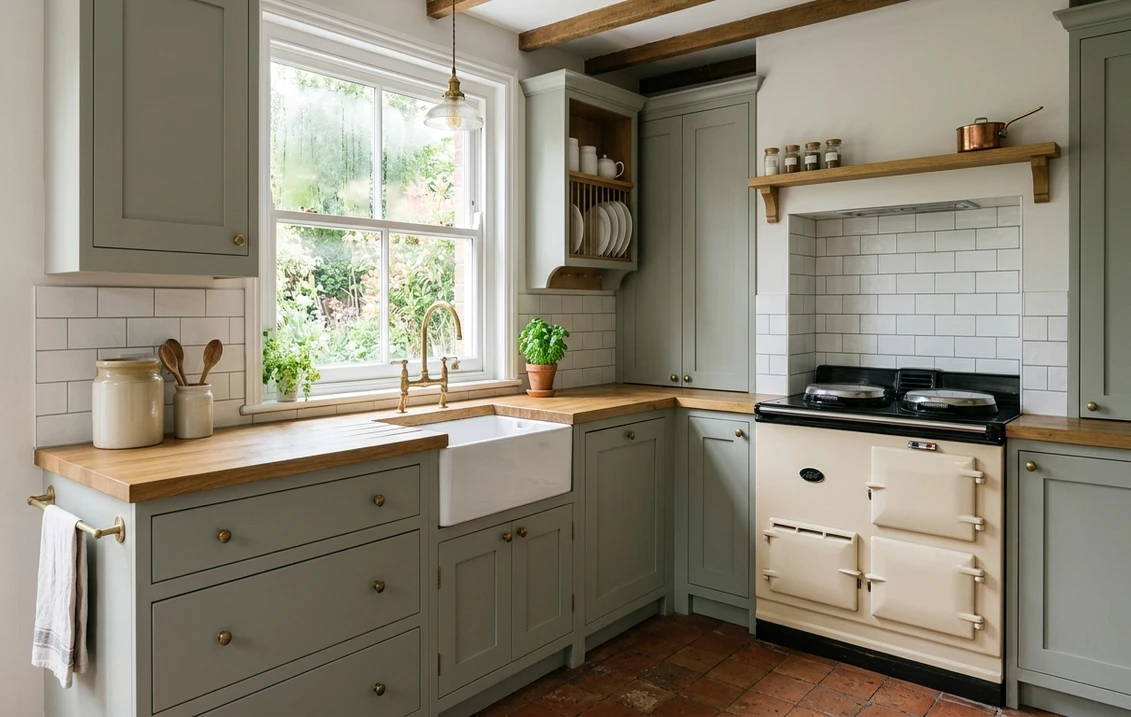
Try it on your room

The best kitchen cupboard paint depends less on the brand than on what your doors are made of. On solid wood or doors that are already painted, a dedicated cupboard paint such as Ronseal One Coat Cupboard Paint or Rust-Oleum Kitchen Cupboard Paint, or a hard-wearing eggshell or satinwood, goes on after cleaning and a light sand. On melamine, laminate or high-gloss doors, adhesion is the problem, so use an adhesion primer such as Zinsser B-I-N or Bulls Eye 1-2-3 first, or a product the maker says can go straight on, such as Dulux Simply Refresh Multi Surface Eggshell. Bare MDF always needs priming. None of the makers below say their cupboard paint is suitable for vinyl-wrapped doors. Expect to pay £15 to £30 for a 750 ml tin, and give the paint about seven days to cure before you treat the cupboards normally.
Specifications below come from the makers' own product pages and technical data sheets, read in October 2026; prices are UK retail prices checked on 26 October 2026 and will move. Johnstone's also sells a cupboard paint in its Revive range, but its data sheet could not be read at the time of writing, so it is not compared here rather than quoted from a retailer.
Try the colour on your own cupboards first
Upload a photo of your kitchen and repaint the cupboard doors in any Farrow & Ball or Dulux colour before you buy a tin. How it works: our interior paint visualiser.
Repaint my cupboards on a photoFirst: what are your cupboard doors made of?
Every failure people describe with painted kitchens, paint that peels off in strips, chips at the handles or never seems to harden, comes back to the surface underneath. Check it before you buy anything. Open a door and look at the edge and the inside face: a thin plastic layer that wraps around the edge is vinyl wrap; a hard, flat, slightly shiny skin that meets the edge in a line is melamine or laminate; a uniform brown fibreboard showing at a chip is MDF; visible grain on the edge and back is solid wood or veneer.
| Door surface | What the makers ask for | Primer | Topcoat options |
|---|---|---|---|
| Solid wood, varnished | Degrease, sand to a dull finish, remove wax with white spirit | Spot-prime bare patches and knots | Cupboard paint, eggshell or satinwood |
| Already painted (sound) | Degrease, light sand with fine paper | Usually none | Any of the products below |
| Melamine, laminate, high gloss | Degrease thoroughly; scuff-sand where the product sheet asks | Adhesion primer (B-I-N, Bulls Eye 1-2-3, Ronseal All Surface Primer) unless the topcoat says otherwise | Ronseal or Rust-Oleum cupboard paint, Dulux Simply Refresh, any eggshell over primer |
| Bare MDF | Sand lightly, especially cut edges | Always: Zinsser calls priming MDF essential | Any of the products below |
| Vinyl wrap (foil) | Not covered by any of the cupboard paints compared here | Only Zinsser Cover Stain lists vinyl among its surfaces | Test a hidden door first, or replace the doors |
Try it on your room
No photo? Try a sample
Vinyl wrap deserves a warning of its own. The foil is glued to MDF, and if it is already lifting at the edges or around the hob, paint will not hold it down: the wrap and the paint will come away together. If the foil is perfectly bonded, an adhesion primer that lists vinyl can work, but none of the cupboard paint makers back it, so try it on one door inside a cupboard before committing a whole kitchen.
Kitchen cupboard paints sold in the UK, compared
These are the products most UK DIY stores stock for cupboards, plus the two routes the paint brands themselves suggest. Coverage figures are the maximum quoted by the maker; drying times are at around 20°C.
| Product | Finish | Coverage | Dry / recoat | Coats | Surfaces named by the maker | 750 ml price (26/10/2026) |
|---|---|---|---|---|---|---|
| Ronseal One Coat Cupboard Paint (water based) | Gloss or satin | 8 m²/L | 1 h touch dry / 4 h before a second coat | 1 (2 on porous surfaces or strong colour changes) | Wood and melamine furniture, doors, drawers, shelves, skirting | £15 (Wickes) |
| Rust-Oleum Kitchen Cupboard Paint | Matt (also sold in satin and gloss) | Up to 14 m²/L | 1 h touch dry, recoat 4 h, full cure 7 days | 2 recommended | Wood, gloss and melamine, over old paint or varnish; not worktops or bare metal | £29.99 (Rust-Oleum), £23 (Wickes) |
| Dulux Simply Refresh Multi Surface Eggshell | Eggshell | About 10 m²/L | At least 6 h between coats, 7 days to cure | 2 | Bare or painted wood, metal, melamine and MDF without a primer | £29 (in store only) |
| Dulux Quick Dry Satinwood | Satin, self-undercoating | Up to 16 m²/L | At least 6 h between coats | 2 | Interior wood and metal (use a primer on melamine) | £25 (Dulux, 2.5 L £35) |
| Farrow & Ball Modern Eggshell | 40% sheen | Up to 12 m²/L | 2 h / 4 h; up to 14 days to harden in deep colours | 2 | Wood and metal; melamine and laminate with a specialist adhesion primer | £36.50 (2.5 L £88) |
Sources: Ronseal One Coat Cupboard Paint, Rust-Oleum Kitchen Cupboard Paint, Dulux Simply Refresh Multi Surface Eggshell, Farrow & Ball Modern Eggshell and Wickes product pages for the store prices.
How to read the table:
- Ronseal One Coat is the cheapest and the fastest on a like-for-like colour change, but its 8 m²/L coverage is the lowest here, and the one-coat claim depends on the surface: dark to light, or a porous door, still needs two. The data sheet lists only white and ivory shades.
- Rust-Oleum Kitchen Cupboard Paint has the widest colour range (more than 100 shades) and a 10 ml sachet for £0.99 that covers a 30 by 30 cm test patch. Its product page says no priming or sanding is needed, but its own data sheet and guide ask you to abrade the surface: follow the data sheet and give the doors a light sand.
- Dulux Simply Refresh is the one product here whose maker says it goes directly onto melamine and MDF without a primer. It is not sold online, so check stock at your local store.
- Dulux Quick Dry Satinwood is the route Dulux's own cupboard guide follows; Dulux no longer sells a dedicated cupboard paint. See our guide to Dulux kitchen paint for the rest of its range.
- Farrow & Ball Modern Eggshell is the premium route and the only one available in the full Farrow & Ball palette; on laminate it needs an adhesion primer first.
Matt, eggshell, satin or gloss on cupboards?
Sheen on a kitchen door is a trade-off between looks and cleaning. A flat matt finish, like Rust-Oleum's, gives the soft, modern look of a factory-painted shaker kitchen and hides small dents, but shows greasy fingerprints around handles more readily. Eggshell (Farrow & Ball's Modern Eggshell sits at 40%) and satin wipe clean more easily and are the usual compromise for the doors people touch most. Full gloss is the toughest and easiest to clean, but it shows every brush mark and every imperfection in an old door, so it rewards spraying or very careful laying off.
A practical rule: matt or eggshell on wall units and tall larder doors, eggshell or satin on base units around the sink and hob, and never a flat wall emulsion on doors. Our guide to interior paint types and decorating costs explains how emulsion, eggshell and gloss differ.
Primers: when you need one, and which
A primer is what makes paint stick to a slippery surface or seals a thirsty one. These are the four most common in UK stores, with the maker's figures from Zinsser UK and Ronseal:
| Primer | Base | Coverage | Dry / recoat / cure | What the maker says it sticks to | Price (Wickes) |
|---|---|---|---|---|---|
| Zinsser B-I-N | Shellac | 12.5 m²/L | 15 min / 45 min / 1 to 3 days | Glossy plastics, metal and ceramic tiles without scuff sanding; also blocks stains and knots | £25 (1 L) |
| Zinsser Bulls Eye 1-2-3 | Water | 10 m²/L | 30 min / 1 h / 7 days | All surfaces without sanding; a grey or deep base under dark topcoats | £23 (1 L) |
| Zinsser Cover Stain | Solvent | 9.8 m²/L | 30 min / 2 h / 4 to 7 days | Lists vinyls and PVC among its surfaces | £23 (1 L) |
| Ronseal One Coat All Surface Primer | Water | 10.5 m² per 750 ml | 30 min / 2 h | Tiles, melamine, cupboards, MDF, wood, metal, uPVC, plastic, glass; not worktops | £20 (750 ml) |
On bare MDF the makers agree: Zinsser's guide to painting MDF calls priming essential and suggests a 120-grit sand first, and Rust-Oleum asks for two coats of Bulls Eye 1-2-3 on stripped MDF before its cupboard paint. On solid pine, prime the knots: Rust-Oleum notes that its cupboard paint does not block stains, and resin bleeding through a pale colour is the classic yellow ring on painted pine doors. Shellac B-I-N is the strongest stain blocker of the four, but it smells strongly and needs methylated spirits to clean the brush, so ventilate well.
Step by step: what the makers tell you to do
Dulux's guide to painting kitchen cupboards, Ronseal's and Rust-Oleum's instructions and Farrow & Ball's own advice on painting kitchen cabinets converge on the same sequence:
- Take the doors off and the handles off. Number each door and its hinge position with tape inside the cupboard. Painting doors flat on trestles avoids runs.
- Degrease. Wash every surface with sugar soap or a strong detergent and rinse with clean water. Kitchen grease is invisible and is the first cause of peeling. If the doors were waxed or oiled, wipe them with white spirit as Rust-Oleum suggests.
- Sand. Ronseal suggests a light sand with 240-grit paper, going down to 120 grit and back to bare wood where old paint is flaking. Dulux notes that you can skip sanding on melamine or high-gloss surfaces if you use the right primer. Vacuum and wipe off the dust; wear a dust mask.
- Prime where the table above says so: bare wood, knots, MDF and slippery surfaces.
- Paint thin coats. Use a small foam or microfibre roller on flat panels and a good synthetic brush in the shaker grooves, working the grooves first. Respect the recoat time on the tin, and sand lightly between coats for a smoother finish, as Dulux advises.
- Paint the frames and carcass edges in place while the doors dry, with the kitchen ventilated.
- Rehang carefully. Leave the doors as long as you can before rehanging, and wait the full cure time before scrubbing or letting doors rub on rubber seals.
All three water-based cupboard paints ask for a room above 10°C. Ronseal also asks you to keep a window open while you work.
How much paint, and what a kitchen costs to repaint
A standard UK kitchen door is about 715 mm by 500 mm, roughly 0.36 m² per face. Take a mid-sized kitchen with 14 doors and 4 drawer fronts:
- Area: 18 fronts × 0.36 m² × 2 faces is about 13 m²; add the visible carcass edges, end panels and plinths and you are near 16 m² for one coat.
- Rust-Oleum, two coats: 32 m² at up to 14 m²/L is about 2.3 litres, so three 750 ml tins: £69 at Wickes' price.
- Ronseal One Coat, one coat: 16 m² at 8 m²/L is 2 litres, so three 750 ml tins: £45. If you need a second coat, double it.
- Farrow & Ball Modern Eggshell, two coats: 32 m² at up to 12 m²/L is about 2.7 litres: one 2.5 litre tin plus one 750 ml, £124.50.
- Primer on melamine: 16 m² of Bulls Eye 1-2-3 at 10 m²/L is 1.6 litres, so two 1 litre tins: £46.
Add sandpaper, sugar soap, a roller kit and masking tape and a DIY repaint costs roughly £100 to £200 in materials for a mid-sized kitchen, against several thousand pounds for new doors. If you would rather hire a decorator, our UK decorator cost guide covers day rates.
Drying, curing and living with a half-painted kitchen
"Dry" and "cured" are not the same thing. Touch dry means you can handle the door; cured means the film has reached its full hardness. Rust-Oleum and Dulux both quote seven days for a full cure, Zinsser up to seven days for Bulls Eye 1-2-3, and Farrow & Ball up to 14 days for deep colours. During that week, open and close doors gently, keep wet cloths and cleaning sprays off them, and do not let cupboard doors rest against rubber bumpers that can stick to soft paint.
Steam and heat matter too. A kitchen that steams up while the paint is curing slows it down. For reference, England's Approved Document F (ventilation) sets intermittent kitchen extraction in new and altered dwellings at 30 litres per second with a cooker hood that vents outside, or 60 litres per second otherwise. Repainting cupboards is not building work and those figures do not apply to it, but they are a useful benchmark: if your extractor is weak, keep a window open during cooking until the paint has cured.
Old paint, lead and VOCs: the UK rules
If your kitchen units are original to an older house, especially a painted dresser or built-in cupboard, the old paint may contain lead. The UK Health Security Agency notes that the sale of lead paint was banned in the UK from 1992 and that children can be exposed through flakes of old paint. Ronseal advises extra care with paint applied before 1960. Do not dry-sand or burn off suspect old paint: test it, wet-sand, and keep children and pets out of the room.
Solvent content is regulated too. Under the Volatile Organic Compounds in Paints, Varnishes and Vehicle Refinishing Products Regulations 2012, interior trim paints for wood and metal are limited to 130 grams of VOC per litre for water-based products and 300 for solvent-based ones; Rust-Oleum states a maximum of 20 g/L for its cupboard paint. Water-based paints are the easier choice in a kitchen you are still cooking in, and the only realistic one if you cannot ventilate well.
Choosing the colour
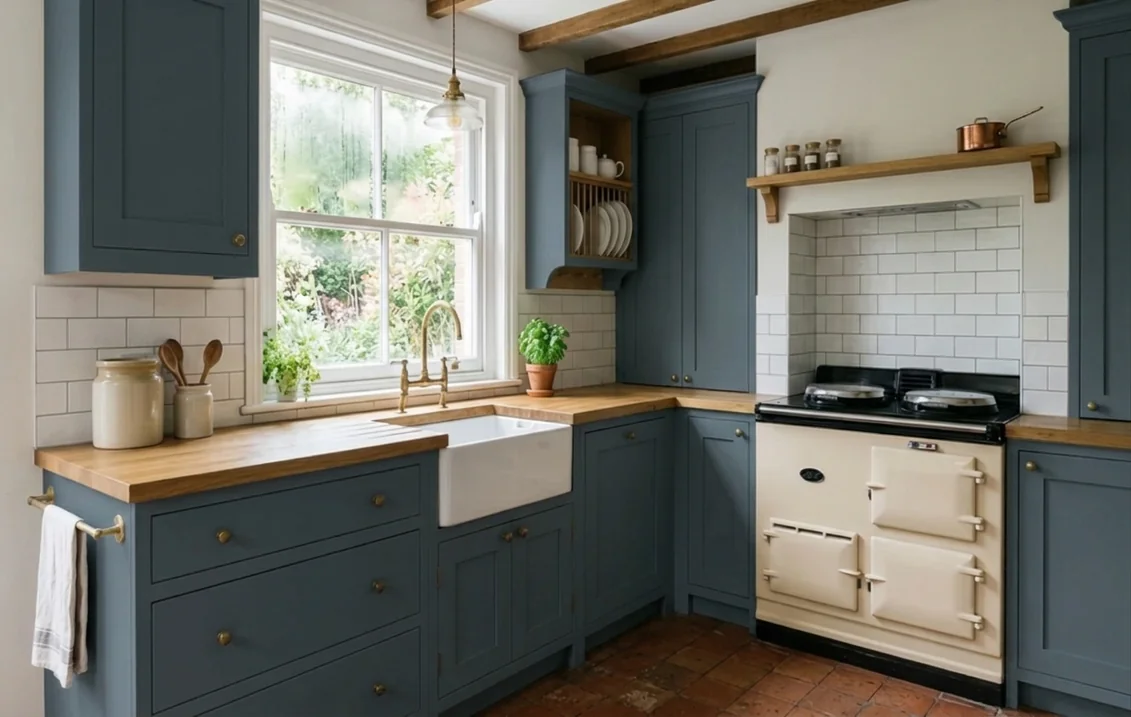
Paint choice settled, the colour is the fun part. Our guide to kitchen paint colours in the UK covers walls and units together, and the guide to colours that go with dark green is useful if you are tempted by deep green cabinetry. Farrow & Ball suggests a popular two-tone scheme on its colour page for Pigeon: Pigeon on a kitchen island with the paler Dimpse on the units around it; our guide to Farrow & Ball Pigeon explains how that grey-green shifts with the light. For small utility spaces, see utility room paint colours. Whatever you choose, test it on a door in your own light: our method for testing paint colours before buying works just as well on cupboards as on walls.
Pigeon, Hague Blue or a soft white?
Compare colours on a photo of your own kitchen: the tool repaints only the cupboard doors, so you see the colour against your worktop, tiles and floor before you order a sample.
Try colours on my cupboardsSources and references
- Ronseal, One Coat Cupboard Paint (water based) and One Coat All Surface Primer and Undercoat: finishes, coverage, drying times, surfaces and preparation.
- Rust-Oleum, Kitchen Cupboard Paint: data sheet figures (coverage, recoat, cure, VOC), surfaces, preparation and price.
- Dulux, Simply Refresh Multi Surface Eggshell and How to paint kitchen cupboards: no-primer surfaces, recoat and cure times, step-by-step method.
- Farrow & Ball, Modern Eggshell and Painting kitchen cabinets: sheen, coverage, drying, laminate and MDF preparation.
- Zinsser UK, B-I-N, Bulls Eye 1-2-3, Cover Stain and How to paint MDF: primer bases, coverage, drying and surfaces.
- Wickes, product pages for Ronseal One Coat Cupboard Paint, Rust-Oleum Kitchen Cupboard Paint and Zinsser B-I-N: retail prices on 26 October 2026.
- UK Health Security Agency, Lead: general information: the 1992 ban on lead paint and exposure through old paint flakes.
- legislation.gov.uk, The Volatile Organic Compounds in Paints, Varnishes and Vehicle Refinishing Products Regulations 2012, Schedule 2: VOC limits for interior trim paints.
- GOV.UK, Approved Document F: Ventilation: kitchen extraction rates for dwellings, used here only as a benchmark.
Frequently asked questions
Can you paint melamine kitchen cupboards?
Can you paint vinyl wrap kitchen cupboards?
Do you need to prime kitchen cupboards before painting?
How long does painted kitchen cupboard paint take to cure?
How much paint do I need for kitchen cupboards?
What finish is best for kitchen cupboard doors?
Trademarks mentioned (Sherwin-Williams, Benjamin Moore, Behr, Caparol, Brillux, Sto, Alpina, Valspar, PPG, Glidden, Dulux, Crown Trade, Sandtex, Farrow & Ball, Johnstone's, Leyland) are property of their respective owners. FacadeColorizer is independent and not affiliated with any of them. Nominative fair use under Lanham Act §1125.