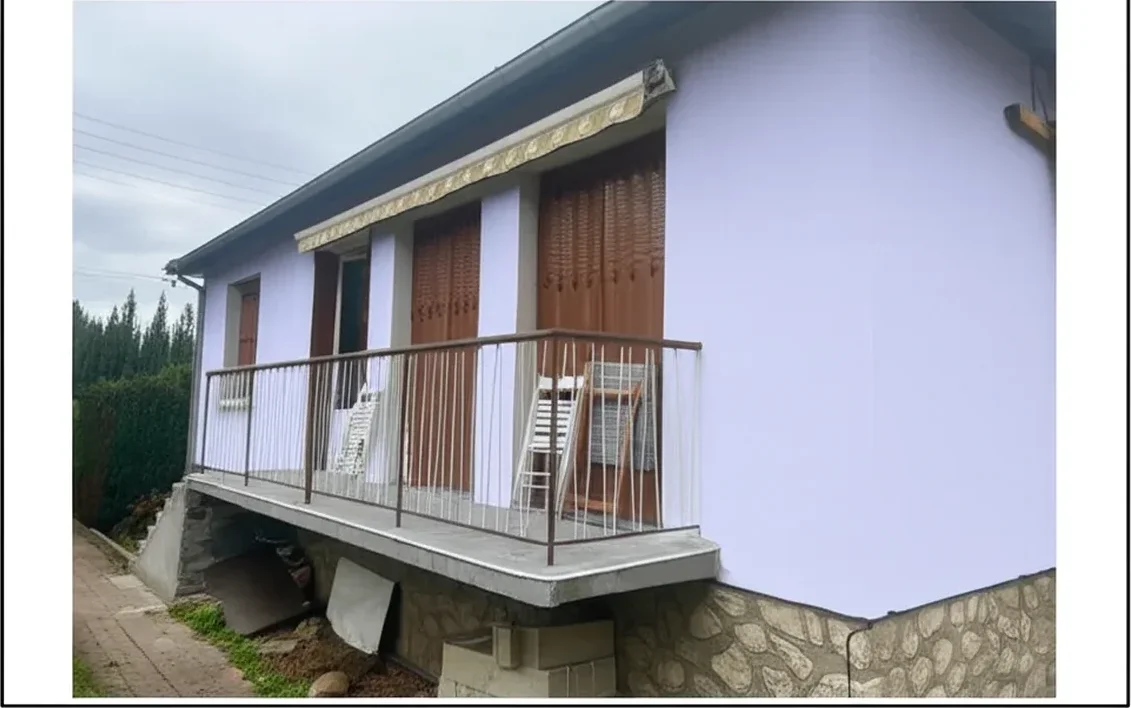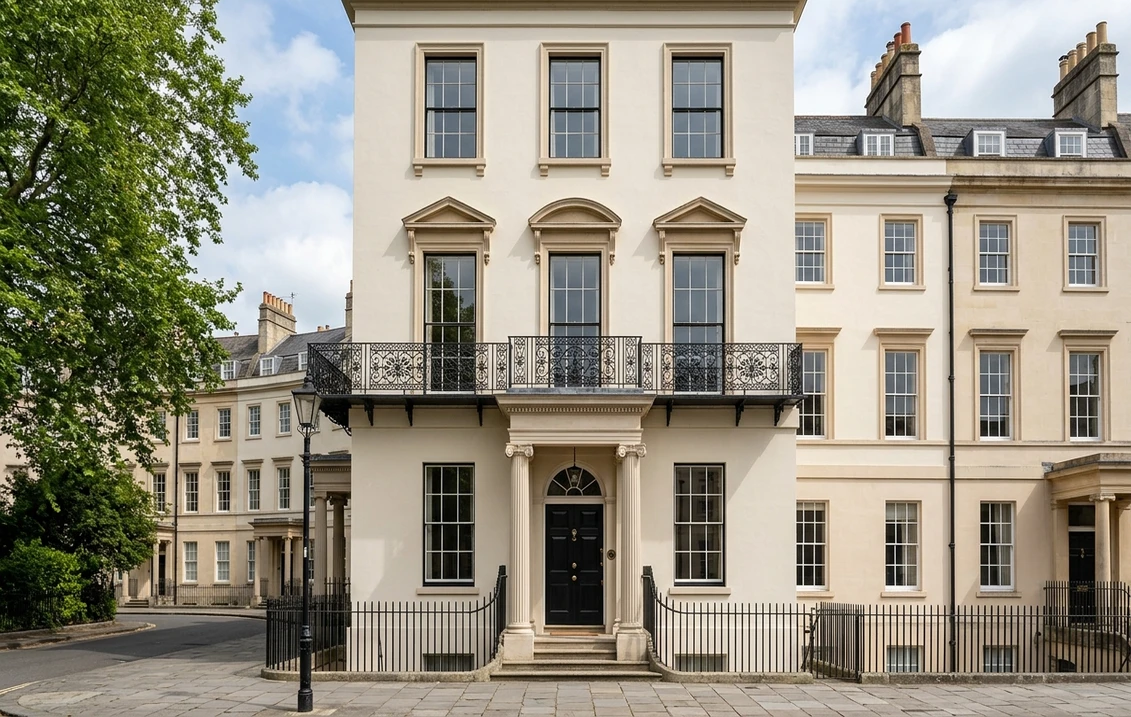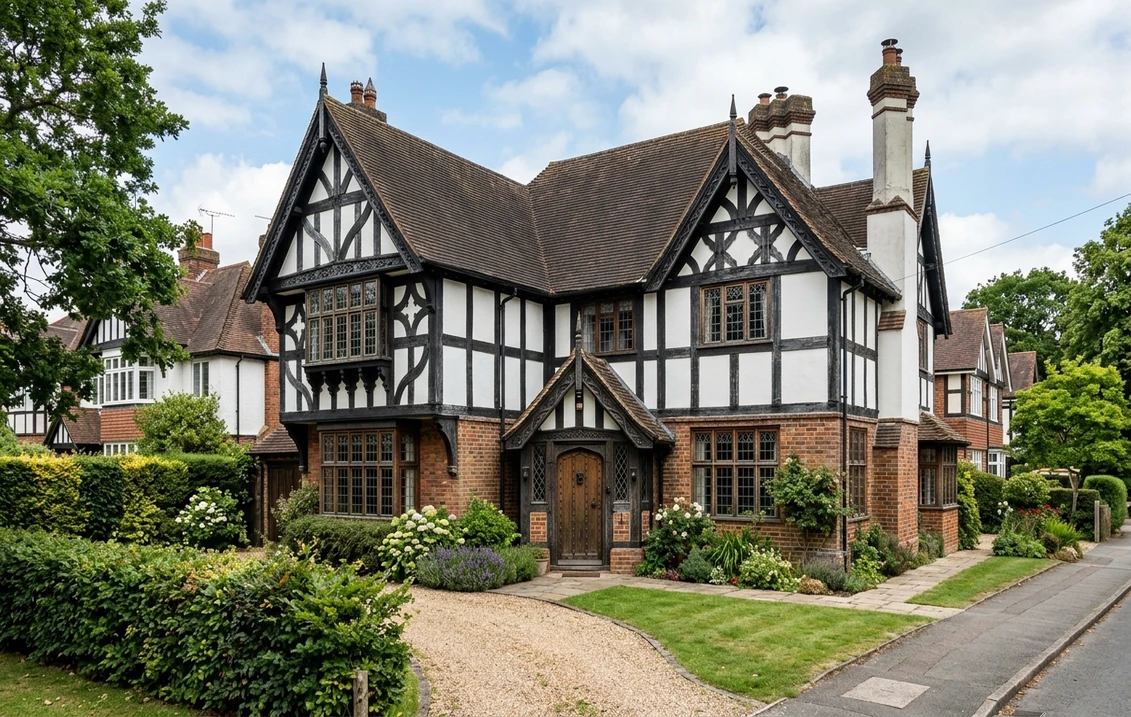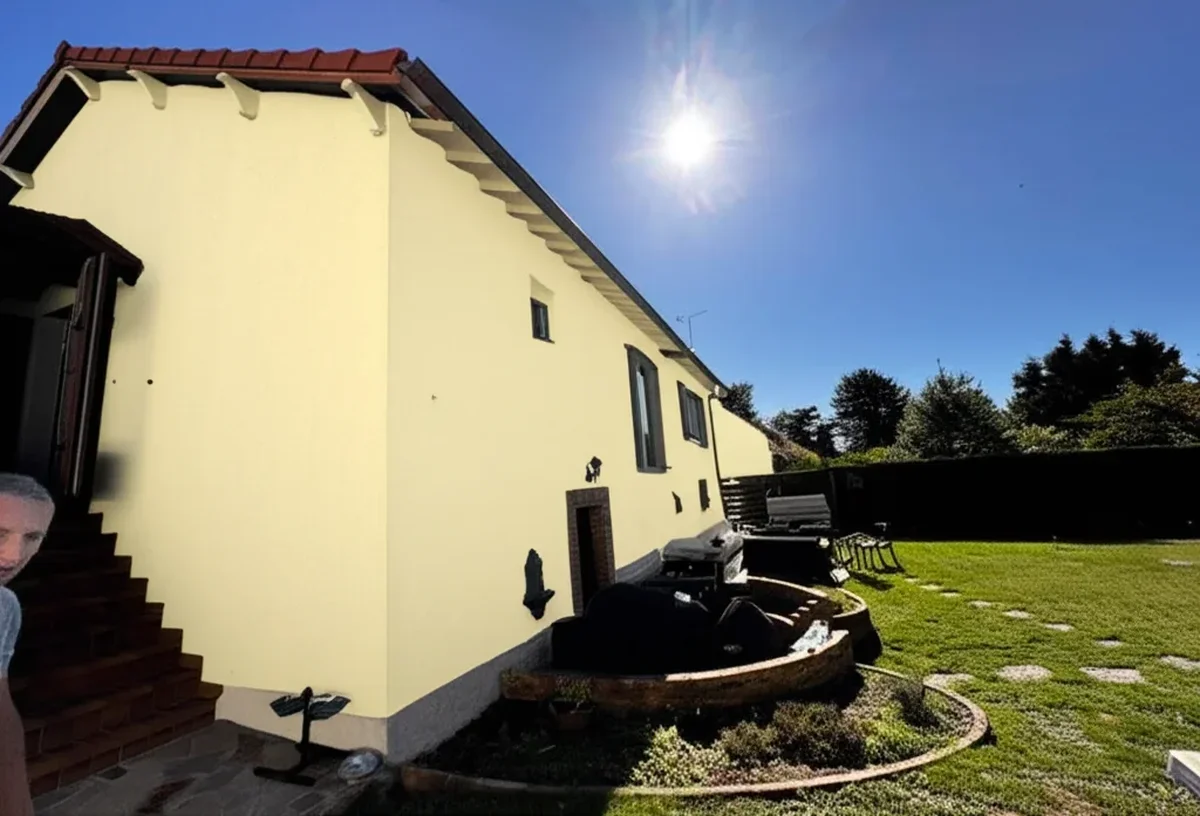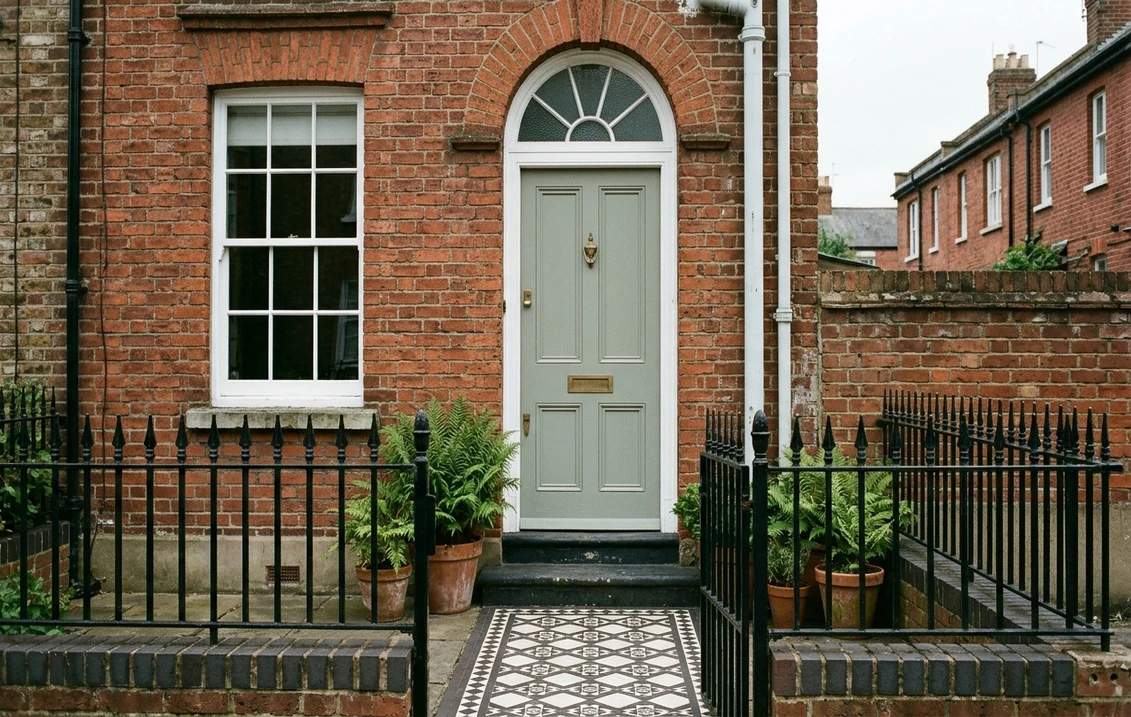
Try it on your house

Farrow & Ball Pigeon No. 25 is a mid-depth grey with green and blue in it: Farrow & Ball titles it "a strong blue grey" and files it among its greens on farrow-ball.com. Outside a British house it is a front door, window and joinery colour first, painted in Exterior Eggshell (20% sheen) or Full Gloss (95%), and it can cover brick or render in Exterior Masonry (2% sheen). At Farrow & Ball's October 2026 prices a 750 ml tin of Pigeon in Exterior Eggshell costs £38, which covers both faces of an ordinary front door twice, and a 5 litre tin of Exterior Masonry costs £111. Repainting a door or window frames in a new colour needs no planning permission on most houses, but an Article 4 direction or a listed building can change that.
Everything below was read on farrow-ball.com, on Farrow & Ball's UK product advice sheets, on legislation.gov.uk, on the Planning Portal and in council conservation guidance in October 2026. Farrow & Ball does not publish a light reflectance value (LRV) for Pigeon, so this guide gives none, and the colour descriptions are summarised from the maker's own pages.
See Pigeon on your own front door first
Upload a photo of your house and repaint the door, the window frames or the whole frontage in Pigeon before you buy a sample pot.
Try our free colour visualiserWhat Farrow & Ball says about Pigeon No. 25
On its Pigeon colour page, Farrow & Ball explains that the name comes from the bird seen all over London, describes the colour as cosy and nostalgic, and sets it against its more contemporary greys: Pigeon is softer and bluer than Mole's Breath. Indoors the brand suggests it for boot rooms, cloakrooms and darker spaces, and says it is very popular on kitchen islands, with the paler Dimpse on the units around it. Those are interior uses, but they tell you something useful for a door: Pigeon is meant to look calm and settled, not crisp.
| Attribute | Pigeon No. 25 (Farrow & Ball) |
|---|---|
| Title on the colour page | A strong blue grey |
| Colour group on farrow-ball.com | Green |
| Recommended primer and undercoat tone | Mid Tones |
| Complementary white suggested | School House White No. 291 |
| Web swatch (screen approximation) | #9A9F94 (RGB 154, 159, 148) |
| Light reflectance value (LRV) | Not published by Farrow & Ball |
| Exterior finishes sold in Pigeon | Exterior Eggshell, Full Gloss, Exterior Masonry, Limewash |
Try it on your house
No photo? Try a sample
The web swatch describes how the colour is drawn on a screen, not a tinting formula. Use it to compare colours on the same device, then decide on a painted sample.
Green, blue or grey? How Pigeon reads on a door
The most common question about Pigeon is which colour it actually is, and Farrow & Ball's own pages explain the confusion: the colour page calls it a blue grey, while the site's colour index places it with the greens. The web swatch shows why both are fair. Green (159) is the strongest channel, red (154) is close behind and blue (148) is lowest, so on paper Pigeon is a greyed green; but the three channels sit within 11 points of each other, which makes it very low in saturation, and low-saturation greens look grey-blue in cool light. That is our reading of the published swatch, not a figure from the maker.
On a British street this plays out in a predictable way:
- North-facing door, or an overcast day. Pigeon reads as a soft blue-grey, close to its name.
- South or west-facing door in afternoon sun. The green comes forward and it looks like a grey sage.
- Against red brick. Warm red makes the cool side of Pigeon stand out, so the door looks greyer and bluer than the sample card.
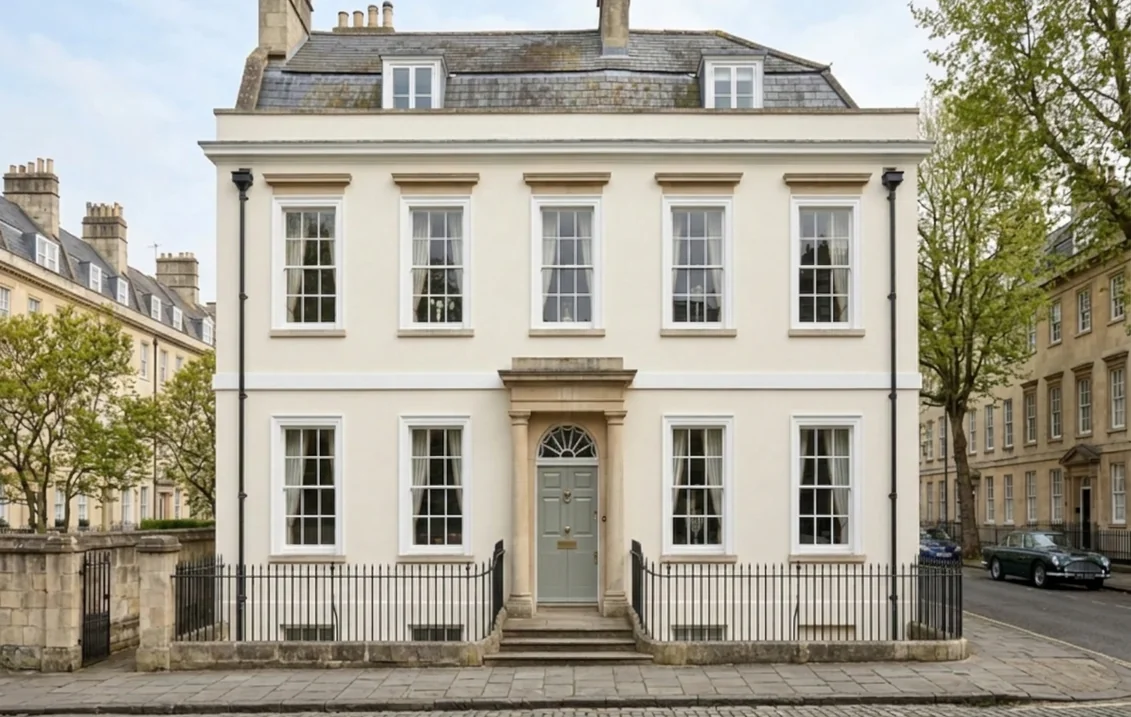
- Against cream or white stucco. The pale wall makes the door look deeper and greener than on the card.
- Next to planting. Box hedges and climbers pull it towards green; brass fittings warm it slightly.
If you want the grey without the green, look at French Gray or Blue Gray below. If you want more green, Treron and Card Room Green are the next steps. For the wider choice of grey doors, our guide to grey front door paint in the UK compares Pigeon with the darker heritage greys, and the guide to green front doors covers the green side.
Pigeon next to Mizzle, Treron, Blue Gray, French Gray and Card Room Green
Farrow & Ball links several of its colours directly to Pigeon, which makes it easy to step lighter, darker or greener while staying in the same family. The descriptions are summarised from each colour page (for example Mizzle and Treron); web swatches are the maker's screen values.
| Colour | What Farrow & Ball says (summary) | Web swatch | Outside, choose it when |
|---|---|---|---|
| Mizzle No. 266 | Presented as a lighter shade of Pigeon and Blue Gray | #BEC1B3 | You want the same mood on window frames or render without a dark door |
| Pigeon No. 25 | A strong blue grey, softer and bluer than Mole's Breath | #9A9F94 | You want a mid-tone door that is neither stark nor dark |
| Treron No. 292 | A darker, greener version of Pigeon, named after the green species of the same bird | #8C8C7A | Pigeon looks too blue against your brick or planting |
| Blue Gray No. 91 | A cooler, more weathered version of French Gray | #AEB2A4 | You want a lighter, more silvery door or window colour |
| French Gray No. 18 | Singled out by the brand as a favourite for front doors in Exterior Eggshell | #B0AF9B | You prefer a lighter, warmer green-grey |
| Card Room Green No. 79 | A dark grey green | #878F81 | You want a clearly green door one step deeper than Pigeon |
| Green Smoke No. 47 | A dark and smoky green | #6F7B71 | The house needs a deeper, more traditional green |
French Gray deserves a note: on its colour page Farrow & Ball calls it a particular favourite for front doors in the low-sheen Exterior Eggshell. If you are torn between the two, Pigeon is the deeper and cooler of the pair, and French Gray is lighter with more yellow in it. The darkest grey in the same conversation, Down Pipe, has its own guide: Farrow & Ball Down Pipe outside. For a warmer, stone-coloured grey there is Manor House Gray outside.
Where Pigeon works on a British house
Pigeon is a mid-tone, and mid-tones are the easiest colours to get right on a front door: dark enough to frame the entrance, light enough not to look heavy on a small terrace. Here is how it behaves on the house types you see most in the UK.
- Victorian or Edwardian red brick terrace. The classic use. The cool grey-green sits opposite the warm brick, white sash windows give it a clean edge, and black railings or a tiled path finish the picture. It is lighter than the deep greens and blues that dominated nineteenth-century doors, so it reads as a modern take on the period rather than a historical copy.
- London stock or buff brick. Yellow brick brings out the blue side of Pigeon. Keep the window frames white or in School House White so the door stays the only colour.
- Cream or white stucco villa. On a pale rendered front the door becomes the focal point and reads greener. Pigeon on the door and Mizzle on the window frames is a quiet scheme for a conservation street.
- Rendered cottage. Pigeon on the door, gate and window frames against a white or off-white render gives a soft country look; on limewashed walls Farrow & Ball also sells Pigeon in Limewash.
- 1930s semi or post-war house. Pigeon suits a panelled timber door and timber windows; on uPVC frames it is better kept to the door, see below.
- Whole frontage in Pigeon. Possible in Exterior Masonry, but a mid-tone body colour changes the whole street scene, which is exactly what conservation officers look at, so read the permission section first.
For the full picture of door colours by house style, start with our UK front door colour guide; for wall and render colours, the best exterior paint colours for UK homes covers the main families.
Exterior Eggshell, Full Gloss or Exterior Masonry: which finish for Pigeon
Pigeon is sold in all of Farrow & Ball's exterior finishes. The figures below come from the finish pages (Exterior Eggshell, Full Gloss and Exterior Masonry), and the prices are those shown for Pigeon on 26 October 2026.
| Finish | Sheen | Surfaces | Coverage | Dry / recoat | Durability claimed | Pigeon price |
|---|---|---|---|---|---|---|
| Exterior Eggshell | 20% | Wood and metal: doors, windows, cladding, fences (not pressure-treated timber) | Up to 13 m² per litre | 2 h / 4 h | Up to 6 years | £38 (750 ml), £91 (2.5 L) |
| Full Gloss | 95% | Wood and metal, inside and out | Up to 12 m² per litre | 2 h / 4 h | Up to 6 years | £35 (750 ml), £85 (2.5 L) |
| Exterior Masonry | 2% | Brick, render, concrete, terracotta, stucco | Up to 8 m² per litre | 2 h / 5 h | Up to 15 years | £111 (5 L) |
A 100 ml sample pot costs £5.95 and Limewash in Pigeon £83 for 5 litres. Coverage figures are "up to": rough timber, open-grained wood and textured render drink more paint.
Which one for a door? Exterior Eggshell is the choice that suits Pigeon best: its low sheen keeps the soft, chalky character the colour is bought for, and it hides small dents in old panelled doors. Full Gloss gives the traditional high-shine Victorian door and is easier to wipe clean, but it makes the colour look a touch darker and shows every imperfection in the timber, so it needs careful preparation. Exterior Masonry is only for the walls: it needs no primer, is rated Class I for water vapour permeability on its advice sheet (sd 0.101 m), and should only go on a substrate with a pH below 10, which rules out fresh render that has not cured.
Primer, old paint and uPVC or composite doors
Farrow & Ball recommends its Mid Tones primer and undercoat under Pigeon. The Exterior Eggshell advice sheet sets out the rest of the system:
- Bare or stripped timber: Exterior Wood Primer and Undercoat in the Mid Tones shade, then two coats of the finish.
- Sound existing paint: wash, sand to a key, spot-prime bare patches, then two coats.
- uPVC or composite doors: the sheet lists them among difficult surfaces. Degrease, sand lightly, apply a specialist adhesion primer, then the Wood Primer and Undercoat and two coats of finish. Check the door maker's warranty before painting a composite door.
- Old paint on a period door: the sheet asks for precautions when removing old coatings that may contain lead. The UK Health Security Agency notes that the sale of lead paint was banned in the UK from 1992, so a door painted before then can carry lead in its lower layers: wet-sand rather than dry-sand, and never burn it off.
Our comparison of exterior primers available in the UK covers the adhesion primers for uPVC and metal in more detail.
How much Pigeon do you need? Three worked examples
The method is always the same: paintable area times the number of coats, divided by the coverage per litre, plus a margin for absorbent or textured surfaces. The examples use the maximum coverage Farrow & Ball gives, so treat the results as a minimum.
- A front door. A typical panelled door of about 0.9 m by 2 m has roughly 1.8 m² per face, so around 4 m² for both faces and the edges. Two coats make 8 m². At up to 13 m² per litre that is about 0.6 litres of Exterior Eggshell: one 750 ml tin (£38) is enough, plus primer where the timber is bare.
- Front door, frame and three sash windows. Window frames, sashes and the door frame add something like 6 to 8 m² of joinery on a narrow terrace. With the door, about 12 m², two coats, 24 m²: just under 2 litres, so a 2.5 litre tin (£91) rather than three small tins (£114).
- A terraced frontage in Exterior Masonry. A front 5 m wide and 6 m high is 30 m²; take off about 6 m² of door and windows and you have 24 m². Two coats make 48 m², which at up to 8 m² per litre needs 6 litres: two 5 litre tins (£222), more on rough render.
When to paint: temperature, dew point and curing
The advice sheets for Exterior Masonry and Exterior Eggshell give the same weather window: do not paint below 10°C or above 30°C, keep the surface at least 3°C above the dew point, and aim for a relative humidity between 40% and 80%. The sheets also allow up to 14 days for the paint to harden fully, longer in deeper colours, so avoid slamming a freshly painted door into its frame or fitting draught excluders in the first days.
In practice that means a dry spell between late April and September for most of the UK. An October or November door is possible on a mild, dry day if you start late morning, once the dew has gone, and finish early enough for the paint to skin before the evening damp. On a south-facing timber door, the sheet also warns about moving from a pale colour to a much darker one, because dark paint heats up in the sun; Pigeon is a mid-tone rather than a dark, but if your old door was white, ask Farrow & Ball about your particular door before you change it.
Do you need permission to paint your front door Pigeon?
For most houses in England, no. Painting the outside of a building is permitted development under Class C of Part 2 of the General Permitted Development Order 2015, unless the painting is for advertisement, announcement or direction, and the order makes clear that painting includes any application of colour. The Planning Portal confirms that repainting window and door frames does not usually need planning permission.
Three situations change the answer:
- An Article 4 direction. A council can withdraw permitted development rights in a conservation area. What is covered depends on the direction: Richmond explains that a direction can include painting and rendering of brickwork, while Worcester's Park Avenue design guide (2026) covers painting the front of a property in a way that differs from the traditional surface treatment, but excludes joinery and states that painting doors or windows needs no permission. In other words, Pigeon on the door is usually fine even under a direction; Pigeon on the brickwork may not be.
- A listed building. Listed building consent is needed for significant works, inside or out. Tendring District Council's painting booklet warns that repainting external joinery in a different colour from the existing one may require consent, and it has no preferred colour range. Ask the conservation officer before you buy the paint.
- Flats and leasehold houses. A lease or the freeholder's rules can control the colour of a shared front door even where planning law does not.
The same Tendring booklet notes that nineteenth-century front doors were typically a dark Brunswick green, blue or black. Pigeon is lighter than any of these, so on a listed or strictly controlled street it reads as a modern choice rather than a historic match. Our guides to painting in a conservation area and painting a listed building explain how to ask the council.
Colours that go with Pigeon outside
Farrow & Ball shows three schemes for Pigeon on its colour page, each pairing it with two other colours, and names School House White as its complementary white:
- Pigeon with Picture Gallery Red No. 42 and Dimpse No. 277. A deep red accent and a pale, cool white: outside, think Pigeon door, Dimpse window frames and a red-brick wall doing the work of the red.
- Pigeon with Shaded White No. 201 and Slipper Satin No. 2004. Two soft off-whites: the gentlest scheme for a stucco or rendered front.
- Pigeon with Cromarty No. 285 and Blue Gray No. 91. A tonal scheme in the same family: Cromarty on render, Blue Gray on window frames, Pigeon on the door.
For trim, School House White No. 291 is the safe choice and keeps the door the focal point; brilliant whites make Pigeon look greyer and colder. Brass or aged-brass door furniture warms it; black iron furniture and black railings make it look sharper and more urban. If you like the colour enough to bring it inside, Farrow & Ball's own suggestion of Pigeon on a kitchen island with Dimpse units is covered in our guide to kitchen cupboard paint in the UK.
Compare Pigeon, Mizzle and Treron on your house
Try the three colours on a photo of your front door and windows, side by side, and order samples only for the one that works with your brick or render. More about the tool on our paint visualiser page.
Upload a photo of my houseSources and references
- Farrow & Ball, Pigeon No. 25: description, colour group, Mid Tones primer, School House White, colour schemes, prices and web swatch.
- Farrow & Ball, colour pages for Mizzle, Treron and French Gray: how the brand relates them to Pigeon and to front doors.
- Farrow & Ball, finish pages for Exterior Eggshell, Full Gloss and Exterior Masonry: sheen, surfaces, coverage, drying times and durability.
- Farrow & Ball, product advice sheets Exterior Eggshell (GBEXE) and Exterior Masonry (GBMAS): temperature, dew point and humidity limits, curing time, difficult surfaces, permeability class and substrate pH.
- legislation.gov.uk, Town and Country Planning (General Permitted Development) (England) Order 2015, Schedule 2, Part 2, Class C: exterior painting as permitted development.
- Planning Portal, Doors and windows: planning permission: repainting frames, Article 4 directions and listed buildings.
- Worcester City Council, Park Avenue Conservation Area Design Guide 2026: what an Article 4 direction on painting covers, and the exclusion of joinery.
- London Borough of Richmond upon Thames, What is an Article 4 direction?: painting and rendering of brickwork as works a direction can cover.
- Tendring District Council, Painting booklet: listed building consent for repainting joinery in a new colour, and historic door colours.
- UK Health Security Agency, Lead: general information: the 1992 ban on the sale of lead paint.
Frequently asked questions
Is Farrow & Ball Pigeon green, blue or grey?
Which Farrow & Ball finish should I use for a Pigeon front door?
How much Pigeon paint do I need for a front door?
What colours go with Pigeon on the outside of a house?
Do I need planning permission to paint my front door Pigeon?
Is there a Dulux equivalent of Farrow & Ball Pigeon?
Trademarks mentioned (Sherwin-Williams, Benjamin Moore, Behr, Caparol, Brillux, Sto, Alpina, Valspar, PPG, Glidden, Dulux, Crown Trade, Sandtex, Farrow & Ball, Johnstone's, Leyland) are property of their respective owners. FacadeColorizer is independent and not affiliated with any of them. Nominative fair use under Lanham Act §1125.