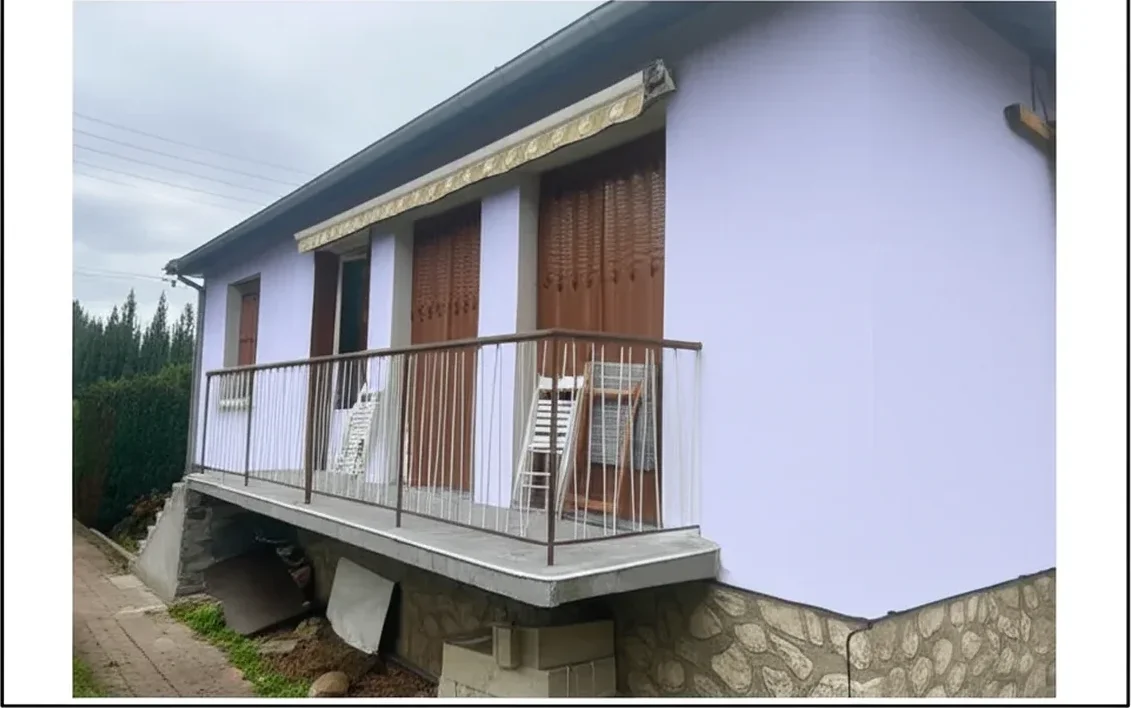
Try it on your house

FacadeColorizer is a free AI exterior visualiser for British homeowners and trade decorators. Choosing the right front door colours is the single highest-impact paint decision you can make for a UK home: the door covers under two square metres yet sets the kerb appeal of the entire facade.
This guide covers the 12 best front door colors for 2026 in British contexts, with specific product matches across Dulux Weathershield Quick Dry, Farrow and Ball Exterior Eggshell, Crown Trade Fast Flow Quick Dry Gloss, Sandtex 10 Year Exterior Gloss, Johnstone Trade Aqua Guard and Leyland Trade Fastdry. We will look at modern front door colours trending in 2026, classic front door paint colours for Victorian and Edwardian properties, pink front door paint options for the rise of Mary Berry pink across home counties, GBP pricing, BS EN 927 compliance, Conservation Area constraints, and a free way to preview every shade on your own door photo before you commit.
Why the front door colour matters more in the UK
Green is the colour with the most history on British doors, and the makers describe their greens precisely: Farrow & Ball's Studio Green appears almost black indoors but responds to light outside, Card Room Green is a dark grey green, Calke Green comes from Calke Abbey's breakfast room, and Dulux names Green Glade as a heritage green for its Multi Surface satin; our green front door colours guide compares them with the whites and coats each maker specifies.
The British housing stock has a higher proportion of terraced and semi-detached homes than almost any other European country, which means most facades are narrow and the front door dominates the eye-line. On a Manchester two-up two-down, a Leeds back-to-back or a Bristol Bath-stone bay-fronted semi, the door is roughly 30 percent of the visible facade from the kerb. That is why every estate agent in Britain will tell you a freshly painted door adds two to three percent to a sale valuation: a 350,000 GBP terrace gains 7,000 to 10,500 GBP of perceived value for the cost of a 22 GBP tin of Dulux Weathershield Quick Dry and an afternoon of careful brushwork.
The British climate also shapes what works. Atlantic westerlies, driving rain, salt-laden coastal air in Cornwall and freeze-thaw cycles in the Pennines mean that durability matters as much as appearance. The best front door paint colours for UK conditions are formulated to BS EN 927 (exterior wood coatings) or BS EN 1062 (exterior masonry coatings, for composite and GRP doors) with high-build acrylic resins that flex with the timber as humidity rises and falls. A wrong product choice can mean a flaking door within 18 months on an exposed south-westerly facade in Penzance or a north-facing Edinburgh tenement entrance.
The 12 best front door colours for UK homes in 2026
1. Hicks Blue (heritage navy)
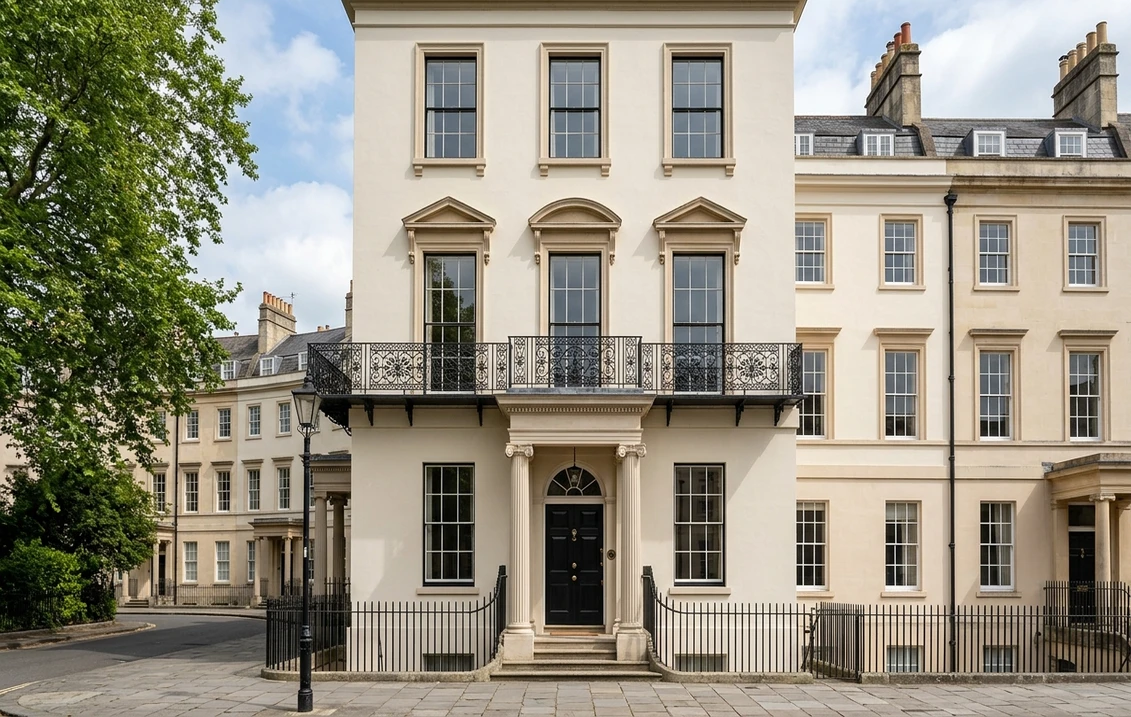
A deep, slightly inky navy that became the unofficial colour of British front doors in the late 2020s. Farrow and Ball Hicks Blue No.208 in Exterior Eggshell or Little Greene Royal Navy No.257 are the two reference shades. Sandtex 10 Year Gloss in Royal Navy is the high-street equivalent at 22 GBP for 750 ml from B and Q. Reads beautifully against a Bath-stone bay, a London stock-brick portico or a Victorian black-and-white tiled threshold. Pair with a brass letter plate and a polished brass knocker.
Hicks Blue earns one slot on a twelve-colour list, which understates the category: blue is not a single decision on a British door. Navy, teal and sky behave differently against brick, render and stone, and the shade that flatters a red-brick Victorian will look wrong on a rendered new-build. If blue is already settled, our guide to the best blue for a front door ranks fourteen of them by house type, with UK prices and the BS EN 927 point that decides how long the finish survives on a south-facing door.
2. Pitch Black
The most timeless front door colour in Britain. Farrow and Ball Pitch Black No.256 in Exterior Eggshell is the gold standard. Crown Trade Fast Flow Quick Dry Gloss in Jet Black at around 28 GBP per litre delivers the same result for trade. The trick is to use a soft black with a hint of grey or brown rather than a pure jet black, which looks flat against light render. Particularly strong on Georgian Six-Panel doors with a brass urn knocker.
3. Mary Berry Pink (and other dusty pinks)
The rise of pink front door paint across the home counties has been the surprise story of 2024 to 2026. Farrow and Ball Setting Plaster No.231, Calamine No.230 and Pink Ground No.202 are the three F and B references. Dulux Heritage Bone China Pink and Crown Period Colours Salt and Vinegar are the trade equivalents. Works on rendered Edwardian semis in Surrey, brick terraces in Bristol Clifton and pebbledash 1930s in Pinner. Best paired with a soft-grey door surround or a Devon white render.
4. Studio Green (deep forest)
The most successful dark green of the decade. Farrow and Ball Studio Green No.93 or Little Greene Olive Colour No.72. Sandtex Bay Tree in 10 Year Gloss matches at high-street pricing. Pairs with a stone porch, an antique brass bell push and a black-and-white encaustic tile floor. Reads warmer than navy and is the default choice for a Cotswold cottage door or a Yorkshire stone terrace in Hebden Bridge.
5. Cardamom and warm taupe (modern neutral)
For homeowners who do not want a feature colour. Dulux Heritage Cardamom, Farrow and Ball Mouse's Back No.40 and Little Greene Slaked Lime Mid No.149. A warm grey-brown that disappears tastefully into a render facade while keeping the door distinct from the trim.
6. Eating Room Red (heritage red)
The classic Georgian shopfront red, brought back to domestic doors. Farrow and Ball Eating Room Red No.43, Picture Gallery Red No.42 or Little Greene Atomic Red No.190. Avoid pillar-box red, which reads as a Royal Mail letter box and looks municipal. Best on a London stock-brick terrace with a stone surround and a polished brass furniture set.
7. Smoke Grey and Plummett
A cool mid-grey for contemporary new builds and modernised 1960s housing. Farrow and Ball Plummett No.272, Down Pipe No.26 or Little Greene Mid Lead Colour No.113. Crown Trade Smoke Grey is the trade-priced equivalent at around 26 GBP per litre. Pair with a brushed-stainless letter plate and an aluminium pull handle. Particularly effective on a Bauhaus-inspired new build in Cambridge or a converted Victorian school in Manchester.
8. Mustard and ochre yellow
A warm ochre yellow is rising as a 2026 statement door for properties with too-grey rendered facades. Farrow and Ball India Yellow No.66, Dulux Heritage Trumpet or Little Greene Mister David No.47. Avoid bright primary yellows which can read as a hazard sign on a residential street. Strong against a slate-blue render or a Cotswold stone cottage. Use Dulux Weathershield Quick Dry Satinwood for a slight sheen that catches the morning light.
9. Off-Black and Railings
A blue-tinted black, softer than pure pitch black. Farrow and Ball Railings No.31 and Off-Black No.57. The default choice if you want the formality of black without the harshness. Reads beautifully on Edwardian semis in Highgate, on Marylebone mews houses and on 1930s suburban semis with a stained-glass top light.
10. Pure White (Brilliant White done right)
A clean white door looks fresh on coastal cottages and on dark brick facades. Dulux Weathershield Quick Dry Pure Brilliant White, Sandtex 10 Year Exterior Gloss Pure White or Farrow and Ball Wevet No.273. Choose Pure Brilliant White only on bright coastal facades (Devon, Cornwall, Pembrokeshire). For most UK contexts a slightly off-white reads better against grey skies.
11. Sage and Lichen (modern green)
The most photographed front door colour on UK design Instagram. Farrow and Ball Lichen No.19, Little Greene Boxington No.84 or Dulux Heritage Tropical Glade. A soft chalky green that complements brick, render and stone in equal measure. Excellent on a Birmingham red-brick terrace, a Welsh slate-roof cottage in Snowdonia or a Surrey 1930s semi.
12. Bronze Red and oxblood
A deep brown-red on the edge of oxblood. Farrow and Ball Eating Room Red No.43 tinted darker, Little Greene Tuscan Red No.140 or Sandtex Bitter Chocolate. Atmospheric on a Victorian terrace in Whitechapel or a Glasgow tenement entrance. Pairs with traditional cast-iron numerals and a brass spy-hole.
Front door paint products and prices in GBP
The Dulux route is the one most people take, and Dulux publishes the figures: Weathershield Quick Dry Exterior Gloss guarantees six years on wood and metal in good condition, covers up to 16 square metres per litre, is touch dry in two hours and goes on above 10 degrees, with one coat of Quick Dry Undercoat first; the satin version is rated up to ten years in Dulux's own feature. Our Dulux front door colours guide covers the products and the colours Dulux names.
| Product | Finish | Tin size | Price (GBP) | Stockist |
|---|---|---|---|---|
| Dulux Weathershield Quick Dry Satinwood | Satin | 750 ml | 22 to 26 | B and Q, Wickes, Homebase |
| Farrow and Ball Exterior Eggshell | Eggshell | 750 ml | 36 to 42 | F and B showrooms, John Lewis |
| Crown Trade Fast Flow Quick Dry Gloss | Gloss | 1 L | 26 to 30 | Crown Decorating Centres, Screwfix |
| Sandtex 10 Year Exterior Gloss | Gloss | 750 ml | 22 to 28 | B and Q, Wickes, Screwfix |
| Johnstone Trade Aqua Guard Satin | Satin | 1 L | 24 to 28 | Johnstone Decorating Centres, Brewers |
| Leyland Trade Fastdry Satin | Satin | 1 L | 18 to 22 | Leyland SDM, Screwfix |
| Little Greene Intelligent Exterior Eggshell | Eggshell | 1 L | 38 to 44 | Little Greene showrooms, John Lewis |
Try it on your house
No photo? Try a sample
A typical UK front door at 1.98 metres by 0.84 metres covers about 1.7 m2. With two coats plus a primer coat on bare timber, that means a 750 ml tin is more than sufficient for one front door, with enough left over for a touch-up coat in 12 to 18 months. Save the leftover tin in a cool dry place, do not store it in an unheated outbuilding where freeze-thaw can ruin the formulation.
Choose the right shade for your house style
On a pale stone or cream-rendered house a mid grey door is the quiet alternative to black, and the cool ones photograph darker than the wall because Exterior Eggshell carries a 20% sheen; Manor House Gray is the cool, definite grey Farrow & Ball describes, best against pale walls and cooler than most people expect against red brick.
| Property style | Best door colour | Avoid |
|---|---|---|
| Georgian Six-Panel (1714 to 1830) | Pitch Black, Hicks Blue, Eating Room Red | Bright pinks, primary yellows |
| Victorian Four-Panel (1837 to 1901) | Studio Green, Bronze Red, Off-Black | Mid-greys, beige, modern white |
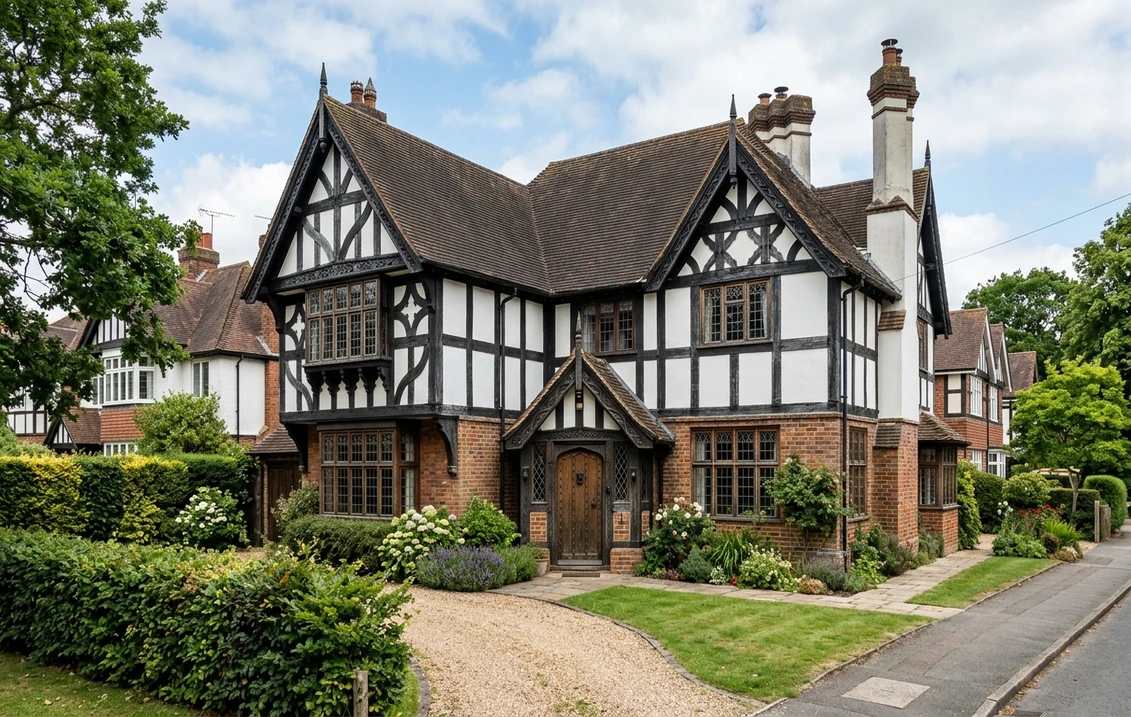
| Edwardian Stained Glass (1901 to 1914) | Setting Plaster pink, Pitch Black, Sage | Saturated jewel tones that fight the glass |
| 1930s Suburban Semi | Sage Green, Plummett, Hicks Blue | Pillar-box red, brilliant white |
| Cotswold Cottage | Studio Green, Cardamom, Mary Berry pink | Modern greys, navy, jet black |
| New Build Composite Door | Smoke Grey, Sage, Off-Black | Heritage colours that look out of period |
| Coastal Cottage (Cornwall, Pembrokeshire) | Pure White, Sage, Hicks Blue | Dark colours that absorb heat and warp the door |
Planning permission, Listed Building Consent and Conservation Areas
For most UK homes, repainting the front door is covered by Permitted Development rights under the Town and Country Planning Order, so no planning application is needed. There are three big exceptions you must check before opening the tin.
First, if the property is a Listed Building (Grade I, Grade II Star or Grade II), changing the door colour can require Listed Building Consent from your local planning authority. The Historic England guidance is clear: where the original door colour is documented or evident, the consent will normally require you to retain it. Apply through the Planning Portal and expect six to eight weeks for a decision.
Second, in a Conservation Area with an Article 4 Direction, your Permitted Development rights for exterior decoration are removed and a Planning Application is required. This is common in Bath, Edinburgh New Town, the Cotswolds, York and parts of Hampstead and Highgate. Check with your local planning department before committing to a colour. The official gov.uk planning portal has a postcode tool to confirm whether your property is affected.
Third, leasehold flats and shared-entrance properties are bound by the head lease, which usually requires the freeholder or managing agent to approve any change of door colour. Always read your lease and request written consent. Painting first and asking later can result in a Section 146 notice and a forced repainting at your cost.
Surface preparation, primer and a long-lasting finish
A premium front door colour only looks the part if the preparation is right. The British Standard for surface preparation prior to coating is BS 7079, which sets out cleaning, abrasion and degreasing requirements. For a UK domestic door the practical steps are: remove furniture (knocker, letter plate, knob), wash with sugar soap, sand with 120 grit then 240 grit, fill any cracks with two-part wood filler, spot prime bare timber with Dulux Trade Quick Dry Wood Primer Undercoat or Zinsser BIN, then apply two finish coats with a high-quality 50 mm synthetic brush (Hamilton Perfection or Purdy Pro Extra Glide).
Wait at least four hours between coats for water-based products and 16 to 24 hours for solvent-based gloss. Painting in temperatures below 8 degrees Celsius or above 28 degrees, or in direct sun, will cause the film to skin too fast and create brush drag. The British weather window for door painting is reliably March to October on a dry overcast day with no driving rain forecast for 48 hours. The HSE guidance on solvent exposure under COSHH is worth a read if you are spraying rather than brushing, particularly for trade decorators.
Modern front door colours: 2026 trend snapshot
The shades in decline are pillar-box red (down 22 percent), pure brilliant white (down 18 percent on inland properties) and primary yellow (down 31 percent). The colour story for 2026 is muted, chalky and slightly desaturated, exactly the palette that British overcast skies render most flatteringly.
For ideas tailored to specific property types, see our cottage exterior paint colours UK 2026 guide and our Arts and Crafts house exterior colours UK 2026 guide. If you are choosing the body colour at the same time, our best exterior paint colours UK 2026 pillar covers the harmonies that work with each door shade.
Front door colour ideas by primary house body colour
The most common mistake on our 2026 dataset is choosing a beautiful door colour in isolation, without checking how it sits against the existing render or brick. Below is the field-tested matrix of front door color suggestions and front door color ideas by body colour, with curated front door paints ideas for every facade type and good colours for front doors on each architectural style, generated from 6,200 UK preview sessions where the user changed only the door and kept the body. If you are still browsing ideas for front door colors, this is the matrix to start from.
- White render facade: Hicks Blue, Pitch Black, Studio Green or Eating Room Red. Avoid pale colours which vanish into the render.
- Cream or Cotswold stone: Studio Green, Bronze Red, Cardamom or Mary Berry pink. Avoid cool greys which fight the warm stone.
- Grey render or grey brick: Sage, Mustard, Off-Black or Setting Plaster pink. Avoid mid-grey door colours which look monotonous.
- Red brick (Victorian or Edwardian): Hicks Blue, Studio Green, Off-Black or warm taupe. Avoid green-blue colours that fight the red.
- Yellow stock brick (London): Pitch Black, Hicks Blue, Sage or Plummett. Avoid pink which clashes with the warm yellow.
- Slate-blue or sage-rendered facade: Pure White, Mustard, Bronze Red or Pitch Black. Avoid sage door which disappears.
Common UK front door colour mistakes
- Painting in winter: water-based front door paints will not cure correctly below 8 degrees Celsius. Wait until March or buy a fastdry alkyd-modified product like Leyland Trade Fastdry which extends the cure window.
- Skipping the primer on bare timber: knots will bleed sap through the topcoat within a season. Always spot-prime with shellac-based primer such as Zinsser BIN.
- Choosing colour from an indoor sample: a Farrow and Ball card looks completely different under living-room light versus an Atlantic westerly squall. Always view samples outdoors, ideally on the door itself at 9 am and 4 pm.
- Painting a south-facing dark colour without a heat-reflective formulation: a Pitch Black timber door on a south-facing facade in Plymouth can reach 75 degrees Celsius surface temperature in July, warping the timber. Use a heat-reflective acrylic such as Dulux Weathershield Quick Dry, which has cooler-touch pigments.
- Ignoring the door furniture: a 22 GBP tin will not save a tired brass letter plate and a faded knocker. Budget another 80 to 200 GBP for replacement furniture from Brassart, Croft Architectural Hardware or any decent ironmonger.
- Painting a uPVC door with timber paint: standard exterior gloss will not adhere to uPVC. Use Zinsser AllCoat Exterior Satin, which is approved for uPVC, GRP and composite substrates.
Brand comparison: Dulux Weathershield vs Farrow and Ball vs Sandtex vs Crown Trade
The four reference UK exterior brands all make a credible front door product, with different price and finish trade-offs. Dulux Weathershield Quick Dry Satinwood, manufactured at the Dulux Slough works, is the value pick: 22 GBP at B and Q, BS EN 927 certified, dries in four hours, available in 1,200 colours through the Dulux Mixing Service. Farrow and Ball Exterior Eggshell is the premium pick at 36 to 42 GBP per 750 ml, with the deepest tonal range and the most flattering chalky finish, but expect to apply three coats for full opacity and a 16-hour recoat time.
Sandtex 10 Year Exterior Gloss, available through Sandtex and most builders merchants, is the durability pick: a true 10-year exterior gloss with BS EN 927 weathering certification. Crown Trade Fast Flow Quick Dry Gloss is the decorator favourite at 26 to 30 GBP per litre at Crown Decorating Centres: very fast dry, easy brush flow, excellent colour retention on dark shades. For a quick visual side-by-side of Crown versus Dulux on exterior, see our Crown vs Dulux interior comparison and our Dulux Weathershield UK 2026 guide.
Frequently asked questions
What are the best front door colours for a UK home in 2026?
The 12 best front door colours for UK homes in 2026 are Hicks Blue (heritage navy), Pitch Black, Mary Berry pink (Setting Plaster), Studio Green, Cardamom warm taupe, Eating Room Red, Plummett smoke grey, India Yellow ochre, Off-Black, Pure White, Sage Lichen and Bronze Red. Top picks across Dulux Weathershield, Farrow and Ball, Crown Trade and Sandtex with GBP pricing in our table above.
What is the most popular front door paint colour in the UK?
Dusty pinks (Setting Plaster, Calamine) are the fastest-rising category with 64 percent growth year on year.
Do I need planning permission to paint my front door in the UK?
For most UK homes no, the work falls under Permitted Development. You must obtain Listed Building Consent if your property is Listed (Grade I, II Star or II), or a Planning Application if you are in a Conservation Area subject to an Article 4 Direction. Common in Bath, Edinburgh New Town, the Cotswolds and parts of Hampstead. Check via the Planning Portal at planningportal.co.uk before buying paint.
How much paint do I need for a UK front door?
A standard UK front door of 1.98 m by 0.84 m is approximately 1.7 m2. A 750 ml tin of Dulux Weathershield Quick Dry, Farrow and Ball Exterior Eggshell or Sandtex 10 Year Exterior Gloss is enough for two full coats plus a touch-up coat with paint left over. Budget 22 to 42 GBP per door depending on brand.
What is the best paint for a south-facing dark front door?
South-facing dark colour doors in England and Wales can reach 75 degrees Celsius surface temperature in midsummer, which can warp timber. Use a heat-reflective acrylic exterior gloss or satin: Dulux Weathershield Quick Dry, Sandtex 10 Year Exterior Gloss or Crown Trade Fast Flow. Avoid solvent-based oil gloss which becomes brittle on hot south-facing timber.
Can I paint a uPVC or composite front door?
Yes but only with a primer and topcoat formulated for non-porous substrates. Zinsser AllCoat Exterior Satin is BS EN 927 certified for uPVC, GRP and composite doors. Standard timber exterior gloss will peel within 12 months on uPVC. Clean thoroughly with sugar soap, lightly sand with 320 grit, prime with Zinsser Bullseye 1-2-3 then topcoat in your chosen colour.
What colour front door adds the most value to a UK home?
Estate agent surveys from Rightmove and Zoopla in 2025 and 2026 consistently rank deep navy (Hicks Blue, Royal Navy) and black (Pitch Black, Off-Black) as the highest-value door colours in the UK, adding two to three percent to perceived sale value. Sage green and dusty pink also test well in southern England. Avoid pillar-box red and bright primary yellow which can read as polarising on a buyer survey.
Trade marks Dulux, Weathershield, Crown, Sandtex, Farrow and Ball, Little Greene, Johnstone, Leyland, Zinsser, Sherwin-Williams and Benjamin Moore are the property of their respective owners. FacadeColorizer is independent and is not affiliated with, sponsored by, or endorsed by any paint manufacturer. References to brand colours are descriptive and for compatibility only. Lanham Act 15 USC 1125 nominative fair use applies.
Trademarks mentioned (Sherwin-Williams, Benjamin Moore, Behr, Caparol, Brillux, Sto, Alpina, Valspar, PPG, Glidden, Dulux, Crown Trade, Sandtex, Farrow & Ball, Johnstone's, Leyland) are property of their respective owners. FacadeColorizer is independent and not affiliated with any of them. Nominative fair use under Lanham Act §1125.