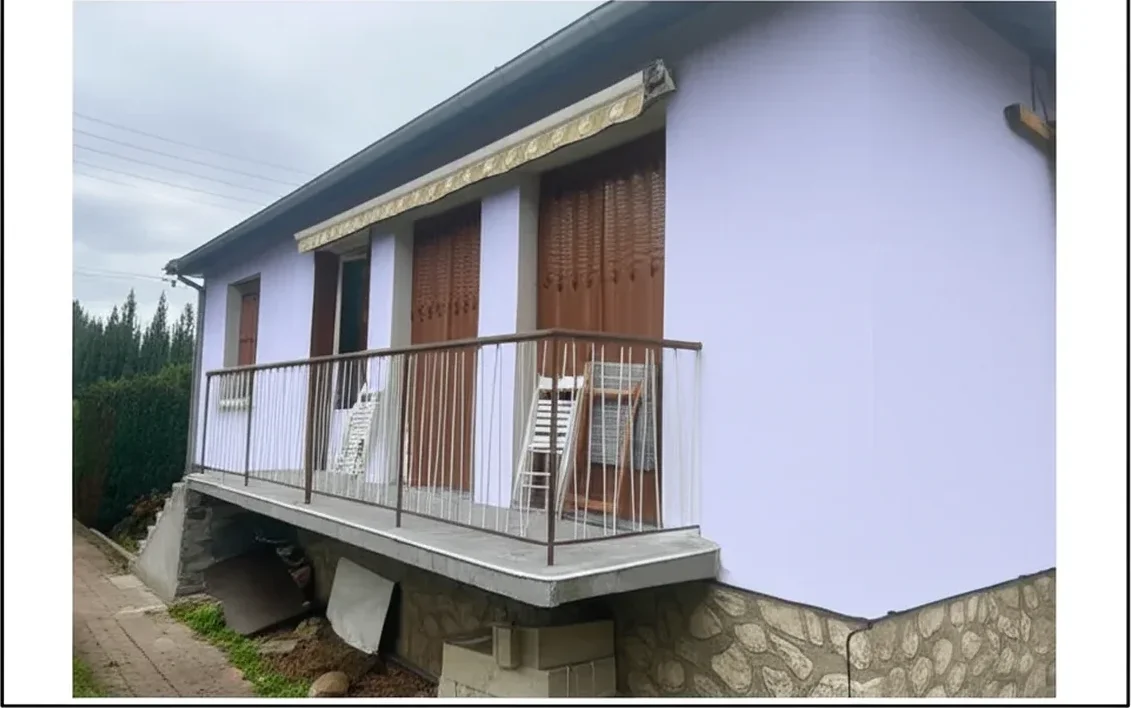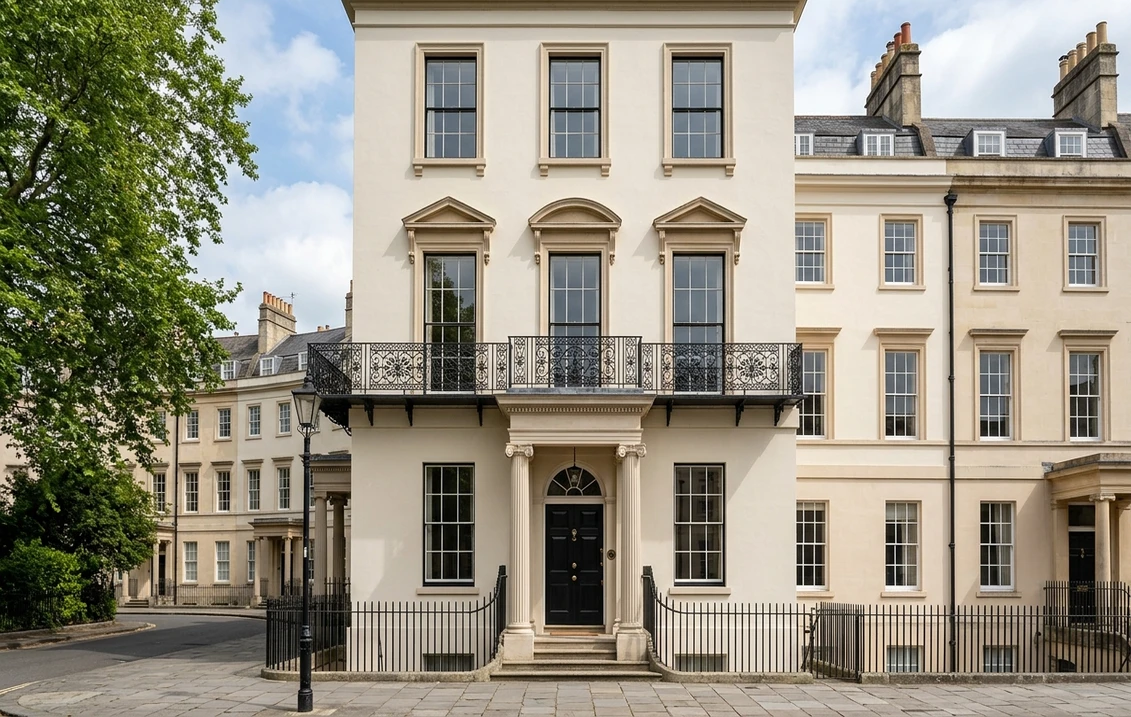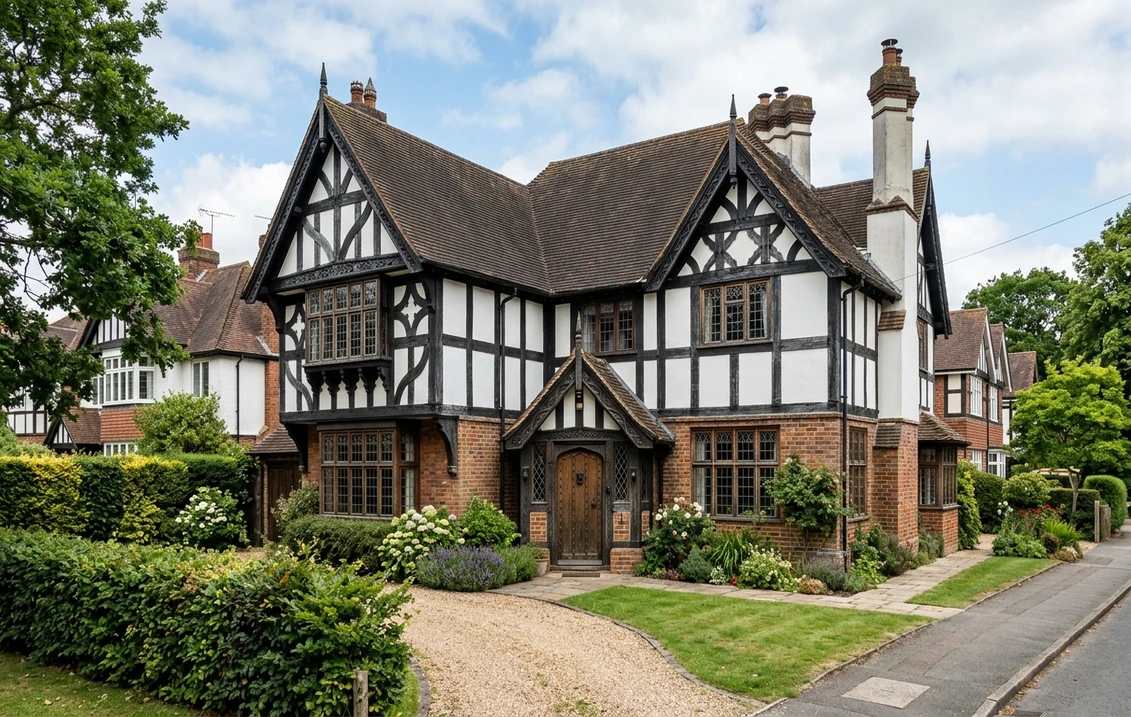
Try it on your house

Green is the quiet classic of British front doors: it sits with red brick, Portland stone, pebbledash and painted render alike, and it has done so since the Georgian terraces of Bath. This guide picks the green front door colours worth sampling in 2026 and describes each one in its maker's own words, from the Farrow & Ball colour pages, the Dulux front door article and the Little Greene Intelligent Exterior Eggshell data sheet. It then covers which green suits which house, how to pair it, what the data sheets say about coats and weather, and when a conservation area has a say.
Why green suits British houses
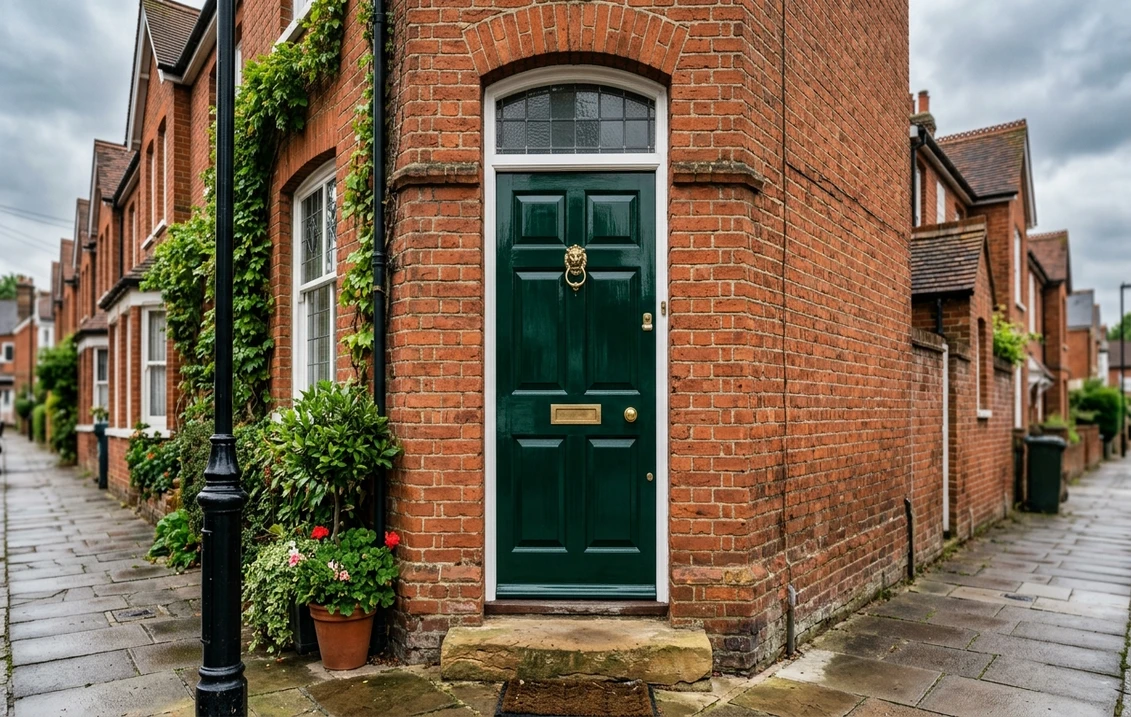
British daylight is cool, diffuse and often grey, and it flatters mid-to-dark greens in a way it does not flatter saturated reds or pale pastels. Green also carries history: Farrow & Ball describes Card Room Green as named after Victorian study rooms and Green Smoke as a colour "popular in interiors during the late 19th century", while Little Greene's Dark Brunswick Green (No. 88) is a Victorian shade long used on front doors. The practical argument is as strong as the historical one. A deep green hides road dust and rain marks better than black shows them, reads as a colour rather than an absence against brick, and pairs with brass, chrome or black door furniture without a fight.
The green front door colours to sample in 2026
| Colour | Maker's own description | Complementary white named by the maker | Where it works |
|---|---|---|---|
| Studio Green No. 93 (Farrow & Ball) | "A deep, dark green", the maker's darkest green and the colour of its original studio; outside, "the rich pigments respond extraordinarily to all types of light", inside it "appears almost black unless in very well lit rooms" | Off-White No. 3 | Georgian and Victorian doors where a near-black with depth is wanted; brass furniture |
| Green Smoke No. 47 (Farrow & Ball) | "A smoky green blue" with "an irresistibly inviting deepness and weathered familiarity when used in exterior situations" | Shaded White No. 201 | Stone and sandstone frontages, cottages, Edinburgh and Bath |
| Card Room Green No. 79 (Farrow & Ball) | "A dark grey green", named after Victorian study rooms, "unapologetic in its strength"; comes alive against Off-White or set against Studio Green | Shaded White No. 201 | Victorian terraces in London stock brick, grey-rendered semis |
| Calke Green No. 34 (Farrow & Ball) | "This rich and traditional green is a cleaned version of a colour originally found in the breakfast room at Calke Abbey"; best on its own or with Old White "to enhance its deep sage notes" | Slipper Satin | Country houses, red brick, cream render; the sage end of the dark greens |
| Green Glade (Dulux Weathershield Multi Surface Quick Dry Satin) | "A heritage green that blends with surrounding foliage", in a product the article says "can be used on a uPVC front door" | Not stated | Composite and uPVC doors, suburban semis, planted front gardens |
| Dark Brunswick Green No. 88 (Little Greene) | A Victorian-era green used on front doors and banisters; sold in Intelligent Exterior Eggshell | Not stated | Listed and period townhouses, railings painted to match |
Try it on your house
No photo? Try a sample
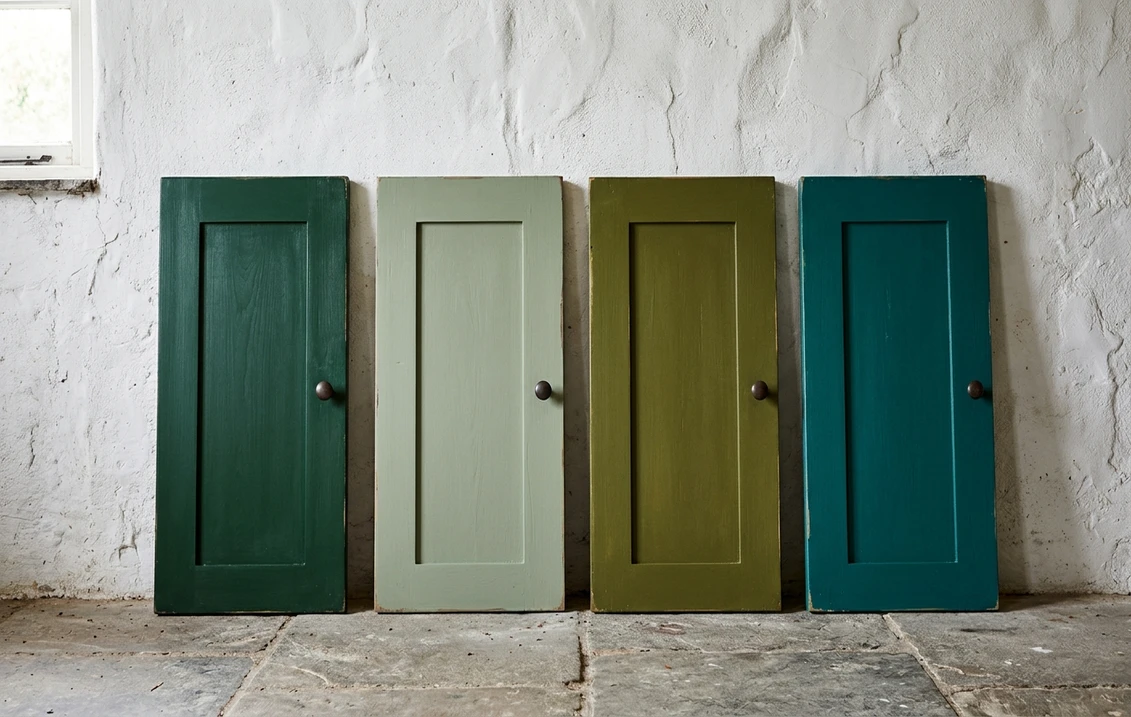
Read the descriptions, not just the swatches. Farrow & Ball's note that Studio Green "appears almost black" indoors but responds to light outside is the whole case for it on a door: it is a green that behaves like a black until the sun hits it. Green Smoke's "weathered familiarity" outside is why it suits stone, and Card Room Green's grey tells you it will not fight a grey render. Calke Green is the one with "deep sage notes" and the only one of the four that reads clearly green from across the street.
Matching the green to the house
- Red or orange brick: Calke Green and Card Room Green; the brick supplies the warmth, the door supplies the depth. Studio Green reads black here, which is fine if that is the intent.
- London stock or yellow brick: Card Room Green or Studio Green with Off-White architraves, the pairing Farrow & Ball itself names.
- Stone, sandstone and granite: Green Smoke, whose blue cast sits with cool stone, with Shaded White on the surround.
- White or cream render: any of the dark greens; the contrast does the work, so pick by undertone against the render white (Calke Green with warm cream, Card Room Green with cool white).
- Pebbledash and roughcast: Green Smoke or Green Glade; a mid-tone that does not fight the texture.
- uPVC or composite doors: Green Glade in the Dulux Weathershield Multi Surface satin that the maker's article recommends for uPVC; the Farrow & Ball and Little Greene eggshells are for timber.
For the rest of the frontage, our guides to Victorian house exterior colour combinations and the best exterior paint colours in the UK cover the walls, windows and railings a green door sits among. If blue is the other candidate, the blue front door colours guide reads the same makers' pages for Hague Blue, Stiffkey Blue and Railings.
What the data sheets say: coats, coverage, weather
A front door is a small area with a long exposure, so the product rules matter more than on a wall. Farrow & Ball's exterior finishes for doors are Exterior Eggshell and, for a traditional high shine, Full Gloss; its paint calculator puts Exterior Eggshell at 32 m² per 2.5 litres per coat, two coats, dry in 2 hours and recoatable in 4, and the Calke Green page names Dark Tones as the primer and undercoat for a deep colour. Little Greene's Intelligent Exterior Eggshell data sheet gives about 12 m² per litre, two coats, a 15 % sheen, 16 hours between coats, application above 10 degrees C and timber below 15 % moisture. Dulux's Weathershield Quick Dry Exterior Gloss page gives a 6-year guarantee, up to 16 m² per litre, touch dry in about 2 hours and application only in dry conditions above 10 degrees C, with a note that some dark colours may need a further coat; its front door article says the Multi Surface satin dries in about 4 hours before a second coat is judged.
| Product (maker's document) | Coverage | Coats and recoat | Conditions |
|---|---|---|---|
| Farrow & Ball Exterior Eggshell (paint calculator) | 32 m² per 2.5 L per coat | 2 coats; dry 2 h, recoat 4 h | Dark Tones primer under deep greens |
| Little Greene Intelligent Exterior Eggshell (TDS) | About 12 m² per litre | 2 coats; 16 h between coats | Above 10 degrees C, timber under 15 % moisture, 15 % sheen |
| Dulux Weathershield Quick Dry Exterior Gloss (product page) | Up to 16 m² per litre | 1 to 2 coats, dark colours may need another; touch dry about 2 h | Dry conditions above 10 degrees C; 6-year guarantee |
In practice a standard door takes well under a litre for two coats in any of these, so buy the smallest tin that covers two coats plus touch-ups and spend the saving on the undercoat: on a dark green the tinted primer is what stops the old colour grinning through at the mouldings.
Conservation areas, listed buildings and flats
Repainting a house door in a new colour is not normally development, but three cases change that. In a conservation area with an Article 4 direction, the council may have removed permitted development rights for external painting, so check before you buy. On a listed building the door is part of the listing and a colour change can need listed building consent. And for a flat, the Planning Portal's page on painting the outside of a flat explains that the rules differ from houses and that the lease and the freeholder usually have a say. Our guides to conservation area painting rules and listed building painting rules set out when to ask first. Green, as it happens, is among the colours conservation officers most readily accept on period doors, which is one more reason it keeps coming back.
How to paint a green front door: the seven steps that matter
- Take the furniture off rather than masking it; brass and a dark green deserve a clean edge.
- Wash, then sand. Sugar soap, rinse, dry, then a fine sand to key the old finish; fill and sand any dents.
- Prime for the colour. Farrow & Ball names Dark Tones under Calke Green; a tinted undercoat under any of the deep greens saves a third coat.
- Check the weather against the sheet. Above 10 degrees C for Little Greene and Dulux, dry conditions, no rain due, and timber below 15 % moisture.
- Panels first, then rails and stiles, finishing with the long vertical strokes; keep a wet edge on a dark colour.
- Respect the recoat time: 4 hours on Farrow & Ball, 16 hours on Little Greene, about 4 hours on the Dulux satin at normal temperatures.
- Leave it open to cure overnight if you can, with the latch taped back, before it closes against the weatherstrip.
Common mistakes with green doors
- Choosing from a chip indoors. Studio Green is near-black inside and green outside, by its maker's own account; judge the sample on the door in daylight.
- Pairing a cool green with a warm white or the reverse: use the complementary white the maker names (Off-White, Shaded White, Slipper Satin) as the starting point.
- Skipping the tinted undercoat under a deep green and ending up with three or four coats.
- Using a timber eggshell on uPVC: Dulux's article points to its Multi Surface satin for that door.
- Painting in a cold snap below the 10 degrees C the data sheets set.
The cheapest test is the one on a photo: upload the front of your house to the paint visualiser, apply two or three of the greens above to the door and see them against your own brick or render before you buy a tin. For the rest of the palette, the Dulux front door colours guide and the Sandtex outdoor paint guide cover the other brands on the shelf.
Gloss or eggshell on a green door
The finish changes a dark green as much as the shade does. A traditional full gloss, the finish of most period doors, deepens the colour, mirrors the street and shows every brush mark and filled dent; it is the finish Farrow & Ball names for its most traditional doors and the one Dulux's Quick Dry Exterior Gloss is built for, with its 6-year guarantee. An eggshell, at the 15 % sheen Little Greene's data sheet gives for Intelligent Exterior Eggshell, reads flatter and more contemporary, forgives an imperfect door and suits the sage end of the greens; Farrow & Ball's Exterior Eggshell is the finish most of its customers now choose for doors. A satin, as in the Dulux Multi Surface product recommended for uPVC, sits between the two. On Studio Green and Dark Brunswick Green a gloss reads almost black and sophisticated; on Calke Green and Green Smoke an eggshell keeps the green visible from the pavement.
Door furniture, surrounds and the step
Brass is the natural partner of a dark green door and the pairing most often seen on Georgian and Victorian frontages; polished chrome suits Green Smoke and the greyer greens on a 1930s or modern door; black ironmongery disappears into Studio Green and is better kept for the sage shades. For the surround, start with the complementary white the maker names, Off-White with Studio Green and Card Room Green, Shaded White with Green Smoke, Slipper Satin with Calke Green, and paint the architrave, fanlight bars and porch columns in it so the door reads as the one dark element. A tiled or stone step in warm red, cream or buff completes the classic British combination; a grey porcelain step suits the cooler Green Smoke better than the warm Calke Green.
Sources and references
- Farrow & Ball colour pages: Studio Green No. 93, Green Smoke No. 47, Card Room Green No. 79, Calke Green No. 34: descriptions, complementary whites, primer recommendation.
- Farrow & Ball, paint calculator: Exterior Eggshell 32 m² per 2.5 L per coat, 2 coats, dry 2 hours, recoat 4 hours.
- Dulux, Weekend project: attention-grabbing front door ideas: Green Glade "a heritage green", Weathershield Multi Surface Quick Dry Satin for uPVC, about 4 hours before judging a second coat.
- Dulux, Weathershield Quick Dry Exterior Gloss product page: 6-year guarantee, up to 16 m² per litre, touch dry about 2 hours, above 10 degrees C, dark colours may need a further coat.
- Little Greene, Intelligent Exterior Eggshell technical data sheet (2024, PDF): about 12 m² per litre, 2 coats, 15 % sheen, 16 hours recoat, above 10 degrees C, timber moisture below 15 %.
- Planning Portal, Paint the outside of a flat: how the rules for flats differ from houses, lease and freeholder consent.
Frequently asked questions
What is the most popular green for a front door in the UK?
Which white goes with a green front door?
How many coats does a green front door need?
Can I paint a uPVC front door green?
Do I need permission to paint my front door green?
Can I preview a green door on my own house?
Trademarks mentioned (Sherwin-Williams, Benjamin Moore, Behr, Caparol, Brillux, Sto, Alpina, Valspar, PPG, Glidden, Dulux, Crown Trade, Sandtex, Farrow & Ball, Johnstone's, Leyland) are property of their respective owners. FacadeColorizer is independent and not affiliated with any of them. Nominative fair use under Lanham Act §1125.