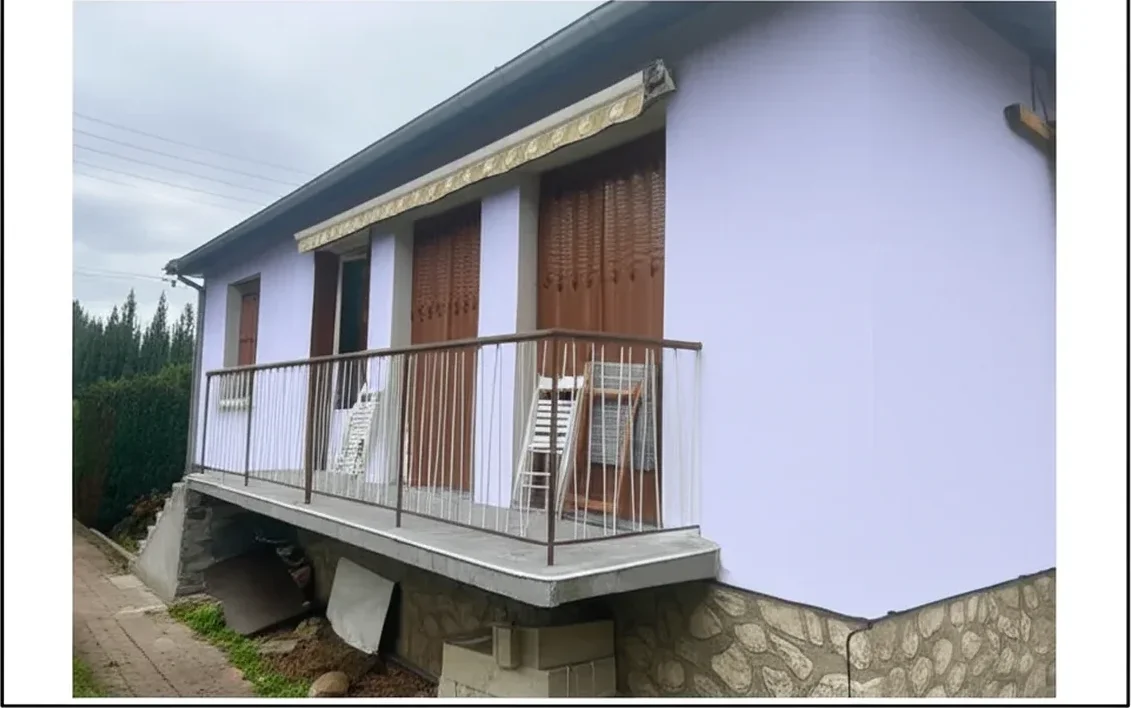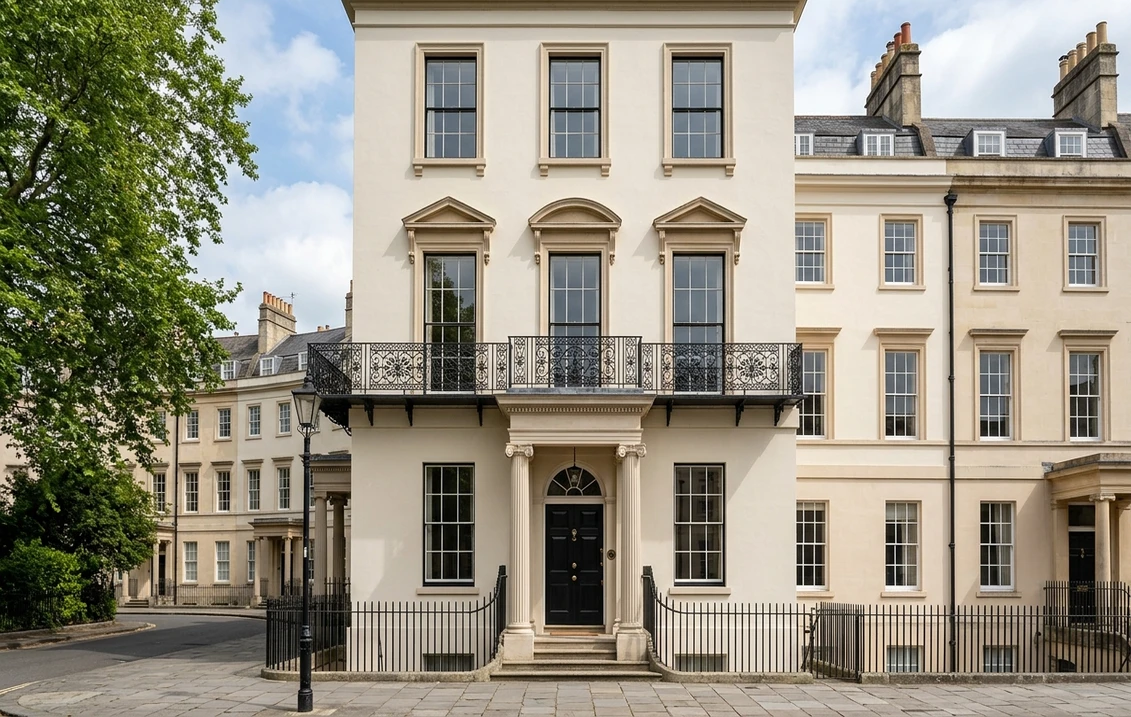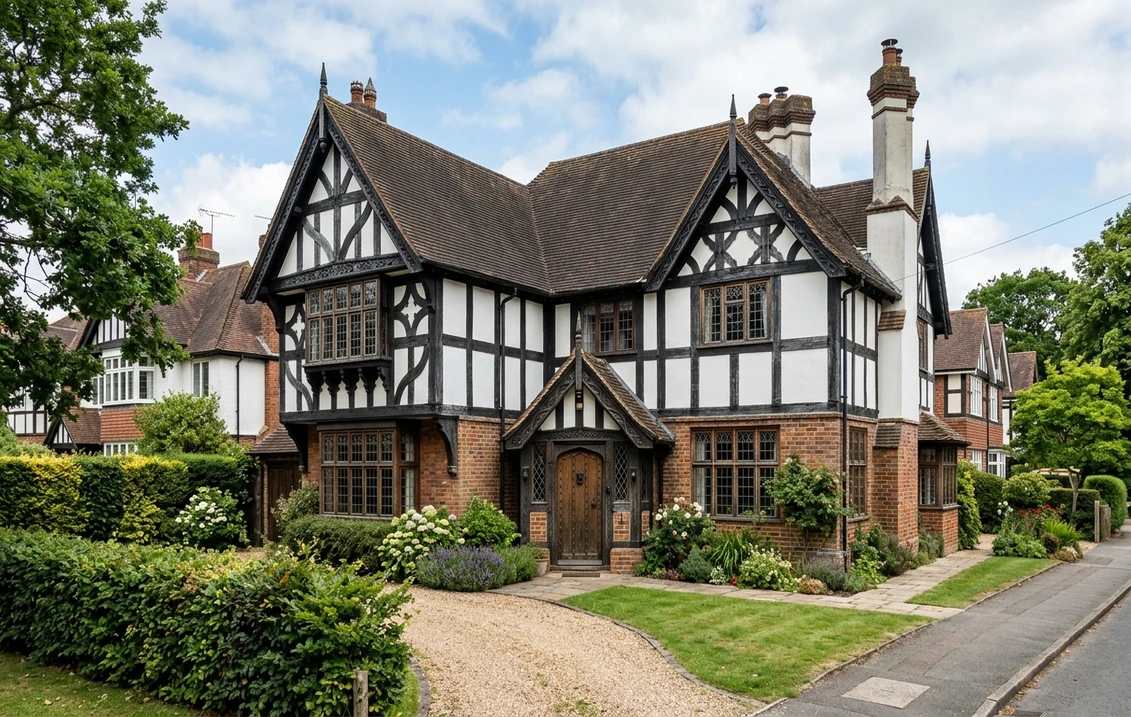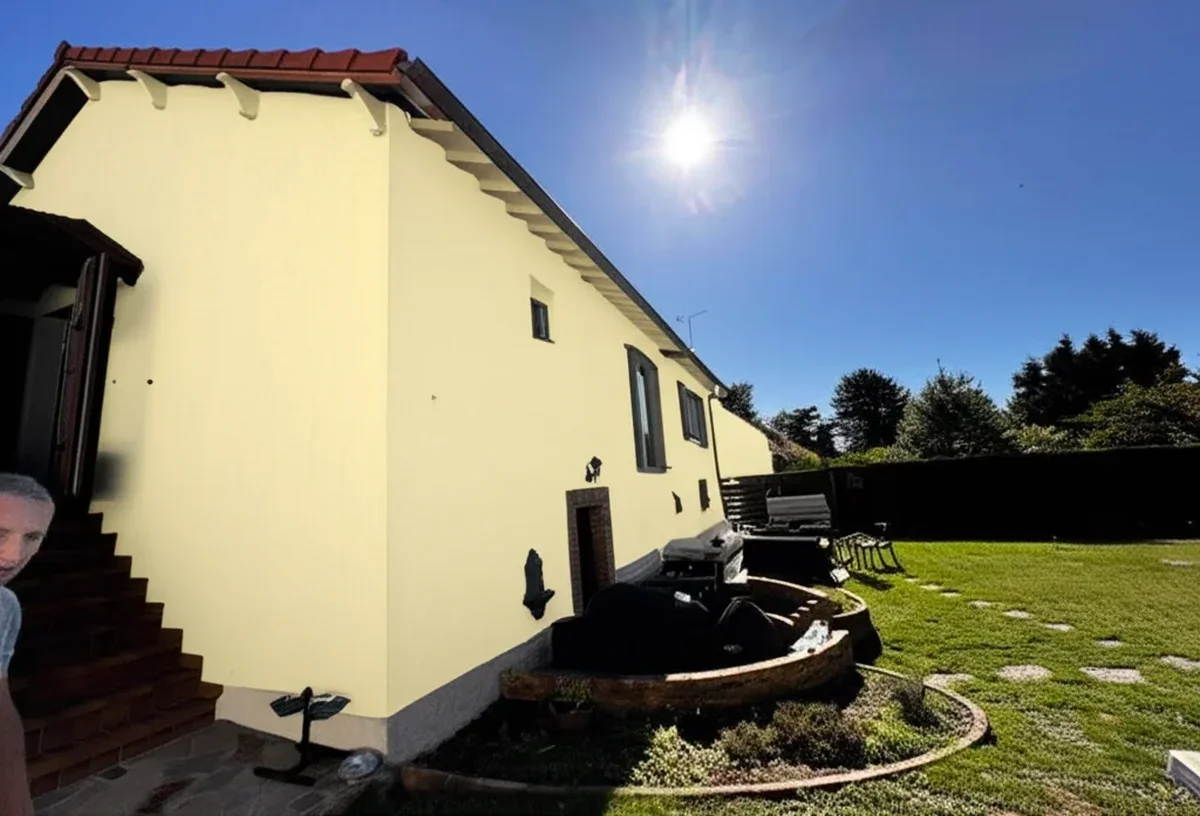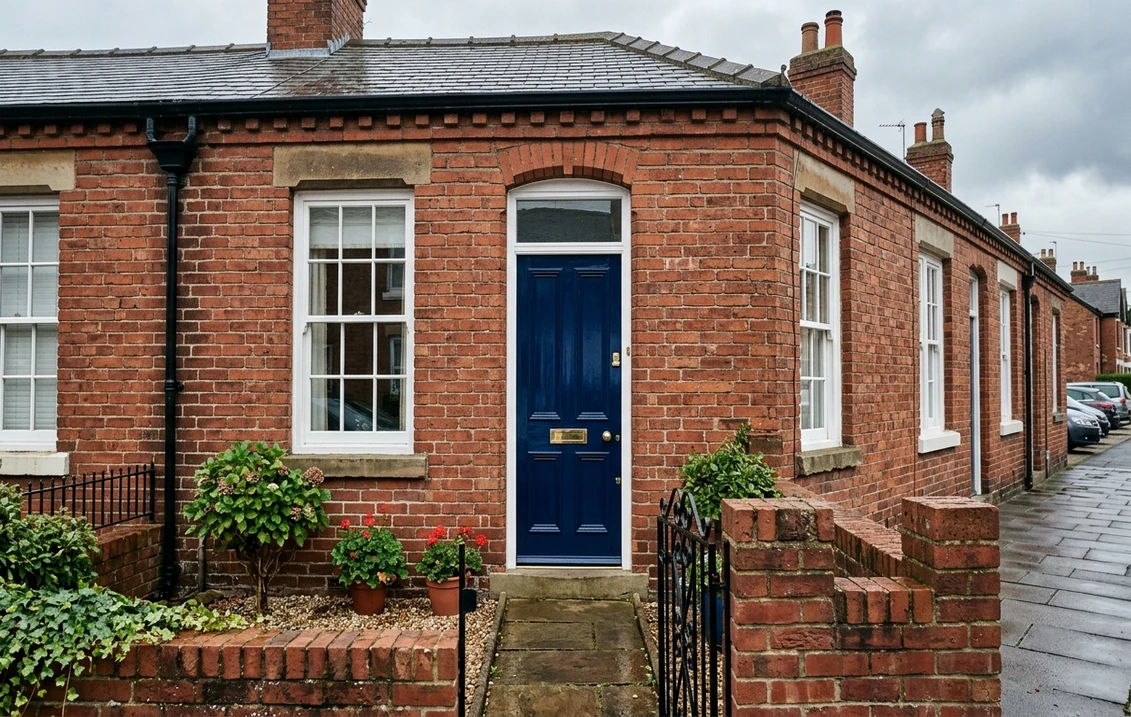
Try it on your house

Blue is the front door colour that suits the most British houses, from a near-black navy on a London townhouse to a dusty slate blue on a 1930s semi and a bright teal on a whitewashed cottage, and it is the colour the paint makers themselves put on their own doors in their advice pages. This guide takes the blues that Farrow & Ball, Dulux and Little Greene describe in their own words, the exterior products they are painted in and what those products' data sheets promise (coverage, coats, drying, temperature), matches the shades to brick, render and house type, explains the planning rules that still apply to a door, and ends with the preparation that decides whether a glossy blue lasts six years or one. No popularity figures: there is no dataset behind "the most popular blue", and this page does not pretend to one.
Why blue works on the British front door
Three things make blue the safe strong colour. It contrasts with the two most common British wall materials, red brick and cream or white render, without clashing with either, which red and green cannot both claim. It reads differently in the two kinds of British light, cool and overcast or warm and low, and the makers say so: Farrow & Ball notes that Stiffkey Blue "will appear much bluer" in well-lit areas and that Hague Blue's green undertones mean it "sits as happily outside as it does in small dark rooms". And it takes brass, chrome and black ironmongery equally, which is why a blue door survives a change of door furniture that a red or a yellow does not.
The blues the makers put on their own doors
Farrow & Ball describes Hague Blue No. 30 as "this strong blue" that "takes its name from the fantastically coloured woodwork much used by the Dutch", a "timeless, deep and dramatic blue" whose green undertones suit the outside; complementary white: Wevet. Stiffkey Blue No. 281 is "this inky blue" named "after the Norfolk beach where the mud, along with the cockles, share a particular deep navy hue"; complementary white: Ammonite. Railings No. 31 is "a soft black with blue undertones", "more blue than black", and in Farrow & Ball's words, "when used in Full Gloss on front doors it creates a handsome and commanding entrance"; complementary white: Blackened. All three are offered in Exterior Eggshell and Exterior Masonry.
Dulux paints its own makeover doors in two blues: "Vast Lake", a dusty blue, in Weathershield Multisurface Quick Dry Satin, and "Teal Voyage" in Weathershield Quick Dry Satin with the frame in Black Weathershield All Weather Masonry (Dulux, three front door makeovers). Any Dulux colour card blue can be mixed into the Weathershield gloss and satin bases; our Dulux front door colours guide covers the full system. Little Greene offers every colour in its range in Intelligent Exterior Eggshell, so its navies, teals and slate blues are available for a door without a separate exterior card; the data sheet for that finish is quoted below.
| Blue (maker's name) | Character, in the maker's words | Exterior finish | Suits |
|---|---|---|---|
| Hague Blue No. 30 (Farrow & Ball) | Deep, dramatic blue with green undertones | Exterior Eggshell | Victorian and Edwardian terraces, cream render, brass |
| Stiffkey Blue No. 281 (Farrow & Ball) | Inky navy, bluer in good light | Exterior Eggshell | Red brick, Georgian fronts, coastal towns |
| Railings No. 31 (Farrow & Ball) | Soft black with blue undertones | Exterior Eggshell (the maker cites Full Gloss on doors) | Townhouses, grey windows, white render |
| Vast Lake (Dulux) | Dusty blue | Weathershield Multisurface Quick Dry Satin | 1930s semis, pebbledash, composite doors |
| Teal Voyage (Dulux) | Teal, with a black frame in Dulux's own scheme | Weathershield Quick Dry Satin or Gloss | Cottages and plain pale facades where the door is the colour |
| Any Little Greene blue | Whole range available for exterior joinery | Intelligent Exterior Eggshell (15 percent sheen) | Heritage and designer schemes; matches interior colours |
Try it on your house
No photo? Try a sample
What the data sheets promise: the products behind a blue door
Dulux Weathershield Quick Dry Exterior Gloss, on Dulux's product page, "guarantees 6 year weather protection" on exterior wood and metal in good condition, covers "up to 16m2/litre", is "touch dry in 2 hours", needs six hours to dry, is finished "with 1 or 2 coats" over the Quick Dry Undercoat, and must be applied "above 10 degrees Celsius" in dry weather (Dulux, Weathershield Quick Dry Exterior Gloss); the satin, in Dulux's door feature, protects "for up to 10 years". Farrow & Ball Exterior Eggshell, on the maker's paint calculator, covers a maximum of "32m² per 2.5 litres" per coat with "2" recommended coats, "dry in 2 hours / recoat 4 hours" (Farrow & Ball, how much paint do I need). Little Greene Intelligent Exterior Eggshell, per its February 2024 data sheet, is "a high quality, water borne, extra durable and flexible opaque wood finish with a UV resistant film", eggshell at 15 percent gloss, "12m² per litre" theoretical coverage, two recommended coats, surface dry in 2 to 4 hours and "16 hours minimum" to recoat, with application at "10°C or above" and wood moisture below 15 percent; it is "not suitable for use on decking" (Little Greene, Intelligent Exterior Eggshell technical data sheet, via Rabart).
| Product | Sheen | Coverage and coats (maker) | Drying | Conditions |
|---|---|---|---|---|
| Dulux Weathershield Quick Dry Exterior Gloss | High gloss, water-based | Up to 16 m² per litre; 1 or 2 coats over undercoat; 6-year guarantee | Touch dry 2 h, dry 6 h | Above 10 °C, dry weather |
| Farrow & Ball Exterior Eggshell | Eggshell | 32 m² per 2.5 L per coat; 2 coats | Dry 2 h, recoat 4 h | Wood and metal; not plastic |
| Little Greene Intelligent Exterior Eggshell | Eggshell, 15 % | 12 m² per litre; 2 coats | Surface dry 2 to 4 h, recoat 16 h minimum | 10 °C or above, wood moisture under 15 % |
Gloss or eggshell on a blue door
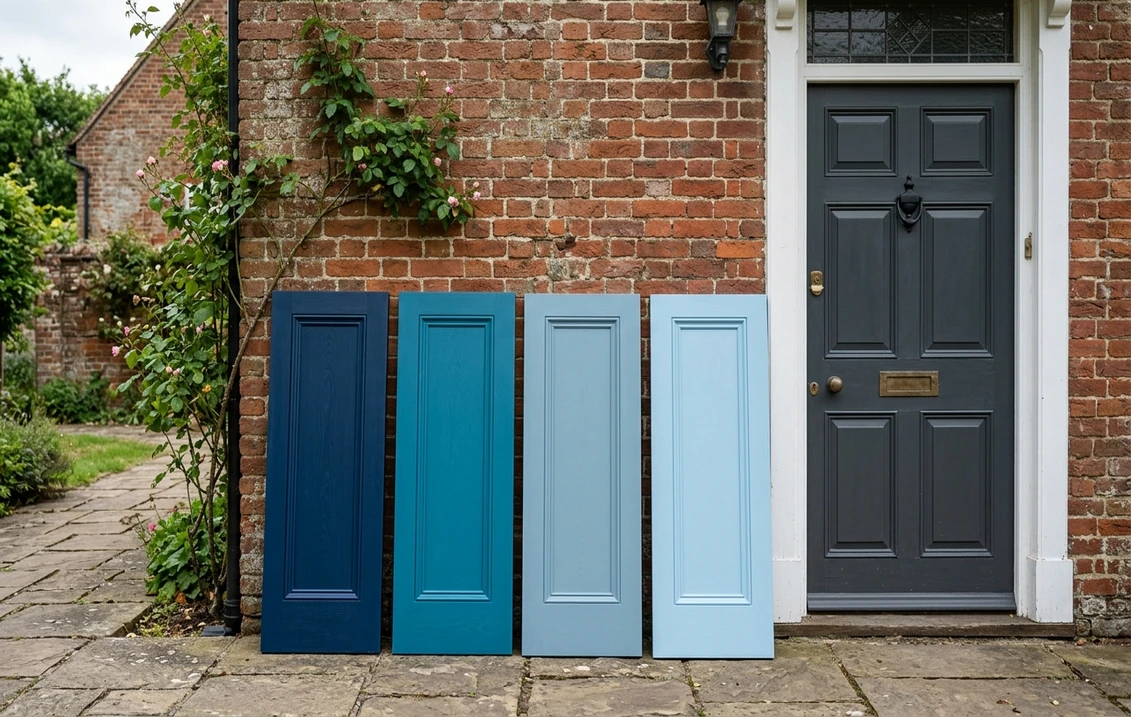
The sheen changes the blue as much as the light does. A full gloss deepens a navy and makes a black-blue like Railings read "handsome and commanding", in Farrow & Ball's phrase, because the reflections add black; it also shows every brush mark and dent, so it belongs on a sound panelled door that has been filled and sanded. An eggshell or satin (Farrow & Ball's Exterior Eggshell, Little Greene's 15 percent sheen, Dulux's Quick Dry Satin) flattens the colour toward its chip, hides an imperfect flush door, and is the finish the makers use on their own dusty blues and teals. A rule that holds across the three brands: navies and black-blues in gloss, mid-blues and teals in satin or eggshell, and the same sheen on frame and door unless the frame is a different colour.
Matching blue front doors to UK house types
- Victorian and Edwardian terrace, red or London stock brick: a deep blue-green (Hague Blue) or an inky navy (Stiffkey Blue) with brass furniture and the frame in the same colour or off-white; this is the pairing the heritage colours were made for.
- Georgian townhouse, painted stucco: Railings or a true navy in full gloss on a six-panel door, white frame, black railings to match the name.
- 1930s semi, pebbledash or render: a dusty mid-blue (Vast Lake) rather than a navy, which goes heavy on a small porch; satin rather than gloss on a flush or composite door.
- Cottage, white or cream render: teal (Teal Voyage) or a bright, slightly green blue; the door is the only colour on the facade, so let it be a colour.
- Modern house, grey windows: a soft black-blue (Railings) so the door reads as a door and not as another window; or go the other way with a pale, greyed blue for contrast.
Pairing blue with brick, render and windows
With red brick, the navies and the green-leaning blues are the safe contrasts; a pale sky blue can look weak against strong red. With cream or white render, almost any blue works and the darker the door the more formal the house. With painted grey render, a warm-leaning blue (teal, petrol) reads better than another cool shade. For windows: white uPVC frames any blue; anthracite or black windows absorb a navy door, so choose a mid-blue or a teal; with timber sashes painted in an off-white, a navy door with the same off-white frame is the classic. Door furniture: brass with the navies and greens, chrome or black with the teals and greyed blues. And look along the street first: on a terrace, the neighbours' doors are part of your scheme. Our guide to front door colours for UK homes covers the other families, and our best exterior paint colours guide the walls around the door.
Conservation areas, listed buildings and permitted development
Painting a front door is normally permitted development in England. The Planning Portal sets out the two exceptions: an Article 4 direction, common in conservation areas, can remove permitted development rights for changes to the front of a house, and a listed building needs listed building consent for changes to its appearance unless it is "repainting in the existing colour" (Planning Portal). Some conservation areas publish door palettes, and blue is usually on them; a call to the conservation officer before buying the paint is cheaper than repainting the door back. Leaseholders in flats need the freeholder's consent whatever the planning position. Our guides to conservation area painting rules and painting a listed building explain the procedure.
Preparation, primer and topcoat: the right system for a blue door
- Furniture off, glass masked. Remove the knocker, letterplate and numbers; mask glazing and the threshold.
- Wash, sand, fill. Sugar soap, rinse, dry; sand the whole door for a key; flaking paint back to a firm edge; exterior filler in dents and open joints. Little Greene's sheet is explicit: degrease, "rub down thoroughly with a medium grade sand paper to provide a key", and never paint "damp or rotting wood".
- Prime bare wood. Spot-prime bare timber; on new or stripped wood, Little Greene specifies two coats of its Aluminium Wood Primer on resinous timber "to prevent staining".
- Undercoat, tinted. A dark blue over a white door needs a tinted undercoat (Dulux's Weathershield Quick Dry Undercoat, or the maker's primer and undercoat) or it will take three topcoats to hide the white.
- Two topcoats. Gloss or eggshell, brushed with the grain, mouldings first; Dulux allows four hours between coats, Farrow & Ball recoats after four, Little Greene wants sixteen hours minimum.
- Weather. Above 10 °C for all three makers' water-based products, no rain forecast, out of direct sun; Little Greene adds "a minimum of 3°C above the dew point" and no painting above 25 °C.
- Leave it open. On blocks until the last coat is hard; a dark blue shows every print of the weather strip.
How to test a blue on your own door before you buy
Blues move more than any other door colour between morning and evening and between a gloss and an eggshell, which is why the makers' own descriptions keep saying "appears much bluer" in one light and "soft black" in another. Photograph the front of the house in flat daylight, apply a navy, a teal and a dusty mid-blue to the door on the photo, and compare them with the brick, the windows and the neighbours' doors. Then paint a tester on a panel in the product and sheen you will use, and look at it at 9 a.m. and at 6 p.m. A glossy Stiffkey Blue and an eggshell Stiffkey Blue are two different doors.
Sources and references
- Farrow & Ball colour pages: Hague Blue No. 30, Stiffkey Blue No. 281, Railings No. 31: the maker's descriptions, complementary whites and exterior finishes; How much paint do I need: Exterior Eggshell coverage, coats and drying.
- Dulux, Weathershield Quick Dry Exterior Gloss and Three front door makeovers: guarantee, coverage, drying, temperature; Vast Lake and Teal Voyage.
- Little Greene, Intelligent Exterior Eggshell technical data sheet (February 2024, PDF via Rabart): sheen, coverage, coats, drying, application climate, preparation.
- Planning Portal: permitted development, Article 4 directions, listed building consent.
Frequently asked questions
What is the best blue for a front door in the UK?
Which paint do I use for a blue front door?
Does a blue door suit red brick?
Do I need permission to paint my front door blue?
Trademarks mentioned (Sherwin-Williams, Benjamin Moore, Behr, Caparol, Brillux, Sto, Alpina, Valspar, PPG, Glidden, Dulux, Crown Trade, Sandtex, Farrow & Ball, Johnstone's, Leyland) are property of their respective owners. FacadeColorizer is independent and not affiliated with any of them. Nominative fair use under Lanham Act §1125.