Try it on your house

There is no single best exterior primer: the best one is the primer the manufacturer writes for the surface in front of you. On bare exterior softwood and hardwood, use a wood primer or a primer undercoat (Dulux Trade Quick Dry Wood Primer Undercoat, for example, goes on in two coats on bare wood and is recoatable in 2 to 4 hours). On highly resinous timber, use an aluminium wood primer. On rusty iron and steel, use a zinc phosphate primer. On galvanised steel and other non-ferrous metal, use a primer written for galvanised surfaces. On most sound masonry, use no primer at all, only a thinned first coat of the masonry paint. Even Dulux Trade's All Purpose Primer, sold for "most wood, metal and masonry surfaces", says that highly resinous wood, galvanised steel and new plaster need a specialist primer.
Every product figure below was read on the Dulux Trade and Johnstone's Trade UK product pages in October 2026. Once the primer is chosen, our exterior wood paint guide and exterior metal paint guide cover the topcoats.
Choose the topcoat colour while the primer dries
Upload a photo of your house and try colours on the front door, window frames and trim before you buy the finishing coat.
Try door and trim colours on my houseWhat an exterior primer does, and what an undercoat does
A primer is the first coat on a bare surface: it grips the surface and, depending on the product, seals porous material, stops resin bleeding through timber or slows rust on steel. An undercoat comes next and builds opacity under a gloss or satin. On woodwork, British trade ranges often combine the two in one tin sold as a "primer undercoat": Dulux Trade describes its Quick Dry Wood Primer Undercoat as a "dual purpose primer undercoat for interior and exterior woodwork", and Johnstone's Trade sells Aqua Guard Exterior Primer Undercoat as both the primer on bare timber and the undercoat for its Aqua Guard gloss and satin.
When you repaint rather than start from bare wood, sound painted woodwork needs a key and an undercoat, and only the bare patches need priming. Some topcoats skip the undercoat, none skip the primer: Dulux sells Once Gloss for primed or painted wood and metal, which is why our Dulux Once Gloss guide covers what goes under it outside.
Which exterior primer for which surface
The table matches each outdoor surface to the type of primer its manufacturer specifies, with UK trade products as examples. Coverage figures are the maximum per litre that each maker publishes; rough or very porous surfaces take more.
| Surface | Primer type | UK examples (maker's figures) | Watch out for |
|---|---|---|---|
| Bare softwood and hardwood: doors, windows, fascias, cladding | Water-based primer undercoat, or solvent-based wood primer | Dulux Trade Quick Dry Wood Primer Undercoat: up to 13 m²/l, recoat 2 to 4 h. Johnstone's Trade Aqua Guard Exterior Primer Undercoat: 13 m²/l. Dulux Trade Wood Primer (solvent): up to 15 m²/l, recoat after 16 to 24 h | Knots need a knotting solution first |
| Highly resinous timber, aged creosote or bitumen | Aluminium wood primer | Dulux Trade Aluminium Wood Primer: up to 17 m²/l, recoat after 16 to 24 h | Solvent-based, brush only; two coats on resinous wood |
| New bare exterior joinery that needs protection against decay | Preservative primer | Dulux Trade Weathershield Preservative Primer+ (BP): up to 5 m²/l, two coats, 24 h | Only on wood free of any coating, mould or algae |
| Iron and steel: railings, gates, rainwater goods | Zinc phosphate anti-corrosive primer | Dulux Trade Metalshield Zinc Phosphate Primer: up to 13 m²/l, recoat 7 h. Johnstone's Trade Quick Dry Zinc Phosphate Primer | Both are solvent-based; remove loose rust first |
| Galvanised steel and other non-ferrous metal | Primer written for galvanised surfaces | Dulux Trade Metalshield Quick Dry Metal Primer: water-based, up to 18 m²/l, recoat 4 to 6 h | General purpose primers exclude galvanised steel |
| Glazed tiles, glass, anodised aluminium, powder-coated metal | Adhesion ("grip") primer | Dulux Trade Super Grip Primer: up to 18 m²/l, recoat 4 to 6 h. Dulux Trade Ultra Grip Primer (two-pack): up to 10 m²/l | Lightly abrade powder coat; test a small area |
| Sound masonry, render and brick | Usually none: a thinned first coat of the masonry paint | Dulux Trade Weathershield Stabilising Primer only where the surface stays powdery: up to 10 m²/l, recoat 16 to 24 h | Alkaline or mineral-system walls need their own primers |
Try it on your house
No photo? Try a sample
Bare wood: front doors, sash windows, fascias and cladding
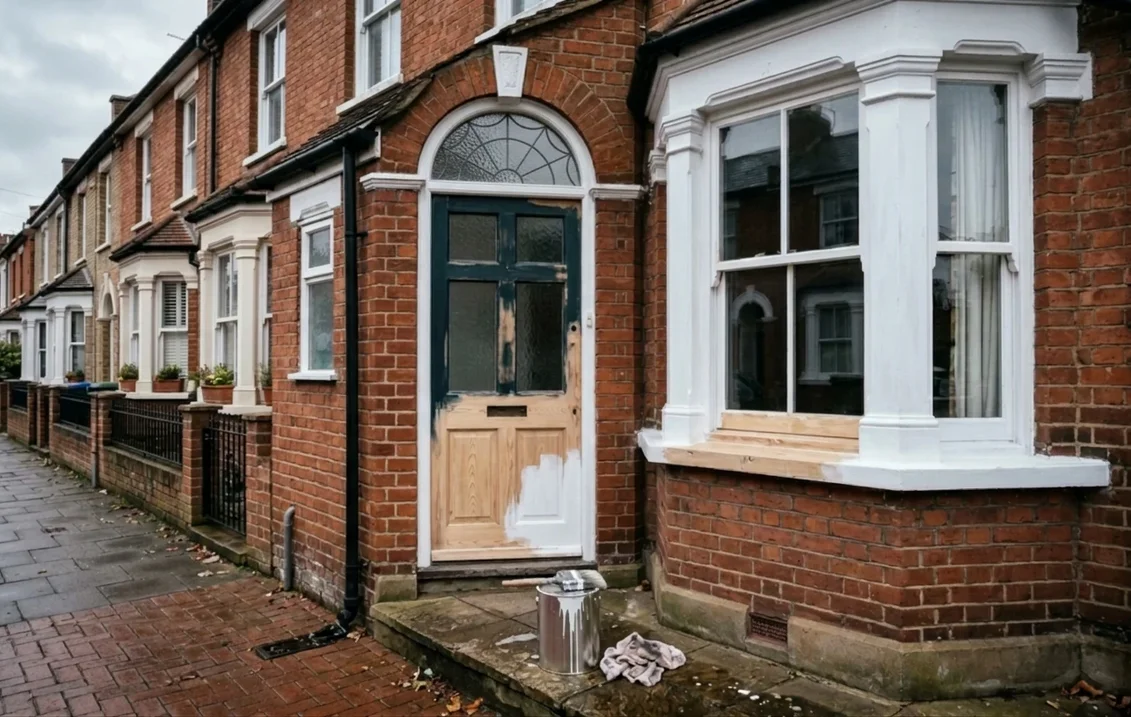
Most outdoor priming in a British house is bare timber: the bottom rail of a front door where the paint has lifted, the sills and lower sashes of Victorian and Edwardian windows, a new softwood fascia, or a stripped door. The first decision is water-based or solvent-based.
Water-based primer undercoats. The Dulux Trade Quick Dry Wood Primer Undercoat is "ideal for use as a primer for softwoods, hardwoods, chipboard and fibre board (except fire retardant-treated types)". Dulux specifies two coats on bare surfaces, one on previously painted ones, at least 2 hours between coats and up to 13 m² per litre. Johnstone's Trade says its Aqua Guard Exterior Primer Undercoat "prevents resins from staining through into the finish" on bare timber, and lists 13 m² per litre and a VOC level of 29.4 g/l against a maximum of 30.
Solvent-based wood primers. Dulux calls its Dulux Trade Wood Primer "a good, general purpose solvent-based primer suitable for use on all types of soft and hard woods, inside and outside". It goes on in one coat on bare wood, by brush only, covers up to 15 m² per litre, dries in 4 to 6 hours and is recoatable after 16 to 24 hours. That overnight wait is the practical difference: on a short autumn day, a water-based primer undercoat can take its second coat the same afternoon, while a solvent-based primer ties the job to the next day.
Knots. Both Dulux wood primers carry the same instruction: "Treat any knots in wood with an appropriate knotting solution." Knots are where resin comes through and stains a white door brown within a season, so seal them before any primer. Dulux also adds a condition that applies to every product here: surfaces must be "sound, clean and dry (new surfaces particularly must be fully dry)". Timber that has sat through a week of rain is not dry because the surface feels dry.
Resinous timber, hardwoods and old creosote
The Dulux Trade Aluminium Wood Primer is the one to reach for when ordinary wood primer will not hold back the resin. Dulux describes it as "a solvent-based primer containing aluminium pigment suitable for use on all types of softwoods and hardwoods, inside and outside, especially those which are highly resinous", and adds that it can seal "aged creosoted or bitumen coated surfaces". The figures: up to 17 m² per litre, 3 to 4 hours to dry, recoatable after 16 to 24 hours, brush only, two coats over highly resinous wood or creosote, and up to 48 hours between coats on aged creosote or bitumen. The Dulux Trade Wood Primer page sends you here too: "Wood that is highly resinous should be primed with Dulux Trade Aluminium Wood Primer."
An aluminium-pigmented primer is silver-coloured, so under a white or pale topcoat expect to need a full undercoat over it.
Preservative primers for new exterior joinery
Dulux says Weathershield Preservative Primer+ (BP) "penetrates into wood to seal and preserve against water damage, decay and blue stain fungi". It is water-based, brushed on unthinned in two coats, with 24 hours for the second to dry, at up to 5 m² per litre because it soaks in. The wood must be "free from any surface coating, mould or algae", so it suits bare new joinery, not repairs on painted wood. In Northern Ireland it is sold for professional use only.
Iron and steel: railings, gates and rainwater goods
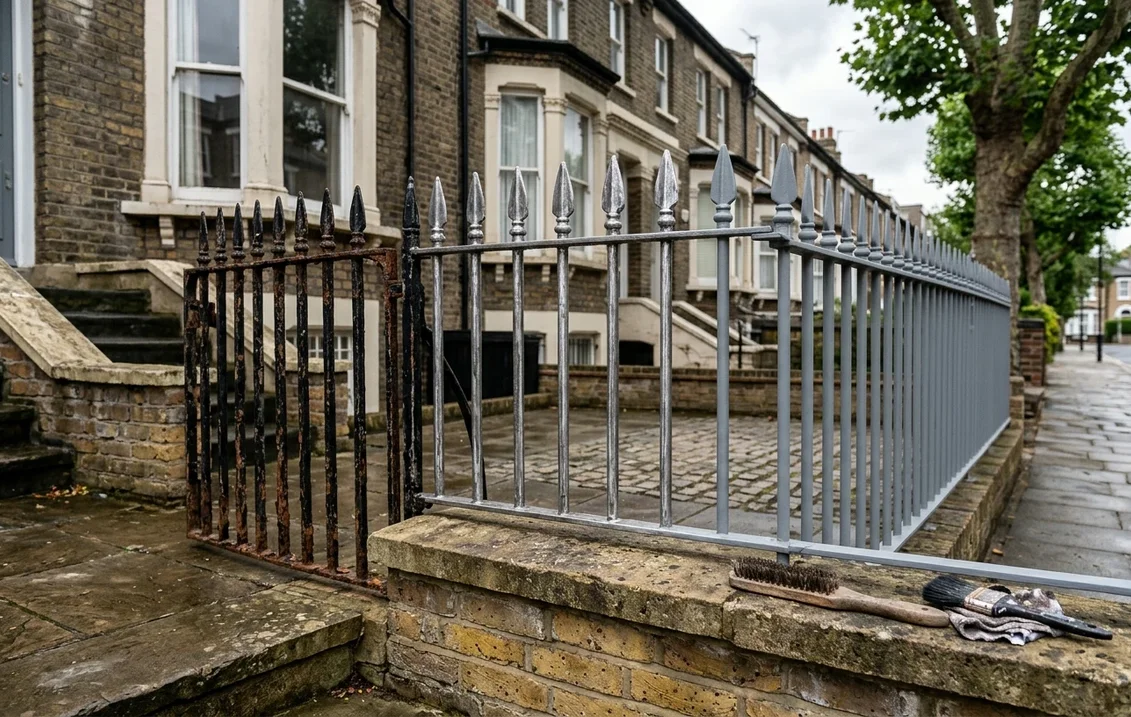
Front railings, gates, boot scrapers and cast-iron gutters and downpipes are a British speciality, and they rust from any chip in the paint. The primer for iron and steel is a zinc phosphate anti-corrosive. Dulux describes Metalshield Zinc Phosphate Primer as "a high performance, high build primer with excellent rust inhibiting performance, suitable for use over hand-cleaned iron and steel as well as blast-cleaned surfaces". It is solvent-based, applied by brush or roller, covers up to 13 m² per litre, dries in 2 to 3 hours and is recoatable after 7 hours. Dulux states that one coat of it followed by two coats of Metalshield Gloss or Satin "will deliver up to 8 years metal protection".
Johnstone's Trade sells a Quick Dry Zinc Phosphate Primer, "a versatile, quick-drying, single pack anti-corrosive primer for steel", recommended "for ferrous metals and all suitably prepared non-ferrous substrates". Its listed VOC level of 372.2 g/l marks it as solvent-based too. Wire-brush off loose rust and flaking paint until you reach a firm surface, prime the same day, and on old railings read the lead section below before you scrape.
Galvanised steel, aluminium and other non-ferrous metal
Galvanised steel is where general purpose primers fail. Dulux's All Purpose Primer names it as an exception, and the product Dulux makes for it is the Metalshield Quick Dry Metal Primer, "a water-based primer that seals and protects the surfaces to provide excellent adhesion to new bright or weathered galvanised metal surfaces and other non-ferrous metal, both inside and out". It covers up to 18 m² per litre and is recoatable in 4 to 6 hours, and Dulux gives the same "up to 8 years" figure for one coat of it under two coats of Metalshield Gloss or Satin. That suits galvanised gates and handrails on newer houses.
For glazed tiles, glass, anodised aluminium and powder-coated metal, Dulux makes two adhesion primers. Super Grip Primer is water-based and single pack, for interior and exterior use, recoatable in 4 to 6 hours; lightly abrade powder-coated metal first. Ultra Grip Primer is a water-based two-pack with a pot life of up to 6 hours at 20°C and a recoat window of 16 hours to 7 days. uPVC is on neither list: for uPVC windows and doors, choose a product whose data sheet names uPVC, and check what the supplier says about painting first.
Masonry, render and brick: usually no primer at all
Masonry is the surface where people buy a primer they do not need. Dulux is explicit on its Weathershield Stabilising Primer page: the product is "specially formulated to seal unstable areas which remain powdery and chalky after the surface has been thoroughly prepared", it "should not be used as a general purpose sealer on normal or sound surfaces", and "new or sound bare surfaces should only be sealed with a thinned first coat of the masonry paint itself". Where it is needed, it covers up to 10 m² per litre and is recoatable after 16 to 24 hours.
Two other cases have their own primers. Dulux Trade Alkali Resisting Primer is a solvent-based primer for masonry and plaster "that may contain alkalis", at up to 9 m² per litre. And mineral systems have primers that only work under their own paint: Johnstone's Trade says its Sol Silicate Masonry Primer "should only be used under the Sol Silicate Masonry paint system and is not compatible with other coatings". Our masonry primer guide compares the stabilising primers brand by brand, and on solid-walled period houses the question of whether to use masonry paint at all comes first: see limewash or masonry paint on solid walls.
All-purpose primers: when one tin is enough
An all-purpose primer makes sense for patch priming on a house that is already painted: a bare corner of a sill, a gate hinge, a few spots where filler shows through. The Dulux Trade All Purpose Primer is "a solvent-based primer suitable for use on most wood, metal and masonry surfaces, both inside and outside", applied by brush or roller in one coat on bare areas and two coats on badly rusted metal, recoatable after 6 hours. Its coverage shows the trade-off: up to 8 m² per litre on wood, 11 on metal and 7 on plaster, against 13 to 15 m² per litre for the dedicated wood primers above. For a whole set of stripped windows, a dedicated wood primer goes further and avoids the exceptions Dulux itself lists.
Old paint on older UK houses: check for lead before you sand
Priming usually starts with scraping and sanding, and on older British houses that is the risky part. Cambridge City Council's guidance on lead paint in your home says lead was used in some paints until the mid-1960s, for windows, doors and other woodwork, and that a home built before the 1960s which still has original coats of paint could contain some. Its advice:
- Sound old paintwork is easiest sealed under a coat of modern paint.
- If it must come off, avoid dust and fumes: a liquid stripper, or a hot-air gun set below 450°C that softens the paint without burning it.
- Wear gloves and a mask with an EN143 P3 filter, close off the area and keep children and pregnant women away.
The Dulux Trade primer pages carry the same warning in their preparation notes: "Before surface preparation, read the Health & Safety information about old lead paints." Dry sanding a Victorian front door or the railings in front of it is exactly what the guidance tells you not to do.
BS 6150 and the "8 years" claims
The British Standard behind most of these systems is BS 6150:2019, Painting of buildings. Code of practice. BSI describes it as covering the preparation, initial painting and maintenance of painted surfaces in buildings, inside and out, with detailed information on wood, metal, masonry and other typical substrates. It does not cover the particular requirements of listed or historic buildings protected by law, limewash and distemper, or the maintenance of lead surfaces.
Durability figures from manufacturers are system figures, not primer figures. Johnstone's Trade states that for the Aqua Guard system to reach "its 8 years to first maintenance the product must be applied in accordance with a project specific Johnstone's Trade Technical Specification and BS 6150:2019, Code of Practice for Painting Buildings". Dulux's "up to 8 years" for Metalshield and Weathershield likewise refers to the full system from one range: mix makers and you lose the claim. If the house is listed or in a conservation area, the colour and the paint type can both be controlled: our conservation area painting rules explain when you need consent.
How much primer: two worked examples
The areas below are assumptions for a typical terraced house; measure your own and allow for mouldings and glazing bars, which add surface without adding much width.
| Job | Assumed area | Primer and coats | Litres at the maker's maximum |
|---|---|---|---|
| Stripped front door (outside face) and frame, plus two sash windows | About 2.6 m² for the door and frame, about 2.5 m² of timber per window: 7.6 m² | Quick Dry Wood Primer Undercoat, 2 coats on bare wood (15.2 m²) | 15.2 ÷ 13 = about 1.2 l |
| The same joinery with a solvent-based primer | 7.6 m² | Dulux Trade Wood Primer, 1 coat, then an undercoat | 7.6 ÷ 15 = about 0.5 l of primer |
| A garden gate and 6 m of plain bar railings | About 6 m² of metal, counting both faces of every bar | Zinc phosphate primer, 1 coat | 6 ÷ 13 = about 0.5 l |
These are the makers' maximum spreading rates, so round up and buy the next tin size. If you would rather have a decorator do the preparation and priming, our exterior house painting cost guide sets out what UK decorators charge and how much of a quote goes on preparation.
Timing primer in a British autumn
Several of the data sheets above say drying is "dependent on temperature and humidity", and all of them say to protect the paint from frost. For October and November work, that means three things:
- Prefer quick-dry primers on short days. A primer undercoat recoatable in 2 to 4 hours lets you prime and undercoat a door in one dry day; a solvent-based wood or aluminium primer needs 16 to 24 hours.
- Respect both ends of the recoat window. Ultra Grip must be recoated within 7 days "for optimum intercoat adhesion".
- Start early. Leave each coat enough daylight to dry before the evening damp, and never prime timber still wet from yesterday's rain.
Once the primer is on, the colour is the decision that shows: our front door colours guide is the place to start for the door.
See the finished colour before the topcoat goes on
Upload a photo of your house and compare front door, window and railing colours in seconds, free.
Try our free colour visualiserSources and references
- Dulux Trade (AkzoNobel), product pages for Quick Dry Wood Primer Undercoat, Aluminium Wood Primer, Metalshield Zinc Phosphate Primer, Metalshield Quick Dry Metal Primer, Weathershield Stabilising Primer and All Purpose Primer, among the eleven primer pages cited above: substrates, exclusions, coverage, drying and recoat times, system claims and the lead paint warning.
- Johnstone's Trade (PPG), product pages for Aqua Guard Exterior Primer Undercoat, Quick Dry Zinc Phosphate Primer and Sol Silicate Masonry Primer: uses, coverage, VOC levels and the BS 6150 condition on the 8-year claim.
- BSI, BS 6150:2019 Painting of buildings. Code of practice (published 31 March 2019): scope of the standard and what it excludes.
- Cambridge City Council, Lead paint in your home: when lead paint was used, how to tell, and safe removal methods.
Frequently asked questions
What is the best exterior primer for bare wood in the UK?
Do I need a primer before masonry paint?
What primer should I use on galvanised steel outside?
Can one primer cover wood, metal and masonry outside?
How long should exterior primer dry before the next coat?
Could old paint on my house contain lead?
Trademarks mentioned (Sherwin-Williams, Benjamin Moore, Behr, Caparol, Brillux, Sto, Alpina, Valspar, PPG, Glidden, Dulux, Crown Trade, Sandtex, Farrow & Ball, Johnstone's, Leyland) are property of their respective owners. FacadeColorizer is independent and not affiliated with any of them. Nominative fair use under Lanham Act §1125.