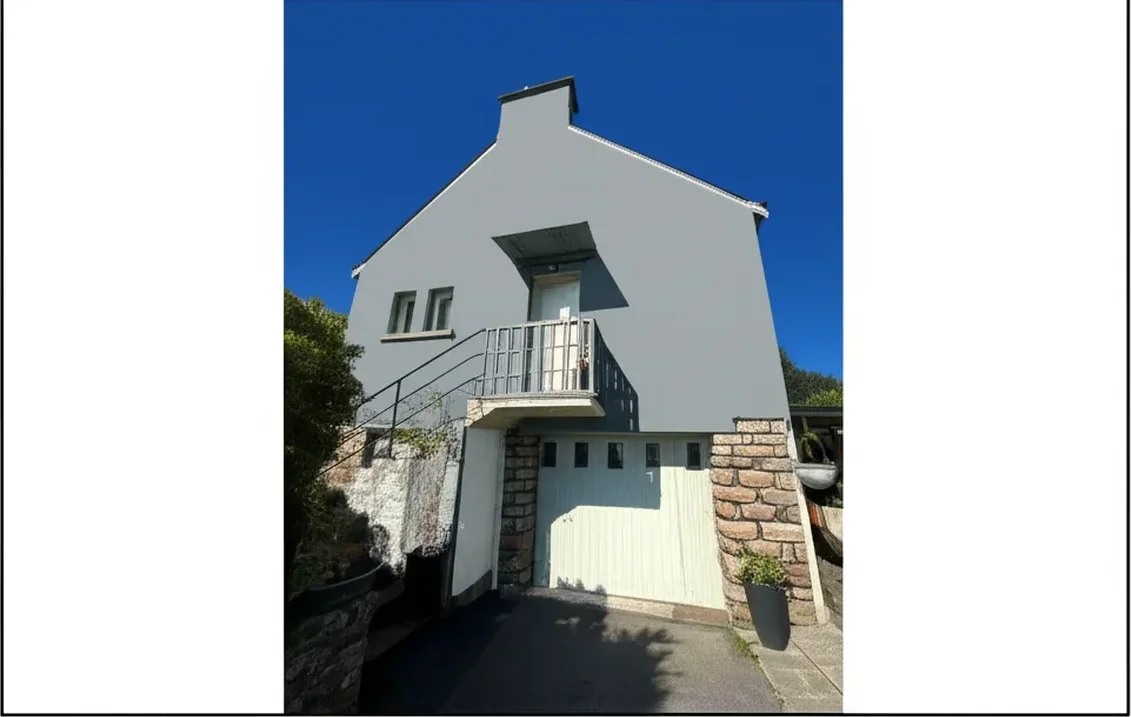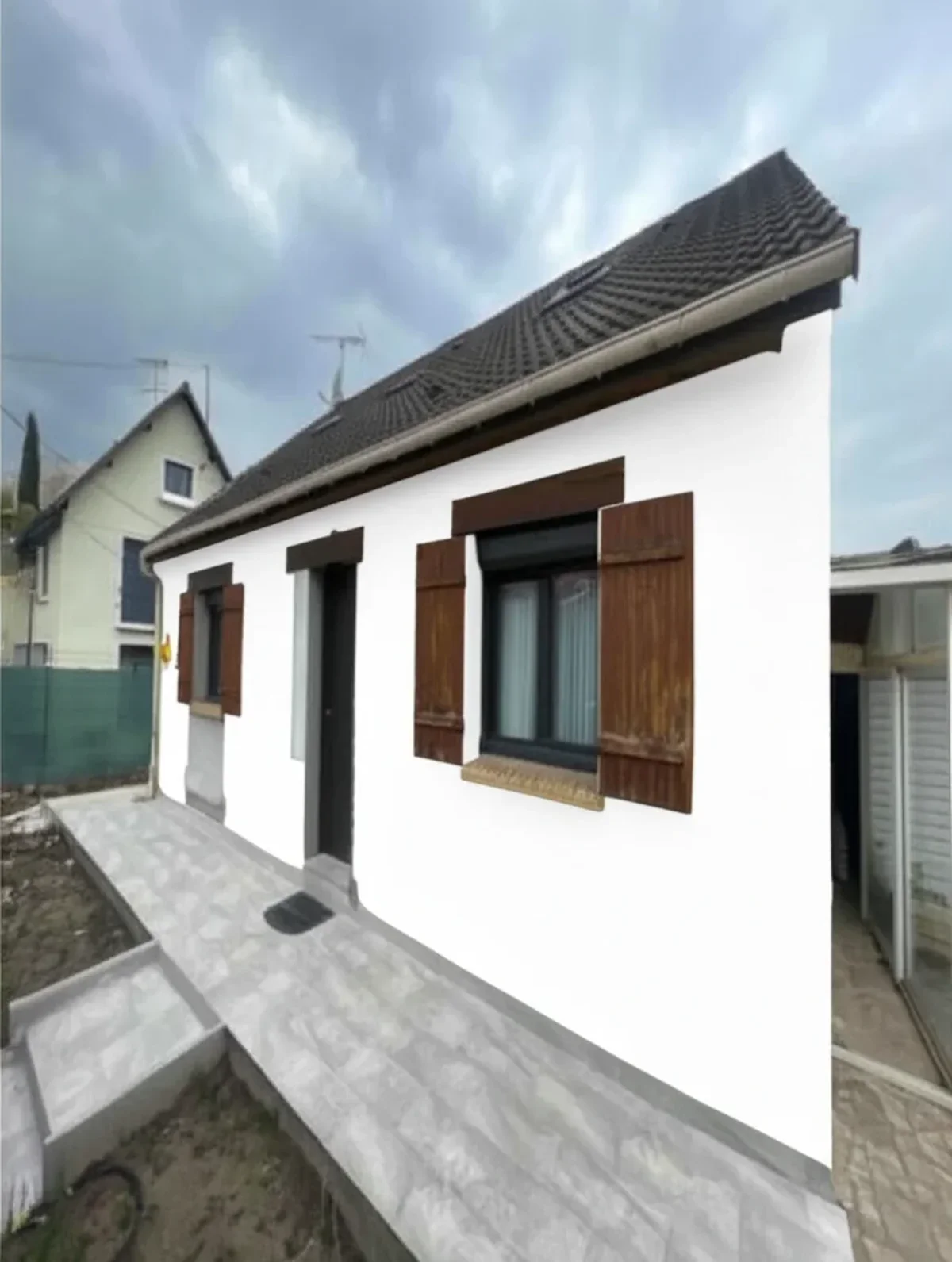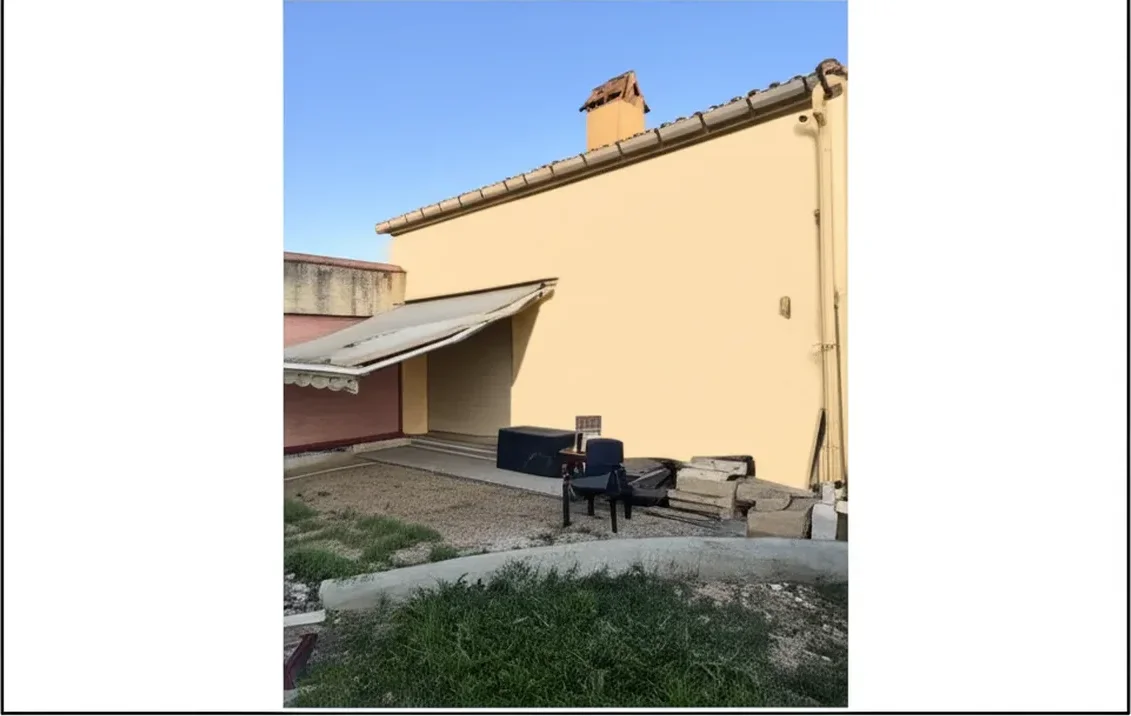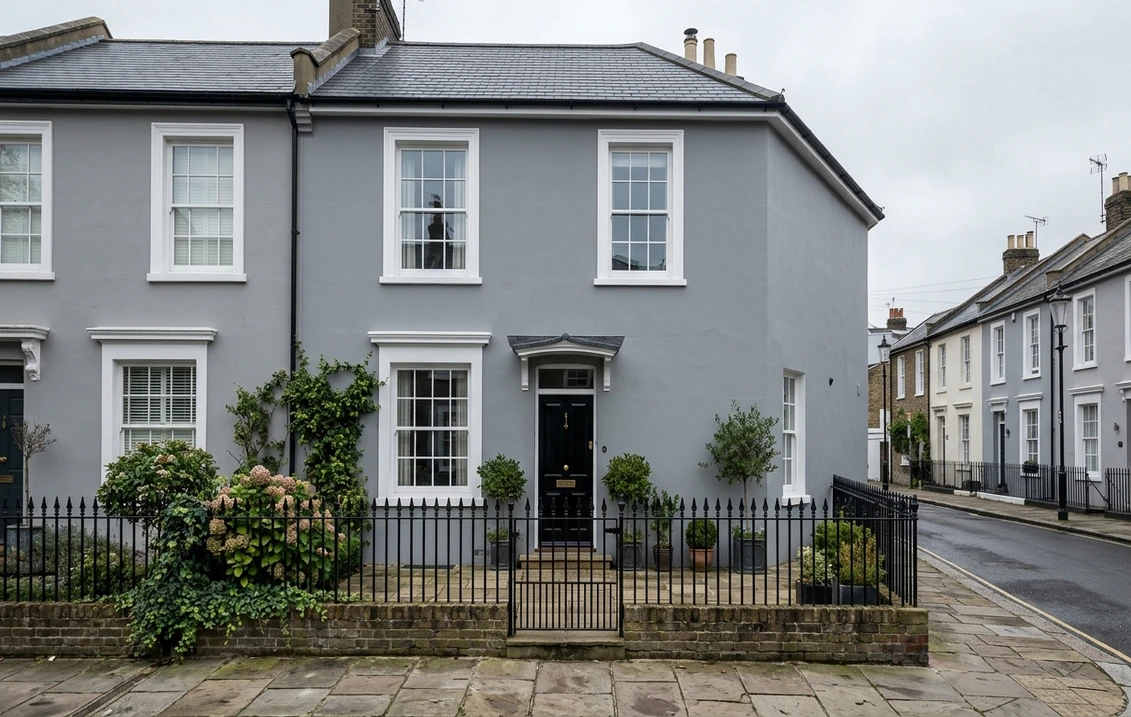
Try it on your house

Farrow & Ball Manor House Gray No. 265 is the grey most often asked for on a British period frontage, and the one most often described wrongly. On the maker's own page it is "a cool architectural grey", "a definite grey which retains its colour in all lights", cooler and cleaner than Charleston Gray, with Pavilion Gray as its complementary white. It is also an Archive colour, made to order and non-returnable, which changes how you buy it for an outside job. This guide sticks to what Farrow & Ball publishes about the colour and its two exterior finishes, what the Planning Portal says about painting a house, and what the paint costs at a UK merchant, so that you can decide whether it belongs on your render, brick or front door before a single made-to-order tin is mixed.
Manor House Gray outside: the short answer
Use it on smooth render, stucco and painted brick as a whole-facade colour when you want a grey that reads grey, not greige and not blue, in every light; use it on a front door, windows and railings in Exterior Eggshell when the walls are a pale stone or white; avoid it on a north-facing wall of a very small frontage, where a mid grey with no warmth can look heavy. Pair it with Pavilion Gray or Wevet for the trim, as Farrow & Ball itself suggests, and with a near-black such as Railings for ironwork. Because it is an Archive colour, order every tin for the job at once so the batches match, and order the sample pot first: a made-to-order colour cannot go back.
What Farrow & Ball actually says about No. 265
The colour page is short and worth quoting, because most of the descriptions that circulate online contradict it. Farrow & Ball heads the page "A cool architectural grey" and writes: "Named after the houses traditionally inhabited by the local lord, Manor House Gray is a definite grey which retains its colour in all lights, especially when contrasted with Wevet." It adds that the colour is "cooler and cleaner in feel than Charleston Gray" and files it among its Architectural Neutrals, with Pavilion Gray listed as the complementary white (Farrow & Ball, Manor House Gray No. 265). Three facts follow from that paragraph.
First, it is cool, not warm. Guides that call it a warm greige with a brown undertone are describing a different colour; if you want a warm grey outside, the maker's own warmer options are Charleston Gray and the greige family. Second, "retains its colour in all lights" is the useful property for an exterior: a north wall, a west wall at six in the evening and a wet February afternoon will show the same grey rather than drifting lilac or green, which is exactly the complaint people make about bluer greys on render. Third, the suggested white is not a bright white. Pavilion Gray No. 242 is itself "a classic mid grey" with "subtle blue undertones" and its own complementary white, Blackened (Farrow & Ball, Pavilion Gray No. 242). A Manor House Gray wall with Pavilion Gray window reveals is a tonal scheme, two greys a step apart, not a grey-and-white one.
One thing Farrow & Ball does not publish is a light reflectance value. Neither colour page carries an LRV, so any figure you see quoted for Manor House Gray is a third-party measurement, not the maker's. For an exterior that matters less than it does indoors, but it means the honest way to judge its depth is the sample pot on your own wall, or a preview on a photograph of the frontage.
It is an Archive colour: what that changes when you buy
Both the colour page and the Exterior Masonry product page carry the same line: "This colour is from our Archive. All Archive colours are made to order just for you, so they're non-returnable" (Farrow & Ball, Manor House Gray in Exterior Masonry). For an inside wall that is a footnote. For a facade it sets the order of operations.
- Sample before tins. A 100 ml sample pot or the maker's grey sample set on the actual render, viewed on two different days, is the only test that counts, because the 5 litre tins cannot go back.
- Order the whole job in one go. Made-to-order tins are mixed per order; a second order weeks later is a second batch. Work out the quantity from the coverage figures below, add the margin for a second coat on the sunny elevation, and buy once.
- Allow lead time. A stock colour is on the shelf at a merchant; an Archive colour is mixed after you pay. Book the decorator for after the tins have arrived, not for the day you order.
- Keep the tin label. The batch and formula on the label are what a merchant needs to match a touch-up tin in two years' time.
Which finish for which surface: Exterior Masonry vs Exterior Eggshell
Manor House Gray is offered in both of Farrow & Ball's outside finishes, and they are not interchangeable. The figures below are the ones the two product pages publish.
| Finish | Surfaces (maker) | Sheen | Coverage per coat | Dry / recoat | Durability claim |
|---|---|---|---|---|---|
| Exterior Masonry (5 L) | Brick, render, concrete | 2% | Up to 8 m² per litre | Dry in 2 hours, recoat in 5 hours | Lasts up to 15 years, "providing it has been applied in accordance with our Product Advice Sheets" |
| Exterior Eggshell | Wood and metal: front doors, cladding, fences (not pressure-treated or tanalised) | 20% | Up to 13 m² per litre | Dry in 2 hours, recoat in 4 hours | Lasts up to six years, same condition |
Try it on your house
No photo? Try a sample
Sources: Farrow & Ball, Exterior Masonry and Farrow & Ball, Exterior Eggshell. Two practical readings. The 2% sheen of the masonry finish is what makes a grey render look like stone rather than plastic; it also means the wall shows no roller lap, which forgives a DIY application. The 20% eggshell on a door sits between a satin and a gloss, which is why a Manor House Gray door photographs darker than the same colour on a wall: the sheen returns the sky. If you want the door to match the wall exactly, expect the eggshell to read a shade deeper and glossier, and choose accordingly.
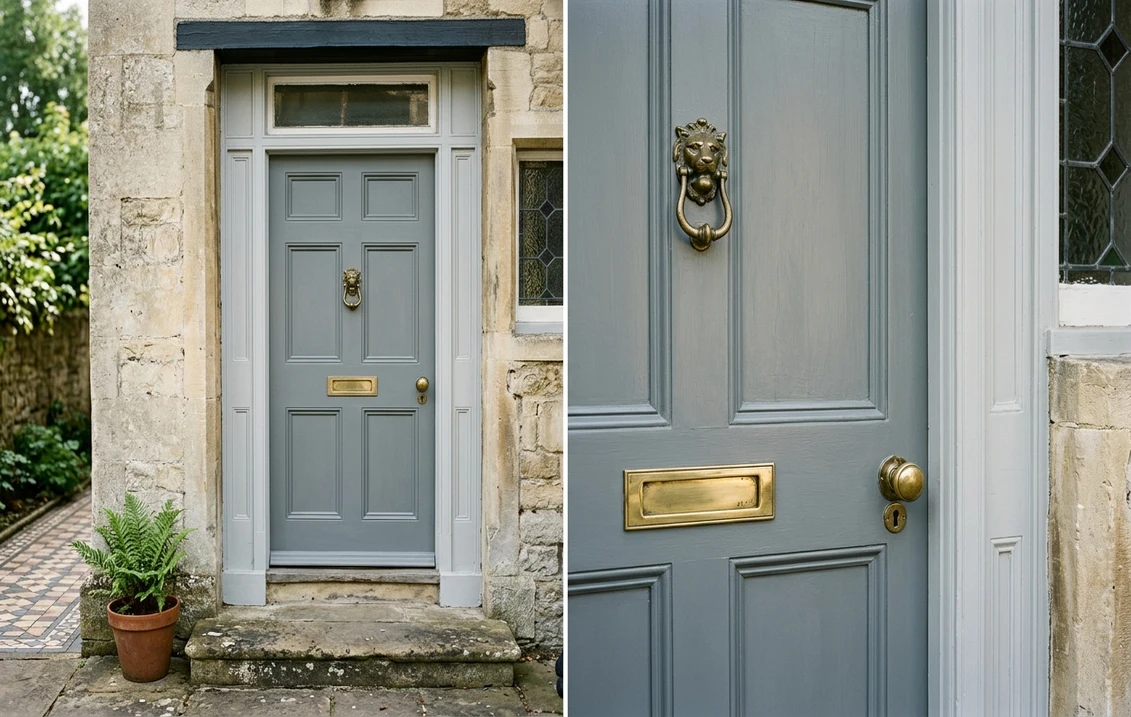
How it behaves on render, brick, stone and a door
Smooth render and stucco. This is where the colour earns its name. On a Victorian or Georgian stuccoed frontage it gives the "architectural" effect of a cool stone, and the "retains its colour in all lights" property means the bays and returns stay one colour instead of splitting into a warm face and a cold side. Keep the window surrounds and cornice in a lighter grey or off-white so that the mouldings read; Pavilion Gray or Wevet is the maker's own pairing, and a brighter white such as the whites in our Victorian exterior colour combinations guide gives a crisper, more modern contrast.
Painted brick. Only on brick that is already painted. A fair-faced brick frontage that has never been painted should stay that way, both for the building's breathability and because conservation guidance treats painting bare brick as a harmful alteration. On previously painted brick the masonry finish's 8 m² per litre figure is optimistic; a textured, porous surface drinks paint, so budget on the low side of the coverage.
Front door, windows, railings. In Exterior Eggshell the colour is a quiet alternative to the usual black or navy on a door, and it works best against pale walls: a white-rendered semi, a cream stucco terrace, a Bath or Cotswold stone frontage. On a red-brick house it reads cool against the brick, which some people want and some do not; our grey front door guide compares it with the warmer greys that flatter red brick. For railings and downpipes, keep to a near-black and let the door carry the grey.
Where it struggles. A small north-facing frontage with no direct sun, a house already shaded by trees, or a facade whose only white is a uPVC window frame. In those cases the "definite grey" has nothing to be definite against, and a lighter grey from the same family does the job with less weight.
Pairings the maker's own pages support
| Element | Colour | Why |
|---|---|---|
| Walls (render) | Manor House Gray No. 265, Exterior Masonry | The "definite grey" that holds in all lights |
| Window reveals, cornice, string course | Pavilion Gray No. 242 or Wevet | Pavilion Gray is the listed complementary white; Wevet is the contrast the colour page names |
| Sash windows | Wevet or an off-white, Exterior Eggshell | Keeps the joinery lighter than the wall, the period convention |
| Front door | Railings or Off-Black, Exterior Eggshell | A near-black door anchors a grey wall; a grey door on a grey wall disappears |
| Ironwork, downpipes | Black | The safe choice on terraces and in conservation areas |
| Pale-walled house, door only | Manor House Gray door, Exterior Eggshell | The colour's cool cleanness against cream or stone |
If you are weighing Farrow & Ball against a trade masonry paint for the walls, the Farrow & Ball vs Dulux Heritage exterior comparison sets out the price and finish differences, and the grey exterior paint shades guide puts Manor House Gray next to the Dulux Weathershield and Sandtex greys that cost a third as much.
What it costs: a worked example on a 95 m² semi
Farrow & Ball's own pages do not display a price in the text we could read, so the figure here comes from a UK stockist: Decorating Centre Online lists Farrow & Ball Exterior Masonry in the 5 litre tin at a regular price of £108.00, with a sale price from £90.00 at the time of writing (Decorating Centre Online, Farrow & Ball Exterior Masonry Paint, read 18 October 2026). Prices move; check the day you order, and remember that an Archive colour may carry a different price or lead time from a stock colour.
On the maker's "up to 8 m² per litre per coat", a 5 litre tin covers up to 40 m² per coat on a smooth, sealed render. A typical 1930s semi-detached with about 95 m² of rendered wall therefore needs about 2.4 tins per coat and 4.8 tins for two coats, so five tins, or six if the render is porous or newly repaired and drinks the first coat. At £108 that is £540 to £648 of paint for the walls alone, before primer or stabilising solution, before the door and windows in Exterior Eggshell, and before labour. For what a decorator charges to put it on, our exterior house painting cost guide gives the per-m² rates by region, and the Farrow & Ball masonry paint buyer guide covers preparation and the two-coat method the Product Advice Sheets require for the 15-year claim.
Do you need permission to paint the house grey?
For most houses, no. The Planning Portal's guidance on external walls says: "You will not need to apply for planning permission to paint or maintain the external walls", with two exceptions it spells out. "However, in some areas these rights have been removed (by way of what is known as an article 4 direction)", which is common in conservation areas, and "if your flat is a listed building you will need listed building consent, unless it is repainting in the existing colour", a rule that applies to houses in the same way (Planning Portal, external walls). Changing a cream stucco terrace to Manor House Gray is a change of colour, so on a listed house it needs consent, and in an Article 4 area it needs a planning application. The Portal's advice is to contact the local planning authority; our listed building painting rules guide explains what the officer will ask for, and a rendered preview of the grey on your own frontage is the quickest way to show them.
Before you order a made-to-order tin
- Photograph the frontage straight on, in flat daylight, and preview Manor House Gray against Pavilion Gray and a warmer grey on the same photo, so the cool bias is a decision rather than a surprise.
- Paint a sample on the shadiest elevation and the sunniest one, and look at both on an overcast day and a bright one.
- Decide the trim white from the maker's pairings (Pavilion Gray, Wevet) rather than defaulting to brilliant white.
- Measure the wall area, divide by 40 m² per tin per coat, multiply by two coats, round up, and order once.
- Check Article 4 and listing status with the council before the tins are mixed, because they cannot be returned.
Sources and references
- Farrow & Ball, Manor House Gray No. 265: the colour description quoted above, Archive status, complementary white.
- Farrow & Ball, Pavilion Gray No. 242: description of the suggested companion colour and its own complementary white.
- Farrow & Ball, Exterior Masonry and Exterior Eggshell: sheen, coverage, dry and recoat times, durability claims and their condition; Manor House Gray in Exterior Masonry: made-to-order and non-returnable notice.
- Planning Portal, external walls: painting: permitted development, Article 4 directions, listed building consent and the existing-colour exception.
- Decorating Centre Online, Farrow & Ball Exterior Masonry Paint, 5 L: UK retail price used in the worked example.
Frequently asked questions
Is Farrow & Ball Manor House Gray warm or cool?
Can Manor House Gray be used outside?
Why is Manor House Gray non-returnable?
Which white goes with Manor House Gray?
How much Manor House Gray do I need for a semi-detached house?
Do I need permission to paint my house Manor House Gray?
Trademarks mentioned (Sherwin-Williams, Benjamin Moore, Behr, Caparol, Brillux, Sto, Alpina, Valspar, PPG, Glidden, Dulux, Crown Trade, Sandtex, Farrow & Ball, Johnstone's, Leyland) are property of their respective owners. FacadeColorizer is independent and not affiliated with any of them. Nominative fair use under Lanham Act §1125.