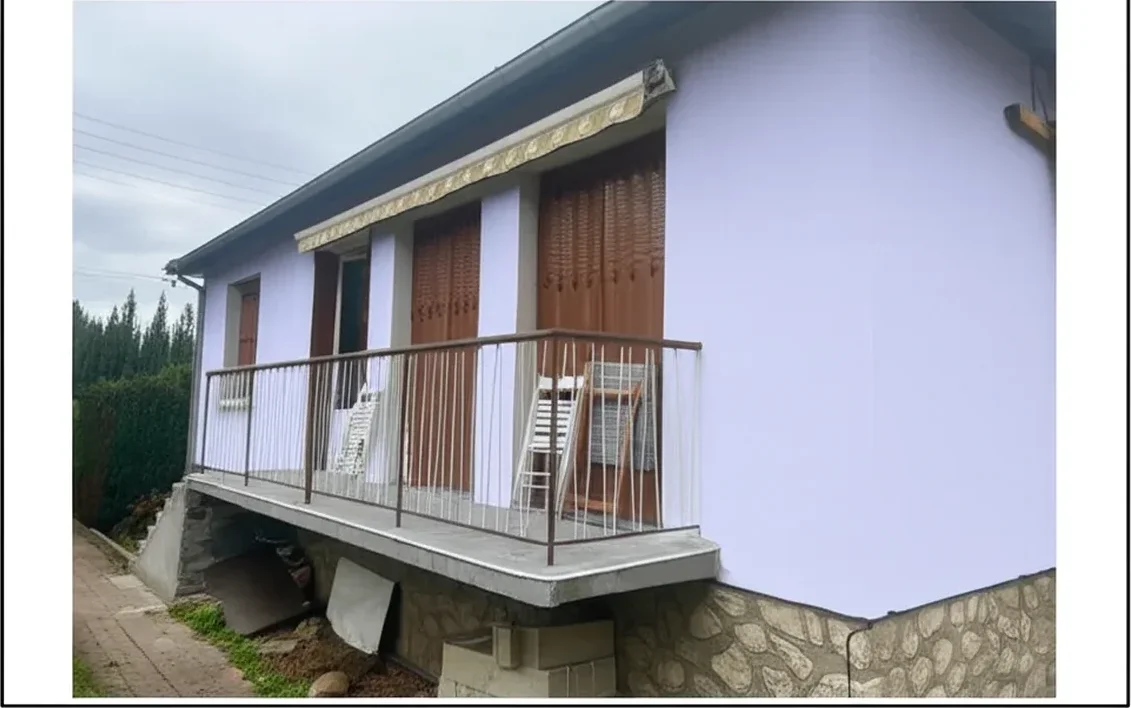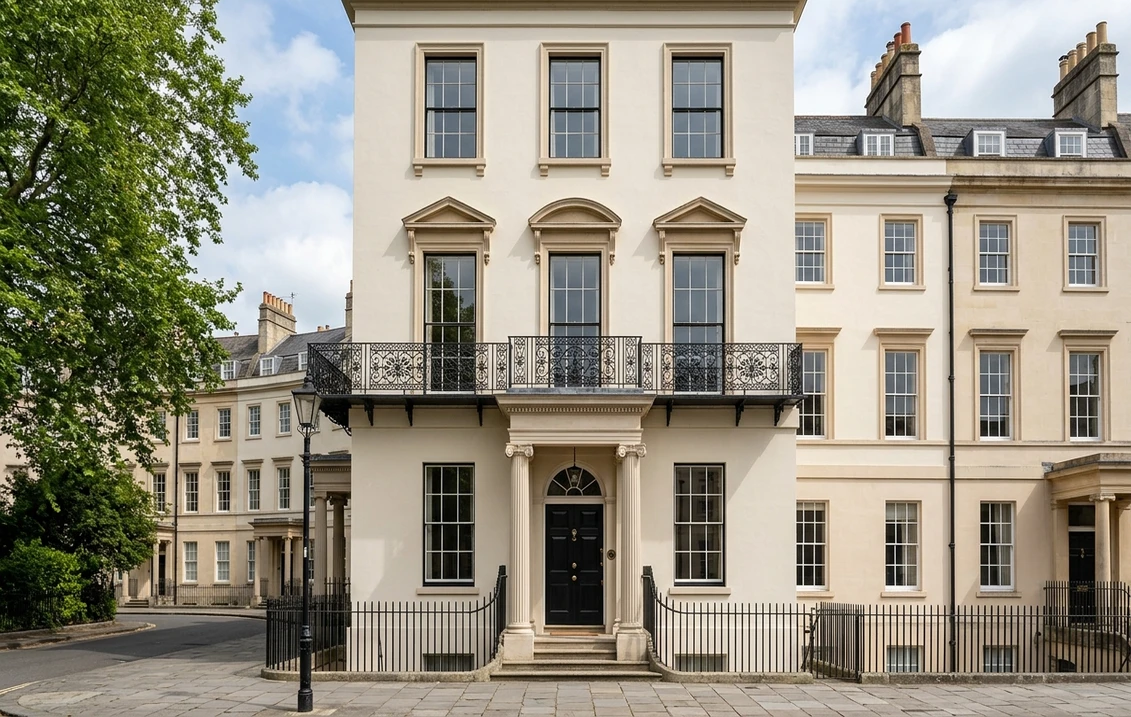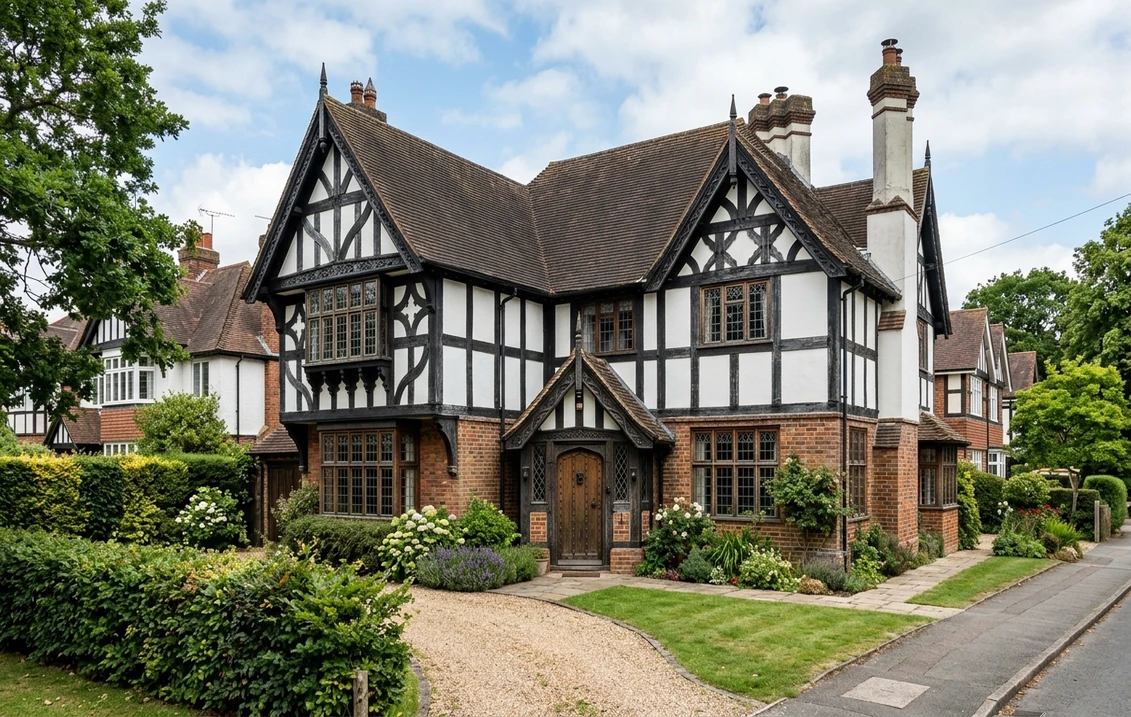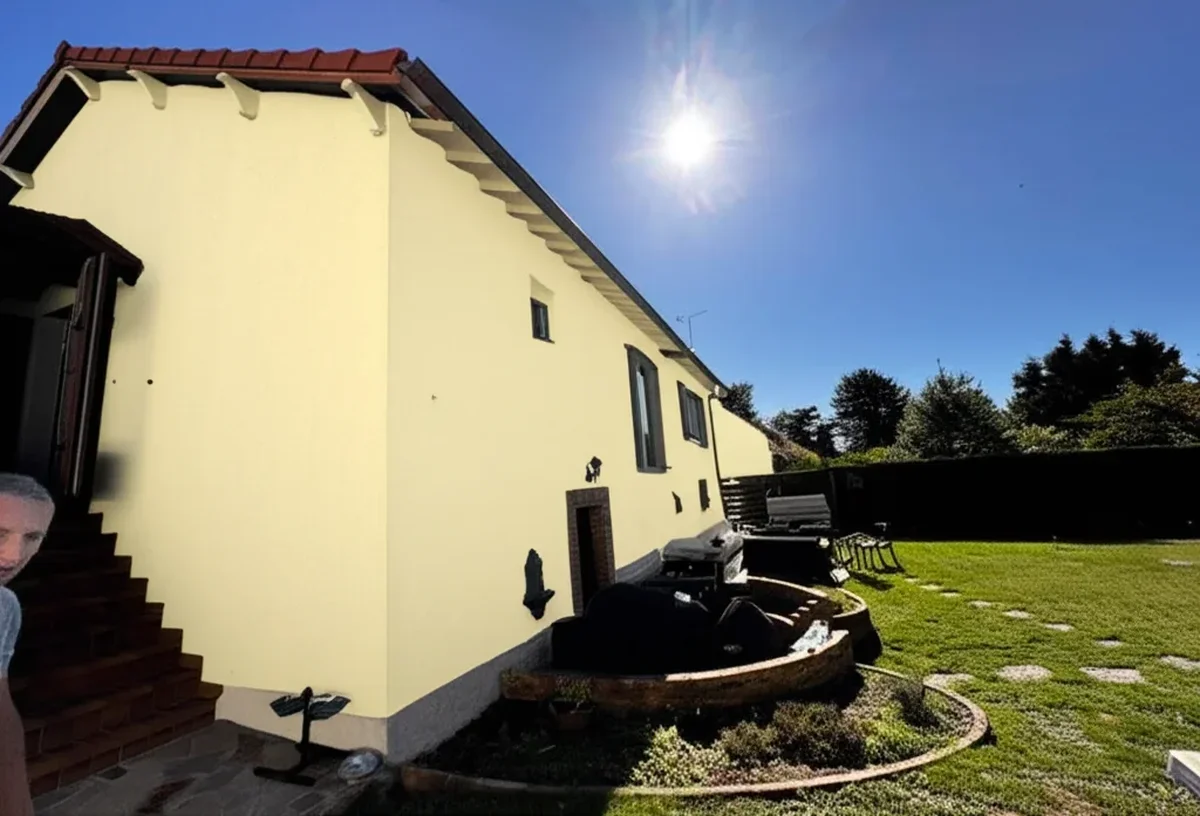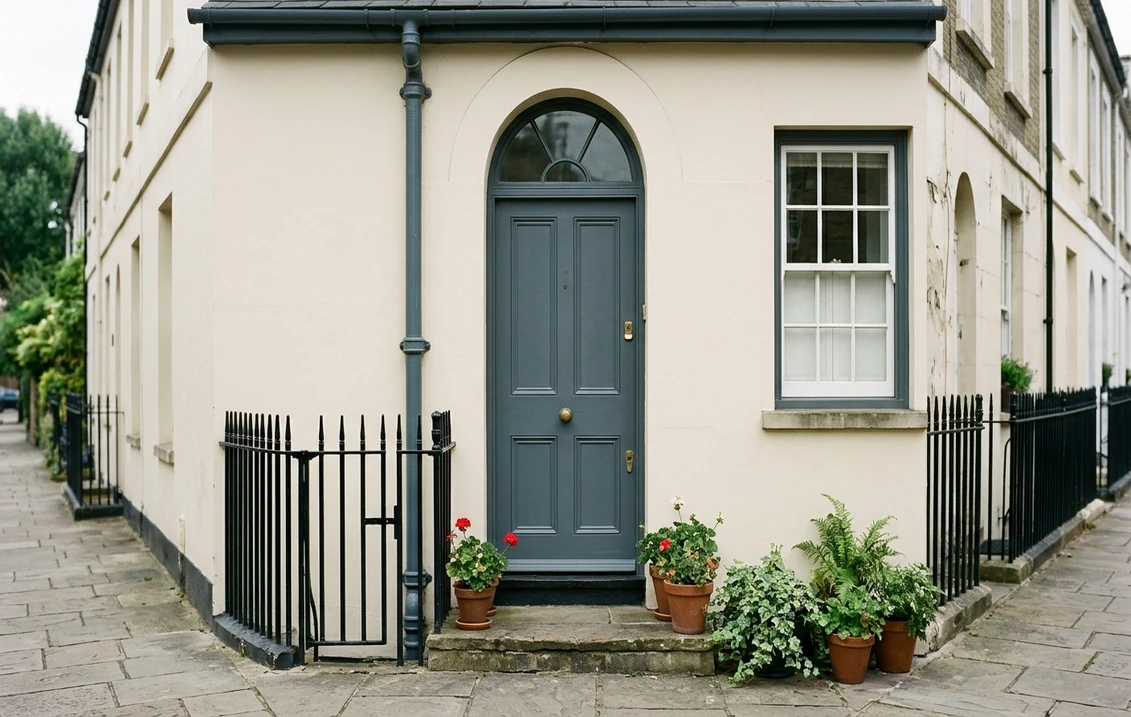
Try it on your house

Farrow & Ball Down Pipe No. 26 is a dark lead grey with a definite blue undertone, named after the colour traditionally used on downpipes and guttering. Outside a British house it belongs on front doors, sash windows, railings and rainwater goods in Exterior Eggshell (20% sheen) or Full Gloss (95%), and on render or brick in Exterior Masonry (2% sheen). At Farrow & Ball's October 2026 prices, a 750 ml tin of Exterior Eggshell in Down Pipe costs £38, enough for both faces of a typical front door, and a 5 litre tin of Exterior Masonry costs £111. Repainting a door or window frame does not usually need planning permission, but an Article 4 direction or a listed building can change that.
Everything below was read on farrow-ball.com, on its UK product advice sheets, on the Planning Portal and in council guidance in October 2026. Where Farrow & Ball does not publish a figure, such as a light reflectance value (LRV) for Down Pipe, this guide says so instead of borrowing one from a retailer or a colour database.
See Down Pipe on your own front door first
Upload a photo of your house and repaint the door, the windows or the whole frontage in Down Pipe before you order a sample pot.
Try our free colour visualiserWhat Farrow & Ball says about Down Pipe No. 26
The Down Pipe colour page is headed "A dramatic lead grey" and describes the colour as "a dark lead grey" with "definite blue undertones to it which deepen the complexity of the finish". It was "originally inspired by the colour used to paint downpipes and guttering", which is where the name comes from, before it was taken up indoors. Inside, Farrow & Ball recommends it as a background to art and for halls; outside, that same depth is why it frames an entrance so firmly without the hardness of a true black.
Three details on that page matter for an exterior job. The recommended primer and undercoat tone is Dark Tones, the darkest of the four tones Farrow & Ball tints its primers in, so the topcoat goes over a dark base rather than over white. The complementary white is Blackened No. 2011, which the company calls its coolest white. And there is no LRV on the page: Farrow & Ball does not print one for its UK colours, so any LRV you see quoted for Down Pipe comes from a third party. The on-screen swatch Farrow & Ball uses is #606565, the same value our visualiser applies; screens vary, which is why a 100 ml sample pot (£5.95) painted outdoors remains the real test. Our one-page Down Pipe colour card shows the swatch next to its usual partners.
Down Pipe next to Plummett, Hopper Head and Railings
Farrow & Ball positions four of its dark greys against each other, and the order matters when you stand on the pavement and look at a door from ten metres. Plummett is lighter, Hopper Head sits one step darker, and Railings is the near-black. The swatch values below are Farrow & Ball's own web swatches: approximate digital renderings, not paint specifications.
| Colour | How Farrow & Ball describes it | Web swatch | Outside, choose it when |
|---|---|---|---|
| Plummett No. 272 | "A lighter lead", a "strong architectural grey" named after the lead anglers use to weight their lines | #8C8E8D | You like the lead-grey look but want a lighter door or window frames on a small or north-facing frontage |
| Down Pipe No. 26 | "A dramatic lead grey" with "definite blue undertones" | #606565 | The classic: front doors, sashes, railings and rainwater goods on pale render or stone |
| Hopper Head No. 305 | "A classic charcoal" that sits "between the ever-popular Railings and Down Pipe", named after the iron hoppers that catch rainwater at the top of a downpipe | #505456 | You want a step darker than Down Pipe without going to black |
| Railings No. 31 | "A soft black with blue undertones", "more blue than black" | #45494C | Ironwork and a near-black front door, especially in Full Gloss |
Try it on your house
No photo? Try a sample
If you want darkness without the blue cast that all four share, Farrow & Ball describes Off-Black No. 57 as having "less of the underlying cool blue of Railings or Black Blue". That difference shows most against warm red brick, where a blue-grey door reads cooler than it does on a cream or white wall. The black front door guide covers the near-blacks from other brands if Railings and Off-Black both feel too strong or too soft.
Where Down Pipe works on a British house
Front doors
This is the most common use, and the easiest to get right. On a white or cream rendered house, a 1930s semi or a Victorian stucco terrace, Down Pipe gives a firm, dark entrance that looks deliberate rather than severe. On London stock brick or red brick, the blue undertone is more visible, which some people want and some do not: paint a sample board and hold it against the brick at midday and at dusk. Our grey front door guide sets Down Pipe against Dulux, Sandtex and Crown greys if you would rather buy a trade gloss, and the front door colours guide matches colours to house types.
Sash windows, frames and joinery
Down Pipe on window frames, fascias and a porch canopy makes a pale house look sharper, and it hides the grime that collects on white sills. There is one caution, printed in the Exterior Eggshell product advice sheet: changing exterior woodwork from light to dark "will greatly increase the amount of heat it absorbs from the sun", which can release resin and warp large items such as garage doors. For a significant colour change on wood in direct sunlight, Farrow & Ball suggests a colour with an LRV above 55. It does not publish Down Pipe's LRV, but it calls the colour a "daringly dark hue" and gives it the Dark Tones primer, so treat it as one of the shades that warning is about. A south-facing timber door or a large timber garage door is where to think twice.
Railings, gutters, downpipes and hopper heads
This is where the name comes from. Farrow & Ball's Metal Primer & Undercoat is described as "a rust inhibiting primer for all bare ferrous metal surfaces", designed for "gates, railings, furniture, radiators and metal downpipes" before Exterior Eggshell or Full Gloss. Two exceptions are in the advice sheet. On cast iron, the company recommends "a specialist primer (usually solvent based)", because water-based primers "may lead to flash rusting"; on ferrous metal in harsh settings such as coastal areas, it suggests a specialist metal primer. Plastic rainwater goods count as a difficult surface: the sheet asks for degreasing, a light abrasion, a specialist adhesion primer, then Wood Primer & Undercoat and two topcoats.
Whole elevations in Exterior Masonry
A whole rendered house in Down Pipe is a strong statement, more common on a detached modern house than in a terrace, where it stands out from its neighbours. The Exterior Masonry advice sheet gives the finish Class I water vapour permeability (sd 0.101 m) and says it does not require a primer, but it is only for surfaces with a pH below 10: lime render and walls with a silicate or mineral paint need a specialist finish instead. If you want a grey frontage that is less dark, the Manor House Gray exterior guide covers the mid grey Farrow & Ball uses as trim in Down Pipe's own scheme, and the Farrow & Ball masonry paint guide compares the wider exterior palette.
Exterior Eggshell, Full Gloss or Exterior Masonry: which finish where
Down Pipe is sold in all three exterior finishes. The figures below come from Farrow & Ball's finish pages for Exterior Eggshell, Full Gloss and Exterior Masonry; the prices are the ones listed for Down Pipe on farrow-ball.com in October 2026.
| Finish | Sheen | Surfaces listed | Coverage per coat | Dry / recoat | Lasts up to | Down Pipe price |
|---|---|---|---|---|---|---|
| Exterior Eggshell | 20% | Wood, metal, front doors, cladding, fences (not pressure-treated or tanalised) | Up to 13 m²/l | 2 h / 4 h | 6 years | £38 (750 ml), £91 (2.5 l) |
| Full Gloss | 95% | Interior and exterior wood and metal, front doors | Up to 12 m²/l | 2 h / 4 h | 6 years outside | £35 (750 ml), £85 (2.5 l) |
| Exterior Masonry | 2% | Brick, render, concrete, terracotta | Up to 8 m²/l | 2 h / 5 h | 15 years | £111 (5 l) |
Farrow & Ball notes that "sheen always affects how colour appears: the same shade in gloss can look very different in matt", and adjusts the formula of each finish. In practice, Down Pipe in Exterior Eggshell shows the colour evenly and forgives an old door with filled dents; Full Gloss reflects sky and street and makes a well-prepared panelled door look formal, but it shows every flaw underneath. One small inconsistency: the brand's paint quantity calculator gives Exterior Masonry a 4 hour recoat time, while the finish page and the advice sheet say 5 hours. Use the longer figure, especially on a cool day.
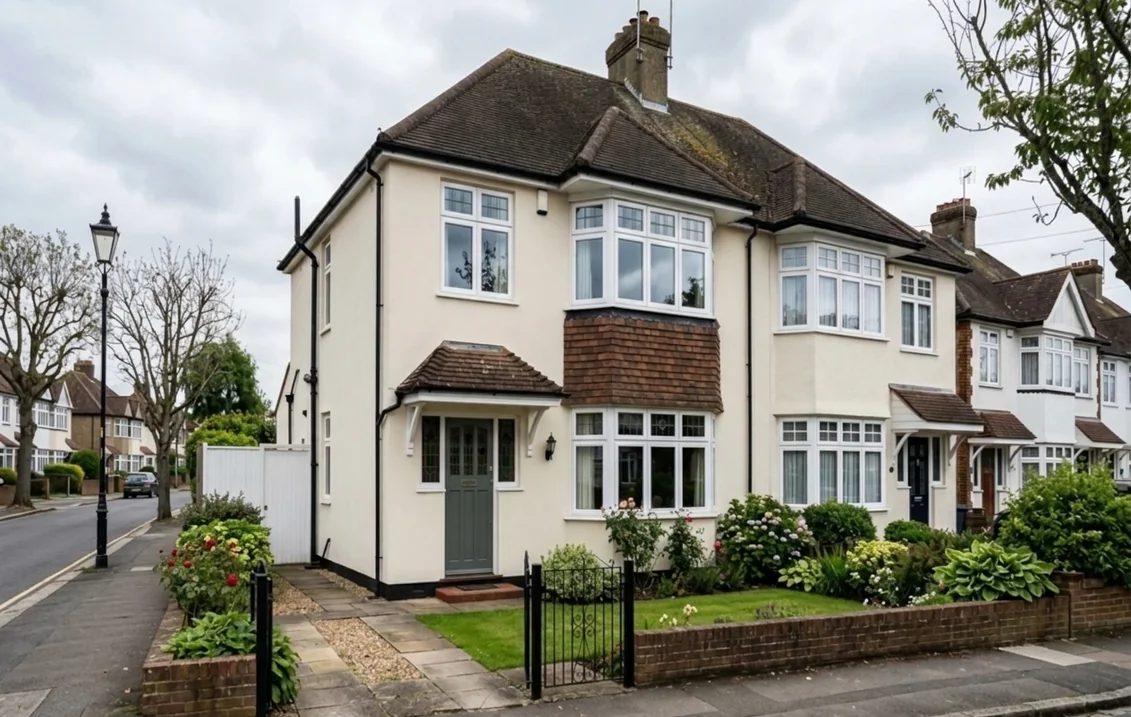
How much Down Pipe do you need? Three worked examples
Farrow & Ball recommends one coat of primer and undercoat followed by two coats of topcoat, and its coverage figures are maxima: rough, porous or weathered surfaces use more. The examples below use the "up to" figures, so treat the result as the least you will need.
| Job | Area per coat | Two coats | Paint at maximum coverage | What to buy |
|---|---|---|---|---|
| Front door, 1981 x 838 mm leaf, both faces plus edges and frame | About 4 m² | 8 m² | 0.62 l of Exterior Eggshell (13 m²/l) | One 750 ml tin, £38 |
| 6 m of 75 mm round downpipe plus 10 m of 115 mm half-round gutter (outer face) | 1.4 m² + 1.8 m² = 3.2 m² | 6.4 m² | 0.5 l of Exterior Eggshell | One 750 ml tin, £38, plus the right metal primer |
| Rendered front elevation, 40 m² after windows and door | 40 m² | 80 m² | 10 l of Exterior Masonry (8 m²/l) | Two 5 l tins, £222 |
The door figure is simple arithmetic: a 1981 x 838 mm leaf (6 ft 6 in by 2 ft 9 in, a common UK size) is 1.66 m² per face, so both faces come to 3.3 m² before edges and frame. A 75 mm downpipe has a circumference of about 0.24 m, so each metre of pipe is roughly a quarter of a square metre. For the render, Farrow & Ball says Exterior Masonry needs no primer on sound masonry; its 5 litre Masonry & Plaster Stabilising Primer (£56) is for patch-priming repaired or powdery areas only, and the advice sheet says not to use it as a general primer. Darker colours "may require additional coats", so keep a little in reserve for touching in.
When to paint: the conditions on the advice sheet
The UK advice sheets are precise about weather. Do not paint below 10°C or above 30°C, avoid direct sunlight and any likelihood of rain, and start early in the day so the paint dries before evening condensation. The surface must be at least 3°C above the dew point, and the ideal relative humidity is 40 to 80%. Application should follow Annex C of BS 6150, the British code of practice for painting buildings. That rules out a good share of British winter days, so a door or rainwater-goods repaint is usually planned between late spring and early autumn.
Two further points apply to a dark colour like Down Pipe. Farrow & Ball warns that "some darker paint colours will take up to 14 days to achieve full hardness, strength and durability", so close a freshly painted door gently and keep draught brushes and doormats from rubbing it for the first fortnight. And on old houses, the sheet asks for special precautions when preparing paint surfaces from before 1990, which may contain lead: no dry sanding of old layers without checking first.
Planning permission, Article 4 directions and listed buildings
For most houses, the answer is reassuring. The Planning Portal's guidance on doors and windows lists "repairs, maintenance, and minor improvements, such as repainting window and door frames" among the works that do not usually need planning permission. Three situations change that.
- An Article 4 direction. The Planning Portal explains that a council can withdraw permitted development rights where "the character of an area of acknowledged importance would be threatened", and that such directions "are most common in conservation areas". Richmond upon Thames Council's guide to Article 4 directions lists "new doors and windows, painting and rendering of brickwork" among the changes a direction can bring under control, adds that this "does not mean that planning permission would always be refused", and advises talking to the conservation officer first.
- A listed building. The Planning Portal says listed building consent is needed "for any significant works, internal or external". Councils read colour changes differently. Babergh District Council, for example, states that you do not need consent to change the external colour of a listed building or its windows and doors, unless you change the finish from limewash to masonry paint, paint a surface that has not been painted before, or change a colour in a way that affects the building's special interest or character. Ask your own council before you buy paint.
- A leasehold flat. The Planning Portal reminds leaseholders that they may first need permission from the landlord or management company.
Down Pipe on a door or on rainwater goods is in keeping with a long tradition of dark painted joinery and ironwork, but being a traditional colour does not make it pre-approved: each council, and often each conservation area, sets its own expectations and decides case by case. The riskiest move is Exterior Masonry on brick that has never been painted, which both councils quoted above single out. Our listed building painting rules guide explains how to make an application and what officers look at.
Colours that go with Down Pipe outside
Farrow & Ball publishes three colour schemes on the Down Pipe page, each with an accent and a trim colour: Pavilion Gray No. 242 with Manor House Gray No. 265; Plummett No. 272 with Hopper Head No. 305; and Blackened No. 2011 with Cornforth White No. 228. The pairing also works the other way round: the Pavilion Gray page uses Down Pipe as the accent with Railings as trim, and the Blackened page pairs it with Plummett. Translated to a house front, that gives three reliable combinations:
- Light walls, dark details. Cream or white render, Blackened or Cornforth White window frames, Down Pipe on the door, railings and rainwater goods. The visualiser image in this guide shows the first step of it, with only the door repainted, and it is the safest choice on a period street.
- Tonal greys. Pavilion Gray masonry, Manor House Gray windows and a Down Pipe door: three greys of the same family, which suits a modern or a rendered Edwardian house.
- Dark and darker. Down Pipe joinery with Hopper Head or Railings on ironwork, over pale stone or white render. The contrast between the two darks is subtle, so it reads as one confident dark colour from the street.
For brick houses, test before committing: a cool blue-grey next to warm red brick can look either crisp or cold depending on the light. The pillar guide to the best exterior paint colours for UK homes places Down Pipe among the other heritage and modern options if you are still choosing the main wall colour.
Compare Down Pipe, Plummett and Railings on your house
Upload one photo and switch the door or the window frames between the three greys in seconds, then order samples of the one that works.
Try Down Pipe on my house photoSources and references
- Farrow & Ball, Down Pipe No. 26 colour page: description, name origin, Dark Tones primer, Blackened as complementary white, three colour schemes, prices per finish.
- Farrow & Ball, colour pages for Plummett, Hopper Head, Railings, Off-Black and Pavilion Gray: descriptions and schemes used in the comparison table.
- Farrow & Ball, finish pages for Exterior Eggshell, Full Gloss and Exterior Masonry, and the paint quantity calculator: sheen, coverage, tin sizes, drying and recoat times, durability.
- Farrow & Ball, UK product advice sheets for Exterior Eggshell and Exterior Masonry, and the Metal Primer & Undercoat page: heat warning for dark colours on wood, cast iron and PVC preparation, application temperatures, curing time, breathability and pH limits.
- Planning Portal, Doors and windows: planning permission and Permitted development rights: repainting as minor works, listed building consent, designated areas, Article 4 directions.
- London Borough of Richmond upon Thames, What is an Article 4 Direction?: the changes a direction can control, including painting and new doors.
- Babergh District Council, Change the colour of a listed building: when a colour change needs listed building consent.
Frequently asked questions
Can Farrow & Ball Down Pipe be used outside?
Is Down Pipe grey or blue?
What is the difference between Down Pipe and Railings?
Do I need permission to paint my front door Down Pipe?
How much does Farrow & Ball Down Pipe exterior paint cost?
What white goes with Down Pipe?
Trademarks mentioned (Sherwin-Williams, Benjamin Moore, Behr, Caparol, Brillux, Sto, Alpina, Valspar, PPG, Glidden, Dulux, Crown Trade, Sandtex, Farrow & Ball, Johnstone's, Leyland) are property of their respective owners. FacadeColorizer is independent and not affiliated with any of them. Nominative fair use under Lanham Act §1125.