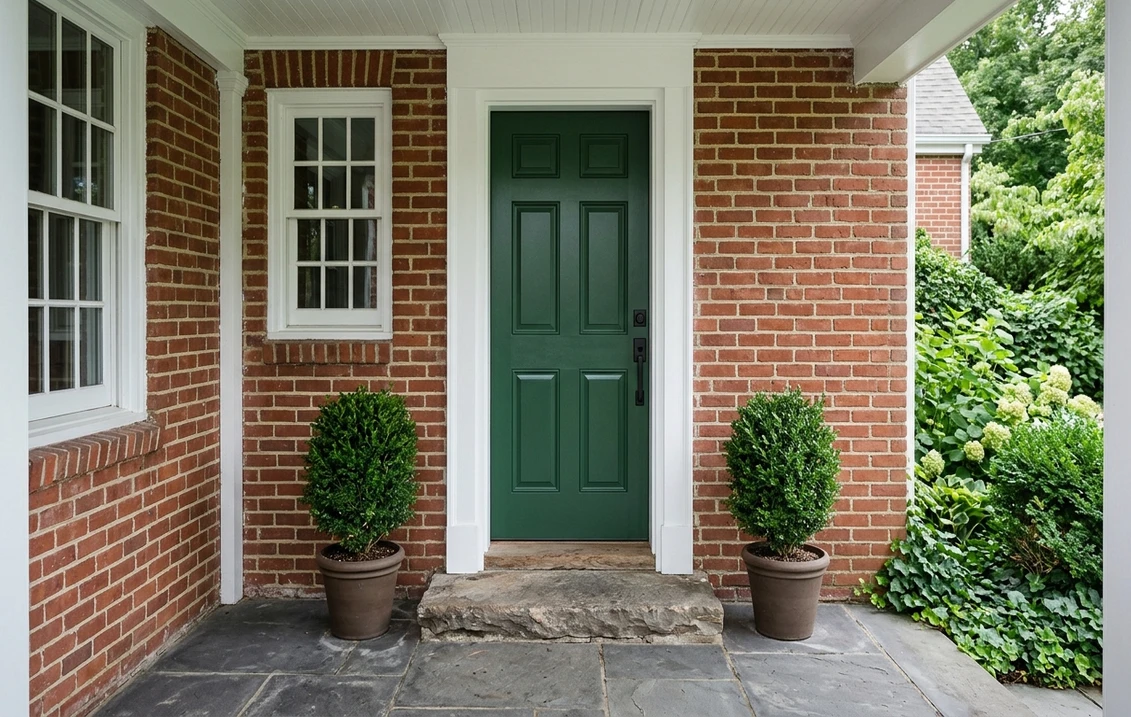

The right paint for a steel front door is a high-quality exterior paint, either 100% acrylic latex or oil-based, applied over the factory primer after cleaning and a light scuff-sanding. That is what door makers themselves specify: Masonite asks for exterior oil-based or 100% acrylic water-based paint and rules out lacquer, and Clopay says its steel doors take most high-quality exterior acrylic latex or oil paints, in at least two coats. What changes from one brand to the next is the prep (solvent or no solvent, which grit), the deadline for painting a new door to keep the warranty, and a few parts you must leave unpainted.
This guide gathers the instructions published by two door manufacturers, the brushing method described by Fine Homebuilding, and the federal lead rules that apply to older houses. Product names and color advice beyond those sources are our recommendations. Always read the finishing sheet of your own door first: if it disagrees with this guide, the door maker wins, because its warranty depends on it.
Upload one photo of your entry and preview door colors before you buy a quart.
Which paint works on a steel entry door
Most steel entry doors leave the factory with a baked-on primer. Your topcoat goes over that primer, so the question is less "what sticks to metal" than "what bonds to the primer and survives sun, rain and hands." Both manufacturers we read give the same answer: a quality exterior paint, acrylic or oil.
| Paint type | Allowed on steel doors? | Practical notes |
|---|---|---|
| Exterior 100% acrylic latex | Yes (Masonite and Clopay) | Easy cleanup with water, flexible, holds color well; the default choice for most homeowners |
| Exterior oil-based (alkyd) | Yes (Masonite and Clopay) | Levels into a very smooth, hard finish; slower to dry; Masonite says not to use oil paint on the wood frame parts |
| Interior paint | Inside face only (Masonite) | Never on the weather side |
| Lacquer | No (Masonite) | Clopay also says not to use lacquer thinner on the door |
| Semi-transparent stain | Not recommended (Masonite) | Stain belongs on wood-grain fiberglass, not on smooth steel |
Try it on your house
- 1Your photoPhoto
- 2Your colorColor
- 3HD render in ~30 sHD render in ~30 s
Your photo is used only to create your preview. JPG, PNG, HEIC (iPhone)
For sheen, satin and semi-gloss are the usual choices on an entry door: they wipe clean and show the panel profiles. High gloss looks striking but shows every brush mark and dent in steel. Our Sherwin-Williams front door colors guide and the SnapDry door and trim paint review cover specific products made for doors.
Prep: the step that decides whether the paint lasts
Paint fails on steel doors for one main reason: it was applied over dirt, grease or a glossy surface it could not grip. Doors collect hand oils around the handle, kitchen grease, dust from installation and shipping residue. The two manufacturers we read prepare the surface differently, which is exactly why you must follow your own door's sheet.
| Step | Masonite (steel doors) | Clopay (steel and fiberglass) |
|---|---|---|
| Cleaning | Wipe with a solvent such as mineral spirits and let it dry until there is no odor | Wipe with a damp cloth; do not use solvents or lacquer thinner |
| Sanding | Light sanding with 220-grit | Pre-sand smooth doors with 600-grit for a uniform surface |
| Washing | Wash with mild detergent in warm water, rinse, dry | Let the surface dry fully before painting |
| Masking | Mask all glass and anything not to be painted | Mask glass and hardware |
| Do not paint | Follow the sheet for frame parts (no oil paint on wood frame components) | The flexible door sweep, the threshold and the aluminum sill plate |
Fine Homebuilding's step-by-step guide by Andy Engel adds a useful trick: clean with window cleaner, which evaporates without leaving residue, then scuff the surface with a fine synthetic steel-wool pad rather than real steel wool, which sheds sharp metal fibers. The article notes that the fine maroon pads are unlikely to cut through the factory primer. Whatever you use, stop the moment you see bare metal: on exposed steel, spot-prime with a metal primer before painting, or rust will creep under the new coat.
Remove the door or paint it in place?
Both manufacturers prefer the door off its hinges and laid flat. Clopay asks to remove it and place it on a flat, level surface off the floor; Masonite recommends removing it and explains how to drive out the hinge pins. Fine Homebuilding's author also lays doors flat: drips and sags are less likely, and there is no risk of spilling on the entry floor. Sidelites are the exception: they stay in the frame and are painted vertically.
Painting in place is possible for a simple refresh, but use thin coats, brush out runs at the bottom of each panel, and keep the door propped open until it is dry enough not to stick to the weatherstripping.
The brushing order that makes a steel door look like wood
Fine Homebuilding's key point is that brush marks should follow the direction the grain would run if the door were wood. On a six-panel door, that means this order:
- Panel moldings first, brushing along the long direction of each edge.
- Panel ends, with short strokes along the length of the panel, never across it.
- Panel centers, with long strokes toward the ends you just painted.
- Center stiles (the vertical parts between panels), brushing up and down.
- Rails (the horizontal parts), brushing across, and blending the overlaps before they set.
- Outer stiles and edges, in long sweeping strokes, passing straight over the lock holes.
Do not let overlaps dry before you brush them out, or you will see lap marks. Masonite lists a 2-1/2 inch brush, with natural bristle for oil-based paint and synthetic bristle for latex. Apply at least two coats, as Clopay asks, and respect the recoat time on the can.
Repainting a door that is already painted
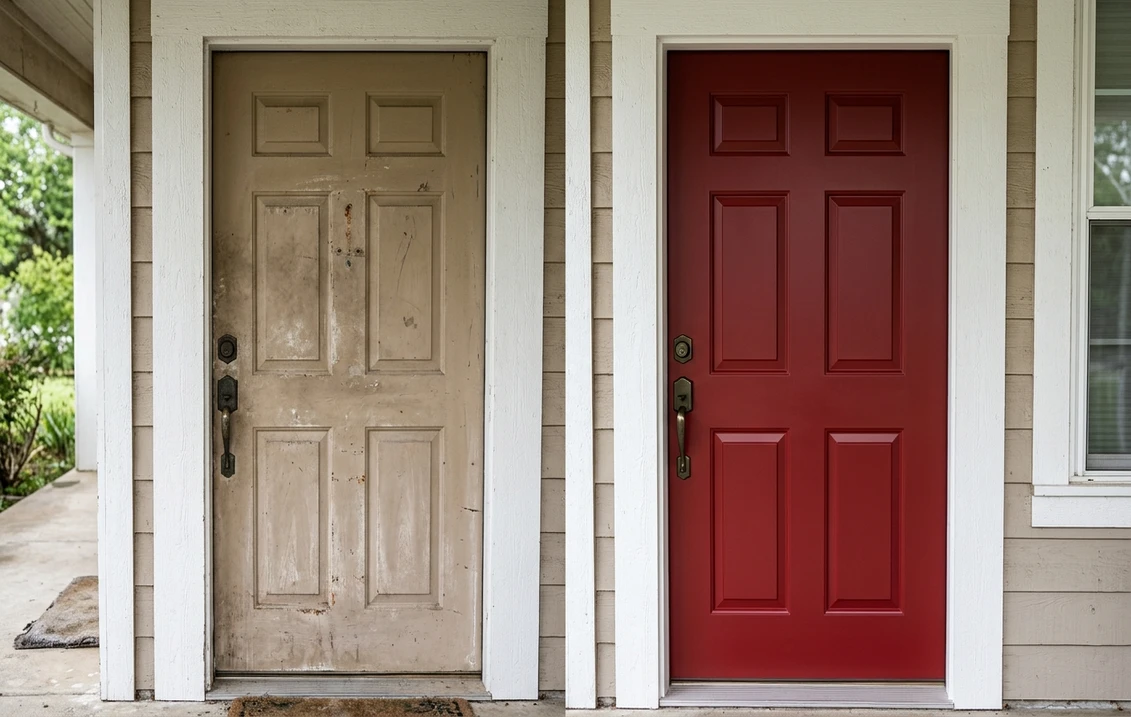
Most steel doors you repaint are not new: they carry one or more coats of old paint, sometimes of an unknown type. The method above still applies, with three extra checks.
- Check adhesion. Press a strip of painter's tape firmly onto the old paint and pull it off quickly. If paint comes away with the tape, the old coat is not sound: scrape and sand those areas back to a firm edge before painting.
- Find out what is on the door. Rub a small area with a cotton pad dampened with rubbing alcohol. Latex paint usually softens and transfers color; oil-based paint usually does not. Going from oil to latex over glossy old paint needs a thorough scuff-sand and, if the paint label asks for it, a bonding primer.
- Dull the gloss. New paint grips a matte, scuffed surface far better than a slick one. Sand until the whole door looks evenly dull, then wipe off all dust.
If the old finish is peeling widely, cracked or built up in thick layers around the panels, removing it with a chemical stripper made for metal doors is sometimes faster than sanding. Follow the stripper's instructions, neutralize and rinse as directed, and prime the bare steel the same day so it does not flash-rust.
Dents, scratches and rust spots
Steel doors dent, and a fresh coat of paint, especially in satin or gloss, makes dents more visible. Small dents can be filled with a two-part body filler or an epoxy filler made for metal, sanded flush and spot-primed. Deep creases are hard to hide; a darker color and a lower sheen help.
Rust usually starts at the bottom edge, around the lockset and where the paint has been chipped. Sand rust spots back to bright metal, remove the dust, and apply a rust-inhibiting metal primer before the topcoat. If rust has eaten through the skin of the door, painting will not fix it: the slab needs repair or replacement.
Hardware, glass and weatherstripping
- Remove hardware rather than taping around it: the result is cleaner and you can paint the lock edge properly.
- Mask glass with painter's tape, as both manufacturers ask, and pull the tape while the paint is still slightly soft to avoid tearing the edge.
- Leave weatherstripping, the sweep and the threshold unpainted; paint stiffens rubber and stops it sealing.
- Let the paint harden before closing the door tightly. Fresh paint can stick to weatherstripping; wait at least overnight, longer in cool weather, and follow the cure time on the label.
Temperature and timing
Masonite recommends painting between 50 and 90°F (10 to 32°C) in a well-lit, dust-free, ventilated place. Fine Homebuilding warns that direct sun or heat makes paint dry too fast to blend brush marks, and that cold makes it harder to spread and can stop it from curing properly if the temperature falls below the product's minimum. Painting a door that sits in full afternoon sun is the most common cause of visible lap marks: wait until the door is in shade.
New doors have a deadline. Masonite's guide asks you to paint the door, frame, header and brickmould within 45 days of installation to keep warranty coverage, and to paint all exposed surfaces. Clopay states that unfinished doors must be completely painted or stained within one month of purchase and before installation, or the warranty may be void. Masonite also expects repainting every 1 to 7 years depending on weather exposure: a door facing south or west without a porch roof sits at the short end of that range.
Choosing a color for a steel door
Steel doors take any color, but the color should agree with the fixed elements around them: siding, brick, roof and trim. Deep colors with some gray or black in them (navy, forest green, oxblood, charcoal) look the most like painted wood and hide fingerprints. Very dark colors on a door in full sun get hot to the touch; if your door is unshaded and faces south or west, read your manufacturer's sheet for any limit on dark colors and consider a mid-tone.
| House color | Door directions that work | Why |
|---|---|---|
| Gray or greige siding | Navy, deep red, black, deep green | A saturated door gives a neutral facade a focal point |
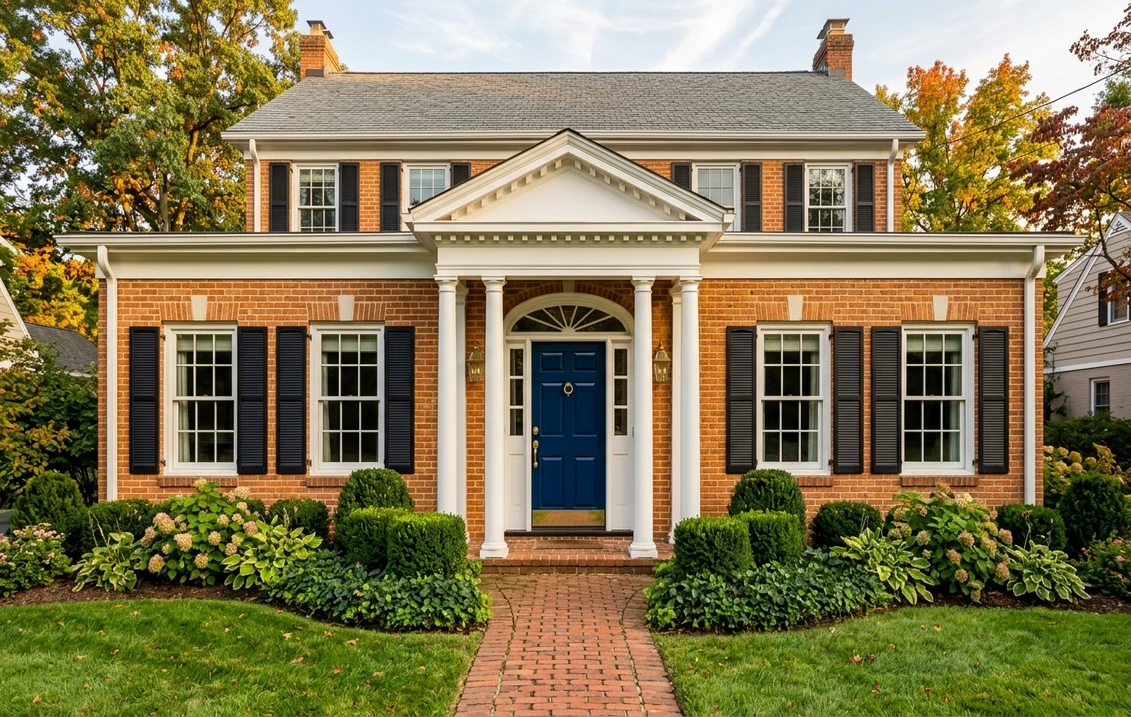
| Red brick | Black, deep green, navy, warm white | Avoid a red that competes with the brick |
| White or cream siding | Almost any deep color; also natural-looking wood tones | The contrast lets the door lead |
| Navy or dark siding | Yellow, coral, warm wood tone, glossy black | A lighter or warmer door stays visible against dark walls |
For ideas by house color, see our guides to front door colors for a gray house, front door colors for a red brick house, a red door on a gray house and a yellow door on a navy house. If you are drawn to heritage shades, our Farrow & Ball Railings guide covers a near-black blue often used on doors.
See navy, green, red or black on your actual door before you open a can.
Older houses: lead on the door frame
The steel slab itself is usually recent, but the frame, brickmould and surrounding trim on an older house may carry decades of paint. Under the US Environmental Protection Agency's Lead Renovation, Repair and Painting (RRP) Program, paid contractors who disturb painted surfaces in homes built before 1978 must be certified and follow lead-safe work practices. If you sand or scrape the frame yourself, test it first, avoid dry sanding and power sanding without HEPA dust collection, and collect chips on plastic sheeting.
Quick checklist
- Read your door maker's finishing sheet and note its paint types, prep and deadline.
- Buy a quality exterior 100% acrylic or oil-based paint in satin or semi-gloss; no lacquer.
- Remove hardware, take the door down if you can, lay it flat on sawhorses.
- Clean, scuff-sand lightly, dust off; spot-prime any bare steel.
- Brush in the order of a wood door, two coats, in shade, between about 50 and 90°F.
- Leave the sweep, threshold and sill unpainted; let the paint dry before rehanging.
Sources and references
- Masonite, How to Paint Steel and Fiberglass Entry Systems (manufacturer guide, 2017, hosted by Lowe's): paint types, mineral-spirits cleaning, 220-grit sanding, 50 to 90°F, brushes, 45-day painting deadline, repainting every 1 to 7 years.
- Clopay, Finishing Instructions, Fiberglass and Steel Entry Door Systems: acrylic or oil exterior paint, no solvents, 600-grit pre-sanding, two coats, one-month deadline, parts not to paint.
- Fine Homebuilding, Brush-Painting a Steel Door (Andy Engel): cleaning, synthetic steel wool, brushing order, temperature advice.
- US Environmental Protection Agency, Lead Renovation, Repair and Painting Program: rules for disturbing paint in pre-1978 homes.
Frequently asked questions
What kind of paint do you use on a steel front door?
Do I need to prime a steel door before painting?
How do you prep a steel door for paint?
How soon must a new steel door be painted?
How do you avoid brush marks on a steel door?
Trademarks mentioned (Sherwin-Williams, Benjamin Moore, Behr, Caparol, Brillux, Sto, Alpina, Valspar, PPG, Glidden, Dulux, Crown Trade, Sandtex, Farrow & Ball, Johnstone's, Leyland) are property of their respective owners. FacadeColorizer is independent and not affiliated with any of them. Nominative fair use under Lanham Act §1125.