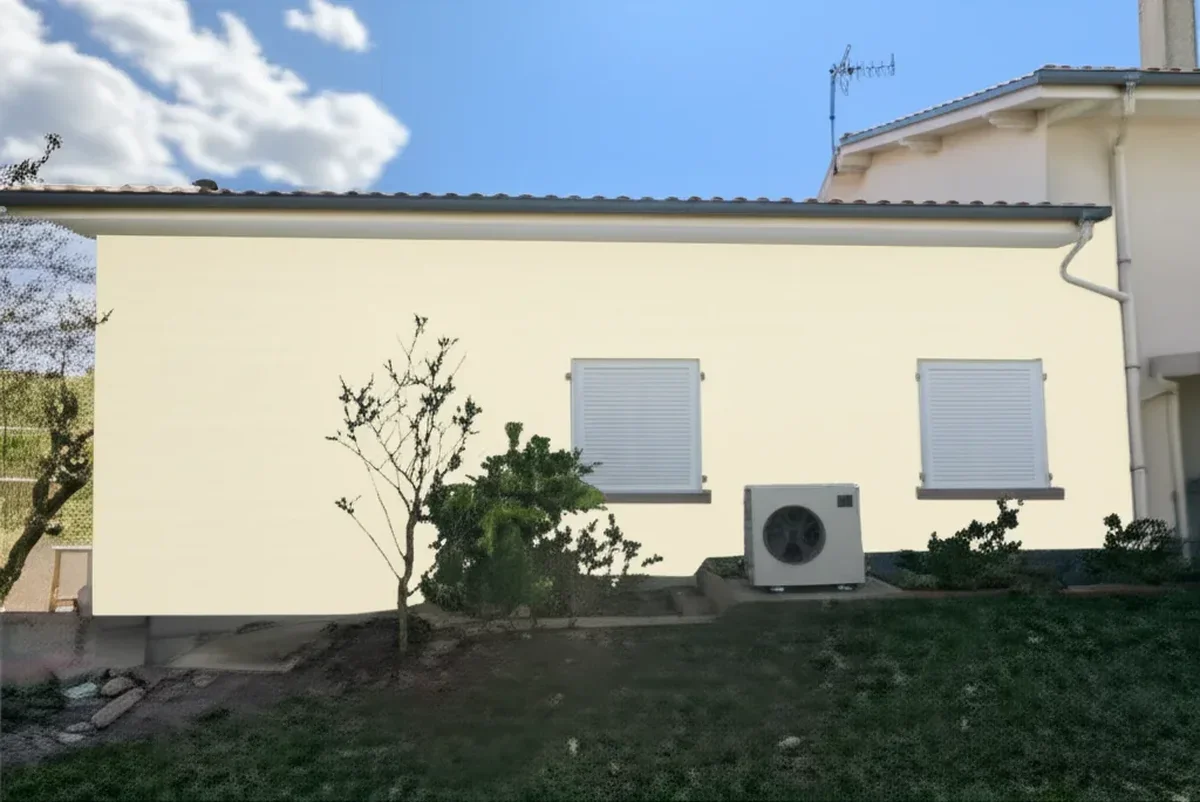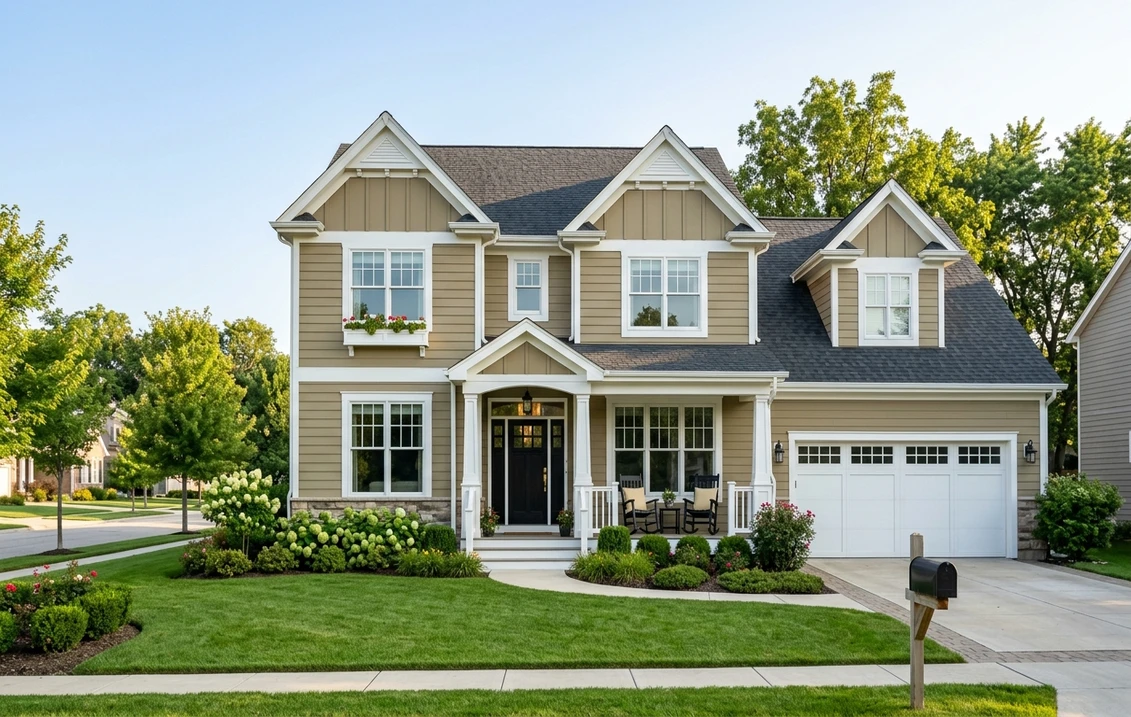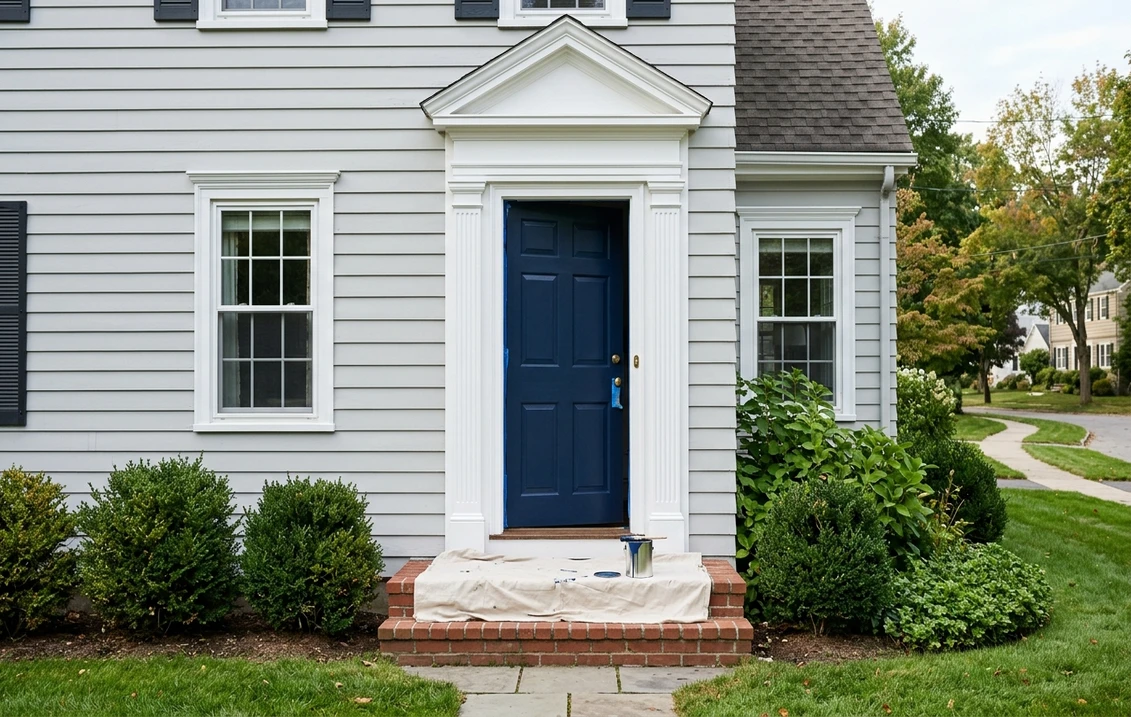
Try it on your house

Sherwin-Williams makes two paints designed for doors and trim, and both work outside: SnapDry Door & Trim Paint, an acrylic latex that is dry to the touch in 1 hour, recoats in 2 hours and lets you close a front door the same day, and Emerald Urethane Trim Enamel, a waterbased urethane modified alkyd with the look of an oil enamel that needs 4 hours between coats. Both cover 350 to 400 sq ft per gallon, stay under 50 g/L of VOC, come in quarts and carry a lifetime limited warranty. Pick SnapDry when the door has to close tonight or for vinyl shutters in a VinylSafe color; pick Emerald Urethane for the hardest, glossiest finish on wood or metal doors and trim. Both need at least 50°F: for trim painted in late fall or along with the siding, Emerald Exterior in Gloss goes on down to 35°F.
How this comparison works: every figure comes from Sherwin-Williams data sheets and product pages read on October 28, 2026, and from the references cited in each section. Calculations are ours and labeled as such. No paint was applied for this page.
Opens the exterior tool with the Sherwin-Williams palette and "Front door" preselected ("Trim" is one tap away). How it works: our exterior paint visualizer.
Which Sherwin-Williams paint for which door or trim job
| Job | Best fit on paper | Why |
|---|---|---|
| Front door that must close the same day | SnapDry | Recoat in 2 hours; Sherwin-Williams says the door can close the day it is painted |
| Wood or steel door, hardest oil-like finish | Emerald Urethane, Semi-Gloss or Gloss | Urethane modified alkyd, up to 65+ gloss units |
| Window casings, sashes, shutters | Either | SnapDry's data sheet names windows and shutters; Emerald Urethane's page names windows |
| Vinyl shutters or trim, darker color | SnapDry in a VinylSafe color | Emerald Urethane's data sheet does not cover vinyl |
| Trim painted with the siding, or below 50°F | Emerald Exterior or Rain Refresh, Gloss | House paints rated down to 35°F |
| Smooth fiberglass door | Check the door maker first | Some makers ask for an exterior acrylic house paint |
| Interior doors and trim only | Either, or ProClassic | ProClassic is an interior enamel |
Try it on your house
No photo? Try a sample
SnapDry vs Emerald Urethane Trim Enamel: the data sheets side by side
SnapDry figures come from its Semi-Gloss (A71) and Satin (A70) data sheets, both dated July 2020, and the SnapDry product page. Emerald Urethane figures come from its Satin (K37, March 2026), Semi-Gloss (K38, March 2026) and Gloss (K39, July 2025) data sheets and the Emerald Urethane product page.
| Spec | SnapDry Door & Trim | Emerald Urethane Trim Enamel |
|---|---|---|
| Resin (vehicle type) | Acrylic latex | Urethane modified alkyd, waterbased |
| Sheens, gloss at 60° | Satin 15 to 25 units; Semi-Gloss 45 to 55 | Satin 35 to 45; Semi-Gloss 60 to 70 (55 to 65 in Deep and Black); Gloss 65+ |
| Coverage per gallon | 350 to 400 sq ft at 4 mils wet | 350 to 400 sq ft at 4 mils wet |
| Dry film per coat | 1.4 mils | 1.2 (Satin) to 1.3 mils |
| Touch / recoat, 77°F and 50% RH | 1 hour / 2 hours | 1 hour / 4 hours (Gloss: 2 / 4) |
| Application conditions | 50 to 90°F; relative humidity 40 to 70% | Above 50°F |
| VOC | Under 50 g/L | Under 50 g/L |
| Exterior scope | Doors, trim, windows, shutters | Doors, trim, other small areas of wood or metal; not the main body of a structure |
| Vinyl | VinylSafe palette, 100 colors | Not addressed |
| Sizes | Quart, gallon, 5 gallons (Extra White) | Quart, gallon, 5 gallons (Satin and Semi-Gloss Hi-Hide White) |
| Warranty | Lifetime limited | Lifetime limited |
| Price on the maker's site, Oct 28, 2026 | Not shown without signing in | Not shown without signing in |
Coverage, VOC and warranty are identical. The differences are the resin, the time between coats, the sheen scale and how far Sherwin-Williams lets each one go outdoors. SnapDry is the older product: the trade magazine Pro Builder covered its launch in July 2016 as a one-hour semi-gloss acrylic for indoor and outdoor doors and windows, in more than 1,500 colors; it now also comes in satin. Emerald Urethane's product page still carries a "new" tag.
Dry time vs recoat time: what "close the door the same day" means
Both data sheets call for two topcoats, so the time between coats matters more than the time to touch. At 77°F and 50% relative humidity (our calculation from the published times):
- SnapDry: second coat at hour 2, dry to the touch around hour 3.
- Emerald Urethane Satin or Semi-Gloss: second coat at hour 4, dry to the touch around hour 5.
- Emerald Urethane Gloss: second coat at hour 4, dry to the touch around hour 6.
That is the whole case for SnapDry on a front door. Sherwin-Williams' front door colors page says it "dries to the touch in about an hour, allowing you to close your door the same day without sticking". The same page presents Emerald Urethane as the paint "known for its hard, durable finish", and its product page claims "excellent blocking resistance" (blocking is two painted surfaces sticking together, the classic door-against-stop problem), but neither page makes a same-day closing promise for it.
Cool or humid air stretches every one of these times. SnapDry's sheet suggests painting in the early morning or late afternoon, out of direct sun, for instance with the door swung into the house. Fast drying has a cost: smooth any drip within 5 to 10 minutes, or let it dry 1 to 2 hours, cut it out, sand and repaint. Any quick-dry primer under SnapDry needs at least 4 hours, whatever its own label says.
Satin, semi-gloss, gloss: the names do not match the numbers
Sheen names are a maker's choice; gloss units at 60° are a measurement. The Master Painters Institute sorts finishes into seven gloss levels, and Cloverdale Paint publishes the table: MPI gloss levels 3 (eggshell-like) at 10 to 25 units, 4 (satin-like) at 20 to 35, 5 (semi-gloss) at 35 to 70, 6 (gloss) at 70 to 85 and 7 (high gloss) above 85. Our reading of where each paint falls:
| Product and sheen name | Units at 60° | MPI band |
|---|---|---|
| SnapDry Satin | 15 to 25 | Level 3, touching level 4 |
| Emerald Urethane Satin | 35 to 45 | Level 5 |
| Emerald Exterior Gloss | 35 to 45 | Level 5 |
| SnapDry Semi-Gloss | 45 to 55 | Level 5 |
| Emerald Urethane Semi-Gloss | 60 to 70 | Level 5, upper end |
| Emerald Urethane Gloss | 65 and up | Level 5 to 6 |
So "satin" is not one look: Emerald Urethane Satin reflects 20 units more than SnapDry Satin, as much as the Emerald Exterior house paint sold as "Gloss". Only Emerald Urethane Semi-Gloss or Gloss passes 60 units, and the higher the sheen, the more it shows dents and brush marks. Our semi-gloss vs satin exterior sheen guide covers the trade-off across brands.
Film build and coverage: why the house paint covers less
A US gallon is 231 cubic inches, so spread 1 mil thick it covers about 1,604 sq ft; at the 4 mils wet both trim enamels specify, 401 sq ft. The dry film is the wet film times the volume solids (our calculation):
| Product | Wet film | Volume solids | Dry film per coat | Coverage |
|---|---|---|---|---|
| SnapDry Semi-Gloss | 4 mils | 34% | 1.36 mils | 350 to 400 sq ft |
| Emerald Urethane Semi-Gloss | 4 mils | 33% | 1.32 mils | 350 to 400 sq ft |
| Emerald Exterior Gloss | 5.3 to 6.4 mils | 38% | 2.0 to 2.4 mils | 250 to 300 sq ft |
The two trim enamels leave almost the same film, about 1.3 to 1.4 mils per coat; the house paint leaves about 2.2 mils at the middle of its range, some 60% more, which is why it covers fewer square feet per gallon. That is a design choice, not a verdict: a thin, self-leveling coat is what makes enamel look smooth on a door panel.
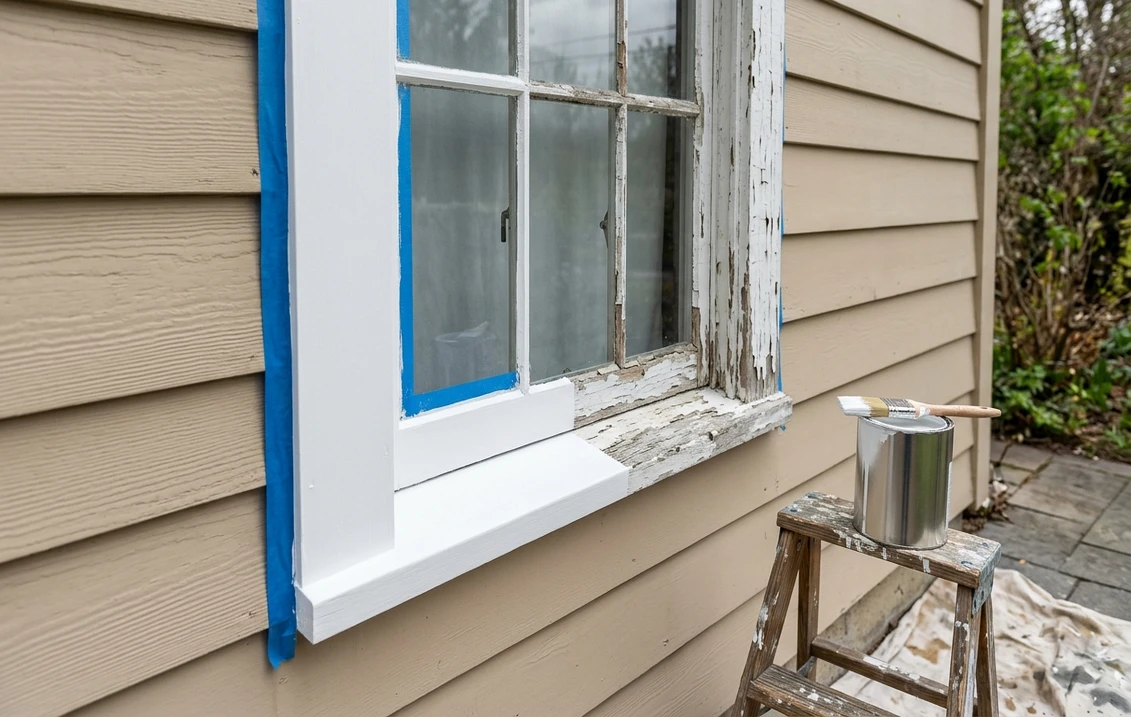
Where Sherwin-Williams draws the line outdoors
Scope. The Emerald Urethane sheets are explicit: "For exterior use on doors, trim, and other small areas of wood or metal. Do not use on the main body of exterior structures." SnapDry's sheet is written for doors, trim, windows and shutters. Neither is a siding paint; our comparison of Sherwin-Williams outdoor paint lines covers the body of the house.
Temperature. Both trim enamels need at least 50°F, and SnapDry adds a 90°F ceiling. Emerald Exterior and Emerald Rain Refresh can be applied when air, surface and material are above 35°F and at least 5° above the dew point, the temperature at which air becomes saturated (National Weather Service, dew point vs humidity), and not when rain or snow is expected within 2 to 3 hours. In late fall that 15-degree gap often decides which paint you can use on a given afternoon; our guide to the best weather for exterior painting goes deeper.
Vinyl. SnapDry's sheet repeats Sherwin-Williams' vinyl rule: no color darker than the original or with a light reflectance value (LRV) below 56 unless you use VinylSafe Paint Colors, or the vinyl may warp. SnapDry can be tinted in the VinylSafe palette of 100 colors, including a few darker ones; vinyl trim and shutters take Multi-Purpose Latex Primer. The Emerald Urethane sheets do not mention vinyl. See our Sherwin-Williams VinylSafe palette guide.
Primers. The two sheets agree on most of the system:
| Exterior surface | Primer named on the data sheets |
|---|---|
| Bare wood, composition board | Exterior Oil-Based Wood Primer or Exterior Latex Wood Primer |
| Redwood, cedar, knots (tannin bleed) | Spot prime with Exterior Oil-Based Wood Primer |
| Steel, aluminum, galvanized | All Surface Enamel Latex Primer |
| Drastic color change | A coat of primer; P-Shade primer for hide and color |
Fiberglass and steel entry doors: read the door maker first
A data sheet tells you what the paint can do; the door's warranty tells you what the door maker accepts. Therma-Tru's finishing FAQ shows why it matters. For its Classic-Craft and Fiber-Classic fiberglass doors it asks for "a high quality acrylic, alkyd or oil-based exterior house paint", primer and paint from the same maker. For its smooth Smooth-Star doors it asks for a quality exterior acrylic latex or latex/acrylic house paint, and warns about paints labeled "interior/exterior" because they often do not adhere well. Fiberglass doors must also be finished within 6 months of installation for the warranty.
SnapDry and Emerald Urethane are both sold as interior-exterior paints. That does not make them fail on fiberglass, but where the door maker uses that wording, an exterior-only acrylic such as Emerald Exterior Gloss matches it more closely. Steel doors follow the metal line of the primer table. For how dark a door can go, our Sherwin-Williams front door colors guide lists 22 shades with their LRV.
Emerald Exterior and Rain Refresh in Gloss: the house-paint route
Sherwin-Williams' front door page names a third product: Emerald Rain Refresh, whose dirt "washes away upon contact with rain or water", per its product page. Its Gloss and the Gloss of the regular Emerald Exterior are both presented for windows, doors and trim. Their data sheets (Emerald Exterior Gloss, Rain Refresh Gloss, March 2026) give:
- Emerald Exterior Gloss: self-priming cross-linking 100% acrylic. At 45°F and above, touch in 1 hour, recoat in 4, "ready for service overnight"; between 35 and 45°F, touch in 2 hours, recoat in 24 to 48.
- Rain Refresh Gloss: proprietary acrylic with Self-Cleaning Technology. At 45°F and above, touch in 2 hours, recoat in 4; between 35 and 45°F, touch in 4 hours, recoat in 24 to 48.
- Both: 250 to 300 sq ft per gallon, 35 to 45 units at 60°, under 50 g/L of VOC, VinylSafe colors, lifetime limited warranty, gallon and 5-gallon sizes only.
This route fits trim painted in the same job as the siding, weather between 35 and 50°F, or a door maker that wants an exterior house paint. You give up Emerald Urethane's 60-plus gloss units and the quart size. See our Emerald Exterior review, SuperPaint vs Emerald Exterior and Duration Exterior.
Interior doors and trim: same cans, plus ProClassic
Both SnapDry and Emerald Urethane are interior-exterior, so a quart left from the front door can finish its inside face. For interior-only work Sherwin-Williams also sells ProClassic Waterborne Interior Acrylic Enamel, a finish "for interior trim, doors and cabinets" in Satin, Semi-Gloss, Gloss and High Gloss: not for the weather side of an entry door. Our guide to painting interior doors, trim and baseboards covers the room side.
How much paint for a front door, and for a house's trim
A front door (our calculation). A 36 by 80 inch door is 20 sq ft per face; its 1¾ inch edges add about 2.8 sq ft and a 3½ inch outside casing about 4.9. One face, edges and casing: about 28 sq ft, or 56 sq ft for two coats. At 350 to 400 sq ft per gallon that is 0.14 to 0.16 gallon, so one quart (0.25 gallon) is enough. Both faces in the same color come to about 96 sq ft for two coats: buy two quarts.
A house's trim (worked example, our calculation): two stories, 12 windows of 3 by 5 ft, four outside corners, 140 ft of fascia.
| Trim | Linear feet | Face width | Area per coat |
|---|---|---|---|
| Window casings and sills (about 18 ft each) | 218 | 3½ in | 64 sq ft |
| Corner boards (2 boards, 18 ft tall) | 144 | 3½ in | 42 sq ft |
| Fascia | 140 | 7¼ in | 85 sq ft |
| Total, one coat / two coats | 190 / 381 sq ft |
Two coats of SnapDry or Emerald Urethane need 0.95 to 1.09 gallons: a gallon plus a quart. Emerald Exterior Gloss, at 250 to 300 sq ft per gallon, needs 1.27 to 1.52 gallons, so two gallons, since it has no quart. Measure your own trim the same way: linear feet times face width in feet. Sherwin-Williams' site showed no prices without signing in on October 28, 2026: ask the store for gallon and quart prices before comparing.
Prep and application, from the data sheets
- Clean, scrape, dull. Wash, scrape and sand peeled paint to a sound surface, sand glossy surfaces dull, fill holes and prime every patch.
- Lead first in older homes. In a house built before 1978, old door and trim paint may contain lead. The EPA advises assuming it does when you cannot date the house, misting before sanding or scraping, HEPA vacuuming and wet cleaning (EPA, lead-safe renovations for DIYers); a contractor paid to disturb painted surfaces in a pre-1978 home generally falls under the EPA Renovation, Repair and Painting rule.
- Tools. SnapDry: a 2 to 2½ in brush, a 3/8 to 1/2 in soft woven roller, or airless at 1,500 to 2,000 psi with a .011 to .015 in tip. Emerald Urethane: a synthetic bristle brush, a 1/4 to 1/2 in woven roller, airless at 2,000 psi with a .013 to .017 in tip, or HVLP. Neither needs thinning.
- Keep a wet edge. Overlap paint that is still wet to avoid streaks, let the first coat dry before the second, and pull tape and refit hardware only once the second coat is dry.
- Clean up with water. Both are waterbased: soap and warm water. Emerald Urethane looks like an oil enamel but needs no mineral spirits.
Pick the trim color before the can is tinted
A tinted quart cannot be returned. Upload a photo of your house, choose "Trim" or "Front door" and compare Sherwin-Williams colors on your own facade in about 30 seconds.
Try Sherwin-Williams colors on my trimChoosing the color for doors and trim
Product first, then color: any Sherwin-Williams color can go into either enamel, within the limits of each base. For trim, our exterior trim paint colors guide ranks 15 shades. For a dark door or window frames, see Tricorn Black SW 6258 on a house, Iron Ore SW 7069 and Urbane Bronze SW 7048. The whole range, colors and product lines, is mapped in our Sherwin-Williams exterior paint guide.
See the door color on your house, not on a chip
Upload one photo of your entry and compare two or three Sherwin-Williams colors side by side before you buy a quart.
Preview my front door in Sherwin-Williams colorsSources and references
- Sherwin-Williams, SnapDry data sheets, Semi-Gloss A71 and Satin A70, and product page: specs, times, conditions, vinyl rule, primers.
- Sherwin-Williams, Emerald Urethane Trim Enamel data sheets, Satin K37, Semi-Gloss K38, Gloss K39, and product page: specs, times, exterior scope.
- Sherwin-Williams, front door paint colors page: the three products it recommends for doors.
- Sherwin-Williams, Emerald Exterior and Emerald Rain Refresh product pages and Gloss data sheets: 35°F application, times, coverage, sizes.
- Sherwin-Williams, ProClassic Waterborne Interior Acrylic Enamel: interior scope.
- Pro Builder, Door and Trim Paint, Sherwin-Williams (July 2016): SnapDry at launch.
- Cloverdale Paint, Paint sheen levels: the MPI gloss level table.
- Therma-Tru, Project center FAQs: paints for fiberglass doors, the 6-month finishing rule.
- National Weather Service, Dew point vs humidity.
- U.S. EPA, Lead-safe renovations for DIYers and Renovation, Repair and Painting Program.
Frequently asked questions
What is the best Sherwin-Williams paint for doors and trim?
Can SnapDry be used on exterior doors?
How long before I can close a door painted with SnapDry?
Is Emerald Urethane Trim Enamel oil-based?
Can I use Emerald Urethane Trim Enamel on siding?
Which Sherwin-Williams paint can I use on trim below 50°F?
How much paint do I need for a front door?
Trademarks mentioned (Sherwin-Williams, Benjamin Moore, Behr, Caparol, Brillux, Sto, Alpina, Valspar, PPG, Glidden, Dulux, Crown Trade, Sandtex, Farrow & Ball, Johnstone's, Leyland) are property of their respective owners. FacadeColorizer is independent and not affiliated with any of them. Nominative fair use under Lanham Act §1125.