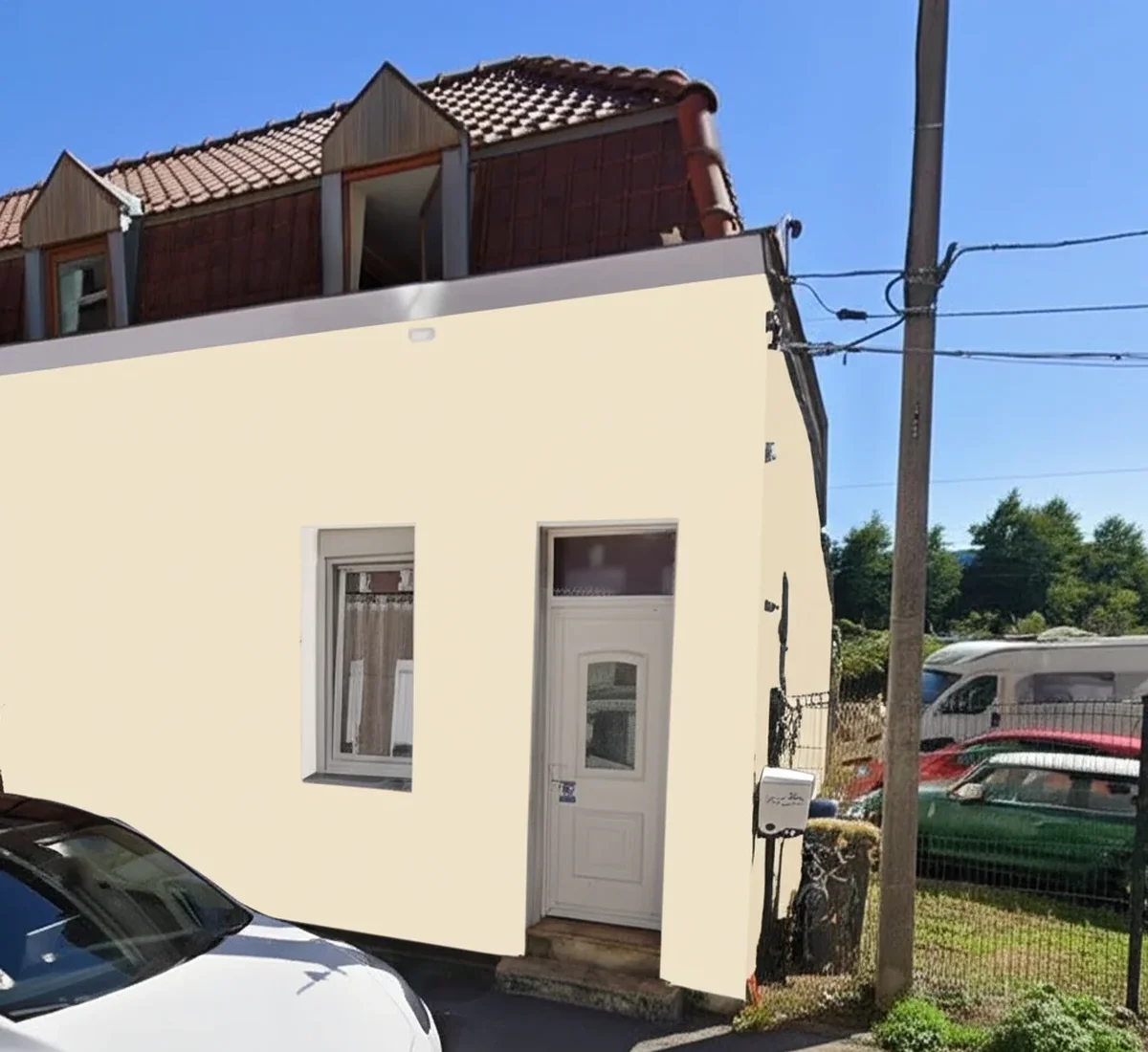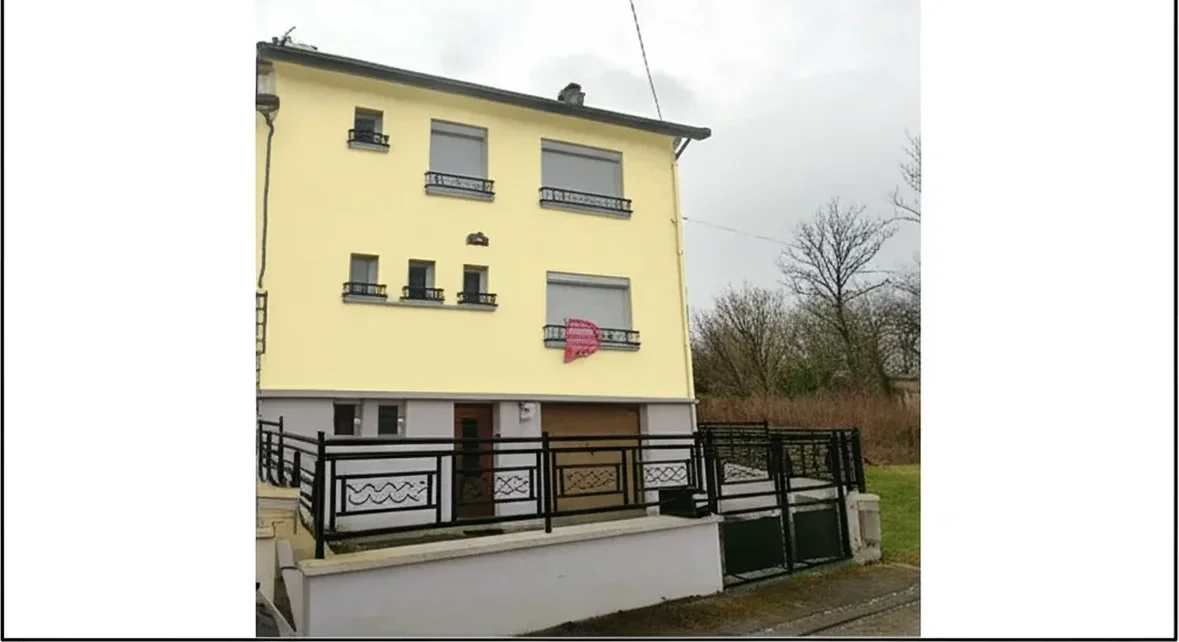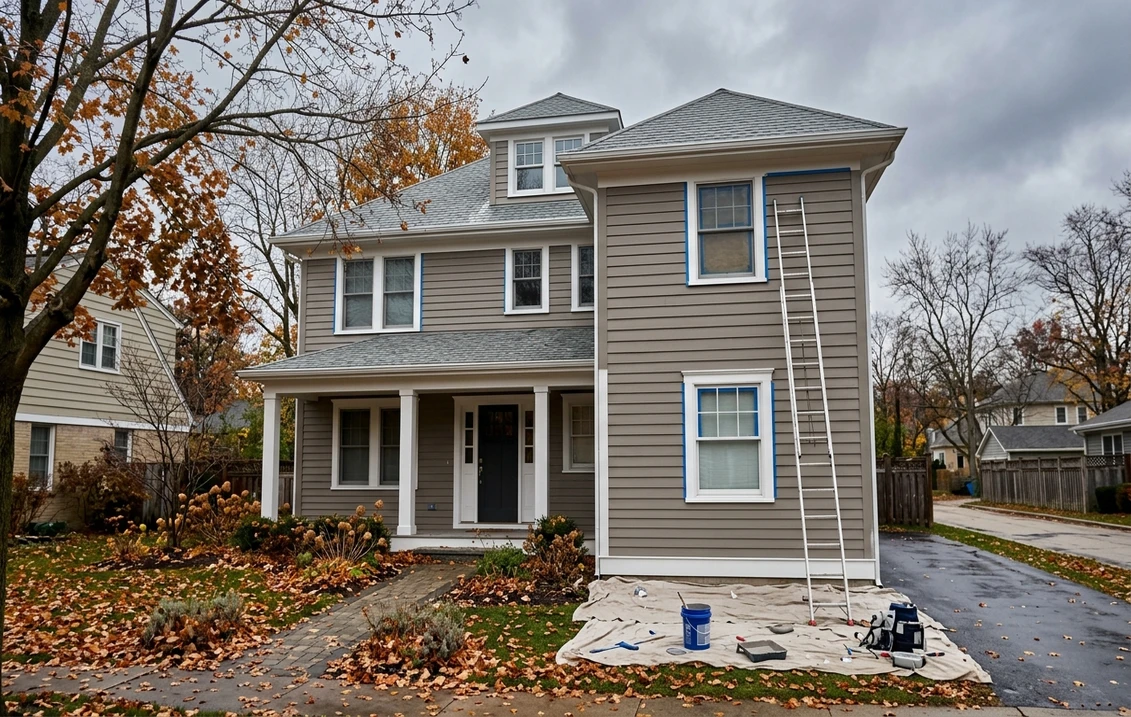
Try it on your house

Quick answer: Latitude Exterior is the Sherwin-Williams line built around weather, not around wall durability. Its ClimateFlex technology lets you paint from 35°F to 120°F and the film resists rain in about 30 minutes, against roughly two hours for the Resilience line it replaced. Expect $73 to $87 a gallon at list, $55 to $60 during the chain's seasonal sales. Buy it when the calendar or the forecast is the constraint: a cold shoulder-season repaint, a humid summer, a job you have to finish before a front comes through. If the weather is mild and you can pick your day, SuperPaint costs $10 to $15 less a gallon for comparable results, and Duration or Emerald buy more years.
Latitude is the newest name on the Sherwin-Williams exterior shelf and the one homeowners most often cannot place. It is not a premium tier above Duration and it is not a budget line under SuperPaint. It exists because Sherwin-Williams needed an answer to a specific problem, which is that most exterior paints are unusable for a third of the year in half the country. This review sticks to what can be checked: the manufacturer's stated technology and temperature range, what painters report about the rain window, the price, and the one fact that changes how you read the rest of the Sherwin-Williams lineup, namely that Latitude replaced Resilience. For the color decision, which is a separate question from the product decision, our Sherwin-Williams exterior paint guide covers the full palette.
Upload one photo and preview the color before you pick the line, free.
What ClimateFlex actually buys you
Every exterior latex has a minimum application temperature, and it is not a marketing number: below it the resin particles stop fusing into a continuous film, and the coat that looks fine in November fails the following spring. The usual floor is 50°F, which is why exterior painting season is short in the northern half of the country. Sherwin-Williams built Latitude around a formulation it calls ClimateFlex, and the claim is a working range of 35°F to 120°F measured on air, surface and material, with the film resisting rain as soon as 30 minutes after application.
Those two numbers are the entire product. The 35°F floor adds roughly six weeks at each end of the season in a temperate climate, which is the difference between finishing in October and waiting until April. The 30-minute rain window is the one that saves jobs: a surprise shower two hours after the last coat used to mean streaking, washout and a return visit. The CompositePaint review of Latitude puts the trade-off in one line: you are buying the calendar, not the film. The same review rates it 8.0 out of 10 and calls it a strong seven-year paint rather than a fifteen-year one, which is the honest way to read it against the tiers above.
Latitude specs at a glance
| Spec | Latitude Exterior Acrylic Latex |
|---|---|
| Headline technology | ClimateFlex |
| Application temperature | 35°F to 120°F (air, surface and material) |
| Rain resistance | From about 30 minutes; rain-ready in 30 to 60 minutes |
| Dry and recoat | Touch 1 to 2 hours, recoat 2 hours, full cure over 30 days |
| Coverage | 250 to 400 sq ft per gallon, substrate dependent |
| Sheens | Flat, Low Lustre, Satin, Gloss |
| Bases | Extra White, Super White, Ultra White, Deep Base, Ultradeep Base, plus Real Red, Light Yellow and Vivid Yellow |
| Container sizes | 1 quart, 1 gallon, 5 gallon |
| VOC | Low, below the federal 100 g/L exterior limit; exact figure not published |
| Price per gallon | $73 to $87 list, $55 to $60 during the 30 to 40 percent sales; Prudent Reviews quotes about $87 |
Try it on your house
No photo? Try a sample
Sheens, bases and container sizes from the Sherwin-Williams Latitude product page; performance figures and prices from the reviews cited in the sources section. Prices move with the chain's frequent sales and vary by region.
Latitude replaced Resilience, and that matters if you are comparing quotes
This is the part most comparison charts still get wrong. Resilience was the Sherwin-Williams moisture specialist, built on MoistureGuard, with a two-hour early-rain window and application down to 35°F. Latitude was introduced in 2021 to replace it, and Sherwin-Williams now lists the Resilience sheens under discontinued products on its own site. Prudent Reviews quotes a Sherwin-Williams specialist directly: Resilience is being phased out, and Latitude is the new and improved formula replacing it. As of 2026 many stores still tint Resilience from remaining stock, so it has not vanished from shelves, but it is on the way out.
Two practical consequences. If a contractor quotes Resilience, the quote is not wrong, but ask whether Latitude is available at the same price, because the successor halves the rain window. And if you are reading an older comparison of the Sherwin-Williams lineup, including ours, treat Resilience as the outgoing line and Latitude as its replacement; our Resilience review now carries that note at the top.
Where Latitude sits in the Sherwin-Williams lineup
| Line | What it is built for | Price per gallon |
|---|---|---|
| Emerald | Deepest color, best fade and dirt resistance; hot and sunny walls, forever homes | About $85 to $98 |
| Duration | Thick, flexible film; one-coat repaints on sound siding | About $80 to $94 |
| Latitude | Weather window: cold, heat and quick rain resistance | $73 to $87 list, about $87 per Prudent Reviews |
| SuperPaint | The value workhorse; mild weather, budget repaints | About $70 |
| Resilience | The outgoing moisture line, replaced by Latitude | About $85 while stock lasts |
Read the table by constraint, not by price. If the constraint is sun, go up to Emerald, whose harder cure holds deep colors longest. If it is film toughness on older siding, Duration's thicker, more flexible film is the answer, and our Duration review goes through it spec by spec. If the constraint is budget on a mild-weather job, SuperPaint does the same work for $10 to $15 less a gallon, as the tier-by-tier SuperPaint vs Duration vs Emerald comparison lays out. Latitude wins only when the constraint is the weather itself. That is a narrower case than the shelf presence suggests, but when it applies, no other line in the range solves it.
Free AI visualizer: test three shades on your own siding in about 30 seconds.
What a seven-year paint actually costs you
Exterior paint is the rare purchase where the sticker price is the least important number. Paint is roughly 15 to 20 percent of a professional exterior job; the rest is preparation, labor and access. That ratio is why a cheaper gallon almost never produces a cheaper decade, and it is the frame for reading Latitude against the tiers above it.
Take a 2,000 square foot house needing about 15 gallons. At list, Latitude runs roughly $1,200 in material against about $1,050 for SuperPaint and about $1,350 for Duration. The spread across the whole lineup is a few hundred dollars on a job that will cost several thousand. What separates them is the interval: a seven-year paint on a house you will own for twenty means three repaints, a twelve-year paint means two, and the second mobilization costs far more than the difference in material. So the arithmetic points up the range for a long hold, and it points at Latitude only when the alternative is not painting at all this season, or painting into weather that will cost you the coat.
There is one case where the arithmetic flips cleanly in Latitude's favor: a house being sold, rented or flipped. The owner needs the exterior to look right now, the repaint horizon belongs to someone else, and the ability to finish in November rather than wait for April has a real dollar value. In that scenario paying for the calendar is exactly the right trade.
What ClimateFlex does not change
A wider temperature range is a permission, not an exemption. Four things behave the same way they do with any exterior latex, and each one accounts for more failures than the choice of line:
- Dew, not just rain. A coat applied at 4 p.m. in October can be wet with dew by 7 p.m. even under a clear sky. The 30-minute figure covers a shower, not a night of condensation on a cooling wall. Stop early in the shoulder season.
- Substrate moisture. Siding that was washed yesterday, or a north wall after a wet week, holds water the surface does not show. Painting over it traps moisture behind the film, and the blistering that follows is not a product fault.
- Chalk and adhesion. An older painted surface that leaves a white residue on your palm needs a bonding primer, whatever goes on top. No formulation bonds to loose material.
- Color and exposure. A deep color on a south or west wall runs hotter and fades sooner in any line. That is a pigment and exposure question, which is why the color choice deserves as much thought as the product; our guide to exterior paint in hot climates covers how heat load changes the decision.
When Latitude is the right buy
- Shoulder-season repaints. Late October in the Midwest or Northeast, early April in New England: the 35°F floor is what makes the job possible at all rather than merely uncomfortable.
- Unstable forecasts. Coastal Southeast summers, Pacific Northwest springs, anywhere an afternoon shower is a coin flip. A 30-minute rain window turns a gamble into a normal work day.
- Desert heat. The 120°F ceiling matters in Phoenix or Las Vegas, where a west wall in July exceeds the working range of ordinary exterior latex by mid-morning.
- Tight schedules. A two-hour recoat means two coats in a single day, which is the difference between one mobilization and two on a small house.
When to spend the money elsewhere
- You can choose your week. In mild, dry conditions Latitude offers nothing SuperPaint does not, at a higher price.
- The body color is deep. Saturated navies, charcoals and forest greens on south and west walls belong in Emerald, whose pigment and cure hold saturation longest.
- You are staying twenty years. Latitude is reported as a seven-year paint. Duration and Emerald buy more of the only thing that matters over that horizon, which is time between repaints.
- The siding is old wood or cedar. The constraint there is breathability and tannin, not weather; that decision is covered in the Duration review.
Getting the weather claims to hold on your job
- Measure the surface, not the air. The 35°F floor applies to air, surface and material. A north wall in shade sits below the reading on your phone, and the temperature has to stay above the floor through the cure, not just during application.
- Read the 30 minutes as a minimum, not a promise. It assumes a normal drying day. Cold, damp, still air stretches it; paint the elevation that will have the longest dry window before the front arrives.
- Prep still governs. ClimateFlex changes when you can paint, not what you can paint over. Wash, scrape, sand failing edges and spot-prime bare wood, chalk and rust.
- Do not stretch the sheen choice. Flat and low lustre hide texture and touch-ups on body siding; satin sheds dirt; gloss is for doors and trim.
- Lock the color first. The line is a durability decision, the color is the one you live with. Our roundup of the most popular Sherwin-Williams exterior colors lists the shades with proven holding power, and the visualizer shows them on your house before you buy.
One HD preview plus three variations, no signup.
Sources and references
- Sherwin-Williams, Latitude Exterior Acrylic Latex product page: sheens (Flat, Low Lustre, Satin, Gloss), bases and container sizes.
- CompositePaint, Sherwin-Williams Latitude Exterior review: ClimateFlex range 35°F to 120°F, 30-minute rain resistance, coverage, dry and recoat times, VOC, price band, seven-year expectation, comparison with SuperPaint, Duration, Emerald and Resilience.
- Prudent Reviews, Sherwin-Williams paint grades explained: current exterior lineup and prices per gallon, and the statement from a Sherwin-Williams specialist that Resilience is being phased out and Latitude replaces it.
- CompositePaint, Sherwin-Williams Resilience Exterior review: the outgoing line's MoistureGuard two-hour rain window, for the comparison above.
Disclaimer: SHERWIN-WILLIAMS, LATITUDE, CLIMATEFLEX, RESILIENCE, MOISTUREGUARD, DURATION, EMERALD and SUPERPAINT are trademarks of The Sherwin-Williams Company. FacadeColorizer is an independent service and is not affiliated with, endorsed by, or sponsored by Sherwin-Williams. Prices, availability and specifications vary by region, sheen and base and change over time; confirm current details with the manufacturer or your store before purchase.
Frequently asked questions
What is Sherwin-Williams Latitude paint?
Did Latitude replace Sherwin-Williams Resilience?
How much does Sherwin-Williams Latitude cost per gallon?
Can you really paint at 35 degrees with Latitude?
Is Latitude better than SuperPaint or Duration?
How long before rain can Latitude get wet?
Trademarks mentioned (Sherwin-Williams, Benjamin Moore, Behr, Caparol, Brillux, Sto, Alpina, Valspar, PPG, Glidden, Dulux, Crown Trade, Sandtex, Farrow & Ball, Johnstone's, Leyland) are property of their respective owners. FacadeColorizer is independent and not affiliated with any of them. Nominative fair use under Lanham Act §1125.