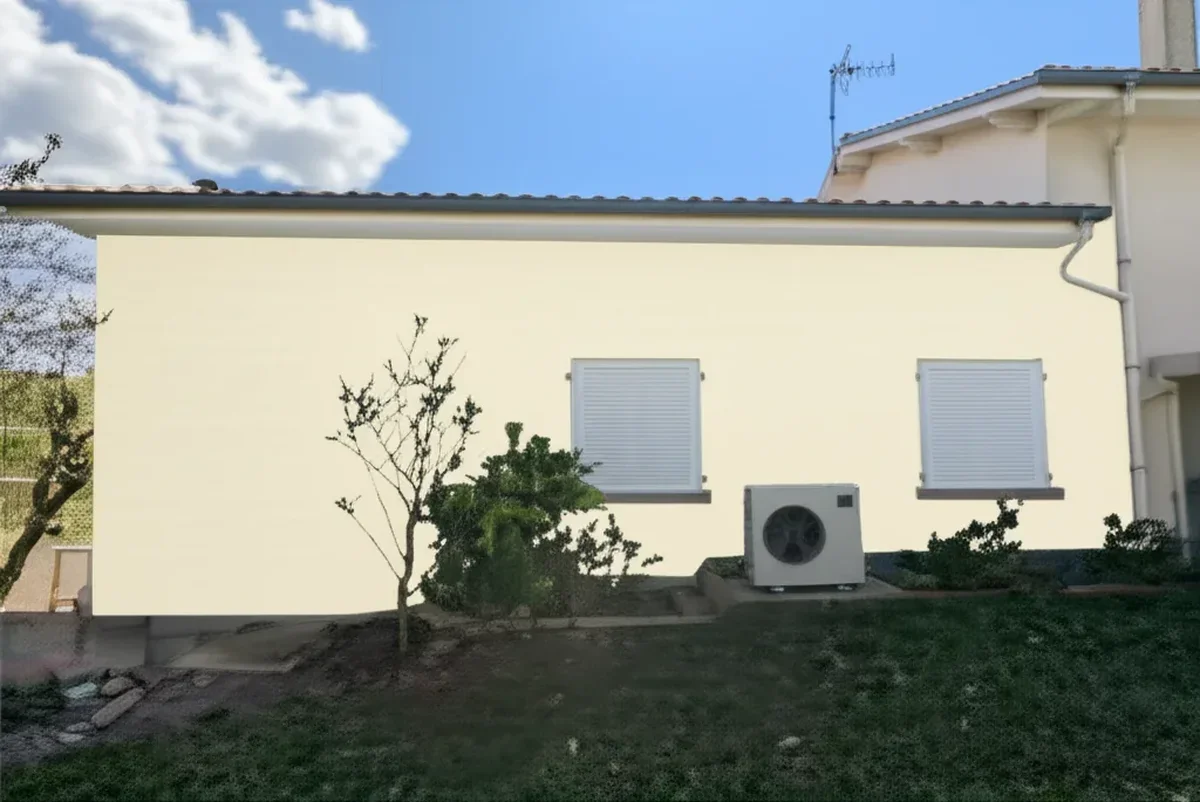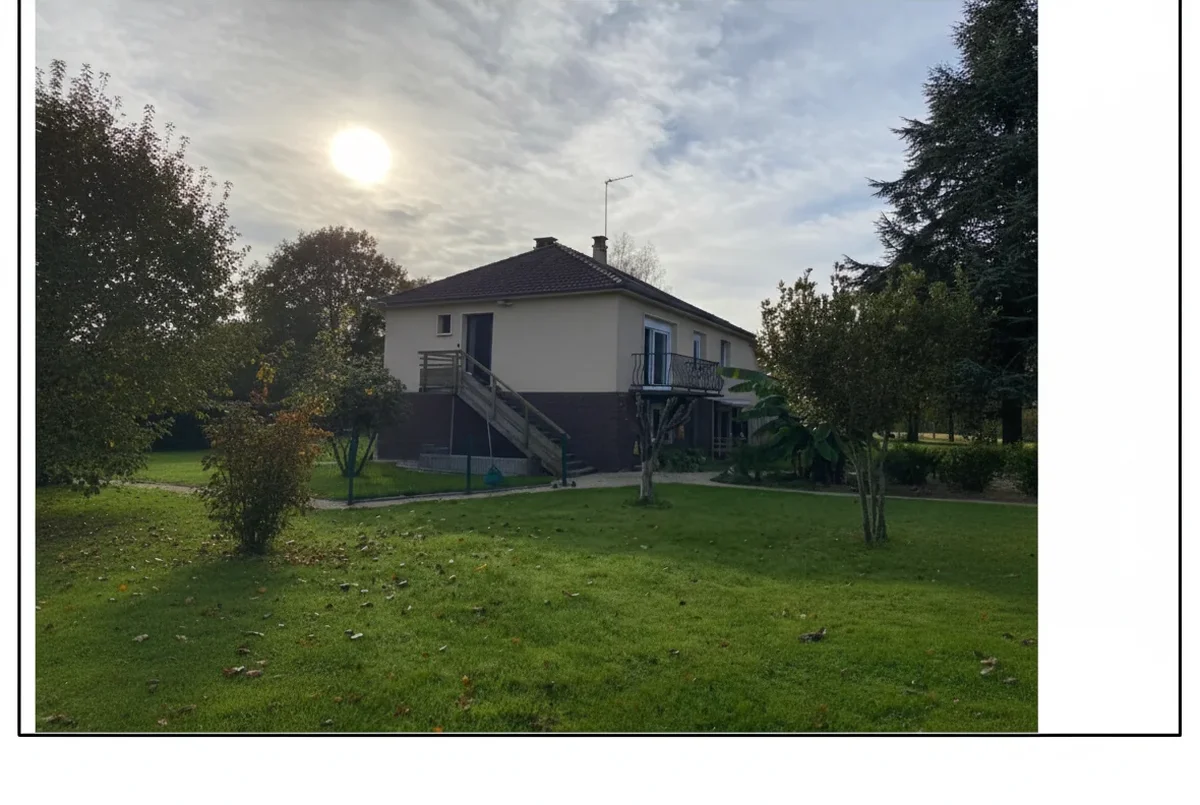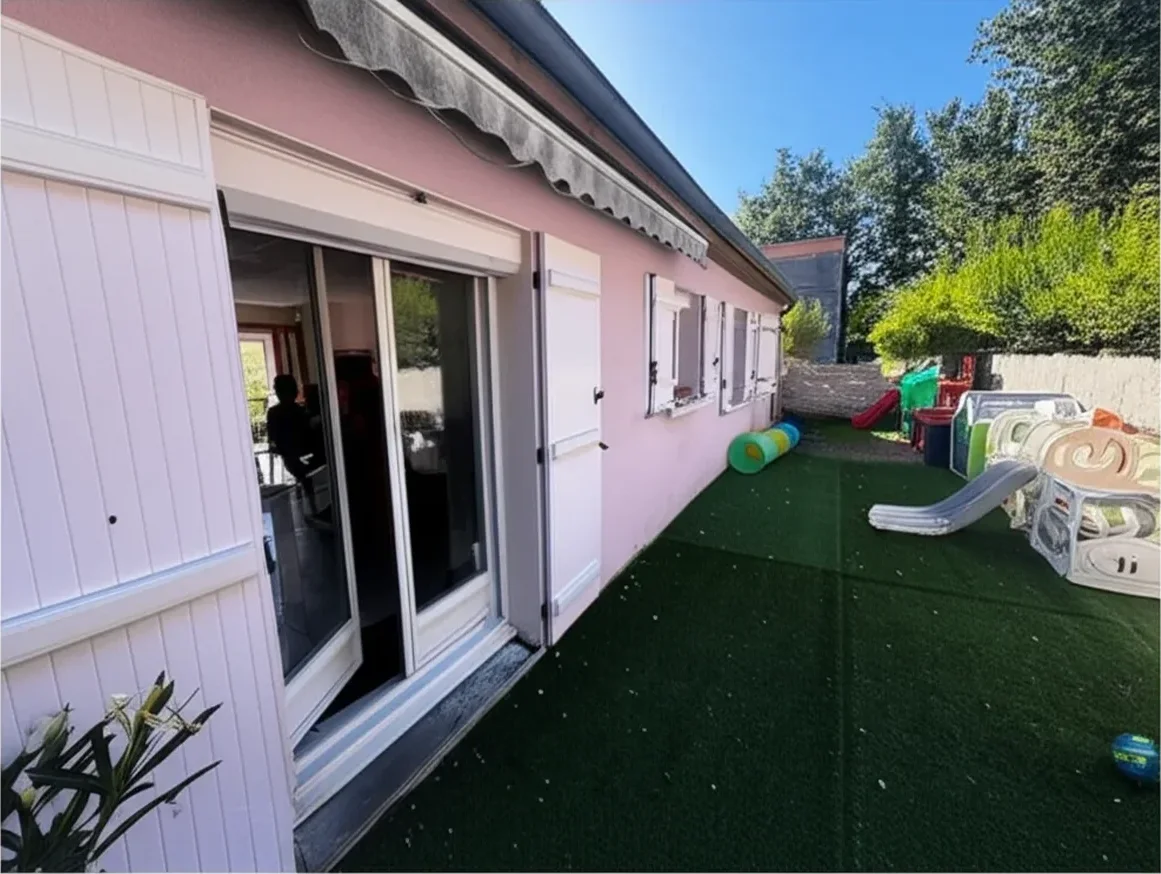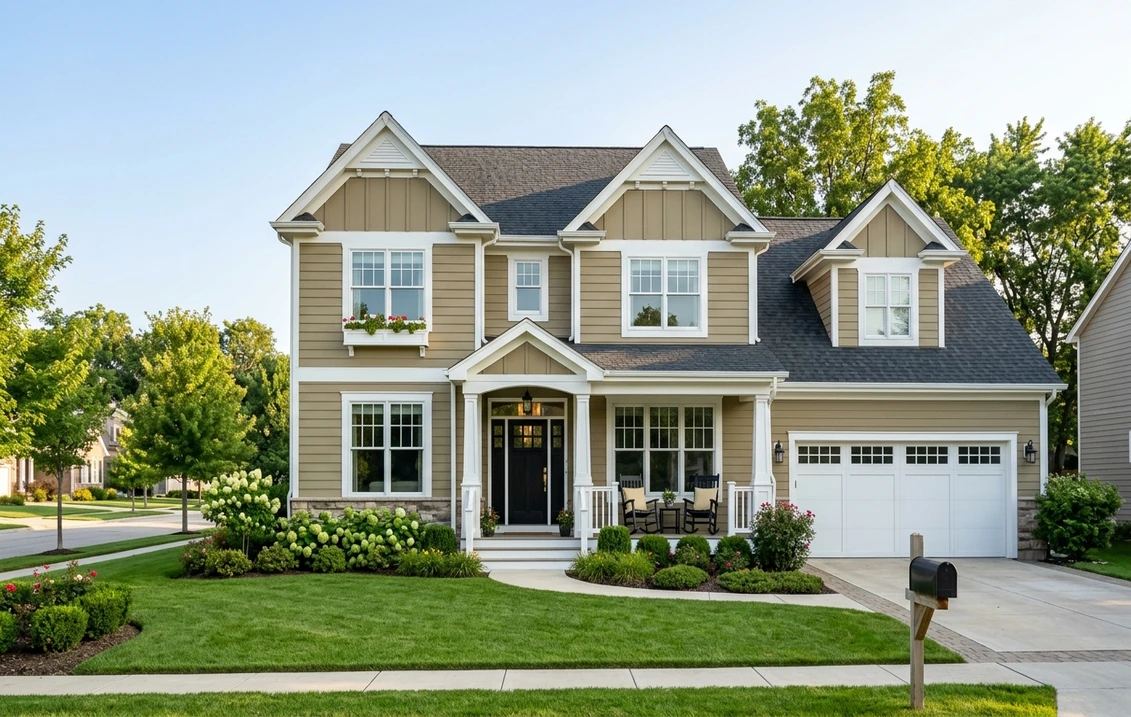
Try it on your house

Urbane Bronze SW 7048 is the dark exterior color that outlived its own trend cycle. Sherwin-Williams named it Color of the Year for 2021, and five years later it is still one of the most specified dark siding colors in the country, because it does something the near-blacks do not: it stays warm. With a Light Reflectance Value of 8.121 on Sherwin-Williams' own color page it is very dark, but its base is brown and gray with a trace of green rather than blue-black, so a whole house in Urbane Bronze reads as earthy and grounded instead of severe. This guide covers what the numbers mean on an exterior, where the color is safe to use and where it is not, the trim whites and door colors that work with it, and how it compares with the other Sherwin-Williams darks people shortlist against it.
Upload one photo and see the color on your own siding, trim and roof in about 30 seconds, free.
The data sheet behind Urbane Bronze SW 7048
Sherwin-Williams files Urbane Bronze among its neutral paint colors and describes it as a "bold neutral" that "invites feelings of moody modernity, natural healing and sophisticated serenity". On the 2021 Color of the Year page, the brand frames it as "nature at its simplest and most elemental", "embodying the richness of the Earth's stone, metal and wood", and recommends pairing it with "pale woods, rich leathers, metals and understated natural stone tones". Those pairing notes were written for interiors, but they translate directly to a facade: cedar, stone veneer, black metal and warm white trim are exactly the materials a dark bronze house wants around it.
The Light Reflectance Value is 8.121, the figure published on the Sherwin-Williams color page for SW 7048, which also gives the digital rendering as hex #54504A (RGB 84, 80, 74) and files the color as "dark" for interior and exterior use. On the 0 to 100 scale that places it in the same band as the Sherwin-Williams near-blacks, two and a half points above Iron Ore (LRV 5.55) and a point and a half above Cyberspace (6.397), both from the same official pages. The undertone is what separates it from them, and here the color reviewers are the better witnesses: The Heathered Nest describes "strong brown and charcoal undertones, but the very subtle green underneath keeps it from reading too warm or too flat". In sunlight the brown comes forward; in shade and overcast light it reads as a deep gray-green. Both are correct, and both should be checked on your own walls before you buy.
| Spec | Urbane Bronze SW 7048 |
|---|---|
| LRV (Sherwin-Williams) | 8.121, notation "dark" |
| Digital rendering (approximate) | Hex #54504A, RGB 84 / 80 / 74 |
| Sherwin-Williams family | Neutral paint colors |
| Undertone | Brown and charcoal with a trace of green; warm for a dark |
| Recognition | Sherwin-Williams Color of the Year 2021 |
| Coordinating colors named by SW | Modern Gray SW 7632, Messenger Bag SW 7740 |
| Exterior substrates | Wood, fiber cement, stucco, brick, metal; not standard vinyl (see heat section) |
Try it on your house
No photo? Try a sample
What LRV 8 means on a facade: heat, substrate and warranty
A wall painted at LRV 8 reflects roughly 8 percent of the visible light that hits it and absorbs the rest as heat. On a south or west elevation in full summer sun, a dark wall gets much hotter than a white one, and that matters in three ways. First, substrate: standard vinyl siding softens and distorts at high surface temperatures, which is why the industry rule for vinyl is never to repaint darker than the factory color; Urbane Bronze is far outside that rule, and on vinyl it belongs only within the manufacturer's vinyl-safe program, which we explain in our VinylSafe colors guide. Wood, fiber cement, stucco, brick and metal do not have that problem. Second, product: a dark color on a hot wall asks more of the binder, so this is a case for a top-tier acrylic rather than a budget line. Third, longevity: dark colors show fading and chalking sooner than light ones, so plan on a premium exterior paint with strong UV resistance and expect a shorter interval before the color looks tired, especially on the sunniest elevation. Our overview of dark exterior paint colors, pros and cons sets out those trade-offs for every dark family.
There is one more practical consequence of a low LRV: coverage. Going from a light body color to Urbane Bronze usually takes a tinted primer plus two finish coats to avoid flash marks where the old color grins through. Ask the store to tint the primer toward the finish color, and budget the extra coat; it is cheaper than repainting a patchy wall.
Where Urbane Bronze works on a house, and where it does not
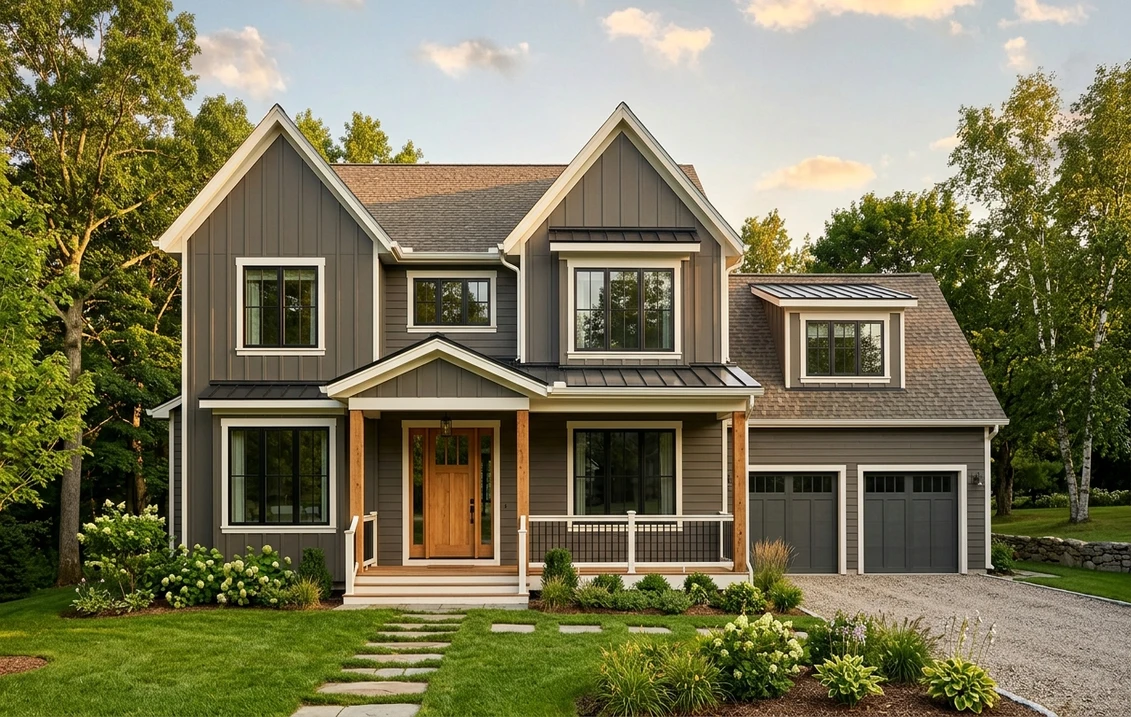
Modern farmhouse and transitional. This is the home of the color: board-and-batten or lap siding in Urbane Bronze, warm white trim, black windows, a natural wood door and a metal porch roof. The warmth of the bronze keeps the composition from looking like a black box, which is the usual complaint about Iron Ore on the same house.
Craftsman and bungalow. Earthy darks were part of the original Craftsman palette, so Urbane Bronze on the body with cream trim and a stone base is historically plausible as well as fashionable. Pair it with a warm wood porch ceiling rather than a white one.
Ranch and mid-century. On a low, horizontal house the color reads as sleek, especially with a lighter roof and wide eaves. Keep the trim minimal and let the wood accents carry the warmth.
Where it struggles. On a tall, flat elevation with few windows and no wood or stone, Urbane Bronze can look heavy; the color needs texture and material contrast around it. In dense tree cover with little direct sun, the green undertone can dominate and the house reads olive-gray rather than bronze. And in a hot southern climate on an uninsulated west wall, the heat argument above applies with full force. In those cases the usual fix is to keep Urbane Bronze for the trim, the door, the shutters or the garage doors and use a mid-tone body color.
Roof, stone and landscaping: the context a dark bronze house needs
Because Urbane Bronze is so dark, the elements around it decide whether the house looks rich or gloomy. The roof is the first: a charcoal or black asphalt roof over a bronze body merges into one dark mass from the street, while a medium gray, weathered-wood or brown roof gives the body an edge to read against. Stone and brick are the second: warm tan stone, limestone veneer and orange-brown brick all sit comfortably against the brown base of the color, whereas gray-blue stone makes it look muddy. Landscaping is the third, and the one people forget. A bronze house against mature green trees looks grounded and settled; the same house on a bare lot with a new lawn can look like a dark box, which is why so many renders look better than the first year of the real thing. Plan for plantings with some height near the foundation, and give the entry a lighter porch ceiling and warm lighting so the door reads at dusk.
A last note on scale: on a small house, Urbane Bronze on every wall can shrink the building visually. Breaking the body with a lighter gable, a stone water table or a wide band of warm white trim restores the proportions without giving up the color.
Trim whites that work with Urbane Bronze
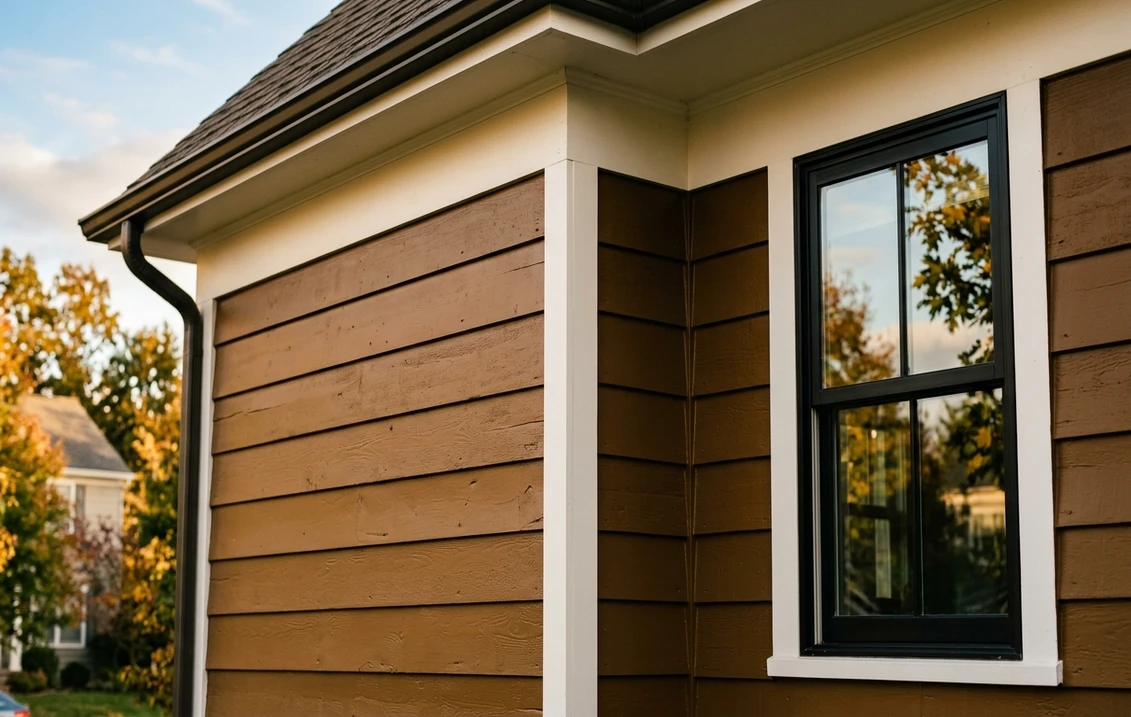
Because the body color is warm, the trim should be warm too; a blue-white trim against bronze looks like two different projects. Two Sherwin-Williams whites come up again and again with this color. Shoji White SW 7042, LRV 74.345 on its Sherwin-Williams page and reviewed as a soft greige-white by Kylie M Interiors, is a soft, slightly greige off-white that lowers the contrast and makes the facade feel calm; it suits farmhouse and Craftsman trim. Alabaster SW 7008, LRV 82.215 on its official page, is creamier and brighter and gives crisper lines; it is the choice when the trim is wide and you want it to read as white from the street. Our Alabaster exterior guide covers how it behaves on each orientation, and the Shoji White versus Alabaster comparison settles the choice between the two.
Pure White SW 7005 (LRV 83.957 on its official page) works when the windows are black and the look is deliberately modern; it is the coolest of the three and reads cleanest against black metal. Avoid stark blue-whites and avoid cream-yellow whites: the first fight the warmth, the second make the bronze look muddy.
Door, shutter and accent pairings
- Natural wood door. White oak, cedar or a mid-tone stained fir door is the pairing that defines the Urbane Bronze house; the wood supplies the warmth the dark body needs.
- Warm white door. Shoji White or Alabaster on the door with the same color on the trim gives a quiet, cohesive front; good on Craftsman and cottage-style houses.
- Black accents. Tricorn Black window frames and hardware sit well with Urbane Bronze because the bronze is clearly warmer; the two never compete.
- Muted color door. A dusty sage, a deep teal or a brick red reads well against bronze; bright primaries look out of place.
- Shutters. Shutters in the same Urbane Bronze on a lighter body color is the reverse pairing and often the safer one on a vinyl house, where the body cannot go dark.
Urbane Bronze versus the other Sherwin-Williams darks
| Color | LRV (official SW pages) | How it differs from Urbane Bronze |
|---|---|---|
| Urbane Bronze SW 7048 | 8.121 | Reference: warm brown-gray with a green trace |
| Peppercorn SW 7674 | 9.681 | Slightly lighter, cooler, a true charcoal without the brown |
| Black Fox SW 7020 | 6.738 | A touch darker and browner; the closest sibling, reads more like a dark taupe-brown |
| Iron Ore SW 7069 | 5.55 | Darker and neutral to cool; the soft black of the modern farmhouse |
| Cyberspace SW 7076 | 6.397 | Darker with a blue lean; the coolest of the group |
| Tricorn Black SW 6258 | 2.849 | A true black; no warmth, maximum contrast |
The LRV figures in the table are the ones Sherwin-Williams publishes on its own color pages for Peppercorn, Black Fox, Iron Ore, Cyberspace and Tricorn Black; the reviewers at The Heathered Nest and Mod and Mood round them to 7 and 6 and are worth reading for the undertone notes rather than the numbers. The practical reading: if you want the dark house but worry it will look black, Urbane Bronze is the warm answer; if you want it to look black but not harsh, Iron Ore is the usual pick. Our head-to-heads go deeper on the two closest calls, Urbane Bronze versus Iron Ore and Urbane Bronze versus Black Fox. If you are matching across brands, the Benjamin Moore equivalent of Urbane Bronze explains why there is no exact match and what comes closest.
Urbane Bronze by siding material: wood, fiber cement, stucco, brick and vinyl
Wood lap and board-and-batten. The natural home of the color. Wood moves with the seasons, so the film has to flex; that argues for a 100 percent acrylic in the top two lines, and for painting rather than staining if the boards are already painted. On rough-sawn cedar a flat or low-sheen finish keeps the texture, on smooth primed boards satin shows the color's depth.
Fiber cement. The easiest substrate for a dark color: it does not move much, does not soften with heat and takes an acrylic well. If the boards are factory-primed, a tinted primer toward bronze saves a coat. Check the manufacturer's own color guidance only if the siding carries a factory finish warranty tied to light colors.
Stucco and masonry. Dark stucco runs hotter and shows efflorescence and hairline cracks more than a light wall, so the surface has to be sound and dry first, and an elastomeric or a masonry-rated acrylic is the right film; our Sherwin-Williams stucco colors guide covers the product side. Flat is the usual sheen on stucco; satin highlights every trowel mark.
Brick. Painting brick is close to irreversible, and a dark color on soft brick traps more heat and moisture than a light one. If the brick is already painted, Urbane Bronze in a breathable masonry acrylic is fine; if it is bare, think twice and consider a limewash or a mineral paint, which our painted brick guide explains.
Vinyl. The one substrate where the answer is usually no. Standard vinyl is formulated for its factory color; a dark repaint absorbs enough heat to warp panels and voids the siding warranty. Sherwin-Williams keeps a separate VinylSafe palette for this reason, and Urbane Bronze is outside the range most vinyl can take; the workaround is the reverse scheme, a light body with bronze shutters, trim and doors.
Coverage, coats and quantities for a dark body
Going from a light body to Urbane Bronze is a three-coat job: a primer tinted toward the finish color, then two finish coats. At the 350 to 400 square feet per gallon that Sherwin-Williams' exterior lines quote on smooth siding, a house with 2,000 square feet of siding needs 5 to 6 gallons per coat, so 10 to 12 gallons of finish plus 5 to 6 of primer, before trim; lap siding, rough-sawn wood and stucco cover less, so round up. Buy the finish in one batch and box the gallons together: a dark color shows a batch difference far more than a white does, and a wall that changes shade at the gallon line is the most common complaint on bronze and black houses. Keep a quart for touch-ups; dark walls chip visibly.
The cost logic follows from that. The paint is a small share of the bill next to labor and prep, which our exterior painting cost guide breaks down, so a dark body is not the place to save on the line: the price difference between a mid-tier and a top-tier gallon is far smaller than the cost of repainting a faded west wall three years early.
Sheen and product line for a dark exterior
On siding, satin is the usual sheen for Urbane Bronze: it has enough light bounce to show the color's depth and to shed dirt, without the glare that semi-gloss gives a large dark wall. Flat hides surface flaws best but holds dirt and shows hand marks; keep it for stucco or rough-sawn wood where texture is the point. Trim in the same bronze can go one step glossier than the body. On the product side, the heat and fade arguments above push toward the top of the range: the Emerald Exterior or Duration Exterior lines, which our Sherwin-Williams exterior paint guide compares line by line.
If a quote for an Urbane Bronze body names A-100, read it twice: the entry-level line has lower volume solids, is not self-priming and warrants peeling and blistering only, which is the wrong profile for an LRV 8 color in sun. Our A-100 exterior review explains where the budget line is rational and where it is a false economy.
How to test Urbane Bronze before you commit
- Upload a street-side photo of the house to the simulator and render Urbane Bronze on the body with your current trim; then render Iron Ore and Black Fox on the same photo. The warm-versus-cool question answers itself on your own roof and landscaping.
- Paint a sample board of the finalist, at least two feet square, and move it: north wall in the morning, west wall in the late afternoon. Note the green shift in shade.
- Hold your trim white sample against the board outdoors. If it looks blue, switch to Shoji White or Alabaster.
- Check the substrate: vinyl means VinylSafe or a lighter body color; everything else is fine with a premium acrylic.
Free preview on your photo, no account needed for the first simulation.
Sources and references
- Sherwin-Williams, Urbane Bronze SW 7048 color page: official family and description.
- Sherwin-Williams, Color of the Year 2021: positioning, material pairings, coordinating colors Modern Gray SW 7632 and Messenger Bag SW 7740.
- Sherwin-Williams color pages with official LRV, hex and RGB: Urbane Bronze SW 7048 (8.121), Iron Ore SW 7069 (5.55), Black Fox SW 7020 (6.738), Peppercorn SW 7674 (9.681), Cyberspace SW 7076 (6.397), Tricorn Black SW 6258 (2.849), Shoji White SW 7042 (74.345), Alabaster SW 7008 (82.215), Pure White SW 7005 (83.957).
- The Heathered Nest, Urbane Bronze review and Black Fox review: undertone behavior of the two colors.
- Mod and Mood, Iron Ore review: how Iron Ore reads next to Tricorn Black.
- Kylie M Interiors, Shoji White review: undertone of the trim white.
Frequently asked questions
What is the LRV of Sherwin-Williams Urbane Bronze SW 7048?
Can I use Urbane Bronze on vinyl siding?
What trim white goes with Urbane Bronze?
Urbane Bronze or Iron Ore for a dark house?
Trademarks mentioned (Sherwin-Williams, Benjamin Moore, Behr, Caparol, Brillux, Sto, Alpina, Valspar, PPG, Glidden, Dulux, Crown Trade, Sandtex, Farrow & Ball, Johnstone's, Leyland) are property of their respective owners. FacadeColorizer is independent and not affiliated with any of them. Nominative fair use under Lanham Act §1125.