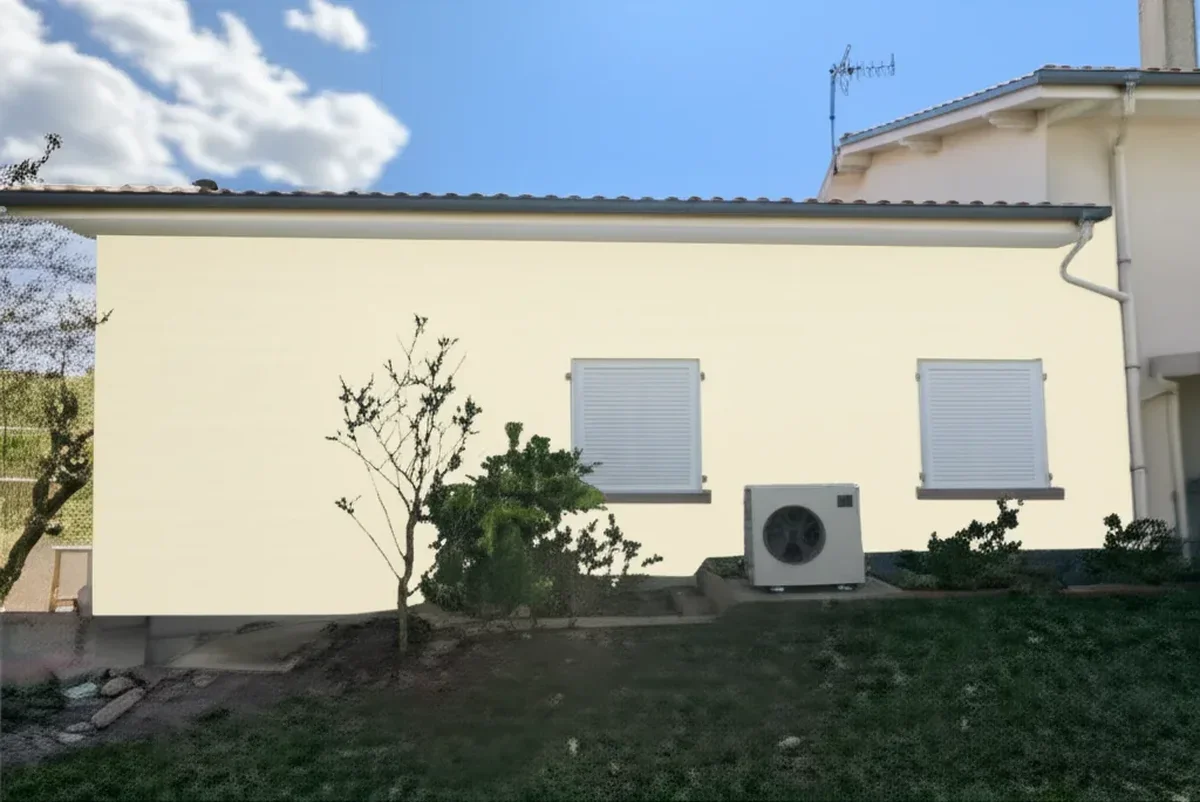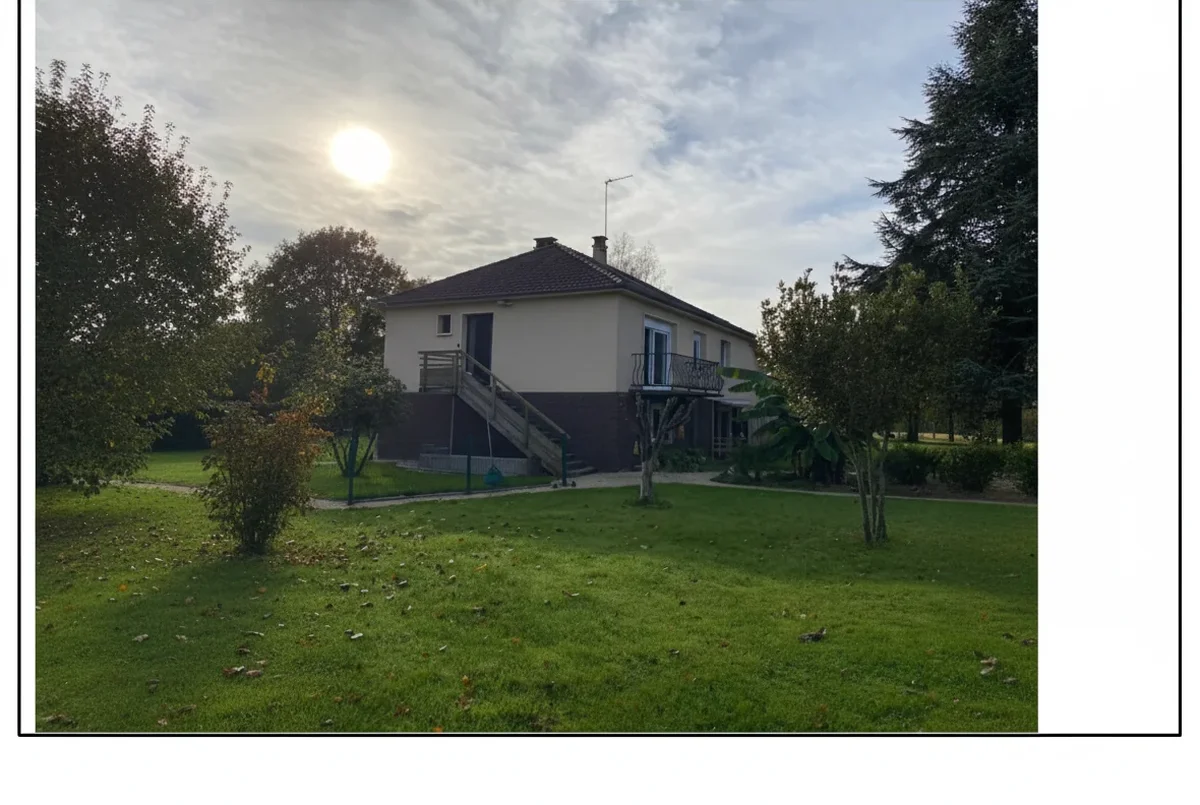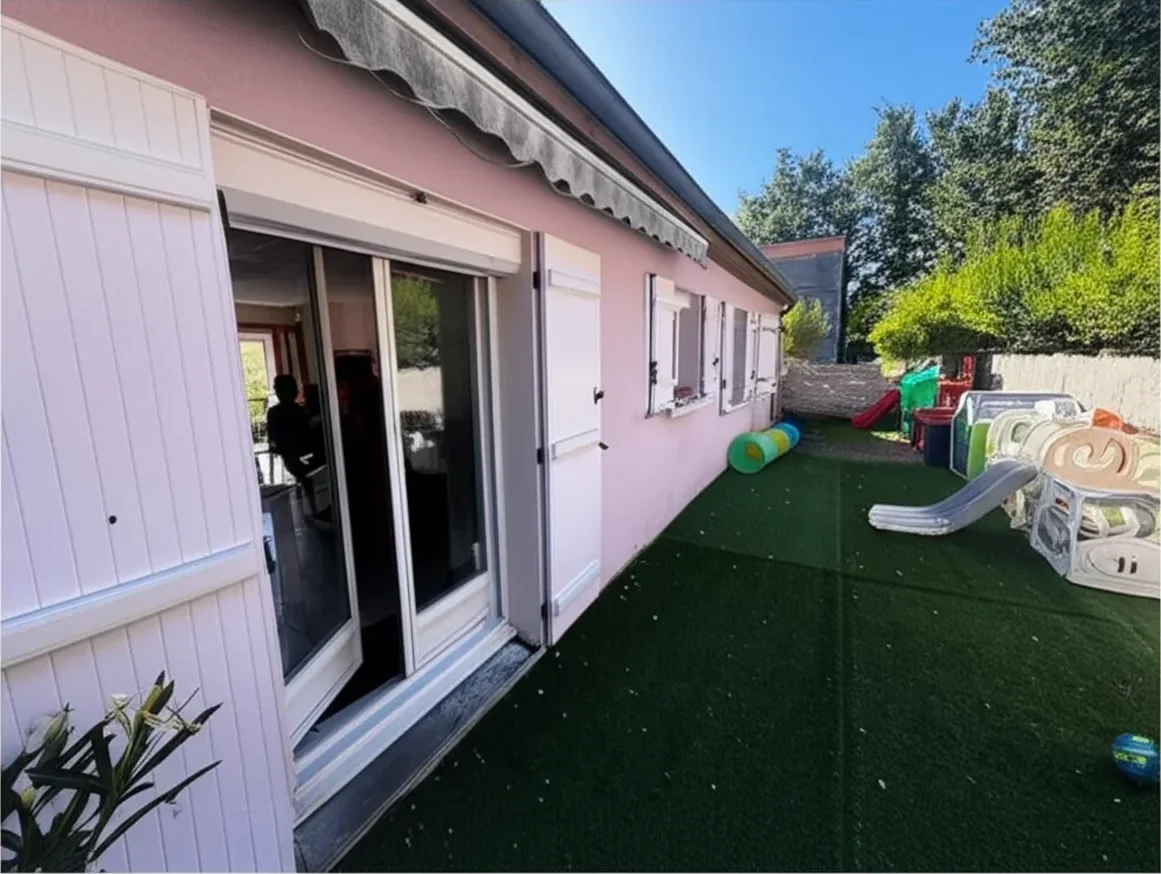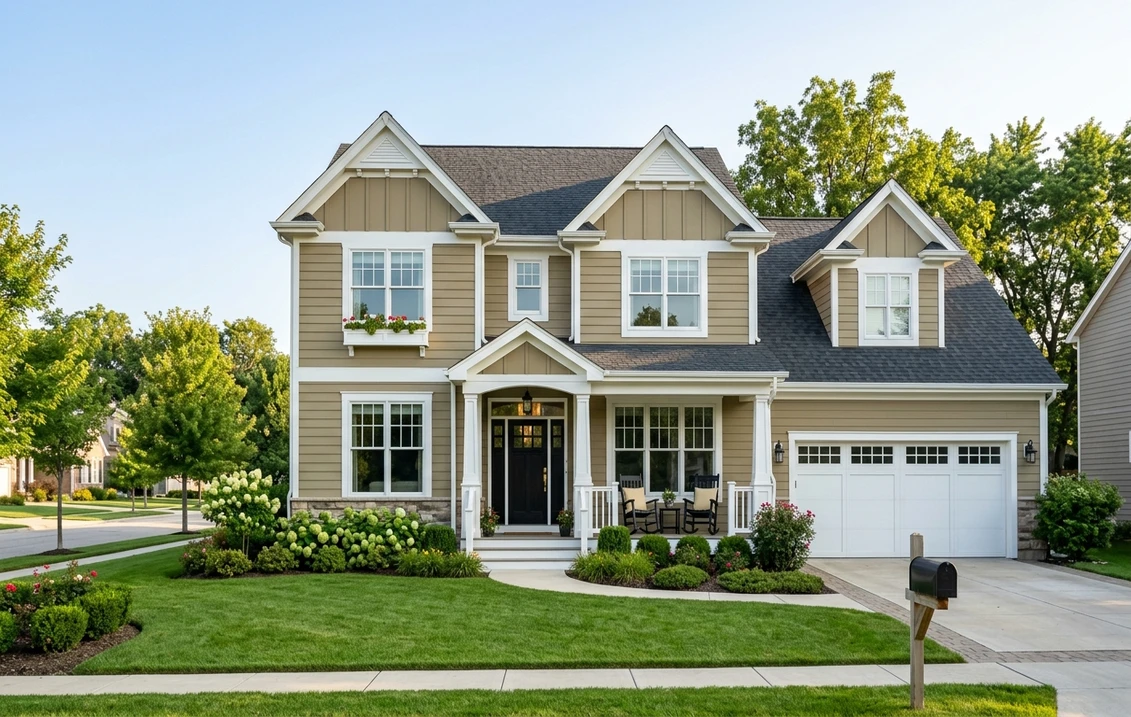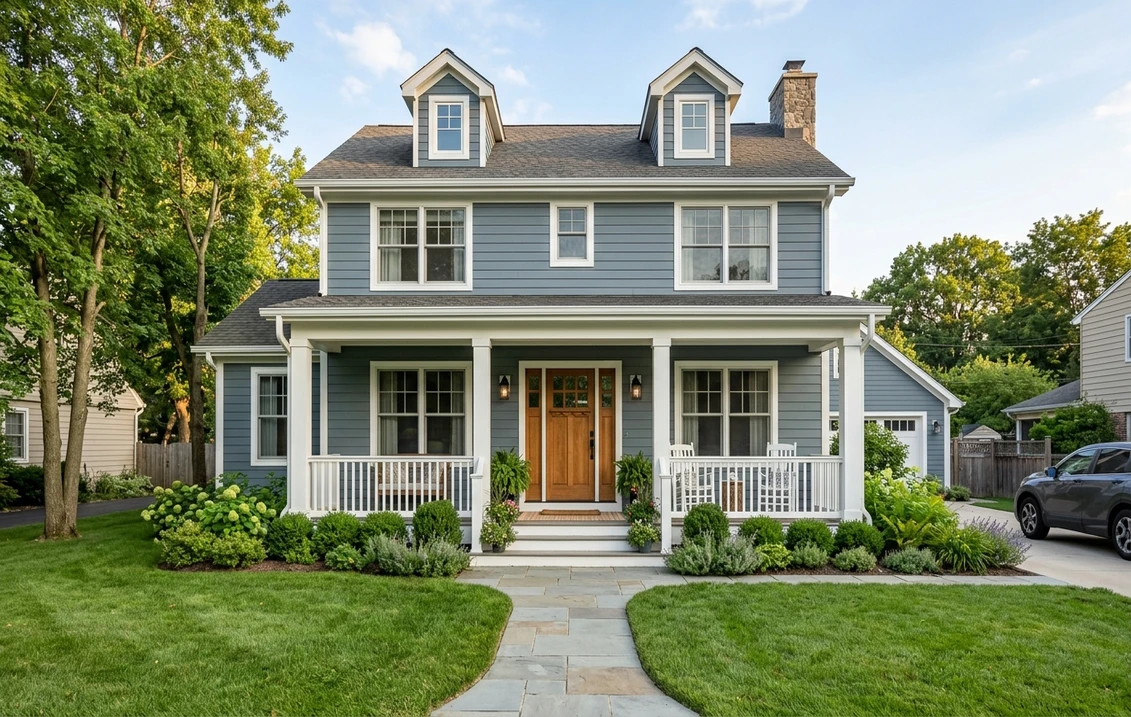
Try it on your house

Sherwin-Williams Smoky Blue (SW 7604) is a dark, dusty blue-gray: Sherwin-Williams publishes an LRV of 14.616, an RGB of 89, 110, 121 (hex #596E79), rates it for interior and exterior use, and, tellingly, files it in its Neutral family rather than with the blues. Outside, that makes it a body color that reads as soft slate blue on siding, a front door or shutter color that works against white, gray or red brick, and a color that is too dark for ordinary paint on vinyl siding: Sherwin-Williams' own data sheets set the limit at an LRV of 56 unless you use its VinylSafe colors, and Smoky Blue is not one of them.
All color values below come from Sherwin-Williams' and Benjamin Moore's own color pages and color data; the color-difference figures between look-alikes are our calculations from those published values and are labeled as such.
The link opens the exterior tool with Smoky Blue preselected on the siding. How it works: our exterior paint visualizer.
Smoky Blue at a glance: the numbers Sherwin-Williams publishes
These values come from the color's page (Sherwin-Williams, SW 7604 Smoky Blue). Hex and RGB describe how the color is drawn on a screen, not a tinting formula, so treat them as an approximate digital rendering and decide on a painted sample outdoors.
| Attribute | Smoky Blue SW 7604 |
|---|---|
| LRV | 14.616 (Sherwin-Williams rates it "dark") |
| RGB | 89, 110, 121 |
| Hex (screen approximation) | #596E79 |
| Hue and saturation on the page | Hue 200.6, saturation 0.27 |
| Color family (Sherwin-Williams) | Neutral |
| Use | Interior and exterior |
| Color strip location | 233-C7 (the deepest color on its strip) |
| Coordinating colors listed | Ice Cube SW 6252, Egret White SW 7570, Yellow Bird SW 9022 (interior only) |
Try it on your house
No photo? Try a sample
One detail matters for an exterior: of the three coordinating colors, Yellow Bird SW 9022 is listed for interior use only on its own page, so it is not a door or shutter option outside. The two whites, Ice Cube and Egret White, are rated for exterior use.
What an LRV of 14.6 means on a house
Light Reflectance Value runs from 0 (absolute black) to 100 (a perfect white). At 14.6, Smoky Blue reflects about a seventh of the light that hits it: it is a genuinely dark color, darker than most people expect from the chip, though far from navy. Naval SW 6244, the navy most people compare it with, is 4.46. Our guide to LRV and how to read it explains the scale.
Two practical consequences follow. First, a large Smoky Blue wall absorbs most of the sunlight that hits it and gets warmer than a light wall. ASTM's standard practice for predicting heat buildup in PVC building products (ASTM D4803) states the general rule plainly: the darker the color, the more energy is absorbed and the greater the heat buildup, which is what causes distortion in plastic siding. Second, trim contrast becomes a design feature: a white trim at an LRV in the 70s or 80s sits 60 or more points above the body, so every window casing and corner board stands out.
Door makers use the same logic. Simpson Door, for example, says any paint with an LRV under 55 counts as a dark color for its exterior products, which puts Smoky Blue firmly in the dark category on a front door. Check your door maker's finishing instructions before painting a south- or west-facing door, especially one behind a glass storm door. Our overview of the pros and cons of dark exterior colors covers fading, heat and maintenance.
Blue, gray or neutral? How Smoky Blue reads outside
The published RGB explains why Sherwin-Williams calls it a neutral. Blue (121) leads, green (110) is close behind and red (89) trails: a blue with a little green in it, heavily grayed. In Sherwin-Williams' color data the Lab values (L 45.16, a −5.04, b −8.67) say the same thing: a moderately dark color leaning blue, with a slight green cast. That is why it reads as blue-gray rather than as a clear denim or navy.
- North-facing elevation or overcast sky. It reads as a cool slate, closer to gray than blue.
- Full sun. The blue comes forward and it looks lighter than the chip, a soft faded denim.
- Next to lawn and green planting. The slight green cast shows; it can lean faintly teal at dusk.
- Against red brick or a warm stone base. The warm masonry makes it look bluer and cooler.
- Under a gray or black roof. It reads calm and coordinated; under a brown roof it reads more blue.
Strip 233: Smoky Blue and its lighter steps
Smoky Blue is the last and deepest color on its Sherwin-Williams strip. The strip is unusual: its three deepest colors sit at almost the same LRV, so they differ in hue rather than depth. Values from Sherwin-Williams' color data:
| Location | Color | LRV | Outside, use it for |
|---|---|---|---|
| 233-C1 | Reflection SW 7661 | 66.06 | A pale gray body with Smoky Blue shutters |
| 233-C2 | Evening Shadow SW 7662 | 60.00 | A light gray body that still passes the vinyl LRV limit |
| 233-C3 | Monorail Silver SW 7663 | 49.54 | A mid-gray body on wood or fiber cement |
| 233-C4 | Steely Gray SW 7664 | 30.36 | A deeper gray body |
| 233-C5 | Wall Street SW 7665 | 14.89 | Same depth as Smoky Blue, grayer |
| 233-C6 | Slate Tile SW 7624 | 14.77 | Same depth, a grayer blue |
| 233-C7 | Smoky Blue SW 7604 | 14.616 | The bluest of the three deep steps |
A two-tone house works well inside one strip: Reflection or Evening Shadow on the upper story or gables, Smoky Blue on the lower story or shutters, and a white trim from outside the strip.
Smoky Blue vs Slate Tile, Waterloo, Distance and Naval
These are the colors Sherwin-Williams lists as similar to Smoky Blue, plus Naval, the navy people often compare it with. LRVs come from Sherwin-Williams; the color difference (ΔE2000) is our calculation from the published values, where a value under about 2 is hard to tell apart on a wall and a value above 5 is clearly a different color.
| Color | LRV | ΔE2000 vs Smoky Blue (our calculation) | How it differs |
|---|---|---|---|
| Smoky Blue SW 7604 | 14.616 | 0 | Dusty blue-gray, slight green cast |
| Waterloo SW 9141 | 12.97 | 2.3 | A touch deeper and bluer |
| Slate Tile SW 7624 | 14.77 | 2.8 | Same depth, grayer and less blue |
| Distance SW 6243 | 15.19 | 3.3 | Clearer, more saturated blue |
| Granite Peak SW 6250 | 14.35 | 3.8 | Grayer, cooler |
| Naval SW 6244 | 4.46 | 17.2 | A true navy, far darker |
If Smoky Blue looks too gray on your sample board, Distance is the step toward a clearer blue; if it looks too blue, Slate Tile or Granite Peak pull it back to gray. If you want the drama of a navy body instead, see our Naval SW 6244 exterior guide; for blue-gray and navy siding ideas across brands, the dark blue siding guide compares the main families.
Benjamin Moore colors near Smoky Blue
There is no official cross-brand equivalent. These are the closest Benjamin Moore colors by our calculation, with LRVs read on Benjamin Moore's color pages; all four are listed as available for exterior use.
| Benjamin Moore color | LRV | LRV gap | ΔE2000 (our calculation) |
|---|---|---|---|
| Blue Spruce 1637 | 16.81 | +2.19 | 2.33 |
| Thousand Oceans 1645 | 17.57 | +2.95 | 2.33 |
| Hamilton Blue HC-191 | 18.25 | +3.63 | 3.29 |
| Nocturnal Gray 2135-30 | 13.81 | −0.81 | 4.0 |
All four are a little lighter or grayer than Smoky Blue. Treat them as starting points for a side-by-side sample, never as a guaranteed match.
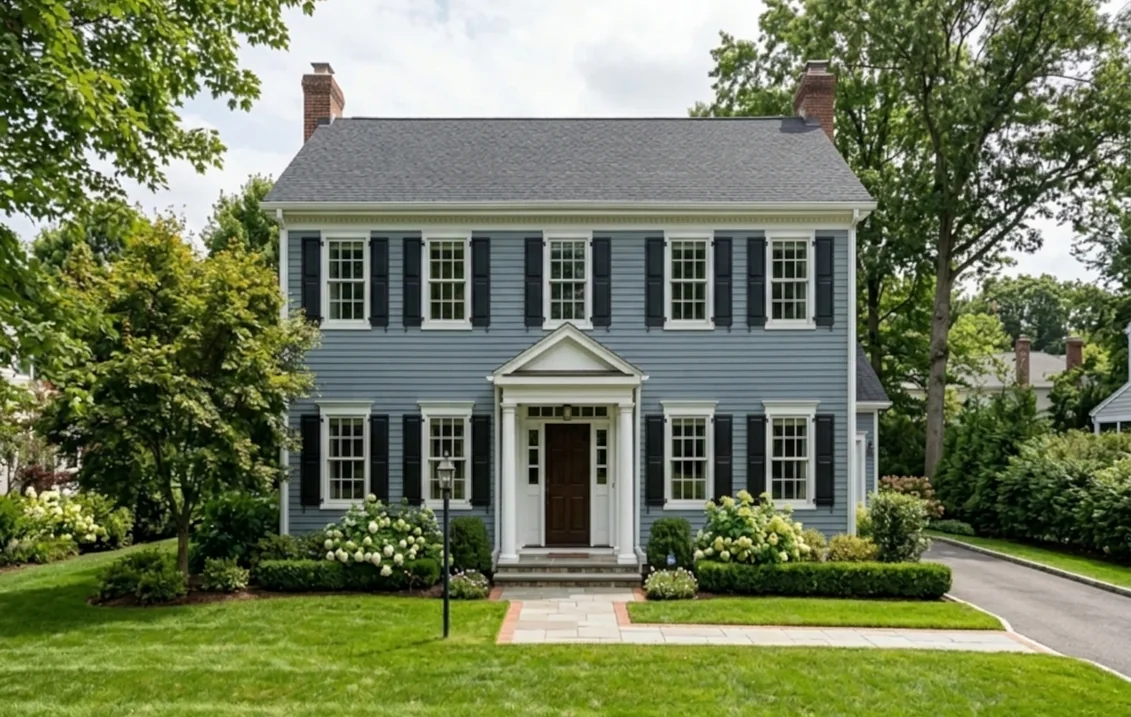
Where Smoky Blue works on a house
- Body color on wood clapboard, fiber cement or stucco. Its natural home: a Colonial, Cape Cod or farmhouse in Smoky Blue with white trim reads classic and calm, darker than the usual pastel blue houses but softer than navy.
- Lower story or board-and-batten accent. On a two-tone house, Smoky Blue grounds the base or a bump-out while a lighter gray from its strip covers the rest.
- Front door. On a white, light gray or greige house it gives a quiet colored door that is not as stark as black. Sherwin-Williams' own front door color ideas lean on deeper blues and blacks for the same effect; our Sherwin-Williams front door colors guide compares them.
- Shutters. Smoky Blue shutters on white or pale gray siding are softer than black ones; see our shutter color guide for body and shutter pairings.
- Red brick homes. On the trim, door and shutters of a red brick house, the cool blue-gray balances the warm brick.
- Vinyl siding. Not with ordinary paint: see the next section.
Smoky Blue on vinyl siding: the LRV 56 rule
Vinyl siding expands as it heats, and a dark coat makes it hotter than the factory color it was designed for. Sherwin-Williams' product data sheets for Duration, Emerald Exterior and SuperPaint all carry the same instruction: do not paint vinyl with any color darker than the original, or with an LRV below 56, unless you use its VinylSafe colors, because the vinyl may warp. The Duration Exterior data sheet is one example.
Smoky Blue, at 14.6, is far below 56, and it is not in the VinylSafe palette, a separate collection of about 100 colors coded SWVS that Sherwin-Williams formulates to resist warping and buckling on sound vinyl. The page explains that before VinylSafe, homeowners could only repaint vinyl the same color or lighter. None of the VinylSafe names is Smoky Blue; if you want a dark blue-gray on vinyl, choose from that palette and compare it with Smoky Blue on a sample board. Vinyl siding itself is made to ASTM D3679, the standard that covers its expansion and surface distortion; the industry certification program is now run by the Polymeric Exterior Products Association, formerly the Vinyl Siding Institute. Our full VinylSafe guide covers the palette and the products it comes in.
Trim, door and shutter colors with a Smoky Blue body
| Role | Color | LRV | Effect |
|---|---|---|---|
| Trim (crisp) | Pure White SW 7005 | 83.96 | Maximum contrast, classic Colonial look |
| Trim (coordinating) | Ice Cube SW 6252 | 77.49 | Sherwin-Williams' own pairing, a slightly cool white |
| Trim (softer) | Egret White SW 7570 | 69.64 | Lower contrast, warmer, kinder to an older house |
| Trim (warm) | Alabaster SW 7008 | 82.2 | Creamier white; see our Alabaster exterior guide |
| Shutters | Tricorn Black SW 6258 or the body color | n/a | Black adds definition; body-color shutters keep it quiet |
| Front door | Natural stained wood, black, or a muted red | n/a | Warm wood is the easiest contrast to a cool body |
The bigger the gap between body and trim, the more the house's architecture shows. Pure White against Smoky Blue is a gap of nearly 70 points: dramatic on a symmetrical Colonial, busy on a house with a lot of trim. Egret White halves the drama.
Which Sherwin-Williams product, and when to paint
Figures from the product pages and data sheets:
| Product | Sheens | Minimum temperature | Dry / recoat (above 45°F) | Coverage per gallon |
|---|---|---|---|---|
| Duration Exterior | Flat, Low Lustre, Satin, Gloss | 35°F, 5°F above dew point | 1 h / 4 h | 250 to 300 sq ft |
| Emerald Exterior | Flat, Satin, Gloss | 35°F | 1 h / 4 h | 250 to 300 sq ft |
| SuperPaint Exterior | Flat, Low Lustre, Satin, Gloss, High Gloss | 35°F | 2 h / 4 h | 350 to 400 sq ft |
| Emerald Urethane Trim Enamel | Gloss, Satin, Semi-Gloss | 50°F | 2 h / 4 h | 350 to 400 sq ft |
Duration and Emerald Exterior should not be applied if the temperature may fall below 35°F within 48 hours, and between 35 and 45°F the recoat time stretches to 24 to 48 hours. That makes a fall paint job possible on a dry, mild week, with the day's work finished early enough for the surface to dry before dew. Emerald Urethane Trim Enamel is for exterior doors, trim and small areas of wood or metal only, not for the body of the house: a good choice for a Smoky Blue front door. Our comparison of SuperPaint vs Emerald and the Duration Exterior guide go deeper on the lines.
If the house was built before 1978, assume the old paint may contain lead. Under the EPA's Renovation, Repair and Painting Program, contractors paid to disturb painted surfaces in pre-1978 homes must be certified and follow lead-safe practices; the rule generally does not apply to homeowners working on their own home, but the same precautions protect your family.
How much Smoky Blue do you need?
- Body of a two-story house. Take 1,800 sq ft of siding after subtracting windows and doors. Two coats make 3,600 sq ft; at 250 to 300 sq ft per gallon of Duration or Emerald Exterior that is 12 to 15 gallons, so three 5-gallon buckets. Rough cedar or stucco can push it higher.
- Front door. A 3 by 7 ft door is 21 sq ft per face, about 45 sq ft with the edges and frame. Two coats make 90 sq ft. At 350 to 400 sq ft per gallon of trim enamel, one quart covers roughly 87 to 100 sq ft: buy two quarts so you are not short on the last coat.
- Shutters. Eight louvered shutters take more paint than their size suggests; one gallon is usually enough for two coats on both faces.
How to test Smoky Blue before you commit
- Paint two coats on a 2 by 2 ft board, not a chip: the color looks darker on a large area than on a swatch.
- Look at it against each side of the house at morning, noon and evening, and on an overcast day.
- Hold your trim white against it, and the roof and any brick or stone in the same view.
- Put Slate Tile and Distance next to it if you are unsure whether you want grayer or bluer.
- Try it on a photo of your own house before buying a single gallon.
See Smoky Blue on your siding, door or shutters
Upload a photo of your house and compare Smoky Blue with Slate Tile, Distance or Naval in a few seconds, then order samples only for the one that works with your roof and trim.
Try Smoky Blue on my front doorFor the wider Sherwin-Williams exterior range, start with our Sherwin-Williams exterior paint guide.
Sources and references
- Sherwin-Williams, SW 7604 Smoky Blue: LRV, RGB, hue, color family, strip location, use and coordinating colors.
- Sherwin-Williams, VinylSafe colors for vinyl siding: the palette, its purpose and the products it comes in.
- Sherwin-Williams, Duration Exterior product data sheet: the LRV 56 rule for vinyl, application temperatures and recoat times.
- Sherwin-Williams, product pages for Duration Exterior, Emerald Exterior, SuperPaint Exterior and front door paint colors: sheens, coverage and door color ideas.
- Benjamin Moore, color pages for Blue Spruce 1637 and Thousand Oceans 1645: LRV and screen values of the closest Benjamin Moore colors.
- ASTM International, D4803, Standard Test Methods for Predicting Heat Buildup in PVC Building Products and D3679, Standard Specification for Rigid PVC Siding: darker colors and heat buildup, and the vinyl siding standard.
- Polymeric Exterior Products Association, certified siding products: the certification program formerly run by the Vinyl Siding Institute.
- Simpson Door Company, Paint it black: LRV under 55 as the definition of a dark exterior door color.
- U.S. Environmental Protection Agency, Lead Renovation, Repair and Painting Program: pre-1978 homes and certified contractors.
Frequently asked questions
What color is Sherwin-Williams Smoky Blue?
Is Smoky Blue a good exterior color?
Can I paint vinyl siding Smoky Blue?
What is the difference between Smoky Blue and Slate Tile?
What trim color goes with Smoky Blue?
What is the Benjamin Moore equivalent of Smoky Blue?
Trademarks mentioned (Sherwin-Williams, Benjamin Moore, Behr, Caparol, Brillux, Sto, Alpina, Valspar, PPG, Glidden, Dulux, Crown Trade, Sandtex, Farrow & Ball, Johnstone's, Leyland) are property of their respective owners. FacadeColorizer is independent and not affiliated with any of them. Nominative fair use under Lanham Act §1125.