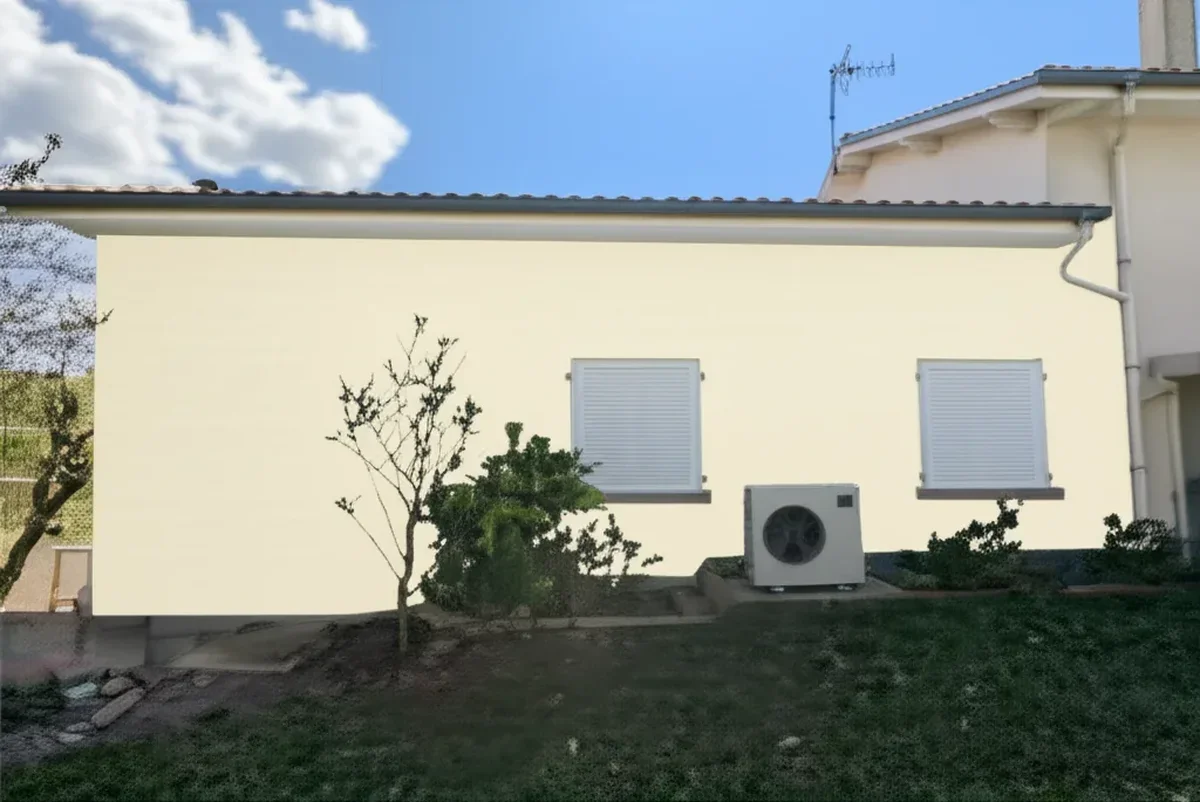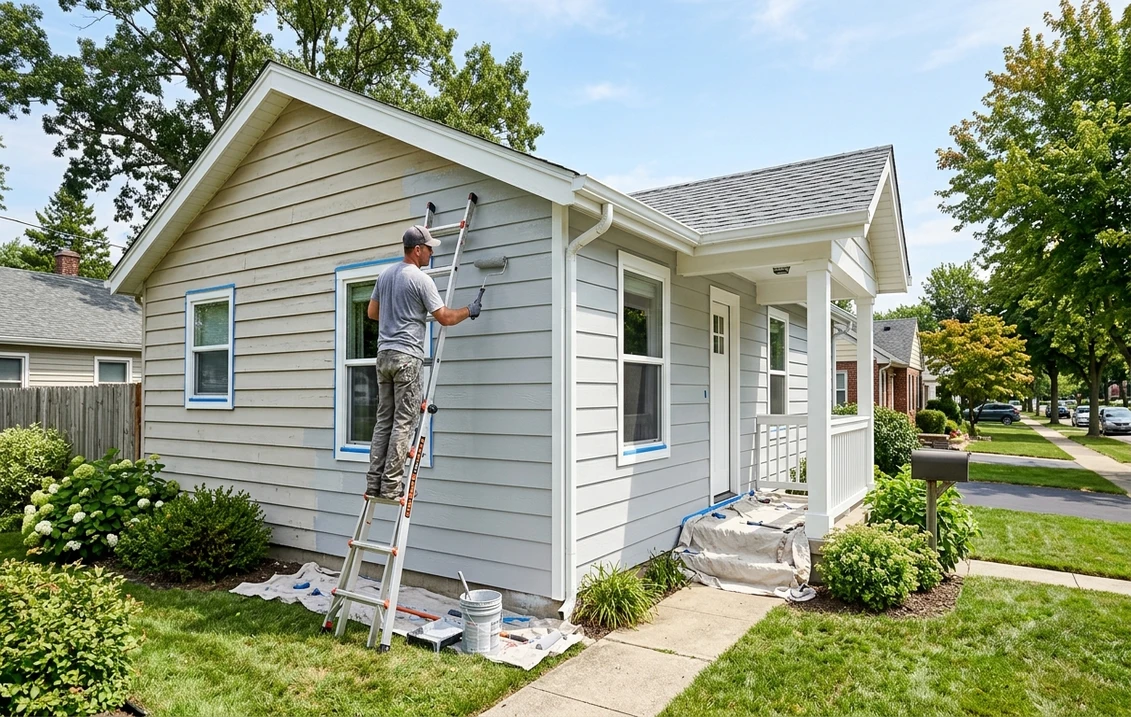
Try it on your house

A-100 is the exterior paint Sherwin-Williams sells when the budget comes before the brochure: a 100 percent acrylic latex that costs less than SuperPaint, Duration or Emerald, carries a 15-year limited warranty, and goes on down to 35 degrees F. It is also the line that generates the most "was that a mistake?" questions, because it is sold as a topcoat only and behaves like one. This guide covers what A-100 actually is, what the warranty says when you read it in full, where the line earns its price on a real house, where it does not, and how to decide between A-100 and SuperPaint on your own job.
Upload one photo and see the color on your own siding in about 30 seconds, free.
What A-100 is, in Sherwin-Williams' own words
On its A-100 product page, Sherwin-Williams describes the line as "a 100% acrylic latex paint formula that covers well and lasts", offering "trusted performance at a great value", and as "a proven performer with good hide, adhesion and color retention" that is "efficient coverage and great for routine color changes". The sheens are flat, satin, low sheen and gloss, with the gloss positioned for "windows, doors and trim". Two technical claims matter more than the adjectives: the line can be applied at temperatures down to 35 degrees F, and it carries a 15-year limited warranty. The phrase "routine color changes" is the honest positioning: A-100 is the paint for repainting a sound, previously painted house in a new color, not for rescuing a failing surface.
| Spec | A-100 Exterior Acrylic Latex |
|---|---|
| Resin | 100 percent acrylic latex |
| Sheens | Flat, low sheen, satin, gloss (no high gloss) |
| Low-temperature application | Down to 35°F |
| Warranty | 15-year limited, peeling or blistering only |
| Primer | Not self-priming; bare or chalky surfaces need a primer |
| Coverage quoted by reviewers | Roughly 350 to 400 sq ft per gallon, two coats recommended |
| Position in the range | Entry level, below SuperPaint, Latitude, Duration and Emerald |
Try it on your house
No photo? Try a sample
The 15-year warranty, read word for word
"15-year warranty" is the number on the can; the warranty document itself is narrower than the number suggests, and it is worth quoting. The coverage: "if this product, when applied according to product application instructions to a properly prepared exterior surface, peels or blisters within 15 years from the date of purchase", Sherwin-Williams will "either replace an equivalent quantity of product sufficient to repair the peeling or blistering free of charge or refund the original purchase price". Three things follow. First, the warranty covers peeling and blistering only; fading, chalking, mildew and dirt pickup are not mentioned, so the color going dull in year six is not a warranty event. Second, it "shall not apply to any defect or damage resulting from improper surface preparation, structural defects, failure of a previous paint or improper application", which in practice means a failure over an unprimed or chalky surface is the owner's problem. Third, it "excludes labor or costs associated with labor", is "made to the original residential consumer paint purchaser" and "is not transferable": the remedy is paint or a refund of the paint, never the cost of repainting.
None of that is unusual; the premium lines' warranties have the same structure with longer terms. But it reframes the choice. The difference between A-100's 15 years and SuperPaint's limited lifetime term is a difference in how long you can claim free replacement paint for peeling, not a promise about how long the color will look good. The question that actually decides the purchase is how the film holds up to sun and weather, and on that the warranty says nothing.
A-100 versus SuperPaint: the seven differences that matter
The comparison homeowners actually make is with SuperPaint, the next step up. Prudent Reviews sets the two side by side: "A-100 is an exterior-only paint, while SuperPaint offers interior and exterior versions"; A-100 is "budget-friendly contractor-grade paint", SuperPaint the premium everyday line; SuperPaint carries higher volume solids (37 to 38 percent exterior against 34 to 37 percent for A-100), which the reviewer links to better coverage and adhesion; "SuperPaint offers a high-gloss finish, which A-100 lacks"; and on warranty, "SuperPaint comes with Sherwin-Williams' limited lifetime warranty" while "A-100 has a more limited 15-year warranty". The price gap in that comparison was about $16.50 per gallon at list ($72.99 against $56.49 in flat).
Volume solids is the number worth understanding. It is the share of the can that stays on the wall after the water evaporates; a few points more solids means a slightly thicker dry film per coat, better hide in one pass and more resin to resist weather. The gap between A-100 and SuperPaint is small on paper, and on a sound, primed surface in a mild climate it is hard to see. On a south wall in Arizona or a coastal wall in Florida, the premium film is the one that is still intact in year eight. Our SuperPaint versus Emerald comparison continues the ladder upward, and the best Sherwin-Williams outdoor paint guide puts all five exterior lines in one table.
What the price actually is, and why the quotes disagree
Published prices for A-100 vary more than for any other Sherwin-Williams line, because almost nobody pays list. The 2026 figures quoted by Fine Home Keeping are $65.49 per gallon in flat, $68.49 in satin and low sheen and $71.49 in gloss; Prudent Reviews quotes $56.49 for flat. The spread reflects store, region, sheen and the moment the page was written. Two rules hold whatever the number: the deeper bases cost more than the extra-white base, and Sherwin-Williams' regular sale events and contractor accounts take a large slice off list. On a whole-house job the gap between A-100 and SuperPaint after discounts is usually a few hundred dollars of paint, which is why so many painters simply specify SuperPaint; the extra is small next to labor. Our exterior paint cost guide shows how paint sits inside the total.
How A-100 shows up in a contractor's quote
A-100 is sold first to painting contractors, and that is where most of it goes: it is the line that lets a painter hit a low bid on a rental turnover, a new-construction builder spec or a one-color repaint where the customer has said "cheapest that lasts". When a quote names A-100 without being asked, read the rest of the line items. A competent bid pairs it with a separate primer line for bare and patched areas and two topcoats; a bid that lists A-100, one coat and no primer is pricing a short-lived job. Ask for the same quote with SuperPaint substituted; on a typical two-story house the paint difference is a few hundred dollars against a labor bill in the thousands, and that comparison tells you whether the painter chose A-100 for your budget or for theirs. Our exterior painting cost guide shows what share of a quote the paint represents.
One more detail from the contractor side: A-100 is a popular choice for spray application on new construction because it atomizes easily and dries fast enough to back-roll. On a repaint of weathered siding that advantage disappears, because the surface, not the paint, sets the pace.
The primer rule: the reason most A-100 complaints exist
A-100 is not a self-priming paint, and Fine Home Keeping puts the consequence bluntly: "A-100 exterior latex paint will not work as a primer besides a paint", so bare wood, chalky old paint, patched areas and tannin-rich woods such as cedar and redwood need a separate primer before the first coat. The premium lines absorb some of that sin because their formulas are thicker and more adhesive; A-100 does not. Skip the primer on cedar and the tannins bleed through in brown streaks within the first season; skip it on chalky siding and the warranty exclusion for "improper surface preparation" applies to the peeling that follows. The practical sequence for a budget job is therefore the same as for a premium one, minus the paint price: wash, scrape, sand, prime the bare and chalky areas with an exterior acrylic or oil-based primer as the surface requires, then two coats of A-100. Done that way, the reviewers who have used it describe it as a dependable, if plain, performer; done without the primer, it is the paint people blame for a preparation problem.
Where A-100 is the right call
A sound, previously painted house in a moderate climate, repainted in a similar or lighter color, with a tight budget or a short ownership horizon: a rental, a flip, a house going on the market, an outbuilding, a fence. Prime the bare spots, apply two coats, and the result will look like any other Sherwin-Williams acrylic for years.
Where to spend more instead
- Dark colors in strong sun. Low-LRV colors push a film hard; chalking and fading show first on budget acrylics. A deep navy, charcoal or bronze body belongs in Duration or Emerald. Our dark exterior colors guide explains why.
- Problem surfaces. Chalky stucco, weathered wood, previously peeling paint: the thicker, more adhesive premium lines tolerate what A-100 cannot, and Duration's one-coat claim over a sound surface changes the labor math. See our Duration Exterior review.
- Unstable weather windows. A-100's 35°F floor is real, but early rain resistance is where Latitude earns its price; a shower an hour after application is a bigger risk on A-100.
- A house you plan to keep for 15 years. When labor is the cost that matters, a premium film that postpones the next repaint by several years is cheaper per year than the budget can. The Emerald Exterior review makes that calculation.
- Vinyl siding in a darker color. Any line is fine on vinyl in a light color; a darker shade needs the VinylSafe palette, which A-100 does not carry. Our VinylSafe colors guide lists the lines that do.
Sheen choice on an A-100 job
Because A-100's film is thinner than the premium lines', sheen choice does a little more of the work. Flat hides surface flaws best and is the usual pick for older siding with patched areas, but it holds dirt and chalks sooner; satin or low sheen on the body sheds water and dirt better and is the sensible default for most houses; gloss belongs on doors and trim, where the harder film takes handling. Keep one sheen on all body walls, because A-100 in two sheens side by side will read as two slightly different colors. Our guide to exterior paint finishes covers the trade-offs in detail.
How to decide on your own house
- Walk the siding and press a damp finger on a sunny wall. White powder on the finger means chalk: primer everywhere, and a strong case for a premium line.
- Decide the color first. Upload a photo and render the finalists; if the winner is dark, move up a line before you price the job.
- Count the years. Selling within five years, A-100 is rational; keeping the house, the premium line is cheaper per year.
- Price both. Ask the store for A-100 and SuperPaint in the same base, with the current promotion applied; the gap is often smaller than the list prices suggest.
- Whatever you choose, do not skip the primer on bare wood and patched areas. It is the one step the warranty will hold against you.
- Check the substrate against the line. Fiber cement, wood, stucco and masonry are all within A-100's brief; previously coated metal needs the surface rust-free and primed; vinyl is fine in a light color only.
- Keep the receipt and the can label. The warranty requires proof of purchase at the store where the paint was bought, and a photo of the batch number makes a future touch-up match far easier.
Free preview on your photo, no account needed for the first simulation.
Sources and references
- Sherwin-Williams, A-100 Exterior Acrylic Latex Paint: product description, sheens, 35°F application, 15-year warranty claim.
- Sherwin-Williams, A-100 Exterior Acrylic Latex 15-Year Limited Warranty: coverage (peeling, blistering), exclusions, remedy, non-transferability.
- Prudent Reviews, Sherwin-Williams A-100 vs. SuperPaint: the seven differences, volume solids, sheens, list prices, warranty terms.
- Fine Home Keeping, Sherwin-Williams A100 review: 2026 prices by sheen, primer requirement, coverage, two-coat recommendation.
Frequently asked questions
Is Sherwin-Williams A-100 a good exterior paint?
What does the A-100 15-year warranty cover?
A-100 or SuperPaint: which should I buy?
Do I need a primer with A-100?
Trademarks mentioned (Sherwin-Williams, Benjamin Moore, Behr, Caparol, Brillux, Sto, Alpina, Valspar, PPG, Glidden, Dulux, Crown Trade, Sandtex, Farrow & Ball, Johnstone's, Leyland) are property of their respective owners. FacadeColorizer is independent and not affiliated with any of them. Nominative fair use under Lanham Act §1125.