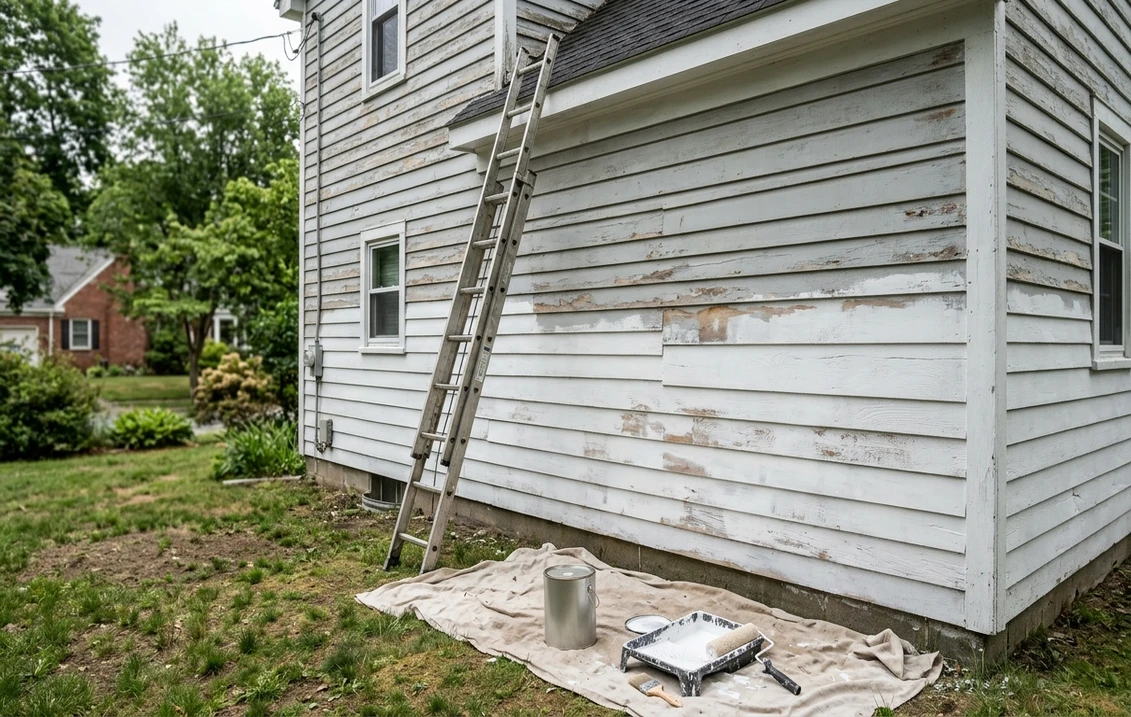

Sherwin-Williams ProBlock is a family of stain-blocking primers, not one product. The one most people mean is ProBlock Premium All-Purpose Water-Based Interior/Exterior Primer (B51-620 series, formerly PrepRite ProBlock): a styrenated acrylic latex that covers 400 sq ft per gallon, takes a topcoat after 1 hour (4 hours over a stain), goes on down to 35°F and comes in White and Deep Base. Outdoors its data sheet lists wood, glossy old paint, aluminum, galvanized metal and masonry, then sets a limit: for a complete whole-house primer it names Sherwin-Williams' exterior wood primers instead.
How this page works: every figure comes from Sherwin-Williams data sheets and catalog pages, the Master Painters Institute, the American Coatings Association, EPA and the Western Red Cedar Lumber Association, read on November 14, 2026. Calculations are ours and labeled as such. No primer was applied for this page. Prices are the list prices shown on sherwin-williams.com that day.
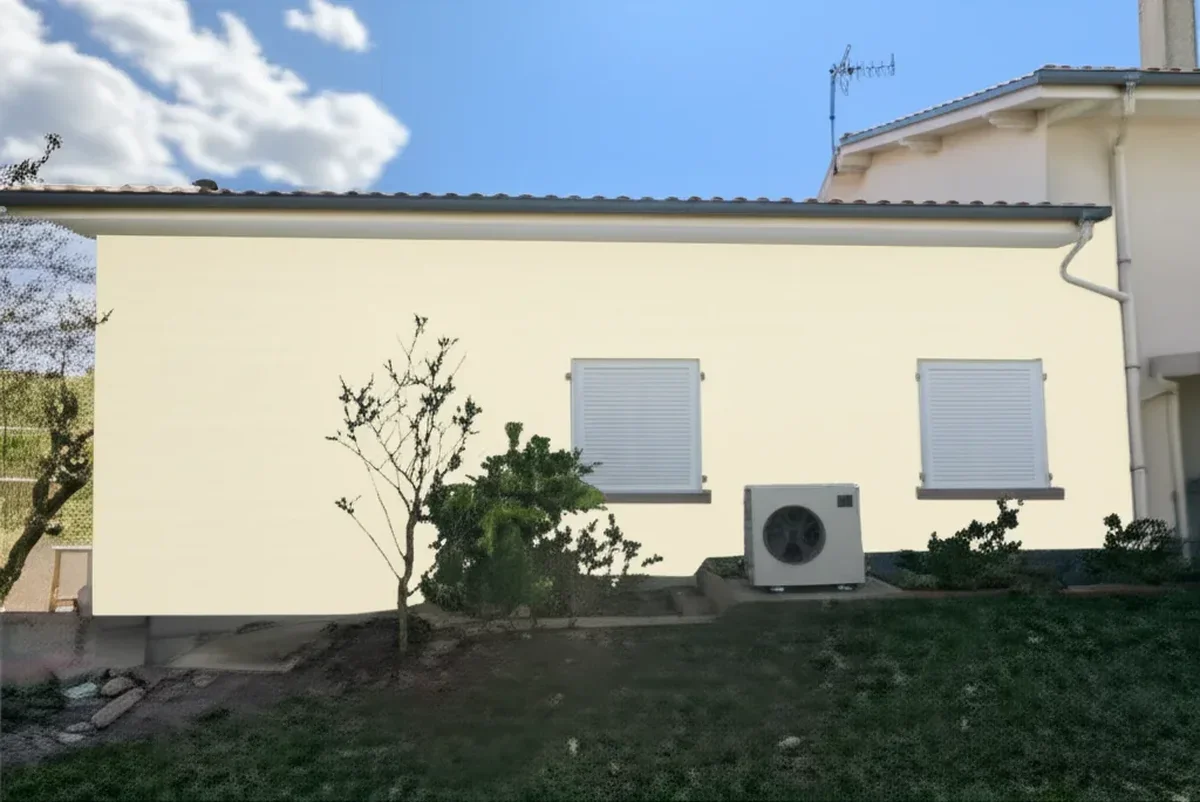
The tool shows a paint color on a photo of your house. It does not show primer or test adhesion. How it works: our exterior paint visualizer.
Which ProBlock is which: four interior/exterior versions
The Sherwin-Williams catalog carries four ProBlock primers rated for interior and exterior work, each with its own data sheet: ProBlock Premium All-Purpose Water-Based (sheet 108.04B, 10/2026), ProBlock Quick Dry Water-Based (108.6, 09/2026), ProBlock Quick Dry Oil-Modified (109.61, 5/2026) and ProBlock 100 Oil-Modified Low VOC (109.62, 5/2026). PrepRite ProBlock is the old name of the first one: its sheet header reads "Formerly PrepRite ProBlock". Three more ProBlock primers are interior only, covered near the end of this page.
| Spec (data sheet) | Premium All-Purpose Water-Based | Quick Dry Water-Based | Quick Dry Oil-Modified | ProBlock 100 Oil-Modified Low VOC |
|---|---|---|---|---|
| Product number | B51W00620 White, B51W00623 Deep Base | PB28W0100 | PB11W0100 | PB19W0100 |
| Resin | Styrenated acrylic latex | Vinyl acrylic | Oil-modified water-based acrylic | Oil-modified water-based acrylic |
| Coverage at 4 mils wet | 400 sq ft/gal, 1.4 mils dry | 400 sq ft/gal, 0.9 mils dry | 400 sq ft/gal, 1.5 mils dry | 400 sq ft/gal, 1.5 mils dry |
| Application temperature | Down to 35°F | Above 50°F | Above 40°F | Above 40°F |
| Touch dry (77°F, 50% RH) | 30 minutes | 30 minutes | 1 hour | 1 hour |
| Recoat as a primer | 1 hour | 1 hour | 2 hours | 2 hours |
| Recoat over a stain | 4 hours | 4 hours | 24 hours | 24 hours |
| VOC | Less than 50 g/L | Less than 50 g/L | 75 g/L | 75 g/L |
| Tinting | White 0 to 4 oz/gal, Deep Base 4 to 12 oz/gal | Up to 4 oz/gal | Up to 4 oz/gal | Up to 4 oz/gal |
| MPI listings on the sheet | #3, 6, 17, 39, 134, 137 | #50, 149 | None | None |
Try it on your house
- 1Your photoPhoto
- 2Your colorColor
- 3HD render in ~30 sHD render in ~30 s
Your photo is used only to create your preview. JPG, PNG, HEIC (iPhone)
The table corrects three things that quick summaries of "ProBlock" get wrong. Application at 35°F belongs to Premium only: Quick Dry Water-Based needs more than 50°F, the oil-modified pair more than 40°F. White and Deep Base is Premium only, the other three are white. And the "dries in 1 hour" line on the Quick Dry Oil-Modified product page is the touch-dry time. Its sheet asks for 2 hours before a topcoat and 24 hours when the primer is holding back a stain.
The two oil-modified sheets print the same numbers line for line. Only the wording differs: Quick Dry Oil-Modified names "water, smoke, fire, knots and tannin bleed", ProBlock 100 names "nicotine, smoke and water" plus tannin. Neither is a solvent-borne oil primer: the resin is an oil-modified water-based acrylic, and the ProBlock 100 page promises soap-and-water cleanup. For primer families in general, see our guide to the four exterior primer types.
What the ProBlock Premium sheet allows outdoors
The ProBlock Premium product page presents it as an all-purpose primer that helps topcoats adhere to slick, glossy surfaces. The sheet lists the surfaces for interior and exterior use: wood, aluminum, galvanized metal, previously painted surfaces, PVC piping, drywall, concrete and masonry, many plastics, glossy surfaces, fiberglass, copper and glazed block.
Then comes the sentence that matters: "For a complete whole house primer outside, use Exterior Latex Wood Primer or Exterior Oil-Based Wood Primer." The Quick Dry Water-Based sheet agrees: "For better performance when priming an entire house, use Exterior Latex or Oil-Based Primers." Our reading of those two sentences: outdoors, ProBlock is a spot and problem-surface primer, for scraped patches, a glossy door, aluminum trim, a galvanized downspout or a stained area.
- Topcoat window. For exterior exposure, all four sheets require a topcoat within 14 days.
- Topcoats named on the Premium sheet include A-100 Exterior Latex, Duration Exterior, Emerald Exterior and SuperPaint Exterior. Our pages on A-100 Exterior, Duration Exterior and SuperPaint vs Emerald cover those finishes. Emerald Rain Refresh names its own primers by surface on its data sheet: see our Emerald Rain Refresh guide.
- Spot priming can show. Each sheet warns that primed and unprimed areas hold out the finish differently, and advises priming the entire surface.
- Plastic and vinyl. Premium lists "many plastics". Quick Dry Water-Based says: "Not for use on vinyl or other plastic surfaces."
Bleeding wood: cedar, redwood and knots
Cedar and redwood carry water-soluble extractives, the brown color that comes through fresh paint. A joint committee of coatings and forest products specialists, two U.S. Forest Service researchers among them, explains the mechanism in "Understanding Extractive Bleed" (CoatingsTech, American Coatings Association, March 2010): water is the primary cause, most of the extractives move into the paint while the film is still wet, and knots hold the highest concentration. Its prevention list: lumber dried below 19% moisture content, wood kept dry before and during finishing, a stain-blocking primer, and a coated back side on siding. It adds that oil-alkyd primers have traditionally blocked best and that waterborne stain blockers, as of 2010, did not work as well.
The ProBlock sheets are consistent with that:
| Primer | What its sheet says about cedar, redwood and knots |
|---|---|
| ProBlock Premium Water-Based | Seals "minor dried water stains and tannin". On redwood and cedar it "can be used" after a test: prime a 4 ft by 4 ft section. No bleeding within 4 hours, carry on. Bleeding, use Exterior Oil-Based Wood Primer. |
| ProBlock Quick Dry Water-Based | No tannin claim. Its stain list is crayon, permanent marker, pencil, mustard, ketchup and tea. |
| ProBlock Quick Dry Oil-Modified and ProBlock 100 | "Wood, including Cedar" is on the surface list. Prime, wait 24 hours, test a small area with the topcoat. If the stain comes through: second coat, dry overnight, test again. |
| Exterior Latex Wood Primer (not a ProBlock) | Tannin is trapped in the first coat. Test after 4 hours. "Knots may need to be sealed with White Pigmented Shellac." |
| Exterior Oil-Based Wood Primer (not a ProBlock) | "Blocks stains from water, wood tannins and knots." Lists cedar and redwood. Spot primer or overall primer. |
First the wood has to be sound: the Premium sheet says to sand weathered wood to a fresh surface and replace deteriorated wood. The Western Red Cedar Lumber Association's cedar siding finishing guide puts a number on it: surface preparation is seldom needed on new cedar provided the wood has not weathered for more than two weeks and is clean and dry. Paint or stain on shakes? See our page on cedar shake siding colors, stain and paint.
Chalky paint, glossy paint, metal and masonry
Chalky old paint. No ProBlock sheet claims to bind chalk. All four say the same: wash off surface contamination with an appropriate cleaner, rinse thoroughly and let dry. If the wall still leaves powder on your hand, it needs a product whose sheet makes a binding claim, such as the one on our Zinsser Peel Stop page. Our pressure washing cost guide covers the wash.
Peeling paint. "Scrape and sand peeled or checked paint to a sound surface", and the sheets caution that anything short of total removal may shorten the life of the system. Every sheet carries a lead warning: in a house built before 1978, read EPA's lead-safe guidance for DIYers before scraping. See also our guide to lead paint testing in pre-1978 homes.
Glossy old paint. Premium "assures adhesion of the topcoat to slick, glossy surfaces", and the Master Painters Institute lists it in category MPI #17, "Primer, Bonding, Water Based". The sheet still asks you to sand glossy surfaces dull and to test: a patch of 2 to 3 sq ft, dried for 1 week before checking adhesion.
Metal. Aluminum, galvanized metal and copper are on the Premium list, and MPI lists it among water-based galvanized primers (#134). Quick Dry Water-Based lists aluminum and galvanized steel. The oil-modified sheets list no metal, and no ProBlock sheet we read mentions bare or rusty steel. For a wall of old metal siding, our aluminum siding painting guide goes through the prep.
Masonry. Premium lists concrete and masonry and sits in MPI #3, alkali-resistant water-based primers. Quick Dry Water-Based is stricter: masonry, stucco and cement must be at pH 6 to 9, dry (moisture content 15% or lower) and cured, usually about 30 days. If painting cannot wait, it names Loxon Concrete & Masonry Primer after 7 days of cure. Our Loxon stucco guide covers that line.
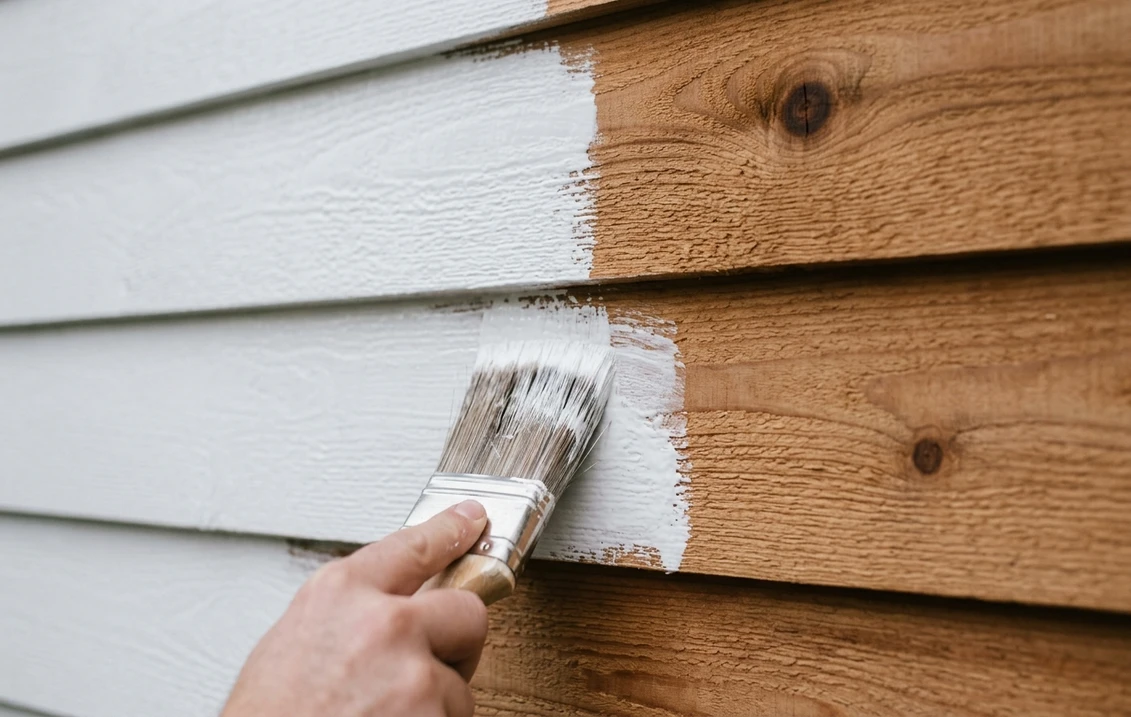
Applying ProBlock Premium outside
- Temperature. Air, surface and material above 35°F and at least 5°F above the dew point. Air and surface must stay at 35°F or more for 48 hours after application, and at 35°F air temperature the wall itself may be colder.
- Rain. Avoid using it if rain or snow is expected within 2 to 3 hours.
- Brush and roller. A nylon-polyester brush (see our exterior brush guide) and a 3/8 inch nap soft woven cover.
- Airless spray. 2,000 psi with a 0.015 to 0.021 inch tip.
- Recoat. 1 hour as a general primer, 4 hours when it is sealing a stain, both at 77°F and 50% relative humidity. Cold, damp days take longer.
- Stain check. After 4 hours, paint a small area with the topcoat. If the stain bleeds: second coat, dry overnight, test again.
- Caulk goes on after priming, per the sheet. See our exterior caulk guide.
How much ProBlock to buy
All four sheets give 400 sq ft per gallon at 4 mils wet. By our calculation that is the geometry of the film: a gallon spread 1 mil thick covers about 1,604 sq ft, so 4 mils gives 401 sq ft with nothing lost to the roller or a rough surface. Rough-sawn cedar will take more. The second column adds a 25% allowance, which is our assumption, not a Sherwin-Williams number.
| Area, one coat (our calculation) | At the sheet figure (400 sq ft/gal) | With a 25% allowance (300 sq ft/gal) |
|---|---|---|
| 150 sq ft (scraped patches, a door, trim) | 0.4 gal: 2 quarts | 0.5 gal: 2 quarts |
| 500 sq ft (one elevation) | 1.25 gal | 1.7 gal |
| 1,500 sq ft | 3.75 gal | 5 gal |
Same coverage, different film: at 4 mils wet, Quick Dry Water-Based leaves 0.9 mils dry and Premium 1.4 mils, about a third less primer on the wall (our calculation).
ProBlock price: where Sherwin-Williams shows it
The product pages show no price to a visitor who is not signed in: they ask you to register or sign in to confirm pricing. The catalog listing pages are different. On November 14, 2026, the exterior primers list and the interior primers list displayed a "List Price" per gallon under each product, without sign-in. The site says these prices are for U.S. Sherwin-Williams locations and exclude taxes. Your store may charge a different amount.
| Primer | List price per gallon (sherwin-williams.com, Nov 14, 2026) | Per sq ft at sheet coverage (our calculation) |
|---|---|---|
| ProBlock Quick Dry Water-Based | $23.99 | 6.0 cents |
| ProBlock Premium All-Purpose Water-Based | $44.49 | 11.1 cents |
| ProBlock Quick Dry Oil-Modified | $55.99 | 14.0 cents |
| ProBlock 100 Oil-Modified Low VOC | $62.99 | 15.7 cents |
| Exterior Latex Wood Primer | $79.49 | 19.9 cents |
| Exterior Oil-Based Wood Primer | $80.49 | 20.1 to 23.0 cents (350 to 400 sq ft/gal) |
| Extreme Bond Primer | $90.49 | 18.1 to 20.1 cents (450 to 500 sq ft/gal) |
ProBlock, Extreme Bond or an oil primer?
Three other Sherwin-Williams primers sit next to ProBlock on exterior jobs: Extreme Bond (sheet 108.51A, 10/2023), Exterior Latex Wood Primer (108.33A, 2/2026) and Exterior Oil-Based Wood Primer (109.31, 8/2024). We compare specifications, not performance.
| Spec | ProBlock Premium | Extreme Bond | Exterior Latex Wood Primer | Exterior Oil-Based Wood Primer |
|---|---|---|---|---|
| Resin | Styrenated acrylic latex | Urethane modified acrylic | 100% acrylic | Alkyd |
| Minimum temperature | 35°F | 35°F | 35°F | Above 35°F |
| Recoat (77°F unless noted) | 1 hour, 4 hours over a stain | 1 hour, 4 hours as a stain sealer | 4 hours; 24 to 48 hours at 35°F | 24 hours; 24 to 48 hours below 45°F |
| Stains | Minor dried water stains, tannin, solvent-sensitive stains | Sheet says to seal heavy stains with a primer-sealer | Tannin trapped in the first coat | Water, tannins and knots |
| VOC | Less than 50 g/L | Less than 50 g/L | 87 g/L | 318 g/L |
| Exterior limit on the sheet | Not the whole-house primer | "Do not use on large surfaces of exterior wood" | Exterior only; not for horizontal surfaces | Exterior only; not for roofs, decks or floors |
- Scraped patches on sound old paint, a glossy door, aluminum or galvanized trim: ProBlock Premium fits its own sheet.
- Glass, glazed block, ceramic wall tile, fiberglass or fluoropolymer coatings: Extreme Bond lists them, and says sanding may not be necessary on most clean, paintable surfaces. For large pre-finished metal siding its sheet names DTM Bonding Primer instead.
- A whole house of bare pine or fir: Exterior Latex Wood Primer, the product the ProBlock sheet names.
- Cedar or redwood that bled through the 4-hour test, or knots: Exterior Oil-Based Wood Primer, or an oil-modified ProBlock with its 24-hour wait.
- Check your state. The oil-based sheet marks "No" for OTC Phase II, SCAQMD and CARB compliance, so it is not sold everywhere. The four interior/exterior ProBlock sheets mark "Yes" on those lines. Our latex vs oil-based exterior paint guide explains the two chemistries.
What ProBlock does not do
- It is not the whole-house primer for bare wood. Both water-based sheets say so.
- It does not replace scraping: no sheet claims to glue down loose paint or bind chalk.
- It does not seal every stain. Premium names minor dried water stains. Quick Dry Water-Based warns that some water-sensitive stains may need an oil-based primer to seal completely.
- It is not for wet zones. The Premium sheet rules out showers, sink surrounds and countertops.
- It is not a floor or deck primer. No ProBlock sheet lists floors, decks or steps. Our page on Sherwin-Williams Porch and Floor Enamel covers painted floors.
- It cannot stay bare. Outdoors, 14 days is the limit before a topcoat.
Indoors, in short: smoke and water stains
Inside, the Premium list adds ceiling tiles, paneling, wall laminate, cured plaster, varnished woodwork, kitchen cabinets and ceramic wall tile. For fire restoration the sheet says to clean thoroughly, apply one or two coats and test a small area for bleeding. The oil-modified pair names heavier stains (smoke, nicotine, fire, water), with a 24-hour wait.
Three ProBlock primers are interior only. We read the sheet of ProBlock Quick Dry Oil-Based Interior Primer (109.6, 04/2026): a solvent-borne primer at 347 g/L VOC, applied above 50°F, recoated in 60 to 90 minutes, listed at $35.99 per gallon and marked "No" for SCAQMD and CARB. The catalog also shows ProBlock Interior Oil-Based Primer and a 12 oz ProBlock Quick Dry Oil-Based aerosol. We did not read their sheets, so we give no figures for them. For brand-by-brand interior choices, see our interior primer guide.
After the primer: the color
Each ProBlock sheet says: "For best topcoat color development, use the recommended P-shade primer." Sherwin-Williams describes its Color Prime System as a run of gray shades from light gray (P1) to the darkest (P6), with the code printed on the back of the color chip when a color needs one. So settle the finish color before the primer is tinted. Our Sherwin-Williams exterior paint guide compares the finish lines, and our guide to choosing an exterior house color covers the decision.
Pick the finish color before the primer is tinted
Upload a photo of your house and try colors on the siding, trim and front door. The preview shows color only, not primer or stains.
Try colors on my houseSources and references
- Sherwin-Williams, ProBlock Premium All-Purpose Water-Based Interior-Exterior Primer data sheet 108.04B (B51-620 series, 10/2026) and product page: surfaces, whole-house limit, cedar test, temperatures, recoat, tinting.
- Sherwin-Williams, ProBlock Quick Dry Water-Based data sheet 108.6 (PB28W0100, 09/2026): 50°F minimum, masonry pH, vinyl exclusion.
- Sherwin-Williams, ProBlock Quick Dry Oil-Modified data sheet 109.61 (PB11W0100, 5/2026), product page, ProBlock 100 Oil-Modified Low VOC data sheet 109.62 (PB19W0100, 5/2026) and product page: resin, cedar, 24-hour stain wait, VOC.
- Sherwin-Williams, ProBlock Quick Dry Oil-Based Interior Primer data sheet 109.6 (PB16W0100, 04/2026): interior-only version.
- Sherwin-Williams, Extreme Bond data sheet 108.51A (10/2023), Exterior Latex Wood Primer data sheet 108.33A (2/2026) and Exterior Oil-Based Wood Primer data sheet 109.31 (8/2024): comparison specifications.
- Sherwin-Williams, exterior primers and interior primers catalog lists: list prices per gallon.
- Sherwin-Williams, Cover Your Bases (Color Prime System): P1 to P6 gray primer shades.
- Master Painters Institute, MPI #17 approved products list (Primer, Bonding, Water Based): category titles and ProBlock Premium listings (#3, #17, #134).
- American Coatings Association, "Understanding Extractive Bleed", CoatingsTech, March 2010: cause of tannin bleed, knots, 19% moisture content, oil-alkyd vs waterborne.
- Western Red Cedar Lumber Association, How to Finish Western Red Cedar Siding: two-week weathering threshold.
- U.S. EPA, Lead-Safe Renovations for DIYers: lead-safe work in pre-1978 homes.
Frequently asked questions
Is Sherwin-Williams ProBlock primer for interior or exterior use?
Is ProBlock the same as PrepRite ProBlock?
How long does ProBlock primer need to dry before painting?
Can you use ProBlock primer on cedar siding?
How much does Sherwin-Williams ProBlock primer cost?
Is ProBlock primer oil-based or water-based?
Can ProBlock primer be tinted?
Trademarks mentioned (Sherwin-Williams, Benjamin Moore, Behr, Caparol, Brillux, Sto, Alpina, Valspar, PPG, Glidden, Dulux, Crown Trade, Sandtex, Farrow & Ball, Johnstone's, Leyland) are property of their respective owners. FacadeColorizer is independent and not affiliated with any of them. Nominative fair use under Lanham Act §1125.