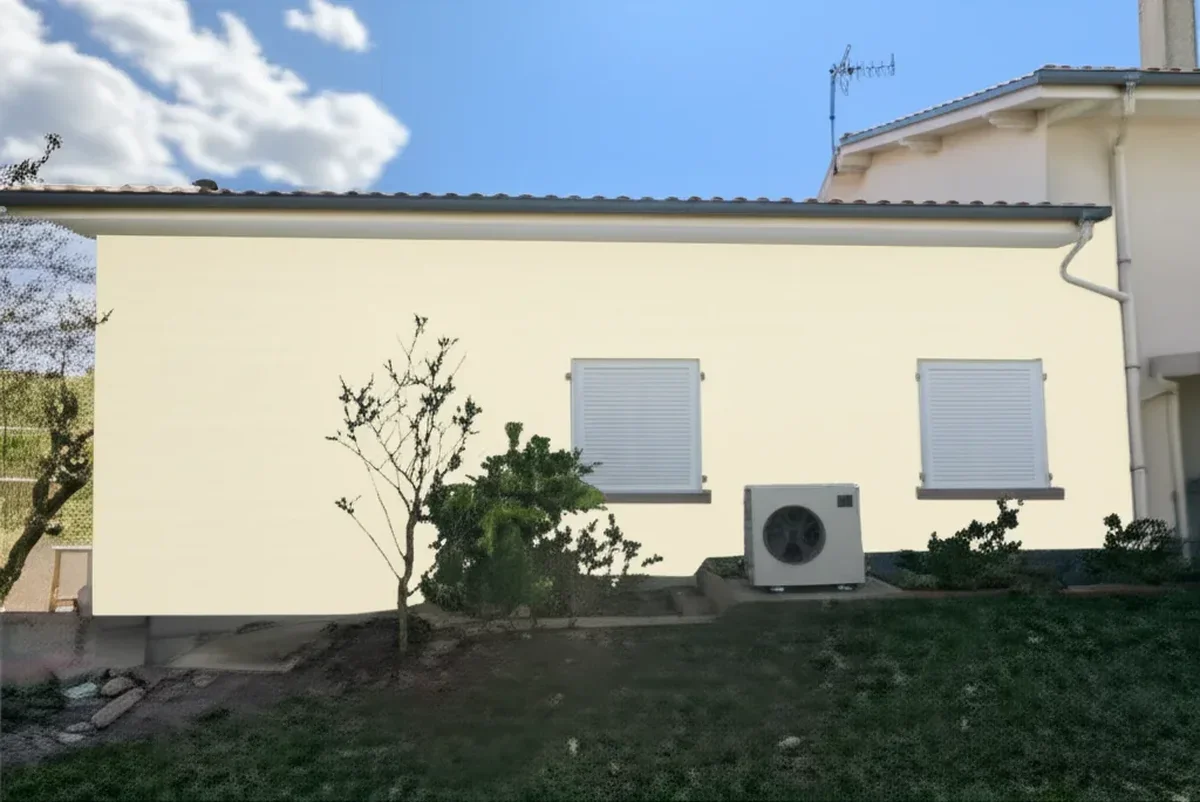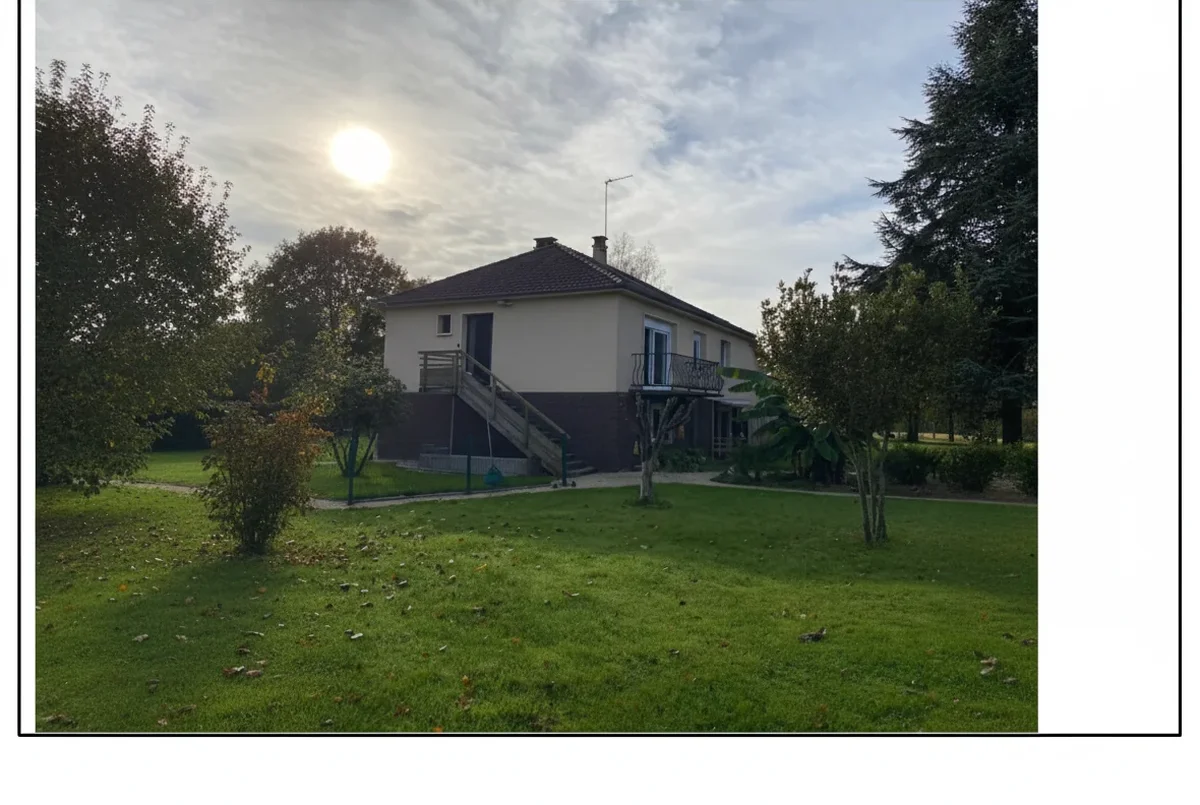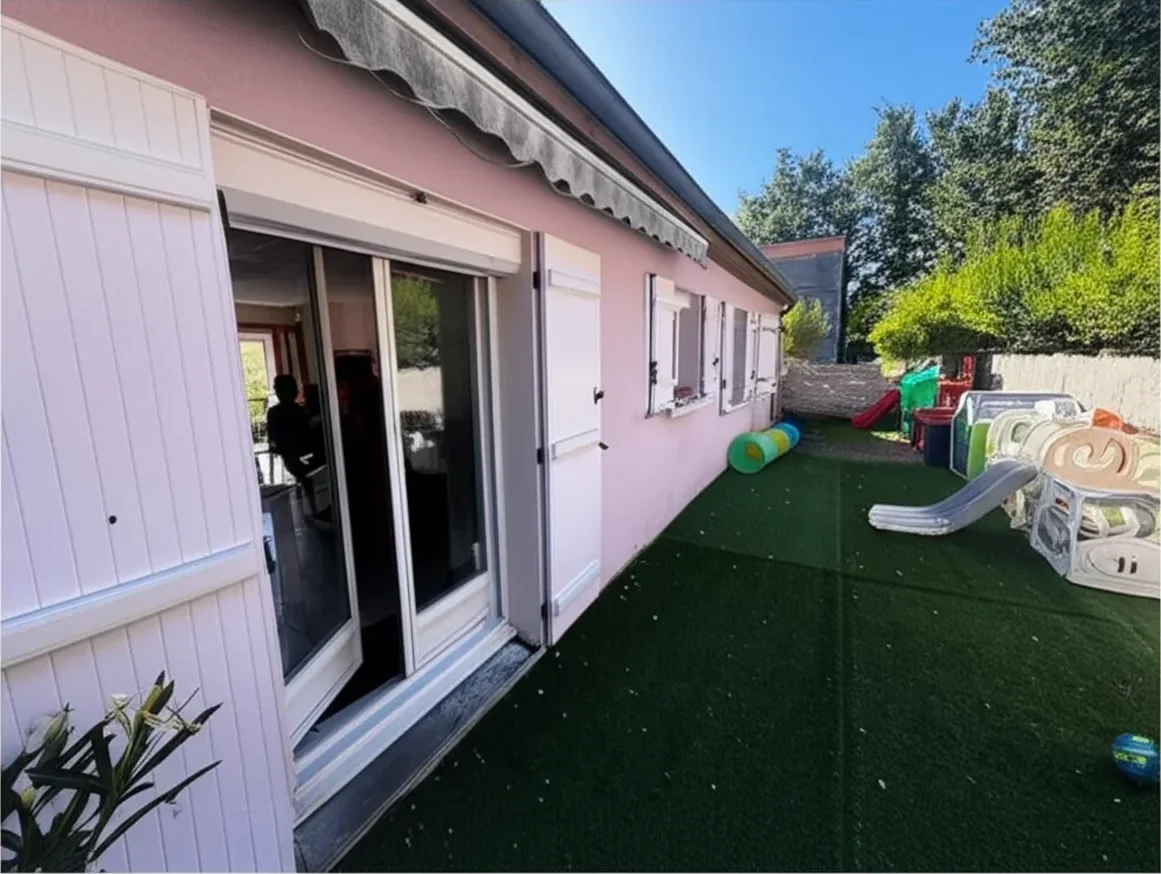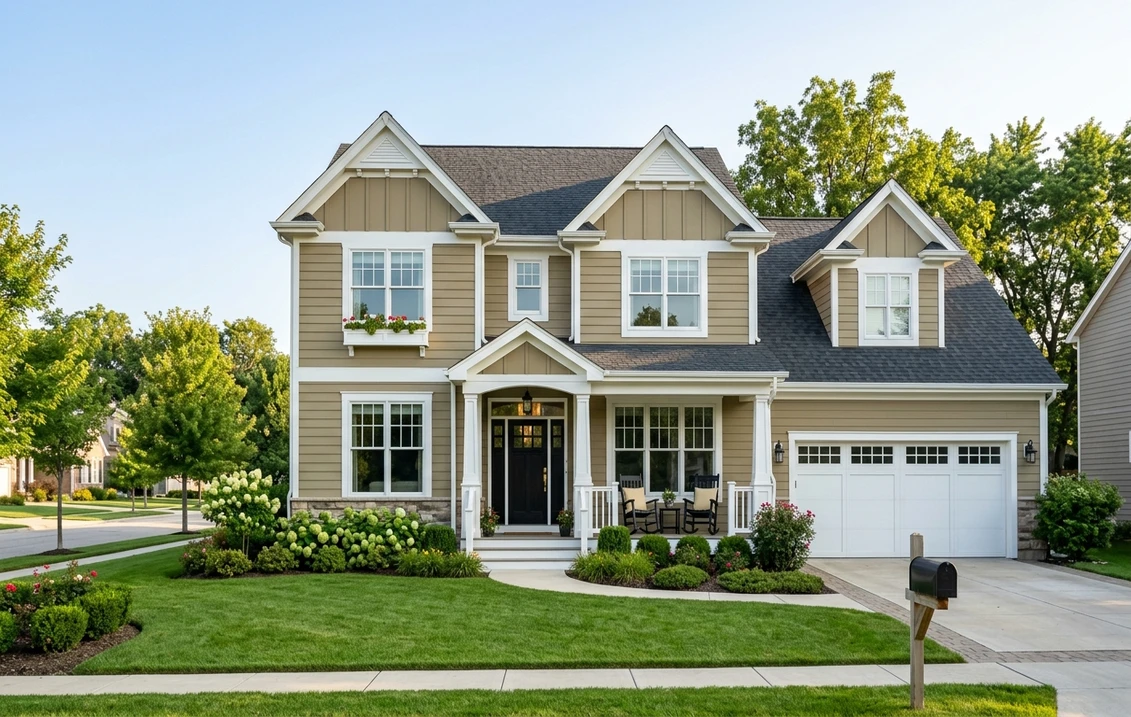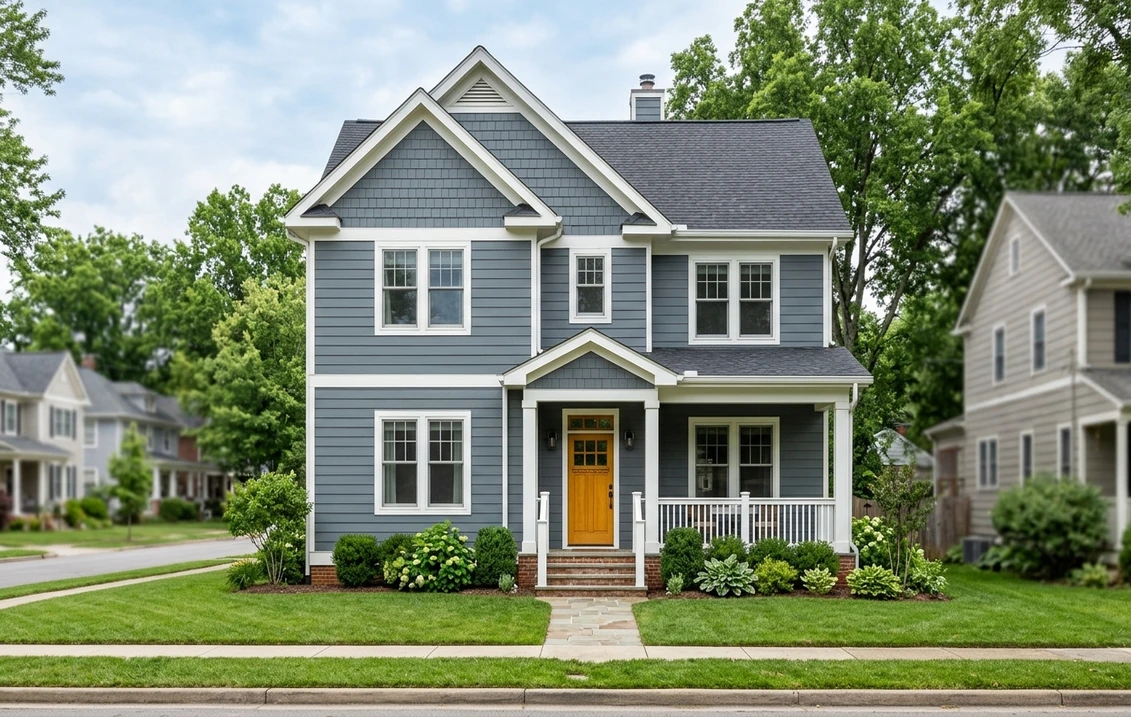
Try it on your house

Sherwin-Williams Storm Cloud (SW 6249) is a mid-dark gray-blue: a blue by family, with so little saturation that it reads as a blue-tinted gray in shade. Sherwin-Williams publishes an LRV of 22.67 and an RGB of 122, 132, 141 (hex #7A848D), files it in its Blue family, rates it for interior and exterior use and places it at 225-C5 on its color strips, with Origami White, Quicksilver and Butternut as coordinating colors. It was the brand's July 2025 Color of the Month. Outside, it works as a body color on wood and fiber cement lap siding, cedar shakes and painted brick, and as an accent on a front door or shutters against a white or pale gray house. Two manufacturer rules set its limits: Sherwin-Williams keeps it off vinyl siding (LRV under 56), and one garage door maker requires solar reflective paint in its LRV band.
Color values come from the makers' pages and color data. Color differences, chroma, hue angles, LRV gaps and gallon counts are our calculations; advice on orientation and pairings is our color reasoning, not a manufacturer's rule.
The link opens the exterior tool with Storm Cloud preselected on the walls; front door, shutters and garage door are one tap away. How it works: our exterior paint visualizer.
Storm Cloud at a glance: the numbers Sherwin-Williams publishes
These values come from the color's page (Sherwin-Williams, SW 6249 Storm Cloud) and from Sherwin-Williams' public color data, which gives the same figures. Hex and RGB are an approximate digital rendering, not a tinting formula.
| Attribute | Storm Cloud SW 6249 |
|---|---|
| LRV | 22.67 (often rounded to 23) |
| RGB | 122, 132, 141 |
| Hex (screen approximation) | #7A848D |
| Lab (Sherwin-Williams color data) | L 54.62, a -1.72, b -6.09 |
| Color family | Blue |
| Use | Interior and exterior |
| Color strip location | 225-C5, the fifth of seven steps on a strip that starts with North Star |
| Coordinating colors listed | Origami White SW 7636, Quicksilver SW 6245, Butternut SW 6389 |
| Similar colors in the color data | Serious Gray SW 6256, Downing Slate SW 2819, Software SW 7074, Bracing Blue SW 6242, among others |
Try it on your house
No photo? Try a sample
Sherwin-Williams' July 2025 Color of the Month page calls Storm Cloud a "dusky blue" and pairs it with Greek Villa SW 7551, Cast Iron SW 6202, Stony Creek SW 9610 and Landmark SW 9609. That page is written about rooms and says nothing about siding.
Is Storm Cloud blue or gray?
Both answers have a basis, which is why the question keeps coming up. Sherwin-Williams files Storm Cloud under Blue. Yet the closest color in its own data, Serious Gray SW 6256, is filed under Neutral, and by our calculation the two are only about 1.4 ΔE2000 apart, a gap most people cannot see across a wall. The Lab values explain it: an a value of -1.72 is almost neutral, and a b value of -6.09 leans to blue. By our calculation the chroma is about 6.3, very low, and the hue angle is about 254 degrees, a blue with almost no green in it. So Storm Cloud is a gray-blue: a blue hue at gray strength. Against the colors it gets compared with:
| Color | Family (Sherwin-Williams) | LRV | Lab a / b | Chroma (our calculation) | Reads as |
|---|---|---|---|---|---|
| Software SW 7074 | Neutral | 22.68 | -1.44 / -1.73 | 2.2 | A plain cool gray at the same depth |
| Serious Gray SW 6256 | Neutral | 22.71 | -1.10 / -4.66 | 4.8 | A gray with a blue cast |
| Storm Cloud SW 6249 | Blue | 22.67 | -1.72 / -6.09 | 6.3 | Gray-blue, the tipping point |
| Bracing Blue SW 6242 | Blue | 24.61 | -4.04 / -10.48 | 11.2 | Clearly blue, nearly twice the chroma |
All four sit within two LRV points of each other, so only the amount of blue changes. A large wall under open sky picks up extra blue, so Storm Cloud usually reads bluer outside than on a chip indoors.
North, south, east or west: how Storm Cloud changes with the light
An LRV of 22.67 means the wall reflects about 23 percent of the visible light that reaches it, on a scale from 0 (black) to 100 (a perfect white); our guide to reading LRV explains the scale. That is a mid-dark color. With so little chroma, the light decides which side of it shows. Color logic, not measurement:
| Front wall faces | Light it gets | How Storm Cloud reads | Trim advice |
|---|---|---|---|
| North | Cool skylight all day | Deeper and bluer; a slate blue under an overcast sky | A warm white (Origami White, Alabaster) keeps it from feeling cold |
| South | Direct sun most of the day | Lighter than the chip and grayer; the blue thins out at midday | A clean white (Pure White) sharpens it |
| East | Morning sun, afternoon shade | Soft gray early, blue from midday on | Judge the trim in the afternoon |
| West | Low, warm sun late | Warm light cancels part of the blue: closest to a true gray at sunset | Paint this side in the morning, out of the sun |
Next to red brick or a warm wood door the blue looks stronger, because warm neighbors make a cool color look cooler. Too blue on your north side? Compare Serious Gray. Too gray in southern sun? Compare Bracing Blue.
Siding, shakes, brick, doors, shutters: where Storm Cloud works
Lap siding and fiber cement
Sherwin-Williams' Duration Exterior data sheet (K32 series) lists wood, plywood, cement composition siding and panels, stucco, concrete, block, aluminum and galvanized steel among its surfaces. New cement composition siding must be tested for pH and, above 9, primed with Loxon Concrete & Masonry Primer. The sheet calls for 2 coats on new, bare substrates and 1 coat for a repaint; over a white body, plan on two anyway. Our Duration Exterior guide covers the product.
Cedar shakes and shingles
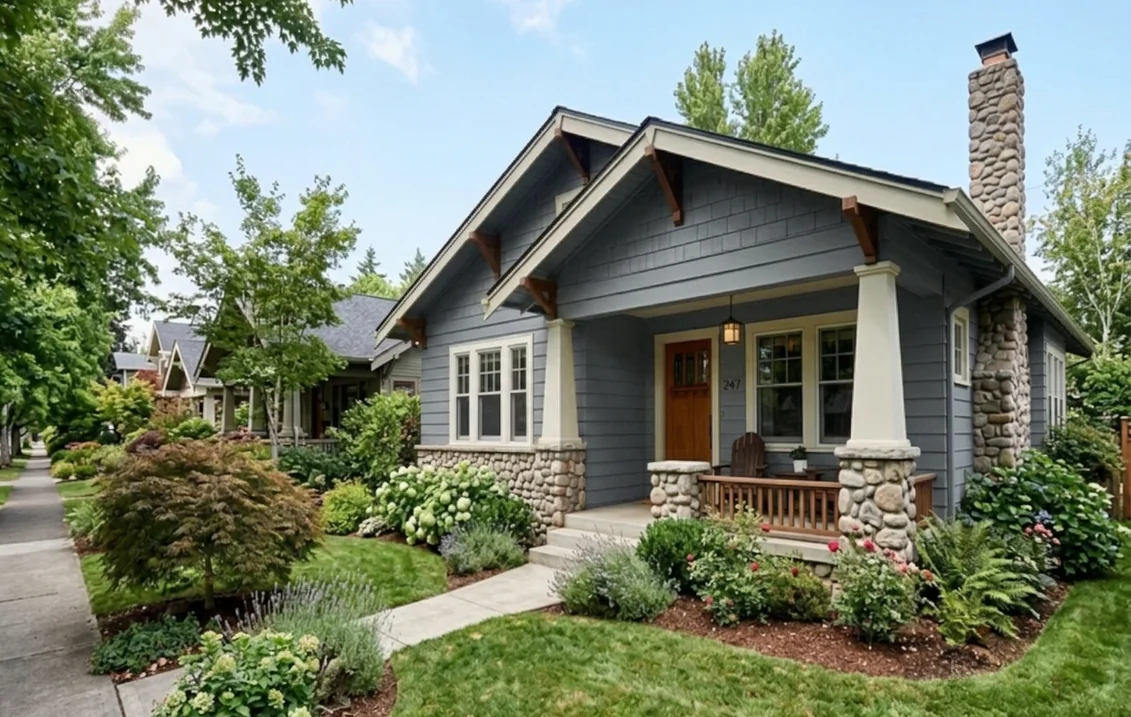
A weathered gray-blue is a traditional look on shingled houses. The rough face of a shake holds more shadow than a smooth board, so gable shakes tend to read slightly deeper than lap siding in the same paint. The risk on cedar is not the color but the wood: the Duration sheet warns that knots and woods such as redwood and cedar contain tannin, a colored extract that can stain the first coat. Per the sheet, a second coat evens the appearance; where staining persists, severe areas are spot primed with Exterior Oil-Based Wood Primer. If you would rather keep the wood texture under a solid stain, ask the store whether SW 6249 can be tinted in that product (we could not confirm it from Sherwin-Williams' pages); our cedar shake siding colors guide compares paint and stain on shakes.
Vinyl siding and PVC: out as Storm Cloud, close in VinylSafe
Under the heading "vinyl or other PVC building products", the same sheet says not to paint vinyl with any color darker than the original or with an LRV under 56 unless VinylSafe colors are used, because the vinyl may warp. Storm Cloud, at 22.67, is about 33 points under that line. Here the news is better than for most dark colors: the VinylSafe palette, coded SWVS, includes two gray-blues at about the same depth. By our calculation from the screen colors on that page, Stone Cold SWVS 418 (#7D8690) is about ΔE 1.2 from Storm Cloud and Prime Time SWVS 429 (#80868D) about 2.0, the second a little grayer. Screen colors are approximations, so compare real chips. PVC trim and molded vinyl shutters fall under the same heading. Our VinylSafe guide walks through the palette.
Brick: left bare beside Storm Cloud siding, or painted
Storm Cloud siding above an unpainted red or orange brick base is a safe pairing: warm, saturated brick against a cool, quiet siding, with white trim between them. Painting the brick itself is a bigger step. The Brick Industry Association's Technical Note 6 (August 2024) warns that paint can be very difficult to remove from brick masonry without causing damage and that multiple layers of a treatment lower its water vapor permeance. New or repaired masonry must cure and dry completely, at least 30 days, first. Our painted brick exterior guide covers the decision.
Front door
As a door color, Storm Cloud is the quiet choice: it will not pop like a red or a navy. It needs a light body to frame it (see the body color table below). For the paint itself, our SnapDry door and trim paint guide compares Sherwin-Williams' two door enamels, and the Sherwin-Williams front door colors page lists stronger options.
Shutters
Storm Cloud shutters on a white or cream house give a soft, coastal version of the black-shutter colonial. On a pale gray body they turn tonal; the table below gives the gaps. Check the material first: vinyl or PVC shutters fall under the LRV 56 rule above unless their maker says otherwise.
Garage door
Clopay's painting instructions (effective May 11, 2020) call for a 100% acrylic latex exterior paint, strongly recommend a bonding primer and recommend solar reflective paint on all doors when available. On its Coachman doors, colors with an LRV of 12 or less are not permitted and a tested and approved solar reflective paint is required between 13 and 38. Storm Cloud's 22.67 falls in that second band, so on a Coachman door it needs the approved paint; on Clopay's other doors solar reflective paint is recommended, not required.
Trim and accent colors with a Storm Cloud body
The colors Sherwin-Williams publishes with Storm Cloud come first; the gap is the LRV difference from Storm Cloud (Sherwin-Williams' color data).
| Role | Color | LRV | Gap | Effect |
|---|---|---|---|---|
| Trim (coordinating) | Origami White SW 7636 | 76.00 | +53 | A soft, slightly warm off-white: the gentlest frame |
| Trim (coordinating) | Quicksilver SW 6245 | 75.41 | +53 | A cool, faintly green-gray white: tonal and calm |
| Door (coordinating) | Butternut SW 6389 | 37.07 | +14 | A golden tan, almost exactly opposite in hue |
| Trim (Color of the Month pairing) | Greek Villa SW 7551 | 84.22 | +62 | A warm white with more contrast than Origami White |
| Door, shutters (Color of the Month pairing) | Cast Iron SW 6202 | 12.50 | -10 | A dark green-gray; earthy, low contrast |
| Trim | Pure White SW 7005 | 83.96 | +61 | Near-neutral; the safe default |
| Trim | Alabaster SW 7008 | 82.22 | +60 | Creamier; best where the blue feels cold |
| Door, sashes | Tricorn Black SW 6258 | 2.85 | -20 | Crisp and modern |
As we read these gaps, every white stands out by 53 to 62 points, so the choice is about temperature: Quicksilver and Pure White keep the house cool, Origami White, Greek Villa and Alabaster warm it. Butternut is the interesting one. By our calculation its hue angle is about 75 degrees against 254 for Storm Cloud, a difference of about 179 degrees, close to a true complement; that is also why a natural oak or fir door looks so right on a blue-gray house. The Sherwin-Williams exterior color combinations show full schemes.
What colors go with Storm Cloud as a door or shutter color
When Storm Cloud is the accent, the body color does the framing. The gap is the LRV difference between the body and Storm Cloud:
| Body color | LRV | Gap to Storm Cloud | Effect of a Storm Cloud door or shutters |
|---|---|---|---|
| Pure White SW 7005 | 83.96 | 61 | White house, soft blue-gray accents: the clearest read |
| Alabaster SW 7008 | 82.22 | 60 | Warmer and softer; the blue shows more against cream |
| North Star SW 6246 | 62.34 | 40 | Same strip: a tonal blue-gray scheme with no undertone clash |
| Agreeable Gray SW 7029 | 60.39 | 38 | A greige body; the warm base makes the accent look bluer |
| Repose Gray SW 7015 | 58.22 | 36 | Gray on gray; calm, readable |
| Mindful Gray SW 7016 | 47.70 | 25 | Too close: the shutters start to merge with the walls |
| Red or orange brick | varies | varies | Hue contrast does the work; add white trim between them |
In our reading, below a gap of about 30 points a low-chroma accent stops registering from the street. On a greige house, see the Agreeable Gray SW 7029 exterior guide; on a cooler gray one, the Repose Gray SW 7015 exterior guide.
Strip 225: from North Star down to Outerspace
Storm Cloud is the fifth of seven steps on Sherwin-Williams strip 225. The colors share one gray-blue base, so they combine without an undertone clash. Values from Sherwin-Williams' color data, all rated for exterior use:
| Location | Color | LRV |
|---|---|---|
| 225-C1 | North Star SW 6246 | 62.34 |
| 225-C2 | Krypton SW 6247 | 51.94 |
| 225-C3 | Jubilee SW 6248 | 45.42 |
| 225-C4 | Let it Rain SW 9152 | 34.29 |
| 225-C5 | Storm Cloud SW 6249 | 22.67 |
| 225-C6 | Granite Peak SW 6250 | 14.35 |
| 225-C7 | Outerspace SW 6251 | 11.64 |
Two one-strip schemes: Jubilee on the upper story or gable shakes with Storm Cloud below (a 23-point gap), or Storm Cloud on the walls with Granite Peak shutters and an Outerspace door. Only North Star clears the LRV 56 line, so on vinyl the rest of the strip is out under Sherwin-Williams' rule.
Storm Cloud vs Serious Gray, Bracing Blue and darker blue-grays
The first two are in Sherwin-Williams' similar colors for Storm Cloud; the rest are darker. The color difference (ΔE2000) is our calculation from Sherwin-Williams' Lab values: under about 2 is hard to tell apart on a wall, above 5 is clearly another color.
| Color | LRV | ΔE2000 vs Storm Cloud (our calculation) | How it differs |
|---|---|---|---|
| Serious Gray SW 6256 | 22.71 | 1.4 | A near twin, a touch less blue |
| Bracing Blue SW 6242 | 24.61 | 4.4 | Clearly bluer, a little lighter |
| Slate Tile SW 7624 | 14.77 | 9.6 | Much darker, a green-leaning slate |
| Granite Peak SW 6250 | 14.35 | 10.0 | The same hue one step down the strip |
| Smoky Blue SW 7604 | 14.62 | 10.3 | Darker, bluer and greener |
| Web Gray SW 7075 | 13.12 | 12.1 | A charcoal with only a hint of blue |
| Naval SW 6244 | 4.46 | 26.1 | A true navy, about a fifth of the reflected light |
So Storm Cloud is not a dark blue: it reflects about five times as much light as Naval (LRV 22.67 against 4.46) and about 1.5 times as much as Slate Tile. If it looks too light on your board, the Slate Tile SW 7624 exterior guide and the Smoky Blue SW 7604 exterior guide cover the next step down; for a charcoal with less blue, see the Web Gray SW 7075 exterior guide; for a deeper, greener dusky blue, the Waterloo SW 9141 exterior guide.
Benjamin Moore colors near Storm Cloud
No official equivalent exists. These are the closest by our calculation from screen colors, with the LRVs Benjamin Moore publishes; treat them as starting points for a painted sample.
| Benjamin Moore color | LRV | LRV gap vs Storm Cloud | ΔE2000 (our calculation) | Note |
|---|---|---|---|---|
| Bachelor Blue 1629 | 23.52 | +0.85 | 2.4 | Benjamin Moore Classics; a little bluer |
| Black Pepper 2130-40 | 21.12 | -1.55 | 2.8 | Described as a cool, dark blue-gray; slightly deeper |
| Montpelier AF-555 | 22.36 | -0.31 | 3.2 | Affinity collection; the closest LRV, a touch greener |
Painting conditions and how much Storm Cloud you need
The Duration data sheet sets the conditions: air, surface and material above 35°F and at least 5° above the dew point, no application if temperatures may drop below 35°F within 48 hours, no rain or snow expected within 2 to 3 hours, and no painting in direct sun. Coverage is 250 to 300 sq ft per gallon.
Our arithmetic at that coverage: for 2,000 sq ft of siding after windows and doors, two coats take 13.3 to 16 gallons, about three 5-gallon buckets plus a spare gallon. A 36 by 80 inch front door is 20 sq ft per face, so two coats on the outside face (40 sq ft) fit in a quart.
If the house was built before 1978, assume the old paint may contain lead. Under the EPA's Renovation, Repair and Painting Program, anyone paid to disturb painted surfaces in that housing must be certified; homeowners working on their own home are generally exempt unless, for example, they rent out all or part of it. Under a homeowners association, check the HOA color rules guide before you order.
How to test Storm Cloud before you commit
- Paint two coats on a 2 by 2 ft board, with a strip of your trim white along one edge.
- View it on the north and south walls, at noon and late in the day, from the street.
- Put Serious Gray beside it if it looks too blue, Bracing Blue if it looks too gray.
- Try the whole scheme on a photo of your own house before buying the first gallon.
See Storm Cloud on your own house
Upload a photo, try Storm Cloud on the siding, then on the front door or shutters, before you order samples.
Try Storm Cloud on my houseFor the wider Sherwin-Williams exterior range, start with our Sherwin-Williams exterior paint guide.
Sources and references
- Sherwin-Williams, SW 6249 Storm Cloud: LRV, RGB, hex, family, use, strip, coordinating colors.
- Sherwin-Williams, July 2025 Color of the Month: Storm Cloud: description and the four colors paired with it.
- Sherwin-Williams, color pages for Origami White, Quicksilver, Butternut, Serious Gray and Granite Peak: coordinating and comparison values.
- Sherwin-Williams, Duration Exterior product data sheet (K32 series): substrates, cedar and tannin, vinyl and PVC rule, primers, application conditions, coverage.
- Sherwin-Williams, VinylSafe colors for vinyl siding: palette, Stone Cold SWVS 418 and Prime Time SWVS 429 swatches.
- Benjamin Moore, color pages for Bachelor Blue 1629, Black Pepper 2130-40 and Montpelier AF-555: LRV, collection, description.
- Brick Industry Association, Technical Note 6, Changing the Appearance of Brick Masonry (August 2024): permanence, water vapor permeance, curing.
- Clopay, Painting your garage door (effective May 11, 2020): paint type, primer, LRV bands, solar reflective paint.
- U.S. Environmental Protection Agency, Lead Renovation, Repair and Painting Program: pre-1978 homes, certification and homeowner exceptions.
Frequently asked questions
Is Sherwin-Williams Storm Cloud blue or gray?
What is the LRV of Sherwin-Williams Storm Cloud?
Is Storm Cloud a good exterior color?
What colors go with Storm Cloud?
What trim color goes with Storm Cloud siding?
Can you paint vinyl siding Storm Cloud?
Is Storm Cloud a good front door color?
What is the difference between Storm Cloud and Serious Gray?
Is Storm Cloud a dark color?
What is the Benjamin Moore equivalent of Storm Cloud?
Was Storm Cloud a Sherwin-Williams Color of the Month?
Trademarks mentioned (Sherwin-Williams, Benjamin Moore, Behr, Caparol, Brillux, Sto, Alpina, Valspar, PPG, Glidden, Dulux, Crown Trade, Sandtex, Farrow & Ball, Johnstone's, Leyland) are property of their respective owners. FacadeColorizer is independent and not affiliated with any of them. Nominative fair use under Lanham Act §1125.