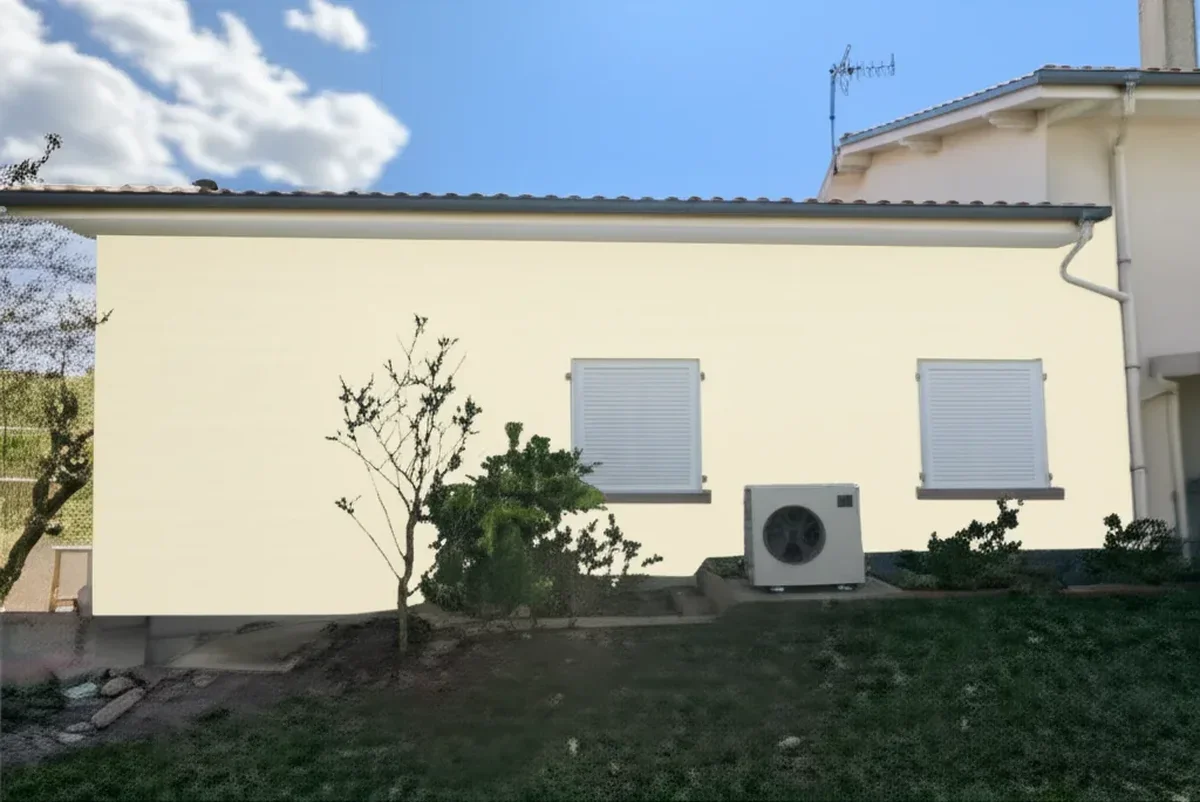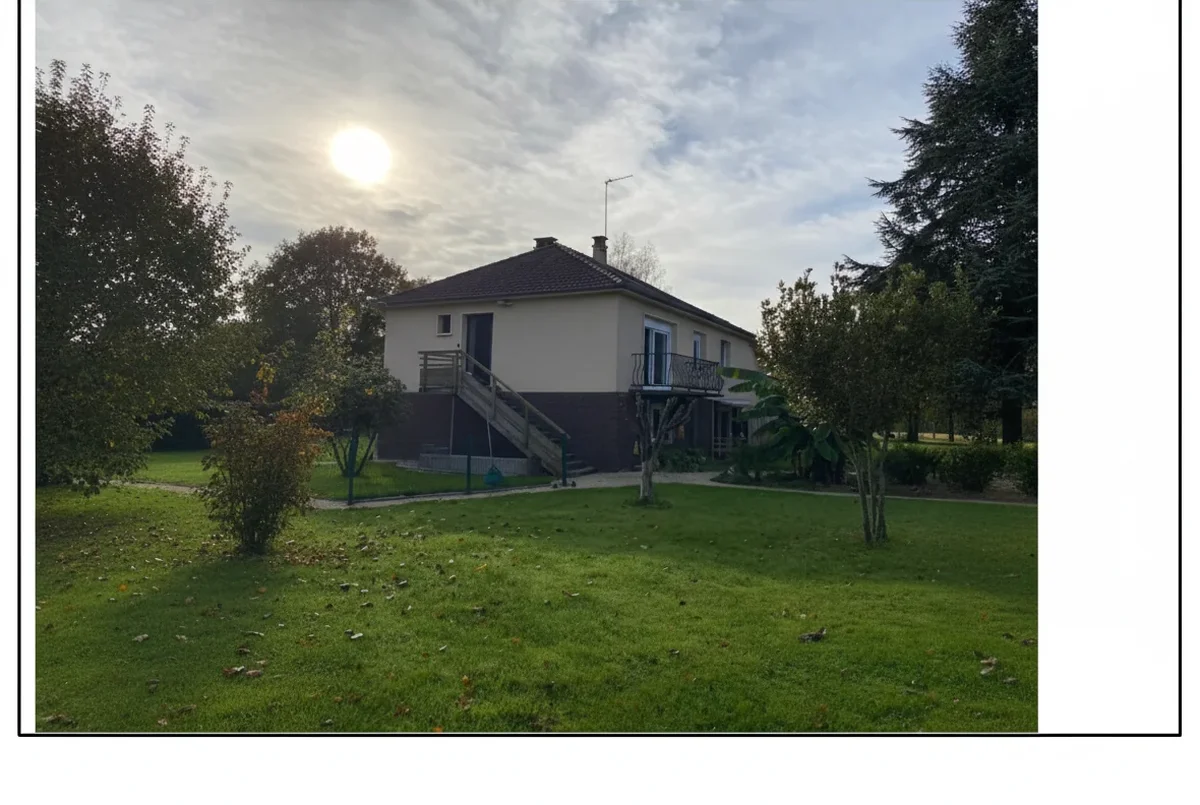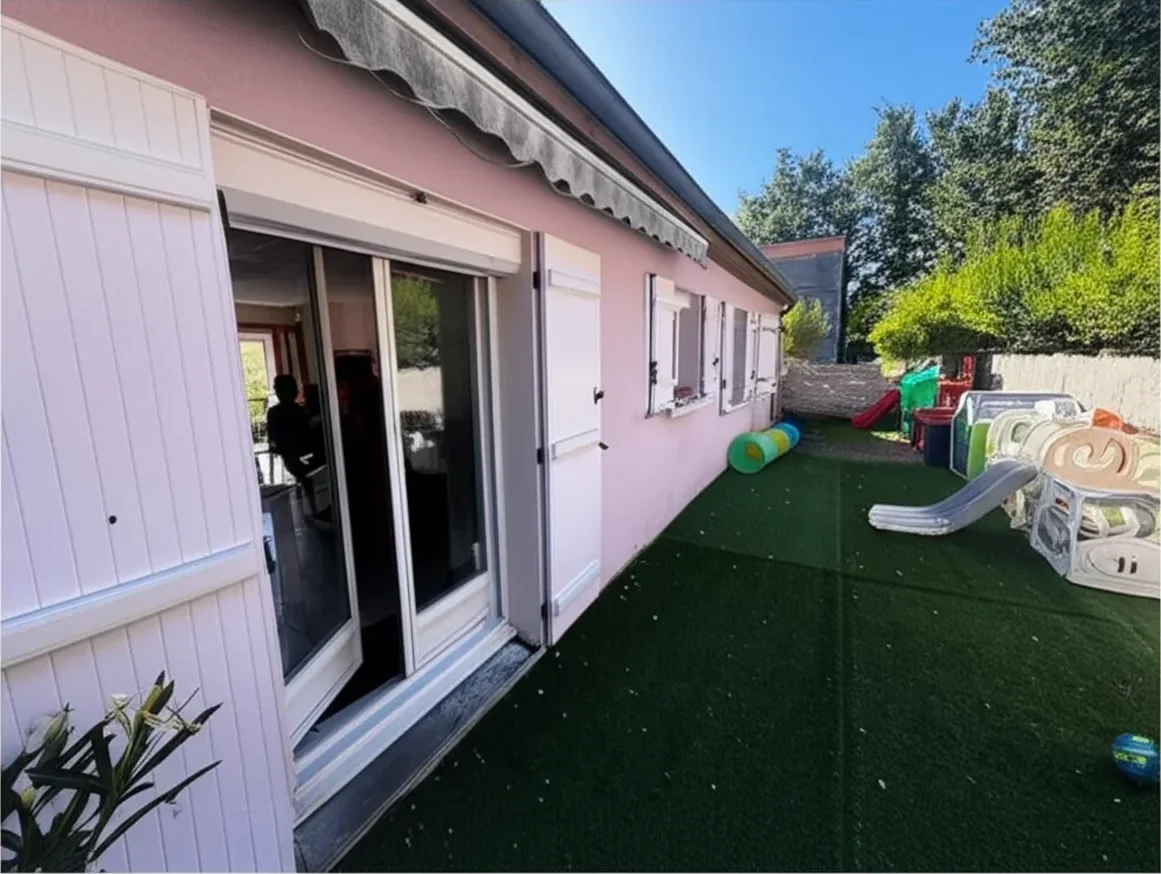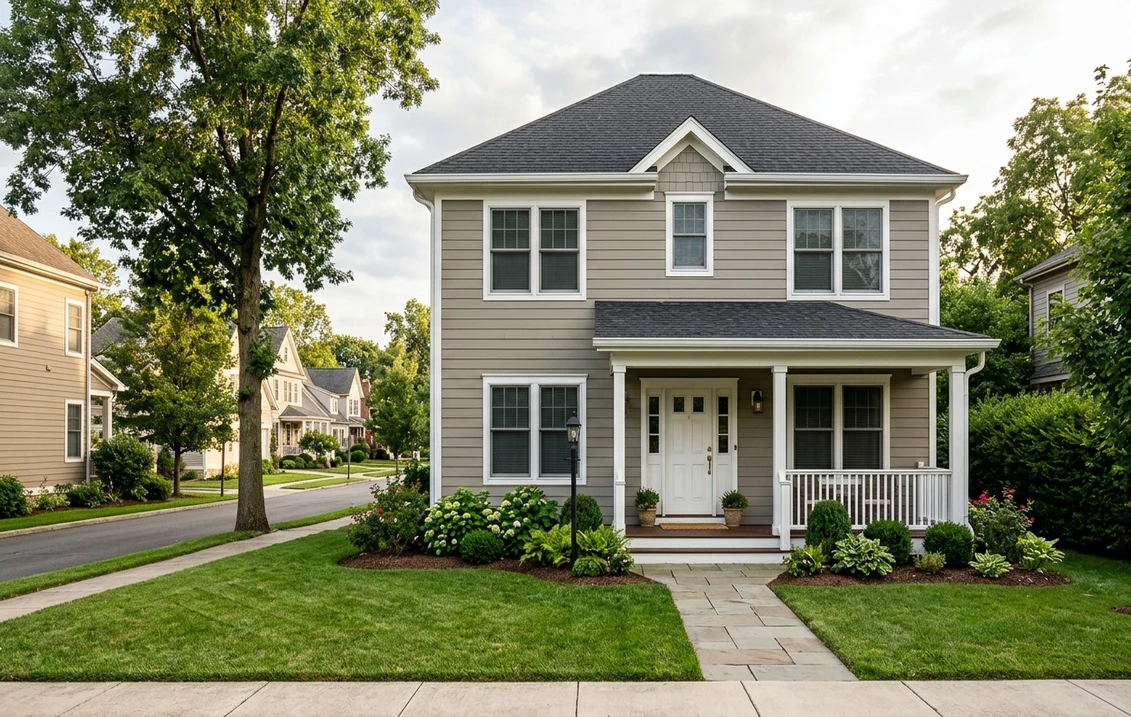
Try it on your house

Sherwin-Williams Analytical Gray (SW 7051) is a medium neutral gray with a warm lean. Sherwin-Williams publishes an LRV of 47.474 and an RGB of 191, 182, 167 (hex #BFB6A7, an approximate digital rendering), and lists the color for both interior and exterior use. On a house it reads as a warm greige rather than a cool blue-gray. In our reasoning, that makes it a comfortable body color beside brick, stone and cream trim. Before you buy it for a house with vinyl siding, check one point: Analytical Gray is not in Sherwin-Williams' VinylSafe palette.
The color values come from the Sherwin-Williams color page for SW 7051 and from the color pages of the grays we compare it with. The hex codes are approximations for screens. Every calculation in this guide, such as the LRV gaps and the red-to-blue differences, is our own and is marked as such. The house advice is our color reasoning, not a finding from a study.
The link opens the exterior tool with Analytical Gray preselected for the facade. To see how the tool works, read our exterior paint visualizer page.
Analytical Gray at a glance: the numbers Sherwin-Williams publishes
These figures come from the Sherwin-Williams color page for SW 7051. The LRV, which stands for light reflectance value, is the number to check first. It is the share of visible light a paint sends back. An LRV of 47.474 means the color returns a little less than half of the light that hits it, so Analytical Gray sits in the middle of the scale, not at the light end and not at the dark end.
| Attribute | Analytical Gray SW 7051 |
|---|---|
| LRV | 47.474 |
| RGB | 191, 182, 167 |
| Hex (screen approximation) | #BFB6A7 |
| Hue, saturation, value (as listed on the page) | 37.5, 0.13, 0.75 |
| Color family (Sherwin-Williams) | Neutral |
| Store strip location | 246-C2 |
| Use (as listed) | Interior and exterior |
Try it on your house
No photo? Try a sample
The hue, saturation and value are worth a second look. Converting the RGB values to HSV gives the same numbers (our check), so the page and the RGB agree. A hue of 37.5 sits on the warm side of the color wheel, in the orange-yellow band, and a saturation of 0.13 is low. Together they explain why the color reads as a gray with a warm cast rather than as a true beige. The warmth comes from the hue, and the gray comes from the low saturation.
What an LRV near 47 does to a house
Outside, the value of a paint often matters more than its name. An LRV near 47 places Analytical Gray in the middle of the Sherwin-Williams range of mid grays, between Requisite Gray at 44.873 on one side and Mindful Gray at 47.698 on the other. A color with that value is light enough to keep a long facade from feeling heavy, and dark enough to show the shape of a house in the afternoon. That is our reading of the value, not a measured result.
Sunlight is the second effect, and it has a physical basis. Berkeley Lab's Heat Island Group states on its About Cool Surfaces page that sunlight that is not reflected is absorbed as heat, and that cool surfaces do not have to be white. In our reading of the LRV, a mid gray at 47 absorbs more of the sun than a white does. The Sherwin-Williams data we checked gives no solar reflectance or near-infrared figure for this color, so we cannot tell you how hot a wall in full sun will get. If a south or west wall in a hot climate matters to you, ask Sherwin-Williams for that data before you choose the color.
Orientation changes how the color reads. Light from the north is cooler and bluer, so a warm greige looks more neutral on a north wall. Strong southern or western sun is warmer, and it brings out the lean. These are general lighting effects and our reasoning, not a test of this paint. Check the color on the side of the house that gets the most sun during the day, and on the side that gets the least, before you commit to the whole facade.
Warm lean: why Analytical Gray and Mindful Gray look different
Analytical Gray (47.474) and Mindful Gray SW 7016 (47.698) are almost the same on LRV, 0.22 points apart (our calculation). Most readers who compare the two expect the same color, and the RGB values show why that is not the case. Analytical Gray is 191, 182, 167. Mindful Gray is 188, 183, 173. The red-to-blue gap is 24 for Analytical Gray and 15 for Mindful Gray (our calculation). Analytical Gray is therefore the warmer of the two, with more red and less blue, while Mindful Gray stays closer to a neutral.
The gap is small, and it is easy to miss on a screen. It shows up on a real wall. Next to a cream or brick front, Analytical Gray can look like part of the palette, in our reading. Next to a cool white trim or a blue-leaning door, the same warmth can look a little yellow. Put the two samples side by side on the house in daylight before you choose. Our SW Mindful Gray 7016 exterior guide covers that color on its own terms.
Analytical Gray among Sherwin-Williams mid grays
The table lists the Sherwin-Williams grays closest to Analytical Gray on LRV. Each value comes from that color's Sherwin-Williams page, and the strip location shows where the color sits on the store display.
| Color | Sherwin-Williams code | LRV | Hex | Strip location |
|---|---|---|---|---|
| Useful Gray | SW 7050 | 59.103 | #CFCABD | 246-C1 |
| Repose Gray | SW 7015 | 58.22 | #CCC9C0 | 244-C1 |
| Worldly Gray | SW 7043 | 57.238 | #CEC6BB | 245-C1 |
| Analytical Gray | SW 7051 | 47.474 | #BFB6A7 | 246-C2 |
| Mindful Gray | SW 7016 | 47.698 | #BCB7AD | 244-C2 |
| Requisite Gray | SW 7023 | 44.873 | #B9B2A9 | 241-C2 |
The nearest lighter option on the same strip is Useful Gray SW 7050, one step up at 246-C1, with an LRV of 59.103 (our calculation: about 11.6 points lighter). Repose Gray SW 7015 and Worldly Gray SW 7043 sit a step lighter again, at 58.22 and 57.238. Requisite Gray SW 7023 is the nearest darker value in this table, about 2.6 points below (our calculation). Our guides to Repose Gray SW 7015 and to Worldly Gray SW 7043 cover the two lighter options.
Trim, door and shutter pairings
Sherwin-Williams lists three coordinating colors on the Analytical Gray page: Nuance SW 7049, Useful Gray SW 7050 and Silken Peacock SW 9059. The page does not say which role each one plays, so the reading below is ours.
| Coordinating color | Sherwin-Williams code | LRV | Hex |
|---|---|---|---|
| Nuance | SW 7049 | 74.277 | #E2E0D6 |
| Useful Gray | SW 7050 | 59.103 | #CFCABD |
| Silken Peacock | SW 9059 | 15.441 | #427584 |
Nuance, at an LRV of 74.277, is about 27 points lighter than the body (our calculation). That gap gives window casings, fascia and corner boards a clear edge, and it suits a house that wants a crisp outline. Useful Gray is only about 12 points lighter, so it gives a softer, lower-contrast trim that keeps the house quiet. It is the better choice when the body and the trim should read as one family.
Silken Peacock is the outlier. Its hex, #427584, is a deep blue-teal, and its LRV of 15.441 is far darker than the body (our calculation). On a front door or on shutters it adds a deep accent against the warm gray. On the walls it would be a bold change, so keep it for the smaller elements. Check every pairing in daylight, on the house itself, next to the real roof and the real stone or brick.
Where a warm mid gray works outside, and where it does not
This section is our reasoning from the published values, not a finding from a study. A warm mid gray such as Analytical Gray tends to suit three kinds of house:
- Brick and stone fronts, where a cool blue-gray can look cold beside the masonry.
- Craftsman, farmhouse and colonial facades with white or cream trim, where the trim gives the body its edges.
- Two-story houses with large windows, which break up the wall and give the eye places to rest.
It is less suitable in three cases. A small one-story house with little trim can turn into one flat block. A house in deep shade for most of the day can make a mid gray read darker than the swatch. A street where the neighbors already use similar warm grays may blend in, so look at the whole block before you commit. If you want a cooler gray, our Sea Salt guide covers a blue-green-gray. For the dark end of the range, our Iron Ore guide does.
Vinyl siding: check the VinylSafe palette before you pick Analytical Gray
This is the point most likely to cost you money. Sherwin-Williams' VinylSafe page says the palette lets you choose from "100 color options, including a limited selection of darker colors formulated to resist warping or buckling when applied to a sound, stable vinyl substrate." The same page gives the reason for the limit: "Using a dark color on top of a lighter would cause the substrate to buckle."
Analytical Gray is not in that palette. We checked the list of colors on the page on 5 November 2026, and the color is not among them. That does not prove that a repaint on vinyl will fail. It does mean the color falls outside the vinyl guidance the manufacturer publishes. If your house is vinyl, choose a color from the VinylSafe list, or ask a Sherwin-Williams dealer for a written answer before you buy. Our VinylSafe guide walks through the palette.
The VinylSafe palette is written for vinyl siding. If the siding is wood, fiber cement, stucco or masonry, the data sheet for the product and the surface you plan to use is the reference, so read it before you paint.
Before you repaint a house built before 1978: the lead rule
The color choice does not change the lead step. The U.S. Environmental Protection Agency's Renovation, Repair and Painting (RRP) rule covers paid work that disturbs painted surfaces in homes, childcare facilities and preschools built before 1978. The EPA page says the rule applies to all firms, even sole proprietorships, and that certified firms must make sure their employees are trained. The lead-safe work practices are meant to minimize occupants' exposure to lead hazards.
Homeowners who do RRP work on their own pre-1978 home are generally not covered by the rule. The EPA says it does apply if you rent all or part of the home, run a childcare business there, or buy, renovate and sell houses for profit. The agency also recommends that homeowners hire a lead-safe certified contractor. If you hire a painter, ask for the firm's certification before work starts, and ask how they will limit dust and debris from the old finish.
Four checks before you buy a gallon
A color decision for a whole facade costs far more than a sample pot, so run these four checks first. They are our reasoning, not a study.
- Check the material. Confirm whether the siding is vinyl, wood, fiber cement, stucco or masonry. The VinylSafe palette covers vinyl only, and each surface has its own product data sheet.
- Compare the LRV and the RGB, not the name. Analytical Gray and Mindful Gray both sit near an LRV of 47, so a name, a swatch or a neighbor's house will not tell you which one is warmer. The published RGB values in the tables above do.
- Treat the hex code as an approximation. The screen value #BFB6A7 is a reference for the color family. The paint in the can can look different under your sky, so use the swatch to narrow the choice, then sample.
- Plan the trim before the body. A warm mid gray takes much of its character from the white or cream next to it. Choose the trim, the door and the shutters in the same daylight, on the same wall, before you settle the body color.
Sample it, then preview it on your own house
A mid gray changes with the light, so sample it before you commit. Put a large sample on the sunniest wall and another on the shadiest one. Look at both in the morning, at midday and in the evening, and compare them with the trim you plan to use rather than with a white card from the store. Keep the samples up for at least a week.
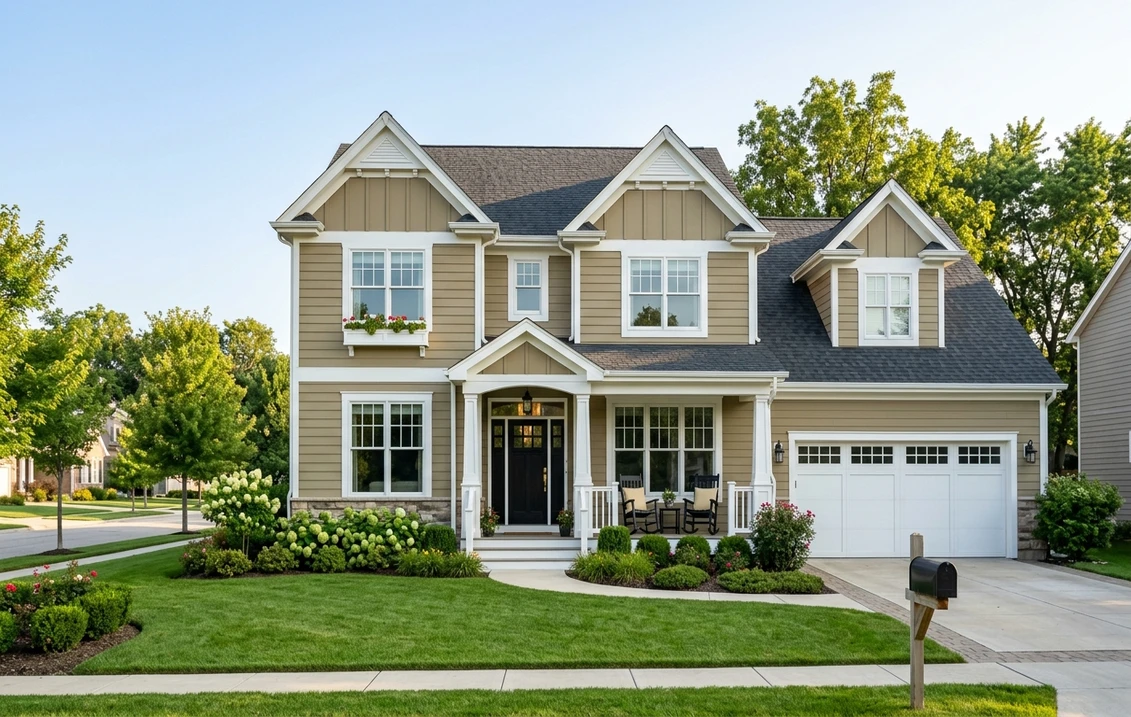
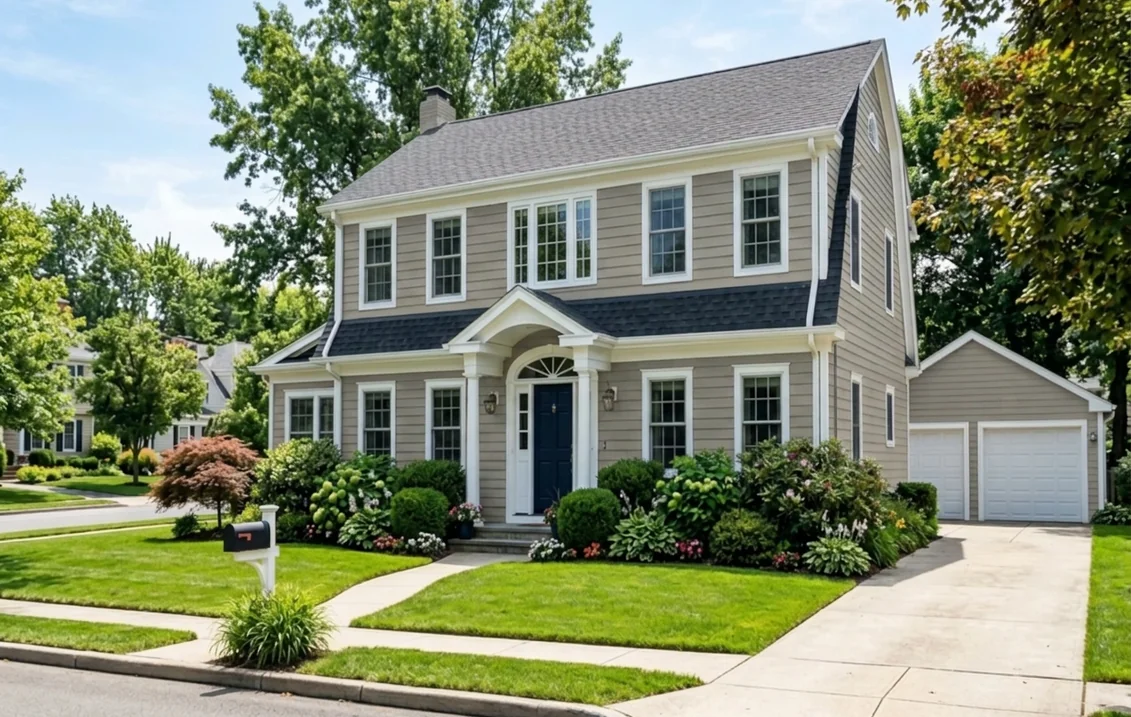
The illustration in this article is a generated preview of the color on a colonial-style house with white trim and a navy door. It is a visual check of the color family, not a prediction of how the paint will look on your siding. Your material, your light and the paint line you choose all change the result, and the wall tones in a generated image are approximate.
Free to start: one HD simulation and three variations.
Which Sherwin-Williams exterior line and sheen to choose
The line you choose sets the sheen and the build of the product, and that matters as much as the color on a mid-value body. This article does not restate line data. Our guides to Emerald Exterior and to Duration set out what each line is built for. Confirm the sheen, the coverage and the recoat details on the product data sheet before you buy.
Sources and references
- Sherwin-Williams, SW 7051 Analytical Gray color page: LRV 47.474, RGB, hex, hue, saturation and value, strip 246-C2, interior and exterior use, coordinating colors.
- Sherwin-Williams, color pages for Repose Gray SW 7015, Mindful Gray SW 7016, Requisite Gray SW 7023, Worldly Gray SW 7043, Useful Gray SW 7050, Nuance SW 7049 and Silken Peacock SW 9059: LRV, RGB, hex and strip location used in the tables.
- Sherwin-Williams, VinylSafe paint colors for vinyl siding: 100 color options, the limited selection of darker colors, and the buckling reason.
- U.S. Environmental Protection Agency, Lead Renovation, Repair and Painting Program: pre-1978 housing, certification of paid firms, lead-safe work practices, and the homeowner exceptions.
- Lawrence Berkeley National Laboratory, Heat Island Group, About Cool Surfaces: unreflected sunlight is absorbed as heat, and cool surfaces do not have to be white.
Frequently asked questions
Is Analytical Gray SW 7051 warm or cool?
What is the LRV of Analytical Gray SW 7051?
Can I paint vinyl siding Analytical Gray?
What trim colors does Sherwin-Williams list with Analytical Gray?
How is Analytical Gray different from Mindful Gray?
Trademarks mentioned (Sherwin-Williams, Benjamin Moore, Behr, Caparol, Brillux, Sto, Alpina, Valspar, PPG, Glidden, Dulux, Crown Trade, Sandtex, Farrow & Ball, Johnstone's, Leyland) are property of their respective owners. FacadeColorizer is independent and not affiliated with any of them. Nominative fair use under Lanham Act §1125.