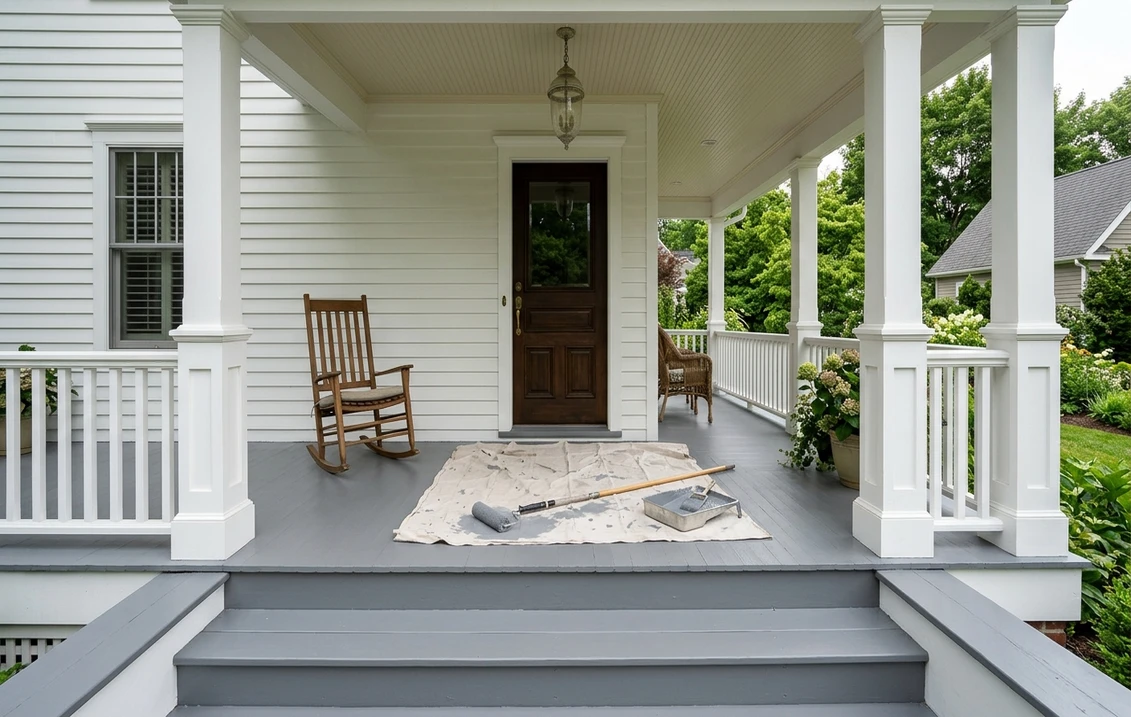
Try it on your house

Sherwin-Williams Porch & Floor Enamel is a one-part waterborne acrylic floor paint in a satin finish, made for wood and concrete porches, steps and interior floors. Its data sheet calls for two coats and names no separate primer. One gallon covers 350 to 400 sq ft per coat, the second coat can go on after 4 hours, light foot traffic is allowed after 24 hours, and furniture and heavy use wait 7 days. It is not suitable for garage floors or for any surface that carries car or truck traffic.
How this page works: every figure comes from Sherwin-Williams data sheets and product pages, the U.S. Access Board, EPA and the USDA Forest Products Laboratory, read on November 13, 2026. Calculations are ours and labeled as such. No paint was applied for this page, and we print no price: the Sherwin-Williams product page shows one only after sign-in.
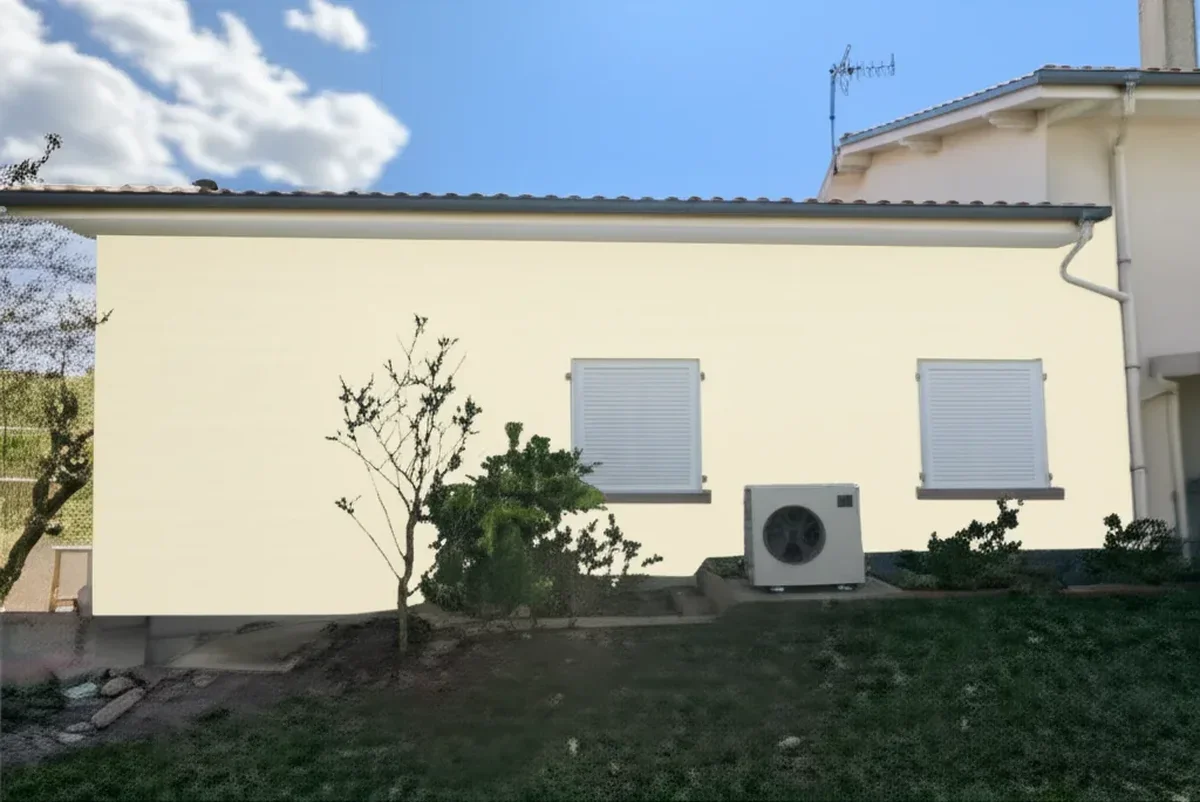
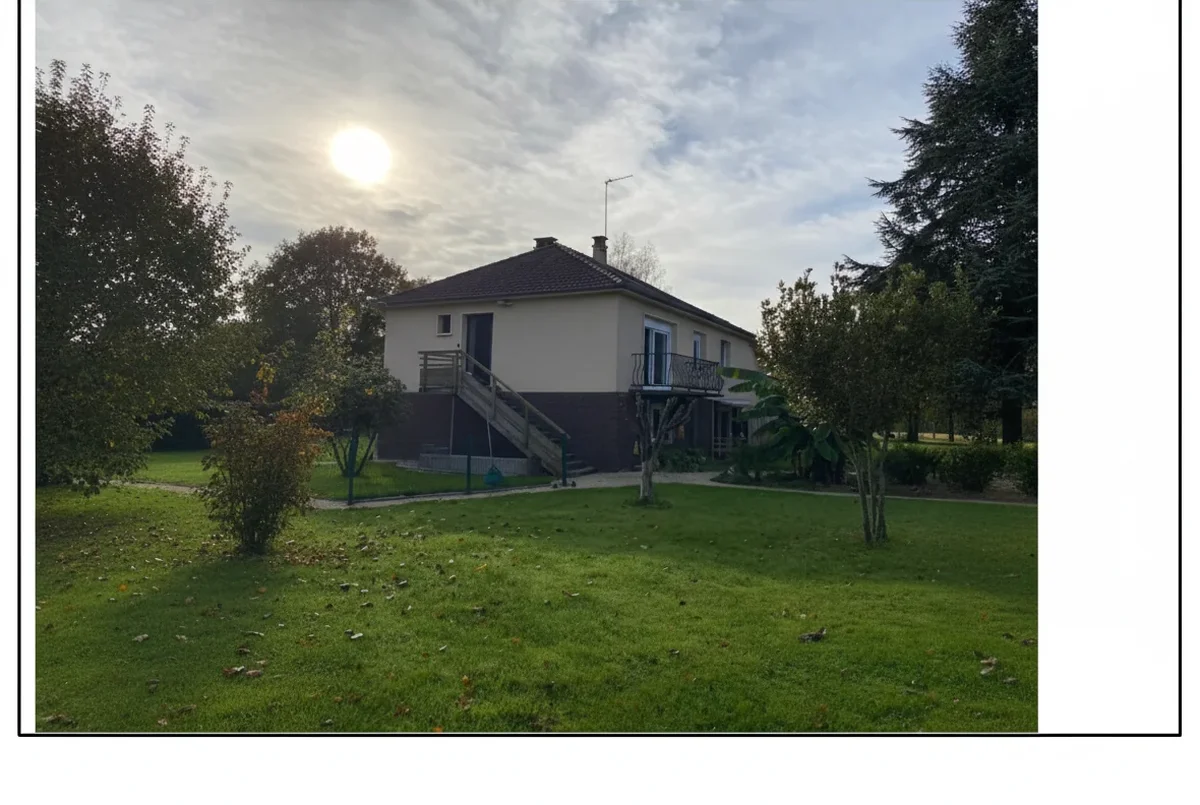
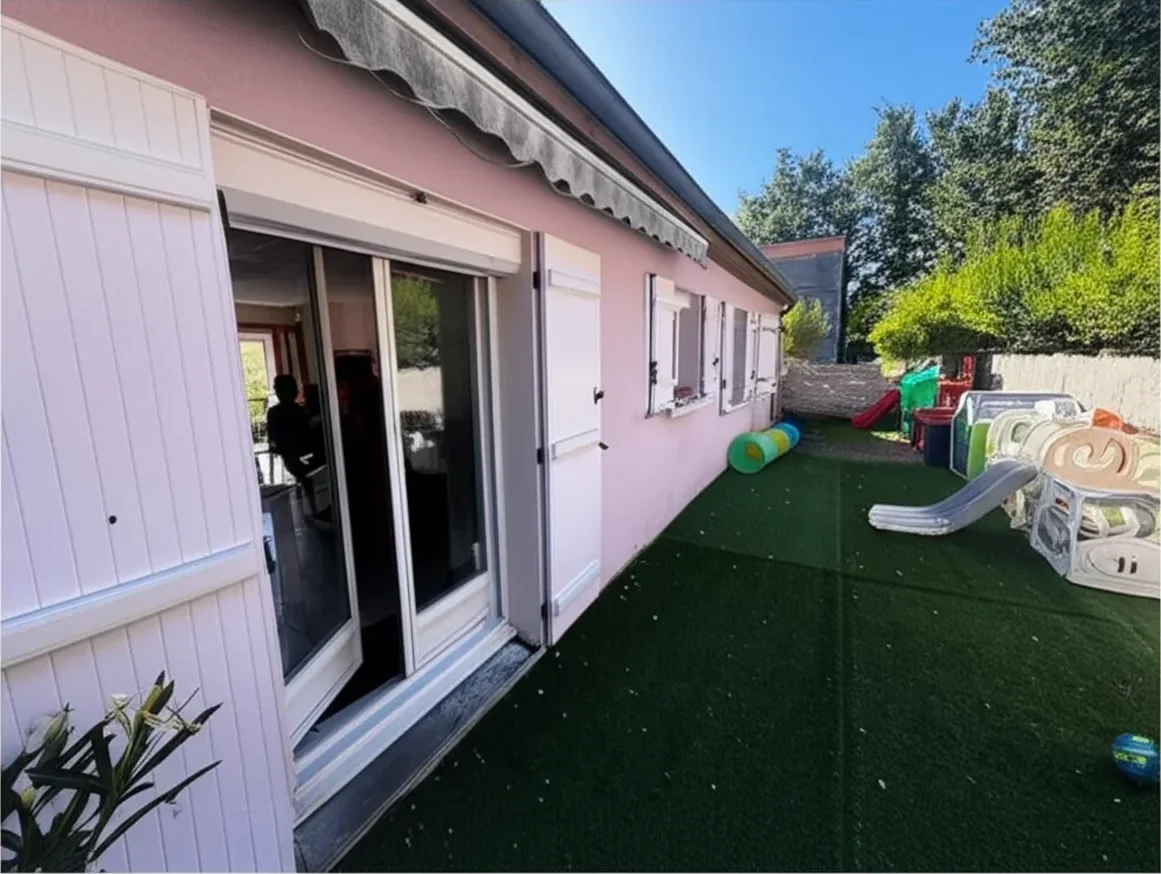
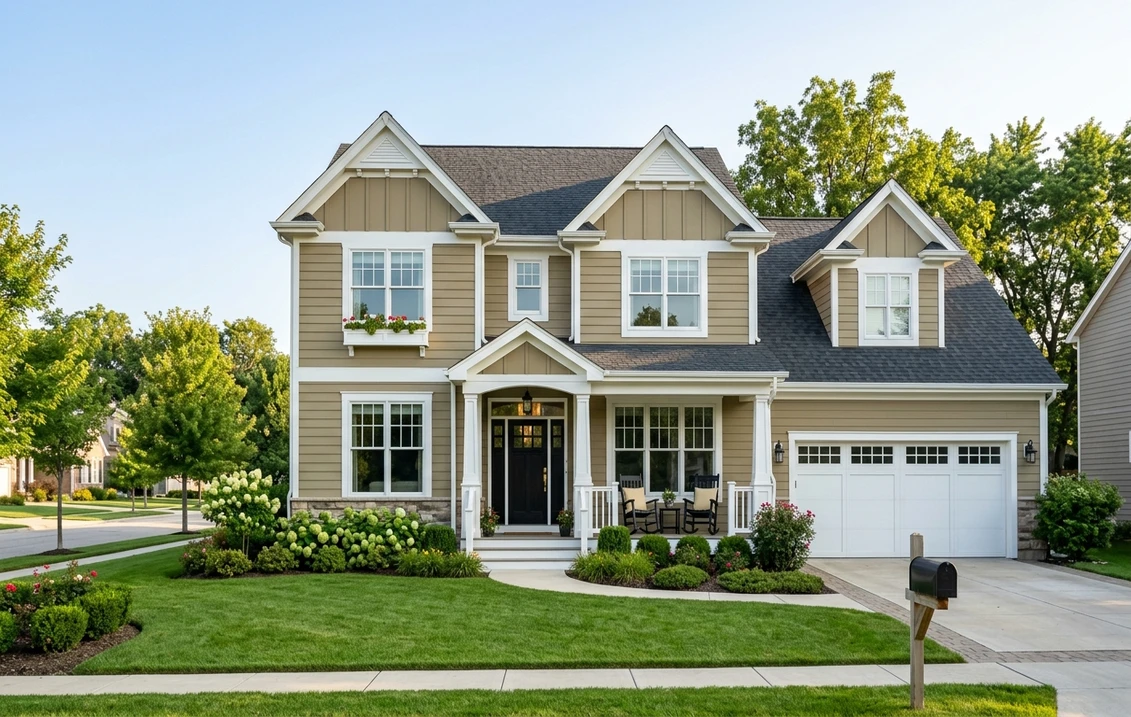
The tool shows paint colors on your own photo: walls, trim, front door, and a Deck option for wood boards and steps. It does not test durability. How it works: our exterior paint visualizer.
What Porch and Floor Enamel is, on the data sheet
The current Porch & Floor Enamel product data sheet (107.41, dated 06/2021) describes "a waterborne acrylic coating designed for interior and exterior, wood and concrete, porches and floors". The Sherwin-Williams product page lists the places it is sold for: porches, patios, basement stairs and floors, workshops, laundry areas and storage rooms. There is one sheen (satin), three tint bases and three can sizes, and cleanup is soap and warm water.
| Spec | Porch & Floor Enamel (sheet 107.41, 06/2021) |
|---|---|
| Finish | Satin, 10 to 20 gloss units at 60° |
| Bases and product numbers | Extra White A32W00251, Deep Base A32W00253, Ultradeep Base A32T00254 |
| Sizes | Quart, gallon, 5 gallons |
| Coverage | 350 to 400 sq ft per gallon at 4.0 mils wet, 1.5 mils dry |
| System | 2 coats on concrete, wood, or sound previously painted floors |
| VOC | Less than 50 g/L (0.42 lb per gallon) |
| Shelf life | 36 months unopened; protect from freezing |
Try it on your house
No photo? Try a sample
The compliance block, dated June 9, 2021, lists the enamel as compliant with OTC, SCAQMD and CARB rules, including CARB SCM 2020. It answers "No" for MPI listing, which only matters if a specification asks for an MPI-listed floor paint. For how this product sits beside the brand's wall paints, see our comparison of Sherwin-Williams outdoor paint lines.
Does Sherwin-Williams Porch and Floor Enamel need a primer?
Not according to its data sheet. The specified system is the same for every substrate: "Concrete and Wood: 2 coats Porch & Floor Enamel", and two coats again on previously painted floors in sound condition. The sheet even lists "good durability over interior and exterior unprimed wood" as a feature. No primer is named anywhere on it.
What takes the place of primer is preparation: smooth concrete is etched, glossy old paint is sanded dull, and peeling paint comes off down to a sound surface. A neighbor in the same catalog works differently: the surface preparation section of the ArmorSeal Tread-Plex sheet tells you to "prime with recommended primer" on wood and to spot prime knots and pitch streaks. So "no primer" is specific to this enamel, not a general rule for floor coatings.
If a store recommends a stain-blocking primer under the enamel, for knots in new pine for example, that advice sits outside the published system: ask which data sheet covers the combination. For primers on siding and trim, our guide to exterior primer types explains which one does what.
Surface prep by substrate
Concrete porches, steps and basement floors
- Age. New concrete and mortar must cure at least 28 days at 75°F before painting.
- Moisture test. Tape a 2 foot by 2 foot plastic sheet to the bare slab, sealing all edges. After 48 hours, look for moisture, discoloration or condensation on the concrete or under the plastic. If you find any, the source "must be located and the cause corrected prior to painting".
- Profile. If the concrete feels like 120-grit sandpaper, the pores are open enough for the enamel to bond. If it does not, etch it.
- Etching strength. Very smooth, troweled concrete with no porosity: concrete etching solution at full strength. Smooth-troweled concrete with some porosity: 1 part etching solution to 2 parts water. Rough-textured concrete: no etching. Never etch a painted surface.
- After etching. Vacuum up the remaining water, which otherwise leaves residue in low spots. Fill cracks, voids and bugholes: the sheet names ArmorSeal Crack Filler.
Bare wood porch boards and stair treads
Wood must be clean, dry and sound. Remove oils and dirt with a degreasing solvent or strong detergent, sand off loose or deteriorated surface wood to get a proper profile, then patch holes with wood filler or putty and sand smooth. Soft or rotted boards are a repair question first, and our deck restoration vs replacement cost guide helps with that call.
Previously painted floors
On sound old paint, clean the surface and dull any smooth, hard or glossy coating by abrading it. Then apply a test area and let it dry one week before testing adhesion. If adhesion is poor, the sheet asks for more abrasion or removal of the old coating, then a retest. Where paint is peeling or badly weathered, clean down to a sound substrate and treat it as a new surface. The sheet adds that any preparation short of total removal of the old coating "may compromise the service length of the system".
Mildew, and lead on older porches
For mildew, the sheet gives a wash of 1 part liquid bleach to 3 parts water, left on for 10 minutes, then rinsed and allowed to dry, with no detergent or ammonia added. Our pressure wash cost guide covers the cleaning step when you hire it out.
The sheet opens its prep section with a lead warning: sanding or scraping old paint can release lead dust, and it gives the National Lead Information Center number, 1-800-424-LEAD. EPA's lead-safe guidance for DIYers says a home built before 1978 may have lead-based paint and recommends misting surfaces before sanding or scraping, then cleaning up with a HEPA vacuum and wet wiping. A painted porch on an older house can fall in that group. Our guide to lead paint testing in pre-1978 homes covers the test options.
Application: tools, temperature and weather
- Temperature. Apply above 50°F. Stir thoroughly. "No reduction necessary", so do not thin it.
- Brush. Nylon-polyester. Our exterior brush guide covers bristle choices for water-based paint.
- Roller. A soft woven cover with a 3/8 to 3/4 inch nap.
- Airless spray. 2,000 psi with a .017 to .021 inch tip. See our exterior sprayer comparison before renting one for a single porch.
The sheet is silent on rain, maximum temperature and humidity. On another exterior acrylic, SuperDeck Deck and Dock, Sherwin-Williams says not to apply if rain is likely within 24 hours and recommends surface temperatures between 50 and 90°F. That is a different product: treat it as a cautious reference, not as this enamel's published limit. Our guide to the best temperature to paint outside covers the weather window for exterior work.
Dry time and cure time
| Stage (sheet 107.41, at 77°F and 50% humidity) | Time |
|---|---|
| Touch | 1 hour |
| Recoat | 4 hours |
| Light foot traffic | 24 hours |
| Tables, chairs and heavy foot traffic | 7 days |
The sheet never uses the word "cure". The practical answer to "how long does it take to cure" is the last line: 7 days before furniture and heavy use. A weekend schedule, by our reading: first coat Saturday morning, second coat at least 4 hours later, walk on it Sunday afternoon, furniture back the following Saturday.
All four figures are for 77°F, and the sheet gives no cold-weather column. The ArmorSeal Tread-Plex sheet, another one-part waterborne acrylic, lists recoat at 6 hours at 55°F against 4 hours at 77°F. Expect the same direction here on a cool day.
Coverage: how much Porch and Floor Enamel to buy
The published rate is 350 to 400 sq ft per gallon, per coat, at 4.0 mils wet. Two coats are specified, so a gallon finishes 175 to 200 sq ft of floor. By our calculation, a gallon spread at 4 mils wet covers about 401 sq ft with zero loss, so the top of the range is close to theoretical. The table adds 10%, which is our margin, not a Sherwin-Williams figure.
| Floor (our calculation) | Area | Paint for 2 coats, with 10% margin | Buy |
|---|---|---|---|
| Front stoop, 6 x 8 ft | 48 sq ft | 0.26 to 0.30 gal | 2 quarts |
| Front porch, 8 x 20 ft | 160 sq ft | 0.88 to 1.01 gal | 1 gallon (add a quart for rough boards or steps) |
| Deep porch, 10 x 30 ft | 300 sq ft | 1.65 to 1.89 gal | 2 gallons |
| Basement floor, 20 x 25 ft | 500 sq ft | 2.75 to 3.14 gal | 3 gallons plus 1 quart |
Steps add up: a tread 11 inches deep and a riser 7.5 inches high on a 4 foot wide stair come to about 6.2 sq ft per step, so five steps add roughly 31 sq ft per coat (our calculation, with assumed dimensions).
Limits: garages, open decks, moisture and slip
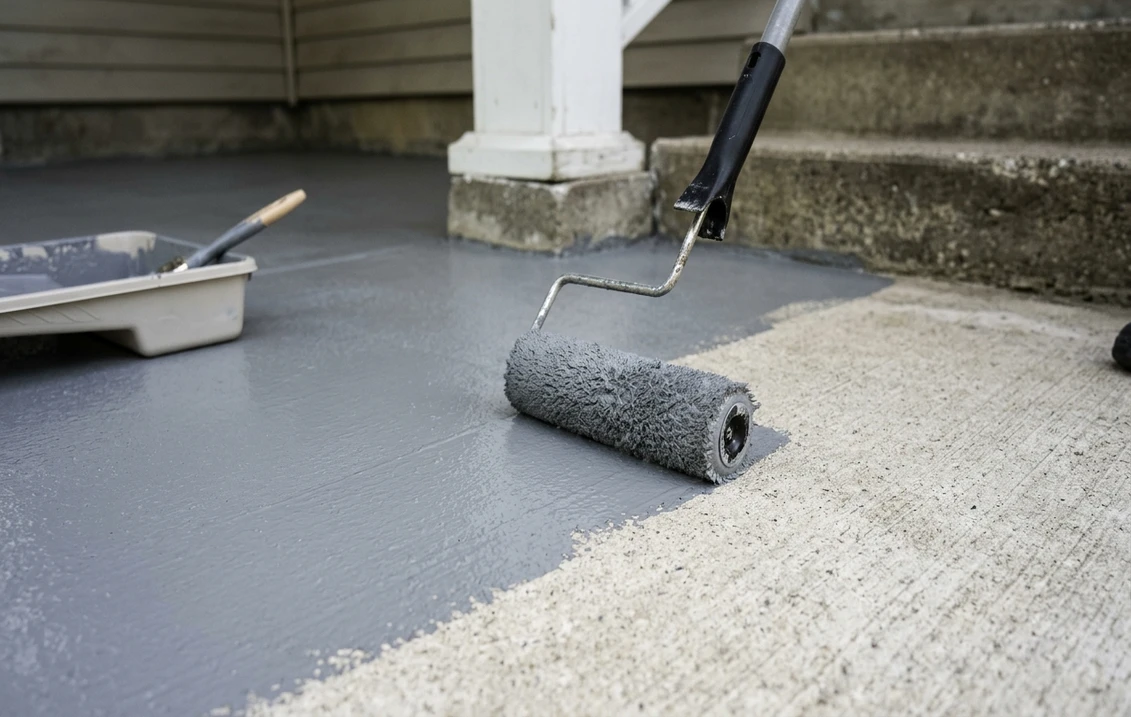
Garage floors and vehicles. The sheet says it twice: the enamel "is not suitable for use on garage floors or surfaces subject to automobile or truck traffic".
Open wood decks. The sheet does not exclude decks by name: its listed uses are floors and steps. Independent advice is firmer. The USDA Forest Products Laboratory's Finishes for Wood Decks (revised July 2013) states that "penetrating finishes, not film-forming finishes, should be used on wood decks", because film-forming finishes such as paint and solid-color stain "are prone to trap moisture and fail by peeling". A roofed porch floor is sheltered from most of that weather: a deck open to rain and sun is the case the Forest Service describes. Our deck stain colors guide covers the penetrating options, and the solid color deck stain guide covers the opaque ones.
Moisture. The sheet claims "excellent water and blister resistance", makes the plastic-sheet test a condition on concrete, and publishes nothing on ponding water. A slab that fails the test, or a porch where water stands after rain, has a problem that paint does not solve.
Slip resistance. Three documents say three different things. The product page says the enamel is "compliant with the low-slip rating required by the Americans with Disabilities Act". The data sheet says surfaces may be slippery when wet and that the product "should not be used in place of a non-skid finish". And the U.S. Access Board's guide to the ADA Standards explains that accessible floors must be "stable, firm, and slip resistant" but that the standards "do not specify a minimum level of slip resistance". On wet steps, plan for the additive. Sherwin-Williams sells one under its H&C brand: the SharkGrip data sheet (rev. 10/17) gives one 3.2 oz container per gallon, mixed into the final coat, and calls the result "slip-resistant but not non-skid". That sheet is written for H&C concrete coatings, so confirm the pairing with the store.
Porch and Floor Enamel vs SuperDeck vs ArmorSeal
Which Sherwin-Williams product goes on which floor? The table sets three other data sheets, SuperDeck Exterior Deck and Dock Coating (114.90A, 07/2020), ArmorSeal Tread-Plex (8.12, revised October 1, 2025) and ArmorSeal 8100 (8.18, revised January 30, 2026), beside the enamel.
| Spec | Porch & Floor Enamel | SuperDeck Deck and Dock | ArmorSeal Tread-Plex | ArmorSeal 8100 |
|---|---|---|---|---|
| Chemistry | One-part waterborne acrylic | One-part high-build acrylic | One-part 100% acrylic, waterborne | Two-part water-based epoxy, mixed 4:1 |
| Where | Interior and exterior floors and steps | Exterior only: decks, steps, patios, walkways | Interior and exterior concrete and wood floors, steps, stairwells | Commercial, industrial and residential floors, garages |
| Finish | Satin | Slight sheen | Semi-gloss | Gloss or satin |
| Coverage per gallon, per coat | 350 to 400 sq ft | About 100 sq ft | 345 to 460 sq ft | 130 to 320 sq ft |
| Recoat at 77°F | 4 hours | 2 to 4 hours | 4 hours | 6 hours minimum, 72 hours maximum without abrading |
| Back in use | 24 hours light foot traffic, 7 days heavy | 24 to 48 hours | 7 days to cure | 18 hours foot traffic, 48 hours heavy traffic, 7 days to cure |
| Vehicles | Not suitable for garage floors | Not for garage floors, driveways or automobile traffic | Not recommended where hot tire pickup can occur | Garages listed; hot tire pickup test passes at 140°F |
Our reading of the sheets, which is a comparison of specifications and not a performance test:
- Covered porch floor, steps, basement or laundry floor in sound condition: Porch & Floor Enamel, a thin film (4 mils wet per coat) and the only one of the four sold in quarts.
- Old, cracked, weathered deck boards or rough concrete outdoors: SuperDeck Deck and Dock. Its sheet calls it "a high build end of life coating" meant to get "one more season" out of a tired surface, at 16 mils wet per coat. One conflict to settle with the store: the sheet says not to apply it over wood coated with paint, while the product page says it can go over existing exterior paint.
- Stairwells and work floors that get cleaned hard: ArmorSeal Tread-Plex, a semi-gloss that still excludes hot tires.
- Garage floor: none of the one-part acrylics. ArmorSeal 8100 is the one sheet here that lists garages, and it is a two-part product with a 5.5 hour pot life at 77°F.
Colors, tinting and sheen
The sheet lists "Color: Most colors" and three bases that are tinted in store: Extra White takes 0 to 5 oz of colorant per gallon, Deep Base and Ultradeep Base 4 to 12 oz. The product page says the enamel is "completely tintable in many colors". We found no dedicated Porch & Floor Enamel color chart on the Sherwin-Williams site. "Most" is not "all": ask the store to confirm your color can be mixed in this product.
Satin is the only sheen. For which color suits a porch floor, and what to put on the ceiling and railings, see our front porch paint color ideas and the haint blue porch ceiling guide. To match the floor to the rest of the house, see the Sherwin-Williams exterior paint guide and our list of popular Sherwin-Williams exterior paint colors. Our Sherwin-Williams color visualizer shows them on your own photo.
How good is it, and what does it cost?
We did not apply it, so this is the product on paper. In its favor: a two-coat system with no primer to buy, same-day recoat, water cleanup, VOC under 50 g/L, and use indoors and out on both wood and concrete. Against it: one sheen only, a full week before furniture goes back, no garage or vehicle use, no MPI listing, and a sheet that asks for real preparation (etching, a 48 hour moisture test, a one week adhesion test on old paint).
On price, the Sherwin-Williams product page asks you to register or sign in to see one, and we could not read a public manufacturer price on November 13, 2026. Store prices can vary by base, size and promotion, so we print no figure. The coverage table above tells you how many gallons to price.
Common mistakes with porch and floor enamel
- Using it in the garage. The sheet excludes garage floors and vehicle traffic.
- Skipping the moisture test. Two days with a taped plastic sheet tells you whether the slab is the problem.
- Painting smooth concrete without etching, or etching old paint, which the sheet forbids.
- Moving furniture back after a day. Light foot traffic at 24 hours, tables and chairs at 7 days.
- Treating satin paint as non-skid. On steps and wet areas, plan for a slip resistant additive.
Pick the porch color before you buy the gallons
Upload a photo of your house and try colors on the walls, trim and front door. The Deck option recolors wood boards and steps. The preview shows color only: it does not show sheen, wear or how the old surface will read under new paint.
Try colors on my houseSources and references
- Sherwin-Williams, Porch & Floor Enamel product data sheet 107.41, 06/2021: system, coverage, dry times, preparation, cautions.
- Sherwin-Williams, Porch & Floor Enamel product page: uses, sizes, slip claim, price behind sign-in.
- Sherwin-Williams, SuperDeck Exterior Deck and Dock Coating data sheet 114.90A, 07/2020 and product page: film build, coverage, weather limits, cautions.
- Sherwin-Williams, ArmorSeal Tread-Plex data sheet 8.12, revised October 1, 2025: drying schedule, primer on wood, hot tire limit.
- Sherwin-Williams, ArmorSeal 8100 data sheet 8.18, revised January 30, 2026: garage use, mix ratio, pot life, hot tire result.
- H&C Products Group (Sherwin-Williams), SharkGrip Slip-Resistant Additive data sheet 111.322, rev. 10/17: dosage and "slip-resistant but not non-skid" limit.
- U.S. Access Board, Guide to the ADA Accessibility Standards, Chapter 3: Floor and Ground Surfaces: no minimum slip coefficient specified.
- USDA Forest Service, Forest Products Laboratory, Finishes for Wood Decks (FinishLine, revised July 2013): penetrating vs film-forming finishes on decks.
- U.S. EPA, Lead-Safe Renovations for DIYers: pre-1978 homes, dust control when sanding or scraping.
Frequently asked questions
Does Sherwin-Williams Porch & Floor Enamel require a primer?
How long does Sherwin-Williams Porch & Floor Enamel take to dry and cure?
How good is Sherwin-Williams Porch & Floor Enamel?
How much is Sherwin-Williams Porch & Floor Enamel?
Can you use Porch & Floor Enamel on a garage floor?
SuperDeck or Porch & Floor Enamel for a wood porch or deck?
What colors does Porch & Floor Enamel come in?
Trademarks mentioned (Sherwin-Williams, Benjamin Moore, Behr, Caparol, Brillux, Sto, Alpina, Valspar, PPG, Glidden, Dulux, Crown Trade, Sandtex, Farrow & Ball, Johnstone's, Leyland) are property of their respective owners. FacadeColorizer is independent and not affiliated with any of them. Nominative fair use under Lanham Act §1125.