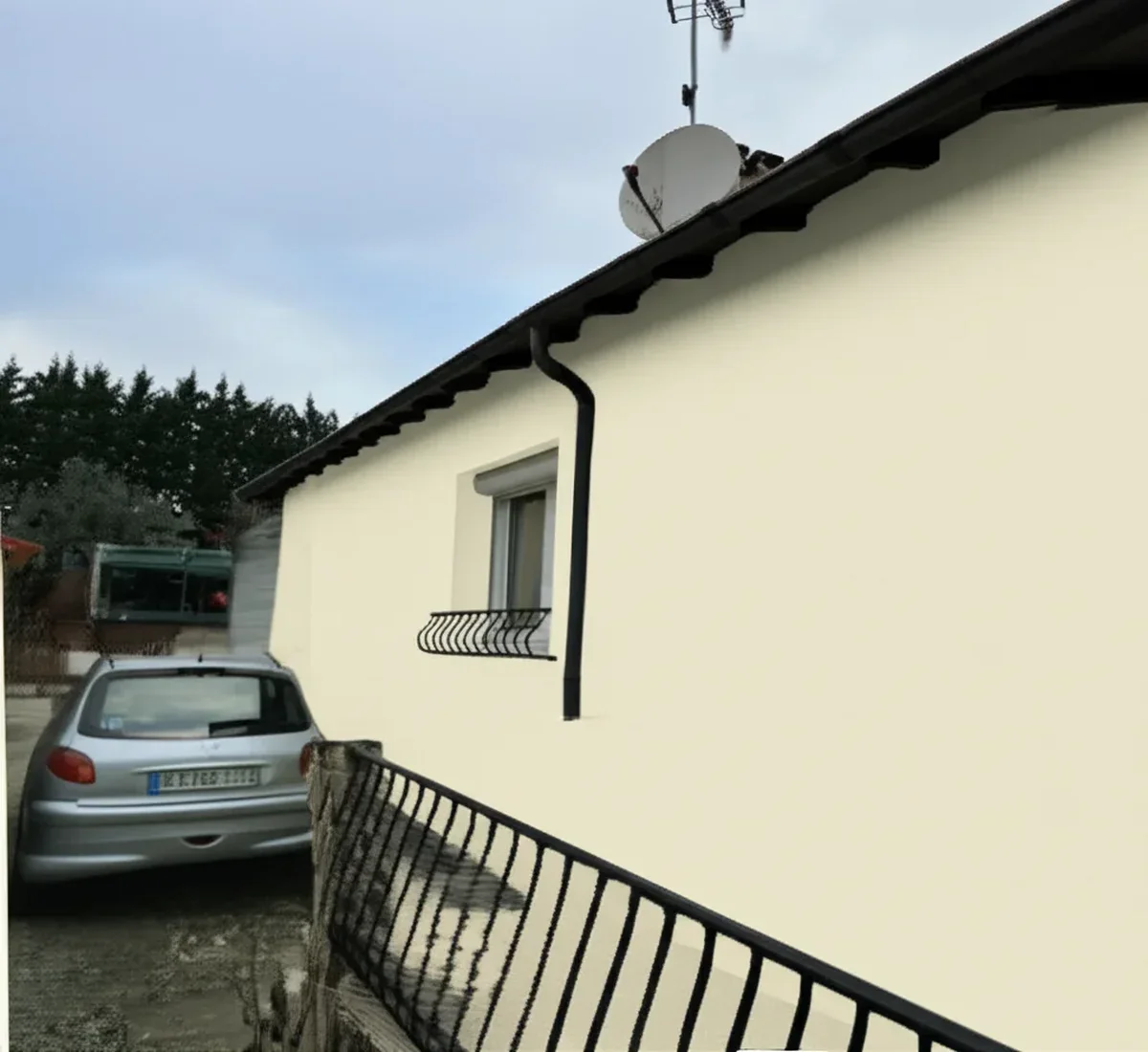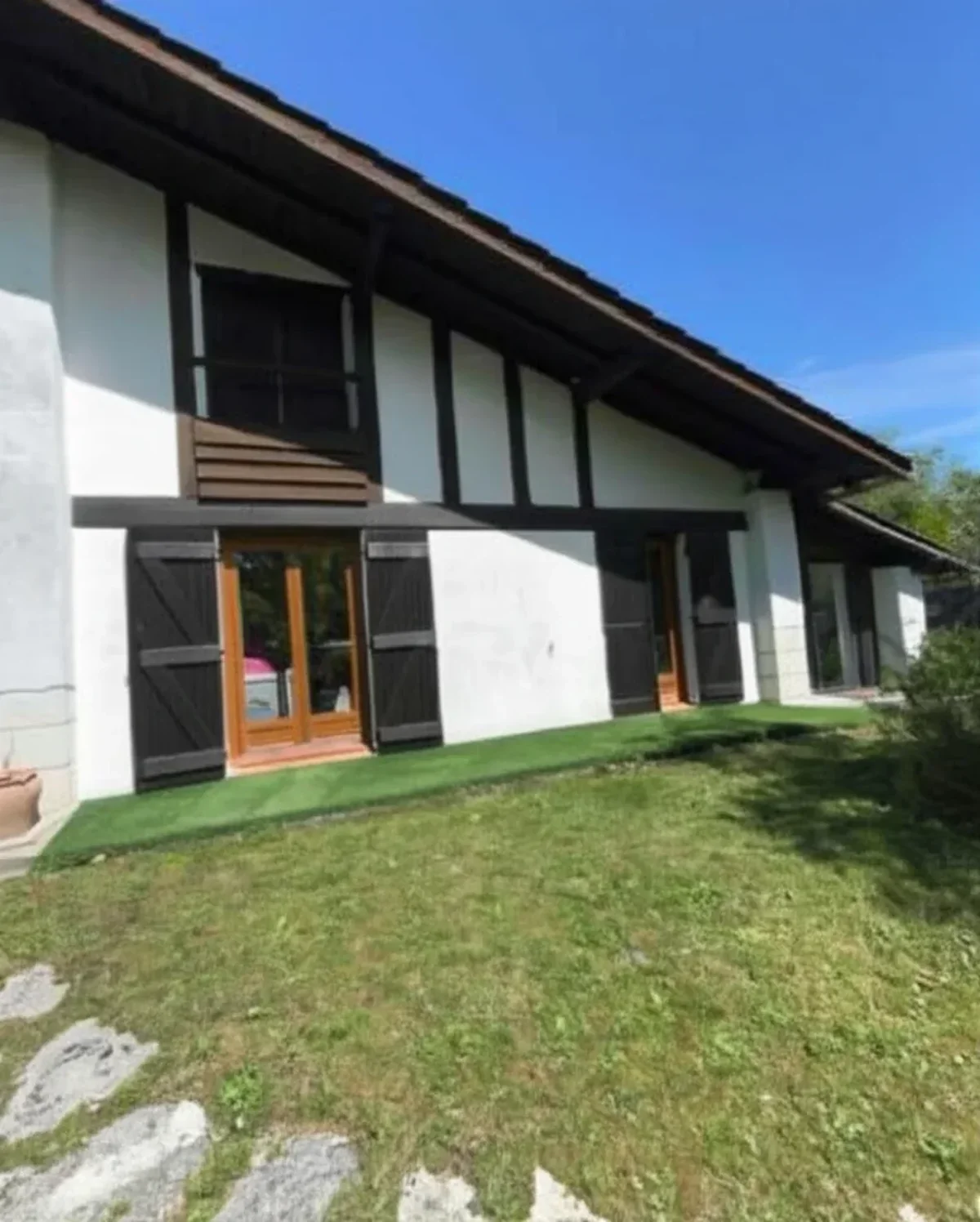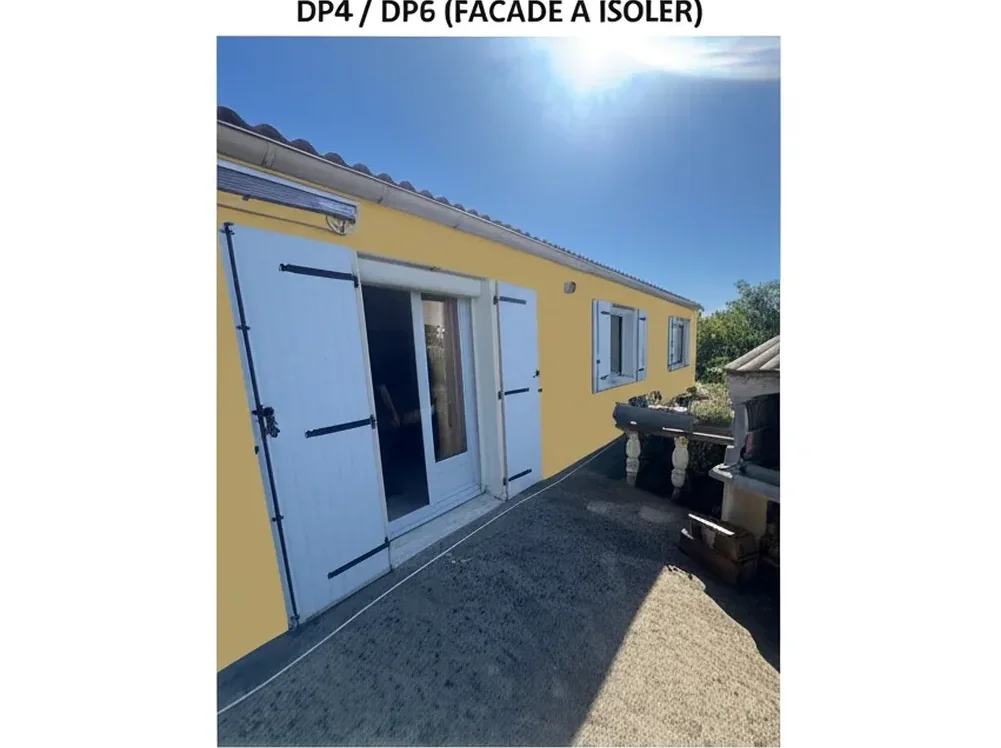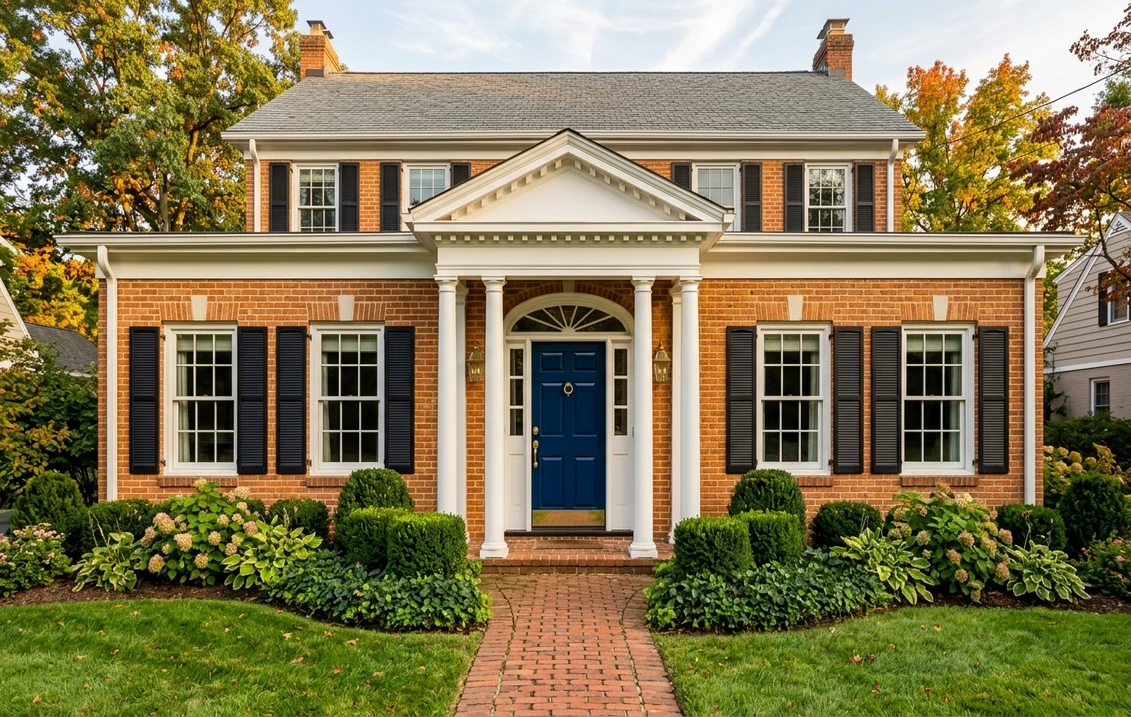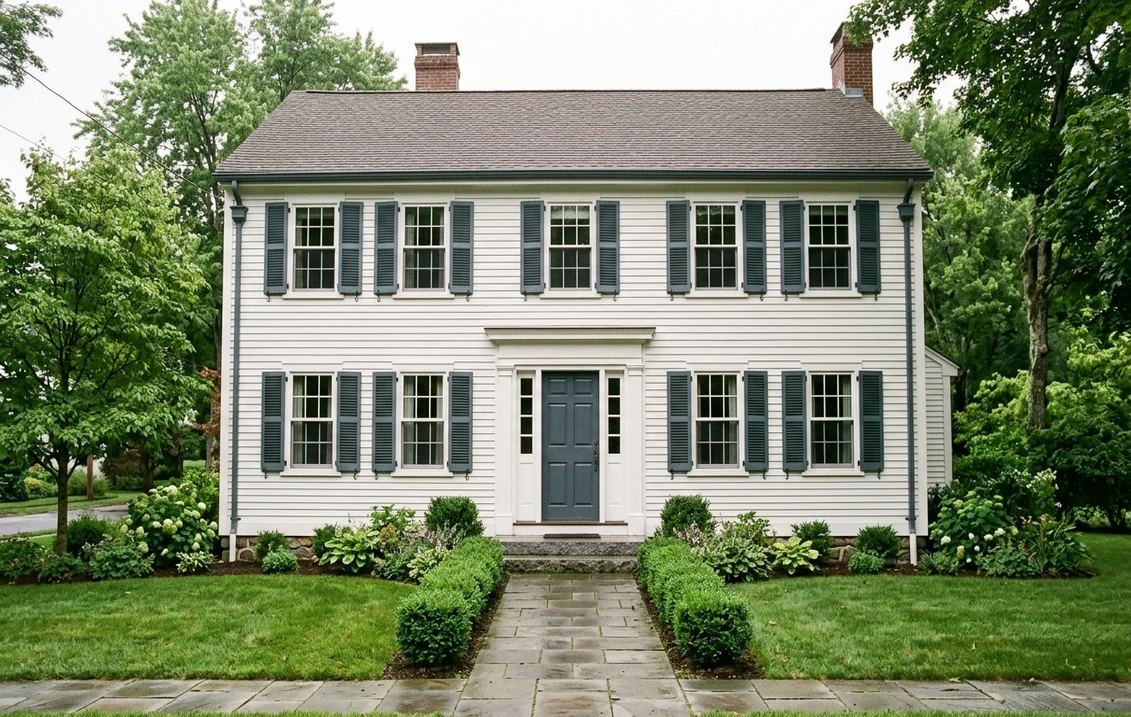

Farrow & Ball Down Pipe (No. 26) is a dark lead gray with a blue undertone, and it was first mixed for the gutters and downpipes of British houses. Outside an American house it works on the places it was made for: front doors, shutters, gutters, downspouts, railings and window sashes, in Exterior Eggshell or Full Gloss, and on brick or stucco in Exterior Masonry. Farrow & Ball does not publish an LRV; by our calculation from the brand's own screen color, it reflects about 13 percent of light, and the closest Sherwin-Williams color is Roycroft Pewter SW 2848.
The color number, the description, the primer, the complementary white, the screen color and the US prices come from the Down Pipe page on farrow-ball.com, read on 20/11/2026. The LRV values of the Sherwin-Williams and Benjamin Moore colors come from those brands. The light index of Down Pipe, the color differences and the gallon counts are our calculations; the advice on doors, trim and brick is our color reasoning. A screen color is an approximation, so judge the paint itself on a sample board, outside, at two times of day.
The US tool uses the Sherwin-Williams and Benjamin Moore color charts, not Farrow & Ball. The link preselects Roycroft Pewter SW 2848, the closest Sherwin-Williams color to Down Pipe by our calculation, on the shutters.
What Farrow & Ball says about Down Pipe No. 26
The Down Pipe page on farrow-ball.com calls it "a dramatic lead grey" and says the blue undertone deepens the finish. The same page tells the story behind the name: the color was originally inspired by the paint used on downpipes and guttering, and has since been taken indoors. It recommends the Dark Tones primer and undercoat and names Blackened No. 2011 as its complementary white. In its color schemes, the page shows Down Pipe on screen as #606565.
| Attribute | Down Pipe No. 26 |
|---|---|
| Name and number | Down Pipe, No. 26 |
| Brand description | A dark lead gray with definite blue undertones |
| Screen color shown by the brand | #606565 |
| LRV | Not published by Farrow & Ball |
| Light index (our calculation from #606565) | About 12.7 on a 0 to 100 scale |
| Recommended primer and undercoat | Dark Tones (wall, wood and metal versions) |
| Complementary white | Blackened No. 2011 |
Try it on your house
- 1Your photoPhoto
- 2Your colorColor
- 3HD render in ~30 sHD render in ~30 s
Your photo is used only to create your preview. JPG, PNG, HEIC (iPhone)
About the light index: an LRV is measured on a painted sample, and Farrow & Ball does not give one for this color. Our figure is the relative luminance of the brand's screen color, so treat it as an order of size, not a lab value. It lands next to the measured LRV of Roycroft Pewter (12.83), the Sherwin-Williams color closest to Down Pipe on screen, which supports the order of size. Either way, Down Pipe sits in the dark band of exterior colors, where a door or a shutter reads as a solid shape against light siding.
The exterior finishes and their US prices
The Down Pipe product page lists three finishes that can go outside, with these US prices on 20/11/2026. Prices change, so read them as a dated snapshot, not a quote.
| Finish | What the brand says it is for | 750 ml | US gallon |
|---|---|---|---|
| Exterior Eggshell | Outdoor wood and metal, soft sheen, resistance to algae and fungi | $60 | $178 |
| Full Gloss | Interior and exterior woodwork, metalwork and masonry details, high shine | $56 | $168 |
| Exterior Masonry | Brick and render, flat matte, self-priming, water-resistant and breathable | Not listed | $160 |
| Sample pot | 100 ml, for test boards | $9 (100 ml) | - |
The uses in the table come from the brand's finish pages: the Exterior Eggshell page describes it for front doors, fences, pergolas and planters, with protection against weather and UV damage; the Full Gloss page calls it scuff, stain and weather-resistant, for front doors and garden furniture; and the Exterior Masonry page says the new formula has enhanced UV protection and lets walls breathe. None of the three pages lists vinyl siding.
How much to buy depends on the area, the number of coats and the spread rate of the finish. Measure each element: a 36 by 80 inch front door is 20 square feet per face, before the edges; a shutter is its height times its width, louvers and edges included; a gutter run is its length times the girth you paint. Add the areas, multiply by the number of coats, and divide by the spread rate that the brand's product advice sheets give for the finish you choose. For a door alone, a 750 ml can is the size to start from; for shutters on every window plus gutters, compare the total with a gallon before you order.
Front doors: Down Pipe, Railings or Off-Black?
Down Pipe is the gray of the three. Railings No. 31 and Off-Black No. 57 are near-blacks: by our calculation from the brand's screen colors, their light index is about 6.6 and 6.3, half that of Down Pipe (12.7). Both sit on the "similar colours" list of the Down Pipe page, with Hopper Head No. 305 (about 8.7) and the much lighter Pigeon No. 25 (about 34). On a door, our color reasoning goes like this: Down Pipe shows the panels and moldings of a six-panel door more clearly than a near-black, because the shadows in the profiles stay darker than the flat faces. Railings and Off-Black read as one dark slab from the street.
That makes Down Pipe the safer choice on a Colonial or Federal door with deep moldings, and the near-blacks the stronger one on a flat slab door or a modern entry. For the near-black option on an American house, our Farrow & Ball Railings exterior guide covers the doors, ironwork and finishes. For a lighter gray-blue from the same brand, read the Farrow & Ball Pigeon exterior guide.
Full Gloss or Exterior Eggshell on the door? Full Gloss gives the traditional high-shine door and makes the moldings catch the light; it also shows every dent and brush mark, so it suits a smooth, well-prepared door. Exterior Eggshell is softer and more forgiving on an older door with dings. The hardware changes the reading too: brass warms the blue undertone, black iron makes the gray look cooler. For more door ideas on gray and white houses, see our front door colors for a gray house.
Shutters and window sashes on American houses
Shutters are the second classic use. On white or cream clapboard, Down Pipe shutters give a strong outline without the hard contrast of black. On red brick, the blue undertone of Down Pipe sits against the orange of the brick, and the pair reads cool and warm at once; check that the mortar color does not fight the gray. On gray or blue siding, Down Pipe can look like a darker shade of the same color, which is quiet but can feel flat: compare it with a near-black before you commit.
Window sashes in Down Pipe frame the glass in a dark line, a look that works on older wood windows. Our color reasoning: keep the casings and the corner boards in a white so the sashes read as an accent rather than a dark hole in the wall. Louvered wood shutters take Exterior Eggshell; composite or vinyl shutters are outside the surfaces listed by the brand, so check the shutter maker's own paint rules first. Our exterior shutter paint colors guide compares other shutter colors by siding color.
Gutters and downspouts: back to where the name comes from
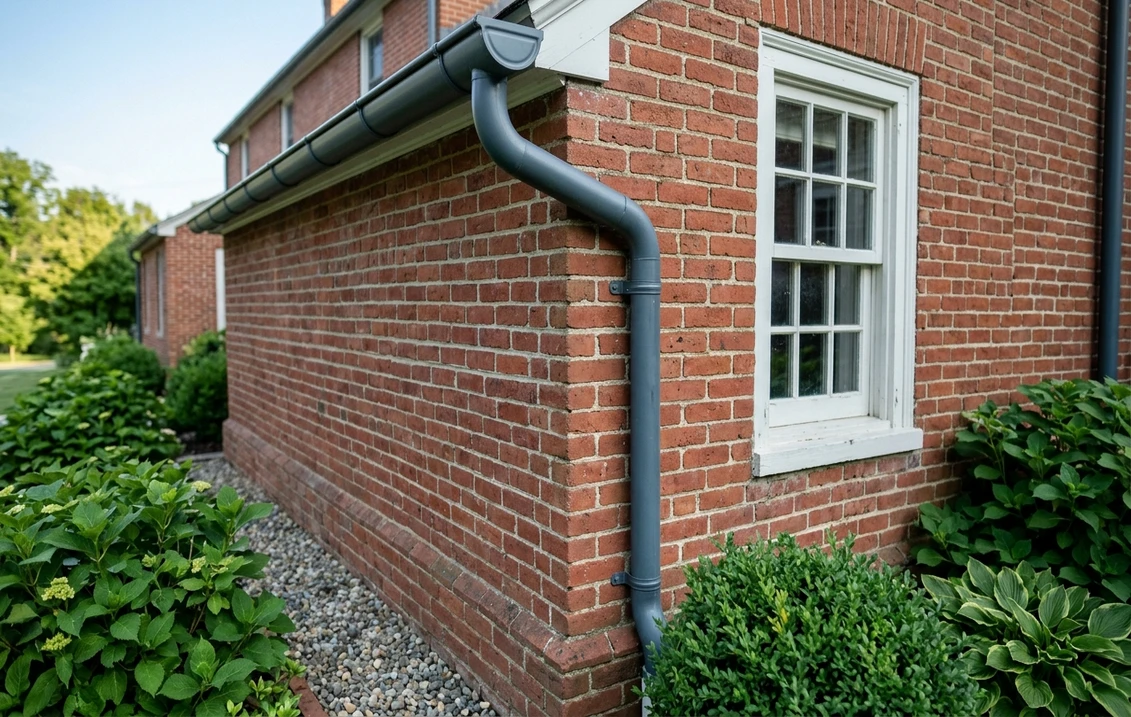
Painting gutters and downspouts in a dark gray hides them against a dark roof and makes them a deliberate line against light siding. Gutters can be aluminum, galvanized steel, copper or vinyl, and the material decides the primer. Farrow & Ball sells a Metal Primer in its Dark Tones version and recommends Dark Tones under Down Pipe; Exterior Eggshell and Full Gloss are the finishes its pages describe for exterior metal. Vinyl gutters are not on those pages, so leave them out of a Farrow & Ball plan unless the brand confirms it.
Preparation matters more than the color on metal. Wash off dirt and the chalky film of old factory paint, let the metal dry fully, and prime any bare spots. On factory-finished gutters, follow the preparation steps of the metal primer you use before the first coat, since a smooth factory coating gives the new paint little to grip. Our color reasoning for the layout: paint the downspouts the color of the wall they run on (Down Pipe on dark siding, the trim white on white trim) if you want them to vanish, or Down Pipe everywhere if you want the old British look of a dark outline around a light house.
Brick, stucco and siding: where Down Pipe can cover a wall
Exterior Masonry is the Farrow & Ball finish for brick and render, which covers stucco in American terms. A whole wall in a dark color is a different decision from a door: the house reads heavier, the windows read as light openings, and the color can look darker than the chip because the large area adds up. Our color reasoning: on a whole wall, Down Pipe suits a modern house with clean lines, a garden wall or an outbuilding better than a narrow Colonial, where it can crowd the trim.
Painting brick is close to permanent, since paint is hard to remove from a porous surface. If the brick is sound and has never been painted, decide with a test patch on a hidden wall and let it weather for a few weeks. Wood clapboard and fiber cement siding are surfaces for a wood or siding paint, not for a masonry finish; on those, a Sherwin-Williams or Benjamin Moore exterior line in the closest color (see the table below) is the usual American route. Vinyl siding is the one surface to avoid in a color this dark without the siding maker's approval.
Closest Sherwin-Williams and Benjamin Moore colors
We compared the Down Pipe screen color with the published color data of both American brands (Delta E 2000: under 1 is very close on screen, 2 to 3 is visible side by side). A close screen match is not the same paint: pigments, sheen and the base change the reading, so paint both samples side by side before you swap one for the other.
| Color | Brand LRV | Screen color | Delta E 2000 to Down Pipe (our calculation) |
|---|---|---|---|
| Roycroft Pewter SW 2848 | 12.83 | #616564 | 0.7 |
| Web Gray SW 7075 | 13.12 | #616669 | 1.9 |
| Bracken Slate CW-690 (Benjamin Moore) | 14.09 | #5E6363 | 0.7 |
| Charcoal Slate HC-178 (Benjamin Moore) | 14.51 | #646769 | 2.1 |
Roycroft Pewter belongs to Sherwin-Williams' historic color range, and Bracken Slate to the Benjamin Moore Williamsburg collection, which the brand's page says was created with white and black pigments. Both are the closest on screen. Charcoal Slate is a little lighter and a little more neutral, and Web Gray is a touch bluer. Our color reasoning: if the goal is the blue undertone that defines Down Pipe, put the samples next to a white card in shade, where the undertone shows most. Use the "closest match" only as a starting point; neither brand presents these colors as equivalents of Down Pipe.
Colors that go with Down Pipe outside
The Down Pipe page pairs it with three schemes. We list them with our light index from each screen color, so you can see the contrast each one gives.
| Farrow & Ball scheme | Light index (our calculation) | Outside, our color reasoning |
|---|---|---|
| Blackened No. 2011 with Cornforth White No. 228 | 71 and 60 | Down Pipe door and shutters on light gray siding with crisp trim |
| Pavilion Gray No. 242 with Manor House Gray No. 265 | 53 and 35 | A tonal gray house, Down Pipe on the darkest parts |
| Plummett No. 272 with Hopper Head No. 305 | 27 and 9 | A dark, moody exterior; works on modern lines, risky on small houses |
With American materials, our color reasoning gives these pairs: white clapboard with Down Pipe shutters and door is the safest; red brick with a white trim and Down Pipe door adds a cool accent to a warm wall; fieldstone and cedar shingles take Down Pipe on the trim if the stone has gray in it. Against a black asphalt roof, Down Pipe gutters disappear; against a brown roof, they read as a separate gray line, which can look unplanned. For more pairings by roof color, see our guide to paint colors for brown roof houses.
How to test Down Pipe outside
A dark gray changes more outdoors than indoors. Paint two coats from a sample pot on a primed board about two feet square, so that the edge of the board does not set the reading. Hold it against the door, the shutters and the siding, in the morning and in the late afternoon, and look at it from the street, not from a foot away. On a north-facing facade, the blue undertone gets stronger; in full sun, the gray flattens and can look lighter than the chip.
Compare it with Roycroft Pewter or Bracken Slate on the same board if you are weighing an American brand for the siding and Farrow & Ball for the door. The sample pot is 100 ml at $9 on the brand's page; a board is a better test than a patch painted on the house, because you can move it from wall to wall.
When to paint, and lead on older houses
Paint outside in dry weather, on a dry surface, and out of hard afternoon sun on a dark color, which heats up fast and can dry too quickly to level. The temperature limits and recoat times differ by finish: read them on the brand's product advice sheets for the finish you buy. In late fall, short days and morning dew leave little drying time, so start late enough for the surface to dry and stop early enough for the paint to set before evening.
Front doors, sashes and shutters on older houses often carry old lead paint. The EPA's Renovation, Repair and Painting Program page says that about three quarters of US homes built before 1978 still contain some lead-based paint, and that anyone paid to disturb painted surfaces in those homes must be certified and trained in lead-safe work practices. The rule does not generally apply to homeowners working on their own house, but the dust is just as harmful: test the old layers before you scrape or sand. Our regulatory guide explains the EPA RRP rule for painting contractors.
Try a dark lead gray on your own house
Before ordering a gallon at $160 to $178, see how a dark lead gray changes your front: upload a photo, pick the shutters, the front door or the walls, and compare a few grays. The US tool does not carry the Farrow & Ball chart; Roycroft Pewter SW 2848 is the closest Sherwin-Williams color to Down Pipe by our calculation, so it is preselected below. Use the result to decide where the gray goes, then confirm the color with the real sample.
One photo, then switch between the door, the shutters, the trim and the walls.
If you are still choosing the main colors of the house, the Sherwin-Williams front door colors guide and our front door colors for a red brick house set out the door first, then the trim.
Sources and references
- Farrow & Ball, Down Pipe No. 26: description, origin of the name, Dark Tones primer, Blackened as complementary white, screen color #606565, color schemes and US prices (read on 20/11/2026).
- Farrow & Ball, Exterior Eggshell, Full Gloss and Exterior Masonry pages: surfaces and properties of each exterior finish.
- Farrow & Ball, product advice sheets: spread rates, temperatures and recoat times by finish.
- Sherwin-Williams, Roycroft Pewter SW 2848: color page; LRV and screen color from the brand's public color data.
- Benjamin Moore, Bracken Slate CW-690 and Charcoal Slate HC-178: LRV, collection and screen color.
- US Environmental Protection Agency, Lead Renovation, Repair and Painting Program: pre-1978 homes, certification of paid contractors, homeowner exemption.
Frequently asked questions
Can Farrow & Ball Down Pipe be used outside?
What is the LRV of Down Pipe?
What Sherwin-Williams color is closest to Down Pipe?
Is Down Pipe a good front door color?
How much does Down Pipe exterior paint cost in the US?
Trademarks mentioned (Sherwin-Williams, Benjamin Moore, Behr, Caparol, Brillux, Sto, Alpina, Valspar, PPG, Glidden, Dulux, Crown Trade, Sandtex, Farrow & Ball, Johnstone's, Leyland) are property of their respective owners. FacadeColorizer is independent and not affiliated with any of them. Nominative fair use under Lanham Act §1125.