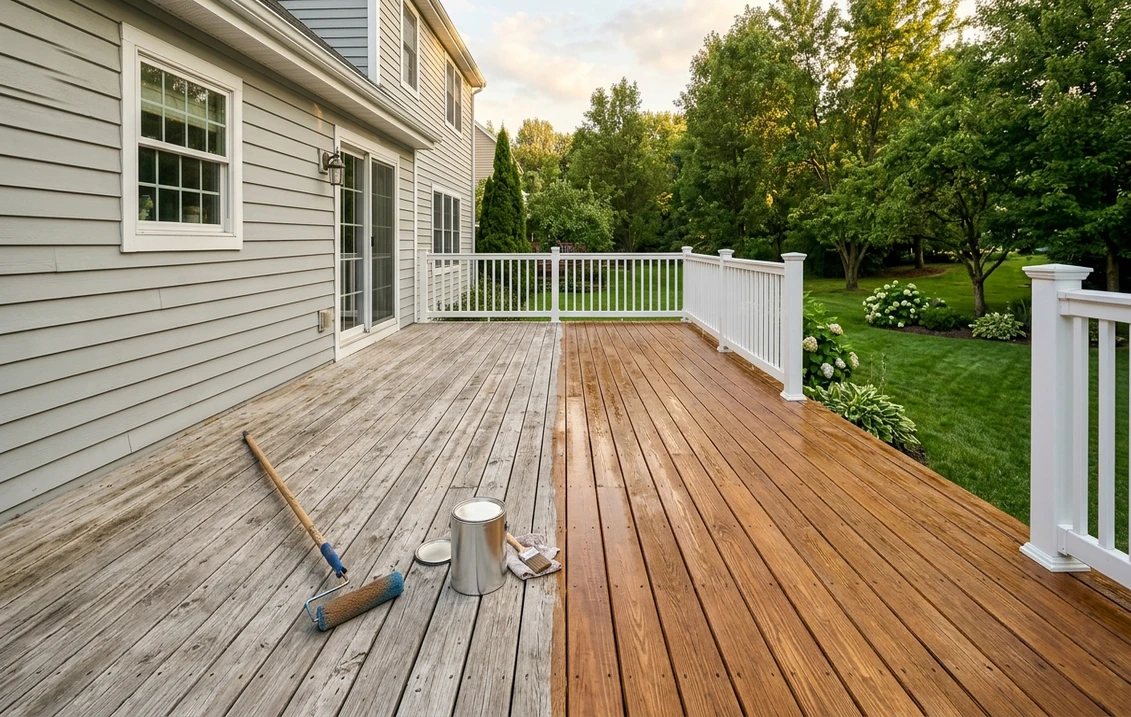

Sherwin-Williams SuperDeck is a deck care line, not a single stain: seven main finishes that run from a clear sealer to a high-build coating, plus three preparation products. The right one depends on your wood and on how much grain you want to keep. The two oil-based stains go on in one coat only. The waterborne semi-transparent needs two coats, the waterborne solid takes two at most, and Deck & Dock Coating needs two heavy coats on old, cracked boards. The data sheets are written for bare or stripped wood, which is the line most buyers miss.
How this page works: every figure comes from Sherwin-Williams data sheets and product pages, the USDA Forest Products Laboratory, the Southern Forest Products Association and EPA, read on November 14, 2026. Calculations are ours and labeled as such. No stain was applied for this page. The two prices quoted are the list prices shown on the Sherwin-Williams deck finishes catalog page on November 14, 2026.
The tool has a Deck option that recolors boards, railings and steps on your photo. It shows color only, not opacity, sheen or wear. How it works: our exterior paint visualizer.
What SuperDeck is: one name, a whole line
The Sherwin-Williams SuperDeck Deck Care System page groups stains, a sealer, a coating and cleaners under one name, and the line brochure carries the tagline "featuring premium Duckback technology". The brochure sorts the finishes with one rule: "protection and durability increase as opacity increases", while the wood grain shows less.
In that order, the line is: a waterborne clear sealer, an oil-based transparent stain, oil-based and waterborne semi-transparent stains, a waterborne semi-solid, a waterborne solid, and Deck and Dock Coating, a high-build coating for old wood and concrete. Three cleaners complete it: Deck Wash, Revive and Stain & Sealer Remover. The system page also lists IR Reflective versions of the semi-solid and solid stains and a Log Home and Deck Stain, which we leave out of the tables below.
Which SuperDeck stain for which deck
Each row is one data sheet, linked in the first column. Times are the sheet values at 77°F and 50% humidity.
| Product (data sheet) | Look | Base | Coats | Coverage per gallon | Ready to use |
|---|---|---|---|---|---|
| Waterborne Clear Sealer (114.10, 12/2019) | Clear, no surface film | Water | One; a second only wet on wet, within 2 hours | 150 to 300 sq ft | 24 hours |
| Oil-Based Transparent, 550 VOC (114.22, 09/2020) | Light tone, no sheen | Oil | One only | 200 to 400 sq ft | 24 to 48 hours |
| Oil-Based Semi-Transparent, 550 VOC (114.40B, 09/2020) | Grain visible, no sheen | Oil-alkyd | One only | 150 to 400 sq ft | 24 to 48 hours |
| Waterborne Semi-Transparent (114.31, 12/2019) | Grain visible, "slight film, no sheen" | Acrylic | Two required, the second within 7 days | 100 to 350 sq ft | Not stated; recoat after 4 hours |
| Waterborne Semi-Solid (114.50, 04/2020) | Some grain, slight film | Acrylic | "Two thin coats may be required", the second within 7 days | 350 sq ft smooth, 100 to 200 rough | Not stated; recoat after 4 hours |
| Waterborne Solid Color (114.70B, 03/2025) | Opaque, low lustre | 100% acrylic | Two recommended, never more than two | 200 to 400 sq ft at 4 to 8 mils wet | 24 hours |
| Deck and Dock Coating (114.90A, 07/2020) | Opaque, slight sheen, fills cracks | Acrylic | Two required | About 100 sq ft at 16 mils wet | 24 to 48 hours |
Try it on your house
- 1Your photoPhoto
- 2Your colorColor
- 3HD render in ~30 sHD render in ~30 s
Your photo is used only to create your preview. JPG, PNG, HEIC (iPhone)
Our reading of the sheets, which is a comparison of specifications and not a performance test:
- New pressure-treated pine, grain to keep: the oil-based transparent or semi-transparent, once the boards pass the water test described below.
- Cedar or redwood: the same oil-based stains, after Revive, the cleaner written for resinous woods.
- Clean and stain in the same weekend: the waterborne semi-transparent or semi-solid, whose sheets allow wood "damp from weathering or cleaning, not to exceed 25% moisture content".
- Gray boards with uneven color: semi-solid or solid. The solid "hides imperfections for uniform color".
- Cracked, splintered boards: Deck and Dock, "a high build end of life coating" that helps "get one more season" out of the surface. A crack wider than 1/8 inch means the board is replaced.
- Composite decking: only the solid sheet lists "some composite decking materials", with a note to consult the decking manufacturer. The waterborne semi-transparent, semi-solid and Deck and Dock sheets exclude composite.
- States with tighter VOC rules: the two 550 VOC oil stains answer "No" on the OTC, SCAQMD and CARB lines of their compliance blocks. A 250 VOC semi-transparent (sheet 114.41B) answers "Yes" for OTC and CARB.
- Siding and walls: the sheets close with "For Vertical surfaces - walls, siding, etc, use WoodScapes". Our Sherwin-Williams Woodscapes stain review covers that line.
Is Sherwin-Williams SuperDeck paint or stain?
It is stain, with one exception. The clear sealer leaves "no surface film", the two oil-based stains are penetrating formulas with no sheen, and the waterborne semi-transparent and semi-solid leave what their sheets call a "slight film". The solid color stain is a 100% acrylic that covers the grain completely, at 1.3 to 2.6 mils dry: it is labeled a stain, but the Forest Products Laboratory groups solid-color stain with paint as a film-forming finish.
The exception is Deck and Dock Coating, built to 8 mils dry per coat to fill cracks and smooth rough boards. Its sheet never calls it a stain. A floor paint for a covered porch is a different product: see our page on Sherwin-Williams Porch and Floor Enamel.
How many coats of SuperDeck should you apply?
It depends on the product, and more is not better. The sheets are firm on this point.
- Oil-based transparent and semi-transparent: one coat. "If a second coat is applied, it will not penetrate or adhere properly. The surface will appear glossy and remain tacky." A maintenance coat waits until water no longer beads on the boards.
- Waterborne semi-transparent: two coats, "required for proper color development". The second goes on no sooner than 4 hours and no later than 7 days after the first. The semi-solid takes one or two thin coats under the same limit.
- Waterborne solid: two, and no more. "2 coats are recommended for maximum durability", and the coverage block adds "Do not apply more than two coats".
- Clear sealer: one. A second coat goes on wet on wet, within 2 hours. After that it "will not penetrate and adhere properly".
- Deck and Dock: two. The first coat fills cracks and the second builds the film.
Coverage: how much SuperDeck to buy
The sheets repeat one note: new wood takes less product than old, more porous wood. The table applies each published range to a 12 by 16 foot deck floor, 192 sq ft. It is our calculation, with no margin and without railings or steps.
| Product | Coats counted | Stain for 192 sq ft (our calculation) |
|---|---|---|
| Clear Sealer | 1 | 0.64 to 1.28 gal |
| Oil-Based Transparent | 1 | 0.48 to 0.96 gal |
| Oil-Based Semi-Transparent | 1 | 0.48 to 1.28 gal |
| Waterborne Semi-Transparent | 2 | 1.10 to 3.84 gal |
| Waterborne Semi-Solid | 2 | 1.10 gal smooth, 1.92 to 3.84 gal rough |
| Waterborne Solid Color | 2 | 0.96 to 1.92 gal |
| Deck and Dock Coating | 2 | 3.84 gal |
Deck and Dock uses at least three times the volume of an oil stain on the same floor, and a rough, thirsty deck can more than triple the amount of waterborne semi-transparent. If the boards are soft or the frame is in doubt, settle that first: our deck restoration vs replacement cost guide covers the decision.
Temperature, rain and dry time
All seven sheets ask for shade and surface temperatures between 50 and 90°F. The waterborne sheets add back-brushing while the stain is still wet. The differences are in the margins.
- Oil-based stains. Not if the temperature will fall below 50°F or if rain is expected within 24 hours, and never "over wet or damp surfaces". Dry to touch in 8 hours.
- Waterborne semi-transparent and semi-solid. Not below 50°F for 24 hours after application, and for the semi-solid no rain or snow in that window. Dry to touch in 1 hour.
- Waterborne solid. The cold-weather product of the line: the limit is 35°F, not 50. At 77°F the sheet gives touch in 1 hour, recoat in 2 to 4 hours and use in 24 hours. At 35 to 45°F: touch in 2 hours, recoat in 24 to 28 hours, use in 48 hours. Air, surface and stain must be at least 5°F above the dew point.
- Clear sealer. Not if the temperature will fall below 40°F. Dry to touch in 5 hours.
- Deck and Dock. Not if the temperature may drop below 50°F or rain is likely within 24 hours, and not on damp wood.
To avoid lap marks, the sheets say to stay out of direct sun and to work each board from end to end. For the general weather window, see our guide to the best temperature to paint outside.
Preparation: Deck Wash, Revive and Stain & Sealer Remover
Each stain sheet names the same three cleaners, chosen "based on the conditions". The cleaners have their own data sheets.
| Product (data sheet) | What it is | Use it for | Limits | Coverage and timing |
|---|---|---|---|---|
| Deck Wash (114.03, 07/2020) | Water-based cleaner, pH 11.7, used full strength | Mildew, algae and dirt on uncoated pressure-treated wood, cedar and pine | Not recommended on previously painted surfaces, redwood or teak | 250 sq ft per gallon. 10 minutes, never more than 15. Rinse 2 or 3 times, then wait at least 24 hours |
| Revive (114.02, 05/2020) | Oxalic acid brightener, pH 1, ready to use | Tannin bleed, nail stains, gray wood and mill glaze on cedar and redwood; required after the remover | Do not let it dry on the wood | 150 to 250 sq ft per gallon. 10 to 15 minutes, 20 sq ft at a time. About 2 days to dry |
| Stain & Sealer Remover (114.01A, 06/2020) | Sodium hydroxide stripper, pH 13.5 | Old semi-transparent stains, weathered solid stains, clear finishes, some weathered latex paint | Not on new, untreated wood. May darken western red cedar and redwood. No metal containers | 150 sq ft per gallon. 10 to 15 minutes, synthetic brush, then Revive to neutralize |
The water test. The stain sheets give one check: sprinkle water on the boards. "If the water penetrates into the wood quickly, the wood is ready to finish. If the water beads up or does not penetrate, remove existing finish or contaminant."
New pressure-treated lumber. The SuperDeck sheets give only the water test, no waiting period. The Southern Forest Products Association's finishing guidance for Southern Pine decks recommends waiting 30 days before a semi-transparent oil-based stain on wet treated wood and at least six months before paint or a solid-color stain, while lumber re-dried after treatment can be coated at once.
Pressure washing. If you hire out the cleaning, see our pressure wash cost guide, and note the Forest Products Laboratory's warning that power washing can remove wood from the surface, particularly on softer species such as western redcedar.
Old decks and safety. The stain sheets carry a lead warning for anyone removing old paint. A deck built before 2004 may also be CCA-treated: EPA's page on chromated arsenicals says manufacturers stopped making CCA-treated wood for homeowner uses in December 2003 and advises goggles and a dust mask when sawing it. With the oil-based stains, the sheets add that soaked rags "may spontaneously catch fire if improperly discarded" and belong in a sealed, water-filled metal container.
How long does SuperDeck last?
Sherwin-Williams publishes one duration that we could read: the waterborne semi-transparent product page promises "premium performance for up to three years" and lists a 3 Year Limited Warranty. The data sheets give no service life, and the other product pages we read show no warranty line.
Deck and Dock is sold to get "one more season" from a worn surface, and its sheet says "Inspect yearly". For clear finishes, the Forest Products Laboratory puts a water-repellent preservative at about 1 year on the exposed surfaces of a deck, and the Southern Forest Products Association recommends reapplying a water repellent "every year or two".
So we print no year count for the oil stains, the semi-solid or the solid: none is published. The water test is the honest schedule: when water stops beading and soaks in, the deck is due.
What the Forest Products Laboratory says about deck finishes
The USDA Forest Products Laboratory's Finishes for Wood Decks (revised July 2013) takes a clear side: "penetrating finishes, not film-forming finishes, should be used on wood decks". Film-forming finishes such as paint and solid-color stain "are prone to trap moisture and fail by peeling", while an oil-based semitransparent stain "will not blister or peel even if excessive moisture enters the wood".
The laboratory also notes that "waterborne formulations are more likely to form a film", which matches the "slight film" on the waterborne SuperDeck sheets. And it treats railings differently: "paints and solid-color stains may perform quite well on the railings". The Southern Forest Products Association agrees on the boards: paint and solid-color stains "are not recommended for decking boards or stair treads".
This does not cancel the brochure's rule that protection rises with opacity, since pigment shields wood from sunlight. It means opaque products fail less gracefully. If you still want opaque color on the floor, our solid color deck stain guide covers when that choice makes sense.
Where the SuperDeck documents disagree or go quiet
- Solid stain over an old coating. The solid sheet (03/2025) says "Do not apply over sealed or previously coated surfaces". The brochure, dated 12/18, says the same product "protects new, weathered or previously stained wood", and older sheets in the line describe it with "Use over existing paint or stain". The newest document is the strictest: plan to strip.
- Deck and Dock over paint. The sheet says not to apply it over "wood coated with paint" and that previous coatings "need to be removed completely". The product page says "Use over existing exterior paint or stained deck".
- Solid stain on damp wood. The product page says it "can be applied to damp wood". The sheet asks for surfaces that are "clean, dry, dull" and a moisture content "ideally 15% or less".
- Porch floors. No SuperDeck sheet we read names porch floors among its uses.
- Clear coats, vehicles, roofs. "Do not varnish or use a clear overcoat", "Not for use on garage floors, driveways, or automobile traffic areas".
- Price. The individual product pages show no price before sign-in, but the Sherwin-Williams deck finishes catalog page does. On November 14, 2026 it listed SuperDeck Exterior Waterborne Solid Color Deck Stain at $81.49 per gallon and SuperDeck Exterior Waterborne Clear Sealer at $72.99 per gallon. A store price or a sale can differ.
Is SuperDeck good? The line on paper
We did not apply it: this is a reading of the documents. In its favor: a complete system from stripper to topcoat, two penetrating oil stains that finish in a single coat, waterborne stains that tolerate damp wood, a solid stain rated down to 35°F, and data sheets that are specific about coats and timing.
Against it: bare or stripped wood is assumed almost everywhere, so a recoat over a failing finish is real work. The oil stains are not compliant in every state, the recoat rules are easy to break, only one product carries a published duration, and the documents disagree on previously coated decks. For other brands, see our Cabot deck stain review and Olympic deck stain review.
Colors: where to look
This page is about products, not shades. What the documents fix: the oil-based transparent comes in five ready-mixed tones and is not tinted, the other stains are tinted in store, and the solid stain is offered with Cool Feel technology in 20 colors, pigments said to reduce surface temperature "by up to 20°F when compared to conventional color technology". We did not measure that claim.
For shades by opacity and brand, start with our deck stain colors guide. To see a tone on your own boards, the wood stain and deck color visualizer explains the photo method, and the Sherwin-Williams exterior paint guide covers the siding side of the pairing.
See the deck color before you open the can
Upload a photo of your deck and house, pick the Deck surface and try a tone on the boards next to your siding color. The preview shows color only: it cannot show how transparent a stain will look on your wood or how it will wear.
Try a deck color on my photoSources and references
- Sherwin-Williams, SuperDeck Deck Care System page and SuperDeck Deck Finishing System brochure (12/18): the line, opacity scale, Cool Feel claim.
- Sherwin-Williams product data sheets: Clear Sealer 114.10, Oil Transparent 114.22, Oil Semi-Transparent 114.40B, 250 VOC 114.41B, Waterborne Semi-Transparent 114.31, Semi-Solid 114.50, Solid Color 114.70B, Deck and Dock 114.90A: uses, coats, coverage, dry times, limits.
- Sherwin-Williams preparation data sheets: Deck Wash 114.03, Revive 114.02, Stain & Sealer Remover 114.01A: chemistry, dwell times, exclusions.
- Sherwin-Williams product pages: Waterborne Semi-Transparent, Waterborne Solid Color, Deck and Dock Coating: warranty, damp wood, use over paint.
- USDA Forest Service, Forest Products Laboratory, Finishes for Wood Decks (FinishLine, revised July 2013): penetrating vs film-forming finishes, service life, railings.
- Southern Forest Products Association, Finishing, Maintenance, and Inspection: waiting periods on treated pine, reapplication.
- U.S. EPA, Chromated Arsenicals (CCA): December 2003 phase-out, handling precautions.
Frequently asked questions
Is Sherwin-Williams SuperDeck paint or stain?
How long does SuperDeck last?
Is Sherwin-Williams SuperDeck good?
How many coats of SuperDeck should I apply?
Can SuperDeck go over an old stain or paint?
Can you apply SuperDeck to damp wood?
What is the difference between SuperDeck and WoodScapes?
Trademarks mentioned (Sherwin-Williams, Benjamin Moore, Behr, Caparol, Brillux, Sto, Alpina, Valspar, PPG, Glidden, Dulux, Crown Trade, Sandtex, Farrow & Ball, Johnstone's, Leyland) are property of their respective owners. FacadeColorizer is independent and not affiliated with any of them. Nominative fair use under Lanham Act §1125.