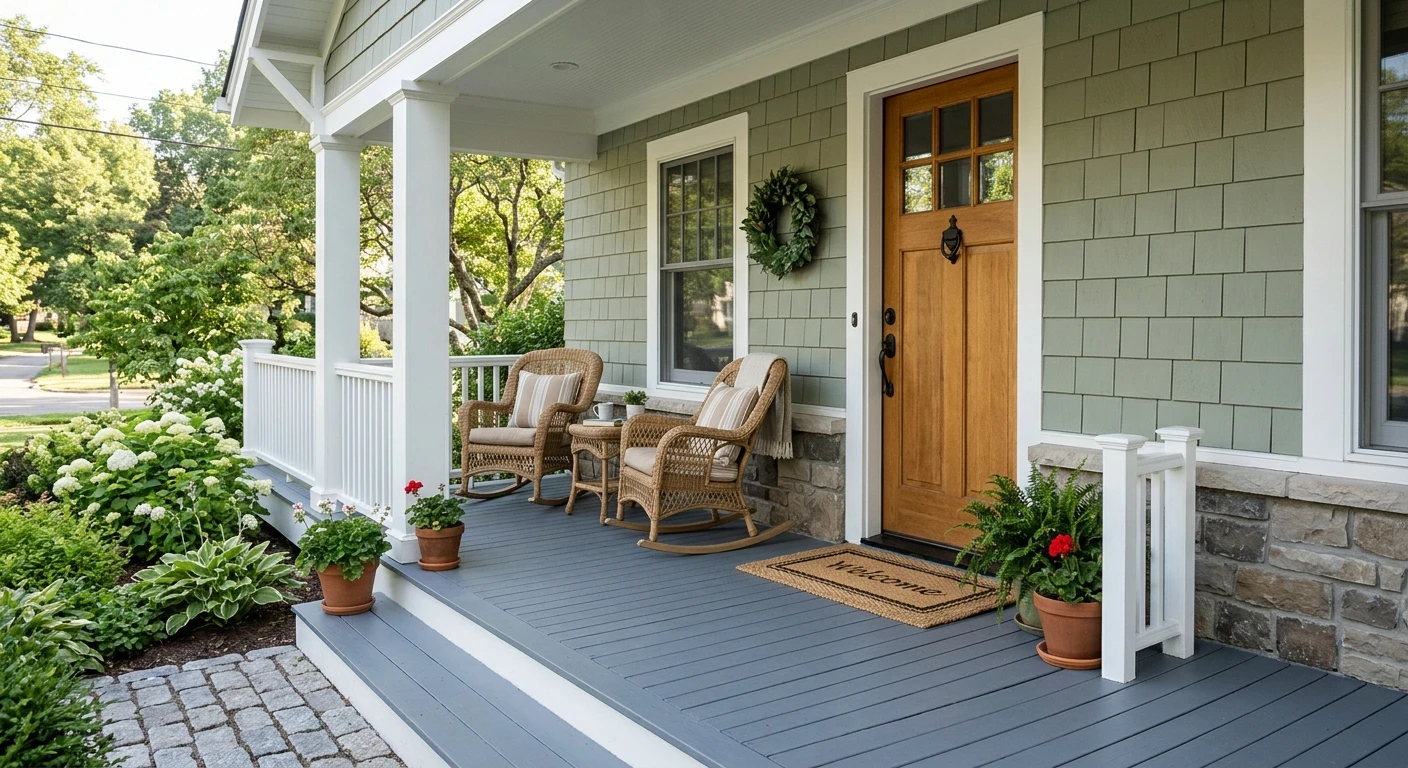

Benjamin Moore Floor & Patio Latex Enamel is an interior and exterior epoxy-modified acrylic latex enamel built for horizontal foot-traffic surfaces. Offered in Low Sheen (N122) and High Gloss (0121), it coats unpainted or previously painted concrete, wood porches, patios, breezeways, basements, showrooms, and light industrial floors with low VOC content (under 50 g/L) and soap-and-water cleanup.
Horizontal surfaces punish paint far harder than vertical siding because they hold standing rain, abrasive shoe grit, and direct sun. This guide covers the technical data for N122 and 0121, concrete etching and wood priming protocols, the 30-day full cure window, wet-weather slip resistance, and the one surface Benjamin Moore rules out: residential garage floors under hot car tires.
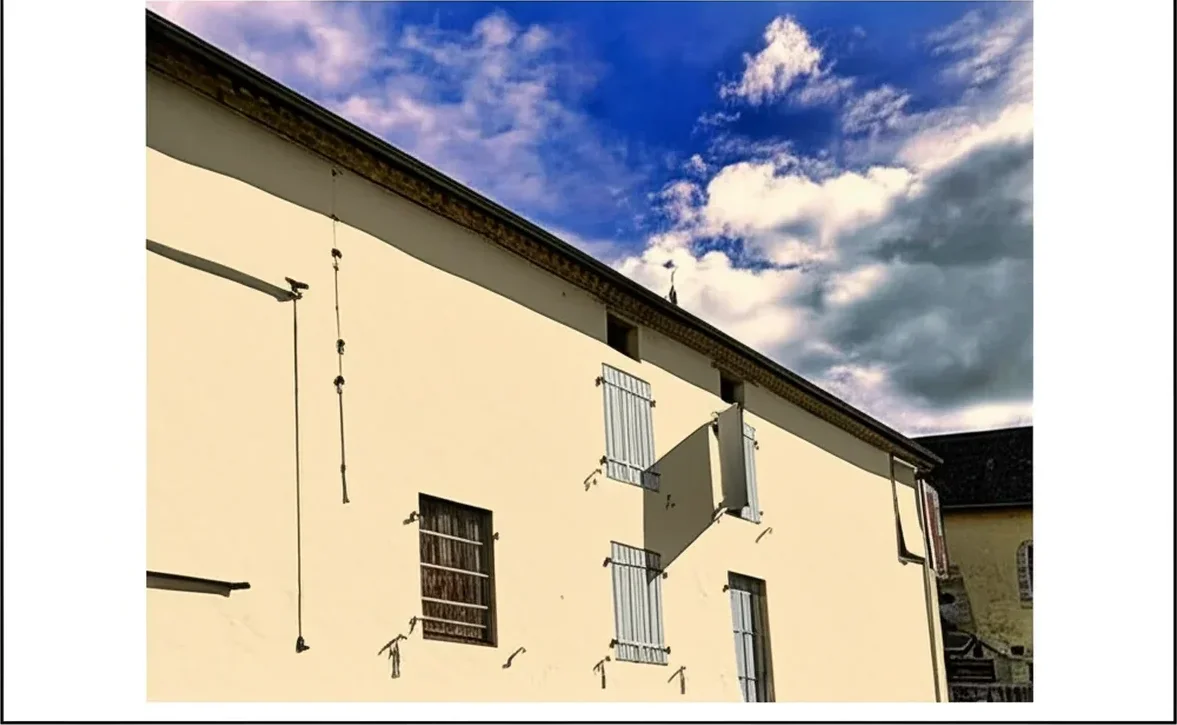
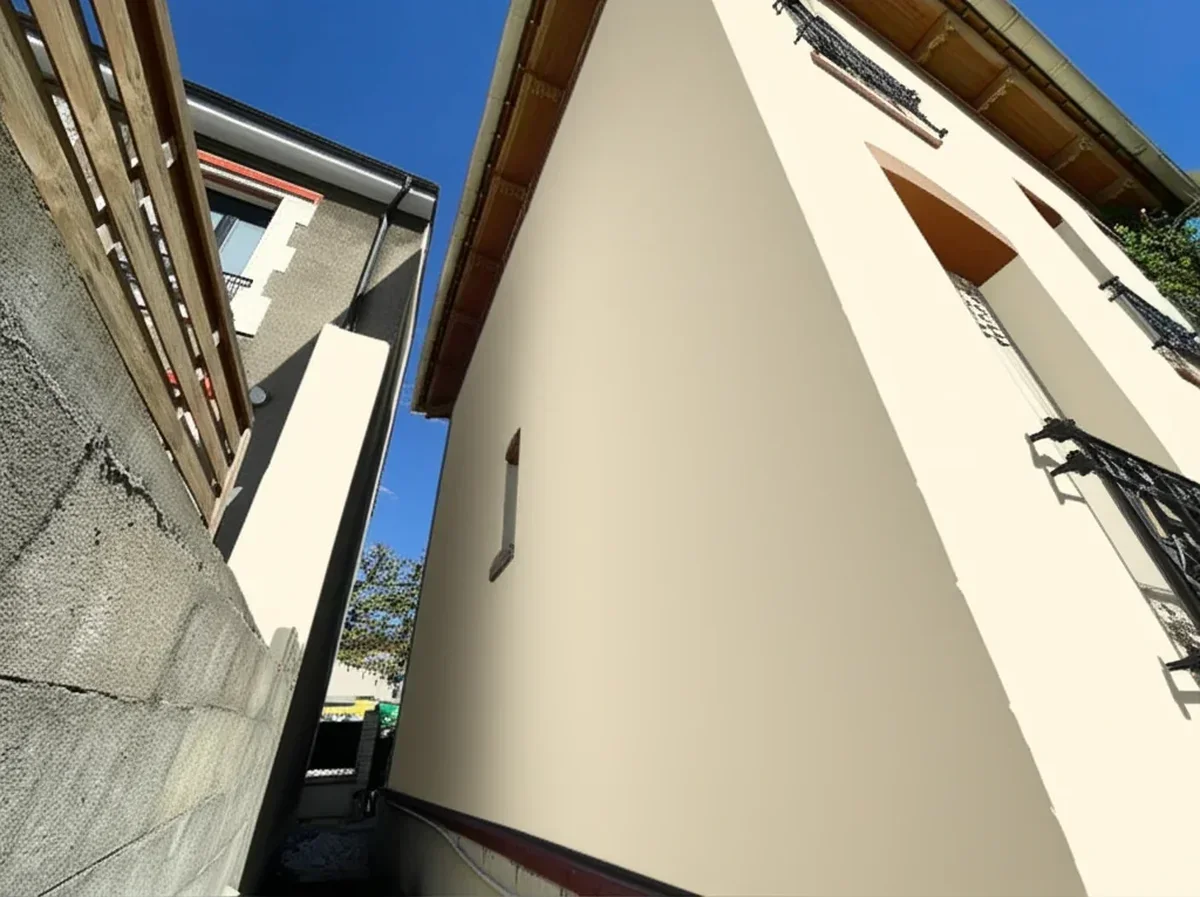
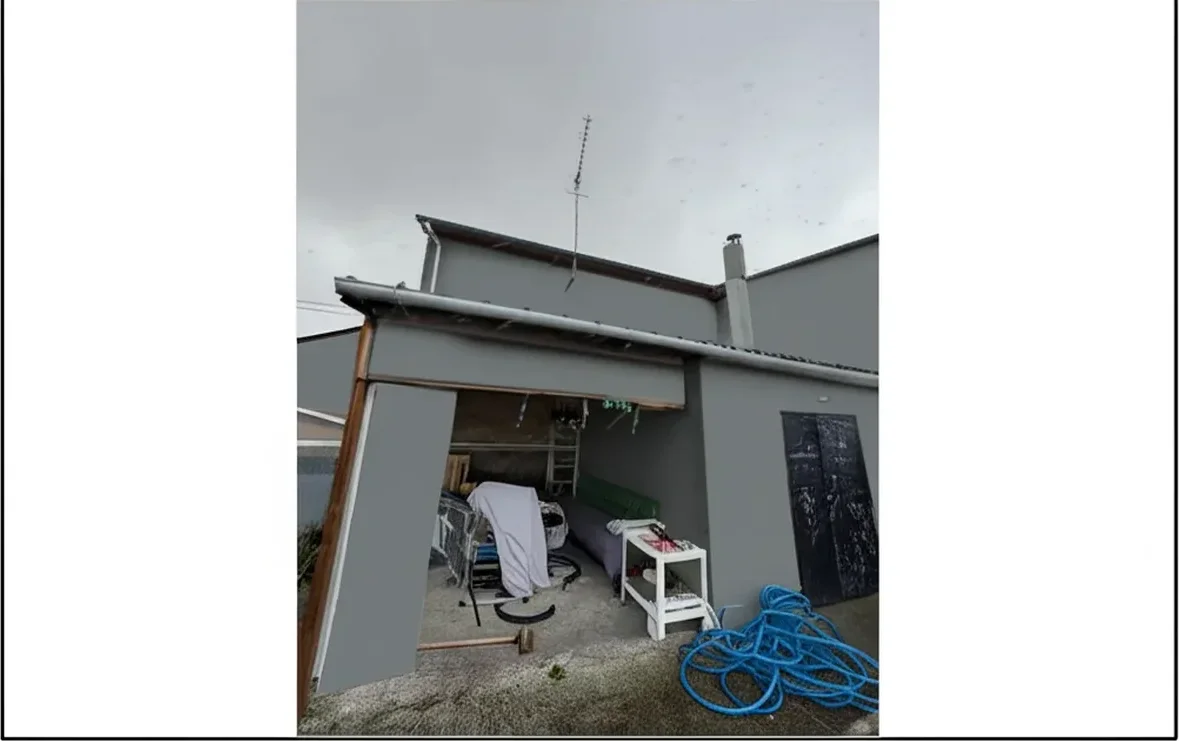
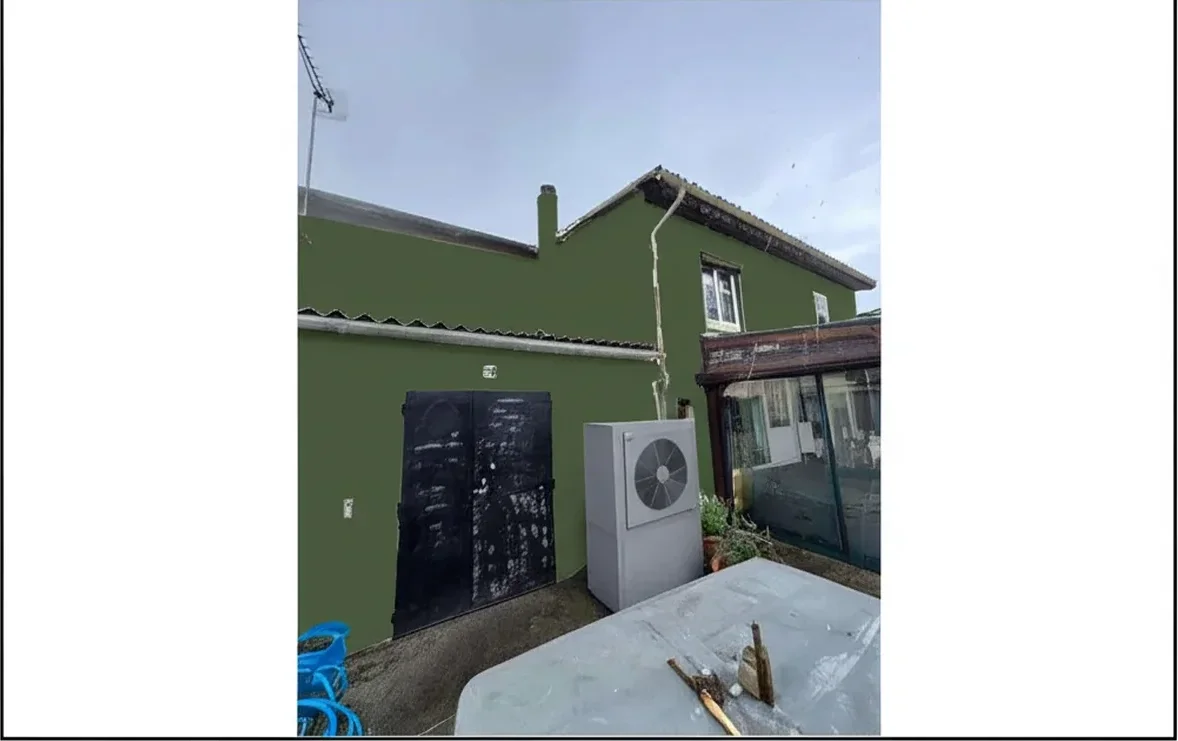
Upload a photo of your house to test Benjamin Moore siding and trim shades (preloaded with Boothbay Gray HC-165) alongside your porch floor plan.
Technical specifications: N122 Low Sheen vs. 0121 High Gloss
Standard acrylic siding paint stays flexible for vertical wood movement, so it scuffs and sticks under foot traffic or patio chairs. Floor & Patio uses an epoxy-modified acrylic latex resin to form a harder, abrasion-resistant film while keeping single-component convenience, low odor, and soap-and-water cleanup.
Its VOC content stays under 50 g/L, which matters when a project includes enclosed basements, sunrooms, or breezeways. As the US Environmental Protection Agency notes on its Volatile Organic Compounds and Indoor Air Quality page, indoor VOC concentrations are consistently higher than outdoor levels, making low-VOC waterborne enamels far easier to live with than solvent-based floor paints.
| Specification | Low Sheen (N122) | High Gloss (0121) |
|---|---|---|
| Resin chemistry | Epoxy-modified acrylic latex enamel | Epoxy-modified acrylic latex enamel |
| Gloss level (60 degrees) | 10 to 25 (low sheen) | High gloss |
| Coverage rate | 500 to 600 sq. ft. per gallon | 500 to 600 sq. ft. per gallon |
| Volume solids | Approximately 35 to 37% | Approximately 35 to 37% |
| Wet / dry film thickness | 2.7 to 3.2 mils wet / 1.0 to 1.2 mils dry | 2.7 to 3.2 mils wet / 1.0 to 1.2 mils dry |
| VOC level | Low VOC (under 50 g/L) | Low VOC (under 50 g/L) |
| Application temperature | 50°F to 90°F (10°C to 32°C) air and surface | 50°F to 90°F (10°C to 32°C) air and surface |
| Cleanup | Soap and water | Soap and water |
Try it on your house
- 1Your photoPhoto
- 2Your colorColor
- 3HD render in ~30 sHD render in ~30 s
Your photo is used only to create your preview. JPG, PNG, HEIC (iPhone)
Choosing between N122 and 0121 depends on surface smoothness and glare. N122 Low Sheen (10 to 25 gloss at 60 degrees) produces a restrained satin-like sheen that hides trowel marks on concrete patios, nail heads on older porch boards, and everyday boot scuffs while cutting sun glare. 0121 High Gloss delivers a classic reflective shine that wipes clean fast on smooth, well-sanded historic tongue-and-groove porches, but it magnifies every concrete pit, board seam, and roller lap mark.
Where Floor & Patio works, and why garage floors are off-limits
Benjamin Moore recommends Floor & Patio Latex Enamel for unpainted concrete (new or old), previously painted wood or concrete floors, porches, patios, breezeways, basements, showrooms, and light industrial floors. Across those surfaces, the coating handles foot traffic, patio chairs, mild household cleaners, and outdoor weathering.
The critical exception is residential garage floors. Benjamin Moore's technical data sheet warns explicitly: "Many tires contain compounds which may attack latex paints, resulting in loss of adhesion and film pickup." After highway driving, hot rubber treads soften a single-component latex film and pull it straight off the concrete as the tires cool (hot-tire pickup). For any garage floor where vehicles park, skip latex floor paint and install a two-part epoxy or polyaspartic garage coating system instead.
Also distinguish covered porches from open backyard decks. Film-forming floor enamels perform best on roofed porches with dry subfloor ventilation. On unroofed pressure-treated or cedar decks soaked by rain and snow from both sides, trapped moisture causes paint to blister. For open decks, compare penetrating and solid stains in our Benjamin Moore Arborcoat deck stain guide.
Concrete patio and basement prep: 30-day cure, etching and moisture testing
Most concrete floor paint failures come from skipping one of three steps: waiting out the initial cure on fresh pours, checking for upward vapor, or profiling slick troweled slabs.
1. Wait at least 30 days on new concrete
New concrete must cure for at least 30 days before painting. Hydration continues for weeks after pouring, releasing moisture vapor and alkaline salts. As the American Concrete Institute explains on its Concrete Curing technical page, controlled curing governs hydration, strength, and durability. Painting a green slab before day 30 traps moisture under the film and triggers blistering and efflorescence.
2. Run the plastic sheet moisture test
Before coating any patio or basement slab, tape a 2-foot by 2-foot square of clear polyethylene plastic tightly to the concrete on all four sides for 24 hours. Pull it up and check for condensation under the plastic or a darkened damp patch on the slab. Visible moisture means vapor is pushing upward through the concrete, which will lift any waterborne floor enamel until drainage or moisture control is corrected.
3. Clean, etch smooth concrete, rinse and dry completely
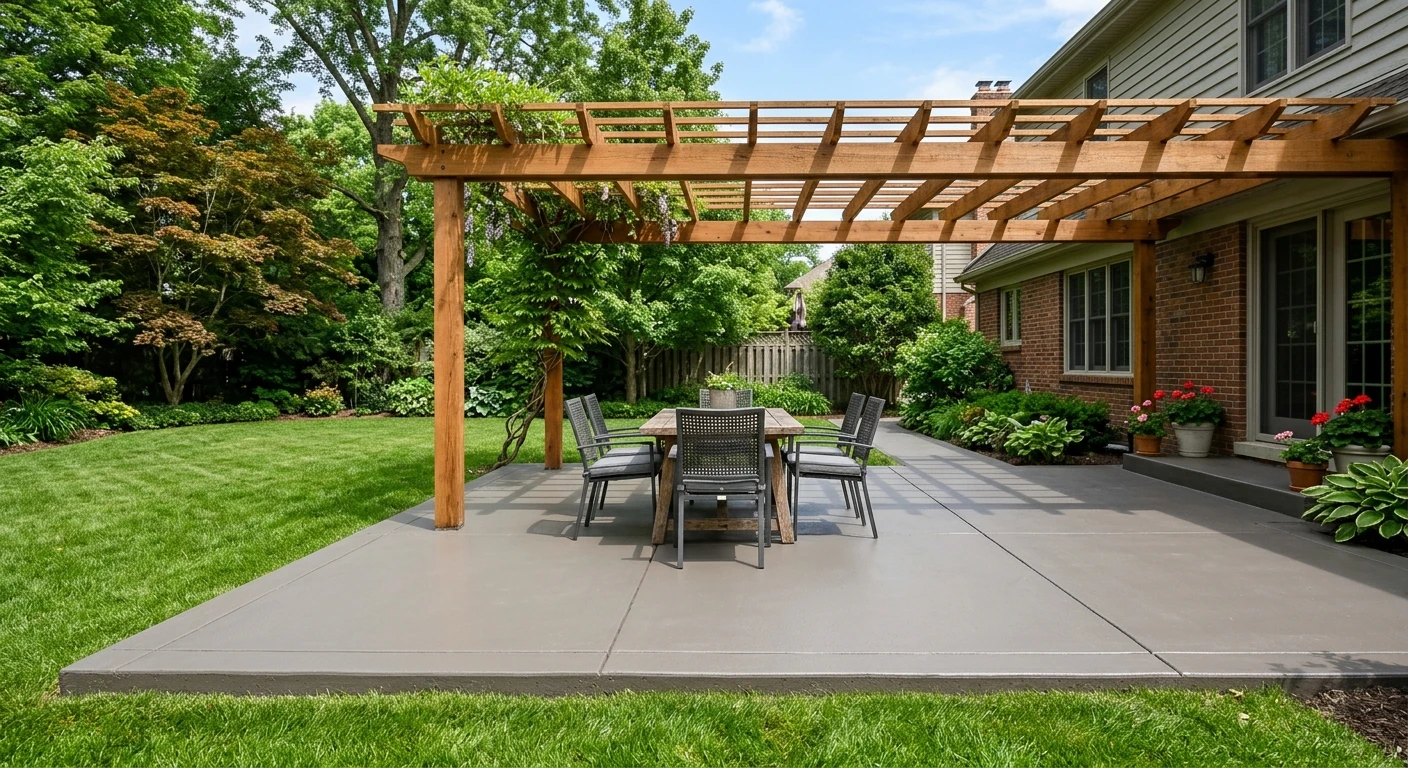
Scrub older concrete with a concrete degreaser to remove oil, grill grease, moss, and chalky efflorescence, then rinse clean. Smooth poured or pre-cast concrete lacks the mechanical tooth paint needs to bond and must be etched with a commercial concrete etching solution or a 10 percent muriatic acid solution (wearing gloves, eye protection, and ventilation). Pre-wet the slab, apply the etcher evenly, scrub with a stiff broom, rinse thoroughly with clean water until all residue is gone, and let the concrete dry completely. Properly etched concrete feels like 120-grit sandpaper and absorbs water drops rather than beading them.
Wood porch preparation, priming and pre-1978 lead paint rules
On wood porches, replace rotted boards, reset popped nails, and wash off dirt and mildew before sanding. Scrape loose or flaking paint back to a solid edge and feather-sand the transition. Existing glossy finishes must be sanded thoroughly to dull the sheen so Floor & Patio can grip. Prime bare wood and tannin-rich boards (such as cedar, redwood, or fir) with a compatible exterior wood primer before topcoating to block tannin bleed and equalize sheen.
On homes built before 1978, test old porch paint before scraping or sanding. Under the US Environmental Protection Agency's Lead Renovation, Repair and Painting (RRP) Program, paid contractors disturbing painted surfaces in pre-1978 homes must be certified and follow lead-safe work practices. Homeowners doing DIY prep should still test old coatings and use wet-scraping with HEPA cleanup so lead dust does not migrate indoors.
Keep vertical wall paints off the walking deck. Siding coatings such as Benjamin Moore Aura Exterior and Benjamin Moore Regal Select Exterior belong on clapboards, columns, ceilings, and railings, while Floor & Patio N122 or 0121 handles the floorboards and stair treads.
Coverage math, application workflow, dry times and the 30-day cure
Floor & Patio covers 500 to 600 square feet per gallon depending on porosity and texture, delivering 2.7 to 3.2 mils wet film thickness and 1.0 to 1.2 mils dry film thickness per coat (35 to 37 percent volume solids). Avoid over-stretching a gallon, since a thin film wears through quickly on front steps.
| Project example | Area | Two-coat area | Estimated gallons (500 to 600 sq. ft./gal) |
|---|---|---|---|
| Covered front porch (8 x 20 ft) | 160 sq. ft. | 320 sq. ft. | 1 gallon (with touch-up reserve) |
| Concrete patio (15 x 24 ft) | 360 sq. ft. | 720 sq. ft. | 2 gallons (accounts for porous first coat) |
| Basement slab (20 x 30 ft) | 600 sq. ft. | 1,200 sq. ft. | 3 gallons (buffers rough texture and cut-ins) |
Apply only when air and surface temperatures are between 50°F and 90°F (10°C to 32°C). Direct midday sun can push a concrete patio well past 90°F even on a mild day, flashing off water too quickly and weakening adhesion. Coat in the shade after morning dew evaporates and finish early enough to dry before evening dew. Cut in edges with a nylon/polyester brush and roll thin, even coats with a 1/4-inch to 3/8-inch nap roller on smooth wood or concrete (1/2-inch nap on broom-finished slabs).
| Milestone (77°F / 25°C, 50% RH) | Minimum time | Practical guidance |
|---|---|---|
| Dry to touch | 1 hour | Tack-free, still too soft for walking |
| Recoat | Minimum 4 hours | Extend in cool or humid weather |
| Light foot traffic | After overnight dry | Light walking only; no sliding objects |
| Full cure | 30 days | Avoid dragging heavy patio furniture until day 30 |
Cool temperatures and high humidity lengthen every stage of that timeline. Even though the porch accepts light foot traffic the next morning, full hardness takes 30 days, so lift rockers, grills, and heavy planters straight up rather than dragging them across the coating during the first month.
Slip resistance on wet porches, steps and poolside patios
Painted wood and concrete floors become slippery when wet with rain, morning dew, or pool water, especially in 0121 High Gloss. On exterior stair treads, uncovered porches, and poolside patios, stir a compatible anti-slip aggregate into the final coat of Floor & Patio. Re-stir frequently while refilling the roller tray so the grit stays evenly suspended rather than sinking, and finish with steady single-direction strokes for uniform traction.
Porch floor color choices and Sherwin-Williams Porch & Floor Enamel comparison
Floor & Patio Latex Enamel tints into thousands of Benjamin Moore colors, making it easy to coordinate the porch deck with siding and trim. Four proven porch-floor picks show the range:
- Boothbay Gray HC-165: A classic blue-gray porch shade that pairs with white railings and sage or white siding. See outdoor light notes in our Boothbay Gray HC-165 exterior guide.
- Chelsea Gray HC-168: A deeper warm charcoal gray that hides muddy footprints better than pale grays while staying softer than black in bright sun.
- Hale Navy HC-154: A rich navy that gives white Colonial and coastal porches crisp contrast alongside brass hardware.
- Revere Pewter HC-172: A warm greige that bridges brick steps, stone foundations, and cream trim. Review undertone shifts in our Revere Pewter exterior guide or browse full-house palettes in our Benjamin Moore exterior paint colors guide.
Homeowners often cross-shop Floor & Patio against Sherwin-Williams Porch & Floor Enamel. Both are interior/exterior single-component waterborne enamels for wood and concrete porches, patios, and basements, both clean up with soap and water, and neither is built for residential garage floors under hot car tires.
| Comparison point | Benjamin Moore Floor & Patio (N122 / 0121) | Sherwin-Williams Porch & Floor Enamel |
|---|---|---|
| Coating type | Epoxy-modified acrylic latex enamel | Interior/exterior waterborne porch and floor enamel |
| Sheen choices | Low Sheen (N122, 10 to 25 gloss at 60°) and High Gloss (0121) | Satin finish |
| Color tinting | Thousands of Benjamin Moore colors | Broad Sherwin-Williams tintable color range |
| Garage floor suitability | Not recommended (hot-tire pickup risk) | Use dedicated garage floor epoxy/concrete coatings |
Benjamin Moore's main advantage is offering a true High Gloss (0121) alongside Low Sheen (N122), whereas Sherwin-Williams centers on a single satin finish. On either system, thorough concrete etching, moisture testing, and respecting the 30-day cure matter far more to long-term wear than the label on the can.
Outdoor lighting, seasonal maintenance and recoating schedule
Horizontal porch surfaces receive light differently from vertical siding. An uncovered patio under direct midday sun reflects sky light straight back up, making medium grays such as Boothbay Gray HC-165 read one to two shades lighter and slightly cooler than on an indoor swatch. Under a deep covered front porch roof, the opposite happens: shadow deepens Chelsea Gray HC-168 and Hale Navy HC-154, while warm greiges like Revere Pewter HC-172 stay more balanced against shaded brick or wood steps. Always brush two coats onto a scrap board or concrete paver and check it at morning and late afternoon before tinting multiple gallons.
Routine maintenance extends the life of a Floor & Patio finish by years. Sweep abrasive sand and gravel off steps regularly so shoe traffic does not grind through the 1.0 to 1.2 mil dry film, and wash salt, pollen, and leaf tannins off each spring with mild dish soap and a soft nylon brush. Avoid aggressive zero-degree pressure-washer tips that can gouge wood grain or undercut paint edges. When high-traffic stair nosings eventually show wear after several seasons, you rarely need a full strip: clean the deck thoroughly, scuff-sand the existing enamel to dull the sheen, spot-prime any bare wood, and roll a fresh maintenance coat of the same N122 or 0121 finish once air and surface temperatures sit comfortably between 50°F and 90°F.
Coordinate your siding and trim before painting the porch floor
Because a porch floor sits right below your siding, columns, and front door, lock in your vertical exterior colors first. Upload a photo of your house to test Benjamin Moore siding and trim shades before tinting your N122 or 0121 porch enamel.
Test Benjamin Moore siding, trim, shutter, and door combinations on a real photo of your house before buying paint.
Sources and references
- Benjamin Moore Technical Data Sheets for Floor & Patio Latex Enamel Low Sheen (N122) and High Gloss (0121): epoxy-modified acrylic resin, 10 to 25 gloss at 60 degrees (N122), 500 to 600 sq. ft./gal coverage, volume solids, wet/dry film thickness, VOC under 50 g/L, dry/cure times, 50°F to 90°F window, concrete etching, slip resistance, and hot-tire pickup warning.
- Benjamin Moore, Boothbay Gray HC-165 color page: color reference and tinting availability.
- Sherwin-Williams, Porch & Floor Enamel product page: satin interior/exterior porch and floor coating overview.
- American Concrete Institute (ACI), Concrete Curing technical topic: hydration and moisture curing principles for new concrete slabs.
- US Environmental Protection Agency, Volatile Organic Compounds' Impact on Indoor Air Quality: indoor VOC levels in enclosed spaces.
- US Environmental Protection Agency, Lead Renovation, Repair and Painting (RRP) Program: lead-safe work practices for pre-1978 homes.
Frequently asked questions
Can you use Benjamin Moore Floor & Patio paint on a residential garage floor?
What is the difference between Benjamin Moore N122 and 0121?
How long should new concrete cure before applying Benjamin Moore Floor & Patio?
How long does Benjamin Moore Floor & Patio take to dry and fully cure?
Is Benjamin Moore Floor & Patio slippery when wet?
Trademarks mentioned (Sherwin-Williams, Benjamin Moore, Behr, Caparol, Brillux, Sto, Alpina, Valspar, PPG, Glidden, Dulux, Crown Trade, Sandtex, Farrow & Ball, Johnstone's, Leyland) are property of their respective owners. FacadeColorizer is independent and not affiliated with any of them. Nominative fair use under Lanham Act §1125.