Try it on your room

Benjamin Moore Waterborne Ceiling Paint (sold in the US as product N508, Ultra Flat) is an acrylic paint made only for ceilings. Its data sheet gives a sheen of 0 to 2 at 85 degrees, coverage of 400 to 450 square feet per gallon, a recoat time of 1 to 2 hours, VOC under 50 g/L, and Gennex bases 1X to 4X, so it can be tinted to Benjamin Moore colors as well as bought in Ceiling White. What you pay for is behavior overhead: a dead-flat film that hides drywall flaws, a formula built to limit spatter, and a long enough open time to avoid lap marks. What you do not get is a scrubbable film: the sheet says it is not intended for areas subject to abrasion.
This review is built from manufacturer documents (data sheets, product pages, Benjamin Moore's ceiling how-to), not from an in-house test. If you are still deciding on the color rather than the product, start with our ceiling paint colors and finish guide.
The link opens the interior tool with "Ceiling" preselected as the surface to paint. How it works: our interior paint visualizer.
The spec sheet at a glance
The values below come from the US technical data sheet (Benjamin Moore, Waterborne Ceiling Paint Ultra Flat N508, technical data sheet, sheet code N508 US 013125) and the N508 product page.
| Specification | Waterborne Ceiling Paint N508 |
|---|---|
| Resin | Acrylic, titanium dioxide pigment |
| Sheen | Ultra Flat, 0 to 2 at 85 degrees |
| Volume solids | 37 percent, plus or minus 2 |
| Spread rate | 400 to 450 sq ft per gallon |
| Film thickness | 3.6 to 4.0 mils wet, 1.3 to 1.5 mils dry |
| Dry time (77°F, 50% RH) | Touch 1 hour, recoat 1 to 2 hours, washable after two weeks |
| Application temperature | 50 to 90°F (air and surface) |
| VOC | Under 50 g/L |
| Colors | Ceiling White (09); Gennex bases 1X to 4X; product page: available in all Benjamin Moore colors |
| Coats | One or two |
| Application | Brush, roller or airless spray (1,000 to 2,000 psi, tip 0.013 to 0.017) |
| Mildew | Antimicrobial additives inhibit mold and mildew on the paint film |
| Compliance | VOC compliant in regulated areas (OTC, CARB, SCAQMD and others); CDPH emissions certified; eligible for LEED v4 |
| Limitations | Do not paint below 50°F; not intended for areas subject to abrasion |
| Sizes | Gallon and quart |
Try it on your room
No photo? Try a sample
On price, Benjamin Moore's US product page showed $60.99 for a gallon when we checked in October 2026. Benjamin Moore sells through independent retailers who set their own prices, so treat that as a reference point, not a quote.
508 or N508: which product is on the shelf
A lot of what you read online about this paint describes an earlier version. Benjamin Moore files the old US data sheet for product 508 under "Discontinued" (Benjamin Moore, Waterborne Ceiling Paint 508, discontinued data sheet). Comparing the two sheets shows what changed:
| Data sheet value | 508 (discontinued sheet) | N508 (current sheet) |
|---|---|---|
| VOC | 0 g/L, marketed as Zero VOC | Under 50 g/L |
| Volume solids | 40.3 percent, plus or minus 2 | 37 percent, plus or minus 2 |
| Spread rate | 400 to 450 sq ft per gallon | 400 to 450 sq ft per gallon |
| Sheen | 0 to 2 at 85 degrees | 0 to 2 at 85 degrees |
| Dry and recoat | 1 hour, 1 to 2 hours | 1 hour, 1 to 2 hours |
The practical takeaway: if a review or a store listing calls this paint "zero VOC", it is quoting the 508 sheet. The current N508 is still a low-VOC paint under the strictest US regional limits, but its own sheet gives "under 50 g/L", not zero. If zero VOC is a hard requirement for you (a nursery, a sensitive occupant), check the label on the can you buy, and compare with the options in our low-VOC interior paint guide. In Canada the product is sold under a different number (F508) with its own sheet.
What "ultra flat" means in numbers
Sheen is measured with a gloss meter at a fixed angle; for flat paints the 85-degree reading is the one that separates products, because it captures light skimming across the surface, which is exactly how light hits a ceiling from a window or a wall sconce. Waterborne Ceiling Paint reads 0 to 2 units at 85 degrees. Benjamin Moore's own Regal Select Flat, a wall paint the company also describes as suitable for ceilings, reads 1 to 4 at the same angle (Benjamin Moore, Regal Select Flat N547, technical data sheet). Two units sounds small, but at a raking angle a lower sheen is what keeps taped joints and roller laps from catching the light.
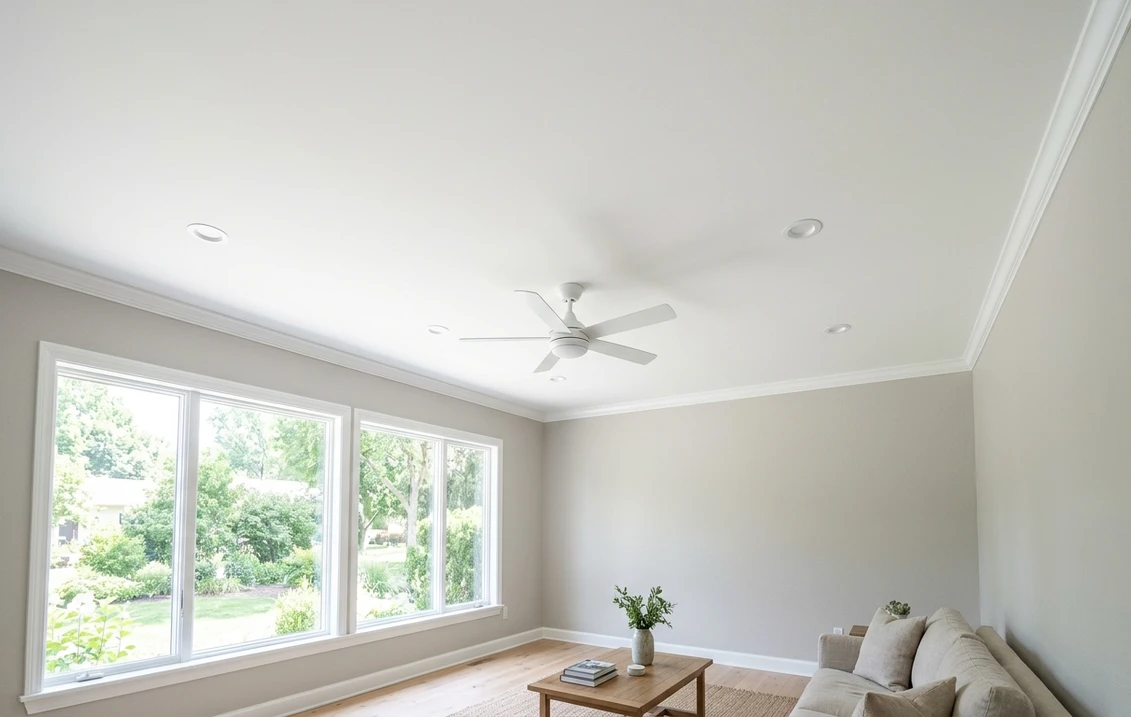
Low sheen also serves lighting. The US General Services Administration's guidance on lighting in high-performance buildings recommends that walls, ceilings and furniture surfaces be light in color, high in surface reflectance and low in glare. A white, dead-flat ceiling does all three: it bounces light back into the room without hot spots from fixtures. That is the reason ceilings are painted flat almost by default, which our guide to interior paint finishes explains for every surface in the house.
Ceiling paint vs wall paint: Waterborne Ceiling Paint vs Regal Select Flat
The fair question is whether a dedicated ceiling paint does anything a good flat wall paint does not. Putting the two Benjamin Moore data sheets side by side answers it:
| Data sheet value | Waterborne Ceiling Paint N508 | Regal Select Flat N547 |
|---|---|---|
| Sheen at 85 degrees | 0 to 2 | 1 to 4 |
| Volume solids | 37 percent | 46 percent |
| Dry film per coat | 1.3 to 1.5 mils | 1.6 to 1.9 mils |
| Spread rate | 400 to 450 sq ft per gallon | 400 to 450 sq ft per gallon |
| Recoat | 1 to 2 hours | 1 to 2 hours |
| Priming on drywall | Drywall Primer (380) or the paint itself | Self-priming |
| Headline features | Minimal spatter, ample open time, conceals imperfections | Stain release, flow and leveling, paint and primer |
| Stated limitation | Not for areas subject to abrasion | Flat finish for ceilings and low-traffic areas |
The wall paint carries more solids and builds a thicker dry film per coat, which is what you want on a surface that gets touched, wiped and bumped. The ceiling paint gives up some film build for a flatter, more forgiving surface and for application qualities that matter only overhead: less spatter coming off the roller onto you and the floor, and more open time to roll back into a wet edge without leaving a lap line. On a ceiling nobody scrubs, those trade-offs go in the ceiling paint's favor. On a wall in a hallway or a kid's room, they go the other way, so do not use the leftover ceiling paint on walls that need to be cleaned.
Waterborne Ceiling Paint vs Sherwin-Williams ProMar Ceiling Paint
The most common alternative at a Sherwin-Williams store is ProMar Ceiling Paint, Interior Latex Flat (product A27W05050). Its product data sheet (Sherwin-Williams, ProMar Ceiling Paint product data sheet, dated 10/2021) and its contractor product page describe a different kind of product:
| Published value | BM Waterborne Ceiling Paint N508 | SW ProMar Ceiling Paint A27W05050 |
|---|---|---|
| Resin | Acrylic | Vinyl acrylic |
| Sheen at 85 degrees | 0 to 2 | 0 to 2 |
| Volume solids | 37 percent | 29 percent |
| Coverage | 400 to 450 sq ft per gallon | 350 to 400 sq ft per gallon at 4 mils wet |
| Dry film per coat | 1.3 to 1.5 mils | 1.2 mils |
| Recoat (77°F, 50% RH) | 1 to 2 hours | 4 hours |
| VOC | Under 50 g/L | Under 50 g/L |
| Tinting | Bases 1X to 4X, any Benjamin Moore color | White base only, 0 to 2 oz of colorant per gallon (light colors) |
| On bare drywall | Drywall Primer (380) or the paint itself | Two coats self-priming, or one coat ProMar 400 primer plus two coats |
| Emissions certification | CDPH emissions certified | GREENGUARD Gold (product page) |
| Positioning | Premium ceiling paint, residential or commercial | Formulated for spray on new residential, commercial and multifamily work |
Read together, the sheets point to two different buyers. ProMar Ceiling is a production paint: sprayed on new construction, where a painter covers thousands of square feet, the four-hour recoat fits the schedule, and the light-colors-only tinting is not a limitation because the ceilings are white. Waterborne Ceiling Paint reads like a paint for rolling a repaint in a lived-in home: more solids per gallon, faster recoat so two coats fit in one day, and full tinting if you want a colored ceiling. Neither sheet publishes a spatter measurement, so the "less spatter" claims on both sides are the makers' words, not a number you can compare.
How much paint a ceiling needs
Ceiling area is length times width of the room; ignore the walls. Divide by the spread rate for one coat, then multiply by the number of coats. Using the data sheet's 400 to 450 square feet per gallon:
| Room | Ceiling area | One coat | Two coats | What to buy |
|---|---|---|---|---|
| 10 x 12 ft bedroom | 120 sq ft | 0.27 to 0.30 gal | 0.53 to 0.60 gal | 1 gallon |
| 12 x 16 ft living room | 192 sq ft | 0.43 to 0.48 gal | 0.85 to 0.96 gal | 1 gallon, plus a quart if textured |
| 20 x 24 ft great room | 480 sq ft | 1.07 to 1.20 gal | 2.13 to 2.40 gal | 3 gallons |
These figures are our arithmetic on the maker's spread rate, which assumes the recommended film thickness on a smooth surface. The sheet itself says coverage depends on texture and porosity: knockdown, orange peel and especially popcorn texture soak up more paint, so plan toward the low end or buy an extra quart. At ProMar Ceiling's 350 to 400 square feet per gallon, the same ceiling needs roughly 12 to 14 percent more paint. For whole rooms including walls, our paint coverage calculator guide does the full math.
Tinting a ceiling: when it is worth it
Because the product comes in four Gennex bases, a Benjamin Moore retailer can mix it in any Benjamin Moore color. Three cases make that worthwhile:
- A white that matches your trim. If your crown molding is White Dove or Chantilly Lace, a ceiling in the same white avoids the faint mismatch you sometimes see between Ceiling White and a warmer trim white.
- A softened version of the wall color. A ceiling a few steps lighter than the walls keeps a warm or colored room from feeling capped by a stark white lid. Ask the retailer for a reduced-strength formula of the wall color and sample it on a board held overhead.
- A colored ceiling as a design choice. Dark ceilings in dining rooms and powder rooms are where the 1X to 4X bases matter, since a white-base ceiling paint can only carry light tints.
The data sheet adds one practical rule: for a significant color change, tint the primer to the approximate shade of the finish coat, and some custom colors need a deep base primer mixed to a special formula. Ceilings are hard to judge from a chip because you see them at an angle, in reflected light. Before you buy a tinted gallon, preview the shade on a photo of your own room with the ceiling selected in our interior paint tool.
Applying it: order, wet edge and spatter
Benjamin Moore's own guide to painting a ceiling and the data sheet together give a clear method:
- Ceiling before walls. Cover the floor and furniture with drop cloths and remove light fixtures where you can.
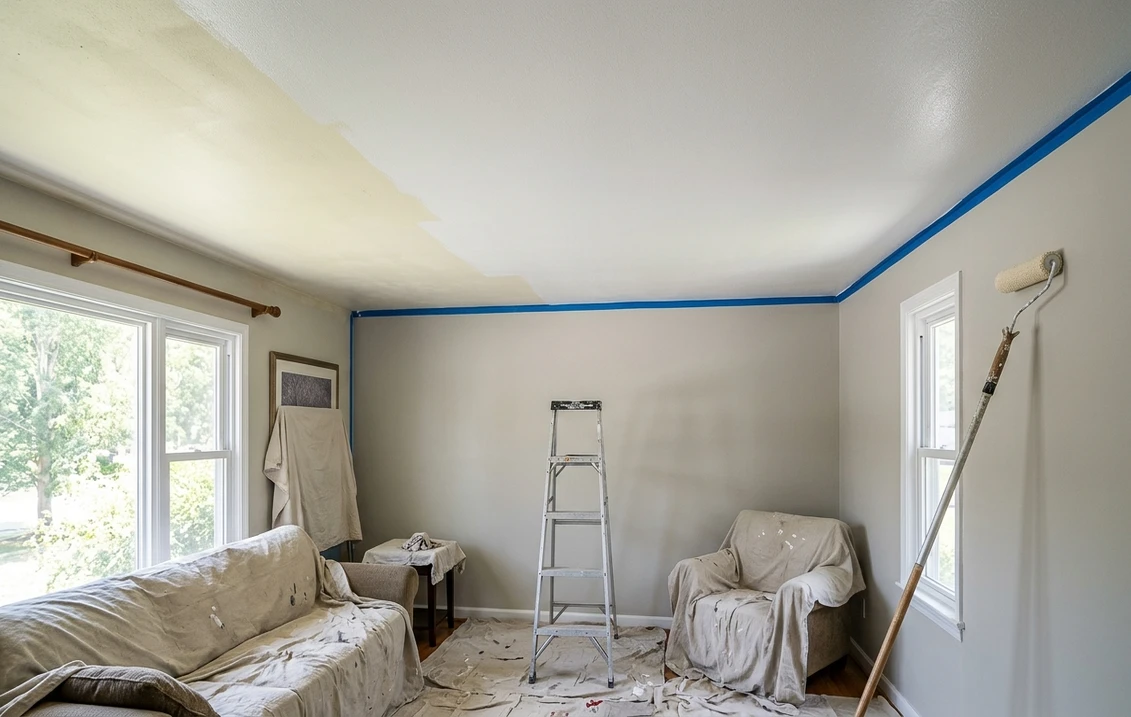
- Cut in first. Brush a band along the edge where ceiling meets wall. If you are painting the walls afterward, Benjamin Moore suggests feathering the ceiling paint 2 to 3 inches down the wall; if not, tape the wall or cut a straight line.
- Roll toward the window. Start in a corner and work toward the main window, so the reflection on the wet paint shows you thin or missed areas.
- Keep a wet edge. Each time you reload, start in unpainted space and roll back into the painted area. The sheet's "ample open time" is meant to make this easier, but it does not replace it.
- Finish in one session. Benjamin Moore advises painting the whole ceiling at once so it dries evenly. Stopping halfway leaves a line that a flat finish will not hide.
- Judge after drying. At the sheet's conditions (77°F, 50 percent humidity) you can recoat after 1 to 2 hours; high humidity and cool temperatures lengthen that. Decide on a second coat once the first is dry, not while it is wet.
Details from the data sheet that are easy to miss: stir before and during use, thin only with 518 Extender or water (8 fluid ounces per gallon at most), do not paint below 50°F air or surface temperature, and wait two weeks before washing the ceiling. If you prefer to see where you have rolled, Benjamin Moore also points to Insl-X Color-Changing Ceiling Paint, a separate product that goes on pink and dries white.
Old ceilings: stains, lead and texture
Benjamin Moore's how-to says most ceilings do not need primer, and the product page calls the paint self-priming. The data sheet is more precise: new surfaces should be fully primed (on drywall, Drywall Primer 380 or the paint itself; on cured plaster, Drywall Primer 380 or Fresh Start High-Hiding All Purpose Primer 046), previously painted ceilings may be spot primed, and water stains, smoke damage or grease call for a special-purpose primer. A water stain painted over with ceiling paint alone usually bleeds back through, so seal it first.
Age of the house matters too. The EPA's Renovation, Repair and Painting program page notes that about three-quarters of US homes built before 1978 still contain some lead-based paint, and anyone paid to disturb paint in them must be certified. Both data sheets carry a lead warning about scraping and sanding. Textured "popcorn" or acoustic ceilings raise a second question. The EPA's page on protecting your family from asbestos says you generally cannot tell whether a material contains asbestos by looking at it, that taking samples yourself is not recommended, and that if in doubt you should treat the material as if it contains asbestos and leave it alone. In practice: do not scrape an old textured ceiling to prepare it for paint without having it assessed first.
Who should buy it, and who can skip it
On the specifications, Waterborne Ceiling Paint makes the most sense when you roll a ceiling yourself in a lived-in room. The 0 to 2 sheen hides flaws on older drywall and plaster, and the fast recoat lets two coats fit in one day. It is also the right base if you want a tinted ceiling deeper than a pale tint.
You can skip it if a contractor is spraying new drywall (ProMar Ceiling is designed for that), if you want one product for walls and ceiling (Regal Select Flat at 1 to 4 is still flat, just less forgiving at raking angles), or if the ceiling gets touched or splashed and needs a more washable finish. Labor is the larger part of a ceiling job; our ceiling painting cost guide covers what a painter charges, and the interior house painting cost guide puts it in the context of a whole-room project. Drying and recoat behavior across brands is compared in our paint drying time chart.
White, tinted or dark: see the ceiling before you mix the gallon
Upload a photo of your room, choose "Ceiling" as the surface, and compare a bright white, a softened wall color or a deep shade overhead in a few seconds.
Try a ceiling color on my photoSources and references
- Benjamin Moore, Waterborne Ceiling Paint Ultra Flat N508, technical data sheet (N508 US 013125): resin, solids, spread rate, film thickness, dry and recoat times, sheen, VOC, primers, limitations, application and thinning.
- Benjamin Moore, Waterborne Ceiling Paint Ultra Flat product page: color availability, coats, sizes, self-priming claim and list price.
- Benjamin Moore, Waterborne Ceiling Paint 508, discontinued data sheet (508 US 032223): zero VOC and 40.3 percent solids of the earlier version.
- Benjamin Moore, Regal Select Flat N547, technical data sheet (N547 US 032525): sheen, solids and film build of a premium flat wall paint.
- Benjamin Moore, How to paint a ceiling: order of work, cutting in, rolling toward the window, wet edge, primer advice.
- Sherwin-Williams, ProMar Ceiling Paint Interior Latex Flat A27W05050, product data sheet (10/2021) and product page: coverage, solids, recoat, tinting limits, priming systems, certification.
- US General Services Administration, Lighting, High-Performance Building Clearinghouse: light, high-reflectance, low-glare ceiling and wall surfaces.
- US Environmental Protection Agency, Lead Renovation, Repair and Painting Program and Protect Your Family from Exposures to Asbestos: lead in pre-1978 homes, and how to handle materials that may contain asbestos.
Frequently asked questions
How much does a gallon of Benjamin Moore Waterborne Ceiling Paint cover?
Is Benjamin Moore Waterborne Ceiling Paint zero VOC?
Can Benjamin Moore Waterborne Ceiling Paint be tinted?
How long before I can recoat Waterborne Ceiling Paint?
Do I need a primer under Benjamin Moore Waterborne Ceiling Paint?
How does it compare with Sherwin-Williams ProMar Ceiling Paint?
Trademarks mentioned (Sherwin-Williams, Benjamin Moore, Behr, Caparol, Brillux, Sto, Alpina, Valspar, PPG, Glidden, Dulux, Crown Trade, Sandtex, Farrow & Ball, Johnstone's, Leyland) are property of their respective owners. FacadeColorizer is independent and not affiliated with any of them. Nominative fair use under Lanham Act §1125.