Try it on your room

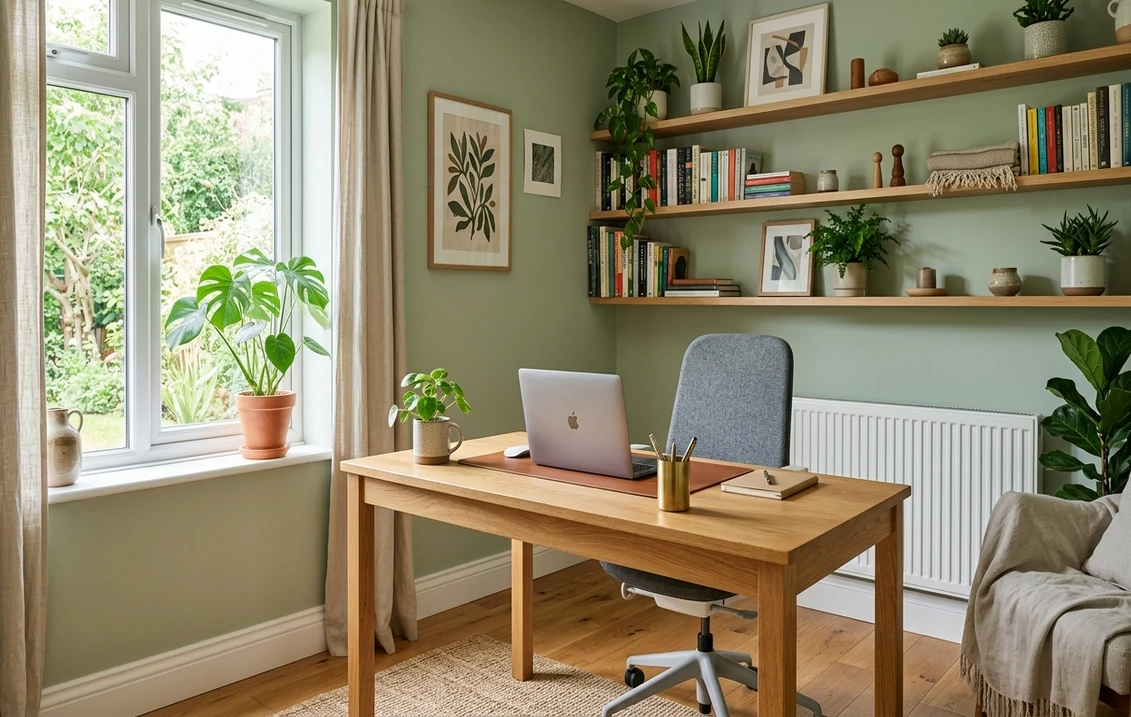
Quick answer: For a home office, the three greens I reach for most are Sherwin-Williams Evergreen Fog SW 9130, a smoky gray-green (LRV about 30) that works as a calm all-wall focus color; Sherwin-Williams Pewter Green SW 6208, a rich deep green (LRV about 12) for the wall behind your desk or webcam; and Benjamin Moore Salamander 2050-10, a near-black green (LRV about 5) for a cinematic studio look. Pair any of them with warm white trim, wood, brass, and a couple of plants.
Green is the quiet overachiever of home office colors: restful enough to sit with for eight hours, alert enough that you do not drift off mid-afternoon. This guide is part of our room-by-room paint color ideas hub, and it stays tightly on one question, which green belongs in a home office and exactly how to use it. If you also want blues, warm neutrals, and other hues in the mix, our wider home office paint palette covers the full range; this page goes deep on green only.
Best green shades for a home office
These are the greens that behave in a working room: focused without feeling cold, restful without tipping into sleepy. All codes are real, and the LRV (Light Reflectance Value, where 0 is black and 100 is white) tells you how much light each one bounces back, which is the whole game in a room you stare at all day.
| Color | Brand + code | Approx LRV | Why it works in a home office |
|---|---|---|---|
| Evergreen Fog | SW 9130 | ~30 | Smoky gray-green that reads calm and focused; the easy all-wall pick that still looks professional on camera. |
| Pewter Green | SW 6208 | ~12 | Rich, blackened green for the wall behind your desk or webcam: drama without darkening the whole room. |
| Salamander | BM 2050-10 | ~5 | Deep near-black green for a cinematic studio wall; needs layered light so it glows instead of swallowing the room. |
| Clary Sage | SW 6178 | ~41 | Muted mid sage for whole-room calm that never tips sleepy; forgiving in mixed and north light. |
| October Mist | BM 1495 | ~54 | Light silvery sage that keeps a small or windowless office bright and open while still reading as green. |
Try it on your house
No photo? Try a sample
Upload one photo and preview these shades on your actual home office. Free, no signup.
How to use green in a home office
Green gives you a huge range to work with, from a barely-there sage to a near-black forest, and the trick in a home office is matching the depth to your light and your camera, not just to your taste. Here is how the picks above land in a real working room.
Where to put it. The lighter sages (Clary Sage, October Mist) are built for all four walls: they wrap the room in calm and keep it bright enough for real work. The deep greens (Pewter Green, Salamander) are happiest on one wall, the one behind your desk or facing your webcam, with the other three in a soft white. That gives you the moody, editorial backdrop everyone wants on video without turning the room into a cave. Evergreen Fog is the flexible middle: it holds up on all four walls in a room with decent light, or as a single focus wall in a darker one.
Trim and ceiling. A warm white is the harmonious default. Sherwin-Williams Alabaster or Benjamin Moore White Dove flatter every green on this list without going stark, and they keep the room from feeling clinical on camera. If you want the deep greens to look crisp and tailored instead of soft, switch to a cooler, cleaner white on the trim. Keep the ceiling a warm white so a dark green accent wall does not feel top-heavy.
Light changes everything. Green is one of the most light-sensitive colors on the fan deck. In a north-facing office, cool daylight can pull a sage toward gray, so warm it back with wood tones and a 2700K to 3000K desk lamp. In a south or west room, the same green deepens and richens through the day. For video calls, a balanced wall (Evergreen Fog, Clary Sage, October Mist) lights your face easily; the deep greens (Pewter Green, Salamander) look fantastic but want a fill light so you are not left underexposed.
Finish. Use matte or eggshell, never satin or semi-gloss on the walls. A flatter sheen kills the ring-light and window glare that makes video calls look amateur, and it lets the color read true. Save the gloss for trim and doors.
What to pair with green (and what to avoid)
Green is a natural color, so it looks best surrounded by other natural materials. A short list of what flatters it, and a couple of traps worth steering around.
- Warm white trim: Alabaster or White Dove is the safe, harmonious frame for a soft sage and a deep forest alike.
- Natural wood: an oak or walnut desk and shelving warm the green and stop it feeling flat.
- Brass: a brass lamp, drawer pulls, or picture frames give a sage or forest wall a quiet, boutique-hotel polish.
- Plants: real greenery amplifies the restful, focused mood better than any accessory, and green loves the company.
- Avoid cool chrome and gray-washed wood on an earthy or olive-leaning green; they drain the warmth and flatten it.
- Avoid full-saturation lime or acid green across all four walls: it looks fresh for a week, then fatigues the eyes on long focus sessions.
Before you commit a gallon, preview your shortlist on a photo of your actual desk wall with our interior paint visualizer: because green shifts so much with light, seeing Evergreen Fog or Pewter Green under your own bulbs beats any paint chip. Still weighing the mood? Compare a cooler, more analytical scheme in our blue home office paint ideas, or borrow a softer, whole-home sage from our sage green living room paint ideas if your office opens onto living space.
Frequently asked questions
Is green a good color for a home office?
Yes. Green is one of the best home office colors because it is restful and focusing at the same time, which is exactly what a room you work in for hours needs. Soft sages keep the space calm and bright, while deeper greens create a grounded, studio-like mood behind your desk. Because green reads as a soft natural color rather than a bold statement, it is easy to live with day after day.
What is the best green shade for a home office?
For an easy all-wall focus color, Sherwin-Williams Evergreen Fog SW 9130 (LRV about 30) is the current favorite: a smoky gray-green that stays professional on camera. For a rich accent wall behind your desk, Sherwin-Williams Pewter Green SW 6208 (LRV about 12) or the near-black Benjamin Moore Salamander 2050-10 (LRV about 5) add depth. If your office is small or dim, a lighter sage like Benjamin Moore October Mist 1495 keeps it open.
Does green work as a video-call background?
It does, and it is one of the more flattering backdrops on camera. A balanced green such as Evergreen Fog or Clary Sage lights your face easily and reads as calm and credible on Zoom or Teams. Deep greens like Pewter Green and Salamander look cinematic but absorb light, so add a fill light so you are not underexposed. Keep the finish matte to avoid glare, and choose a true green rather than a yellow-green that can tint skin.
Should I paint the whole office green or just one wall?
It depends on the shade and the light. Lighter sages such as Clary Sage and October Mist are comfortable on all four walls and keep the room bright. Deep greens like Pewter Green and Salamander are usually best on a single wall behind the desk or webcam, with the other three in a warm white, so you get the drama without darkening the whole space. Evergreen Fog works either way in a room with decent natural light.
1 HD render plus 3 free color variations.
Color names and codes are trademarks of their respective owners (Sherwin-Williams, Benjamin Moore, Behr). FacadeColorizer is an independent AI visualization tool and is not affiliated with them. LRV and hex values are approximate; the authoritative reference is a physical paint sample in your own light.
Trademarks mentioned (Sherwin-Williams, Benjamin Moore, Behr, Caparol, Brillux, Sto, Alpina, Valspar, PPG, Glidden, Dulux, Crown Trade, Sandtex, Farrow & Ball, Johnstone's, Leyland) are property of their respective owners. FacadeColorizer is independent and not affiliated with any of them. Nominative fair use under Lanham Act §1125.