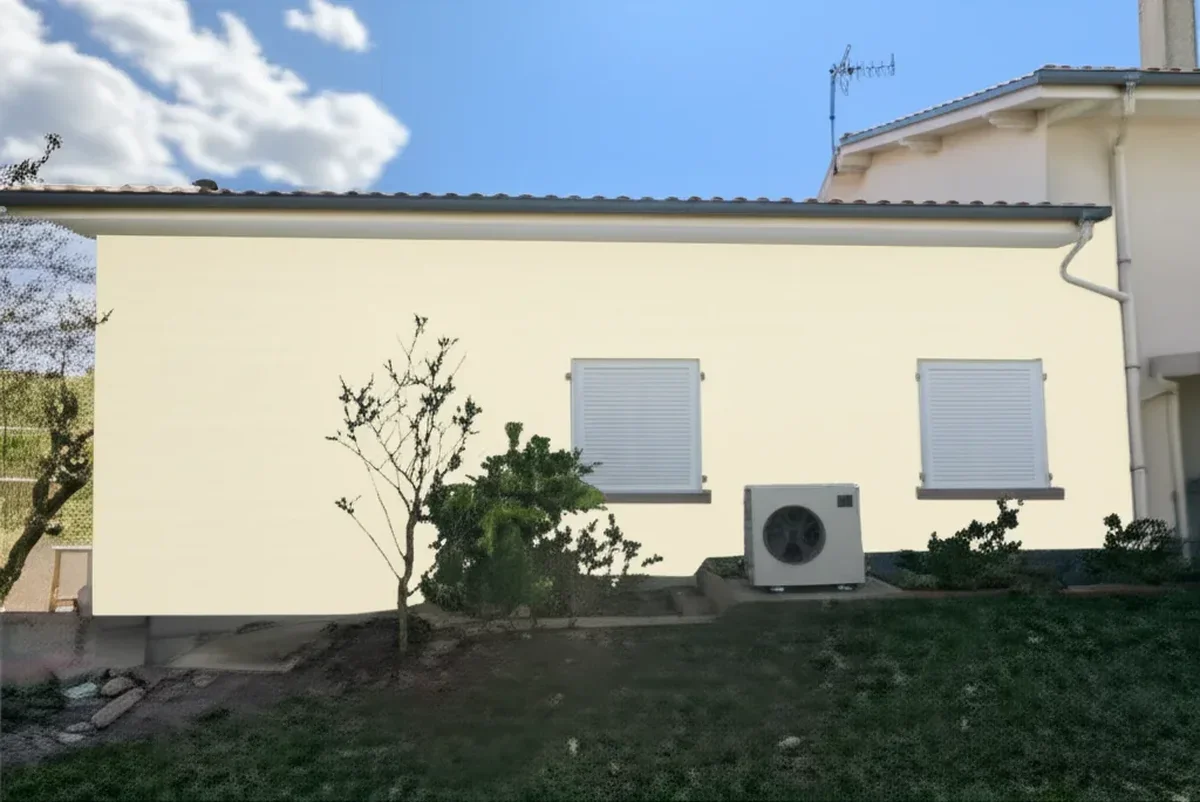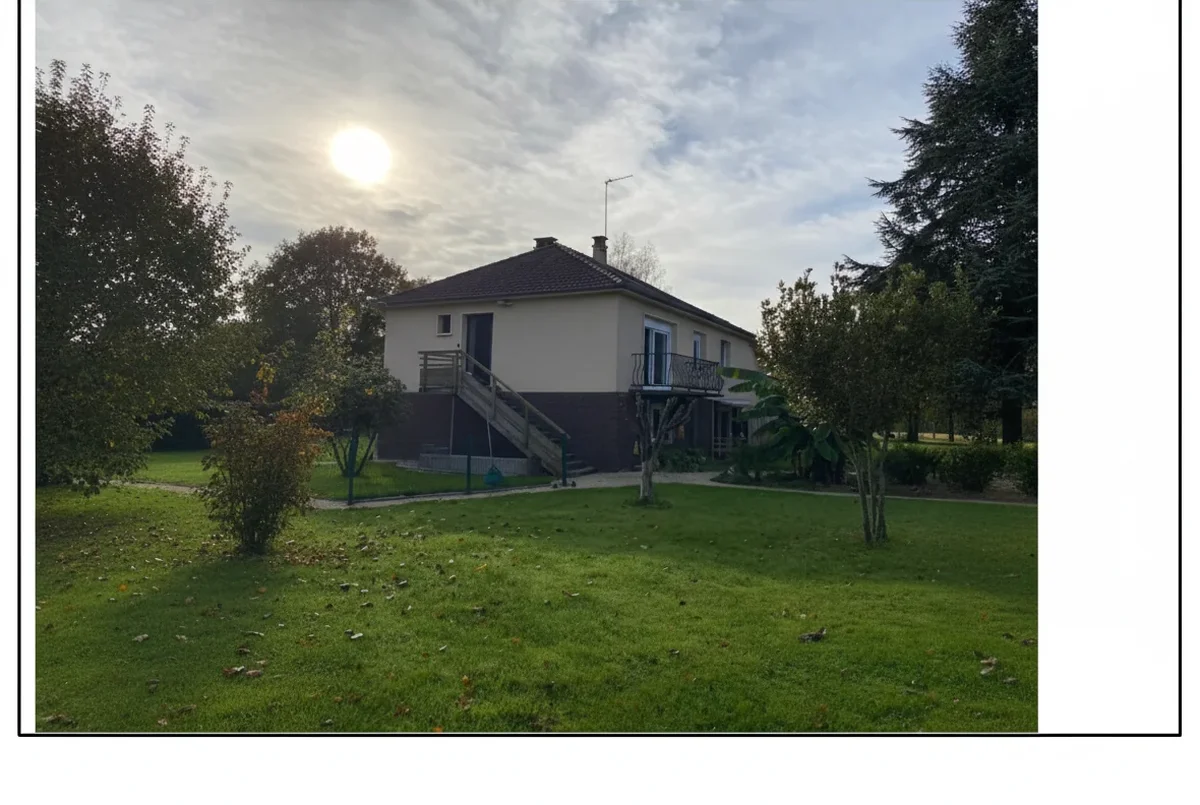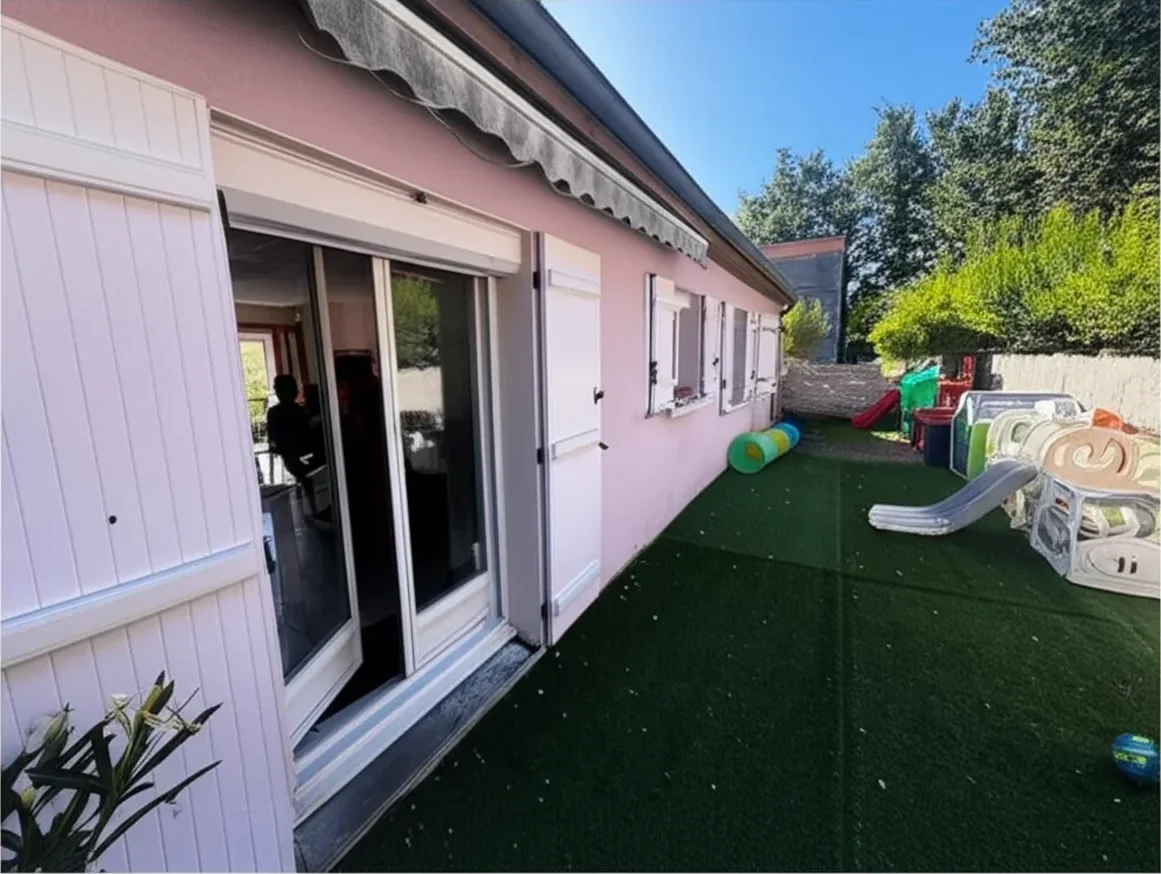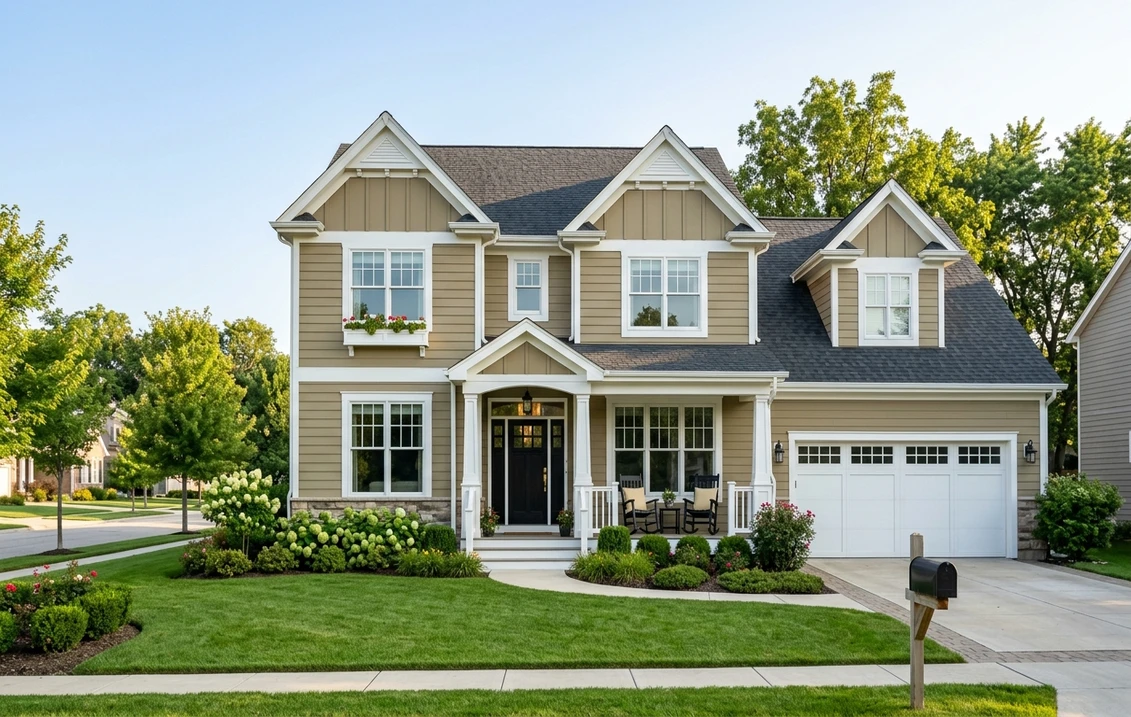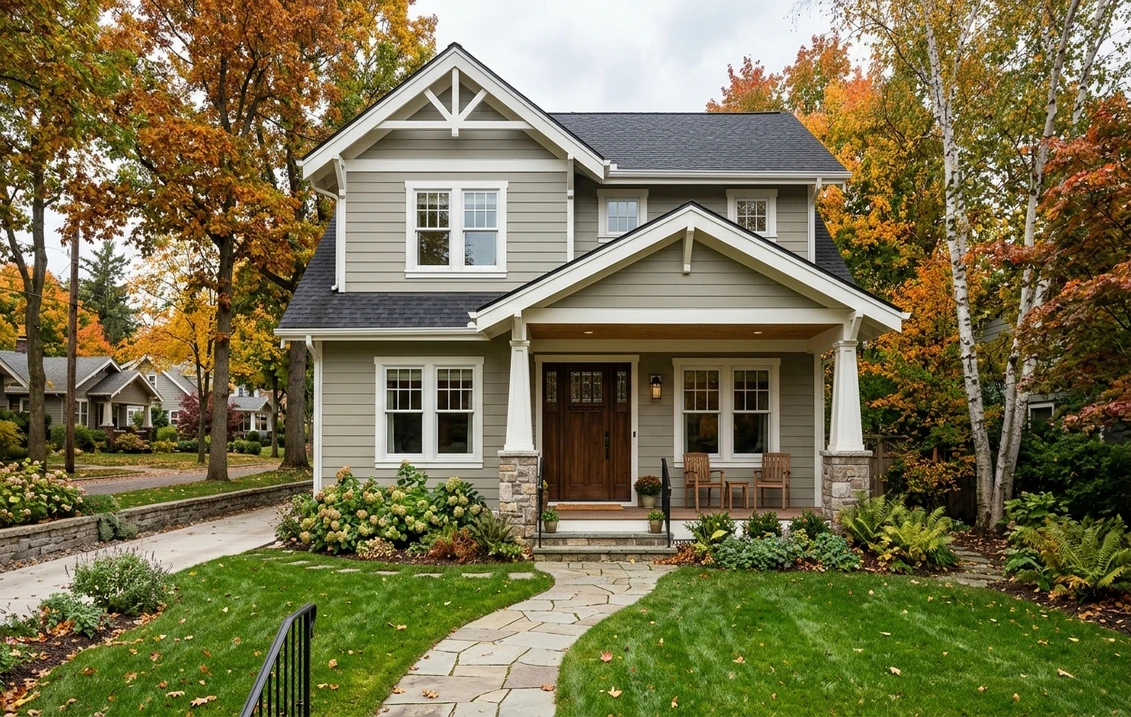

Sherwin-Williams Sensible Hue (SW 6198) is a light neutral with a faint green lean. Its LRV is 46.083, which means the wall reflects a little under half of the visible light that reaches it. Sherwin-Williams files it in its Green family and states that it is for interior and exterior paint projects; its store strip is 216-C2. Outside, the reading depends on the light, so this guide gives the published numbers first, then the Sherwin-Williams colors that go with it, the closest Benjamin Moore match, and the product and surface rules for siding, stucco, brick and vinyl.
Color values come from Sherwin-Williams' public color data and its color page, and from the Benjamin Moore color pages for the comparisons. Lab values, chroma, hue angles, color differences and gallon counts are our calculations; advice on light, trim and pairings is our color reasoning. Hex and RGB are an approximate digital rendering, so judge the real color on a painted sample, in the morning and in the late afternoon.
The link opens the exterior tool with Sensible Hue preselected on the walls. The same tool works with your own siding, stucco and trim.
Sensible Hue SW 6198 at a glance: the numbers Sherwin-Williams publishes
The official name, the number SW 6198 and the Green family come from the Sensible Hue color page on sherwin-williams.com. The LRV, RGB and Lab figures come from the brand's public color data. The official name is Sensible Hue and the number is SW 6198. Hex and RGB are a screen approximation, not a formula for the paint.
| Attribute | Sensible Hue SW 6198 |
|---|---|
| Name and number | Sensible Hue, SW 6198 |
| LRV | 46.083 (not labeled dark by Sherwin-Williams) |
| RGB | 182, 181, 171 |
| Hex (screen approximation) | #B6B5AB |
| Lab (Sherwin-Williams color data) | L 73.50, a -1.46, b 5.20 |
| Color families | Green and Living Well |
| Collections | Cool Neutrals, Nurturer, Living Well (Unplug) |
| Store strip | 216-C2 |
| Use | Interior and exterior |
Try it on your house
- 1Your photoPhoto
- 2Your colorColor
- 3HD render in ~30 sHD render in ~30 s
Your photo is used only to create your preview. JPG, PNG, HEIC (iPhone)
Neutral, gray or green? What the Lab values say
Sherwin-Williams' Lab values put Sensible Hue close to the neutral axis. By our calculation, the chroma is about 5.4, which is low: the color is a near-neutral, not a saturated green. Its hue angle is about 106 degrees, in the yellow-green part of the Lab wheel, and the yellow component (b 5.20) is larger than the green one (a -1.46). That is why the same color can read as a warm gray in one light and as a faint sage in another.
Our color reasoning: direct sun brings the yellow forward, so the wall looks warmer at midday and at sunset. Under an overcast sky the faint green comes forward and the color reads more gray. Hold the sample on the actual wall and check it at two times of day, because the neighboring trees, the roof and the lawn will all change the reflected light.
Reading a sample in three lights
Our color reasoning: a sample is the only test that settles the question, so set the sample on each side of the house, not only the sunny side. Look at it in the morning, at midday and in the late afternoon, next to the trim, the door and the roof you already have. Note which side shows the faintest yellow and which shows the faintest green, because those are the two readings the Lab values predict.
Start with the siding alone, then add the trim and the door. A color that reads as a gray-green beside a white trim can look more neutral beside a dark door, and the reverse can also happen. Compare what you see with the whites and the darker accent above, and write down each reading before you choose.
Sherwin-Williams colors around Sensible Hue
Sherwin-Williams lists two coordinating colors for Sensible Hue and names Frosty White as its white. The LRV gap is given in points. The color difference (Delta E 2000) is our calculation on the screen values, so it describes how close two swatches look on a screen, not on a wall.
| Color | Code | Role on the list | LRV | LRV points from Sensible Hue |
|---|---|---|---|---|
| Origami White | SW 7636 | Coordinating color | 76.0 | +29.9 |
| Frosty White | SW 6196 | White | 72.0 | +25.9 |
| Retreat | SW 6207 | Coordinating color | 20.9 | -25.2 |
These are the colors near it on the screen values, with the LRV gap and the Delta E 2000 from our calculation:
| Color | Code | LRV | LRV points | Delta E 2000 (our calculation) |
|---|---|---|---|---|
| Allegory | SW 9553 | 44.6 | -1.5 | 1.1 |
| Chelsea Gray | SW 2850 | 46.9 | +0.8 | 1.6 |
| Gray Clouds | SW 7658 | 47.3 | +1.2 | 2.4 |
| Magnetic Gray | SW 7058 | 45.8 | -0.3 | 2.5 |
| Oyster Bay | SW 6206 | 44.1 | -2.0 | 3.0 |
Allegory is the closest on screen values, but the Sherwin-Williams data gives it no store strip. Gray Clouds and Magnetic Gray are the closest of those in the table that have a store strip. Our color reasoning: a near match on screen is a starting point for a sample, and the trim and the roof will decide the final read.
Benjamin Moore: Gray Huskie 1473 is the closest match by our calculation
Benjamin Moore publishes an LRV on each color page. By our calculation, across the 212 Benjamin Moore colors read on the color pages and harmony lists consulted for this guide, the closest on screen values is Gray Huskie 1473, with the hex #B6B4AC and an LRV of 45.51. This is a closest match, not an equivalence published by either brand. The table adds Sea Haze 2137-50, the next closest, and Coventry Gray HC-169 as a lighter comparison.
| Benjamin Moore color | Number | LRV | LRV points from Sensible Hue | Delta E 2000 (our calculation) |
|---|---|---|---|---|
| Gray Huskie | 1473 | 45.5 | -0.6 | 1.2 |
| Sea Haze | 2137-50 | 45.4 | -0.7 | 1.5 |
| Coventry Gray | HC-169 | 48.2 | +2.1 | 3.3 |
A screen gap of 1.2 is small, but the same paint reads differently on different siding, under different roofs and in different light. Our color reasoning: order a sample of the Benjamin Moore color and place it on the wall next to the Sherwin-Williams one before you switch brands. Do not assume a match from a screen.
Siding and coverage: what the Duration sheet says
The exterior product sheet used for the coverage and surface rules here is Sherwin-Williams' Duration Exterior Acrylic Flat product data sheet, K32 series, dated 03/02/2026. It is a flat sheen. The sheet states that the paint is self-priming on most surfaces, that it takes two coats on new, bare surfaces and one coat for a repaint, and that coverage is 250 to 300 square feet per gallon at 5.3 to 6.4 mils wet.
The surfaces the sheet lists include wood, cement composition siding and panels, aluminum siding, stucco, concrete block, split-face block and plywood. Vinyl and other PVC products are the only surfaces where the sheet sets a Light Reflective Value condition, which is why the vinyl section comes later in this guide.
By our calculation, 1,500 square feet of wall needs 5 to 6 gallons for one coat at that coverage, before trim, doors, shutters and waste. A repaint of that wall takes 5 to 6 gallons, and a new bare surface takes two coats, so 10 to 12 gallons. Buying the full amount in one batch keeps the job on one lot of paint.
| Surface state | Coats in the sheet | Gallons for 1,500 sq ft (our calculation) |
|---|---|---|
| Repaint of sound paint | 1 coat | 5 to 6 |
| New, bare surface | 2 coats | 10 to 12 |
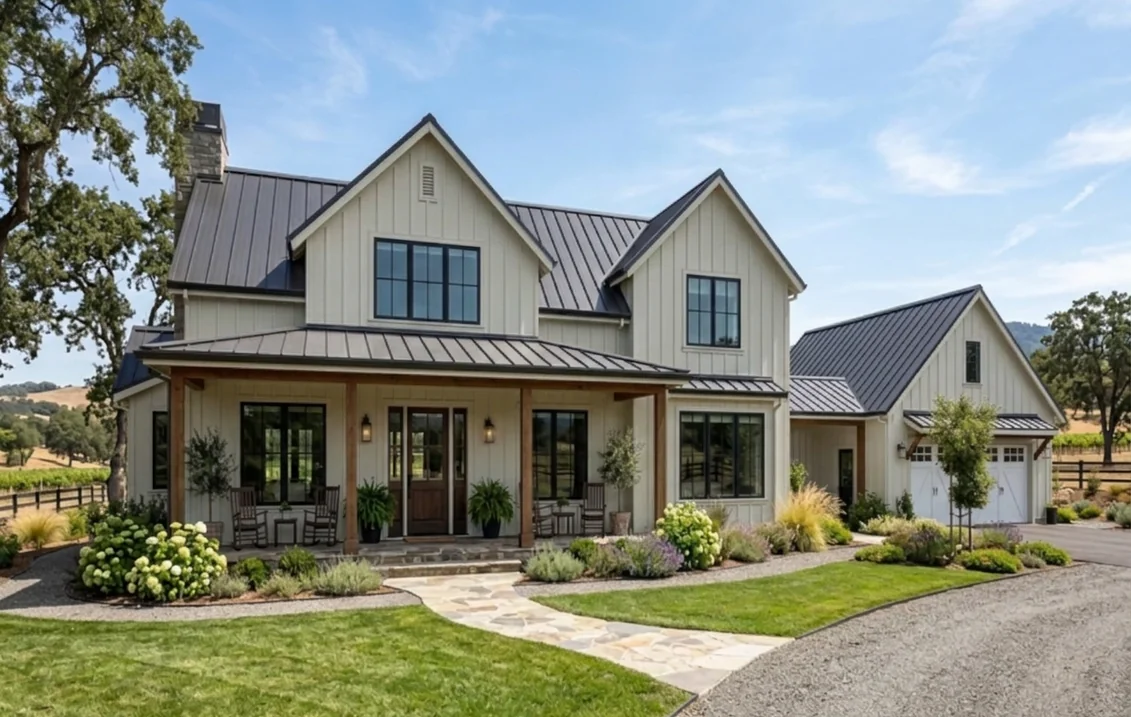
Our color reasoning: on wood and fiber cement lap siding, a neutral at an LRV of 46 sits in the middle of the range, so the shadow lines of the lap, the trim and the gable do much of the work. On stucco, the texture breaks up the light, so the same color reads softer and less defined than on smooth siding. Check the sample on the surface you actually have.
Stucco and brick: the cure time and the primer rule
The sheet lists stucco among its surfaces. For new stucco, it says to let the surface cure at least 30 days before painting. If the job cannot wait, allow the surface to dry 7 days and prime with Loxon Concrete & Masonry Primer. Before painting, the sheet also asks you to repair cracks, voids and other holes with an elastomeric patch or sealant, and to remove any loose stucco and efflorescence.
For brick, no brick-specific rule for this color was found in the sources checked for this guide, so this section does not state one. The sheet names the Loxon Concrete & Masonry Primer for new masonry whose pH is above 9, and for stucco that cannot cure for 30 days; for painted masonry with a powdery surface, it calls for Loxon Conditioner before the topcoat. The color values above are the only color facts this guide can give for brick. Our color reasoning: a neutral this light lets the brick and the mortar read as a second color on the wall, so test a sample next to the actual brick and not on a white card.
Vinyl siding: what the sheet says and where Sensible Hue falls
The Duration sheet says not to paint vinyl or other PVC products with any color darker than the original, or with a Light Reflective Value below 56, unless VinylSafe colors are used, because the vinyl may warp. Sensible Hue has an LRV of 46.083, so this rule applies to it. Sensible Hue is not on Sherwin-Williams' VinylSafe colors page, checked on 19/11/2026, which lists 99 swatches with their SWVS codes.
By our calculation on the screen values, the closest VinylSafe swatches are Foster SWVS 415 (Delta E 2000 about 3.0), Dusted SWVS 375 (about 3.3) and Thimble SWVS 349 (about 3.4). A close screen match is not an approval. Before any vinyl job, check the VinylSafe list and the vinyl maker's own rules, and do not decide a vinyl job from this guide alone.
Trim, doors and shutters: the whites and the darker partner
Origami White SW 7636 (LRV 76.0) and Frosty White SW 6196 (LRV 72.0) sit 26 to 30 LRV points above Sensible Hue, which gives the siding a clear outline. Origami White is the brighter of the two by LRV, and Frosty White is the white Sherwin-Williams lists for this color. Our color reasoning: compare both whites on the house, in sun and in shade.
Retreat SW 6207 (LRV 20.9) is the darker coordinating color on the Sherwin-Williams list, about 25 points below Sensible Hue. Our color reasoning: it suits a front door, shutters or a narrow accent band, where the contrast with the siding is wanted. Check the door maker's own finish rules before painting a door; this guide does not cover them.
| Element | Suggested color | LRV | Our color reasoning |
|---|---|---|---|
| Siding and stucco | Sensible Hue SW 6198 | 46.1 | The base color; check it in sun and in shade |
| Trim and window frames | Origami White SW 7636 or Frosty White SW 6196 | 76.0 or 72.0 | The clearest outline; compare both |
| Front door and shutters | Retreat SW 6207 | 20.9 | A deeper accent for contrast |
Where Sensible Hue sits among the brand's exterior guides
Sensible Hue is a light-to-mid neutral, and the darker Sherwin-Williams colors are a different job. For darker colors from the same brand, read our Urbane Bronze and Iron Ore comparison. For another neutral from the brand, see the Wool Skein SW 6148 exterior guide. The Sherwin-Williams exterior paint guide sets out the brand's exterior lines for the whole cluster.
When to paint: temperature, dew point and rain
The Duration sheet sets application limits that matter in late fall. Air, surface and material temperatures must be above 35°F (1.7°C) and at least 5° above the dew point, and the sheet says to avoid painting when rain or snow is expected within 2 to 3 hours. It also warns that substrates can be colder than the air, so check the surface temperature as well as the forecast.
Drying and recoat times depend on temperature, humidity and film thickness, so the times on the can are a guide and not a promise. Before painting, the sheet says that mildew must be removed, because it is a fungus that looks like dirt but will not wash off. Clean it from the surface first, then let the surface dry.
Lead and older houses: check before you scrape
The EPA's lead page describes the dust-lead standards it is implementing, which target lead-based paint hazards in pre-1978 homes and childcare facilities. If the house was built before 1978, test the old layers before any scraping or sanding.
The Duration sheet adds that scraping, sanding or removing old paint may release lead dust, that lead is toxic, and that exposure to lead dust can cause serious illness, such as brain damage. Keep children out of the work area while the surface is prepared, and treat the old layers as a hazard until they have been checked.
Test Sensible Hue on your house before you order
Color data gives the numbers, and your house gives the answer. Upload a photo of your house and see Sensible Hue on the walls next to your own trim, roof and door. Then compare it with the whites and the darker accent above, and order a sample for the wall before you buy the full amount.
What this guide does not cover
The coverage figures and the stucco and vinyl rules here come from one product sheet, Duration Exterior Acrylic Flat, and other Sherwin-Williams products may carry different rules. No brick rule for this color was found, no door maker's rule is given, and no price is given, because this guide does not quote prices.
Sources and references
- Sherwin-Williams, Sensible Hue SW 6198 color page: name, number, Green family, interior and exterior use. The LRV, RGB and Lab values come from the brand's public color data.
- Sherwin-Williams, Duration Exterior Acrylic Flat product data sheet (K32 series, 03/02/2026): self-priming and coats, coverage, application temperatures, stucco cure, the LRV 56 rule for vinyl and PVC, and the mildew and lead warnings.
- Sherwin-Williams, VinylSafe Paint Colors for vinyl siding: the list of SWVS colors, checked on 19/11/2026 (99 swatches).
- Benjamin Moore, Gray Huskie 1473 color page: LRV 45.51 and hex B6B4AC.
- U.S. Environmental Protection Agency, Lead: dust-lead standards and lead-based paint hazards in pre-1978 homes and childcare facilities.
Frequently asked questions
What is the LRV of Sherwin-Williams Sensible Hue?
Is Sensible Hue for interior or exterior use?
Can you paint vinyl siding Sensible Hue?
What is the Benjamin Moore equivalent of Sensible Hue?
What trim color goes with Sensible Hue?
How much Sensible Hue paint does a house need?
What should you check for lead before painting an older house?
Trademarks mentioned (Sherwin-Williams, Benjamin Moore, Behr, Caparol, Brillux, Sto, Alpina, Valspar, PPG, Glidden, Dulux, Crown Trade, Sandtex, Farrow & Ball, Johnstone's, Leyland) are property of their respective owners. FacadeColorizer is independent and not affiliated with any of them. Nominative fair use under Lanham Act §1125.