Try it on your room

Accent walls are back, and in 2026 they are smarter, not louder. The Sherwin-Williams 2026 Colormix Forecast and Benjamin Moore Color Trends both report a 38 percent rise in single-wall color commissions, driven by homeowners who want the drama of a saturated hue without repainting the full envelope. Done right, an accent wall costs $80 to $250 in paint and one weekend of labor, yet it shifts the entire mood of a room.
This guide walks you through which wall to pick in every room, the contrast math that keeps the feature wall from looking like a mistake, five texture techniques beyond flat paint, and the exact Sherwin-Williams and Benjamin Moore codes that are selling best this year. It is built for US homes, US paint brands, and US room layouts.
Upload a photo of your room and preview any accent color in under 30 seconds
How to Pick the Right Accent Wall (Room by Room)
An accent wall only works when it has a reason to exist. That reason is almost always a focal piece of furniture or an architectural anchor. Painting a random wall without a focal point just creates visual noise. Here is the rule most US interior designers follow in 2026:
- Bedroom - the wall behind the headboard. It frames the bed as the hero and reads beautifully in morning light.
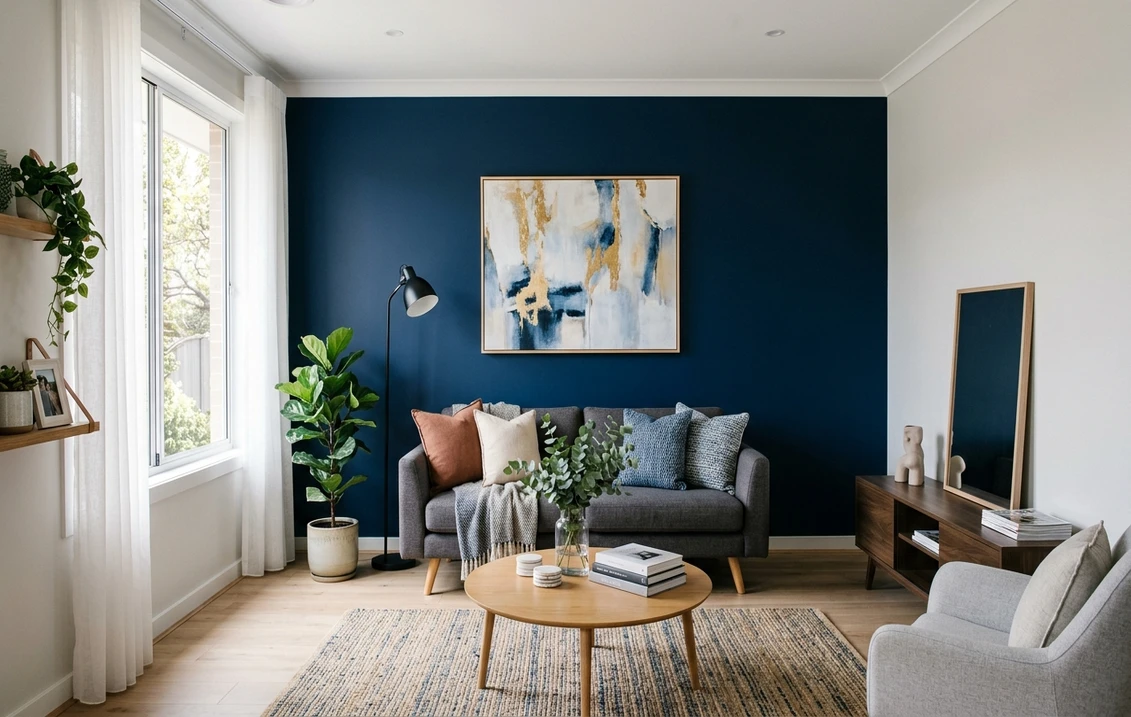
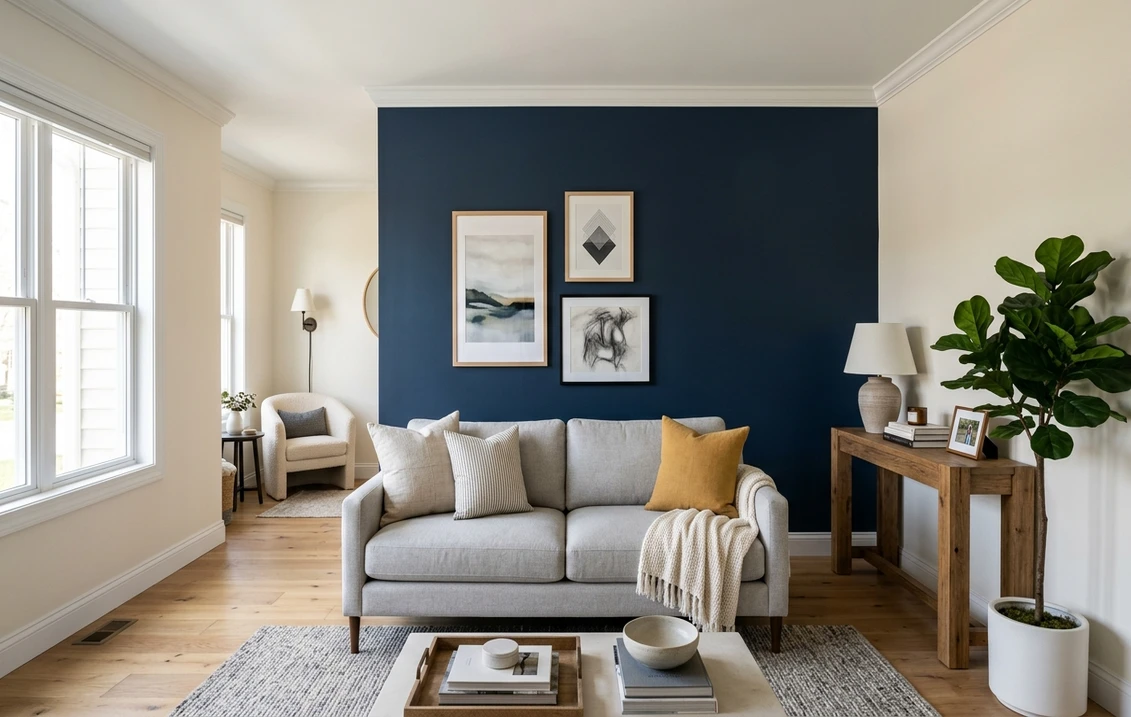
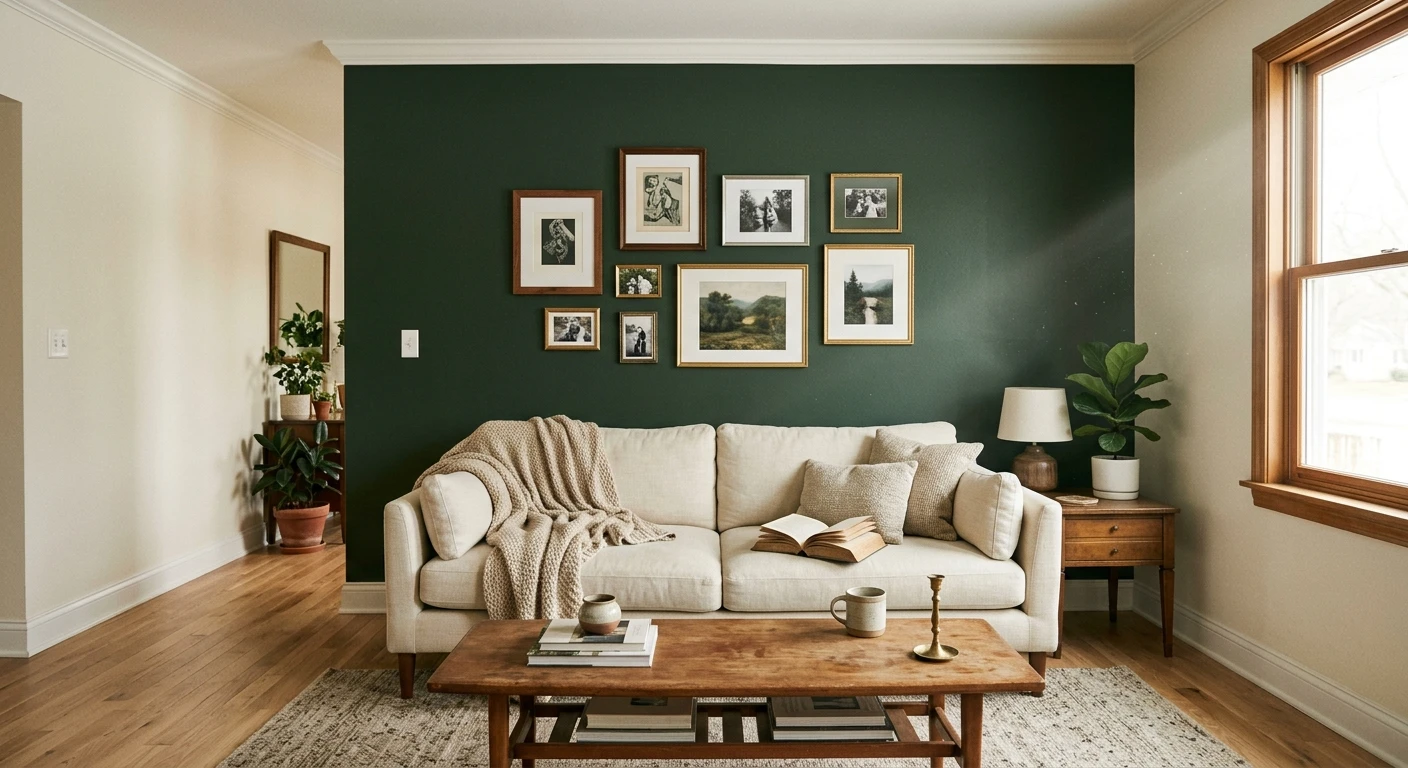
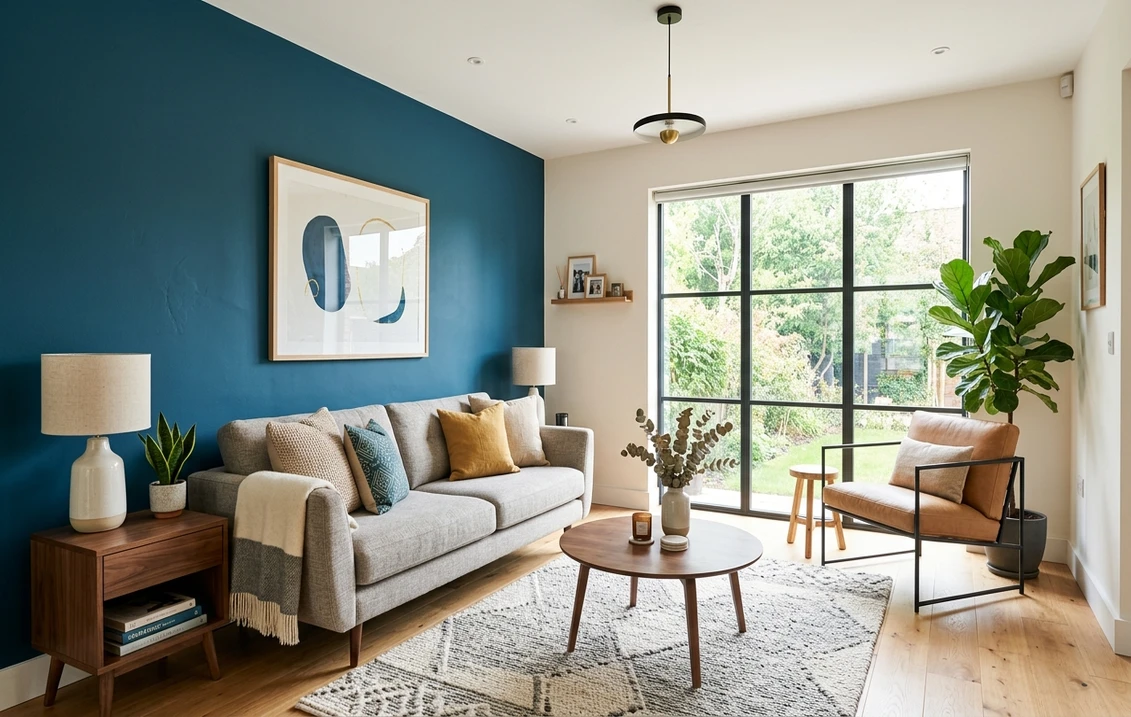
- Living room - the wall behind the main sofa, or the fireplace wall if it is centered and uninterrupted.
- Family room - the wall behind the TV or media console. A dark accent here reduces screen glare and hides cable clutter.
- Dining room - the wall behind the dining table, ideally the one you see when walking in. Pair with a chandelier for a built-in spotlight.
- Home office - the wall behind your desk (so it shows up on video calls) or the bookcase wall for a gallery effect.
- Entryway - the first wall visible from the front door, usually the one opposite the entrance.
- Kitchen - usually skip it. Upper cabinets, tile backsplash, and appliances already compete for attention. If you must, use the pantry door wall or a small breakfast nook wall.
- Bathroom - the wall behind the vanity mirror or the freestanding tub wall. Keep moisture-rated paint in mind.
The 2-3 Shade Contrast Formula
The most common accent wall mistake is picking a color that is either too close to the other walls (making it look like a paint error) or too far from them (making the room feel chopped in two). The safe formula is two to three shades darker or richer than your primary wall color, staying within the same undertone family.
If your main walls are a warm off-white like Sherwin-Williams Alabaster (SW 7008), the accent should stay in the warm family: a terracotta, a deep caramel, a sage. If your main walls are a cool gray like Benjamin Moore Classic Gray (OC-23), the accent goes cool too: navy, forest green, charcoal. Mixing warm and cool across an accent wall is the fastest way to make a room feel visually unbalanced.
Quick test: hold your accent swatch next to the main wall paint chip and squint. If the accent looks clearly deeper but related, you are in the sweet spot. If it looks like a different temperature, pick another swatch.
5 Accent Wall Techniques Beyond Flat Paint
Flat, single-color accent walls still dominate in 2026, but five other techniques are driving the Pinterest-to-paint-aisle pipeline this year. Each adds texture or pattern without major construction.
1. Paint Only (Classic Block)
A single saturated color across one full wall, corner to corner, floor to ceiling. Cost: $80 to $150 including one gallon of premium paint, primer, and supplies. Best for renters and first-time accent wall attempts. Works in every room.
2. Vertical Stripes
Two tones from the same color family applied in 8 to 14 inch vertical bands. Makes ceilings feel taller, ideal for bedrooms and entryways with 8-foot ceilings. Cost: $120 to $200 with extra painter's tape and a second quart. Use satin sheen for the deeper stripe so it catches light.
3. Color Block (Geometric Horizon)
The wall is split horizontally or diagonally into two colors, often with a crisp taped line at chair-rail height (36 inches) or at the two-thirds mark. Very popular in kids' rooms, home offices, and dining rooms. Cost: $150 to $220. Pair a deeper bottom with a lighter top to anchor the room visually.
4. Textured Molding (Picture Frame or Slat)
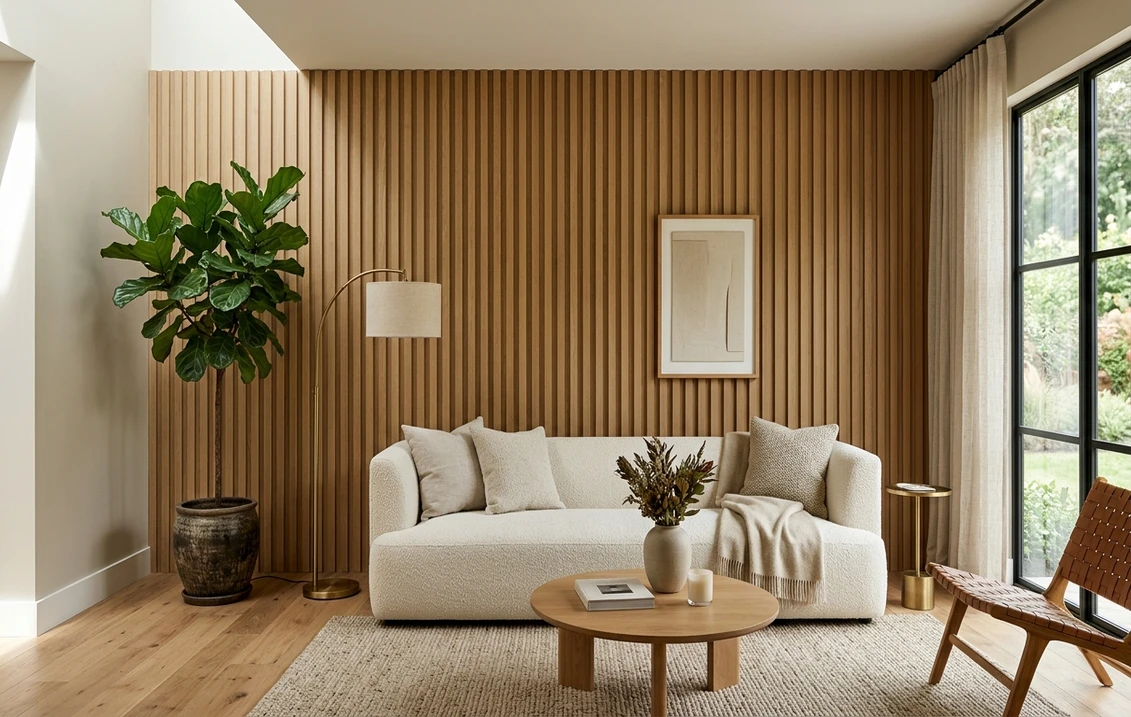
Thin MDF trim (picture-frame molding) or vertical wood slats applied to the wall, then painted the same accent color as the drywall behind. Adds architectural depth without full wainscoting. Cost: $180 to $250 for a standard 10-foot wall, including trim, adhesive, nails, and paint. Huge in dining rooms and primary bedrooms in 2026.
5. Geometric Shapes (Arch, Half-Circle, Diamond)
A painted shape (arch behind a bed, half-circle behind a desk, diamond grid on a kids' wall) rather than the full wall. Requires a pencil, a long string, and patience with a taping knife. Cost: $100 to $180. Very renter-friendly because the rest of the wall stays your original color.
Best Accent Wall Colors by Room (SW + BM Codes)
For a dining room or a study used mostly after dark, a deep charcoal such as Sherwin-Williams Peppercorn (LRV 9.681) gives an enveloping wall without the flatness of black; Gauntlet Gray (17.428) is the lighter step if the room is small. How the two compare, and which trim whites Sherwin-Williams lists for Peppercorn, is in the SW Peppercorn profile.
The table below pairs the most-commissioned accent colors of 2026 with the rooms they perform best in, based on Sherwin-Williams and Benjamin Moore sales data plus designer submissions to Houzz and Apartment Therapy.
| Room | Wall to Paint | Recommended Color | SW / BM Code | Cost |
|---|---|---|---|---|
| Bedroom | Behind headboard | Deep navy blue | SW 6244 Naval / BM 2062-10 Gentleman's Gray | $90 - $160 |
| Living room | Behind sofa | Emerald / forest green | SW 6461 Isle of Pines / BM HC-134 Tarrytown Green | $110 - $180 |
| Family room | Behind TV wall | Charcoal / iron gray | SW 7069 Iron Ore / BM 2124-10 Wrought Iron | $100 - $170 |
| Dining room | Behind dining table | Warm terracotta | SW 7597 Rookwood Red / BM 1203 Audubon Russet | $120 - $200 |
| Home office | Behind desk or bookcase | Olive green | SW 6138 Artichoke / BM HC-120 Dakota Shadow | $90 - $160 |
| Entryway | Opposite the front door | Warm clay / muted rust | SW 6040 Less Brown / BM HC-62 Wethersfield Moss | $80 - $140 |
| Kitchen (if any) | Pantry door wall / breakfast nook | Soft sage | SW 9130 Evergreen Fog / BM 1496 Camouflage | $80 - $140 |
| Bathroom | Vanity mirror wall | Moody teal | SW 6236 Grays Harbor / BM 2053-20 Newburg Green | $90 - $150 |
Try it on your house
No photo? Try a sample
What Drives Accent Wall Cost
A standard accent wall (8 feet tall by 10 to 14 feet wide, or roughly 80 to 130 square feet) runs $80 to $250 total including paint, primer, tape, a roller kit, and drop cloths. The variables:
- Paint grade - a quart of builder-grade flat runs $18, while a gallon of Sherwin-Williams Emerald or Benjamin Moore Aura hits $85 to $105. Deep colors almost always need the premium line to avoid patchy coverage. Looking for a 2026-ready dramatic shade? Try Benjamin Moore Silhouette AF-655 (2026 COTY): perfect dark accent wall behind a TV or headboard, the soft black undertone reads moody without going flat.
- Number of coats - saturated navy, emerald, and terracotta usually need a tinted primer plus two topcoats (three coats total). Budget one full gallon even for a single accent wall.
- Wall prep - filling nail holes, light spackle, and a quick sanding pass is $0 in supplies if you already own a putty knife. Major drywall patching adds $30 to $60 in compound and mesh.
- Texture upgrades - adding MDF picture-frame molding or wood slats pushes cost to $180 to $250. Geometric stencils, arches, or painted shapes stay under $180 because they only need tape and a little patience.
- Hiring a pro - a painter charges $150 to $400 for a single accent wall depending on ceiling height, prep, and specialty finish. Still, many homeowners DIY this specific project because it is low-risk and forgiving.
Accent Wall Mistakes to Avoid in 2026
Three errors show up in 80 percent of accent walls that homeowners end up repainting within a year. First, picking a wall with a window or a door in it breaks the color block and kills the focal-point effect. Always pick the most uninterrupted wall. Second, choosing a trendy color without a fabric anchor in the room (a rug, a sofa, throw pillows) leaves the accent wall floating. Pull the accent color from something that is already in the space. Third, forgetting to paint the inside edges of adjacent walls by 1 to 2 inches. When the accent wraps slightly onto the neighboring wall, the corner shadow line disappears and the feature wall looks intentional, not abrupt.
For related pricing and color guides, see our interior house painting cost guide 2026, best interior paint colors 2026, and the bedroom painting cost guide.
Frequently Asked Questions
Which wall should I pick for an accent wall?
Pick the wall with the strongest focal point: behind the headboard in a bedroom, behind the sofa in a living room, behind the TV in a family room, or behind the dining table. The wall should be uninterrupted by large windows or doors so the color block stays intact. In kitchens, most designers skip accent walls because cabinets and backsplash already compete for attention.
How much darker should an accent wall be than the other walls?
Two to three shades darker or richer than your primary wall color, staying in the same undertone family (warm with warm, cool with cool). If your main walls are Alabaster (SW 7008, warm), go terracotta or caramel. If they are Classic Gray (BM OC-23, cool), go navy or forest green. Mixing warm and cool temperatures across an accent wall is the top reason homeowners repaint within a year. To check the pairing first, preview an accent wall on your own room with a photo.
How much does a DIY accent wall cost in 2026?
A standard 80 to 130 square foot accent wall costs $80 to $250 in materials: one gallon of premium paint ($55 to $105), a quart of tinted primer ($25), painter's tape, a roller kit, and drop cloths. Adding MDF molding or wood slats pushes cost to $180 to $250. Hiring a painter for a single accent wall runs $150 to $400 depending on ceiling height and prep.
Do accent walls still look dated in 2026?
No. The Sherwin-Williams 2026 Colormix Forecast reports a 38 percent rise in single-wall color commissions. What feels dated is the 2010s-era "one bright red wall" look. In 2026, accent walls lean into saturated but sophisticated tones (navy, emerald, terracotta, olive, moody teal) and increasingly use texture techniques like picture-frame molding, vertical slats, or painted arches rather than flat paint alone.
What sheen should I use on an accent wall?
Matte or eggshell for bedrooms and living rooms - it absorbs light and deepens rich colors like navy and emerald. Satin for family rooms and dining rooms if you want a subtle glow under lamplight. Semi-gloss only if you are doing a textured molding accent and want the trim to pop. Never use high-gloss on a full accent wall in 2026 - it reflects every drywall imperfection.
Free - No signup - Preview SW + BM codes on your own room photo
An accent wall is the single highest-impact paint decision you can make in 2026 for under $250. Pick the right wall (focal point, uninterrupted), apply the 2-3 shade contrast formula, and test your shortlist on a photo of your room before committing. Sources: Sherwin-Williams 2026 Colormix Forecast, Benjamin Moore Color Trends 2026, Houzz US Home Design Trends Report.
Trademarks mentioned (Sherwin-Williams, Benjamin Moore, Behr, Caparol, Brillux, Sto, Alpina, Valspar, PPG, Glidden, Dulux, Crown Trade, Sandtex, Farrow & Ball, Johnstone's, Leyland) are property of their respective owners. FacadeColorizer is independent and not affiliated with any of them. Nominative fair use under Lanham Act §1125.