Try it on your room

The wall behind my desk was builder beige for three years, and I stared at it on every video call without once thinking about it. One Saturday I rolled two coats of deep olive across it, added four thin pine slats, and the whole office stopped looking like a spare bedroom. That is the quiet power of an accent wall: one plane, one weekend, and the room reorganizes itself around it. If you have been collecting accent wall ideas but cannot picture them on your own four walls, this is a visual gallery sorted two ways, by room and by material.
This is the broad picture book. If you want the decision framework first (which wall earns the accent, how much contrast to run, when to skip it), start with our accent wall color strategy guide, then come back for the designs. For exact color codes by room, our room-by-room accent wall paint colors piece is the companion. Everything below is built for US homes, US paint lines, and US room layouts.
Upload a photo of your room and preview any accent color in about 30 seconds, free.
The one rule before any design: pick the wall with a reason
Before you fall for a single design, get the wall right, because no color or texture saves a wall that had no business being the feature. An accent wall needs a focal point already living on it: a headboard, a sofa, a fireplace, a media console. Paint a random wall with a door punched through it and you get a paint job that looks unfinished, not a feature. The rule: choose the most uninterrupted wall the eye already lands on. If every wall has a window or doorway, a whole-room color beats an accent. With that settled, here are 30 accent wall designs, grouped so you can skim to your room, then jump to the material section for how to build the look. One focal point deserves its own rules: a brick fireplace is masonry, not drywall, and painting, whitewashing or limewashing it is covered separately in the painted brick fireplace guide.
Accent wall ideas by room
Living room (the focal wall everyone sees)
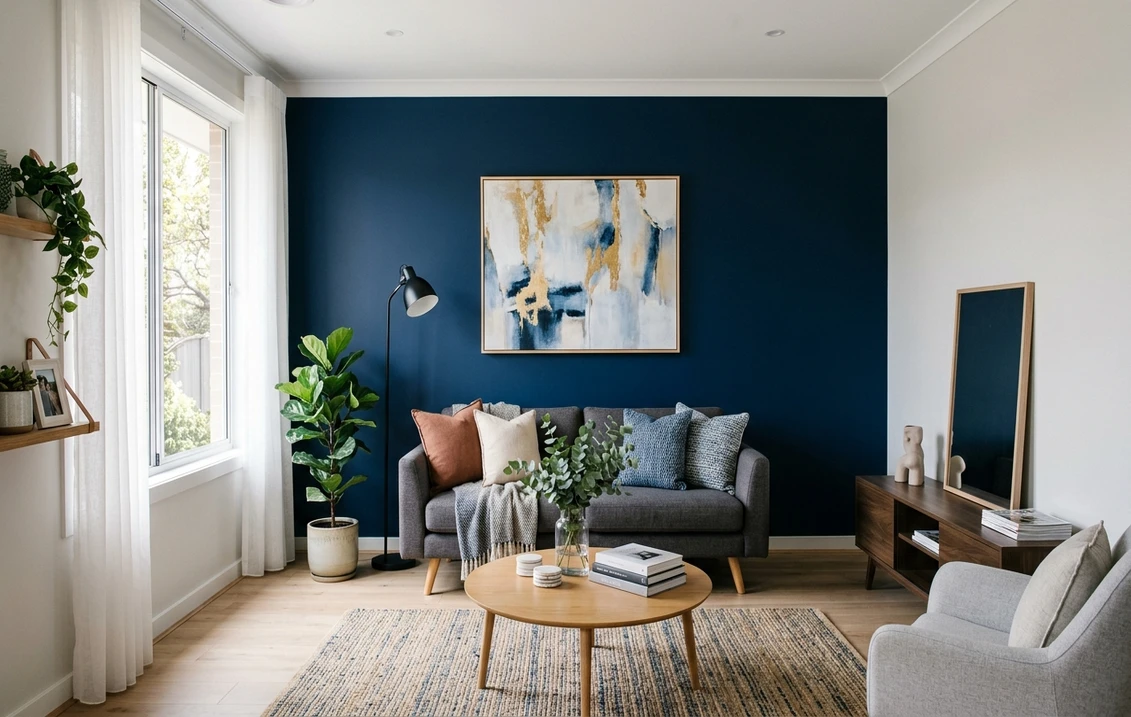
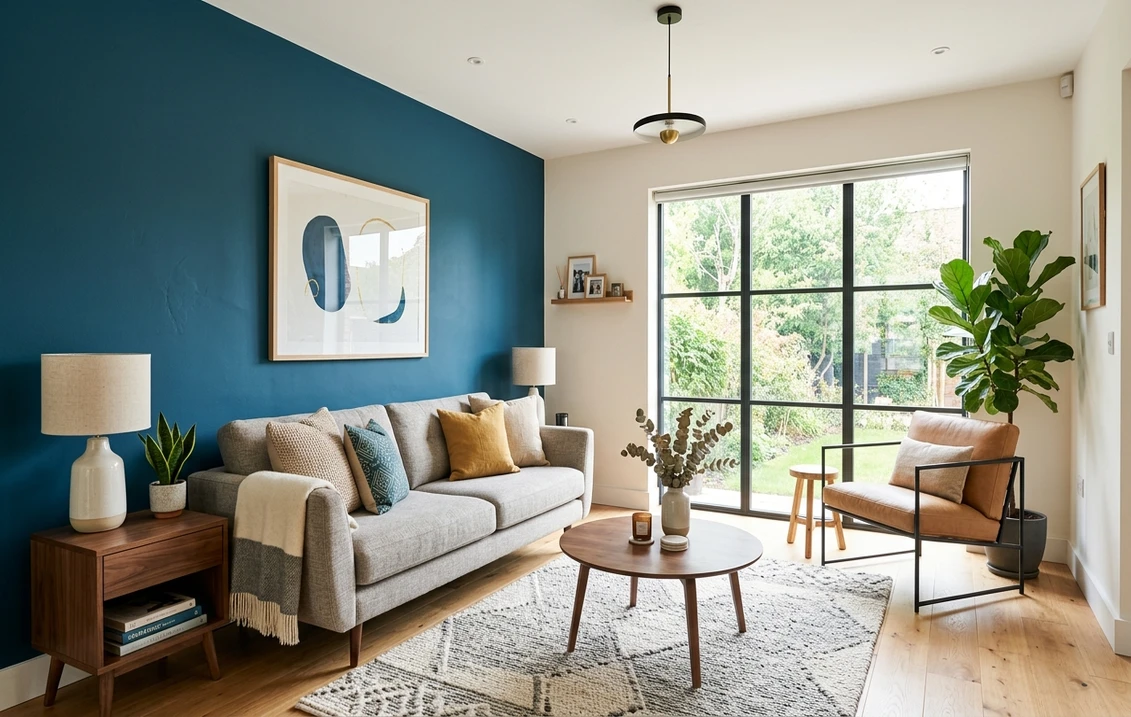
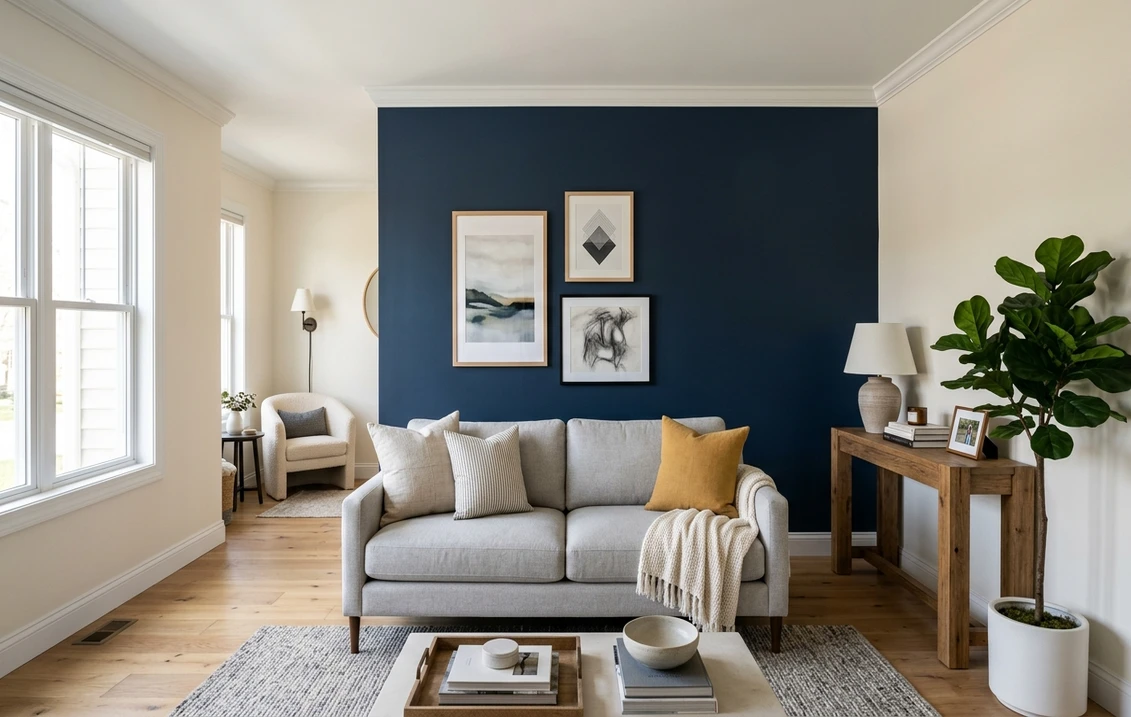
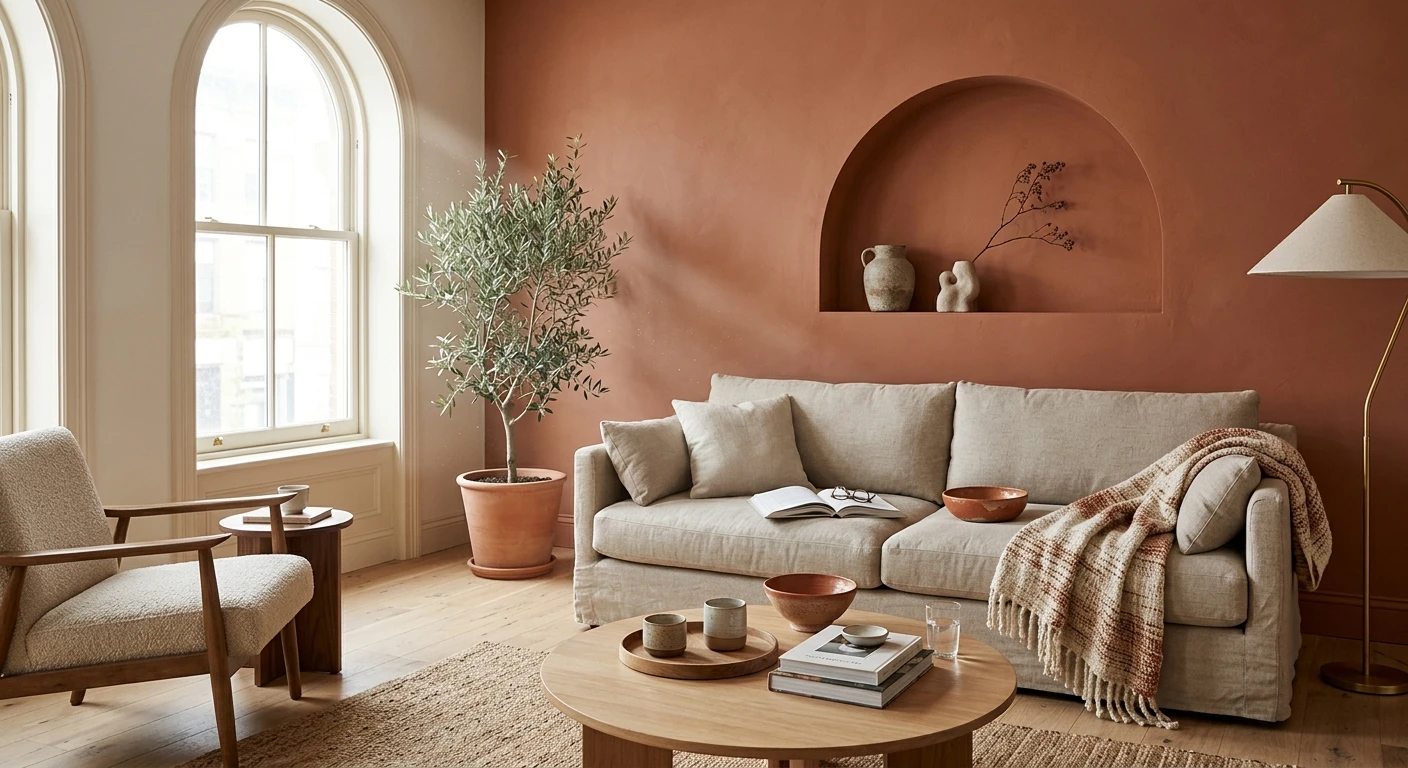
The living room accent goes behind the main sofa or on a centered fireplace. Five that hold up: a deep navy like Benjamin Moore Hale Navy (HC-154) behind a low sofa; a forest green such as SW Pewter Green (SW 6208) wrapping a fireplace; a warm near-black (SW Urbane Bronze, SW 7048) on a media wall to kill TV glare; a board-and-batten grid in soft greige; and a limewash wall in terracotta for texture without trim. Our living room accent wall ideas guide goes deeper on furniture pairings. If the fireplace and the screen share the same wall, which is the usual modern layout, that combination has its own constraints and its own color hierarchy: see our accent wall with a fireplace and TV guide.
Bedroom (frame the bed, calm the room)
The wall behind the headboard is the hero, and it reads beautifully in low morning light. Five that work: a muted sage-gray (SW Evergreen Fog, SW 9130) for a restful look; a painted arch in soft clay; walnut-stained slats over a dark wall; a moody aubergine for a small primary; and a two-tone color block, deeper on the bottom two-thirds, to ground a bed with no headboard. Our bedroom accent wall ideas guide covers sheen and headboard-height math.
Home office (it shows up on every call)
Put the accent behind the desk so it backs you on video, or on the bookcase wall for a gallery effect. Five ideas: olive green (SW Artichoke, SW 6138) with floating shelves; pine slats over charcoal for depth and sound dampening; a deep teal for a library feel; a picture-frame molding grid painted out the wall color; and a half-painted color block at desk height to separate the work zone.
Dining room and entryway (high-drama, low-traffic)
These rooms take more saturation because nobody lives in them for eight hours. Five designs: a deep Rookwood Red (SW 2802) behind the dining table under a chandelier; board-and-batten in warm white for a refined nook; a glossy black entry wall for arrival drama; a wallpaper-look stencil; and a wood slat accent in the entry. Many use real millwork, which is where our wood accent wall paint color ideas guide picks up.
Kids' rooms, bathrooms, and the wall to skip (kitchen)
Kids' rooms love a painted arch, a rainbow color block, or a diamond grid, since the rest of the wall keeps your base color and repaints fast. Bathrooms do well with a single moody teal or navy behind the vanity mirror in a moisture-rated satin. The kitchen is the one place I usually say no: cabinets, backsplash, and appliances already compete, so a fifth element reads busy. If you must, the pantry door wall or a breakfast nook is safest.
Free visualizer. Test the design before buying a sample pot.
Accent wall ideas by material and technique
The room tells you where the accent goes; the material tells you how much weekend and budget it costs. These accent wall design ideas run from a Friday-night roller job to a real woodworking project.
Paint only (the classic block)
One saturated color, corner to corner, the most renter-friendly option, and it still outperforms most fancy techniques when the color is right. Cut in with a brush, roll two coats (deep colors need a tinted primer first), and you are done in an afternoon. The painter's truth: a second coat is not optional on navy, emerald, or terracotta, whatever the can promises.
Color block and painted shapes
A taped horizon line at chair-rail height, a painted arch behind a bed, a half-circle behind a desk, or a diamond grid in a kid's room. All you need is tape, a pencil, a length of string for curves, and patience pulling the tape while the paint is still slightly wet. Very low risk, because the rest of the wall keeps your base color.
Wood slats and board-and-batten
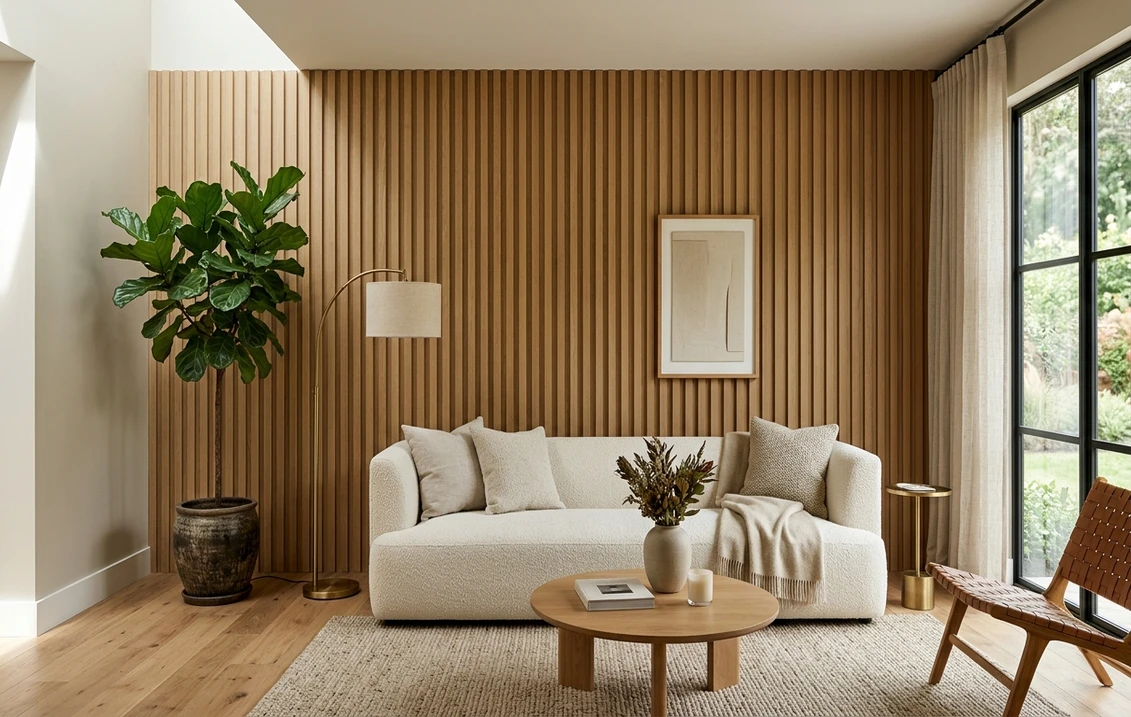
This is where an accent wall becomes light carpentry. Vertical pine or MDF slats, or a board-and-batten grid, add real architectural depth. Paint the wall and trim the same color for a monolithic look, or stain the slats over a dark wall for contrast. Our wood accent wall guide covers the colors that flatter natural and stained wood.
Picture-frame molding and limewash
Thin MDF molding in rectangles, painted the wall color, gives a classic European look without full wainscoting. Limewash goes the other way: no trim, just a mineral paint that dries with soft cloudy movement, best in warm earth tones.
Technique comparison: cost, effort, and best room
How the main techniques stack up for a standard accent wall (roughly 80 to 130 square feet). Costs are materials only, DIY:
| Technique | Material cost | Effort | Best room |
|---|---|---|---|
| Paint only (block) | $80 to $150 | Low, one afternoon | Any room, first-timers |
| Color block / painted shape | $100 to $180 | Low to medium | Kids' rooms, offices, bedrooms |
| Vertical wood slats | $180 to $300 | Medium to high, a weekend | Living rooms, bedrooms, entries |
| Board-and-batten or molding | $150 to $280 | Medium to high | Dining rooms, primary bedrooms |
| Limewash / color wash | $90 to $170 | Low to medium | Living rooms, bedrooms |
Try it on your house
No photo? Try a sample
Sources: Sherwin-Williams and Benjamin Moore 2026 product pricing, designer field reports compiled by FacadeColorizer.
See wall, trim, and floor together in one preview, free.
Picking the accent color so it does not look like a mistake
The best accent wall paint ideas all share one habit: the color does not fight the room. The rule I trust: go two to three shades deeper than your main wall color, and stay in the same undertone family. Warm off-white walls take a warm accent (terracotta, caramel, olive); cool gray walls take a cool one (navy, forest, charcoal). Mixing a warm accent against cool walls is the single most common reason people repaint within a year. A few starting points by mood:
- Moody and grounding: Hale Navy (BM HC-154) or Urbane Bronze (SW 7048), both rich without going flat black, forgiving on a media or headboard wall.
- Soft color, low commitment: Evergreen Fog (SW 9130) or a muted sage, calm enough for a bedroom you sleep in.
- Warm and inviting: terracotta or Rookwood Red (SW 2802) for dining rooms and entries you pass through rather than linger in.
- Check the undertone in your light: a greige or green can shift cooler in a north-facing room. Look at it on the wall, not the chip.
For how saturated darks behave indoors, our Benjamin Moore Hale Navy HC-154 review and our SW Urbane Bronze guide break down undertone and best rooms.
How to actually paint it (the part most guides skip)
A clean accent wall is mostly about edges. Tape the adjacent walls and ceiling, run a thin bead of the base wall color along the tape line first (it seals the edge so the accent cannot bleed under), let it dry, then cut in and roll the field. Pull the tape before the final coat fully cures for the sharpest line. One detail separates a deliberate accent from an abrupt one: wrap the color about an inch onto the inside edge of the neighboring walls so the corner shadow line disappears. Full step-by-step is in our how to paint an accent wall guide.
On sheen: matte or eggshell for bedrooms and living rooms (it absorbs light and deepens rich colors), satin for dining and family rooms where you want a soft glow, and semi-gloss only on textured molding. Skip high-gloss on a full drywall accent; it mirrors every imperfection.
Three mistakes that send people back to the paint store
First, choosing a wall with a window or door in it, which breaks the color block and kills the focal effect. Second, picking a trendy color with nothing in the room to anchor it: pull the accent from a rug, sofa, or art already there. Third, going too timid, one shade off the main wall, so it reads as a patch job. Err bolder than feels safe, because color reads lighter on a chip than rolled across a full wall.
Preview a bold and a soft accent side by side, free.
Frequently asked questions
What are the best accent wall ideas for a small room?
Keep the design simple and let color do the work: a single saturated wall behind the bed or sofa, a painted arch, or a two-thirds color block. Avoid busy slat grids or heavy molding in a tight room, since they can make the wall feel like it is closing in. A deeper color on the focal wall actually makes a small room feel more intentional, not smaller.
Which wall should be the accent wall?
Pick the wall with the strongest focal point and fewest interruptions: behind the headboard in a bedroom, behind the sofa or a centered fireplace in a living room, behind the desk in an office, or behind the dining table. Skip any wall with a large window or door, because the color block gets broken. In kitchens, most designers skip the accent wall entirely since cabinets and backsplash already compete for attention.
Are accent walls still in style in 2026?
Yes, but the look has matured. The dated version is the 2010s single bright red wall. In 2026 accent walls lean into saturated, sophisticated tones (navy, forest green, olive, warm near-black, terracotta) and increasingly use texture: wood slats, board-and-batten, and painted arches rather than flat paint alone. With a real focal point and the right contrast, an accent wall reads current, not trendy.
How much does an accent wall cost to do yourself?
A standard 80 to 130 square foot paint-only accent wall runs about $80 to $150 in materials: a gallon of premium paint, tinted primer for deep colors, tape, a roller kit, and drop cloths. Wood slats or board-and-batten push it to $180 to $300, and picture-frame molding lands around $150 to $250. Hiring a painter is typically $150 to $400 depending on ceiling height, prep, and millwork.
What is the easiest accent wall design for a beginner?
A paint-only block, one color from corner to corner, is the easiest and most forgiving. Cut in the edges with a brush, roll two coats (deep colors need a tinted primer first), and you are done in an afternoon with no carpentry. For a bit more interest, a taped color block or a painted arch needs only tape, a pencil, and patience, and the rest of the wall keeps your base color so it is easy to undo.
Preview any accent color and design on your actual walls before buying a single sample.
Disclaimer: Sherwin-Williams, Evergreen Fog (SW 9130), Urbane Bronze (SW 7048), Pewter Green (SW 6208), Artichoke (SW 6138), and Rookwood Red (SW 2802) are trademarks of The Sherwin-Williams Company. Benjamin Moore and Hale Navy (HC-154) are trademarks of Benjamin Moore & Co. FacadeColorizer is an independent paint visualization service, not affiliated with, endorsed by, or sponsored by either brand. Screen color approximates the manufacturer's chip; always confirm with a sample under your own light. Costs are estimates that vary by region, wall size, and product line. Sources: Sherwin-Williams and Benjamin Moore 2026 color and pricing data, Houzz US Home Design Trends Report.
Trademarks mentioned (Sherwin-Williams, Benjamin Moore, Behr, Caparol, Brillux, Sto, Alpina, Valspar, PPG, Glidden, Dulux, Crown Trade, Sandtex, Farrow & Ball, Johnstone's, Leyland) are property of their respective owners. FacadeColorizer is independent and not affiliated with any of them. Nominative fair use under Lanham Act §1125.