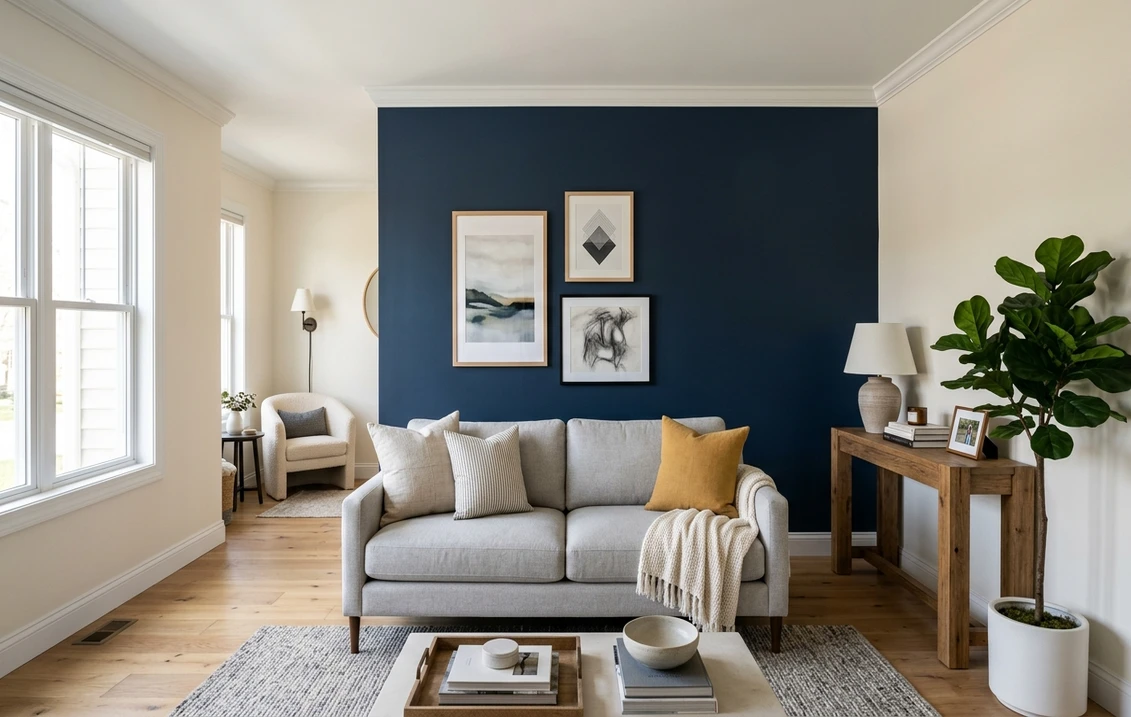
Try it on your room

Most paint blogs sell you on the color. They skip the part that actually decides the result: an accent wall is 90 percent prep and edge work, maybe 10 percent the actual color. One jagged line at the ceiling, a halo of bleed under the tape, or a patchy second coat undoes the most expensive can on the shelf. This guide walks the full process using a deep navy (Benjamin Moore Hale Navy HC-154, LRV 6) as the example, because dark colors are the least forgiving. Get it right and one wall transforms a room in a weekend for $60 to $110.
If you have not locked the wall and color yet, start with the accent wall color strategy guide. This article assumes the design is decided and focuses entirely on execution.
Upload a photo of your room and see Hale Navy (or any color) on the actual wall in 30 seconds, free.
Tools and materials: the short, honest list
For a single accent wall up to about 12 by 9 feet (roughly 100 square feet), this is the complete list. Buy these and skip the gimmicks.
- Paint: 1 gallon of a premium product covers ~350 sq ft in two coats. Budget paint goes chalky and patchy on navy and charcoal.
- Tinted primer: 1 quart, tinted gray to about half the topcoat depth. On dark colors this is the difference between two coats and four.
- FrogTape Multi-Surface (the green roll): its PaintBlock polymer seals the edge when it meets latex paint. Generic blue tape bleeds.
- 3/8-inch nap roller cover for smooth drywall, a 2.5-inch angled sash brush, a frame, and a tray.
- Prep: lightweight spackle, a putty knife, 120 and 220-grit sanding sponges, a microfiber cloth, and a drop cloth.
Sheen changes how the wall reads. Matte and eggshell hide drywall imperfections and mute reflections, which is why designers default to them on accent walls. Satin and semi-gloss bounce light and exaggerate every roller mark, so reserve them for trim. On Hale Navy, eggshell is the sweet spot: enough depth to feel rich, enough flatness to forgive.
Step 1: Surface prep (the part everyone rushes)
Dark paint reveals flaws. Every nail pop, old picture-hook hole, and roller ridge catches side light once the navy goes on. Spend 45 minutes here and you save a ruined finish.
- Clear and protect. Pull everything off the wall, slide furniture out, lay a drop cloth, and remove outlet and switch covers.
- Fill and sand. Press lightweight spackle into every hole, let it dry, knock it flat with 120-grit, then scuff the whole wall with 220-grit to give the paint a tooth to grip.
- Degloss if needed. If the wall is satin or semi-gloss, a full 220-grit scuff is mandatory or the new coat will not bond.
- Wash and dry. Wipe top to bottom with a damp microfiber cloth to lift dust and grime. Tape will not seal to a dusty wall, the number-one cause of bleed.
One detail people miss: run a phone flashlight flat against the wall so the light rakes across it. A low angle finds ridges your eyes miss head-on. Sand them down, because eggshell navy shows every one.
Step 2: Tape a razor edge that does not bleed
The line where your accent wall meets the ceiling, the adjacent walls, and the trim is the design. A clean edge reads professional; a fuzzy one reads DIY. FrogTape's green roll uses a PaintBlock polymer that gels on contact with water-based paint and seals the micro-gaps along the edge, but only if you apply it right.
- Lay it on clean, dry, dust-free surfaces. Run the tape along the ceiling line, the corners with adjacent walls, and the trim.
- Burnish the edge. Press the inner edge down hard with a putty knife to activate the seal. Skip it and you get bleed.
- Seal the line first (the pro move). Before your color, run a thin pass of the existing wall color or clear caulk along the taped edge and let it dry. Any bleed then seeps base color into base color, invisibly. Paint the navy over the top and the line comes out laser-sharp.
- Pull while slightly tacky, at 45 degrees. Remove the tape while the final coat is still a touch tacky, pulling back on itself at about 45 degrees. Pulling fully dry tape lifts dried paint and re-creates the jagged line.
For inside corners, tape each wall separately so the seam falls into the corner crease, the only place a tiny imperfection disappears.
See exactly where the accent line lands on your real room before you tape a single inch, free.
Step 3: Prime, then two coats of color
Deep colors have a way of humbling people right at this step. Hale Navy over white with no primer can need three or four coats to stop looking blotchy, because the white keeps reading through. The fix is a gray-tinted primer at roughly half the topcoat depth. Ask the counter to tint it medium gray; it gives the navy a uniform dark base, and two finish coats then look solid and even.
- Cut in the edges. With the angled brush, paint a 2 to 3-inch band along all taped edges and into the corners the roller cannot reach.
- Roll while the cut-in is wet. Roll the field in 3-foot W shapes and fill them in, working into the wet cut-in band so the textures blend. This avoids a "picture-frame" halo around the edges.
- Keep a wet edge. Always roll into the area you just painted; overlapping dry paint leaves lap marks, brutally visible on dark eggshell.
- Respect dry time. Let the primer and each coat dry the full recoat time (usually 2 to 4 hours). Rushing drags the layer below and streaks.
Plan on primer plus two color coats for a deep shade like Hale Navy. A mid-tone (sage or terracotta around LRV 25 to 40) often covers in two coats, sometimes without primer. For what a full room repaint costs beyond one wall, see the interior house painting cost guide.
Why Hale Navy works as an accent (and how it behaves in light)
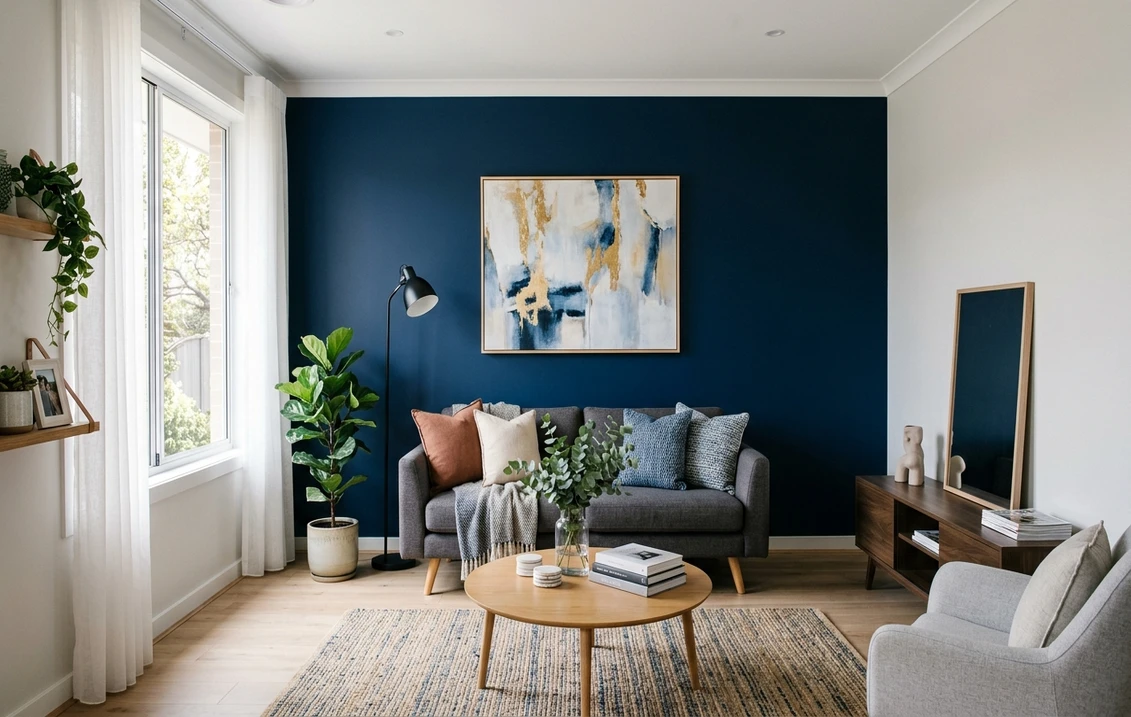
There is a reason this guide picked Hale Navy. It is one of the most popular accent colors in the US, and the slate-gray undertone is why. That gray base stops it from reading as a flat primary blue, so it passes for a sophisticated near-neutral instead. Its published values:
- Code: Benjamin Moore HC-154, part of the Historical Color collection.
- LRV (Light Reflectance Value): 6, inside the ideal 5 to 30 accent range, so it reads as true color, not dark gray.
- Undertone: navy blue with a slate-gray base and the faintest cool lean; not purple, not teal.
- Closest cross-brand match: Sherwin-Williams Naval (SW 6244, LRV 4) sits a hair deeper; the two are frequently swapped in design specs.
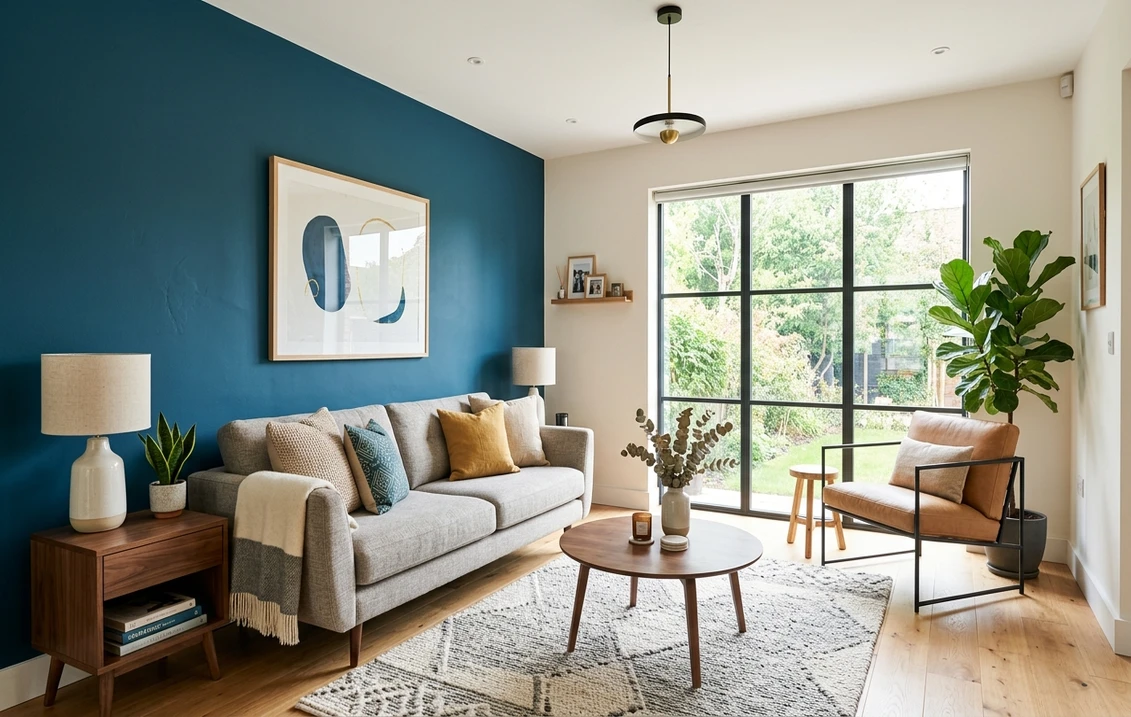
Because the LRV is so low, light direction shifts the mood more than the hue. In a bright south or west-facing room, Hale Navy reads rich and almost royal; in a north-facing or low-light room it goes moody and inky, leaning toward black at dusk. That is why it shines behind a sofa or headboard, walls usually away from the main window. Never put an LRV-6 color on the wall with your largest window: backlight turns a dark wall into a silhouette.
Best rooms, trim, and decor pairings
A deep accent lives or dies by what surrounds it. The table below maps Hale Navy (and dark accents broadly) to rooms and pairings that consistently work in 2026 US homes.
| Room | Best wall | Trim pairing | Decor that lifts it |
|---|---|---|---|
| Living room | Behind the sofa | Bright white (BM Simply White OC-117) | Brass picture lights, warm oak, ivory upholstery |
| Bedroom | Headboard wall | Soft white (BM White Dove OC-17) | Linen bedding, rattan, warm bedside lamps |
| Home office | Wall behind the desk | Crisp white or matching navy trim | Walnut shelving, brass, leather; great on video calls |
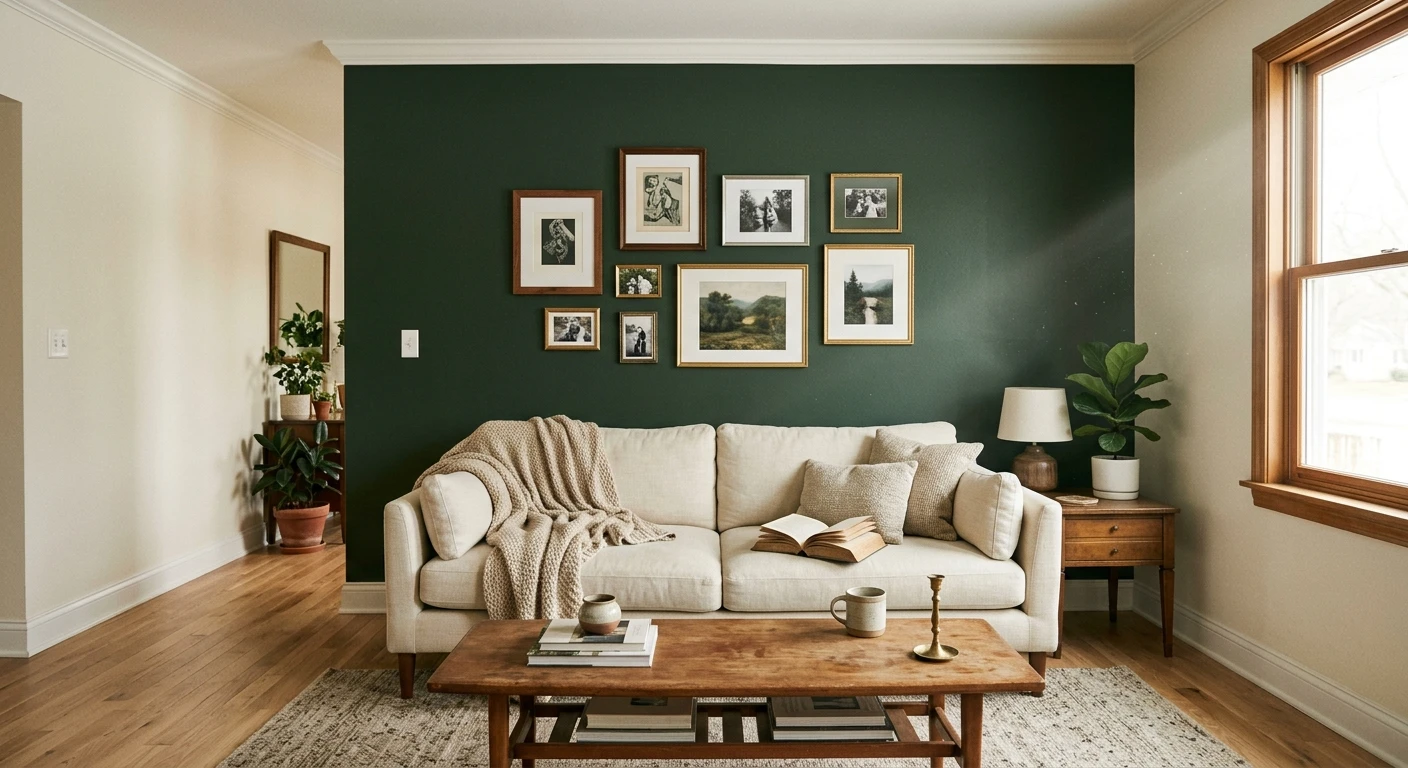
| Dining room | Wall opposite the entry | Cream or antique white | Gold-framed art, candlelight, dark wood table |
Try it on your room
No photo? Try a sample
Sources: Benjamin Moore Color Trends 2026; Benjamin Moore HC-154 technical data sheet; designer pairings reported by The Spruce 2026 accent-wall coverage.
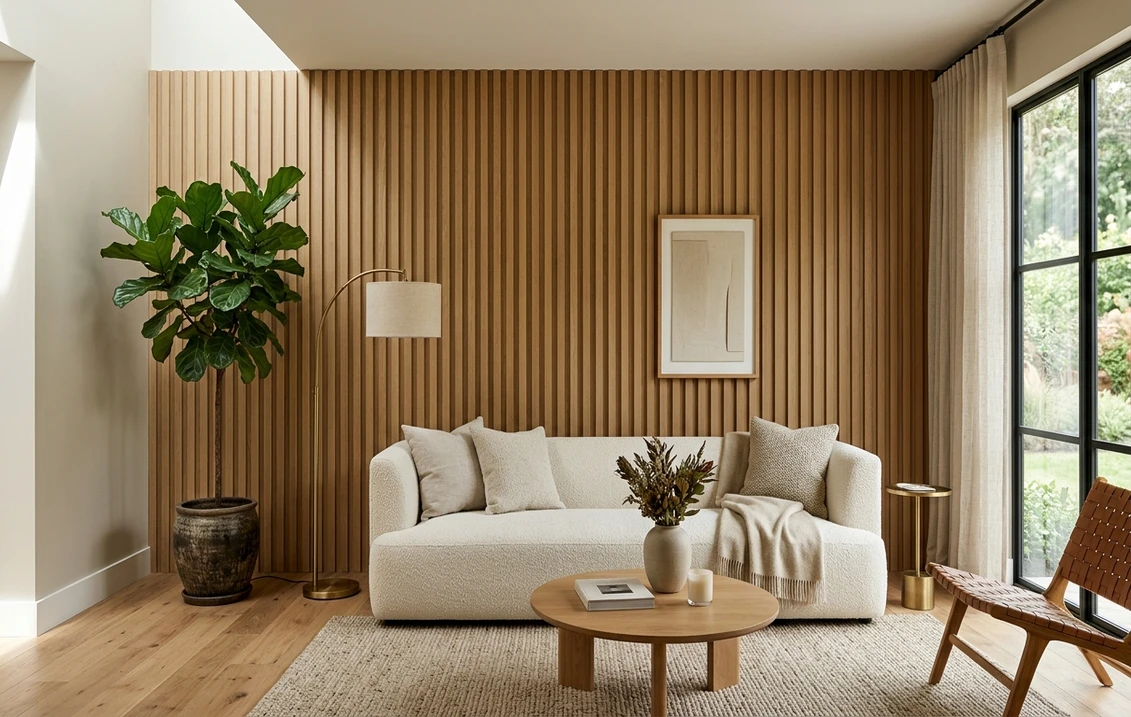
With a near-black navy you want high contrast, so bright white trim frames the wall like art (the inverse of the rule for a soft white). Brass, gold, oak, and walnut all warm the navy and keep it from feeling cold. Cool chrome does the opposite and pushes it austere. Drawn to warmth more than navy? The same prep-tape-finish process applies to a wood accent wall and its companion paint colors, and the interior paint color families guide explains why blues and greens behave as they do.
On product, formulation matters more than the brand. Benjamin Moore Aura uses Color Lock to keep deep blues true, and Sherwin-Williams Emerald covers in one to two coats over tinted primer even on burgundy. Either one in eggshell, over a gray-tinted primer, gives a single wall a flawless finish; the real decision is usually which store you can reach. For a head-to-head on coverage and price see the Sherwin-Williams vs Benjamin Moore interior comparison, and the best interior paint colors of 2026 roundup is the shortlist designers pull from this year.
Test before you commit: chip, sample, or visualizer
A fan-deck chip is the worst way to choose a dark accent: a 2-inch navy chip reads far lighter than a full wall and ignores your room's actual light. Two reliable methods:
- Peel-and-stick sample. A 12-inch sample on the candidate wall, viewed at 9 a.m., 2 p.m., and at night under your lamps, shows the real mood swing of a low-LRV color.
- AI visualizer. Upload a room photo into the free interior visualizer and drop the accent color onto the exact wall. Nothing confirms the wall, and the contrast against your trim, faster, all before you commit to a gallon.
Do both if the wall is prominent. The sample confirms the pigment in your light; the visualizer confirms the composition against your actual sofa and floor. A few dollars. Ten minutes. That is the whole cost of dodging the most expensive accent-wall mistake there is: rolling a color that turns out wrong.
Frequently asked questions
Do I really need primer for an accent wall?
For a light or mid-tone accent over an already-painted wall, often no; two coats of premium paint cover fine. For a deep color like Hale Navy, charcoal, or burgundy over white, a gray-tinted primer turns a four-coat headache into a clean two-coat finish by stopping the white from reading through the dark pigment. Call it a $15 quart that buys you back a half-gallon of topcoat and an extra evening of your weekend.
How do I stop paint from bleeding under the tape?
Three things, in order. Tape only a clean, dry, dust-free edge, since dust is the main cause of bleed. Burnish the inner edge hard with a putty knife or gift card to activate the seal. Then run a thin pass of the existing wall color or clear caulk along the taped line and let it dry before your accent color, so any bleed happens invisibly in the base color. Use FrogTape's green Multi-Surface roll, not generic blue tape.
When should I pull the tape off?
While the final coat is still slightly tacky, not bone dry, peeling it back on itself at about 45 degrees. Removing tape after the paint fully cures lets the dried film tear along the edge and re-creates the ragged line. If it has already dried, score the tape edge with a utility knife first so it breaks cleanly.
What sheen is best for an accent wall?
Eggshell or matte for almost every accent wall. They hide drywall imperfections and mute reflections so the color reads rich and even. Satin and semi-gloss bounce light and exaggerate roller marks, which is why they are usually kept for trim. On a deep color like Hale Navy, eggshell gives depth while still forgiving small surface flaws.
See Hale Navy and any alternative on your real wall before you prep, tape, or paint.
Disclaimer: Benjamin Moore, Hale Navy HC-154, Aura, Sherwin-Williams, Naval SW 6244, Emerald, and FrogTape are trademarks of their respective owners. FacadeColorizer is an independent paint visualization service and is not affiliated with, endorsed by, or sponsored by Benjamin Moore, Sherwin-Williams, Behr, or FrogTape. Color reproduction on screens approximates the manufacturer's chip; always confirm with a manufacturer sample before purchase. Sources: Benjamin Moore HC-154 Hale Navy technical data sheet 2026, Benjamin Moore Color Trends 2026, Sherwin-Williams Emerald product data 2026, FrogTape application guidance, and accent-wall technique coverage from The Spruce 2026.
Trademarks mentioned (Sherwin-Williams, Benjamin Moore, Behr, Caparol, Brillux, Sto, Alpina, Valspar, PPG, Glidden, Dulux, Crown Trade, Sandtex, Farrow & Ball, Johnstone's, Leyland) are property of their respective owners. FacadeColorizer is independent and not affiliated with any of them. Nominative fair use under Lanham Act §1125.