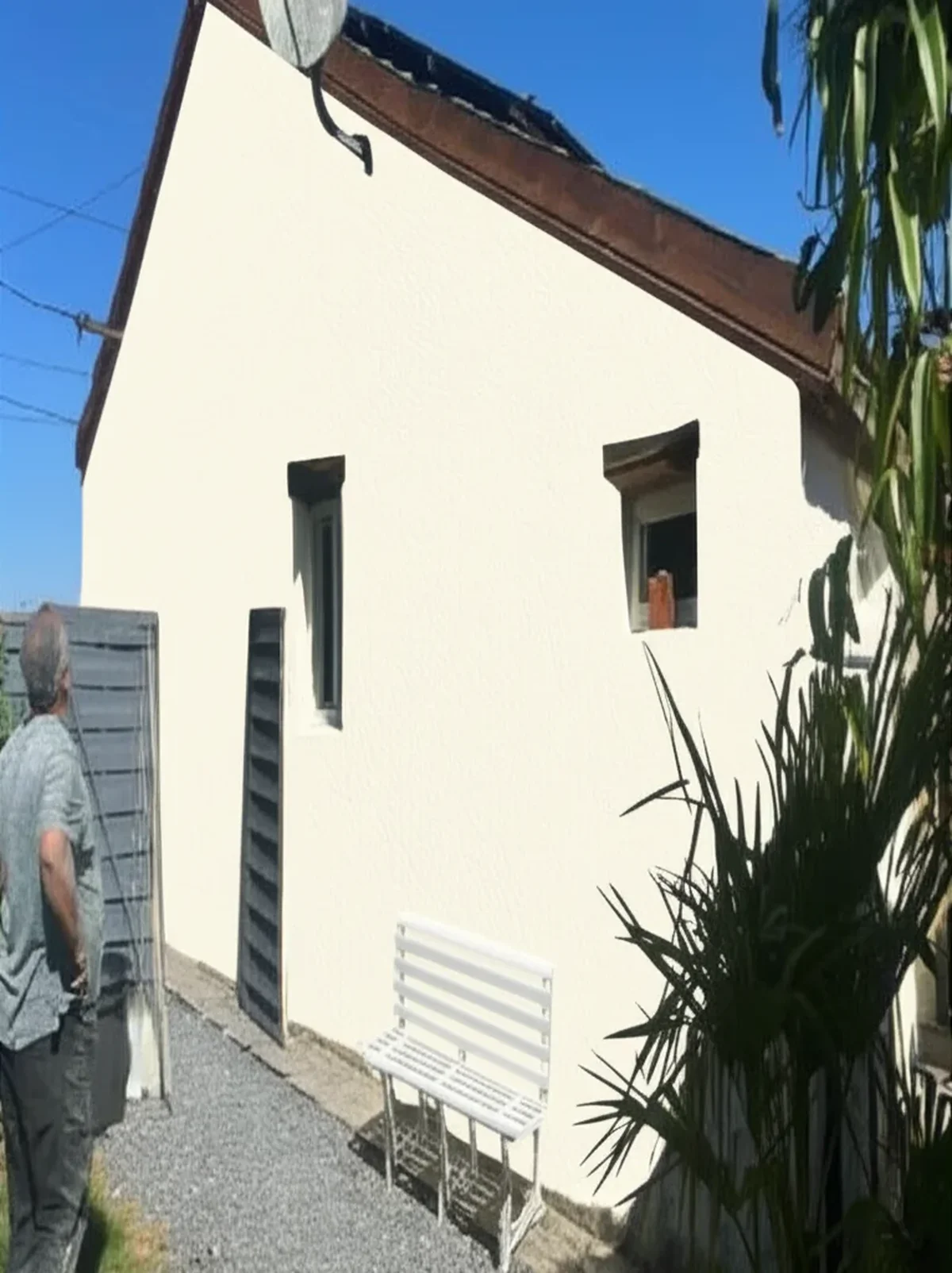
Try it on your house
Tucson sits at the heart of the Sonoran Desert, where summer surface temperatures on a south-facing stucco wall regularly cross 140 degrees Fahrenheit and ambient UV indexes spike above 11 from May through September. The combination of brutal radiation, century-old adobe construction in Barrio Anita, Sam Hughes, and Sam Hill, and the August monsoon cycle makes exterior house painting in Tucson one of the most demanding regional projects in the United States. This 2026 guide breaks down what local painting contractors charge, the five Tucson-specific factors that shift quotes by 30 to 50 percent, and the products and timing that actually survive a full Sonoran year on the wall. For statewide pricing context, see our Phoenix house painting cost guide and the national exterior house painting cost by city benchmark.
Before requesting any free estimate, run your color short list through our free AI exterior paint visualizer so you arrive at the contractor walkthrough with a verified palette, especially helpful for Pueblo Revival districts where city design review boards reject saturated or non-earth-tone submissions on first pass.
How Much Does Exterior Painting Cost in Tucson?
In 2026 the average cost per square foot for exterior house painting in Tucson ranges from $3.10 to $5.50, measured against finished wall area (not floor area). Most homeowners on a typical 1,800 to 2,400 square foot ranch or Spanish Colonial pay between $4,800 and $9,200 for a full repaint that includes power washing, scraping, caulking, masonry primer, and a premium UV-rated two-coat system. Adobe and traditional stucco homes in Barrio Anita, Armory Park, and West University historic districts sit at the upper end because substrate repair, elastomeric topcoats, and historic-compliant color consultation all add labor hours.
| Home Size (sq ft) | Low Estimate | High Estimate | Average |
|---|---|---|---|
| 1,000 sq ft | $3,100 | $5,500 | $4,300 |
| 1,500 sq ft | $4,650 | $8,250 | $6,450 |
| 2,000 sq ft | $6,200 | $11,000 | $8,600 |
| 2,500 sq ft | $7,750 | $13,750 | $10,750 |
| 3,000+ sq ft | $9,300 | $16,500+ | $12,900 |
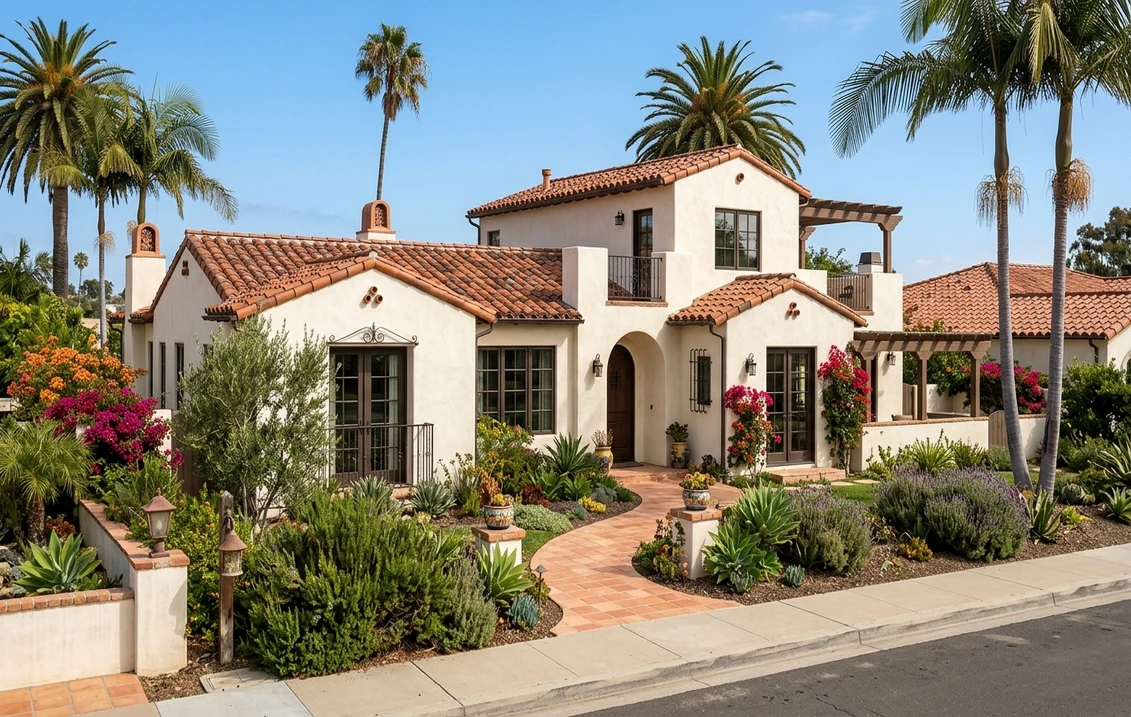
Try it on your house
No photo? Try a sample
Tucson sits roughly 8 to 12 percent above the national city-painting average tracked in our national exterior house painting cost guide, mostly because UV-rated acrylic paint and elastomeric formulas carry a 20 to 30 percent premium over standard product. The trade-off is repaint frequency: a properly specified premium system in Tucson typically holds 8 to 11 years, while a budget bid often fails inside 36 months. To size your project before that math even matters, our painting estimate calculator translates your Tucson wall area and substrate into a defensible budget range. Get our visualizer-verified palette ready before requesting quotes at /us/upload.
5 Tucson-Specific Factors That Move Your Quote
Every city has its own punishment list. In Tucson, five factors explain almost every dollar of variance between competing bids:
- Extreme UV (the worst US fade rate): Tucson averages 286 sunny days a year with peak UV indexes of 11 to 12 between May and August. Saturated reds, deep blues, and organic pigments fade visibly within 18 to 30 months without titanium-dioxide-loaded premium product. Always specify a paint with documented fade resistance rated for Class 1 desert UV exposure, this single specification is the difference between an 8-year and a 3-year wall. See our best exterior paint for hot climates guide for tested formulations.
- Pueblo Revival district enforcement: The City of Tucson Historic Preservation Zone covers Barrio Anita, Armory Park, El Presidio, and West University. The Plans Review Subcommittee requires submitted color samples that fall inside published earth-tone ranges, applications outside these palettes are routinely denied. Build a contingency for a second submittal cycle (2 to 4 weeks). Reference tucsonaz.gov for the latest design review checklists.
- Adobe and traditional stucco prevalence: A meaningful share of central Tucson housing stock built between 1880 and 1920 is true mud-and-straw adobe, sometimes covered in lime plaster, sometimes in modern Portland-based stucco. Adobe walls need vapor-permeable mineral or silicate paint; trapping moisture behind a film-forming acrylic destroys the substrate. Insist your painting contractor identifies your wall system before quoting, our guide to Santa Fe adobe exterior paint colors covers the same vapor-permeability principles that apply in Tucson.
- Monsoon August through mid-September: The North American Monsoon delivers sudden, intense thunderstorms with wind-driven rain almost daily during peak weeks. Painting after late July risks washed-out coats and dust contamination during dry-out. Most reputable Tucson crews book heavy exterior work either March through early June, or October through December. Always confirm the weather conditions window in writing.
- Saguaro National Park Heritage influence: Properties bordering or within view-shed lines of Saguaro National Park East and West, plus the Catalina Foothills overlay, face informal design guidance favoring desert-blending palettes (warm tans, rust ochre, sage, soft cream). City code, HOA covenants in places like Catalina Foothills Estates, and resale comp behavior all pull homeowners toward this range. Bright white facades depress resale in these zip codes.
Best Time to Paint a House in Tucson
Tucson's painting calendar has two real windows and two zones to avoid. The ideal temperature range for application is 50 to 85 degrees Fahrenheit on the wall surface, with relative humidity between 30 and 70 percent, and no rain in the 24-hour forecast.
- Best window 1, March through early June: Daytime highs 70 to 95 degrees, very low humidity, monsoon still weeks away. Book 4 to 6 weeks ahead, this is peak season.
- Best window 2, October through December: Highs drop into the 70s and 80s, monsoon is over, dust storms are infrequent. Workmanship lasts because cure conditions are ideal.
- Avoid mid-June through July: Surface temperatures on south and west walls routinely exceed 140 degrees. Paint flashes before it can level, causing visible roller marks, adhesion failure, and skinning over within minutes.
- Avoid August through mid-September monsoon: Daily thunderstorms, 45 to 65 mph microburst winds, and blowing dust contaminate fresh coats and washout uncured paint.
Mild Tucson winters (January and February highs near 65 to 70 degrees) allow opportunistic painting on calm clear days, but nighttime lows can dip to the high 30s, which is below the minimum cure temperature of most premium acrylic paint and latex paint lines. Confirm the manufacturer's stated minimum application temperature before committing.
Tucson Painter Networks and How to Vet Them
Tucson supports a mid-sized contractor market dominated by independent crews of 3 to 8 painters, plus a smaller number of regional firms that also serve Phoenix. Arizona requires a Registrar of Contractors (ROC) licensed credential for any residential painting job exceeding $1,000 total, classification CR-34 (Painting and Wall Covering). Verify license, bond, and workers' compensation status at azroc.gov before signing.
Beyond licensing, vet on four signals:
- Substrate diagnosis on the walkthrough: A capable Tucson house painter will tap your walls, identify true adobe versus modern stucco versus wood-frame siding, and flag any prior elastomeric film that traps vapor. If the bid does not mention substrate, walk away.
- Specification by product line, not "premium paint": A serious quote names Dunn-Edwards Evershield, Sherwin-Williams Duration or Emerald, or Benjamin Moore Aura, plus the masonry primer (for example, Dunn-Edwards EZ-Prime W101 or Sherwin-Williams Loxon XP). Vague language ("we use top-quality paint") usually means switch-and-substitute.
- Two-coat system in writing: A proper Tucson exterior is masonry primer plus two finish coats, never a one-coat tint-and-go application. If a quote claims one coat is enough on stucco, it will not pass UV stress.
- Historic-district experience: If you live in Barrio Anita, Armory Park, Sam Hughes, El Presidio, or West University, your painter should reference recent permits or design-review submissions. Ask for two reference projects inside your zone.
Get 3 free quotes from ROC-licensed Tucson painters
Skip the back-and-forth and get 3 free quotes in 60 seconds from AZ ROC CR-34 licensed Tucson contractors who know Sonoran UV specs, monsoon scheduling, and design-review palettes for Barrio Anita, Sam Hughes, and Catalina Foothills.
Get 3 free Tucson painter quotesTrending Tucson Exterior Colors for 2026
The same logic holds in coastal Southern California, where our San Diego exterior painting guide reads the 2026 Colors of the Year (Universal Khaki, Hidden Gem, Silhouette) against stucco, salt air and the county's low-VOC coating rule.
Tucson 2026 palettes lean firmly into Sonoran desert blending and Pueblo Revival heritage tones. Bright cottage whites and saturated coastal colors that work in Phoenix master-planned communities are not a fit for central Tucson's historic fabric. Here is what local house painters are spraying this year:
- Dunn-Edwards Tundra (DE6224) with Pueblo Tan trim: A warm sandstone neutral that disappears into the desert backdrop and reads naturally against saguaro silhouettes. Used heavily across Catalina Foothills custom builds. Pairs with a rust-ochre wood door for a Pueblo Revival accent that satisfies most design-review boards.
- Sherwin-Williams Cavern Clay (SW 7701) with Creamy (SW 7012) trim: The current favorite for Sam Hughes craftsman bungalows and Spanish Colonial cottages. Cavern Clay is a saturated terracotta-adobe red, balanced by a soft cream that prevents the facade from reading too dark in afternoon sun.
- Dunn-Edwards regional dominance: Tucson is firmly Dunn-Edwards territory. The brand's local pro distribution, desert-tested formulations, and decades of color consultation for southwestern markets give it the highest pro spec rate in southern Arizona. Sherwin-Williams holds a strong second place, particularly for HOA-restricted Oro Valley and Marana communities. See our deep dive on Dunn-Edwards Evershield exterior performance.
- Adobe Brown (DE6080) with Saguaro Green accents: A heritage combination that references early Tucson territorial architecture, popular for restored 1880-1920 adobe homes in Barrio Anita and El Presidio.
- Soft sage with warm stone trim: Increasingly common in Oro Valley and Catalina Foothills HOA palettes, complies with Saguaro National Park view-shed guidance, and reads cool against the desert horizon.
Test these combinations on your actual facade before submitting any design-review or HOA paperwork, use FacadeColorizer's free AI visualizer to preview Dunn-Edwards, Sherwin-Williams, and Benjamin Moore swatches on your photo. For broader 2026 inspiration, browse our best exterior paint colors 2026 and Mediterranean Revival exterior paint colors guides.
Tucson Pricing Matrix by Surface and Scope
Beyond home size, three line items move a Tucson quote more than anything else: substrate type, story height, and prep complexity. Use this matrix to sanity-check any bid.
| Variable | Adds to Total | Why |
|---|---|---|
| True adobe substrate | +$1,200 to $3,500 | Mineral or silicate paint, mud repair, vapor-permeable system |
| Two-story home (scaffolding) | +$800 to $1,800 | Staging, harness, longer crew days |
| Heavy stucco crack repair | +$600 to $1,500 | Elastomeric patch, mesh embed, retexture |
| Historic district submittal | +$200 to $500 | Design review prep, color sample boards |
| Elastomeric premium topcoat | +$900 to $2,400 | Higher material cost, slower application, longer warranty |
| Lead paint abatement (pre-1978) | +$1,500 to $4,000 | EPA RRP-certified crew, containment, disposal |
DIY vs. Pro: What Actually Lasts in Tucson
DIY exterior painting in Tucson saves cash on paper, but the desert is unforgiving on amateur prep and timing. A typical homeowner painting a 1,800 sq ft single-story stucco home spends $1,400 to $2,300 on materials (paint, primer, caulk, masking) and 4 to 6 weekends of labor. The pro version on the same house runs $5,800 to $8,400 but holds 8 to 11 years versus 24 to 36 months for a typical DIY attempt that skipped masonry primer or applied in heat above the manufacturer's spec.
- Heat safety: Wall surfaces in June and July routinely exceed 140 degrees. Start crews at dawn (4:30 to 5:30 a.m.) and stop by 10 a.m. Heat exhaustion is the real DIY risk.
- Substrate diagnosis: Pros walk in already knowing your wall system. DIYers often assume Portland stucco when the house is actually adobe under lime plaster, and a film-forming acrylic on that combination causes paint to delaminate in sheets within two summers.
- Two-coat coverage on textured walls: Stucco texture absorbs paint unevenly. Pros expect coverage per gallon of 200 to 280 sq ft instead of the 350 to 400 sq ft the label claims. DIYers typically under-buy by 25 to 35 percent and end up with blotchy thin spots that fade first.
- Caulking and crack repair: Sonoran thermal expansion (60-degree daily swings in spring) opens hairline cracks every year. A pro painting contractor embeds mesh tape in elastomeric patch before painting. DIY caulk-and-cover usually telegraphs within 18 months.
If you do DIY, at minimum use a true masonry primer (Loxon XP or EZ-Prime W101), follow the manufacturer's surface-temperature cap (most lines max out at 100 to 110 degrees applied), and avoid June, July, August, and September entirely. For complementary HOA color reading, see our HOA approved exterior colors Arizona 2026 guide.
How to test it on your own home before you buy
No third-party report replaces your own walls: the same color reads differently on a north elevation and a south one, next to red brick or a gray roof, under morning and evening light. Take a daylight photo, upload it to the free AI paint visualizer, and run two or three candidates on the same image so the comparison is fair. Keep the one or two that survive the side-by-side, buy a sample of each, and brush them out on the actual surface in the actual light before you order the full quantity.
Surface Preparation and Application in Tucson Detail
Surface preparation drives 60 to 70 percent of long-term Tucson paint performance. A serious painting contractor sequence looks like this: low-pressure power washing at 1,500 to 2,000 psi to remove dust and oxidized chalk, full scrape and feather of any peeling areas, mesh-embedded patch on hairline stucco cracks, fresh caulking at every window, door, and fascia transition, two-day dry-down, then a uniform masonry primer coat before the first finish coat goes on. Skipping the primer step or running a one-coat application is the single most common corner-cutting move on budget Tucson bids, and it is also the most consistent predictor of premature failure inside 36 months.
Application equipment matters too. Tucson pros typically use airless spray rigs for the body of stucco walls (faster, more uniform on textured surfaces), back-rolling with a 1-inch nap roller immediately after spraying to drive paint into the texture, and brush work for trim, fascia, soffit, and detail. The back-roll step is what separates a pro finish from a one-pass spray job that looks fine on day one but fails to penetrate the texture and chalks out within two summers. For two-story homes, proper scaffolding (not extension ladders) is required, both for safety and for consistent application angles on upper elevations.
On paint sheen selection: most Tucson pros default to a low-sheen matte or eggshell on the body of the wall (hides texture irregularities, reads softer in harsh sun), satin for trim and fascia (better dirt resistance), and semi-gloss for doors and shutters (washable, durable). High-gloss finishes are rarely used on Tucson facades because they telegraph every stucco imperfection and amplify reflected heat into living spaces.
Boost Curb Appeal and Property Value
A well-executed exterior repaint in Tucson typically returns 55 to 95 percent of the project cost at resale, with the highest ROI on properties in Sam Hughes, Catalina Foothills, and Oro Valley where buyers reward verified UV-rated product and design-review compliance. Outside historic districts, faded west-facing facades remain the single most common inspection callout depressing offer prices in Tucson's resale market. Comp data from 2025 closings in Sam Hughes (85716) showed repaint-prior-to-listing homes sold a median of 11 days faster than comparable un-repainted listings at the same price band. For broader hot-climate product selection logic, cross-reference the best exterior paint hot climates guide.
See your Tucson home in any color, free
Upload a photo to FacadeColorizer and preview Dunn-Edwards Tundra, Sherwin-Williams Cavern Clay, or Benjamin Moore Aura colors on your actual facade in seconds. It is the fastest way to nail a color consultation before requesting a free estimate from a Tucson painting contractor, and the smoothest path through historic design review.
For additional reading, the City of Tucson historic preservation portal at tucsonaz.gov publishes current design-review checklists, the Dunn-Edwards regional color library at dunnedwards.com documents tested desert formulations, and HGTV's regional inspiration archive at hgtv.com collects southwestern exterior case studies.
Frequently asked questions
How much does it cost to paint the exterior of a house in Tucson, AZ?
What is the best time of year to paint a house exterior in Tucson?
Do painting contractors need a license in Tucson, Arizona?
Why do Tucson exterior paint jobs cost more than Phoenix?
What paint brand do most Tucson contractors actually use?
Do I need historic district or HOA approval to paint my Tucson home?
How long should an exterior paint job last in Tucson?
Can I paint over true adobe walls with regular acrylic exterior paint?
Trademarks mentioned (Sherwin-Williams, Benjamin Moore, Behr, Caparol, Brillux, Sto, Alpina, Valspar, PPG, Glidden, Dulux, Crown Trade, Sandtex, Farrow & Ball, Johnstone's, Leyland) are property of their respective owners. FacadeColorizer is independent and not affiliated with any of them. Nominative fair use under Lanham Act §1125.