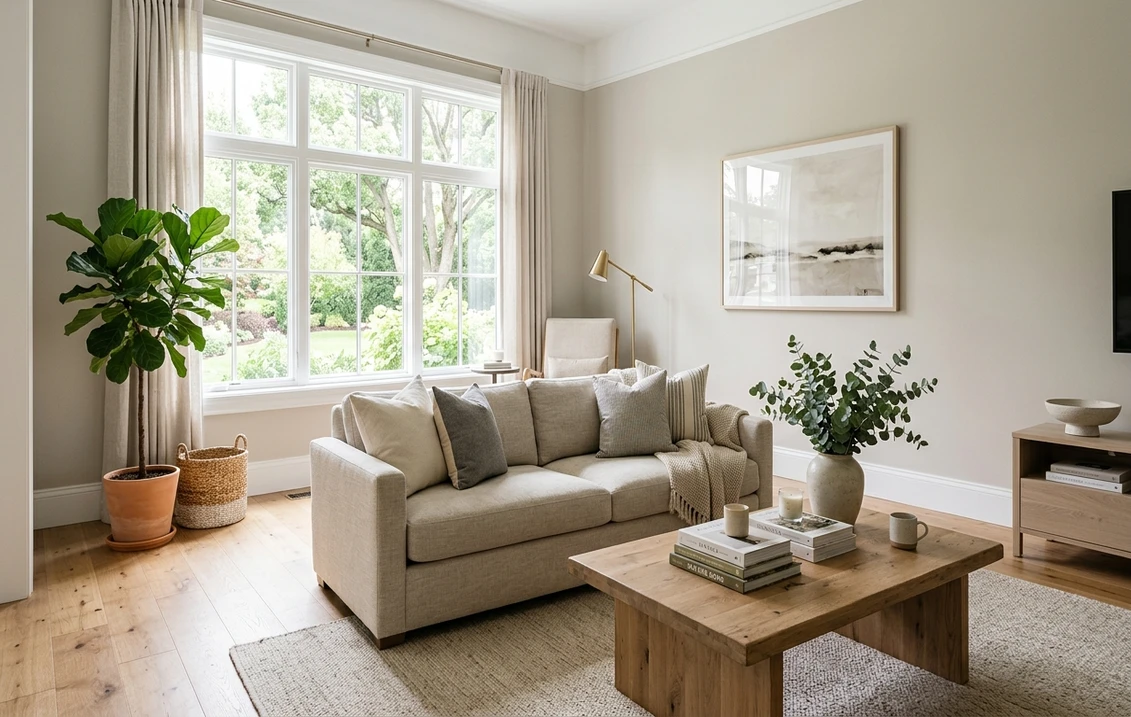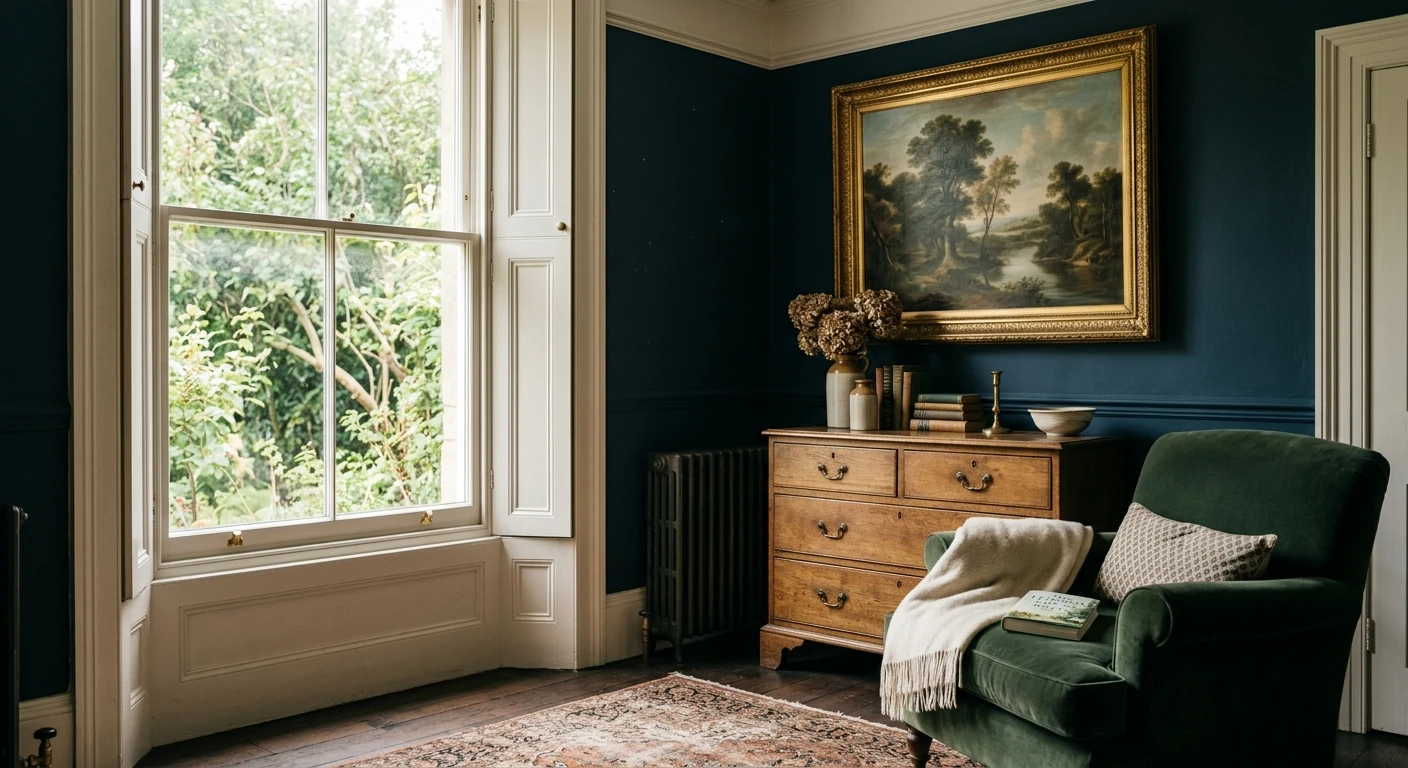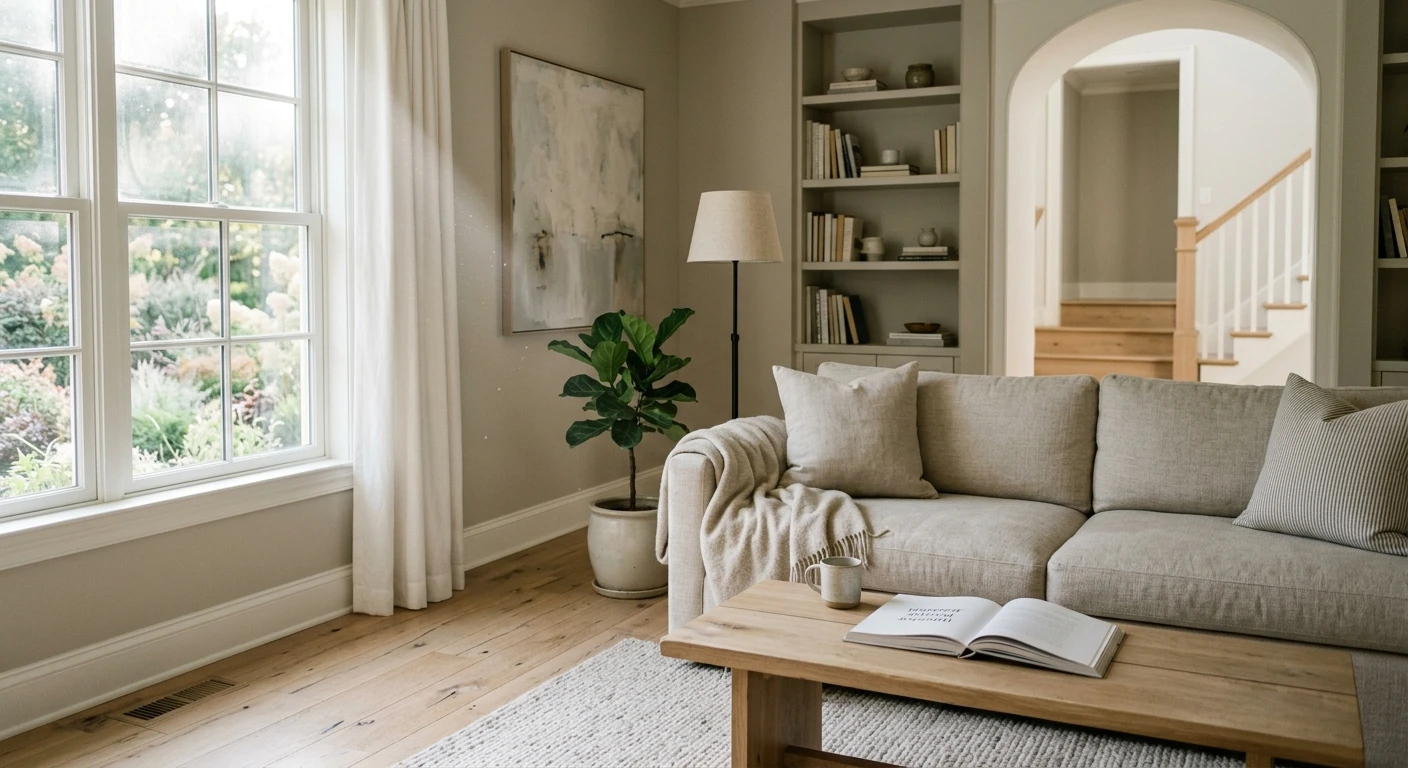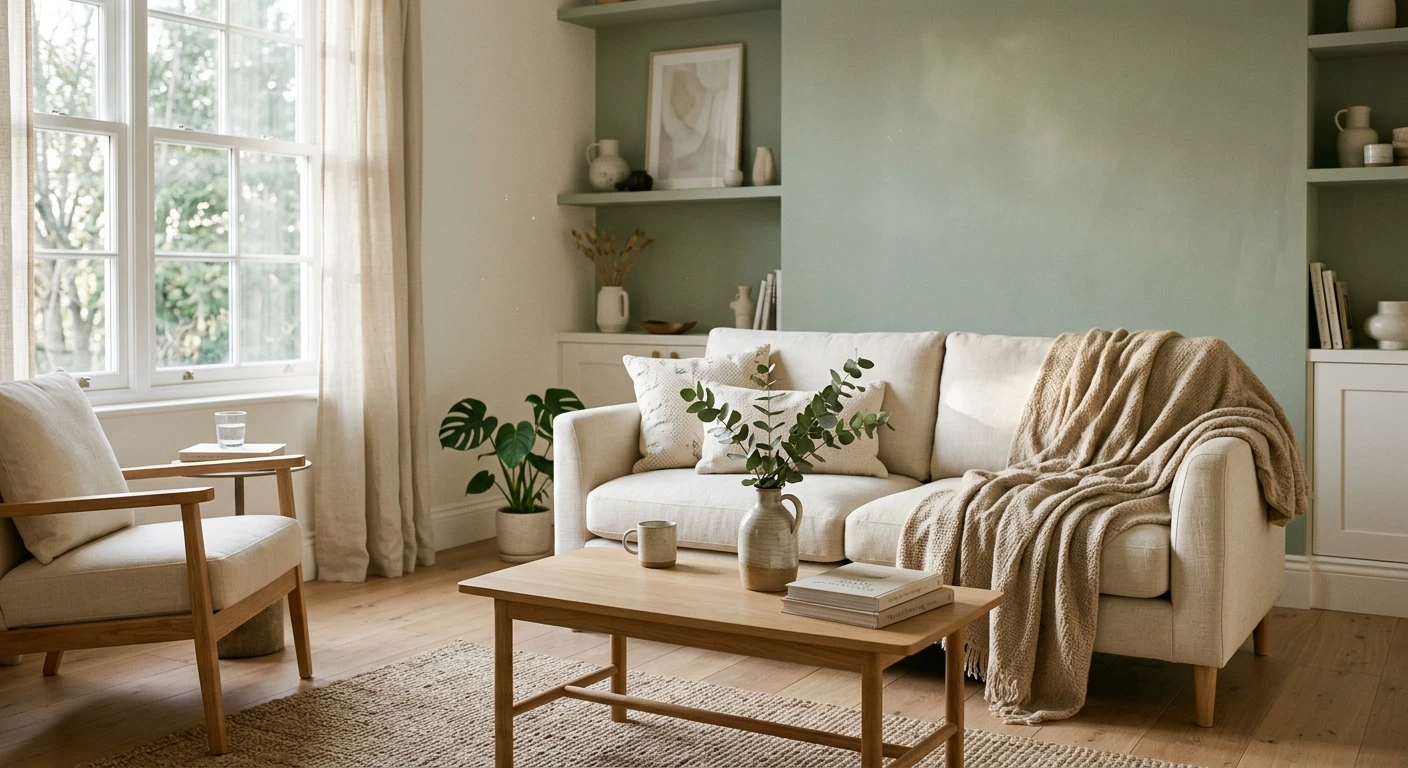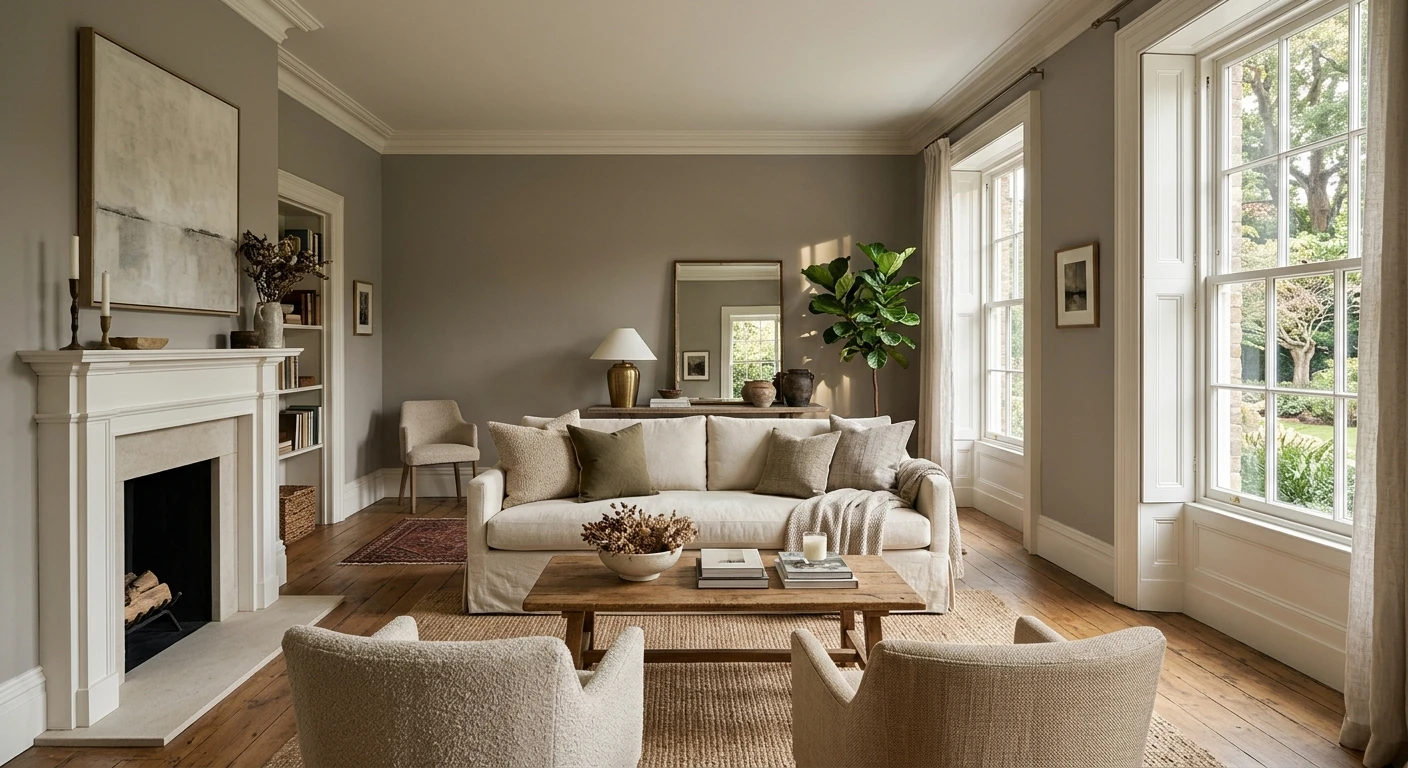

Farrow & Ball Elephant's Breath (No. 229) is a warm mid gray originally created by English interior designer John Fowler and kept in the brand's Core palette. Inside an American home, it sits between warm gray and soft taupe, with a hint of magenta that adds depth in warm light and can lean almost lilac in cool west-facing rooms. Farrow & Ball does not publish an LRV; by our calculation from the brand's screen color (#C7BEB3), its relative luminance is about 52.2 on a 0 to 100 scale, and the closest Sherwin-Williams match on screen is Twilight Gray SW 0054.
All brand facts below (number, John Fowler origin, magenta description, Mid Tones primer, Strong White complementary white, scheme pairings, screen color and US prices) come from farrow-ball.com, read on 21/11/2026. The light index, Delta E 2000 comparisons and room-area estimates are our calculations; the advice on lighting, trim and flooring is our color reasoning. Because digital swatches only approximate pigment, always judge the paint on a sample board in the room before ordering gallons.
The US interior tool uses Sherwin-Williams and Benjamin Moore charts, not Farrow & Ball. This link preselects Twilight Gray SW 0054, our closest calculated Sherwin-Williams match to Elephant's Breath.
What Farrow & Ball says about Elephant's Breath No. 229
The Elephant's Breath page on farrow-ball.com calls No. 229 "a warm mid grey" with a hint of magenta that "can become almost lilac in the cooler light of west facing rooms," and credits its creation to John Fowler. Because it sits in the Core palette rather than the Archive, it is readily stocked across standard US finishes. The brand specifies Mid Tones Primer & Undercoat and names Strong White No. 2001 as its complementary white.
| Attribute | Elephant's Breath No. 229 |
|---|---|
| Official name and number | Elephant's Breath, No. 229 (Core palette) |
| Origin | Originally created by English interior designer John Fowler |
| Brand description | A warm mid gray with a hint of magenta; can read almost lilac in cool west-facing light |
| Screen color shown by the brand | #C7BEB3 (approximate digital rendering) |
| Official LRV | Not published by Farrow & Ball |
| Calculated light index (from #C7BEB3) | About 52.2 on a 0 to 100 scale |
| Recommended Primer & Undercoat | Mid Tones |
| Complementary white | Strong White (No. 2001) |
Try it on your room
- 1Your photoPhoto
- 2Your colorColor
- 3HD render in ~30 sHD render in ~30 s
Your photo is used only to create your preview. JPG, PNG, HEIC (iPhone)
Treat 52.2 as a practical band marker, not a lab LRV: it is the relative luminance calculated from #C7BEB3. A mid-50s light index puts Elephant's Breath squarely in mid-tone territory, dark enough to contrast cleanly with white molding while keeping a typical US living room or bedroom open.
Undertones and how north, south, east and west light shift No. 229
Surprises with Elephant's Breath almost always come from its magenta undertone rather than its depth. In dim or cool light, yellow warmth drops back and a faint purple-taupe cast surfaces, which is why Farrow & Ball warns that No. 229 can turn almost lilac in cool west-facing light. For rooms with cool mornings and warm afternoon sun, our west-facing room paint colors guide explains how shifting light temperatures affect warm neutrals.
| Orientation | How No. 229 typically reads | Practical adjustment |
|---|---|---|
| South-facing | Warm, balanced stone-taupe all day | Pairs cleanly with Strong White No. 2001 or All White No. 2005 |
| East-facing | Crisp warm gray in morning sun; deeper and cooler late afternoon | Use 2700K to 3000K lamps in the evening |
| West-facing | Cool morning shade pulls lilac; late-afternoon sun warms it to taupe | Check a sample board at 9 a.m. and 5 p.m.; avoid icy blue-white trim |
| North-facing | Steady cool light makes it darker, grayer and violet-taupe | Best for a cozy, enveloping room rather than a bright neutral |
Bulb color temperature matters just as much after sunset. Under 2700K warm-white LEDs, Elephant's Breath settles into a calm mushroom-gray; under 4000K cool-white LEDs, the magenta sharpens and walls can look chilly. If your recessed lights have selectable Kelvin switches, test 2700K and 3000K before deciding.
US interior finishes, sheen levels and prices
Farrow & Ball sells Elephant's Breath across six interior finishes in the United States, plus a 100 ml sample pot. The prices below come from the brand's US product pages read on 21/11/2026; treat them as a dated snapshot rather than a permanent quote.
| Finish | Sheen level | Best interior role | 750 ml | US gallon |
|---|---|---|---|---|
| Estate Emulsion | 2% (chalky matte) | Low-traffic living rooms, bedrooms and ceilings | Not listed | $160 |
| Modern Emulsion | 7% (washable matte) | Hallways, kitchens, bathrooms and family rooms | Not listed | $160 |
| Dead Flat | 2% (multi-surface matte) | Color-drenching walls, woodwork and radiators in one sheen | $56 | $168 |
| Flat Eggshell | 20% (low-sheen wood/metal) | Baseboards, doors, paneling and built-ins with soft luster | $56 | $168 |
| Modern Eggshell | 40% (mid-sheen durable) | Kitchen cabinets, stair risers, high-wear doors and trim | $56 | $168 |
| Full Gloss | 95% (high shine) | Statement interior doors, millwork and dramatic ceilings | $56 | $168 |
| Sample Pot | Estate Emulsion base | 100 ml pot for painting sample boards | $9 (100 ml) | - |
Choosing between the three main wall finishes comes down to wear and sheen. The Estate Emulsion page positions its signature 2% chalky matte for calm walls and ceilings where maximum depth of color matters more than scrubbing. The Modern Emulsion page steps up to a 7% washable, scuff-resistant matte suited to busy hallways, kitchens and bathrooms at the same $160 per US gallon price. If you want the ultra-flat 2% look of Estate Emulsion with multi-surface versatility across drywall, baseboards and trim, the Dead Flat page lists it at $56 for 750 ml and $168 per US gallon.
Sheen also changes how warm or cool Elephant's Breath looks on the wall. At 2% sheen in Estate Emulsion or Dead Flat, light scatters softly across the surface, emphasizing the velvety taupe character and hiding minor drywall tape joints. Moving up to Modern Eggshell (40%) or Full Gloss (95%) on cabinetry or doors adds crisp specular highlights that make the mid gray look slightly cooler and sleeker. On older American plaster or imperfect drywall, sticking to 2% or 7% sheen on the walls keeps surface waves from catching raking window light.
Best rooms in an American home for Elephant's Breath
At a calculated light index of about 52.2, Elephant's Breath adds architectural weight without turning a room dark. Here is how it performs room by room:
- Living and family rooms: Its strongest setting, especially alongside white fireplace mantels, built-ins and oak floors. Use Estate Emulsion in formal parlors or Modern Emulsion in busy family rooms.
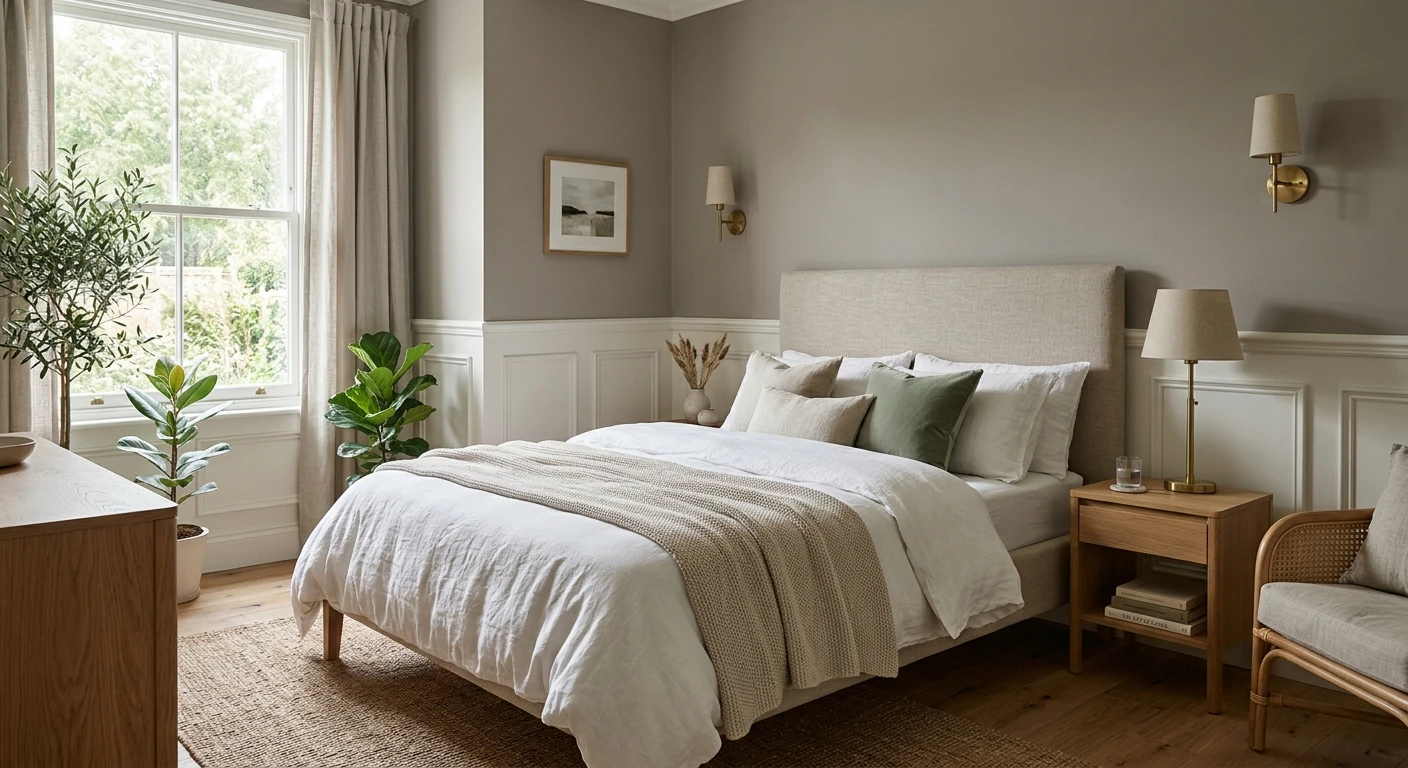
- Primary bedrooms: Warm 2700K bedside lamps and linen textiles create a quiet, cocooning backdrop. In west-facing bedrooms, pair the dusk-lilac shift with soft cream bedding and walnut wood.
- Dining rooms: Candlelight and warm chandeliers bring out the taupe side next to dark wood tables and brass. For a deeper, rosier dining room, compare our Farrow & Ball Sulking Room Pink No. 295 guide.
- Hallways and stairwells: Low natural light deepens No. 229 into a grounded mid-taupe that hides scuffs well in Modern Emulsion (7% sheen), with Flat Eggshell (20%) or Modern Eggshell (40%) on trim.
- Kitchen cabinets: Modern Eggshell No. 229 on perimeter cabinets or an island pairs well with honed marble, soapstone or warm quartz; avoid cool blue-white granite.
- Bathrooms: Modern Emulsion handles humidity next to white tile and warm brass. In windowless powder rooms, use 2700K vanity bulbs so the magenta does not look flat. For a cooler gray-green option, see our Farrow & Ball Mizzle No. 266 interior guide.
Trim, ceilings, woodwork and flooring pairings
The fastest way to make Elephant's Breath look off-balance is to pair it with the wrong white trim. Stark blue-white trim makes the magenta undertone jump forward, while heavily yellowed cream trim can make No. 229 look muddy by comparison. Farrow & Ball solves this by naming Strong White (No. 2001) as the official complementary white: it carries a light gray undertone that bridges cleanly to Elephant's Breath without clashing. For a crisper, gallery-like contrast in south-facing rooms, the brand's own schemes also include All White (No. 2005).
Beyond trim whites, the Elephant's Breath product page lists five sibling colors for tonal schemes and step-up or step-down comparisons. If you are building a whole-house palette around Farrow & Ball neutrals, our Farrow & Ball paint colors guide maps how the brand's architectural neutrals group by undertone.
| Farrow & Ball color | Relationship to No. 229 | How to use it in an American room |
|---|---|---|
| Strong White (No. 2001) | Official complementary white (lighter) | Ceilings, crown molding, baseboards and window casings |
| All White (No. 2005) | Scheme pairing (purest white) | Clean modern trim and ceilings in bright south-facing rooms |
| Skimming Stone (No. 241) | Lighter compare shade and scheme pairing | Adjacent hallway or open-plan walls when No. 229 feels too deep |
| Dove Tale (No. 267) | Darker compare shade and scheme pairing | Wainscoting, kitchen islands or an adjoining cozy den |
| Jitney (No. 293) | Darker compare shade | Earthier, more brown-toned alternative if you want less lilac risk |
| Charleston Gray (No. 243) | Scheme pairing (deeper warm gray) | Interior doors, fireplace surrounds or built-in shelving |
| London Clay (No. 244) | Scheme pairing (deep magenta-brown) | Statement dining room, powder room or dark cabinetry accent |
Pairing Elephant's Breath with Charleston Gray No. 243 or London Clay No. 244 works because all three share warm, red-brown-influenced undertones; see our Farrow & Ball London Clay No. 244 interior guide for the darker end of that family.
Flooring also steers the undertone. Natural white oak, dark walnut and clear-finished red oak pair easily with No. 229, since red oak's faint pink grain harmonizes with the magenta hint. Test carefully next to strong orange-yellow 1990s honey oak, which can push Elephant's Breath slightly purple by contrast.
Closest Sherwin-Williams and Benjamin Moore matches
At $160 to $168 per US gallon, many American homeowners compare Sherwin-Williams or Benjamin Moore options for larger rooms. We compared Elephant's Breath (#C7BEB3, calculated luminance 52.2) against both charts using Delta E 2000 (under 1.0 is virtually indistinguishable on screen; 1.0 to 2.0 is very close). Treat these as closest-match starting points only, never official equivalents: pigment blends and bases differ, so always paint a sample right next to a $9 Elephant's Breath sample pot on the same board.
| Brand and color | Screen color | Calculated light index (0 to 100) | Delta E 2000 to No. 229 (our calculation) |
|---|---|---|---|
| Sherwin-Williams Twilight Gray (SW 0054) | #C8BFB5 | 52.9 | 0.56 |
| Sherwin-Williams Skyline Steel (SW 1015) | #C6BFB3 | 52.5 | 1.28 |
| Sherwin-Williams Colonnade Gray (SW 7641) | #C6C0B6 | 53.1 | 1.47 |
| Benjamin Moore Annapolis Gray (HC-176) | #C9BEAF | 52.3 | 1.70 |
| Benjamin Moore Hot Spring Stones (AC-31) | #CABFB0 | 53.0 | 1.72 |
| Benjamin Moore Shale (861) | #C3BDB1 | 51.2 | 1.82 |
Twilight Gray SW 0054 is the closest match across both American charts by our screen calculation (Delta E 2000 of 0.56, calculated luminance 52.9). Skyline Steel SW 1015 and Colonnade Gray SW 7641 sit right behind it with slightly less magenta warmth, which makes them useful alternatives if you love the depth of Elephant's Breath but want to dial back the lilac risk in a north- or west-facing room. On the Benjamin Moore side, Annapolis Gray HC-176 (Delta E 1.70, calculated luminance 52.3) and Hot Spring Stones AC-31 (Delta E 1.72) bring a slightly warmer, sandier undertone, while Shale 861 (Delta E 1.82, luminance 51.2) sits a fraction deeper and cooler. If you are comparing national store brands and retail paint lines across budgets, our US retail paint brands and store picks guide breaks down how major US paint lines stack up.
Wall preparation, primer, gallon math and indoor air quality
Because Elephant's Breath is a nuanced mid tone, surface prep and primer directly affect whether the final color looks rich or patchy. Farrow & Ball recommends its Mid Tones Primer & Undercoat beneath No. 229. Priming is essential on bare drywall mud patches, newly skimmed plaster, glossy woodwork being repainted in Flat Eggshell or Modern Eggshell, and walls transitioning from a much darker or brighter color. Skipping primer over high-contrast walls often forces a third finish coat, which costs more than a coat of primer at $160 to $168 per gallon.
Before ordering, calculate your net wall area so you do not overbuy or run short mid-wall:
- Standard bedroom (12 by 14 feet, 8-foot ceiling): Perimeter is 52 linear feet, giving 416 square feet of gross wall area. Subtract roughly 55 square feet for two windows and two doors to get about 360 square feet of paintable wall, or 720 square feet across two finish coats.
- Medium living room (16 by 20 feet, 9-foot ceiling): Perimeter is 72 linear feet, giving 648 square feet of gross wall area. Subtract roughly 90 square feet for windows and openings to get about 558 square feet of paintable wall, or 1,116 square feet across two finish coats.
Divide two-coat square footage by the spread rate on the finish's official product advice sheet, adding 10 percent for textured drywall. A 12 by 14 foot bedroom typically takes two US gallons; a 16 by 20 foot living room usually takes three.
Before ordering gallons, paint two coats from a $9 sample pot onto a primed white board (at least 24 inches square, leaving a 1-inch white border). Move it across the sunlit wall, opposite wall and darkest corner at 9 a.m., 2 p.m. and under evening lamps to catch any lilac shift.
Also plan ventilation while painting. The EPA's Volatile Organic Compounds and Indoor Air Quality page notes that paints and primers are common indoor VOC sources whose levels stay elevated while coatings dry. Even with water-based emulsions, crack windows, exhaust air outward with a fan during drying, and store sealed cans outside living areas.
Preview a warm mid gray on your own walls
Before buying $160 to $168 gallons, upload a daylight photo of your room to check how a mid-50s warm gray works with your floors and trim. The button below preloads Benjamin Moore Annapolis Gray HC-176 on your walls; confirm the final undertone with a painted sample board.
Upload one photo of your living room, bedroom or hallway and compare warm mid grays against your trim and floors.
Sources and references
- Farrow & Ball, Elephant's Breath No. 229: Core palette status, John Fowler origin, warm mid gray and magenta/west-light description, Mid Tones primer, Strong White No. 2001 complementary white, scheme pairings, screen color #C7BEB3 and US prices (read on 21/11/2026).
- Farrow & Ball, Estate Emulsion, Modern Emulsion and Dead Flat product pages: interior sheen levels, surface recommendations and US container pricing (read on 21/11/2026).
- Sherwin-Williams, Twilight Gray SW 0054: reference color page used alongside published screen hex data for Delta E 2000 comparison.
- Benjamin Moore, Annapolis Gray HC-176: reference color page used alongside published screen hex data for Delta E 2000 comparison.
- US Environmental Protection Agency, Volatile Organic Compounds' Impact on Indoor Air Quality: indoor paint VOC emissions and ventilation guidance.
Frequently asked questions
What undertones does Farrow & Ball Elephant's Breath No. 229 have?
What is the LRV of Elephant's Breath No. 229?
What is the closest Sherwin-Williams or Benjamin Moore match to Elephant's Breath?
What white trim goes best with Elephant's Breath?
How much does Farrow & Ball Elephant's Breath cost in the US?
Trademarks mentioned (Sherwin-Williams, Benjamin Moore, Behr, Caparol, Brillux, Sto, Alpina, Valspar, PPG, Glidden, Dulux, Crown Trade, Sandtex, Farrow & Ball, Johnstone's, Leyland) are property of their respective owners. FacadeColorizer is independent and not affiliated with any of them. Nominative fair use under Lanham Act §1125.