Try it on your room

If you have spent any time in the furniture flipping world, you already know the name. Fusion Mineral Paint is the Canadian-made, water-based acrylic mineral paint that took over thrift-store dresser projects and kitchen cabinet refreshes alike. The pull is simple: a built-in topcoat, almost no prep on most pieces, and a tightly edited palette of roughly fifty colors that actually look good together. This guide walks through the best Fusion Mineral Paint colors for 2026, grouped by undertone, with a quick-reference table so you can match a shade to your project instead of scrolling a chip wall for an hour.
Quick orientation before the colors. Fusion is a furniture and cabinet paint first, not a wall paint. It self-levels well, dries to a matte-to-low-sheen finish, and has a penetrating resin that bonds without the heavy sanding most cabinet jobs demand. It is sold in pints and testers through independent retailers and online, not big-box stores, which is why it sits in a different category from the brands in our Lowe's paint colors store-brand guide. If you want a premium wall-color comparison instead, our Farrow & Ball colors guide covers that end.
Upload a photo of your actual kitchen or dresser and preview a color in about 30 seconds, free. One HD render plus three variations.
What makes Fusion different from chalk paint
The most common question is how Fusion compares to a true chalk-style paint. The short answer: Fusion is an acrylic mineral paint with the topcoat baked in, while classic chalk paint is a porous matte that nearly always needs a wax or sealer on top. With Fusion, you skip the wax step on most pieces, which is the single biggest time saver and the reason cabinet flippers love it. It also self-levels, so brush strokes soften out as it dries, where chalk paint tends to hold a more textured, vintage stroke.
That built-in durability matters for the two jobs people buy it for: furniture that gets handled and kitchen cabinets that get touched a hundred times a day. You still want to let it cure fully before heavy use, and high-wear surfaces like a tabletop benefit from an extra wipe-on topcoat. But for a dresser, a bookshelf, or cabinet doors, one of these colors over two thin coats is usually the whole project.
The best Fusion Mineral Paint colors for 2026, by undertone
Here are the shades worth knowing, grouped so you can pick by the look you want. Undertone is the column that decides whether a color works with your floor and counters, so read that before the name:
| Color | Family | Undertone | Best use |
|---|---|---|---|
| Casement | White | Warm, soft cream | Cabinets, farmhouse furniture |
| Champlain | Off-white | Warm beige-gray | Dressers, transitional pieces |
| Sterling | Gray | Cool greige | Modern cabinets, side tables |
| Soapstone | Gray | Deep, slightly green-gray | Statement cabinets, bookcases |
| Bayberry | Green | Muted sage | Kitchen island, hutch |
| Park Bench | Green | Deep forest green | Lower cabinets, accent furniture |
| Midnight Blue | Blue | Deep navy | Island, dressers, vanities |
| Liberty Blue | Blue | Slate, gray-blue | Coastal furniture, cabinets |
| Coal Black | Black | True warm black | Modern accents, hardware-look pieces |
| Algonquin | Brown | Warm chocolate | Wood-look refresh, frames |
Try it on your house
No photo? Try a sample
Sources: Fusion Mineral Paint published color range 2026; furniture-finisher field reports compiled by FacadeColorizer. Undertone descriptions are approximate and vary with light.
Free AI visualizer. Test a deep navy on your real cabinets before buying a single pint.
The whites and off-whites: Casement and Champlain
If you are repainting kitchen cabinets, you almost certainly start in this group. Casement is the warm soft white that flippers reach for first. It is creamy enough to feel like a farmhouse classic rather than a cold builder white, and it sits beautifully against natural wood floors and brass or oil-rubbed bronze hardware. On cabinet doors it reads clean without going stark, which is why it shows up on so many before-and-after kitchen posts.
Champlain is the half-step toward greige: a warm beige-gray that bridges white and taupe. It is the safe pick when a true white feels too bright for a room with limited light, or when you want furniture to recede rather than pop. Both colors are forgiving to apply, but watch your sheen. A flat white shows fingerprints around handles, so an extra topcoat near hardware pays off. For a deeper read on choosing a white by undertone before brand, our best white paint guide uses the same logic.
The grays: Sterling and Soapstone
Gray furniture went through a flat, cool phase that aged badly. Fusion's grays avoid that trap by carrying a little warmth or a little green. Sterling is a cool greige that reads modern without going icy, a strong choice for a contemporary cabinet run or a pair of nightstands. It plays well with stainless and chrome and stays neutral under both warm and cool bulbs, which makes it one of the more predictable colors in the line.
Soapstone is the one to know if you want drama without going to navy or black. It is a deep gray with a faint green base that gives it the look of the natural stone it is named after. On a bookcase or a statement set of lower cabinets it feels architectural and expensive, and it pairs effortlessly with brass. Because it is dark, cut in carefully and use thin coats; deep colors punish thick application with lap marks.
The greens and blues: where Fusion shines
This is the part of the palette that has driven the recent furniture-color shift, and it is where Fusion is genuinely strong.
Bayberry and Park Bench
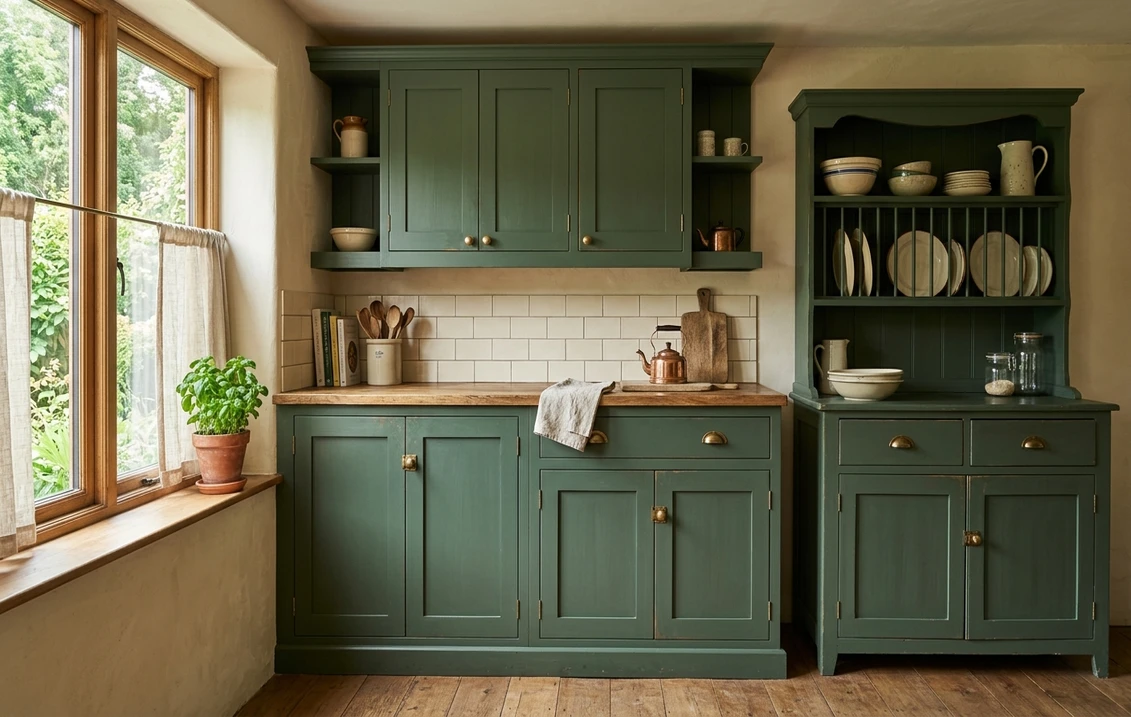
Bayberry is a muted sage, soft and earthy, perfect on a hutch or an island where you want color that still feels like a neutral. Park Bench is the deep forest green that has replaced navy as the trendy cabinet color in a lot of kitchens. On lower cabinets under a white upper run, Park Bench reads rich and grounded, and it makes wood counters and brass hardware look intentional. Green is a forgiving statement color because the eye reads it as natural, so it dates more slowly than a bold blue. For more on green as a room direction, see our broader interior color schemes guide.
Midnight Blue and Liberty Blue
Midnight Blue is the classic deep navy, a workhorse for an island, a dresser, or a bathroom vanity. It is dark enough to feel dramatic but blue enough to stay friendly, and it is one of the most photographed Fusion colors for that reason. Liberty Blue is the softer, slate-leaning cousin, a gray-blue that suits coastal and cottage pieces where you want color without intensity. If you are torn between the two, navy commits the room to a bold direction while the slate keeps things calm.
The darks and browns: Coal Black and Algonquin
Coal Black is a true, slightly warm black that avoids the flat plastic look cheaper black paints fall into. It is the go-to for modern accent furniture, metal-look frames, and high-contrast cabinet bases. Black hides nothing, so surface prep and even coats matter most here. Algonquin is the warm chocolate brown, useful when you want to refresh a wood-look piece without stripping it to bare timber. It reads like a stained finish from a few feet away, which makes it a quiet, traditional choice rather than a statement.
See lowers, uppers, and counters together in one preview, free, before you commit to a green base.
Finish, durability, and the topcoat question
Fusion dries to a matte-to-low-sheen finish straight from the can, with the protective resin already in the paint. For most furniture, that is enough: two thin coats and you are done, no wax, no separate sealer. The practical notes that save projects:
- Prep is light, not zero. Clean the piece, scuff any glossy factory finish, and prime over raw or heavily stained wood that might bleed through.
- Two thin coats beat one thick one. Self-leveling works best on light passes; thick coats can drag and show brush marks, especially in dark colors.
- Add a topcoat on high-wear surfaces. A dresser is fine as is, but a kitchen table, a desk, or cabinet doors near a sink benefit from a wipe-on protective coat for extra scrub resistance.
- Let it cure. It dries to the touch fast but reaches full hardness over a couple of weeks. Go gentle on freshly painted cabinets at first.
If your project is a full kitchen rather than a single piece, the technique scales but the stakes go up. Our step-by-step kitchen cabinet painting guide covers the prep, order of operations, and drying that make a cabinet job hold up over years.
How to choose and test before you buy
Fusion's palette is small enough that you can shortlist fast, but undertone still trips people up. A green-gray like Soapstone can clash with warm wood floors, and a cream like Casement can look yellow under warm bulbs. Two ways to get it right before you commit to pints:
- Buy a tester. Fusion sells small testers. Brush two coats on a scrap board or an inside cabinet door and check it in morning light, afternoon light, and under your own bulbs at night. Undertones move more than you expect.
- Preview it digitally first. Upload a photo of your real cabinets or furniture and apply a color, plus a warmer and a cooler alternative, before you order anything. It narrows the shortlist to the one or two shades actually worth a tester. Color reproduction on a screen is an approximation, so always confirm with a real sample under your own light.
Preview a Fusion shade against a warmer and a cooler option, side by side, free. One HD render plus three variations.
Frequently asked questions
What is the most popular Fusion Mineral Paint color?
Casement, the warm soft white, is the most-used color for cabinets and farmhouse furniture because it reads clean without going stark. Among the statement shades, Park Bench (deep forest green) and Midnight Blue (deep navy) lead for islands and lower cabinets, while Coal Black is the go-to true warm black for modern accent pieces.
Do I need a topcoat over Fusion Mineral Paint?
For most furniture, no. Fusion has a protective resin built into the paint, so a dresser or bookcase is done after two thin coats with no wax or sealer. For high-wear surfaces like a kitchen table, a desk, or cabinet doors near a sink, a wipe-on topcoat adds extra scrub resistance and is worth the step.
How is Fusion different from chalk paint?
Fusion is an acrylic mineral paint with the topcoat built in, so you usually skip the wax step that chalk paint requires. It also self-levels, softening brush strokes as it dries, while chalk paint holds a more textured, vintage stroke and almost always needs a separate wax or sealer on top for durability.
Can I use Fusion Mineral Paint on kitchen cabinets?
Yes, it is one of the most common uses. Clean and lightly scuff the doors, prime over raw or stain-prone wood, apply two thin coats, and add a wipe-on topcoat on doors near the sink for extra durability. Let the paint cure fully before heavy daily use. Our step-by-step cabinet guide covers the full process.
How many Fusion Mineral Paint colors are there?
The core range sits at roughly fifty colors, a tightly edited palette compared with the thousand-chip fan decks of wall-paint brands. That smaller selection is deliberate: the colors are designed to coordinate, so it is easier to pair a cabinet color with a furniture color from the same line without clashing.
Preview shades like Casement, Park Bench, and Midnight Blue on your actual cabinets and furniture under your own light before you buy. One HD render plus three variations.
Disclaimer: Fusion Mineral Paint and the color names referenced here (Casement, Champlain, Sterling, Soapstone, Bayberry, Park Bench, Midnight Blue, Liberty Blue, Coal Black, and Algonquin) are trademarks of their respective owner. Farrow & Ball, Behr, and other brands named are trademarks of their respective owners. FacadeColorizer is an independent paint visualization service and is not affiliated with, endorsed by, or sponsored by Fusion Mineral Paint or any other brand named here. Color and undertone descriptions are approximate, vary with light, and are based on the manufacturer's published range. Color reproduction on screens approximates the manufacturer's sample; always confirm with a manufacturer sample under your own light before purchase. Sources: Fusion Mineral Paint published color range 2026, furniture-finisher field reports compiled by FacadeColorizer.
Trademarks mentioned (Sherwin-Williams, Benjamin Moore, Behr, Caparol, Brillux, Sto, Alpina, Valspar, PPG, Glidden, Dulux, Crown Trade, Sandtex, Farrow & Ball, Johnstone's, Leyland) are property of their respective owners. FacadeColorizer is independent and not affiliated with any of them. Nominative fair use under Lanham Act §1125.