Try it on your room

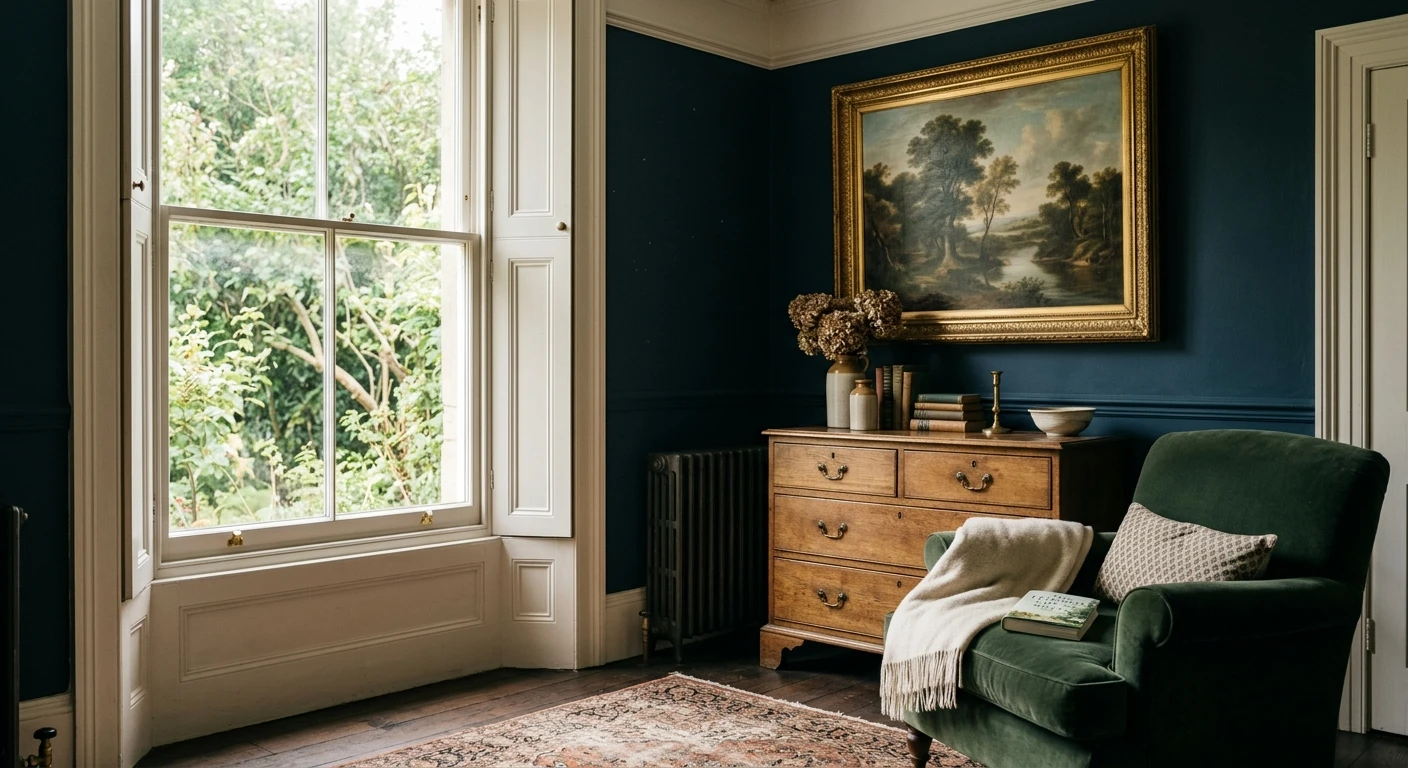
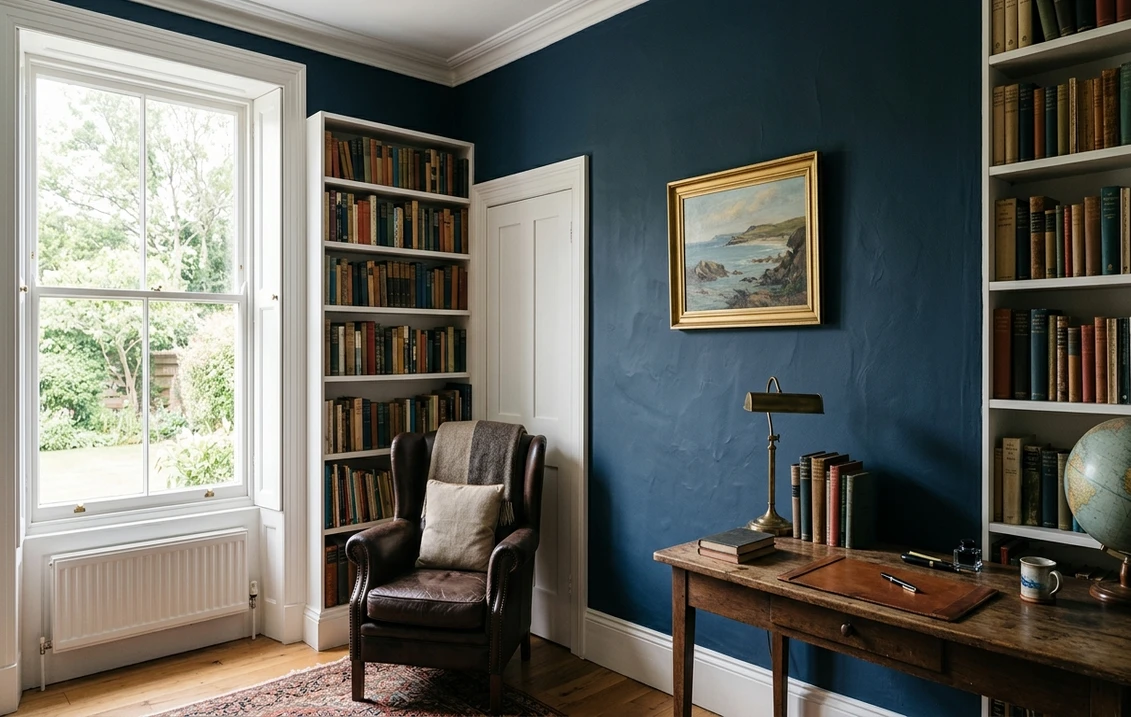
Farrow & Ball Hague Blue (No.30) is the color people reach for when they want a navy that feels like an heirloom, not a builder default. It is a deep, inky blue with a quiet green base that keeps it from going cold or flat, the sort of color that reads almost black under lamplight and then turns rich and dimensional when daylight hits it. It is dramatic, expensive-looking, and very easy to get wrong if you treat it like an ordinary navy.
This profile is for the homeowner already drawn to Hague Blue: what its undertone actually does, the published LRV and why that number matters more here than almost anywhere, the rooms it flatters, how it shifts by orientation, and the trim and metals that keep it looking intentional. It is one of the standout darks in our wider Farrow & Ball paint colors guide, and it sits squarely in the deep-blue conversation we map out in our best navy interior paint colors roundup.
Upload one photo and preview Hague Blue under your room's actual light in about 30 seconds, free.
The numbers behind Hague Blue No.30
Start with the published data. With a color this dark, the spec sheet predicts the wall far better than a small swatch can, because depth and finish do most of the work:
| Spec | Value |
|---|---|
| F&B name and number | Hague Blue No.30 |
| HEX (screen approximation) | #30353B |
| RGB approximation | 48, 53, 59 |
| LRV (Light Reflectance Value) | 6 |
| Hue family | Deep near-black navy with a green base |
| F&B color group | Blue |
| Closest F&B neighbors | Stiffkey Blue No.281, Inchyra Blue No.289, Railings No.31 |
Try it on your house
No photo? Try a sample
Sources: Farrow & Ball Hague Blue No.30 color data, retrieved 2026; The Spruce paint undertone references.
The LRV of 6 is the headline. Light Reflectance Value runs from 0 (true black) to 100 (pure white), and an LRV of 6 means Hague Blue reflects almost no light back into the room. It is one rung above true black. That has two practical consequences: the color will swallow light, so a dim room gets noticeably darker, and the navy you saw on the chip in daylight reads as near-black after sunset. This is not a flaw, it is the point, but it is why Hague Blue is a "use it on purpose" color rather than a safe default. For the lighter end of the deep-blue spectrum, our best interior blue paint shades guide shows where the airier blues sit.
The green undertone that does the heavy lifting
Most "navy" paints are built on a black or violet base, which is what makes a cheap navy read cold and a little dead on the wall. Hague Blue is different: under the blue sits a quiet green pigment, and that green is the reason designers keep specifying it. It does three things you can actually see:
- It warms the navy. The green keeps Hague Blue from going icy or sterile the way a blue-black navy can. It reads rich and a little organic rather than corporate.
- It adds depth. Because there are two pigment directions fighting for attention, the color shifts subtly as you move past it, which is what makes a deep wall feel expensive instead of like a flat block of color.
- It surfaces in warm light. Under incandescent or 2700K bulbs, and in low evening daylight, the green base steps forward and Hague Blue can read almost teal or petrol at the edges of a wall, before settling back to navy in the field.
This is also the catch with cheap color-matching. A hardware-store match into a standard base will usually nail the blue but lose the green, and the result reads flatter and colder than the real thing. At this depth the undertone is most of what you are paying for. Because the undertone is finely balanced, the direction a room faces moves Hague Blue more than it moves a one-note navy. Typical behavior across the four Northern Hemisphere orientations:
| Room orientation | Daylight character | How Hague Blue reads |
|---|---|---|
| South-facing | Warm, abundant midday light | Richest, most dimensional navy; the green base glows and the wall feels alive |
| West-facing | Cool by day, very warm at sunset | Inky and cool midday, then a warm green-teal flash at golden hour |
| East-facing | Warm early sun, neutral later | Lively navy in the morning, settling to a deep moody blue by afternoon |
| North-facing | Cool, indirect, no direct sun | Darkest and coolest; reads near-black, dramatic but can feel heavy if light is scarce |
Sources: American Institute of Architects daylight reference; Farrow & Ball Hague Blue No.30 color data; designer notes on deep-blue paints.
Want the navy to feel rich rather than oppressive? Give it a room with real daylight, ideally south or east, and warm bulbs at night. A windowless powder room can absolutely carry Hague Blue, but lean into the drama with good layered lighting rather than fighting it with a single overhead fixture. For how deep blue behaves as a whole-room direction, our colors that go with navy blue guide is the companion read.
The rooms Hague Blue was made for
Hague Blue is a "moment" color. It is at its best where you want enclosure, focus, or a touch of theater, and it rewards small or transitional spaces where the depth feels like a feature instead of a weight:
- Studies, libraries, and home offices: the classic use. Painted wall to wall, including the trim and the bookcases, Hague Blue makes a small room feel cocooning and serious in the best way.
- Powder rooms: a windowless powder room is the ideal low-stakes place to be bold. The near-black depth feels like a jewel box, especially with brass fittings and a good mirror.
- Cabinetry and kitchen islands: increasingly the most popular use in the US. On a kitchen island or lower cabinets, Hague Blue reads custom and timeless against white uppers, warm wood, and a marble or quartz top.
- Dining rooms: a room you mostly use after dark is a smart fit, because Hague Blue is most flattering by candlelight and lamplight, when its depth becomes an asset rather than a darkening problem.
- Accent and feature walls: behind a bed or framing a fireplace, it anchors a room without committing all four walls to near-black. See our blue living room paint ideas for how a single deep wall plays against lighter neutrals.
Where to be careful: a large, low-light open-plan space painted entirely in Hague Blue can feel closed in, and the low LRV means glare and lap marks show more, so the prep and the finish matter. Because the color is dark and the finish is everything, this is a job where a confident painter earns the fee.
Free AI visualizer: test Hague Blue on a study wall, in a powder room, or on cabinets before you buy a sample pot.
Trim, ceiling, metals, and decor
With a color this dark, the contrast you choose around it sets the whole mood. There are two strong directions, and a few finishes that consistently flatter it:
- Crisp white trim for sharp contrast: Farrow & Ball Pointing (No.2003), a soft warm white, frames Hague Blue without the harshness of a stark bright white. This is the traditional, high-contrast look on paneling and built-ins.
- Self-trim for the cocooning look: paint the trim and ceiling the same Hague Blue (in the appropriate finish) to dissolve the edges of a small study or powder room and make it feel enveloping and bigger than it is.
- Ceiling: a pale warm white keeps a room open; going dark overhead too is only for spaces where you want full drama and have good lighting.
- Metals that sing against it: unlacquered or antique brass is the designer default and looks made for Hague Blue. Aged bronze and matte black work; bright chrome can read cold beside it.
- Decor and woods: warm woods (walnut, oak), natural rattan and leather, and brass or gold accents all warm the navy. Cool grays and stark whites pull it colder.
On finish: Farrow & Ball Estate Eggshell is the right product for cabinetry, trim, and doors in Hague Blue, while Modern Emulsion suits high-traffic or moisture-prone walls. For pairing deep navy with the rest of a scheme, our colors that go with dark blue guide lays out the warm neutrals, terracottas, and mustards that bring it to life.
Hague Blue vs the deep blues people cross-shop
Hague Blue has two Farrow & Ball near-twins that constantly get confused with it, plus the most common American cross-shop. Knowing the difference saves a wasted sample pot:
- vs F&B Stiffkey Blue (No.281): Stiffkey is the bluer, more purple-leaning navy of the family. It reads as a truer, more saturated blue with a faint violet cast, where Hague Blue is greener and darker. Stiffkey feels like a deep blue; Hague Blue feels like a near-black with blue depth. Choose Stiffkey for a room you want to read clearly as "blue," Hague Blue for drama and near-black depth.
- vs F&B Inchyra Blue (No.289): the easiest mix-up. Inchyra is a blue-green-gray, much grayer and more muted than Hague Blue, and it shifts dramatically between blue, green, and charcoal depending on light. It is also lighter in feel (higher LRV) than Hague Blue. Pick Inchyra for a chameleon teal-gray; pick Hague Blue when you want a committed, saturated dark navy that stays navy.
- vs BM Hale Navy (HC-154): the most common American cross-shop. Hale Navy is a more straightforward, slightly grayer classic navy at a higher LRV, easier to live with on big walls and more forgiving in low light. Hague Blue is deeper, greener, and more dramatic. Our Benjamin Moore Hale Navy profile covers that color in full if you want the safer all-rounder.
Worth flagging: Hague Blue is also sometimes confused with Railings (No.31), the off-black F&B sibling. Railings is a blue-gray charcoal that reads as a soft black, not a navy. If a designer says "the dark F&B blue," confirm whether they mean Hague Blue, Stiffkey, Inchyra, or Railings before you buy, because all four behave differently on the wall.
How to test Hague Blue before you commit
At LRV 6, a small chip lies to you more than almost any color in the deck, because a tiny dark sample looks one way next to white paper and another way covering a whole wall in a dim room. The reliable physical method is a large painted sample board (or a Farrow & Ball peel-and-stick swatch) moved around the room and checked at midday, late afternoon, and after dark under your normal bulbs. The after-dark check is the one that matters, because that is when Hague Blue goes near-black and you find out whether the room still works. The faster, no-paint first pass is a digital visualizer: upload a photo of the room and apply Hague Blue beside a bluer alternative (Stiffkey) and a grayer one (Inchyra) to see which way your light pulls it, ruling out the directions that were never going to work.
Preview Hague Blue beside Stiffkey and Inchyra under your real light, free: 1 HD preview and 3 variations.
Frequently asked questions
What undertone does Farrow & Ball Hague Blue have?
Hague Blue No.30 is a deep navy built on a green base rather than a black or violet one. That green undertone is what keeps it from reading cold or flat: it warms the navy, adds depth, and can surface as a faint teal or petrol cast under warm light and in low evening daylight. In the body of a daylit wall it still reads clearly as a rich, dark navy.
What is the LRV of Hague Blue No.30?
Hague Blue has a Light Reflectance Value of about 6 on the 0 to 100 scale, which puts it one step above true black. It reflects very little light, so it darkens a room noticeably and reads as near-black after sunset. That low LRV is why it is best used on purpose, in rooms with good daylight or deliberate lighting, rather than as a default whole-house color.
What is the difference between Hague Blue and Stiffkey Blue?
Stiffkey Blue (No.281) is the bluer, slightly purple-leaning navy of the family and reads as a truer, more saturated blue. Hague Blue (No.30) is greener, deeper, and darker, reading closer to a near-black navy. Choose Stiffkey when you want a room to read clearly as blue, and Hague Blue when you want maximum depth and drama.
What trim and metals go with Hague Blue?
For high contrast, a soft warm white like Farrow & Ball Pointing frames Hague Blue without harshness; for a cocooning look, paint the trim the same Hague Blue. Unlacquered or antique brass is the standout metal pairing, with aged bronze and matte black as alternatives. Warm woods, rattan, and leather warm the navy, while cool grays and stark whites pull it colder.
See Hague Blue under your real light, beside Stiffkey and Inchyra, before you buy a single pot.
Disclaimer: Farrow & Ball, Hague Blue No.30, Stiffkey Blue No.281, Inchyra Blue No.289, and Railings No.31 are trademarks of Farrow & Ball Limited. Benjamin Moore is a trademark of its respective owner. FacadeColorizer is an independent paint visualization service and is not affiliated with, endorsed by, or sponsored by Farrow & Ball or Benjamin Moore. Screen color approximates the manufacturer's sample; always confirm with a physical sample before purchase. Sources: Farrow & Ball Hague Blue No.30 color data 2026, Farrow & Ball Stiffkey Blue, Inchyra Blue, Railings, and Pointing color data, Benjamin Moore Hale Navy HC-154 color data, The Spruce paint undertone references, and designer notes on deep-blue paints.
Trademarks mentioned (Sherwin-Williams, Benjamin Moore, Behr, Caparol, Brillux, Sto, Alpina, Valspar, PPG, Glidden, Dulux, Crown Trade, Sandtex, Farrow & Ball, Johnstone's, Leyland) are property of their respective owners. FacadeColorizer is independent and not affiliated with any of them. Nominative fair use under Lanham Act §1125.