Try it on your room

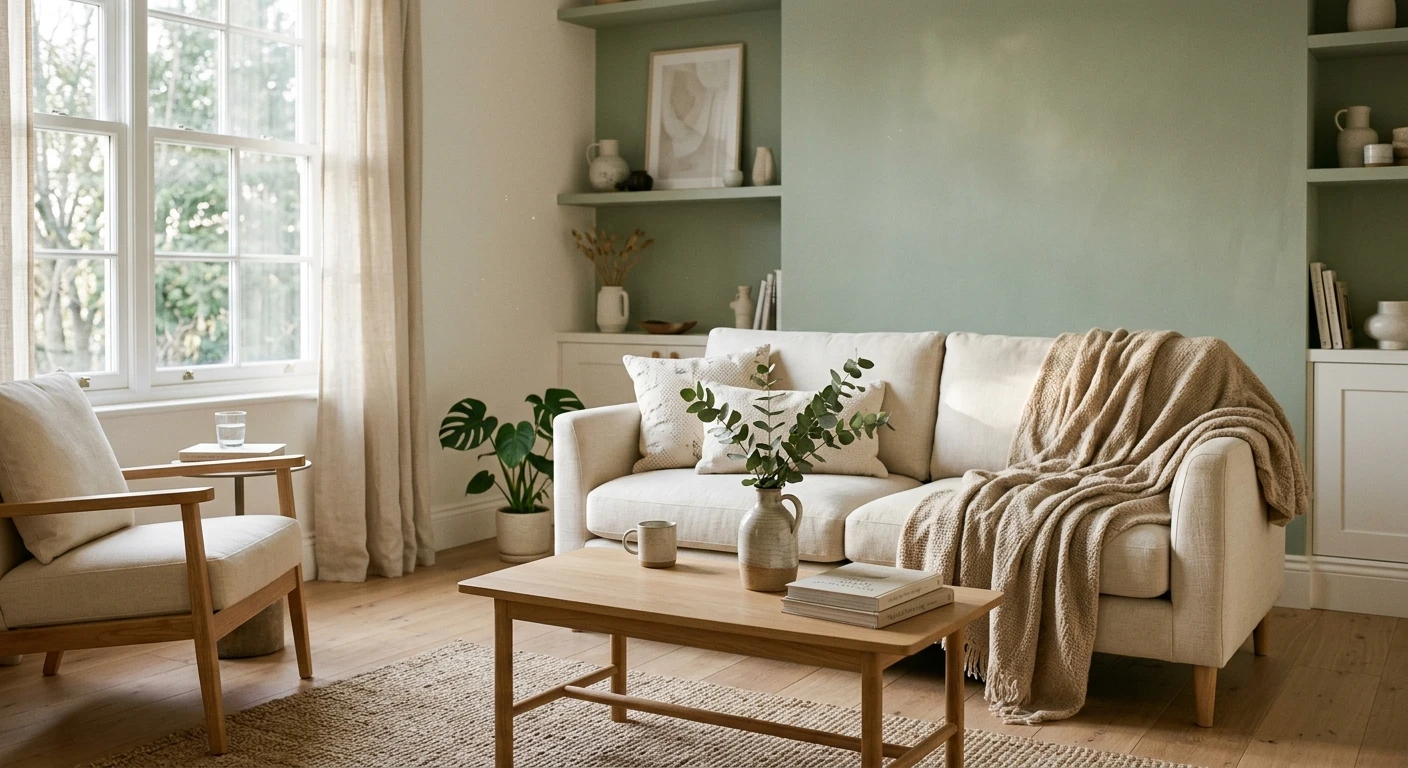
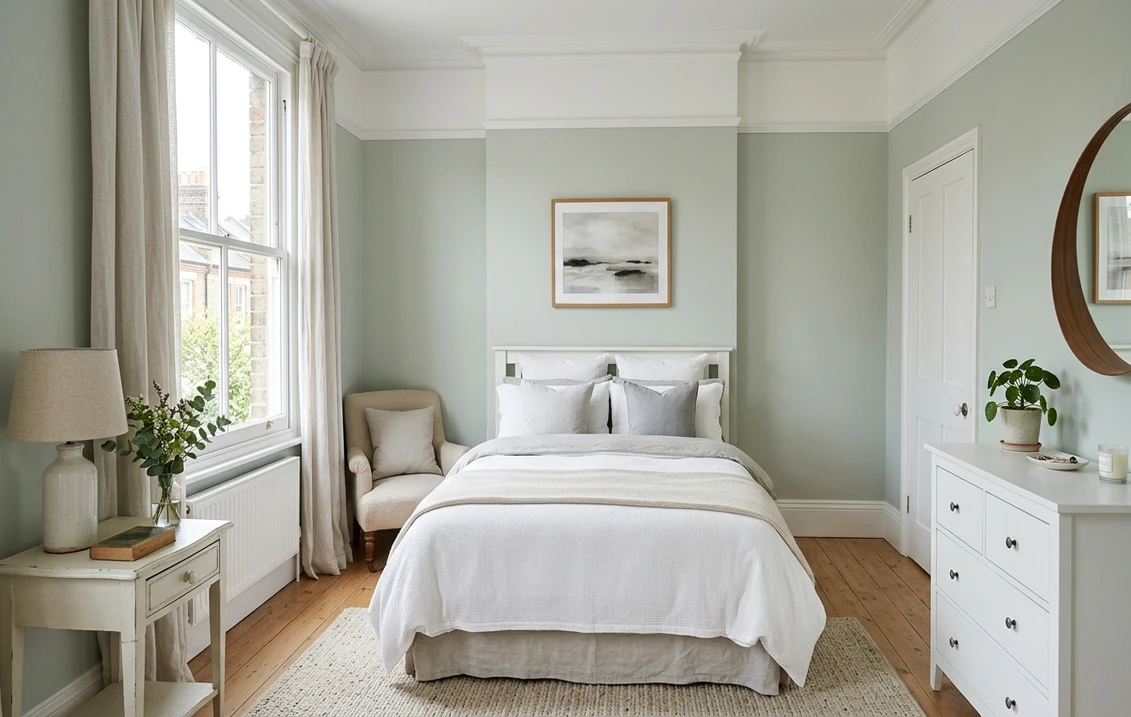
You order Farrow & Ball Light Blue No.22 expecting a soft blue, brush it onto the wall, and step back to find something closer to a muted gray-green. That is not a mistinted can. Light Blue is one of Farrow & Ball's most famously misnamed colors: it reads far more green-gray than blue, a quiet sage with a cool, smoky base that only flashes its blue side under the right light. The name is a holdover from an older palette; the paint behaves like a green.
This profile is for the homeowner who has settled on Light Blue and wants to know exactly how it will behave: how its undertones shift, the published LRV, the rooms it flatters, and the trim and decor that keep it crisp instead of gloomy. It is one of the soft heritage tones in our wider Farrow & Ball paint colors guide, and you can see where it sits among the cool neutrals in our best interior paint colors for 2026 roundup.
Upload one photo and preview Light Blue No.22 under your room's actual light in about 30 seconds, free.
The numbers behind Light Blue No.22
Start with the published data; these figures predict the wall better than the name or a small fan-deck card. They come from the Farrow & Ball color references:
| Spec | Value |
|---|---|
| F&B name & number | Light Blue No.22 |
| HEX (screen approximation) | #C5CABF |
| RGB approximation | 197, 202, 191 |
| LRV (Light Reflectance Value) | 53.8 |
| Hue family | Soft gray-green with a cool, smoky base (reads more green than blue) |
| Closest F&B relatives | Oval Room Blue No.85 (deeper), French Gray No.18 (greener), Pigeon No.25 |
Try it on your house
No photo? Try a sample
Sources: Farrow & Ball Light Blue No.22 color data, retrieved 2026; published LRV references for the Farrow & Ball palette.
The LRV of 53.8 is the figure most people skip and then regret. That is a true mid-tone: light enough to keep a room from feeling closed in, but with enough body that it will deepen noticeably in a north room or a space with small windows. It is not a pale, airy color the way the name suggests. If you want the same family but lighter and more clearly blue-green, the Sherwin-Williams equivalent in spirit is covered in our SW Sea Salt profile, which sits brighter at LRV 63.
Why "Light Blue" reads green
Light Blue is built on a green-gray base with a small amount of blue pigment and, like most Farrow & Ball colors, a touch of black for depth. That black is what gives it the chalky, slightly smoky quality F&B is known for, and it is also what keeps the blue from ever reading as a clean sky tone. In practice you will see three different reads depending on the light:
- The green read. Under warm light (direct sun or a 2700K bulb), the warmth cancels what little blue there is and the soft sage-green steps forward. This is the version most people end up living with.
- The blue read. Under cool, indirect light (an overcast sky, a north window, a 5000K daylight LED), the warm side drains away and the faint blue finally surfaces as a smoky, dusty blue-gray. The version that explains the name.
- The gray read. In low or balanced light (dawn, dusk, a dim hallway), green and blue both recede and the smoky gray base takes over, the moodiest of the three.
None of these is "wrong," they are all the same paint doing what it was formulated to do. Because the blue is so subordinate, the orientation of the room moves Light Blue more than it would move a committed beige or a true gray, as the interior color families guide explains. Typical behavior across the four Northern Hemisphere orientations:
| Room orientation | Daylight character | How Light Blue reads |
|---|---|---|
| South-facing | Warm, abundant midday light | Greenest and softest, a restful sage; the blue all but disappears |
| West-facing | Cool by day, very warm at sunset | Gray-green by day, warming to a glowing sage late afternoon |
| East-facing | Warm early sun, neutral later | Green in the morning, settling to a cool gray-green by afternoon |
| North-facing | Cool, indirect, no direct sun | Smokiest and bluest version; here it finally earns its name |
Sources: American Institute of Architects daylight reference; Farrow & Ball Light Blue No.22 color data; designer notes on Farrow & Ball green-grays.
Want the sage you probably picture? Put Light Blue in a south or east room and lean warm with your bulbs. Want the smoky blue that justifies the name? A north-facing room with daylight bulbs is the only place it reliably appears. In a dim, north-lit space the LRV of 53.8 can feel heavier than expected, so judge it there before committing.
The rooms Light Blue No.22 suits best
Light Blue is a quiet, period-leaning color that does its best work in rooms where you want calm and a sense of age rather than brightness:
- Bedrooms: the smoky, low-saturation quality is genuinely restful, and it flatters white, cream, and natural-linen bedding without going cold. A classic Farrow & Ball bedroom color.
- Bathrooms and powder rooms: the cool side reads clean against white tile, marble, and nickel or chrome, while the green keeps it from feeling clinical. In a windowless bath, choose warm bulbs or it can drift gray.
- Studies, libraries, and reading nooks: the mid-tone depth makes these small enclosed rooms feel considered and quiet, especially with painted shelving in the same color.
- Kitchens, on cabinetry: Light Blue is a popular Shaker-cabinet color in heritage and English-country kitchens, where the gray-green reads custom against white walls and warm wood counters. For where Farrow & Ball sits against US store brands on durability and price, see our best interior paint brands ranked.
Where to be careful: in a large, bright, open great room the mid-LRV can read as a lot of cool color wall to wall, so many designers use it on a single accent wall, on cabinetry, or in smaller rooms instead. Our interior house painting cost guide covers what the repaint should run before you commit a whole floor to it.
Free AI visualizer: test Light Blue in a bedroom, bath, or on cabinets before you buy a sample pot.
Trim, ceiling, and decor that keep it crisp
Because Light Blue carries a smoky base, the white beside it decides whether it reads fresh-historic or just dingy. Soft, slightly warm whites flatter it more than a stark bright white, which can make it look gray by contrast:
- Best all-around trim: Farrow & Ball Wimborne White No.239 or School House White No.291. Soft and gently warm, they frame Light Blue without the harsh edge a stark white creates, keeping the period feel intact.
- For a crisper look: Strong White No.2001 nudges the scheme cooler and cleaner if you want the blue side to come forward.
- Ceiling: a soft white keeps the room open. Avoid carrying Light Blue overhead in a low or north room, where the mid-tone can feel heavy.
- Deeper coordinating tones: for cabinetry, a built-in, or a door, the deeper Oval Room Blue No.85 or a charcoal like Down Pipe No.26 reads as a natural in-family step down. If the cabinetry is being mixed at a Sherwin-Williams counter instead, Cyberspace SW 7076 covers both of those moves in a single color: charcoal once the light drops, clearly blue in the morning.
- Decor and finishes: aged brass, unlacquered nickel, white oak and warm woods, natural linen, and rattan all flatter it. Cold steel grays and very bright whites drag it toward murky.
If you want a warm sage to pair in adjoining rooms rather than another cool tone, a deeper green like the one in our SW Evergreen Fog profile flows naturally beside Light Blue and adds the cozy contrast its mid-LRV cannot supply on its own.
Light Blue vs the colors people cross-shop
Light Blue has two F&B near-twins shoppers line up against it, plus one cross-brand match. Knowing the difference saves a wrong sample pot:
- vs F&B Oval Room Blue No.85: the deeper cousin. Oval Room Blue (LRV 30) is a saturated, confident smoky teal-blue that reads clearly blue-green even in poor light. Light Blue is the pale, quiet version that often reads green; Oval Room Blue is the moody one you would use on a study wall, a paneled room, or cabinetry for drama. Pick Light Blue for soft and airy, Oval Room Blue for enveloping.
- vs F&B French Gray No.18: the closest call, and the one people confuse most. French Gray (LRV 44) is even more clearly a gray-green and a touch darker, with almost no blue at all, reading as a sage-gray. Light Blue is lighter and keeps a faint cool blue cast that French Gray lacks. Choose French Gray when you want an unambiguous green-gray with no surprises; choose Light Blue when you can accept (or want) the occasional blue flash in cool light.
- vs SW Sea Salt SW 6204: the most common US cross-shop. Sea Salt is brighter (LRV 63) and swings more openly between green, blue, and gray. Light Blue is the deeper, smokier, more heritage-feeling option that holds its green side longer. Choose Sea Salt for an airy spa feel, Light Blue for a quieter, more aged look.
One naming trap worth flagging: Farrow & Ball also retired and renumbered colors over the years, so an old chart may list Light Blue differently. Always confirm the current No.22 reference before ordering, and never rely on the word "blue" in the name to predict the wall.
How to test Light Blue No.22 before you commit
Light Blue is the textbook color where a small fan-deck card or a phone screen will mislead you, because it photographs and prints far bluer than it paints. The reliable physical method is a Farrow & Ball sample pot brushed onto a large piece of primed board (two coats), moved around the room, and checked mid-morning, mid-afternoon, and after dark under your normal bulbs; the dim-light gray-green is the version you live with at night. The faster, no-paint first pass is a digital visualizer: upload a photo of the room and apply Light Blue beside a deeper alternative (Oval Room Blue) and a greener one (French Gray) to see which way your light pulls it, and rule out the directions that were never going to work before you spend on sample pots.
Preview Light Blue No.22 under your real light, beside a deeper and a greener alternative, free.
Frequently asked questions
Is Farrow & Ball Light Blue actually blue?
Mostly no. Despite the name, Light Blue No.22 reads as a soft gray-green far more often than as a blue. It is built on a green-gray base with only a small amount of blue pigment and a touch of black for depth. The blue side surfaces only under cool, indirect light, such as a north window or a daylight bulb. In warm light it is clearly a sage. The name is a historical holdover, not a description of the wall.
What is the LRV of Light Blue No.22?
Light Blue No.22 has a Light Reflectance Value of about 53.8, a true mid-tone. That is light enough to keep a room from feeling closed in, but it will deepen noticeably in a north-facing room or a space with small windows, so it is not a pale, airy color despite the name. Judge it in your darkest light before committing, because the mid-LRV is where most surprises come from.
What is the difference between Light Blue and French Gray?
They are close, which is why people confuse them. French Gray No.18 (LRV 44) is a slightly darker, unambiguous gray-green with almost no blue at all. Light Blue No.22 is a bit lighter and keeps a faint cool blue cast that can flash in cool light. Choose French Gray when you want a predictable sage-gray with no surprises, and Light Blue when you can accept the occasional smoky blue read.
What trim color goes with Light Blue No.22?
A soft, slightly warm white flatters Light Blue more than a stark bright white, which can make it look gray by contrast. Farrow & Ball Wimborne White No.239 or School House White No.291 keep the heritage feel intact. For a crisper, cooler scheme that brings the blue side forward, use Strong White No.2001. A soft white ceiling keeps the room feeling open.
See Light Blue under your real light, beside a deeper and a greener alternative, before you buy.
Disclaimer: Farrow & Ball and Light Blue No.22 are trademarks of Farrow & Ball Limited. Sherwin-Williams is a trademark of The Sherwin-Williams Company. FacadeColorizer is an independent paint visualization service and is not affiliated with, endorsed by, or sponsored by Farrow & Ball or Sherwin-Williams. Screen color approximates the manufacturer's sample; always confirm with a physical sample before purchase. Sources: Farrow & Ball Light Blue No.22, Oval Room Blue No.85, and French Gray No.18 color data 2026, Farrow & Ball white color references, Sherwin-Williams SW 6204 Sea Salt color data, and designer notes on Farrow & Ball green-grays.
Trademarks mentioned (Sherwin-Williams, Benjamin Moore, Behr, Caparol, Brillux, Sto, Alpina, Valspar, PPG, Glidden, Dulux, Crown Trade, Sandtex, Farrow & Ball, Johnstone's, Leyland) are property of their respective owners. FacadeColorizer is independent and not affiliated with any of them. Nominative fair use under Lanham Act §1125.