Try it on your room

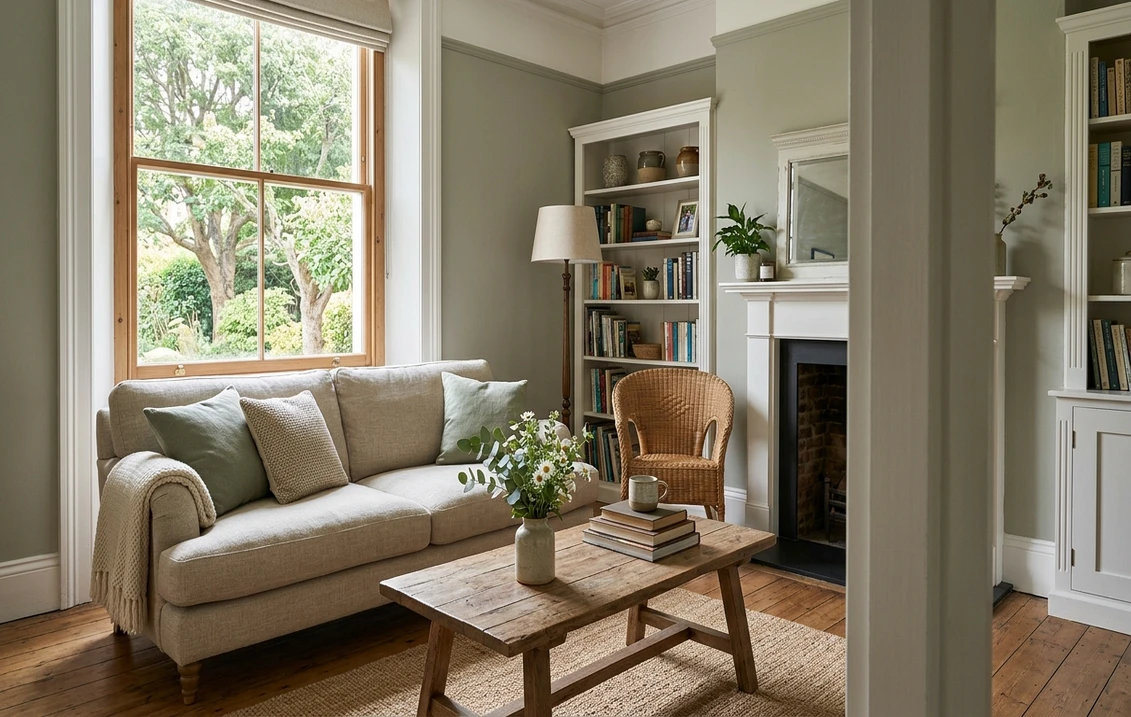
You order a sample pot of Farrow & Ball French Gray No.18 expecting a tasteful gray, brush it on, and pause. That is not gray. In daylight it reads as a soft, dusty sage; by lamplight it settles into a muted green-gray. The name is one of the most quietly misleading in the Farrow & Ball deck. French Gray is a gray-green, and the green usually wins. Knowing that before you commit is the difference between a kitchen that feels like a calm botanical retreat and one that feels like a mistake you have to repaint.
This profile is for the shopper who is already eyeing French Gray No.18 and needs the truth about how it behaves: where its undertones go under your light, the published LRV, the rooms it flatters, the trim that frames it, and the near-twins people confuse it with. It is one of the softer heritage greens in our wider Farrow & Ball paint colors guide, and you can see where it sits among the year's quiet hues in our best interior paint colors for 2026 roundup.
Upload one photo and preview Farrow & Ball French Gray No.18 under your room's actual light in about 30 seconds, free.
The numbers behind French Gray No.18
Start with the published data; these figures tell you more about the wall than any printed swatch card. They come from the Farrow & Ball color reference:
| Spec | Value |
|---|---|
| Color name and number | French Gray No.18 (Farrow & Ball) |
| HEX (screen approximation) | #ADA995 |
| RGB approximation | 173, 169, 149 |
| LRV (Light Reflectance Value) | 44 |
| Hue family | Soft gray-green, more green than gray, muted and earthy |
| F&B archive group | Sits among the muted greens with Lichen No.19 and Light Blue No.22 |
Try it on your house
No photo? Try a sample
Sources: Farrow & Ball French Gray No.18 color data, retrieved 2026; manufacturer LRV reference.
The LRV of 44 is the figure most people misjudge. At 44, French Gray is a true mid-tone: not a pale, airy wash and not a deep, enveloping color. It absorbs roughly as much light as it reflects, so it grounds a room with body and shadow rather than bouncing light around. That is why it can feel heavier than its sample-pot first impression in a darker space, and why it sings in a room with good natural light. For a lighter, more open take on the green-gray idea, our profile of SW Pewter Green shows how a deeper member of the same family reshapes the same rooms.
Undertones: why it never looks gray
The name promises gray, but the pigment load tells a different story. French Gray No.18 is built on a green base with a soft warm-gray quieting it down. There is no true neutral here; the green is always present, and the only question is how loud it gets.
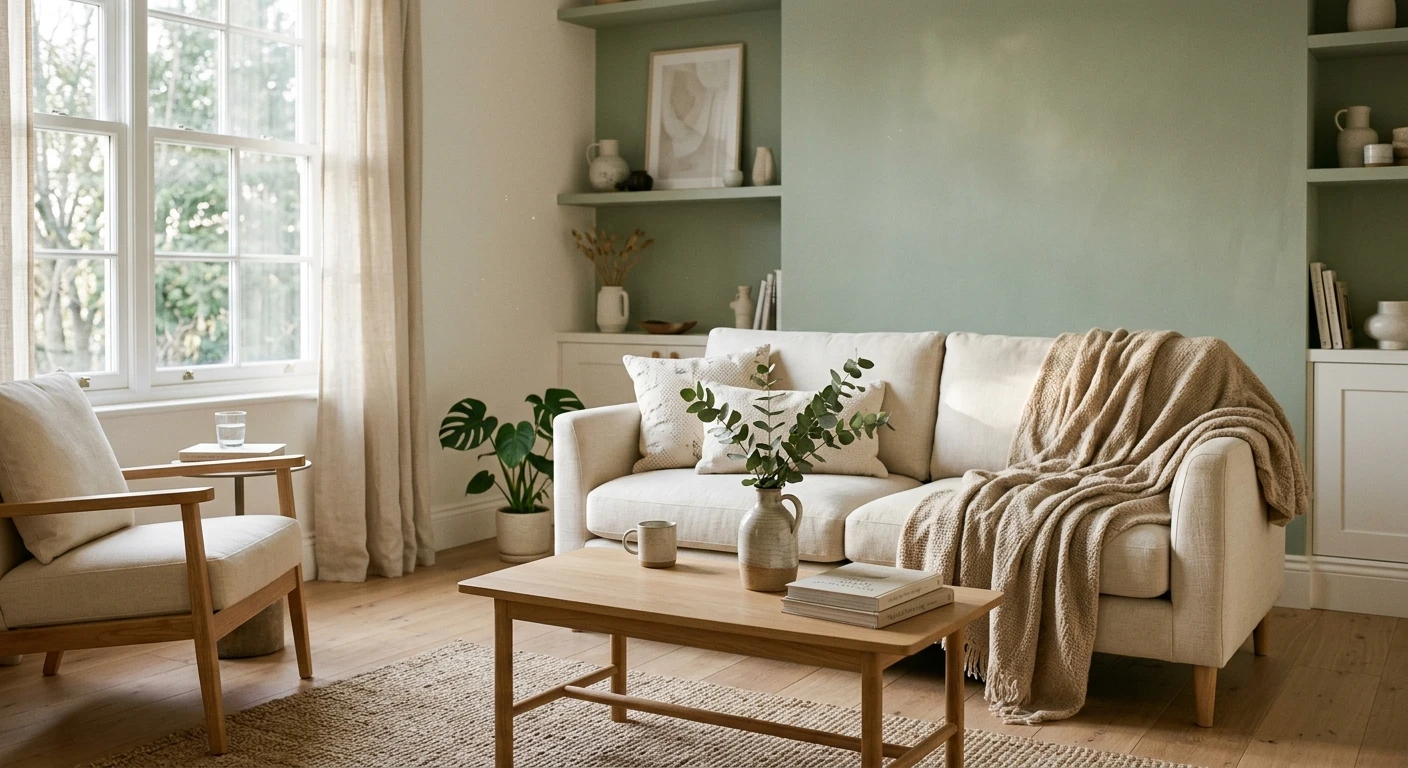
- The sage read. Under warm, generous light (direct sun, a 2700K bulb), French Gray pushes its green forward as a soft, dusty sage with a faintly khaki warmth. The version most people end up loving.
- The gray-green read. Under cool or indirect light, the warmth recedes and the color settles into a muted, dignified green-gray, the closest it ever gets to living up to its name, though still clearly green.
- The earthy read. In dim or low light, the muted base takes over and French Gray reads as a quiet, smoky olive-gray, calm and a little moody.
None of these is wrong; they are all the same paint responding to light. Because the green never fully disappears, the room's orientation moves French Gray noticeably, more than it moves a committed beige or a true gray, as the interior color families guide explains. Typical behavior across the four Northern Hemisphere orientations:
| Room orientation | Daylight character | How French Gray reads |
|---|---|---|
| South-facing | Warm, abundant midday light | Greenest version, a warm dusty sage, its best self |
| West-facing | Cool by day, very warm at sunset | Muted green-gray by day, glowing olive-sage late afternoon |
| East-facing | Warm early sun, neutral later | Sage in the morning, settling to gray-green by afternoon |
| North-facing | Cool, indirect, no direct sun | Coolest and most muted, leans smoky olive-gray, can feel heavy |
Sources: Farrow & Ball French Gray No.18 color data; American Institute of Architects daylight reference; designer notes on heritage greens.
Want the sage you fell for? Put French Gray in a south or east room and lean warm with your bulbs. A north-facing room is where it is most likely to disappoint, draining to a flat olive-gray that needs warm lighting and warm woods to rescue it. The alternative is to stop fighting that light and pick a color it flatters: Sulking Room Pink in a north-facing room is the F&B tone that behaves the opposite way, its mauve and gray going full and moody in exactly the cool indirect light that flattens French Gray. For a brighter, more reliably sage alternative if your light is poor, our SW Clary Sage profile is the easier-going counterpart.
The rooms French Gray was made for
French Gray earns its reputation in rooms that want quiet sophistication with a botanical edge. Its earthy, grounded quality reads as collected and calm rather than trendy, which steers it toward a clear set of spaces:
- Kitchens, especially on cabinetry: the signature modern use. On Shaker cabinets it reads custom and timeless against white or off-white walls, brass hardware, and warm wood counters. The mid-tone depth gives lower cabinets real presence.
- Studies, libraries, and home offices: the muted green is focused and restful, ideal for a room you want to feel grounded and a little serious.
- Dining rooms: wall to wall, the depth at LRV 44 creates an intimate, candlelit-friendly mood that flatters wood furniture.
- Mudrooms and entryways: hardy, smudge-forgiving, and far more interesting than a builder beige. For a softer, lighter sage if a small entry needs to stay open, our sage green interior shades and pairings guide covers the lighter options.
Where to be careful: a small, dark north-facing room painted wall to wall can feel closed in, since at LRV 44 the color absorbs as much light as it gives back. In those spaces, French Gray works better on cabinetry or a single feature wall than across all four. Our interior house painting cost guide covers what the repaint should run if you are budgeting a cabinet or full-room project.
Free AI visualizer: test French Gray on kitchen cabinets, a study wall, or a dining room before you buy a sample pot.
Trim, ceiling, and decor that flatter it
Because French Gray is a green at heart, the white beside it decides whether it reads warm and collected or cold and dull. Warm, soft whites win; bright cool whites can make it look muddy by contrast.
- Best all-around trim: Farrow & Ball School House White No.291 or Pointing No.2003. Both are soft, warm whites that frame French Gray without the icy contrast a stark white creates.
- For more warmth still: a creamy white pulls French Gray further toward its sage side, good in a dining room or warm-light kitchen.
- Ceiling: a soft white keeps a French Gray room from feeling top-heavy. Reserve the color itself for walls and joinery, not overhead, in any room with limited height.
- Deeper coordinating tones: for a darker step in the same family, a deep olive or a soft black like Farrow & Ball Off-Black reads as a natural anchor. A warm terracotta or rust accent brings out its green beautifully.
- Decor and finishes: unlacquered brass and antique gold, warm and mid-toned woods (oak, walnut), natural linen, rattan, and aged leather all flatter it. Cool chrome and stark cool grays drag it toward murky.
French Gray vs the colors people cross-shop
French Gray No.18 has a few near-twins shoppers line up against it, and the differences are subtle enough that a wrong sample is easy. Knowing them saves a repaint:
- vs Farrow & Ball Light Blue No.22: the in-house twin that confuses people most, because despite its name Light Blue is also a gray-green, not a blue. The key difference is direction and depth: French Gray (LRV 44) is warmer, more khaki, and noticeably deeper, while Light Blue (LRV 54) is cooler with a faint blue-gray lean and reads clearly lighter and airier. Choose French Gray for warmth and a grounded sage, Light Blue for a cooler, distinctly airier gray-green. Both betray their names; neither is the color you expect from the label.
- vs SW Svelte Sage (SW 6164): the most common Sherwin-Williams cross-shop. Svelte Sage is a brighter, cleaner, more clearly green sage with less of the warm-gray muting that defines French Gray. Side by side, French Gray looks dustier, earthier, and more heritage; Svelte Sage looks more contemporary and a touch livelier. Pick French Gray for an old-world, collected feel, Svelte Sage for a fresher modern green.
- vs SW Pewter Green (SW 6208): a much deeper, moodier green-gray. Pewter Green is a dramatic cabinet color where French Gray is a softer, more livable mid-tone. Choose Pewter Green when you want depth and drama, French Gray when you want quiet.
One practical note: French Gray sits inside the Farrow & Ball numbered archive, so a designer asking for it should always include the number (No.18). Other brands sell colors named simply "French Gray" that are true neutrals with no green at all; confirm the brand and number before you order a sample. We cover how the heritage palette is organized in the full Farrow & Ball paint colors guide.
How to test French Gray before you commit
French Gray No.18 is a textbook color where a small printed card will mislead you, because the green only fully shows at scale and under real light. The reliable method is a large painted sample, ideally Farrow & Ball's peel-and-stick swatch or two coats on a board, moved to at least two walls and checked mid-morning, mid-afternoon, and after dark under your normal bulbs. The dim-light olive-gray is the version you live with at night, and it is the read most people forget to test. The faster, no-paint first pass is a digital visualizer: upload a photo of the room and apply French Gray beside a brighter sage (Svelte Sage) and a deeper green-gray (Pewter Green) to see which way your light pulls it, ruling out the colors that were never going to work before you spend on sample pots.
Preview French Gray beside a brighter and a deeper alternative under your real light, free: 1 HD render and 3 variations.
Frequently asked questions
Is Farrow & Ball French Gray actually gray or green?
It is green, despite the name. French Gray No.18 is a soft gray-green built on a green base with a warm-gray muting it down, and the green almost always reads first. Under warm light it shows as a dusty sage; under cool or dim light it settles into a muted green-gray or smoky olive, but it never becomes a true neutral gray. If you want an actual gray with no green, French Gray is the wrong color.
What is the LRV of French Gray No.18?
French Gray No.18 has a Light Reflectance Value of 44, a true mid-tone. It reflects and absorbs light in roughly equal measure, so it grounds a room with body and depth rather than bouncing light around. That makes it rich and characterful in a well-lit room but potentially heavy in a small, dark, north-facing space, where it works better on cabinetry or a single wall than across all four.
What trim color goes with French Gray No.18?
A soft, warm white frames French Gray best. Farrow & Ball School House White No.291 and Pointing No.2003 are the natural pairings, since they avoid the cold, muddy contrast a stark bright white creates beside a warm green. A soft white ceiling keeps the room from feeling top-heavy, and unlacquered brass, warm woods, and natural linen all bring out its sage side.
What is the difference between French Gray No.18 and Light Blue No.22?
Both are Farrow & Ball gray-greens whose names mislead, and neither is the color the label suggests. French Gray (LRV 44) is warmer, more khaki, and deeper; Light Blue (LRV 54) is cooler with a faint blue-gray lean and reads clearly lighter and airier. Choose French Gray for a grounded, warm sage and Light Blue for a cooler green-gray. Always quote the number, since both betray their names.
See Farrow & Ball French Gray No.18 under your real light, beside a brighter and a deeper alternative, before you buy.
Disclaimer: Farrow & Ball and French Gray No.18 are trademarks of Farrow & Ball Limited. Sherwin-Williams, Svelte Sage, Pewter Green, and Clary Sage are trademarks of The Sherwin-Williams Company. FacadeColorizer is an independent paint visualization service and is not affiliated with, endorsed by, or sponsored by Farrow & Ball or Sherwin-Williams. Screen color approximates the manufacturer's sample; always confirm with a physical sample before purchase. Sources: Farrow & Ball French Gray No.18 and Light Blue No.22 color data 2026, Farrow & Ball School House White No.291 and Pointing No.2003 references, Sherwin-Williams Svelte Sage SW 6164 and Pewter Green SW 6208 color data, American Institute of Architects daylight reference, and designer notes on heritage greens.
Trademarks mentioned (Sherwin-Williams, Benjamin Moore, Behr, Caparol, Brillux, Sto, Alpina, Valspar, PPG, Glidden, Dulux, Crown Trade, Sandtex, Farrow & Ball, Johnstone's, Leyland) are property of their respective owners. FacadeColorizer is independent and not affiliated with any of them. Nominative fair use under Lanham Act §1125.