Try it on your room

Paint peels off a wall when it loses its grip on the surface underneath. The usual causes are moisture (shower steam, a leak, a damp exterior or basement wall), a surface that was dusty, greasy or glossy when painted, unprimed drywall or joint compound, and an incompatible layer below, such as old calcimine or wallpaper paste. Painting over it will not hold. Stop the moisture, check for lead if the home was built before 1978, scrape back to paint that is still tight, let the wall dry, then seal or prime according to the cause: Zinsser Peel Stop Clear on previously painted drywall or plaster, Zinsser Gardz on torn drywall paper, a stain blocker such as Zinsser B-I-N or KILZ Restoration over water stains. If water is still getting in, no primer solves it, and the Peel Stop Clear data sheet rules out walls that fail from chronic moisture.
How this page works: figures come from maker data sheets and official pages read on November 1, 2026. kilz.com blocks automated reading, so its Restoration and PVA pages were read only as search extracts, and we say so where they are used. Calculations and suggestions are ours and labeled. No primer was applied for this page and no test is claimed. Black spots rather than flakes are a different problem: see our mold-resistant bathroom paint guide.
The tool does not diagnose or repair a wall. It changes the color in your photo, so you can compare shades before you buy the topcoat. How it works: our interior paint visualizer.
Why paint peels off a wall: a quick diagnosis
Sherwin-Williams' guide to flaking and peeling blames poor prep, paint applied too thick, incompatible paint types, and moisture, the main cause in bathrooms. These checks are our practical pointers, not lab tests.
| What you see | Likely cause | Quick check | Repair route |
|---|---|---|---|
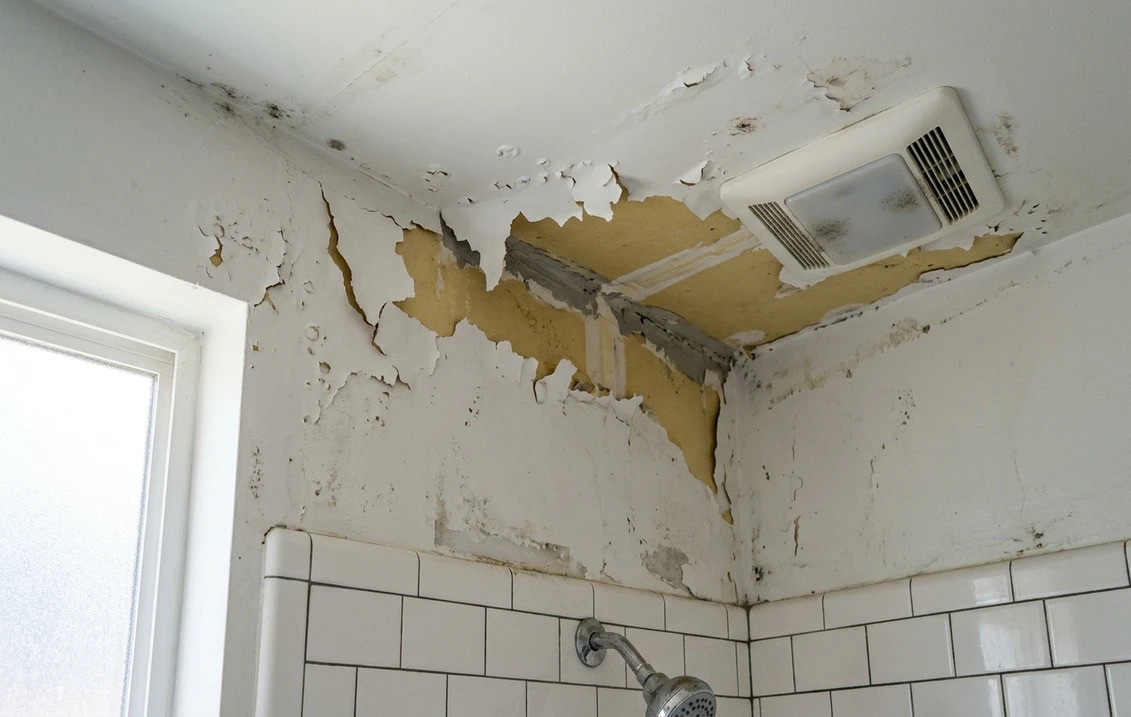
| Blisters and curling flakes on a bathroom or kitchen ceiling | Steam, weak exhaust | Ceiling stays wet after a shower; tissue will not cling to the running fan | Fix the fan, scrape, seal, repaint |
| A patch that spreads after rain or under a bathroom, often with a brown ring | Leak | Moisture meter against a dry wall; look at the roof and pipes above | Repair, dry out, stain-blocking primer |
| Blisters low on a basement or outside wall | Water moving through the wall | Damp in every season, not only after showers | Not a painting job until the source is fixed |
| Paint comes off in sheets, like skin, with bare drywall paper or joint compound behind | No primer, or sanding dust left on the wall | The back of the film looks powdery; failures follow the seams | Scrape, remove dust, seal or prime |
| Latex peeling in strips from a shiny layer | Oil or gloss paint never sanded or primed | Rubbing alcohol test, below | Clean, sand, bonding primer |
| Old ceiling, chalky behind the flakes, paint falling in large strips | Calcimine under later paint | A damp sponge turns white on the bare patch | Seal with Gardz or shellac |
| Cracking and peeling soon after wallpaper came down | Old paste reactivated by water-based paint | Slippery film when the wall is wetted | Wash, then seal with Gardz |
Try it on your room
No photo? Try a sample
Bubbling is often the same failure at an earlier stage. Benjamin Moore's blistering page says the loss of adhesion usually comes from heat, moisture or both, and eventually leads to peeling. Dunn-Edwards' paint problem solver gives a useful test: break a blister open. If only the newest coat lifted, heat is the likely cause. If several coats lifted and the bare surface shows, suspect moisture. In a pre-1978 home, read the lead section first.
Then measure the problem. Sherwin-Williams' interior peeling guide says to test the coating in a 6 to 12 inch radius around any peeled area. Our suggestion: press painter's tape onto paint that looks sound and pull it away. If paint comes off, the failure is wider than the visible patch.
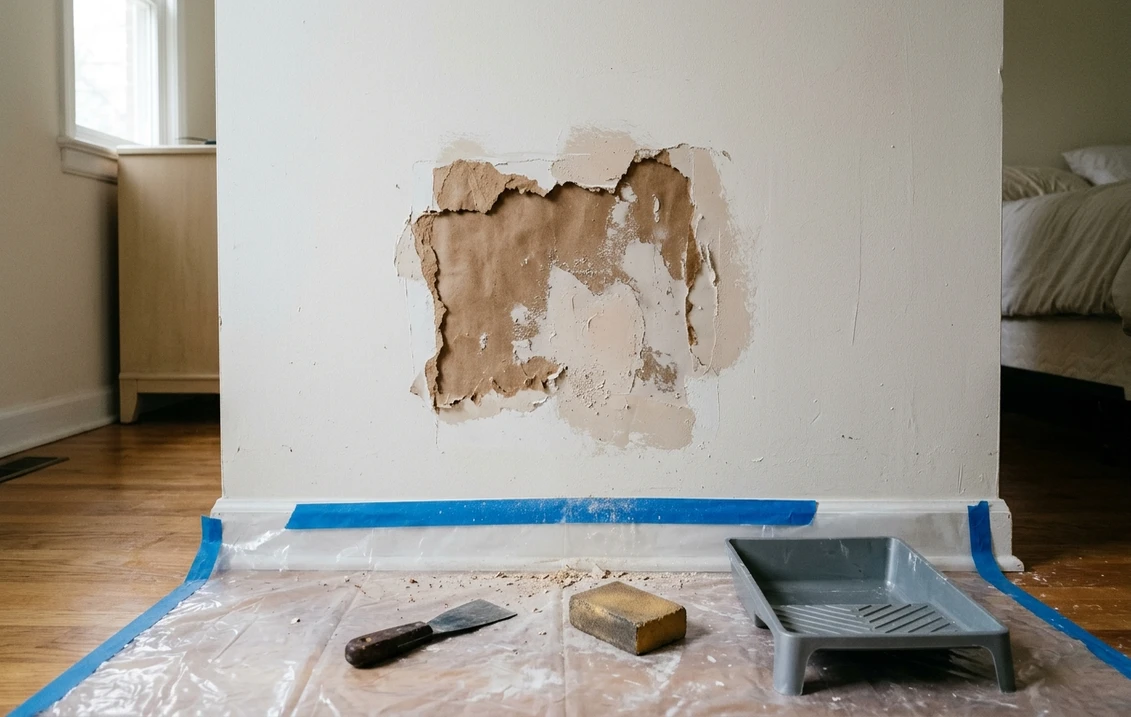
Paint peeling off drywall
A drywall wall is really two surfaces: face paper and joint compound. USG's answer on priming explains that a drywall primer evens out their differences in texture and porosity. Benjamin Moore lists priming new joint compound with a latex primer among its ways to prevent blisters. USG's finishing white paper adds that all sanding dust must come off before any surface treatment, and warns that not every two-in-one paint and primer will equalize the surface. The paper is about appearance, but dust under paint is also a weak bond, by our reading.
The product depends on what the scraper uncovers:
- Previously painted drywall with failing edges. Peel Stop Clear (PST-02, rev. 11/2018) names previously painted drywall, plaster and ceilings among its interior surfaces. The thicker Triple Thick (PST-01, rev. 01/2022) is also rated for interior use, and its list has walls and plaster but does not name drywall. It also says it does not replace drywall mud.
- Torn brown paper. Zinsser Gardz (GDZ-01, rev. 01/2023) seals damaged facing paper and prevents the bubbles that form when it is skim coated. Sequence, from the B-I-N sheet (BIN-03): spot prime the tear with Gardz, skim coat with drywall mud, then prime the whole area. Gardz wants joint filler within 14 days and paint within 7.
- Bare, never-painted board. KILZ describes its PVA Drywall Primer (search extract) for new, uncoated drywall. So it is a poor fit for a failing painted wall, by our reading.
- Soft, sagging or crumbling board. We would replace it, since primer will not rebuild it. EPA's mold and moisture guide says to dry water-damaged materials within 24 to 48 hours, and names the back of drywall as a place mold can hide.
How dry is dry? Of the sheets we read, only B-I-N sets a figure: substrate moisture no higher than 12%. Our suggestion: compare a pin meter reading on the repair with a sound, dry part of the same wall, and wait until they match.
Paint peeling from a bathroom ceiling
Sherwin-Williams says moisture works through the film and pushes it off, and that proper ventilation can fix most interior moisture problems. So deal with the air first. Three published numbers help:
| Question | What the source says | Source |
|---|---|---|
| Minimum fan capacity | At least 50 cfm run intermittently, or at least 20 cfm run continuously, citing ASHRAE 62.2 and the IRC | DOE Building America Solution Center |
| Sizing by room | 1 cfm per square foot in bathrooms up to 100 sq ft, so 40 cfm for a 40 sq ft bath | Home Ventilating Institute |
| Indoor humidity | Below 60%, ideally 30 to 50% | EPA mold guide |
For a small bath, the 50 cfm floor beats the HVI figure, so we would buy to the larger number. DOE also says to vent outdoors, never into an attic or crawlspace, and suggests a timer. Run times differ: DOE suggests one hour after a shower, HVI 20 minutes after using the bathroom. If paint keeps failing, start with the longer one.
Then rule out a leak. A brown ring points to water from above, not steam. Sherwin-Williams' blistering guide sets the order for water damage: fix the source, let the surface dry completely, scrape and sand, then use a stain-blocking primer. The B-I-N sheet lists water stains among those it blocks, usually in one coat. KILZ positions Restoration for heavy stains including water (search extract). The KILZ 2 data sheet (Lowe's copy) claims only minor water stains, so it is the wrong pick for a dark ring.
Mold changes the job. EPA says not to paint or caulk moldy surfaces, and that a patch under about 10 sq ft is usually a DIY job. For the topcoat, Sherwin-Williams names Duration Home for moist rooms. Compare the options in our mold-resistant paint guide, or check Sherwin-Williams ceiling paints and the Benjamin Moore Waterborne Ceiling review. Benjamin Moore warns against exposing latex to moisture soon after it dries, without giving a figure; our paint drying time guide explains dry versus cure.
Gloss, oil paint and dirty walls
Sherwin-Williams names latex over oil, and the reverse, as a cause of bubbling, along with surfaces contaminated by oil, wax, grease or silicone. Benjamin Moore lists oil-based or alkyd paint over latex.
Dunn-Edwards' guide to oil-based surfaces gives the usual check: rub the paint with a cotton ball soaked in rubbing alcohol. Paint on the cotton means latex. Nothing means oil. Its prep is strict: clean off grease, sand until the gloss is essentially flat, wipe the dust, then apply a premium primer. It says scuff sanding and chemical deglossers are not enough.
Makers differ here. KILZ 2's sheet says to scuff sand glossy surfaces thoroughly for maximum adhesion. B-I-N's sheet claims excellent adhesion to gloss without scuff sanding, while the Sherwin-Williams flaking guide names Extreme Bond Primer. Our reading: follow the sheet for the primer you buy, and sand anyway when a heavy shine remains and lead is not a concern. Cleaners differ too: the KILZ 2 sheet accepts a TSP substitute, while the B-I-N sheet says household ammonia and water, not TSP.
Old plaster, calcimine and wallpaper paste
If an old ceiling sheds in long strips, look at its first coat. The National Park Service's Preservation Brief 28 explains that a stronger paint pulls off a weaker one that is losing its bond, which is why oil or alkyd paint over old calcimine peels in large strips on many older ceilings. Calcimine is the common American name for distemper, a water-based paint.
The brief calls calcimine difficult to remove. It describes breaking it down with vinegar and coating any remaining chalk with white shellac as a stable base. B-I-N is shellac-based, although neither the brief nor its sheet links the two. The Gardz sheet offers a water-based route: it penetrates calcimine and stops water-based topcoats softening it. On decorative or historic plaster, get specialist advice before removing anything. A house this old also needs the lead precautions below.
Wallpaper paste is simpler. Gardz warns that water-based coatings reactivate old adhesive and cause cracking and peeling, and it can seal in the residue. The Peel Stop and KILZ 2 sheets want the surface free of adhesive or paste, so wash the wall first and use Gardz for what is left. Our KILZ vs Zinsser primer guide compares these primer families on sound surfaces.
Before you scrape: lead in homes built before 1978
EPA's lead page says the federal government banned lead-based paint for homes in 1978, and that sound lead paint is usually not a problem, but paint that peels or chips can become a hazard before anyone scrapes it. The odds rise with age:
| Home built | Share likely to have lead-based paint (EPA) |
|---|---|
| Before 1940 | 87% |
| 1940 to 1959 | 69% |
| 1960 to 1977 | 24% |
- Find out first. EPA's guidance for DIYers recommends a certified lead inspector or risk assessor, and says to assume lead if you cannot establish the home's age.
- Do not lean on a kit. EPA's test kit page recognizes kits when used by certified renovators or trained professionals, and only recognizes tests by certified inspectors, risk assessors and renovators.
- Contain and mist. Seal doors, cover floors with plastic, shut off forced air and cover vents. Mist before scraping or sanding, and keep non-workers out.
- Protect yourself and clean up. The data sheets call for a NIOSH-approved respirator, a HEPA vacuum and a wet mop, and warn especially about children and pregnant women. The National Lead Information Center is at 1-800-424-LEAD.
If you hire it out or rent. EPA's RRP program requires certification for anyone paid to disturb paint in pre-1978 homes. It generally does not cover homeowners working on their own home, but it does if you rent out part of it. The contractor page exempts minor repairs that disturb 6 sq ft or less of paint per room inside, and a peeling ceiling can pass that quickly. If you are a tenant, we suggest reporting peeling paint to the landlord in writing rather than scraping it. For detail, see our lead paint testing and removal guide and EPA RRP compliance guide.
How to fix peeling paint on a wall, step by step
- Stop the cause. Repair the leak, fix the fan, deal with the damp.
- Check for lead if the home predates 1978, and protect the floor and furniture.
- Scrape to a sound edge. Sherwin-Williams says peeling paint must be completely removed, and every sheet we read asks for loose paint to come off. Our Zinsser Peel Stop data sheet guide, a page focused on exterior use, explains why "coat right over" claims do not change that.
- Sand the edges smooth. If lead is possible, follow the precautions above instead of dry sanding.
- Clean and dry. Remove dust, grease and mildew, then let the wall dry completely.
- Seal or prime. Use the table below. The Peel Stop Clear sheet asks for a second coat if dull spots appear.
- Fill and smooth. Use joint compound or spackling, sand it, and spot prime it, because filler is porous.
- Repaint. Sherwin-Williams suggests two thin coats. For an even finish over Peel Stop Clear, which dries with a slight sheen, its sheet suggests Bulls Eye 1-2-3 or Cover-Stain first.
Which primer for peeling paint: Zinsser and KILZ compared
| Product | Use it for | Coverage per gallon | Topcoat after | Limits |
|---|---|---|---|---|
| Zinsser Peel Stop Clear | Failing edges on painted drywall, plaster, ceilings | 300 to 400 sq ft | 2 hours | Not for chronic moisture; 50 to 90°F; humidity below 85% |
| Zinsser Peel Stop Triple Thick | Cracked, uneven plaster and walls; dries white | 50 to 200 sq ft | 2 hours | Not a substitute for filler or drywall mud; 40 to 90°F |
| Zinsser Gardz | Torn paper, bare drywall, joint compound, calcimine, paste residue | 350 to 450 sq ft | 3 hours, before 7 days | Interior; do not thin; 50 to 90°F; humidity below 85% |
| Zinsser B-I-N (shellac) | Water stains, glossy surfaces | About 500 sq ft | 45 minutes | Substrate moisture up to 12%; humidity below 70%; respirator and ventilation |
| KILZ 2 All-Purpose | Sound, scraped walls; minor water stains | 300 to 400 sq ft | 1 hour | Scrape peeling paint first; thinning not recommended; 50 to 90°F |
| KILZ Restoration (search extract) | Heavy water stains, interior | 300 to 400 sq ft | 1 hour | Test a small section for bleed-through |
| KILZ PVA Drywall (search extract) | New, uncoated drywall only | 300 to 400 sq ft | 2 hours | 50 to 90°F; not for a failing painted wall, by our reading |
No KILZ document we read presents a binding product for failing paint: its KILZ 2 sheet (Home Depot copy) says to scrape off loose paint and sand to a smooth surface. That is the practical difference: Peel Stop sets out to glue down remaining edges, while the KILZ primers above go over a surface you have made sound. Times assume about 70 to 80°F and 50% humidity; cooler or wetter rooms take longer. For a larger area, use our paint coverage calculator guide.
How much primer you need
Two worked examples for one coat over the whole area, from the makers' coverage figures (our arithmetic). Spot priming takes less; porous surfaces and second coats take more.
| Area | Peel Stop Clear or KILZ 2 | Gardz | Triple Thick |
|---|---|---|---|
| Bathroom ceiling, 5 by 8 ft (40 sq ft) | 0.10 to 0.13 gal: 1 quart | 0.09 to 0.11 gal: 1 quart | 0.2 to 0.8 gal: 1 gallon to be safe |
| Bedroom ceiling, 10 by 12 ft (120 sq ft) | 0.30 to 0.40 gal: 2 quarts | 0.27 to 0.34 gal: 2 quarts | 0.6 to 2.4 gal: 1 to 3 gallons |
When to call a pro, and how to stop it coming back
Bring someone in if a whole ceiling is shedding, if drywall or plaster rather than paint is coming away, if lead is confirmed, or if you cannot find the source of the damp. A plumber or roofer may need to go first. Our ceiling painting cost guide, bathroom painting cost guide and interior painting cost guide help you budget.
To prevent a repeat: prime new drywall and joint compound, clean off dust and grease before every repaint, run the fan through and after showers, respect the limits on the can, and never paint a damp surface.
Wall repaired? Now see the color on it
The visualizer cannot fix a peeling wall. It can show how a new color may look in your own room, from a photo, before you buy the topcoat. More on the tool: our interior paint visualizer.
Compare colors on my roomSources and references
- Rust-Oleum / Zinsser data sheets: Peel Stop Clear PST-02, Peel Stop Triple Thick PST-01, Gardz GDZ-01, B-I-N BIN-03: uses, limits, coverage, drying.
- KILZ data sheets for KILZ 2: No. 2000 (Lowe's copy) and label sheet (Home Depot copy). KILZ, Restoration and PVA Drywall Primer (search extracts only).
- Sherwin-Williams, interior paint peeling, paint blistering and flaking, cracking and peeling: causes and repair order.
- Benjamin Moore, paint blistering troubleshooting. Dunn-Edwards, blistering and refinishing oil-based surfaces: heat and moisture check, alcohol test.
- USG, First Coat primer FAQ and Finishing and Decorating Gypsum Panels: porosity, primer, sanding dust.
- U.S. EPA, Protect your family from lead, lead-safe renovations for DIYers, lead test kits, RRP program and RRP for contractors; A brief guide to mold, moisture and your home.
- U.S. Department of Energy, Building America Solution Center (PNNL), bathroom exhaust fans. Home Ventilating Institute, bathroom ventilation: fan sizing and run time.
- National Park Service, Preservation Brief 28: Painting Historic Interiors: calcimine, strip peeling, removal.
Frequently asked questions
Why is paint peeling off my wall?
Why is the paint bubbling on my walls?
Can you paint over peeling paint?
Why is paint peeling off my drywall?
Why is paint peeling from my bathroom ceiling?
What primer should I use on peeling paint?
Is it safe to scrape peeling paint in an old house?
Trademarks mentioned (Sherwin-Williams, Benjamin Moore, Behr, Caparol, Brillux, Sto, Alpina, Valspar, PPG, Glidden, Dulux, Crown Trade, Sandtex, Farrow & Ball, Johnstone's, Leyland) are property of their respective owners. FacadeColorizer is independent and not affiliated with any of them. Nominative fair use under Lanham Act §1125.