Try it on your room

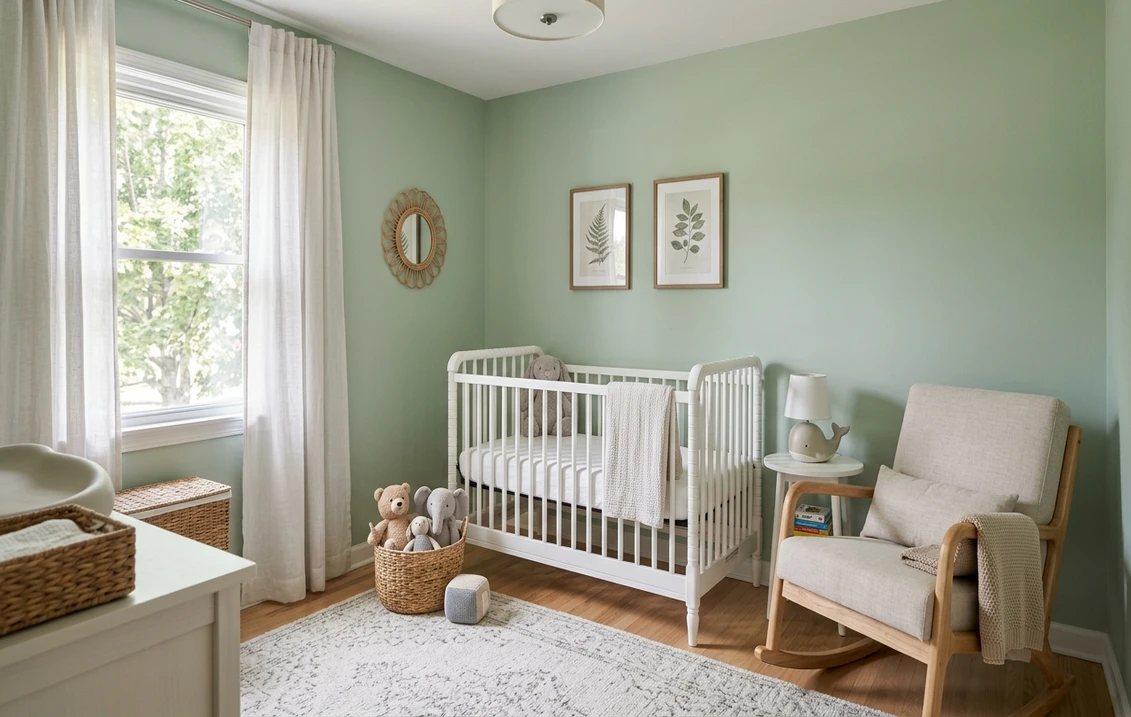
Short answer: the best nursery paint in the UK is a water-based matt emulsion in the Trace or Minimal band of the British Coatings Federation VOC globe, applied weeks rather than days before the baby uses the room. If you also want to paint a cot, toy box or shelf, choose a product its maker declares compliant with EN 71-3, the toy-safety standard, because Dulux states that none of its paints are suitable for children's toys or furniture. The colours that suit a nursery best are soft greens, pale blues, dusty pinks and warm off-whites; twelve real shades from Farrow & Ball, Little Greene and Earthborn are listed below.
This guide is written for UK parents choosing paint for a nursery: what the law caps, what the VOC labels on the tin mean, what Dulux and other makers actually say about babies, how long to air the room, which finish to choose and which colours work in a typical British house with limited daylight. Where no official figure exists, for example on how many hours to wait before the baby sleeps in the room, we say so rather than invent one.
What the law caps, and what it does not
Every interior paint sold in the UK already has a legal ceiling on solvent content. Schedule 2 of the Volatile Organic Compounds in Paints, Varnishes and Vehicle Refinishing Products Regulations 2012 sets the limits by product category. Category (a), "interior matt walls and ceilings" with a gloss of 25 or less at 60 degrees, is capped at 30 grams of VOC per litre. Category (b), glossy walls and ceilings above that gloss level, is capped at 100 g/l. You will often see ISO 11890-2 mentioned next to these numbers: it is the laboratory method used to measure VOC content, not a limit in itself.
Two practical points follow. First, any matt emulsion on a UK shelf is already at or under 30 g/l, so "baby-safe" on a tin means the maker has gone further than the law, not that other paints are illegal. Second, a soft sheen or silk that measures above 25 gloss units falls in the 100 g/l category, so a higher sheen does not automatically mean a lower-VOC paint.
Low odour paint for a nursery: reading the VOC globe
Most UK tins carry a small globe symbol with a band name. It comes from the British Coatings Federation VOC Globe Scheme, a voluntary scheme originally devised by B&Q. The bands are set as a percentage of VOC by weight, which works out at roughly the grams per litre divided by ten:
| Globe band | VOC content | Approx. g/l | For a nursery |
|---|---|---|---|
| Trace | under 0.1% | under 1 | Best choice |
| Minimal | 0.1 to 0.29% | 1 to 2.9 | Very good |
| Low | 0.30 to 7.99% | 3 to 79.9 | Acceptable, check the exact figure |
| Medium | 8 to 24.99% | 80 and above | Avoid for walls |
| High / Very high | 25% and above | 250 and above | Solvent products, avoid |
Try it on your room
No photo? Try a sample
The Low band is wide: a paint at 4 g/l and one at 70 g/l both qualify. If a tin says Low, look for the exact maximum on the product page or data sheet. For a nursery, aim for Trace or Minimal, which is where most modern water-based matt emulsions from the big brands now sit.
Is Dulux paint safe for babies?
Dulux answers this directly in its kids' bedrooms FAQ: "Once it is dried and any residual odour from the paint has gone… it is safe for a child to sleep in the bedroom." The same page adds that "none of our paints are suitable for painting your child's toys or furniture", because toys and children's furniture fall under the Toy Safety Directive. So Dulux emulsion is fine for nursery walls and ceilings once dry and odour-free, but it is not the product for a cot.
On VOCs, Dulux Trade states that Diamond Matt is "99.9% VOC free", measured on in-can content under ISO 11890-2, with a Class 1 wet-scrub rating under ISO 11998 and testing up to 10,000 scrubs. That makes it a strong choice for the toddler years, when hand prints arrive at skirting level. Dulux also notes for pregnant parents that you can "expect no problems" if you ventilate the room well and do a little at a time, and recommends water-based paint because solvent-based products can cause nausea. One more detail worth knowing: like most water-based emulsions, Dulux matt contains a small amount of preservative (C(M)IT/MIT), which the label flags as a possible cause of an allergic reaction in sensitive people, another reason to ventilate and keep the baby out while you paint.
The best paint for nursery walls: five options compared
"Premium nursery paint" is a marketing term, not a standard. The useful questions are the VOC band, whether the maker declares EN 71-3 compliance (only relevant if you paint furniture or toys), how washable the finish is, and the sheen. Here is what the makers themselves publish:
| Paint | What the maker states | Best use in a nursery |
|---|---|---|
| Farrow & Ball Modern Emulsion | 7% sheen, "washable and wipeable", "toy safe", A+ for indoor air quality; colour pages cite EN 71-3:2019+A1:2021 | Walls that need wiping, plus small furniture |
| Earthborn Claypaint | "Virtually VOC free", meets EN 71-3:2019+A1:2021, breathable clay paint | Ultra-matt walls, older solid-wall houses |
| Dulux Trade Diamond Matt | "99.9% VOC free", Class 1 ISO 11998, tested to 10,000 scrubs | Hard-wearing walls for the crawling and toddler years |
| Dulux Heritage Velvet Matt | Data sheet: maximum 10 g/l VOC, Low band | Heritage colours on walls, painted well ahead |
| Little Greene Intelligent Matt | Water-based washable matt; check the current data sheet for VOC and EN 71-3 | Deeper heritage colours that must stay washable |
Farrow & Ball describes its Modern Emulsion as toy safe and rated A+ for indoor air, and Earthborn reports that its child-safe paints pass the latest toy safety standard, EN 71-3:2019+A1:2021, across Claypaint, Eco Chic, Lifestyle and its Eggshell No.17. If you are torn between the two big heritage brands, our Farrow & Ball vs Little Greene comparison covers finish and price, and Dulux Heritage vs Farrow & Ball covers the cheaper heritage route.
How long after painting can a baby sleep in the room?
There is no official UK figure in hours. NICE guideline NG149 on indoor air quality at home recommends increasing ventilation, for example by opening windows if possible and safe, when using paints, and following the product instructions. Dulux's criterion is the paint being dry and any residual odour gone. Anything more precise you read, such as a "72-hour rule", is cautious practice, not a standard.
The timing is easier than it sounds because of NHS safe-sleep advice. The NHS page on sudden infant death syndrome says to put the baby in a cot in the same room as you for every sleep for at least the first 6 months, and its guide to helping your baby to sleep repeats the same six-month rule. In most homes the nursery is a changing and play room first and a bedroom later, so painting during the second trimester or in the first months leaves plenty of airing time. A sensible sequence:
- Paint with the windows open and the door to the rest of the house closed.
- Keep the window open or on the latch for several days after the last coat, until there is no paint smell at all.
- Bring in the cot mattress and soft furnishings only after the odour has gone, so fabrics do not hold the smell.
- Once the baby sleeps there, keep the room between 16 and 20°C, the range both the NHS and The Lullaby Trust recommend, noting that the risk of SIDS is higher in babies who get too hot.
12 nursery paint colours for UK homes
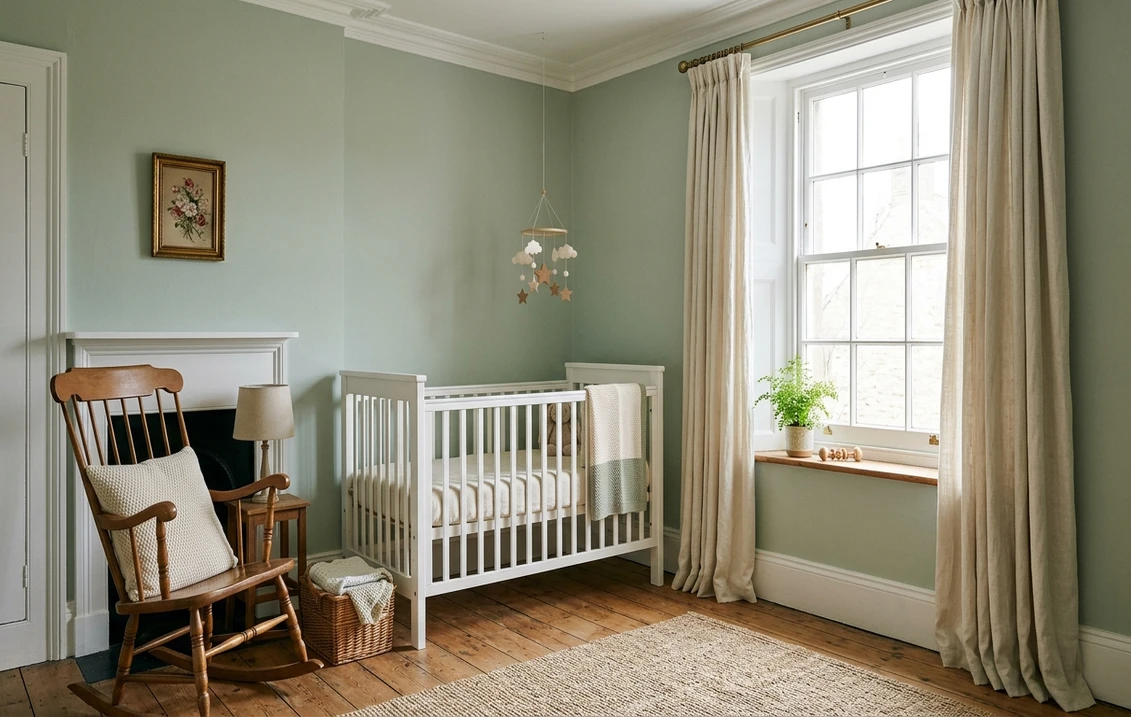
British nurseries are often small second or third bedrooms with one window, so the colours below lean soft and light. Each name and number has been checked on the maker's own website; descriptions in quotation marks are the maker's words.
Soft greens
- Farrow & Ball Mizzle No.266: "a soft grey green" named after West Country evening skies. A calm, gender-neutral green that does not turn minty in north light.
- Farrow & Ball Cromarty No.285: "neither too blue nor too grey", with a muted softness. Reads as a pale green-grey in most rooms.
- Farrow & Ball Teresa's Green No.236: "an aqua fresh tone" with a blue base and soft green undertones. Brighter than the two above, good in a south-facing room.
Pale blues and greys
- Farrow & Ball Borrowed Light No.235: "a wonderfully pale blue", almost white on a dull day.
- Farrow & Ball Skylight No.205: "a pale and traditional blue", a little more colour than Borrowed Light.
- Farrow & Ball Pavilion Gray No.242: "a cool mid grey" with subtle blue undertones, the choice for a nursery that will grow into a child's room.
Dusty pinks and lilac
- Farrow & Ball Setting Plaster No.231: "a dusty plaster pink", warm without being sugary.
- Farrow & Ball Calamine No.230: a paler, lighter pink for a softer result.
- Earthborn Lily Lily Rose: a blush pink from Earthborn's Claypaint range, the brand's colour of the year in 2022.
- Farrow & Ball Calluna No.270: "a tranquil lilac" named after Scottish heather.
Warm off-whites
- Farrow & Ball Dimity No.2008: "a very pale taupe", a soft white that avoids the cold look of brilliant white.
- Farrow & Ball Skimming Stone No.241: named after a 19th-century plaster colour, a warm stone neutral that suits a north-facing room. Little Greene's Slaked Lime No.105 plays a similar role in that brand's range.
Farrow & Ball no longer publishes light reflectance values on its colour pages, so we do not quote LRV figures here. Test two or three finalists as large painted sample boards at different times of day, as described in our guide on how to test paint colours before buying. For colours that will last into the school years, see the child's bedroom paint colours guide.
Matt or soft sheen paint for a nursery?
Dulux's guide to paint finishes sums up the trade-off: matt is "smooth, velvety and helps to hide imperfections", while on silk "lumps and bumps may show up a bit more", although "you can wipe silk wall finishes easily". Soft sheen sits between the two. In a nursery the walls are rarely perfect, and a low sheen also limits glare from a night light, so matt is the usual choice for walls and ceiling.
The modern answer to washability is not more sheen but a washable matt. Products rated Class 1 for wet scrub resistance, such as Dulux Trade Diamond Matt, keep the matt look and survive repeated wiping. Use an eggshell on skirting, door and window frames, which take the knocks. Avoid solvent-based gloss in the room altogether: it sits in the higher VOC bands and the smell lingers.
Older houses: solid walls and breathable paint
Many British nurseries are in Victorian or Edwardian houses with solid brick walls and lime plaster. On these walls a breathable finish, such as a clay paint or a limewash, lets moisture move through the wall instead of being trapped behind a plastic film, which helps avoid damp patches. Our interior limewash guide explains when lime is the right choice, and the period property colours guide covers colours that suit cornices and picture rails. If the nursery is above a bathroom or has a cold outside wall with condensation, deal with the damp first; no paint fixes it.
Cots, shelves and furniture
Children's furniture is the one place where the toy-safety standard matters. EN 71-3 limits how much of certain elements, such as lead, can migrate out of a coating if a child chews or sucks it. Dulux says its paints are not intended for children's toys or furniture. Farrow & Ball and Earthborn both declare EN 71-3:2019+A1:2021 compliance for specific products, and Farrow & Ball sells eggshell finishes intended for woodwork. Whichever you use, sand and prime bare wood properly, let the furniture cure for the full time on the tin, and never paint a cot while the baby is using it. If the cot is second-hand and older, assume it may carry old paint and strip it rather than painting over.
A simple nursery painting plan
- Choose the colour on a photo first. Preview two or three shades on a picture of the room, then buy sample pots only for the finalists.
- Pick the paint by its band. Trace or Minimal on the VOC globe for walls and ceiling, a washable matt if the room will become a playroom.
- Paint early. The baby sleeps in your room for at least six months, so there is time to finish and air the nursery well before it becomes a bedroom.
- Ventilate and wait for the smell to go. Follow the tin, keep windows open and move soft furnishings in last.
- Furniture separately. Use an EN 71-3 product for anything the child can reach and chew.
If you would rather hand the job to a decorator, our interior decorator cost guide gives UK day rates, and the small bedroom colours guide helps when the nursery is a box room.
Sources and references
- UK legislation, SI 2012/1715, Schedule 2: VOC limits of 30 g/l for interior matt walls and ceilings and 100 g/l for glossy ones.
- British Coatings Federation, VOC Globe Scheme: Trace, Minimal, Low, Medium, High and Very High bands.
- Dulux UK, Kids' bedrooms FAQ (sleeping in a painted room, toys and furniture, pregnancy) and Paint finishes explained.
- Dulux Trade, Diamond Matt: VOC, scrub class and scrub testing.
- Farrow & Ball, Modern Emulsion and colour pages for Mizzle, Cromarty, Teresa's Green, Borrowed Light, Skylight, Pavilion Gray, Setting Plaster, Calamine, Calluna, Dimity and Skimming Stone.
- Earthborn, Our child safe paints pass the latest Toy Safety Standard: EN 71-3:2019+A1:2021.
- NICE, NG149 Indoor air quality at home: ventilation when using paints.
- NHS, Sudden infant death syndrome and Helping your baby to sleep: room-sharing for at least six months, room temperature.
- The Lullaby Trust, Room temperature: 16 to 20°C.
Dulux, Farrow & Ball, Little Greene and Earthborn are trade marks of their owners. FacadeColorizer is independent and not affiliated with any paint maker. This guide is general information, not medical advice; follow the instructions on the tin and NHS safe-sleep guidance.
Frequently asked questions
What is the best paint for a nursery in the UK?
Is Dulux paint safe for babies?
What is the best low odour paint for a nursery?
How long after painting can a baby sleep in the nursery?
Should I use matt or soft sheen paint in a nursery?
Can I paint a cot with normal emulsion?
What colours are best for a nursery?
Trademarks mentioned (Sherwin-Williams, Benjamin Moore, Behr, Caparol, Brillux, Sto, Alpina, Valspar, PPG, Glidden, Dulux, Crown Trade, Sandtex, Farrow & Ball, Johnstone's, Leyland) are property of their respective owners. FacadeColorizer is independent and not affiliated with any of them. Nominative fair use under Lanham Act §1125.