Try it on your house

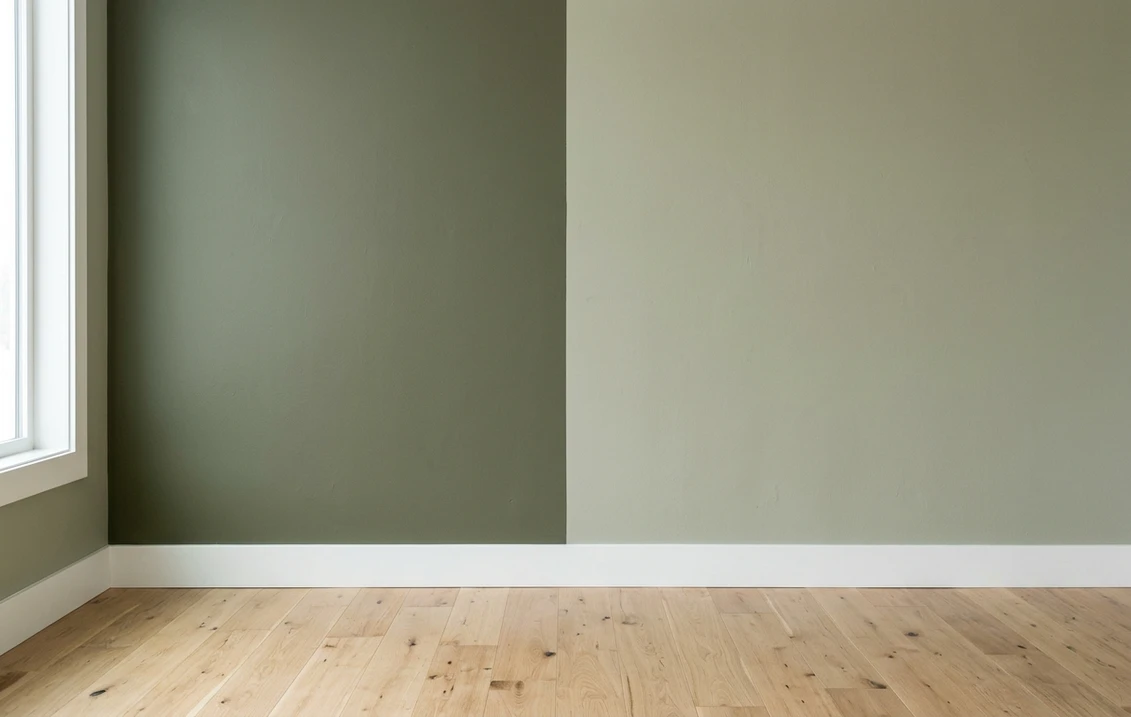
The verdict in three lines. Dried Thyme SW 6186 is the deep sage: an earthy, olive-leaning green built for cabinets, front doors, and moody accent walls.
Clary Sage SW 6178 is the light sage: a soft, silvery gray-green that is pale enough to wrap a whole room without closing it in.
Unlike most duels, undertone is not the battleground here. Both are muted gray-based sages; depth decides everything, so the real question is how much green your room can carry.
Sherwin-Williams Dried Thyme (SW 6186) and Clary Sage (SW 6178) keep landing on the same shortlists because they solve the same brief: a calm, gray-softened green that feels natural rather than minty. On chips they read like cousins. On a wall they behave like two different tools, because one is markedly darker than the other. This head-to-head puts the numbers side by side, plays the duel out room by room and exposure by exposure, and tells you exactly when each sage wins. For the general method behind any two-color decision, start with our side-by-side method for comparing paint colors.
The numbers side by side
| Attribute | Dried Thyme SW 6186 | Clary Sage SW 6178 |
|---|---|---|
| Family | Deep muted sage, olive lean | Light muted sage, silver lean |
| Depth | Mid-to-deep; clearly the darker of the pair | Light-to-mid; clearly the lighter of the pair |
| Approximate hex | #7B8070 | #ACAD97 |
| Approximate RGB | 123, 128, 112 | 172, 173, 151 |
| Undertone | Gray-olive, herbal and earthy | Gray-green, soft and slightly silvery |
| Loves | Brass, cream trim, warm wood, leather | Crisp white trim, light oak, linen, matte black |
| Watch out for | Can turn murky gray-olive in dim north light | Can wash toward pale gray in strong direct sun |
| Overall vibe | Grounded, botanical, a little moody | Airy, restful, spa-like |
Try it on your house
No photo? Try a sample
Sherwin-Williams publishes official LRV figures for both colors; check the current chip or the SW site for exact numbers. Hex and RGB above are approximate digital renderings; the authoritative reference is a physical Sherwin-Williams chip or peel-and-stick sample.
Read that table once and the shape of this duel is clear. In the greige wars, two near-identical depths fight over undertone. Here it is the opposite: the undertones are close relatives, both muted, both gray-based, both unmistakably sage. What separates them is a wide depth gap. Dried Thyme soaks up light and delivers a rich, dried-herb green that registers as a statement. Clary Sage bounces far more light back and behaves like a tinted neutral. That gap is also why this pair almost never produces a bad answer: pick wrong on undertone and a room feels off; pick between these two and you are really choosing between a feature color and a wall color.
Upload one photo, get a photorealistic render, then swap to Clary Sage in one click. Free, no signup.
Room by room, exposure by exposure
Because depth is the deciding factor, the winner in each room depends on how much natural light it gets and how much of the surface you plan to paint. Here is how the duel typically plays out.
| Situation | Usual winner | Why |
|---|---|---|
| All four walls, average light | Clary Sage | Light enough to wrap a room; Dried Thyme on every wall demands generous daylight |
| North-facing bedroom or office | Clary Sage | Flat, cool light can push Dried Thyme toward a murky gray-olive; Clary Sage keeps the room open |
| Bright south-facing room | Dried Thyme | Strong sun keeps its depth rich, while it can bleach Clary Sage toward pale gray |
| Kitchen cabinets or island | Dried Thyme | The deeper green reads custom and grounds light counters and walls |
| Spa-style bathroom | Clary Sage | Its silvery softness flatters white tile and keeps small rooms calm, not dark |
| Front door or exterior accents | Dried Thyme | Deeper colors hold their character in harsh outdoor light; sample outside first |
If this shortlist is really about a soft, light-filled palette rather than depth, the coastal pair in our Sea Salt vs Rainwashed coastal duel is the logical next comparison. And if you are still deciding between green and a safer neutral, the Agreeable Gray vs Repose Gray greige duel shows how the same side-by-side method settles that question too.
When to choose Dried Thyme
- You want the green to be the feature. On an island, built-ins, a headboard wall, or a front door, Dried Thyme delivers a rich botanical statement that lighter sages cannot match.
- The room gets real daylight. Generous windows keep its olive depth alive all day instead of letting it slide toward gray.
- Your finishes are warm. Brass hardware, cream trim, walnut or oak furniture, and leather all sit naturally beside its earthy base.
- You are painting outside. Harsh exterior light visually lightens every color, and a deeper sage keeps its identity where a pale one can vanish against the trim.
For its full undertone breakdown, best rooms, and trim pairings, see the dedicated Dried Thyme undertones and best rooms profile.
When to choose Clary Sage
- You are painting all four walls. Clary Sage is pale enough to live on every surface of a bedroom, living room, or bath without shrinking the space.
- The room is dim or north-facing. Its higher light reflectance keeps low-light rooms feeling open where Dried Thyme would go somber.
- You want green as a whisper, not a statement. From across the room it reads as a warm-ish neutral; the green registers up close and in daylight.
- You are layering a restful palette. White trim, linen, light oak, and unlacquered metals build an easy, spa-like scheme on top of it.
The full room-by-room treatment, including its lighting behavior and companion shades, lives in the Clary Sage room-by-room profile. A duel decided by depth alone, with undertone sitting out, is rarer than it sounds. The gray version of it is Benjamin Moore Chelsea Gray against Kendall Charcoal: two neighbors on the Historic deck, about ten LRV points apart, and the same question of how much weight the room can carry.
Same wall, both sages, your actual light. Free render in about 30 seconds.
Frequently asked questions
What is the real difference between Dried Thyme and Clary Sage?
Depth, not undertone. Both are muted Sherwin-Williams sages with plenty of gray in the base, but Dried Thyme SW 6186 is a markedly darker, olive-leaning green while Clary Sage SW 6178 is a much lighter, silvery gray-green. On a wall they read as two depths of the same family rather than two competing undertones.
Is Dried Thyme darker than Clary Sage?
Yes, clearly. Hold the two chips side by side and Dried Thyme reads as a deep, herbal olive-sage while Clary Sage reads as a pale gray-green. The gap is wide enough that most designers treat them as different tools: Dried Thyme for statements and accents, Clary Sage for whole rooms.
Which is better for a north-facing room, Dried Thyme or Clary Sage?
Clary Sage for full walls, in most homes. North light is dim and cool, and it can push Dried Thyme toward a murky gray-olive that loses its charm. Clary Sage stays soft and keeps the room feeling open. Dried Thyme can still work in a north room as a cabinet or accent color where a moody reading is the point.
Can I use Dried Thyme and Clary Sage together?
Yes, and it is one of the easiest two-color pairings in the Sherwin-Williams deck. Because they share a sage character but sit far apart in depth, the contrast reads deliberate: Clary Sage on the walls with Dried Thyme on an island, built-ins, or a front door is a classic tonal scheme.
Settle it on your photo
Chips lie, screens lie, and sage greens are especially slippery because gray-based colors shift with every hour of daylight. The fastest honest answer to Dried Thyme vs Clary Sage is to test both on a photo of your actual room and let your own light, floor, and trim pick the winner. And once the winner is on the wall, our guide to the colors that go with sage green helps you build the rest of the palette around it.
1 HD render plus 3 free color variations. Start with Dried Thyme, swap to Clary Sage in one click.
Trademark notice. Sherwin-Williams®, Dried Thyme®, Clary Sage® and Evergreen Fog® are trademarks of The Sherwin-Williams Company. FacadeColorizer is not affiliated with, endorsed by, or sponsored by The Sherwin-Williams Company. Brand and color names are used for descriptive and editorial purposes only, consistent with nominative fair use. Hex and RGB values are approximate digital renderings; the only authoritative reference is a physical Sherwin-Williams color sample.
Trademarks mentioned (Sherwin-Williams, Benjamin Moore, Behr, Caparol, Brillux, Sto, Alpina, Valspar, PPG, Glidden, Dulux, Crown Trade, Sandtex, Farrow & Ball, Johnstone's, Leyland) are property of their respective owners. FacadeColorizer is independent and not affiliated with any of them. Nominative fair use under Lanham Act §1125.