Try it on your room

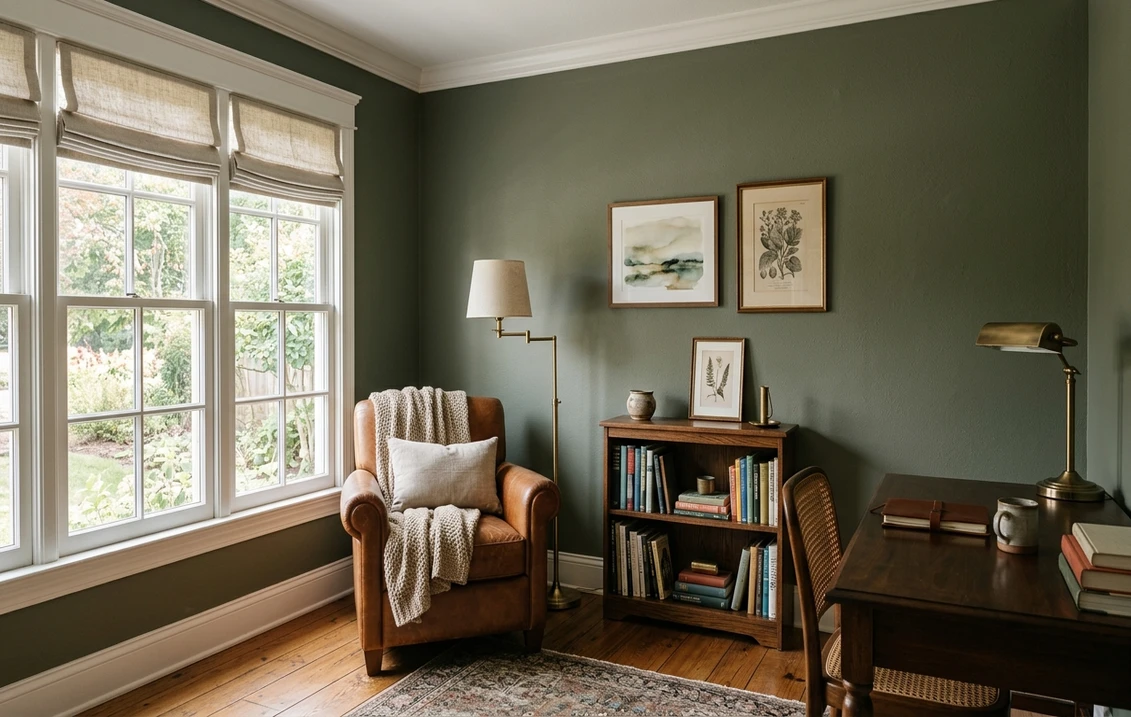
A dining room at dusk, candles lit, walls the color of a herb garden after the first frost: that is the promise of Sherwin-Williams Dried Thyme (SW 6186). It is a deep, dusty sage that behaves more like a soft neutral than a bold statement, a green designers reach for because it reads calm rather than loud. But it is also a moody, low-light color with an LRV of 21, and that single number explains both why it feels so enveloping and why it can fall flat in the wrong room.
This is a full color profile, not a swatch dump: the exact undertones, where Dried Thyme shines and where it sulks, how north versus south light tips its character, and the trim, ceiling, and decor that keep it from going murky. If you are still weighing greens, sages, and warm grays in general, our best interior paint colors for 2026 guide sets the wider scene.
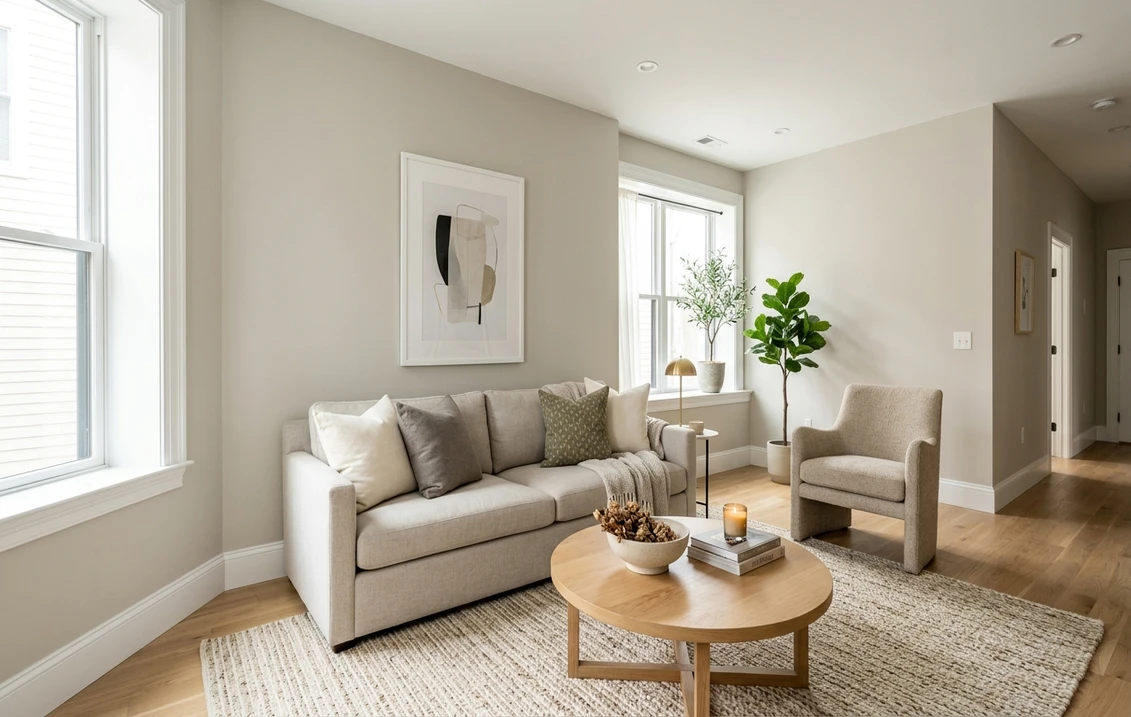
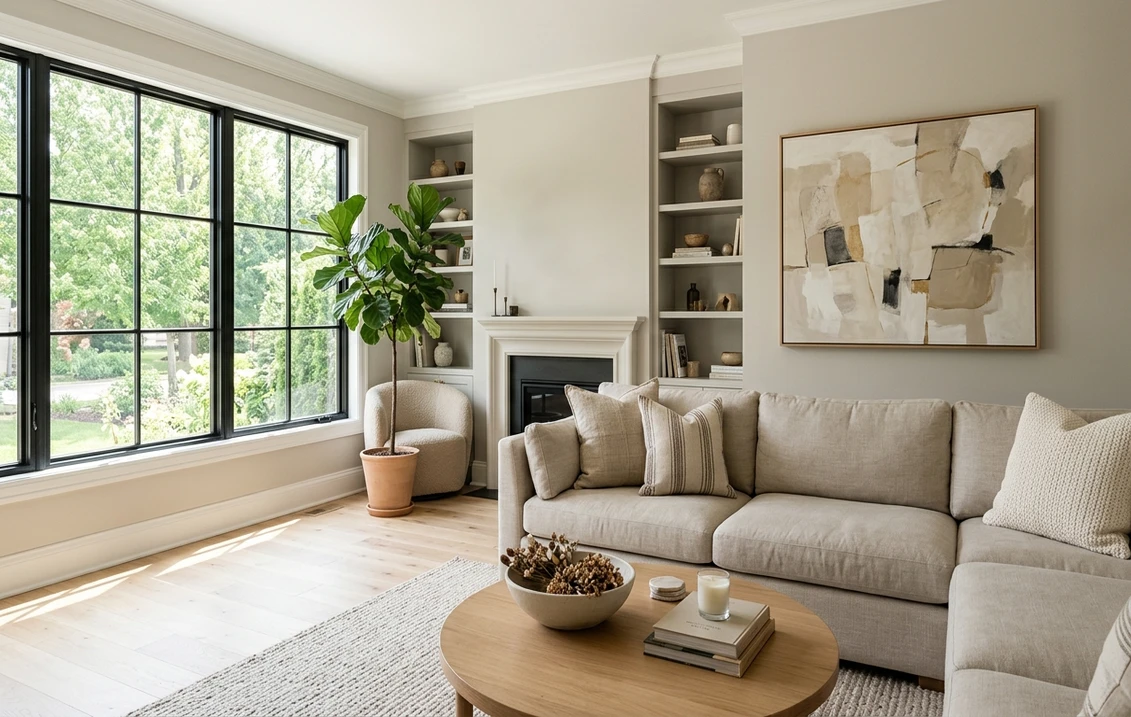
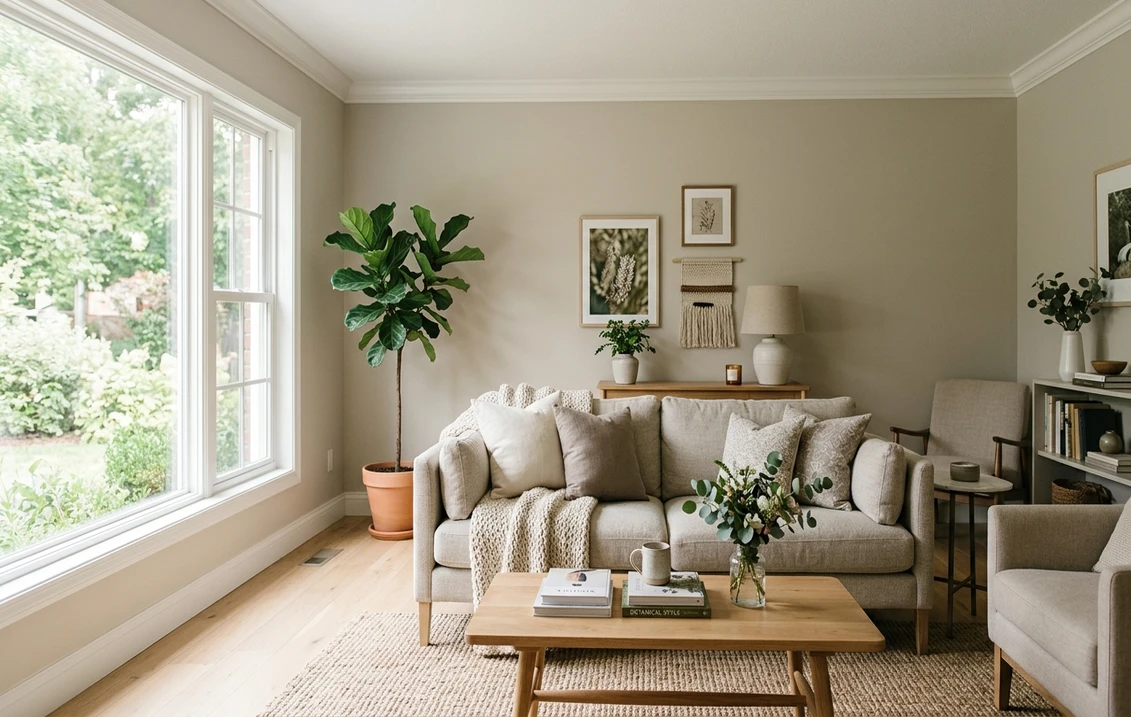
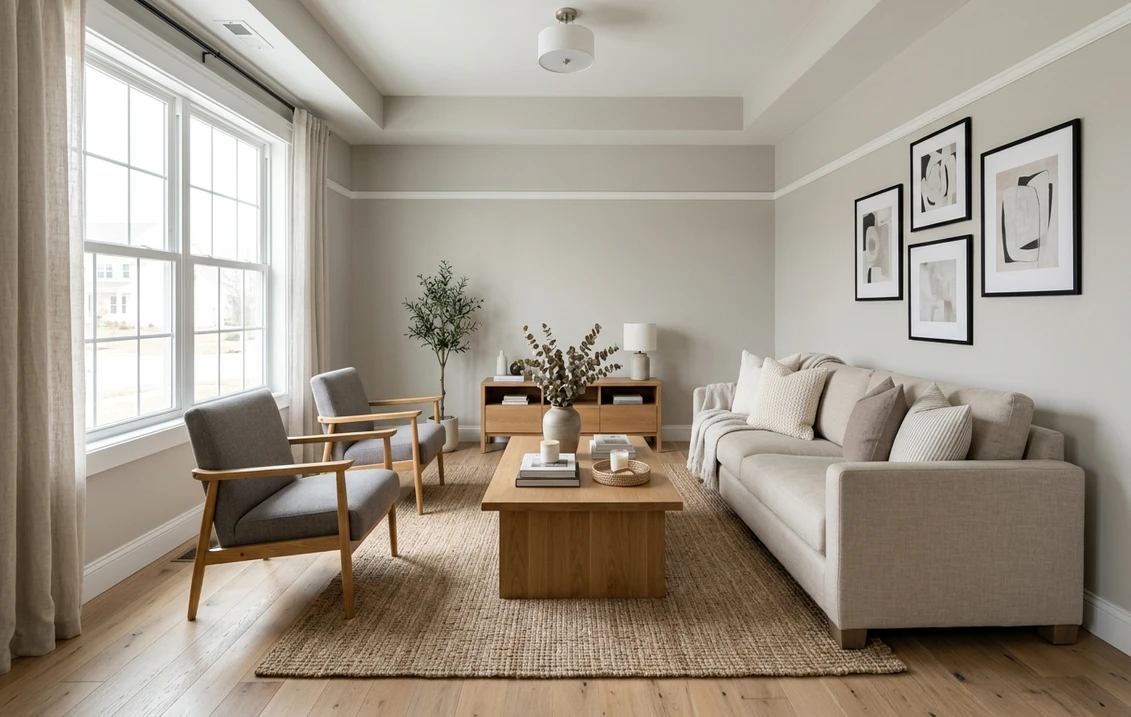
Upload a photo of your actual room and preview SW Dried Thyme under your own light in about 30 seconds, free.
The numbers behind Dried Thyme SW 6186
Before the mood, the math. These are the published values that determine how the color reads on a wall:
- SW color code: 6186.
- LRV (Light Reflectance Value): 21. That is firmly in deep-color territory. A wall at LRV 21 absorbs roughly four-fifths of the light that hits it, which is why Dried Thyme feels grounding and a little dramatic.
- Color family: muted sage green, sitting between a true gray-green and a soft olive.
- RGB approximation: 122, 124, 105, with near-equal red and green channels (the gray) and a lower blue value (the olive warmth).
- Collection: a long-running Sherwin-Williams favorite in farmhouse, English-country, and transitional schemes.
LRV is the percentage of visible light a color reflects, from 0 (black) to 100 (white). At 21, Dried Thyme is darker than a mid-tone sage like SW Evergreen Fog (LRV 30) but softer than a true forest green. If deep colors are new to you, our interior paint color families guide explains how LRV shapes the feel of a room.
Reading the undertones: sage, gray, and a whisper of olive
Dried Thyme is not a single-note green. Three things happen at once, and which one you notice depends on the light, the floor, and the colors next to it.
- The dominant note is dusty sage. This is the gray-softened green that makes the color feel timeless and a touch faded, like a dried herb rather than a fresh leaf, and it is what keeps Dried Thyme from ever looking like a jewel-tone green.
- A genuine gray base. The near-equal red and green values give it a real gray skeleton. In flat north light this gray comes forward and the color can look almost taupe-green, which some people love and others find muddy.
- A warm olive undertone. The slightly lower blue value adds a yellow-green warmth. In warm afternoon light, or under 2700K bulbs, that olive surfaces and the color leans earthier.
So Dried Thyme is a chameleon, but a disciplined one. It never goes blue or mint. It just slides between cool sage-gray and warm olive as conditions change, and that quiet range is exactly what lets it carry a whole room rather than just an accent wall.
Free AI paint visualizer. See whether your room pulls the sage or the olive before you buy a sample.
How light direction changes its character
A low-LRV color like Dried Thyme is more sensitive to light than a pale neutral, because so little reflected light softens the room's cast. In the Northern Hemisphere, expect roughly this:
| Room orientation | Light character | How Dried Thyme reads |
|---|---|---|
| North-facing | Cool, indirect, no direct sun | Coolest and grayest version, leans sage-taupe and can feel heavy |
| East-facing | Warm early, cool by afternoon | Cozy olive at breakfast, settles into balanced sage later |
| South-facing | Bright, warm, lots of direct sun | Liveliest and clearest green, the olive warmth shows best |
| West-facing | Cool morning, very warm sunset | Quiet by day, glows golden-olive in late-day sun |
Try it on your room
No photo? Try a sample
Sources: Sherwin-Williams SW 6186 technical data, The Spruce paint-undertone references, and designer notes on low-LRV greens.
The takeaway: south and west rooms get the friendliest, most three-dimensional version, while north rooms get the moodiest. A north room benefits from warm artificial light to wake the color back up. Stick with 2700K to 3000K bulbs to keep the olive warmth alive after dark; a cool 4000K bulb pushes it gray.
The rooms Dried Thyme was made for
Because it absorbs so much light, Dried Thyme is at its best where you want depth and intimacy rather than airy brightness.
Dining rooms and studies
This is the color's home turf. A dining room wrapped in Dried Thyme, ideally with the trim painted to match, feels grown-up and candle-friendly at night, and a study gets the same library-like calm. In rooms used mostly in the evening, the lower light level is a feature, not a flaw.
Kitchen cabinetry and islands
Dried Thyme is one of the most popular sage cabinet colors in the country. On lower cabinets or an island under white or cream uppers, it brings earthy warmth without committing the whole room to a dark color. Against brass hardware and a warm wood or marble-look counter, it is hard to beat.
Powder rooms, bedrooms, and accent walls
A small powder room is the perfect place to be bold, and Dried Thyme on all four walls turns a forgettable space into a jewel box. In a bedroom it reads restful and cocooning behind the bed, while a single accent wall lets you test the commitment. It struggles only in a small, north-facing room used mainly in daytime, where the low LRV tips from cozy into closed-in; there, a mid-tone sage is the safer call.
Trim, ceiling, and decor pairings
What you put next to Dried Thyme decides whether it looks intentional or accidental. Here is the shortlist that holds up in real rooms:
- Warm white trim: Sherwin-Williams Alabaster (SW 7008, LRV 82) or Creamy (SW 7012, LRV 81). A warm white keeps the contrast soft and pulls out the cozy olive side, where a stark cool white can make Dried Thyme look gray and dated. See our deep dive on how Alabaster behaves in different light if it is on your trim shortlist.
- Tone-on-tone trim: for the enveloping, English-country look, paint the trim and even the ceiling in Dried Thyme itself. It hides architectural awkwardness and makes a small room feel like a jewel box.
- Ceiling: a warm white ceiling keeps things bright overhead, while a Dried Thyme ceiling deepens the cocoon. Avoid a bright cool-white, which fights the warmth of the walls.
- Pairs beautifully with: warm woods (white oak, walnut, honey pine), brass and aged-bronze metals, cream and oatmeal textiles, and terracotta. A warm greige such as SW Accessible Beige is a natural partner on adjoining walls; see our Accessible Beige guide.
- Use with caution: cool chrome, stark blue-grays, and high-gloss black, which can pull the muddy potential of the gray undertone forward.
Sheen matters too. A flat or matte finish flatters the walls and hides surface flaws, while a satin or semi-gloss on cabinets and trim catches the olive warmth. Higher sheen exaggerates whichever undertone the room is throwing, so save it for cabinetry.
Preview the walls, white trim, and warm wood floor together in a single render, free.
Dried Thyme versus the greens people cross-shop
Almost nobody decides on Dried Thyme in isolation. Lined up against the sages and greens it tends to share a mood board with, here is where it lands:
- SW Evergreen Fog (SW 9130, LRV 30): the 2022 Color of the Year. It is noticeably lighter and a touch grayer, reading as a soft gray-sage. Choose Evergreen Fog for a brighter, more versatile whole-room sage; choose Dried Thyme when you want more depth and drama.
- SW Clary Sage (SW 6178, LRV 41): much lighter and airier, the daytime counterpart to Dried Thyme's dusk. We break down the two shades wall by wall in our Dried Thyme vs Clary Sage comparison.
- SW Pewter Green (SW 6208, LRV 12): darker, moodier, and more gray-blue. Pewter Green is the choice for a true dark, dramatic green. Dried Thyme is its warmer, slightly lighter, more olive cousin.
- SW Rosemary (SW 6187, LRV 14): the next step down on the same SW strip, deeper and more forest-leaning. If Dried Thyme feels too light for your dining room, Rosemary is the direct darker sibling.
- Benjamin Moore equivalents: BM Mountain Lane (1517) and BM Sherwood Green sit in the same muted-sage neighborhood. If you are weighing the two brands, our Sherwin-Williams vs Benjamin Moore interior comparison covers coverage, sheen, and color libraries.
That comparison stays almost entirely inside one Sherwin-Williams strip. Put the whole family on a single LRV ladder across both brands and Dried Thyme at 21 sits between Evergreen Fog at 30 and Pewter Green at 12, with the airy half of the category (Saybrook Sage HC-114 at 45, October Mist 1495 at 47, Softened Green SW 6177 at 49) well above it: a useful check that Dried Thyme belongs to the deep end of sage, not its middle. Our guide to sage green shades and their pairings ranks them that way and sets out what belongs next to a sage wall, from warm white trim and brass through to the cool chrome and gray-washed wood that fight it.
To see where Dried Thyme sits among the brand's most-used grays, beiges, and whites, browse our Sherwin-Williams interior paint colors hub.
How to test Dried Thyme before you commit
Deep colors are unforgiving. A small undertone shift that you would never notice on a pale wall looks huge across one this absorptive, and the little fan-deck chip is no help at all, since it reads far lighter than the finished wall ever will. Skip it and do this instead:
- Paint a large swatch, at least 2 feet by 2 feet, on two different walls so you can compare a lit wall with a shaded one.
- Look at it three times: mid-morning, mid-afternoon, and after dark under your actual bulbs, watching for the cool-gray-to-warm-olive shift.
- Hold your trim and floor samples against it at the same time, since the color reacts strongly to neighboring tones.
- Budget the whole job, not just the color. Deep colors can need an extra coat for even coverage; our interior house painting cost guide covers what that adds.
The fastest no-paint shortcut is a digital preview. Upload a real photo of your room into our visualizer, apply Dried Thyme alongside alternatives like Evergreen Fog or Rosemary, and judge the mood on your own walls first. It will not replace a final swatch, but it rules out the colors that never stood a chance.
Frequently asked questions
What undertones does Sherwin-Williams Dried Thyme have?
Dried Thyme (SW 6186) is a muted sage with three notes: a dominant dusty-sage green, a genuine gray base from its near-equal red and green values, and a warm olive undertone from a slightly lower blue value. It never reads blue or mint, but it slides between a cool sage-gray in flat north light and a warmer olive in sunny or warm-bulb conditions.
What is the LRV of Dried Thyme?
Dried Thyme has a Light Reflectance Value of 21 on the Sherwin-Williams technical data, which places it in deep-color territory. It absorbs roughly four-fifths of the light that hits it, so it feels enveloping and a little dramatic. It is darker than SW Evergreen Fog (LRV 30) and lighter than SW Pewter Green (LRV 12).
Which rooms work best for Dried Thyme?
It shines in dining rooms, studies, powder rooms, bedrooms, and on kitchen cabinetry or islands, where depth and intimacy are the goal. Because of its low LRV it is best with good natural light or warm artificial light. It is the riskiest in small, sunless, north-facing rooms used mainly in daytime, where it can feel closed-in; a mid-tone sage suits those spaces better.
What trim color goes with Dried Thyme?
A warm white such as SW Alabaster (SW 7008) or SW Creamy (SW 7012) keeps the contrast soft and brings out the cozy olive side. For an enveloping look, paint the trim in Dried Thyme itself. Avoid a stark cool white, which can make the green look gray and dated by comparison.
Is Dried Thyme the same as Evergreen Fog?
No. Evergreen Fog (SW 9130) is lighter at LRV 30 and reads as a brighter gray-sage, while Dried Thyme at LRV 21 is deeper and slightly more olive. Choose Evergreen Fog for a versatile, airy sage on a whole room, and Dried Thyme when you want more depth, drama, and a candle-lit, cocooning feel.
See SW Dried Thyme and a couple of sage alternatives on your actual walls before buying a single sample pot.
Disclaimer: Sherwin-Williams and SW 6186 Dried Thyme are trademarks of The Sherwin-Williams Company. Benjamin Moore and Behr are trademarks of their respective owners. FacadeColorizer is an independent paint visualization service and is not affiliated with, endorsed by, or sponsored by Sherwin-Williams, Benjamin Moore, or Behr. Color reproduction on screens approximates the manufacturer's chip; always confirm with a manufacturer sample before purchase. Sources: Sherwin-Williams SW 6186 Dried Thyme technical data 2026, Sherwin-Williams SW 9130 Evergreen Fog and SW 6208 Pewter Green technical data 2026, The Spruce paint-undertone references, and designer notes on low-LRV green interiors.
Trademarks mentioned (Sherwin-Williams, Benjamin Moore, Behr, Caparol, Brillux, Sto, Alpina, Valspar, PPG, Glidden, Dulux, Crown Trade, Sandtex, Farrow & Ball, Johnstone's, Leyland) are property of their respective owners. FacadeColorizer is independent and not affiliated with any of them. Nominative fair use under Lanham Act §1125.