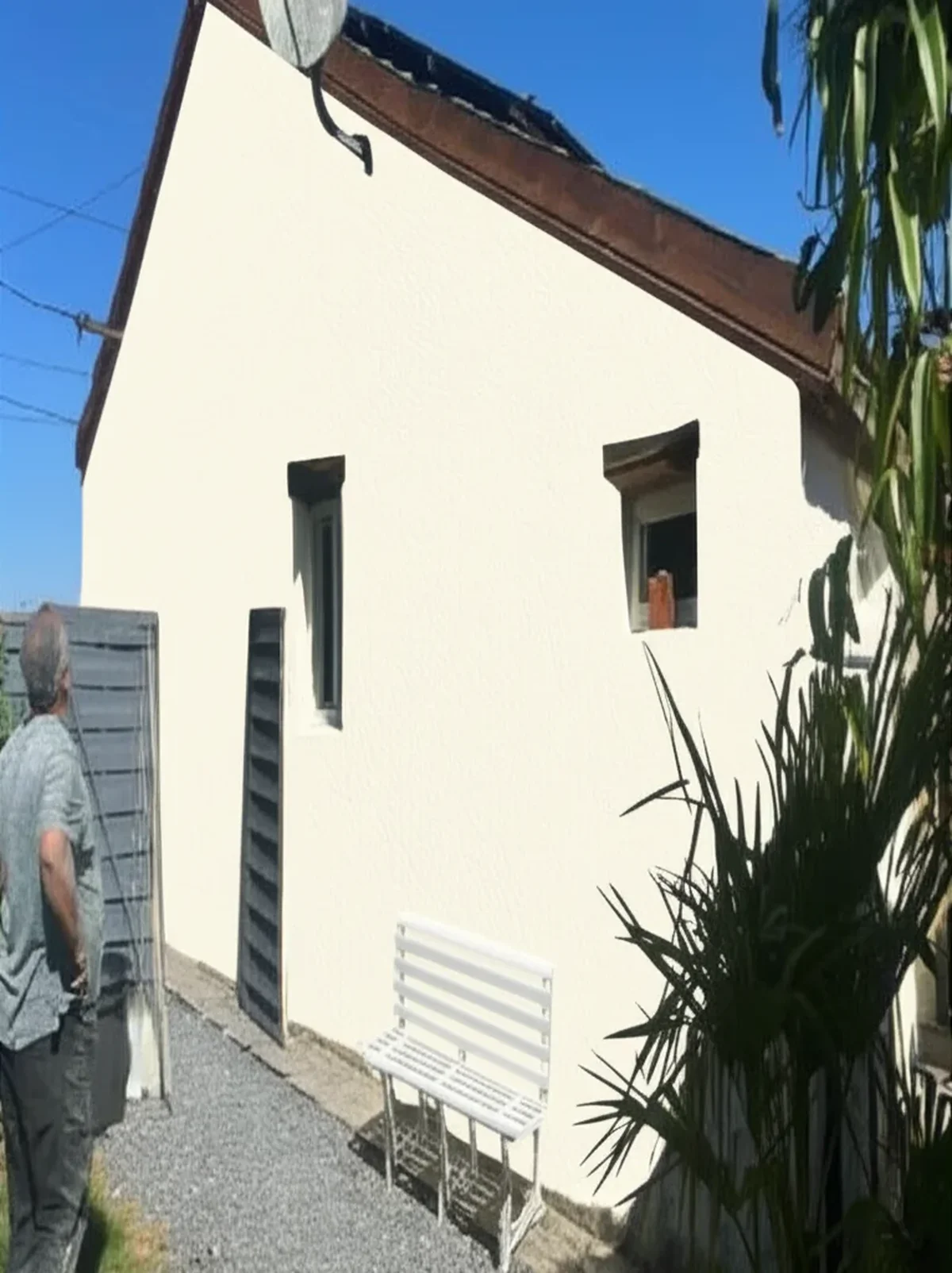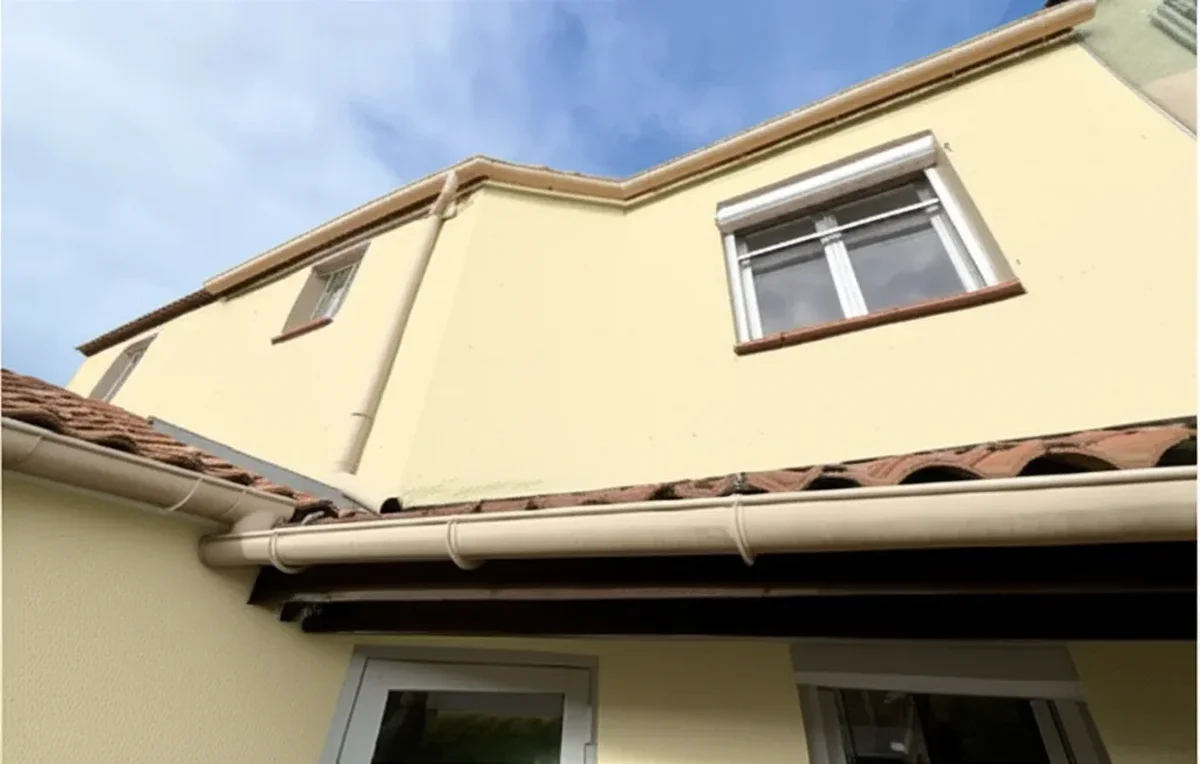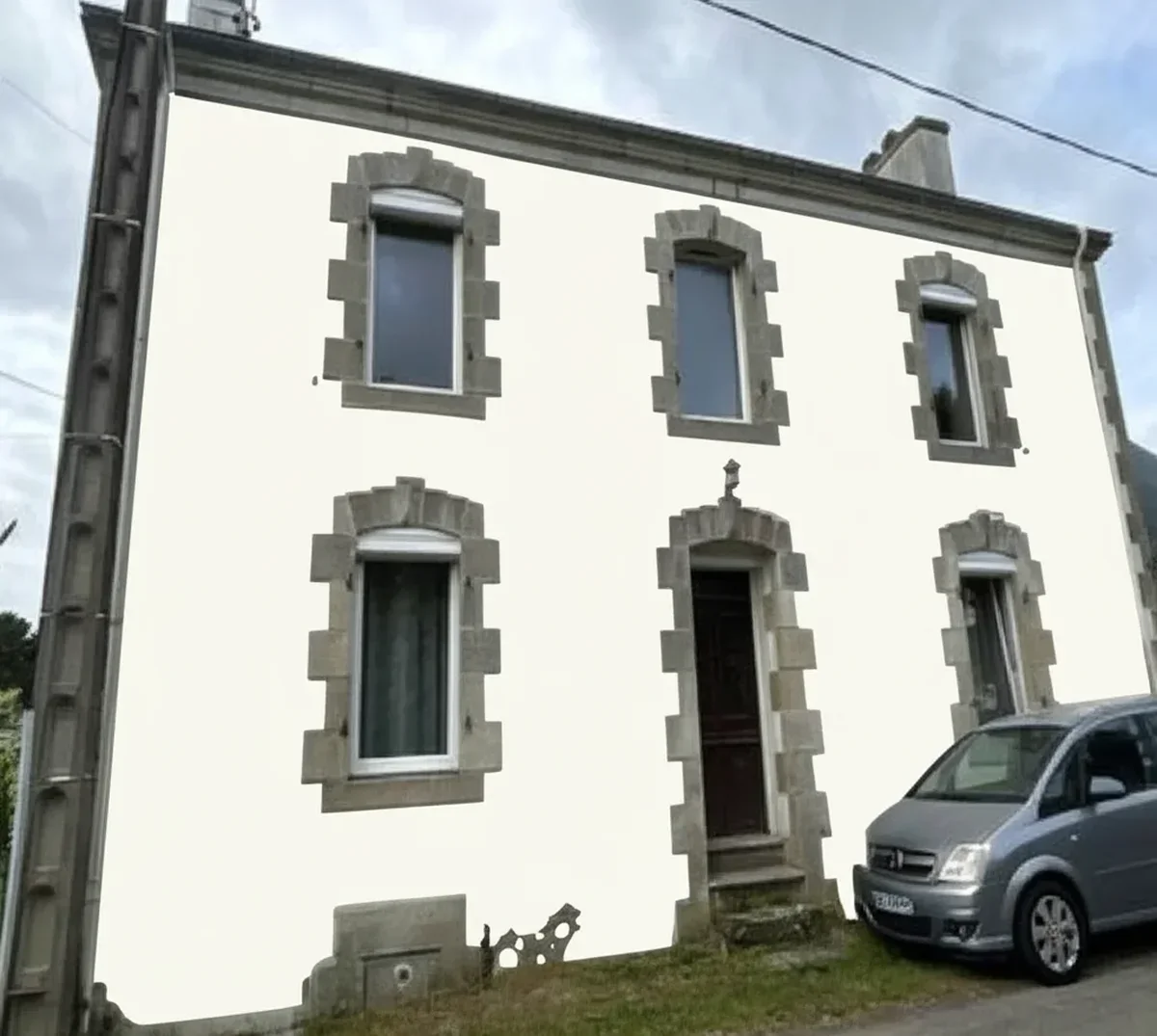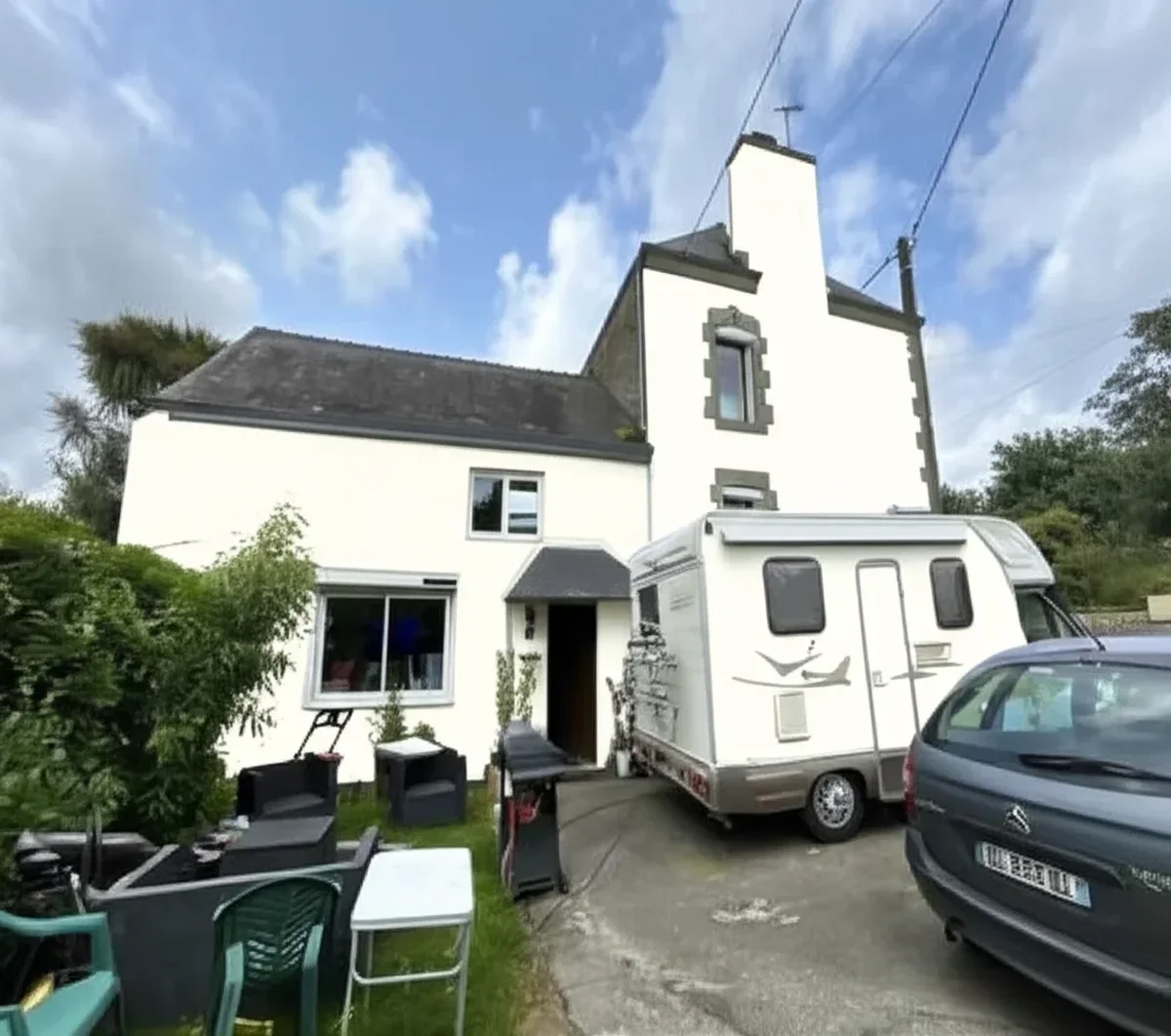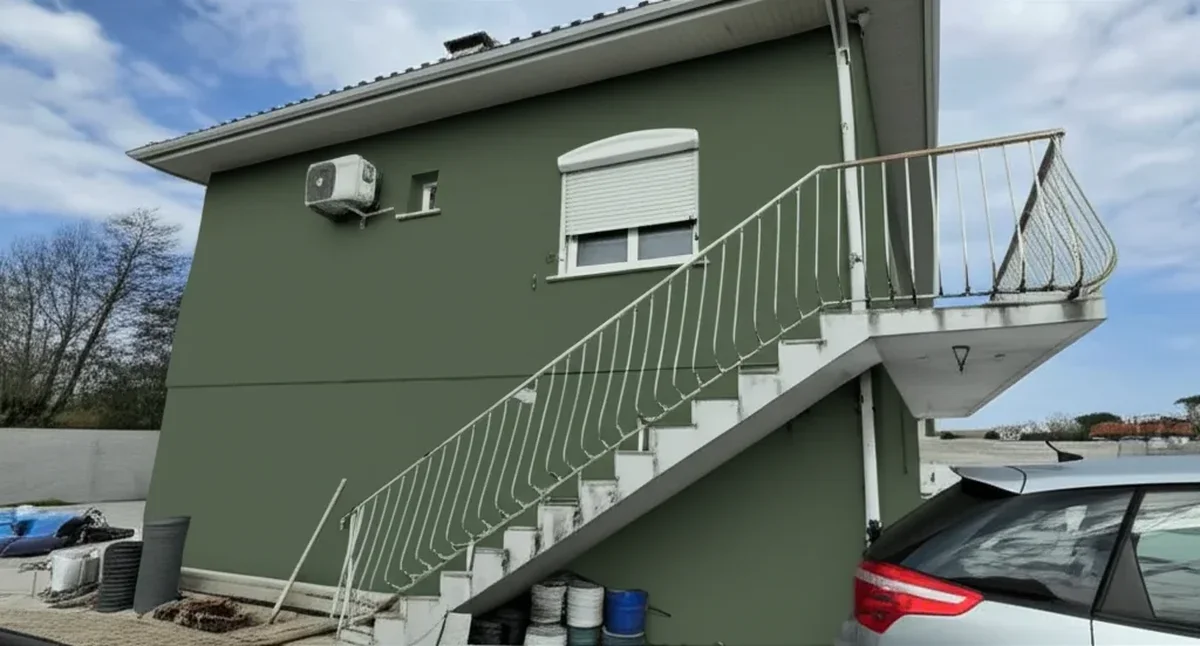
Try it on your house

California Spanish Colonial Revival homes share a strict visual grammar: hand-troweled cream stucco walls, low-pitched terracotta barrel tile roofs, arched entries, wrought iron balcony railings, exposed wood beams, and a single carved walnut front door set into a deep reveal. Born at the 1915 Panama-California Exposition in San Diego's Balboa Park and refined through the 1920s and early 1930s by George Washington Smith in Santa Barbara, Wallace Neff in Pasadena, Roland Coate in the Hollywood Hills, Lilian Rice in Rancho Santa Fe, and the Mission Revival builders of San Francisco's Mission District and Dolores Heights, the style still defines historic California neighborhoods from State Street to Hancock Park to Mission Hills. Picking the right paint color is the single most important decision in restoring or refreshing one of these California homes.
This guide walks through the top 8 California-specific Spanish Colonial paint colors for 2026, the five authentic schemes calibrated for Santa Barbara red tile, San Diego stucco, Mission Revival Los Angeles and San Francisco, Pasadena, and the Hollywood Hills, plus the HOA and historic review playbook and the Mediterranean integration rules that govern most California color committees. Each color has been cross-checked against the Santa Barbara El Pueblo Viejo design guidelines, the Pasadena Cultural Heritage Commission palette, the San Diego Historical Resources Board, the San Francisco Mission Dolores Landmark District guidance, and Los Angeles Historic Preservation Overlay Zone (HPOZ) rules.
California Spanish Colonial Revival, 1915 to 1935
California Spanish Colonial Revival dominated residential design across the state between 1915 and 1935 in six core regions: Santa Barbara (State Street, Riviera, Montecito) with its signature red tile roofs, San Diego (Mission Hills, Kensington, Balboa Park) with its pure white-stucco aesthetic, Los Angeles (Hancock Park, Los Feliz, Windsor Square), San Francisco (Mission District, Dolores Heights, Forest Hill) with its Mission Revival vocabulary, Pasadena (Oak Knoll, San Rafael, Linda Vista), and the Hollywood Hills (Whitley Heights, Outpost Estates, Beachwood Canyon). The style draws on the 17th and 18th century California mission chain from Mission San Diego de Alcala (1769) through Mission Dolores in San Francisco (1776) to Mission Santa Barbara (1786), and on Andalusian haciendas. Common architectural cues include curved Mission parapets, tile-capped chimneys, deep window reveals, hand-forged iron grilles, glazed Talavera tile insets, and barrel-tile roofs in a faded California terracotta gradient.
The authentic California color vocabulary is narrow on purpose. Stucco bodies read as sun-bleached lime plaster: warm white, antique white, cream, or pale pink-terracotta. Trim is almost invisible, just one half-shade above the body. Wrought iron, vigas, and front doors carry the only deep saturation: matte black, oil-rubbed bronze, deep walnut, or oxblood red. The contrast against red clay tile is what gives California Spanish Colonial its signature warmth. Any cool gray, blue-white, or saturated pastel on the body breaks the visual logic and triggers an immediate denial in Santa Barbara, Pasadena, or LA HPOZ review. Test the authentic CA Spanish Colonial palette on your home now.
Upload a photo of your California Spanish Colonial and test all 8 colors in 30 seconds.
Top 8 California Spanish Colonial paint colors for 2026
These eight colors cover the four roles every California Spanish Colonial facade needs: stucco body, trim, wrought iron and door accents, and terracotta tile harmonization. Each has been cross-checked against Santa Barbara El Pueblo Viejo ABR approvals, Pasadena Cultural Heritage Commission rulings, and LA HPOZ board decisions for Hancock Park, Whitley Heights, and Windsor Square. All codes are 2026 fan-deck current.
| # | Color | Code | LRV | Role |
|---|---|---|---|---|
| 1 | Antique White | SW 6119 | 71 | Stucco body (warm cream, El Pueblo Viejo default) |
| 2 | Audubon Russet | BM HC-51 | 11 | Front door (walnut substitute for replaced doors) |
| 3 | Cavern Clay | SW 7701 | 26 | Accent body, tower, or chimney mass |
| 4 | Wrought Iron | BM 2124-10 | 6 | Grilles, balcony railings, lanterns |
| 5 | Navajo White | BM OC-95 | 79 | Alternate body for Pasadena and Hancock Park |
| 6 | Linen White | BM 912 | 75 | Trim (one half-shade above body) |
| 7 | Reddened Earth | SW 6053 | 14 | Door / shutter (oxblood accent) |
| 8 | Baked Clay | SW 6340 | 15 | Vent caps, chimney pots, tile field patches |
Try it on your house
No photo? Try a sample
1. SW Antique White 6119 (default CA body)
The single most popular Spanish Colonial body color in California historic approvals. A warm cream with a soft yellow undertone that reads exactly like sun-faded lime plaster on a 1924 Santa Barbara hacienda. LRV 71 reflects enough light to keep stucco substrate temperatures below the 130F thermal-cracking threshold even on west-facing State Street walls in August. The default body in Santa Barbara El Pueblo Viejo ABR repaint submissions and a routine pass at the Pasadena Cultural Heritage Commission. Avoid SW 7005 Pure White or BM Chantilly Lace on California SCR: they read blue against terracotta tile and trip rejection on first submission.
2. BM Audubon Russet HC-51 (front door)
When the original carved walnut front door has been replaced with a paintable fiberglass or steel insert, Audubon Russet delivers the visual of dark walnut without a stain system. LRV 11, a deep red-brown with warm undertones that lifts the door against an Antique White wall and harmonizes with terracotta tile above. The first choice for Hancock Park and Windsor Square restorations where the original door is gone. Pair with hand-forged iron clavos, an oversized iron knocker, and a single wrought iron pull.
3. SW Cavern Clay 7701 (accent body)
A warm terracotta with a measurable pink-orange undertone that pulls directly from California's faded barrel-tile roofs. LRV 26, too dark for full bodies on west-facing elevations without a near-infrared cool-paint formulation, but ideal as a single accent wing, a tower mass, or a chimney face under a tile cap. Cavern Clay was a Sherwin-Williams 2026 trend revival pick for California stucco accents and tracks closely with original 1920s ochre-pigmented stucco recipes.
4. BM Wrought Iron 2124-10 (iron details)
The single most important accent color on a California Spanish Colonial. Used on window grilles, Juliet balcony railings, lanterns, gate hardware, and chandelier arms. LRV 6, a deep matte near-black with a touch of warmth to harmonize with terracotta. Apply with an oil-modified alkyd or rust-inhibitive 100 percent acrylic for ironwork exposed to coastal salt air in Santa Barbara and Pacific Palisades. Avoid glossy black on California SCR ironwork; it should read as hand-forged, not factory-painted.
5. BM Navajo White OC-95 (alternate body)
A slightly pinker, slightly cleaner alternative to Antique White. LRV 79 makes it one of the safest body colors on a west-facing Hancock Park or Pasadena facade. Reads as warm cream in morning light and clean pale terracotta in late afternoon. Pair with Linen White trim and Wrought Iron grilles for a polished look that photographs cleanly under direct LA basin light.
6. BM Linen White 912 (trim)
Trim on California Spanish Colonial Revival should be almost invisible. Linen White at LRV 75 reads as a half-shade lighter than Antique White but never as bright contrast. Use on window casings, fascia boards behind tile, and the underside of arched openings. Bright trim white kills the hand-troweled stucco illusion and is a fast track to rejection in El Pueblo Viejo or HPOZ review.
7. SW Reddened Earth 6053 (door / shutter accent)
An oxblood red with deep terracotta undertones. LRV 14. The traditional alternative to dark walnut on California Spanish Colonial doors. Use on the door alone, or on a single pair of shutters flanking a tall arched window above the entry. Reddened Earth holds delta-E under 2.0 over a simulated 5-year coastal UV cycle when applied in SW Emerald Exterior with a Rain Refresh top coat.
8. SW Baked Clay 6340 (tile harmonization)
SW Baked Clay matches faded California terracotta barrel tile within a delta-E of 3 on most 1920s roofs. LRV 15. Use for vent stack caps, chimney pots, replacement tile field patches, and any visible metal flashing. Without harmonization, galvanized flashing reads as a silver scar against terracotta and is the second-most-common reason ABR rejects a Santa Barbara repaint plan. Preview Baked Clay tile harmonization on your roof flashing.
Free California Spanish Colonial AI visualizer. No credit card needed.
Five authentic California schemes
The same eight colors arrange into five regional schemes that match the historic vocabulary of each California submarket. Pick the one that fits your city, your tile-roof color, and your design review board.
Scheme 1: Santa Barbara El Pueblo Viejo
The textbook palette. Body: SW Antique White 6119. Trim: BM Linen White 912. Wrought iron and lanterns: BM Wrought Iron 2124-10. Front door: original carved dark walnut, or BM Audubon Russet HC-51 if replaced. Tile roof: standard faded terracotta barrel tile. This scheme passes Santa Barbara El Pueblo Viejo ABR review without modification and is the dominant look on State Street, lower Riviera, and Montecito's Old Coast Highway corridor. Best for coastal Santa Barbara County where summer highs stay below 95F.
Scheme 2: Pasadena Wallace Neff (Oak Knoll, San Rafael)
The Wallace Neff signature look. Body: BM Navajo White OC-95 at LRV 79 to read clean against Pasadena's San Gabriel Mountains backdrop. Trim: BM Linen White 912. Wrought iron: BM Wrought Iron 2124-10. Front door: BM Audubon Russet HC-51 with hand-forged iron clavos. This scheme tracks Wallace Neff's documented 1926 to 1932 Pasadena palette and passes Pasadena Cultural Heritage Commission review for properties inside the Oak Knoll and San Rafael landmark districts.
Scheme 3: Los Angeles HPOZ (Hancock Park, Windsor Square, Los Feliz)
The LA basin version. Body: SW Antique White 6119. Trim: BM Linen White 912. Wrought iron: BM Wrought Iron 2124-10. Front door: SW Reddened Earth 6053 oxblood or BM Audubon Russet HC-51 walnut. Add a single Cavern Clay 7701 accent wall on a tower or chimney mass for visual depth. The Hancock Park, Windsor Square, and Los Feliz HPOZ boards consistently approve this combination on first submission. For LA-specific pricing context, see our Los Angeles exterior painting cost guide.
Scheme 4: Hollywood Hills (Whitley Heights, Outpost Estates)
The hillside cinema-era variant. Body: SW Antique White 6119 with a Cavern Clay 7701 accent tower. Trim: BM Linen White 912. Wrought iron: BM Wrought Iron 2124-10. Front door: SW Reddened Earth 6053. Hollywood Hills SCR homes often have a tower or stair-tower mass that benefits from a Cavern Clay accent under a barrel-tile cap. Whitley Heights HPOZ board approves the accent under a single-tower rule, capped at 25 percent of facade area.
Scheme 5: San Diego stucco and San Francisco Mission Revival
The whiter-stucco coastal-California variant. Body: BM White Dove OC-17 (LRV 85) or BM Navajo White OC-95 (LRV 79). Trim: BM Linen White 912. Wrought iron: BM Wrought Iron 2124-10. Front door: SW Reddened Earth 6053 (oxblood, mandatory in coastal SF and SD where dark walnut weathers fast under marine layer humidity). Tile flashing harmonization in SW Baked Clay 6340. This scheme suits San Diego Mission Hills, Kensington, and Rancho Santa Fe, plus San Francisco's Mission District, Dolores Heights, Forest Hill, and St. Francis Wood. It passes the San Diego Historical Resources Board and the San Francisco Historic Preservation Commission Article 10 reviews on first submission. The brighter body reads correctly under SF fog and SD coastal haze where Antique White can pull dingy.
Tile roof terracotta and adobe-effect finishes
California Spanish Colonial walls and roofs read as a single warm composition. Two execution details govern whether the composition holds together or breaks:
- Tile-roof color audit: faded California barrel tile drifts toward a 6340 Baked Clay / Behr S180-7 Spanish Tile reading after 40 years of UV. New replacement tile reads brighter and clashes with the older field. If you are patching the roof field, weather-blend new tile by burying it in the field where the run meets the ridge, not at the eave.
- Adobe-effect finish: use a sand-fine aggregate (less than 30 mesh) integrated into the body paint to mimic the texture of hand-troweled lime plaster. Loxon Stucco Acrylic plus a 20 percent dilution with a mineral aggregate slurry produces a true adobe finish at roughly 12 percent extra cost per gallon. The texture catches morning sidelight on Montecito east elevations and reads as authentic 1920s plaster.
For the broader terracotta-and-white stucco look that travels well across California submarkets, our terracotta stucco with white trim guide covers proportion rules, contrast ratios, and trim line conventions in detail.
California HOA, HPOZ, and Mediterranean integration
California Spanish Colonial repaints sit inside one of the densest design review environments in the United States. Four overlapping authorities can affect color approval, and most California SCR repaints touch at least two:
- City landmark district (Santa Barbara El Pueblo Viejo, LA HPOZ): board approval required for exterior color visible from the public way. Approval times 20 to 45 days.
- Cultural heritage commission (Pasadena, San Diego): separate from HPOZ, often more discretionary. Submit a wet sample, drawdown, manufacturer name, and color code.
- HOA color committee: in master-planned developments like parts of Montecito and the Palos Verdes Peninsula. Generally faster (10 to 20 days) but stricter on Mediterranean palette integration.
- Coastal Commission (oceanfront properties): rare but can add 30 to 60 days if the property is inside the coastal zone and the color change is judged to affect public view corridors.
The Mediterranean integration rule, used by most California HOAs, requires that any Spanish Colonial color choice harmonize with the neighborhood's broader Mediterranean palette (Italian Renaissance, Spanish Colonial Revival, Mission Revival, Monterey Revival). Antique White, Navajo White, Linen White, Wrought Iron, Audubon Russet, Reddened Earth, and Cavern Clay are pre-approved on every California HOA palette we have reviewed. For pre-approval shortcuts and palette overlap with HOA review boards, see our HOA-approved exterior colors California 2026 guide.
For coordination with neighboring Mediterranean Revival homes that share streetscape sightlines, our Mediterranean Revival paint color guide covers shared California palette conventions, while our Spanish Mission Revival paint guide handles the earlier, simpler Mission Revival vocabulary common in Pasadena, South Pasadena, and San Francisco's Mission District.
Coastal UV, heat-tolerant paint, and stucco prep
California Spanish Colonial homes face two distinct UV environments: coastal (Santa Barbara, Palos Verdes, Pacific Palisades, Malibu) with salt-laden marine layer and steady mid-80s heat, and inland basin (Pasadena, Hancock Park, Hollywood Hills, San Fernando Valley) with sharper UV peaks, occasional 100F+ days, and Santa Ana wind cycles.
For coastal California, prioritize 100 percent acrylic exterior paints with mildewcide and an LRV above 70: Benjamin Moore Aura Exterior, Sherwin-Williams Emerald Exterior with Rain Refresh, and Behr Marquee Exterior. All three carry 25-year limited warranties and resist coastal mildew and salt cycling.
For inland basin California (Pasadena, San Fernando Valley, eastern Hollywood Hills), prioritize NIR (near-infrared) reflective formulations: SW Emerald Rain Refresh, BM Aura Exterior, and the LA-basin-favored Dunn-Edwards Evershield system (Dunn-Edwards is headquartered in Los Angeles and dominates the California specifier market). NIR formulations reduce wall surface temperatures by 10 to 15F at peak, extending paint life from 7 years to 12 to 15 on west-facing accent walls.
Stucco prep on a California SCR repaint follows a five-step sequence: pressure wash at 1,500 to 2,500 psi with a 25-degree tip, spot prime alkaline efflorescence with a masonry bonding primer (Loxon XP, Aura Block Filler), patch hairline cracks under 1/16 inch with elastomeric patching compound, apply two finish coats brushed-and-backrolled, and add a cool-paint NIR top coat on south and west elevations. Skipping prep is the top reason California Spanish Colonial repaints fail in 3 to 5 years instead of lasting 12 to 15.
Local market guidance: Santa Barbara, San Diego, LA, San Francisco, Pasadena, Hollywood Hills
The six California cities with the densest Spanish Colonial Revival housing stock each enforce different design review rules and offer different cost dynamics on a 2,200 sq ft repaint.
Santa Barbara red tile country (El Pueblo Viejo, Riviera, Montecito)
The El Pueblo Viejo Landmark District (most of downtown and the lower Riviera) requires Architectural Board of Review (ABR) approval for any exterior color change visible from the public way. Santa Barbara's signature red barrel tile roofs (a deeper, more saturated terracotta than the faded LA basin tile) drive a strict body palette: Antique White, Navajo White, Cavern Clay, Linen White, Wrought Iron, Reddened Earth, and Audubon Russet. Approvals typically take 30 to 45 days. Repaint cost runs 8,500 to 19,500 dollars for a 2,200 sq ft home, including stucco prep and elastomeric crack repair. Montecito HOAs (Birnam Wood, Hedgerow) layer an additional 10 to 20 day color committee review on top of ABR.
San Diego stucco country (Mission Hills, Kensington, Balboa Park, Rancho Santa Fe)
San Diego is the birthplace of California Spanish Colonial Revival (the 1915 Panama-California Exposition in Balboa Park introduced the style nationally). The San Diego Historical Resources Board governs color changes inside the city's 16 historic districts including Mission Hills, Kensington, and South Park. The San Diego look leans toward purer white stucco than the Santa Barbara cream palette, anchoring on BM Navajo White OC-95 (LRV 79) or BM White Dove OC-17 (LRV 85) body with the Reddened Earth or Audubon Russet door. Lilian Rice's 1920s Rancho Santa Fe Covenant enforces the same vocabulary with a stricter Mediterranean integration rule. Repaint cost runs 6,500 to 15,500 dollars for a 2,200 sq ft home. Coastal La Jolla and Point Loma SCR repaints need the coastal acrylic-mildewcide spec.
Pasadena (Oak Knoll, San Rafael, Linda Vista)
The Pasadena Cultural Heritage Commission and Design Commission review color changes inside the city's 13 landmark districts and 6 individual landmark properties. The Wallace Neff scheme (Navajo White body, Linen White trim, Audubon Russet door) consistently passes review. Repaint cost runs 7,500 to 17,000 dollars for a 2,200 sq ft home. Oak Knoll and San Rafael landmark districts enforce barrel-tile-roof harmony as a precondition, meaning galvanized flashing must be painted in Baked Clay or Spanish Tile before color review begins. Preview the Wallace Neff Pasadena scheme on your home.
Los Angeles (Hancock Park, Windsor Square, Los Feliz)
LA's 35 Historic Preservation Overlay Zones (HPOZs) cover most of the city's Spanish Colonial Revival stock. Hancock Park HPOZ, Windsor Square HPOZ, and Los Feliz HPOZ all approve the Antique White body, Linen White trim, Wrought Iron grilles, and Audubon Russet or Reddened Earth door combinations. HPOZ board reviews take 30 to 60 days. Repaint cost runs 6,500 to 16,500 dollars for a 2,200 sq ft home. Full LA pricing context lives in our Los Angeles exterior painting cost guide.
Hollywood Hills (Whitley Heights, Outpost Estates, Beachwood Canyon)
Whitley Heights HPOZ enforces the strictest hillside Spanish Colonial palette in LA County, with a single-accent-tower rule limiting Cavern Clay or other deep accents to 25 percent of total facade area. Outpost Estates HOA layers an additional design review. Hollywood Hills repaint cost runs 8,000 to 19,000 dollars for a 2,200 sq ft home due to scaffolding requirements on hillside sites. For San Diego SCR repaint pricing as a cross-reference for coastal California, see our San Diego exterior painting cost guide. Preview Whitley Heights single-tower accent on your facade.
San Francisco Mission Revival (Mission District, Dolores Heights, Forest Hill)
San Francisco's Mission Revival stock is concentrated around Mission Dolores (the 1776 mission anchor) and the early 20th century streetcar-suburb tracts of Dolores Heights, Forest Hill, St. Francis Wood, and the upper Mission District. The San Francisco Historic Preservation Commission (Article 10 landmarks) and the Forest Hill / St. Francis Wood HOAs govern color changes. The SF Mission Revival palette runs cooler than Southern California due to the persistent fog ceiling: prioritize BM Navajo White OC-95 or SW Antique White 6119 with deeper Reddened Earth doors and Wrought Iron grilles. The clay tile in SF is older and more weathered (often original 1908 to 1925 Gladding McBean stock) so Baked Clay flashing harmonization is mandatory. Repaint cost runs 9,500 to 22,000 dollars for a 2,200 sq ft home, the highest in California due to SF labor rates and the steep-grade access surcharges typical in Dolores Heights and Forest Hill.
Free 30-second AI preview of all four regional schemes.
Related California Spanish Colonial guides
For deeper coverage of the California stylistic family, see our Spanish Mission Revival paint guide (Pasadena, South Pasadena, and the SF Mission District), the Mediterranean Revival paint color guide, and the terracotta stucco with white trim guide. For local pricing, our Los Angeles exterior painting cost guide and San Diego exterior painting cost guide cover the labor and materials math for a California Spanish Colonial repaint. For HOA approvals, our HOA-approved exterior colors California 2026 guide maps pre-approved Mediterranean palettes. For inland-basin paint system selection, our Dunn-Edwards Evershield exterior review covers the NIR system most popular across the LA basin.
For authoritative outside coverage of California Spanish Colonial Revival, San Diego Magazine maintains a deep Spanish Colonial Revival architecture history, HGTV publishes a Spanish Colonial style design library, and Old House Online covers period-correct restoration techniques across California Spanish Colonial submarkets.
Frequently asked questions
What is the most authentic California Spanish Colonial body color?
SW Antique White 6119 (LRV 71) is the most popular California Spanish Colonial body color in 2026 historic district approvals. It reads as sun-faded lime plaster, harmonizes with terracotta barrel tile, and is approved in Santa Barbara El Pueblo Viejo, Pasadena Cultural Heritage Commission, and LA HPOZs (Hancock Park, Windsor Square, Los Feliz) without modification.
Can I use pure white on a California Spanish Colonial home?
Generally no. Pure whites like SW 7005 Pure White or BM Chantilly Lace read blue against California's terracotta barrel tile, break the warm visual logic, and are rejected by Santa Barbara ABR, Pasadena Cultural Heritage Commission, and most LA HPOZ boards. Use BM Navajo White OC-95 (LRV 79) or SW Antique White 6119 (LRV 71) instead.
What front door color works on a California SCR with a replaced door?
If the original carved walnut door is gone, use BM Audubon Russet HC-51 (walnut substitute) or SW Reddened Earth 6053 (oxblood). Both pair with hand-forged iron clavos and a single iron pull or knocker. Both pass Santa Barbara ABR, Pasadena Cultural Heritage Commission, and LA HPOZ review.
Does Santa Barbara El Pueblo Viejo require board approval for color?
Yes. Any exterior color change visible from the public way inside the El Pueblo Viejo Landmark District requires Architectural Board of Review (ABR) approval. Approval takes 30 to 45 days. Submit a wet sample, drawdown, manufacturer name, and color code. The pre-approved Spanish Colonial palette covers Antique White, Navajo White, Cavern Clay, Linen White, Wrought Iron, Audubon Russet, and Reddened Earth.
What does an LA HPOZ Spanish Colonial repaint cost in 2026?
Roughly 6,500 to 16,500 dollars for a 2,200 sq ft Hancock Park, Windsor Square, or Los Feliz home, including stucco prep, elastomeric crack repair, two finish coats, wrought iron repaint, and tile-flashing harmonization. Add 1,500 to 3,000 dollars for hillside scaffolding in Whitley Heights or Outpost Estates.
Can I add a single accent wall on my California Spanish Colonial?
Yes, on a tower or chimney mass, using SW Cavern Clay 7701 (LRV 26). Whitley Heights HPOZ caps the accent at 25 percent of total facade area. Most other California HPOZs approve a single accent tower or chimney without a hard percentage cap as long as the accent reads as a discrete architectural element, not a full elevation.
What wrought iron color is correct on California SCR?
BM Wrought Iron 2124-10 (LRV 6) is the default for window grilles, Juliet balcony railings, and gate hardware on California Spanish Colonial. Apply matte, not glossy: SCR ironwork should read as hand-forged. Bronze patina is acceptable on lantern fittings and exterior light fixture mounts only.
How does Mediterranean integration work in California HOAs?
Most California HOAs (Montecito Birnam Wood, Palos Verdes Estates, Bel Air master-planned tracts) require any Spanish Colonial color choice to harmonize with the neighborhood's broader Mediterranean palette: Italian Renaissance, Spanish Colonial Revival, Mission Revival, and Monterey Revival homes. The top 8 colors in this guide are pre-approved on every California HOA Mediterranean palette we have reviewed.
Trademarks mentioned (Sherwin-Williams, Benjamin Moore, Behr, Caparol, Brillux, Sto, Alpina, Valspar, PPG, Glidden, Dulux, Crown Trade, Sandtex, Farrow & Ball, Johnstone's, Leyland) are property of their respective owners. FacadeColorizer is independent and not affiliated with any of them. Nominative fair use under Lanham Act §1125.