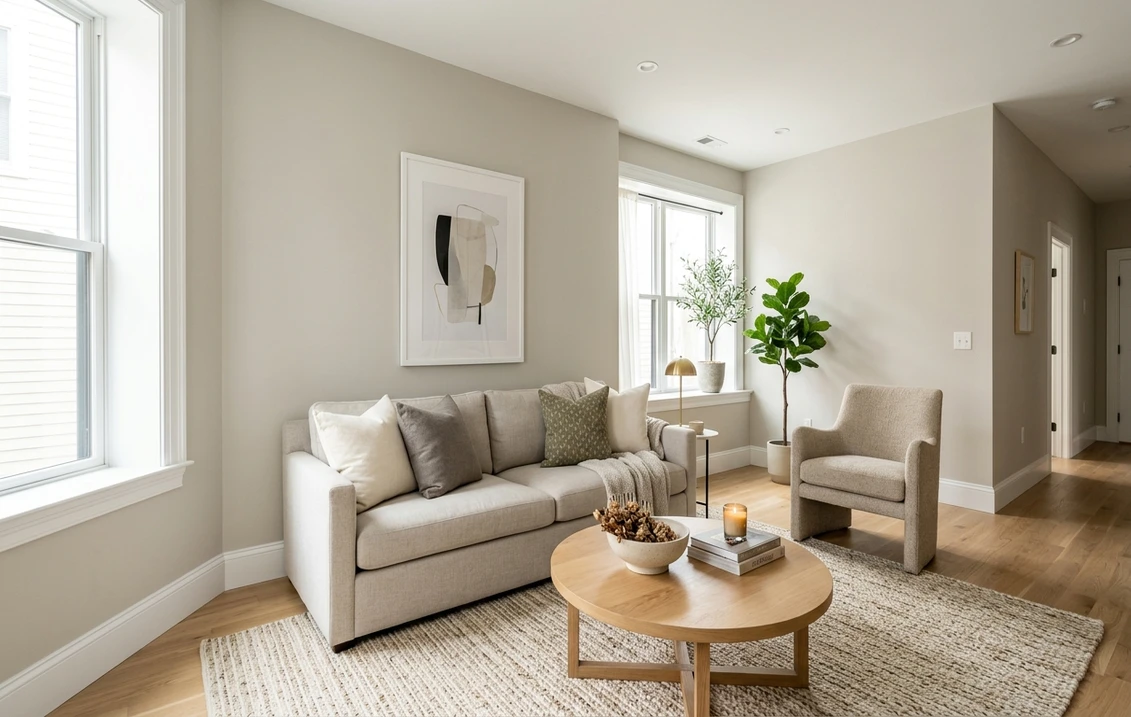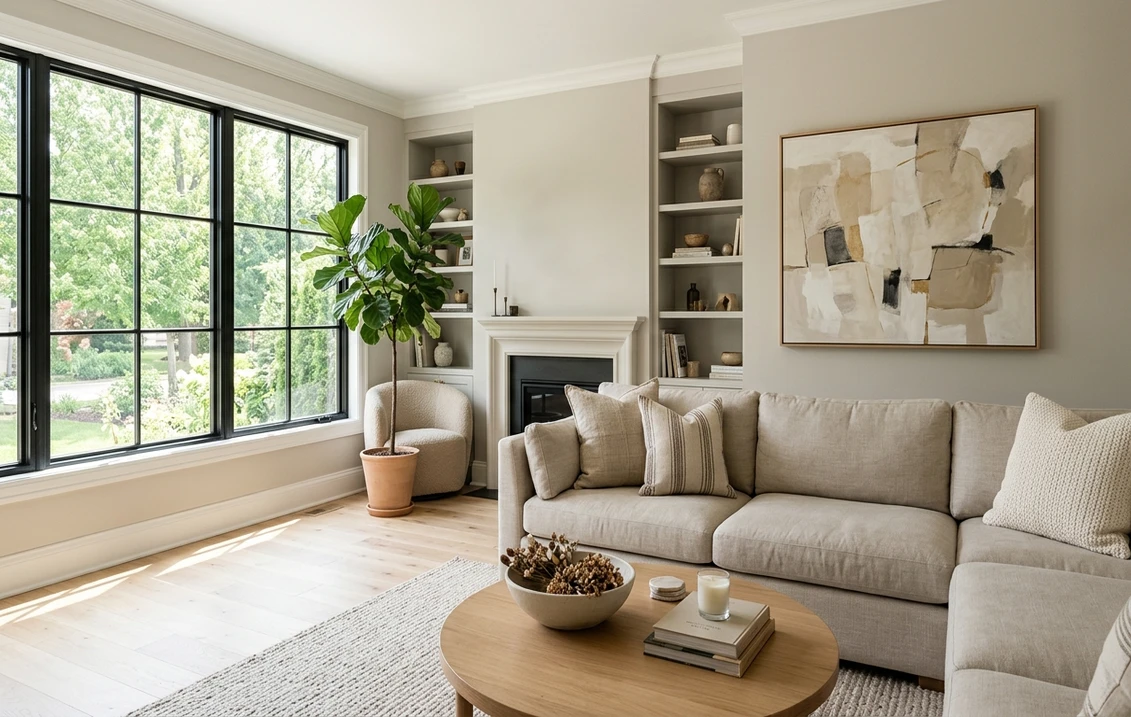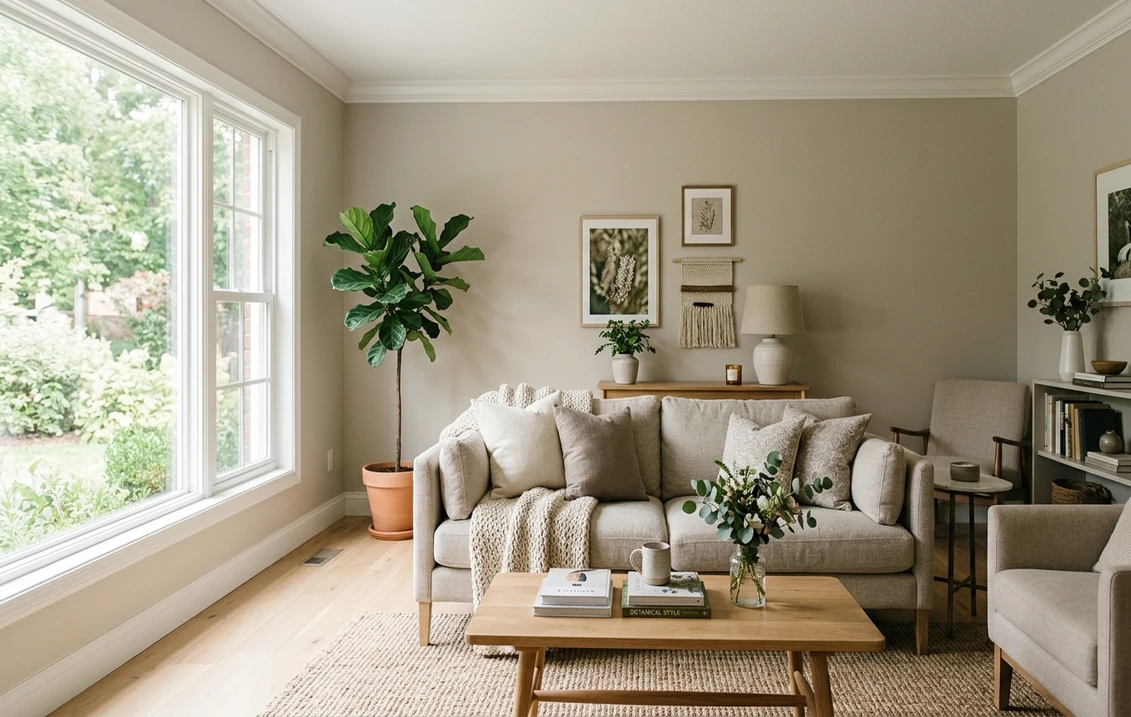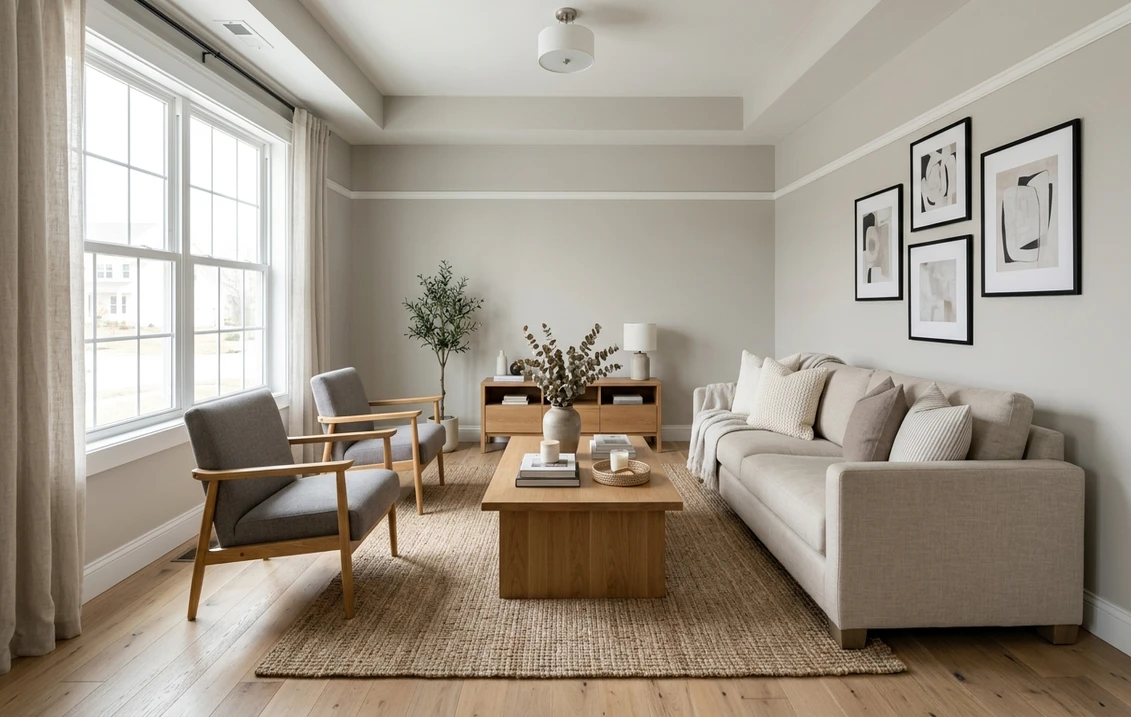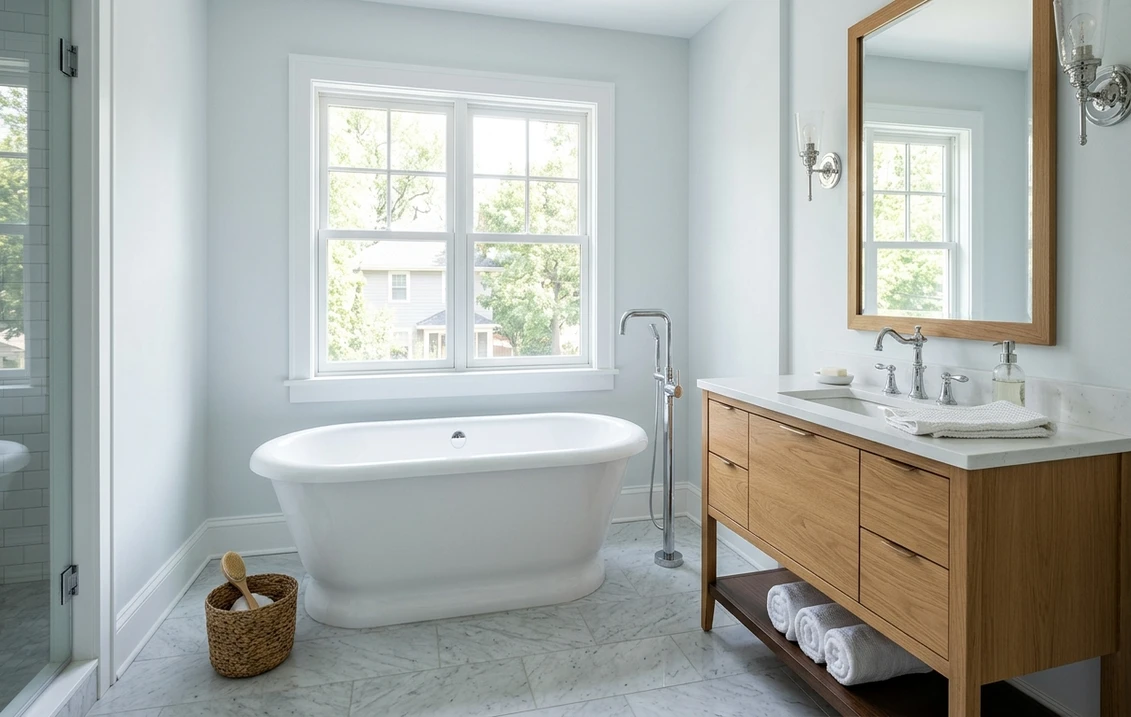

Sherwin-Williams Ice Cube (SW 6252) is a cool off-white with an LRV of 77.49: lighter than most greiges, but clearly darker than the brand's bright whites such as Extra White (85.86). Sherwin-Williams files it in its White and Pastel family and lists it for interior and exterior use; its store strip is 257-C3. People often describe it as blue-white, yet its published Lab values show a near-neutral with a faint green-gray lean. Indoors, it suits bathrooms, kitchens and sunny rooms, and it can look gray in a dim north-facing room.
The LRV, RGB, Lab, families, collections, coordinating colors and store strips come from Sherwin-Williams' public color data and the Ice Cube color page, read on 20/11/2026. Coverage and drying times come from the Emerald Interior Latex Matte product data sheet. Chroma, hue angles and color differences are our calculations; advice on rooms and light is our color reasoning. Hex and RGB are a screen approximation: decide on a painted sample in the room.
The interior tool carries the Sherwin-Williams chart. Choose Ice Cube SW 6252 for the walls and compare it with the whites on the same strip.
Ice Cube SW 6252 in numbers
The name, number and family come from the Ice Cube color page on sherwin-williams.com, which presents it as a white for interior and exterior projects. The other values come from the brand's public color data.
| Attribute | Ice Cube SW 6252 |
|---|---|
| LRV | 77.49 |
| RGB | 227, 228, 225 |
| Hex (screen approximation) | #E3E4E1 |
| Lab (brand color data) | L 90.44, a -0.87, b 1.33 |
| Families | White and Pastel, Designer Color Collection, Living Well |
| Collections | Designer Color Collection (Pure + Pristine), Living Well, Cool White, Finest Whites |
| Store strip | 257-C3 |
| Coordinating colors | Morning Fog SW 6255, Coral Clay SW 9005, with Extra White SW 7006 as the white |
Try it on your room
- 1Your photoPhoto
- 2Your colorColor
- 3HD render in ~30 sHD render in ~30 s
Your photo is used only to create your preview. JPG, PNG, HEIC (iPhone)
Blue, gray or green? What the numbers say
The first question Google lists about Ice Cube is its undertone. The Lab values answer it: a is -0.87 (a hair toward green) and b is +1.33 (a hair toward yellow, not blue). By our calculation the chroma is about 1.6, which is almost no color at all, and the hue angle sits around 123 degrees, a green-gray direction. In plain words, Ice Cube is a near-neutral off-white whose tiny lean is green-gray, not blue.
So why do so many people see blue? Our color reasoning: next to warm whites, cream trim, beige tile or wood, any neutral white looks cooler by contrast, and the eye reads "cool" as blue. In north light, which is bluish by nature, the wall picks up the color of the light. And at an LRV of 77, Ice Cube is light enough to look white but dark enough to show shading, so the shadow side of a room reads gray-blue. Test it next to your own trim and floor before deciding whether it looks blue in your house.
Strip 257: the whites around Ice Cube
Ice Cube sits in the middle of store strip 257, which runs from the brand's crisp whites to pale grays. Seeing the whole strip is the quickest way to place it.
| Position | Color | LRV | Hex |
|---|---|---|---|
| 257-C1 | Extra White SW 7006 | 85.86 | #EEEFEA |
| 257-C2 | Ceiling Bright White SW 7007 | 82.53 | #E9EBE7 |
| 257-C3 | Ice Cube SW 6252 | 77.49 | #E3E4E1 |
| 257-C4 | Rhinestone SW 7656 | 74.36 | #DEE0DE |
| 257-C5 | Nebulous White SW 7063 | 73.72 | #DEDFDC |
| 257-C6 | Rock Candy SW 6231 | 74.56 | #DEE1DF |
| 257-C7 | Site White SW 7070 | 72.96 | #DCDEDC |
Ice Cube is the lightest of the strip's off-whites, about 8 LRV points under Extra White and 3 to 4 points over Rhinestone and Nebulous White. Our color reasoning: if Extra White feels too stark on your walls, Ice Cube keeps the cool, clean look one step softer; if Ice Cube looks too white, Rhinestone or Nebulous White add a little gray. Our guides to Extra White SW 7006 and to High Reflective White SW 7757 cover the brighter end.
How Ice Cube reads by light
| Room orientation | How Ice Cube reads (our color reasoning) | What helps |
|---|---|---|
| South-facing | Clean, fresh off-white; the warm light cancels the cool lean | The best case for Ice Cube |
| North-facing | Grayer and cooler, can look slightly blue-gray in shade | Warm bulbs, wood and warm textiles; or a warmer white |
| East-facing | Bright in the morning, grayer by afternoon | Check the sample at 4 pm |
| West-facing | Cool by day, warm off-white at sunset | Usually easy |
Bulbs change a cool white more than a warm one. Under warm 2700 K bulbs, Ice Cube reads as a soft white; under 4000 K bulbs or daylight LEDs, it reads crisp and can look clinical in a bedroom. For a full explanation of each exposure, see our guide to paint colors by room orientation.
Room by room
Bathroom. Ice Cube with white sanitaryware, chrome and gray or white marble looks clean and coherent, because all the materials share the same cool family. With brass fittings and a wood vanity, it still works, and the warm materials take the edge off. Kitchen. On walls above white or gray cabinets, it keeps the room bright without the glare of a pure white; next to cream cabinets, it can make the cabinets look yellow, so test it against the doors.
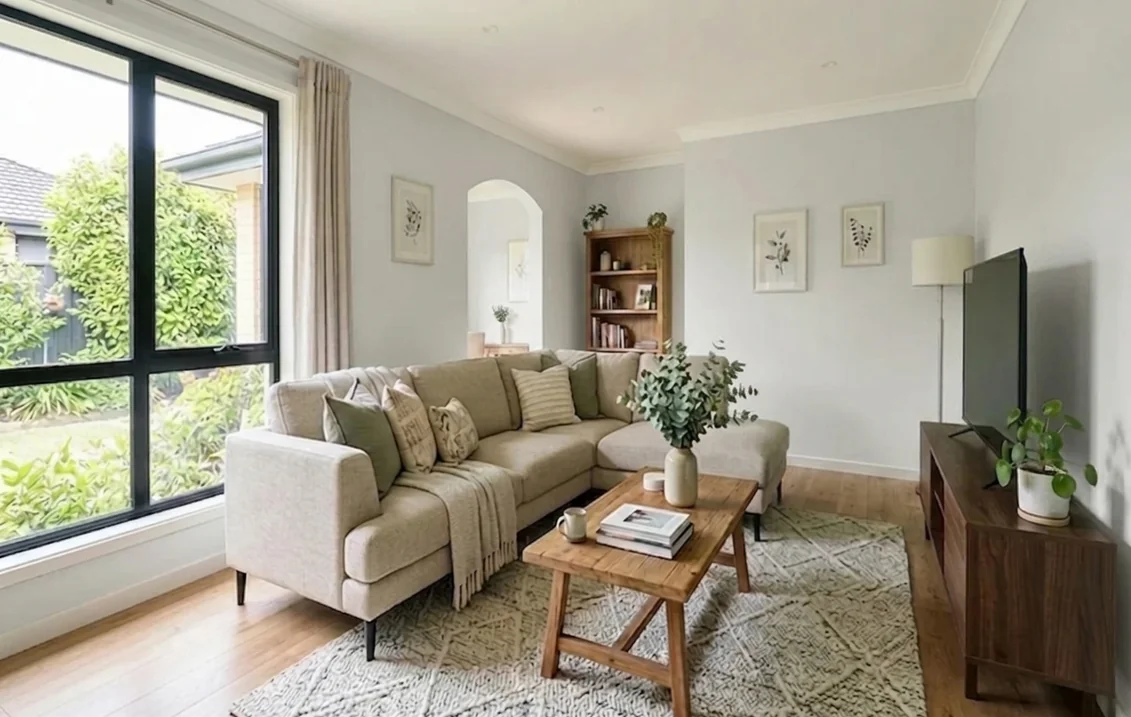
Living room. In a sunny room with cool or neutral furniture, Ice Cube gives a calm, gallery-like backdrop. In a dim room with beige sofas and warm wood, a warmer white such as Alabaster may sit better. Bedroom. It suits a bright bedroom with white or gray linen; in a north-facing bedroom, the gray side shows, which some people like and others find cold. Home office. Under neutral light, a cool off-white keeps the room bright without adding a warm cast to paper and screens.
Trim, ceilings and coordinating colors
Sherwin-Williams names Extra White SW 7006 as the white for Ice Cube. At 85.86, it is about 8 LRV points lighter and shares the same cool, clean family, so the trim reads as a crisp edge rather than a different white. Ceiling Bright White SW 7007 (82.53) is the softer option for a ceiling. Avoid creamy trim whites with Ice Cube walls unless you want the contrast of warm and cool: the trim will look yellow next to the wall.
| Element | Color | LRV | Our color reasoning |
|---|---|---|---|
| Walls | Ice Cube SW 6252 | 77.49 | The base |
| Trim and doors | Extra White SW 7006 | 85.86 | The brand's white for Ice Cube |
| Accent wall, cabinets | Morning Fog SW 6255 | 41.65 | A mid blue-gray from the brand's list |
| Warm accent | Coral Clay SW 9005 | 26.00 | The brand's warm partner: textiles, a door or a powder room |
Morning Fog is covered in our Morning Fog SW 6255 guide. For a gray-green neighbor that keeps the same calm, see the Sea Salt guide.
Paint, coverage and drying
As an example of what a Sherwin-Williams interior product sheet says, the Emerald Interior Latex Matte product data sheet (K36 series), dated 08/17/2026, gives a coverage of 350 to 400 square feet per gallon, a drying time of 1 hour to touch and 4 hours to recoat at 77°F and 50 percent relative humidity, and an application temperature above 50°F. It says the paint can self-prime bare drywall in two coats, and it lists the VOC content at less than 50 grams per liter.
By our calculation, a 12 by 14 foot room with 8-foot ceilings has about 376 square feet of wall after a door and a window, so about 750 square feet for two coats: 2 gallons at the sheet's coverage. The same sheet notes that using the same method and the same batch for touch-ups improves the result, which matters with a light color that shows patches in raking light. Buy the job in one order and keep a little for later.
Which sheen for an off-white
Sheen changes how a light color reads more than people expect. Our color reasoning: in matte, Ice Cube looks soft and slightly chalky, and it hides small dents and drywall seams, which matters on a light wall where raking light shows everything. In eggshell or satin, the same color looks a little crisper and brighter, because the surface reflects more of the room, and it is easier to wipe in a hallway or a child's room. In semi-gloss on trim, Ice Cube can look cooler than on the wall, since the gloss reflects the sky through the window.
For a bathroom, choose a finish and a line that the maker describes for humid rooms, and run the fan during and after showers. For ceilings, a flat finish is the usual choice, since it hides the joints and the light from the windows. If you paint walls and trim in the same Ice Cube for a quiet, tone-on-tone room, the difference in sheen alone is what separates them.
Preparation, and lead in older homes
A light, cool color shows the state of the wall. The Emerald sheet lists the steps that matter: mildew must be removed before painting, because it grows through a new coat; bare plaster must be cured and hard, and powdery plaster is treated with a solution of 1 pint of household vinegar to 1 gallon of water, repeated until the surface is hard, then rinsed and dried; bare wood is sanded to a fresh surface and holes are filled and sanded smooth. Over stains from water or smoke, a primer-sealer goes on first, or the stain can bleed through a light color.
In a house built before 1978, test the old paint before you sand trim, doors or window sills. The EPA's Renovation, Repair and Painting Program page says that about three quarters of US homes built before 1978 still contain some lead-based paint, and that anyone paid to disturb painted surfaces in those homes must be certified in lead-safe work practices; the rule does not generally apply to homeowners working in their own home. The Emerald sheet adds its own warning that scraping, sanding or removing old paint may release lead dust, and that lead is toxic. Keep children and pregnant women out of the room while the surface is prepared.
The closest Benjamin Moore white and nearby Sherwin-Williams colors
On the Benjamin Moore side, the nearest color on screen is Pure White OC-64, with an LRV of 78.94 and a screen color of #E5E7E4 on the brand's page; by our calculation the difference to Ice Cube is about 0.8, which is very close on screen. Benjamin Moore's page for Mountainscape 870 showed the same LRV and screen color when we checked. It is a closest match, not an official equivalent.
| Color | LRV | Delta E 2000 to Ice Cube (our calculation) | Our reading |
|---|---|---|---|
| Intrepid Grey SW 9556 | 75.74 | 0.8 | Almost the same, a touch darker |
| Rhinestone SW 7656 | 74.36 | 1.1 | A little grayer |
| Nebulous White SW 7063 | 73.72 | 1.1 | A little grayer and warmer |
| Winsome Grey SW 9624 | 80.99 | 1.2 | Lighter |
| Pure White OC-64 (Benjamin Moore) | 78.94 | 0.8 | The closest Benjamin Moore |
Do not confuse Benjamin Moore's Pure White OC-64 with Sherwin-Williams' Pure White SW 7005, a warmer, brighter white with an LRV of 83.96. For the Sherwin-Williams one, read our Pure White SW 7005 guide. The Sherwin-Williams interior paint colors hub lists the brand's other whites.
How to test Ice Cube
Whites are the hardest colors to judge on a chip, because the eye compares them with everything around. Paint two coats on a white board about two feet square, then hold it against the trim, the ceiling and a piece of plain printer paper: next to the paper, Ice Cube will look clearly off-white. Move the board to the darkest corner and to the window, and look at it in the morning, late afternoon and at night. Compare it on the same board with Extra White and Rhinestone, its neighbors on strip 257.
Then try it on a photo of the room, which shows the whole wall with your furniture. The interior paint visualizer keeps the floor, the sofa and the window, so you see how the off-white sits with your own materials.
For a kitchen: test a white on the cabinets.
Sources and references
- Sherwin-Williams, Ice Cube SW 6252 color page and public color data: LRV, RGB, Lab, families, collections, store strip 257 and coordinating colors (read on 20/11/2026).
- Sherwin-Williams, Extra White SW 7006 color page: the white the brand pairs with Ice Cube.
- Sherwin-Williams, Emerald Interior Latex Matte product data sheet (K36), 08/17/2026: coverage, drying and recoat times, application temperature, VOC, touch-up advice.
- Benjamin Moore, Pure White OC-64: LRV and screen color.
- US Environmental Protection Agency, Lead Renovation, Repair and Painting Program: pre-1978 homes, certification of paid contractors, homeowner exemption.
Frequently asked questions
What is the undertone of Sherwin-Williams Ice Cube?
What is the LRV of Ice Cube SW 6252?
What colors go with Sherwin-Williams Ice Cube?
Is Ice Cube a good color for a north-facing room?
What is the Benjamin Moore equivalent of Ice Cube?
Trademarks mentioned (Sherwin-Williams, Benjamin Moore, Behr, Caparol, Brillux, Sto, Alpina, Valspar, PPG, Glidden, Dulux, Crown Trade, Sandtex, Farrow & Ball, Johnstone's, Leyland) are property of their respective owners. FacadeColorizer is independent and not affiliated with any of them. Nominative fair use under Lanham Act §1125.