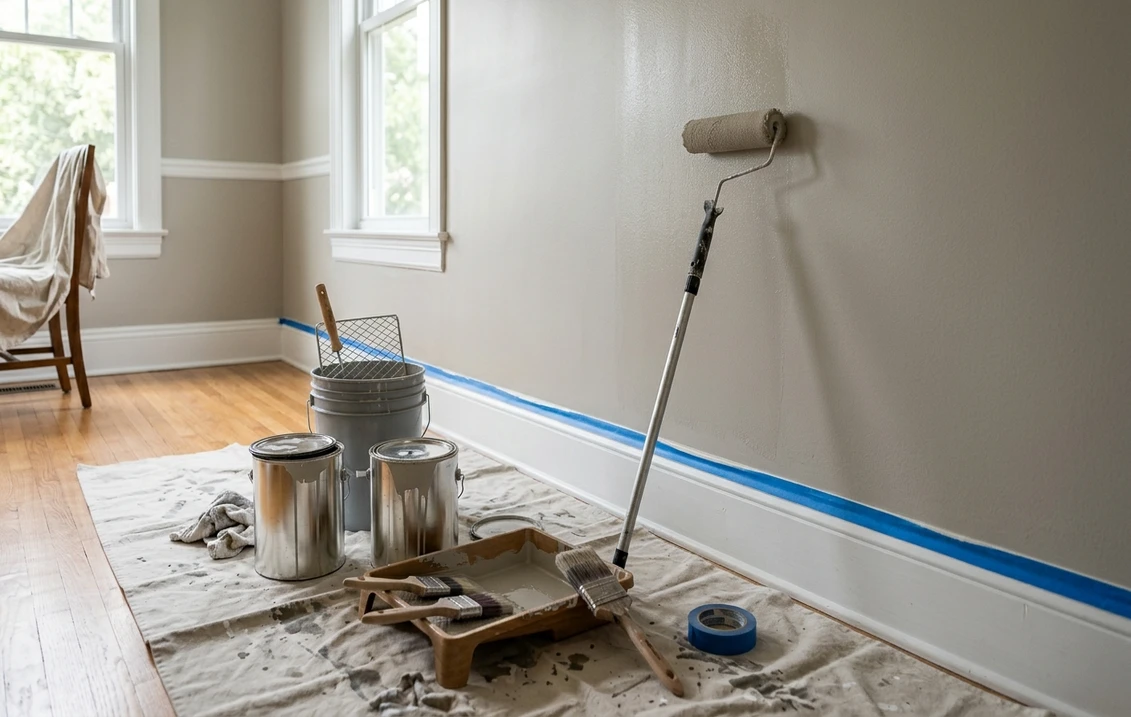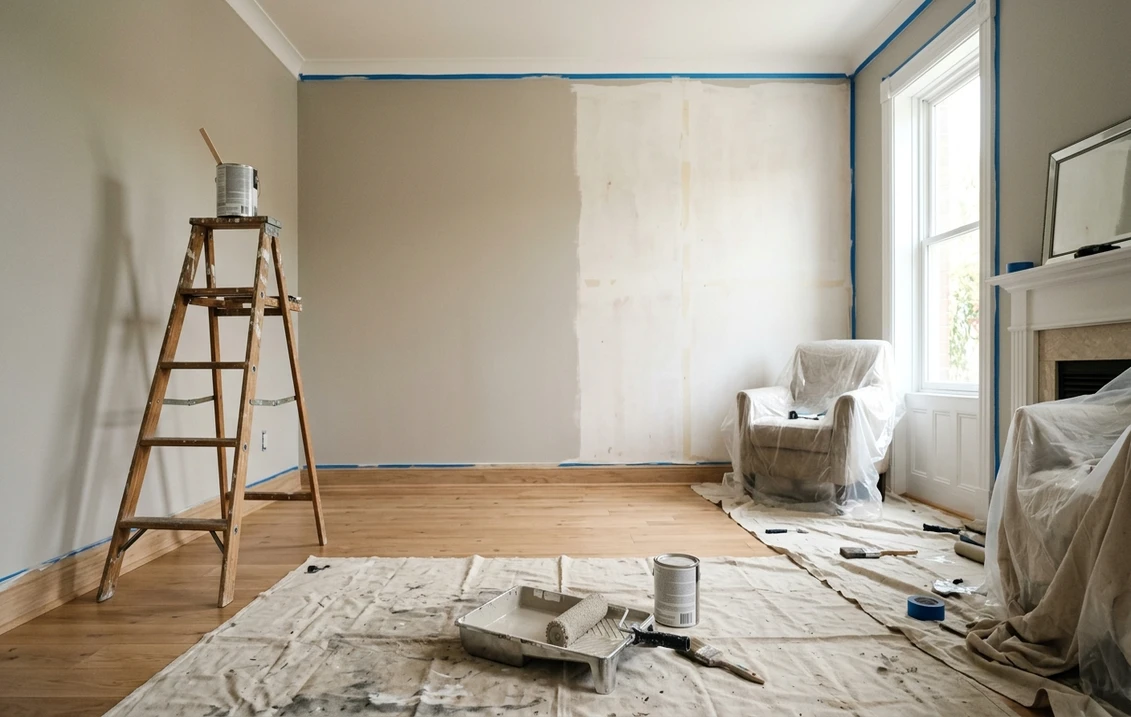
Try it on your room

Johnstone's Trade Acrylic Durable Matt is a water-based matt emulsion for interior walls, ceilings and previously painted or primed wood and metal, radiators included. Its data sheet gives a Class 1 scrub rating under ISO 11998, a mould-resistant formulation, a sheen of 5 to 10%, coverage of about 11 to 13 m² per litre, and a recoat time of 4 hours. So yes, it is washable, and on paper it suits halls, kitchens and other busy rooms. Against Dulux Trade Diamond Matt, both claim Class 1; Dulux publishes higher coverage, while Johnstone's also covers radiators, which the Dulux sheet rules out, and is sold for surfaces prone to condensation. On 11 November 2026, Johnstone's Decorating Centres listed the white at £45.13 for 2.5 litres, £61.32 for 5 litres and £116.53 for 10 litres, VAT included. Every figure below comes from the makers' published sheets; we have not tested either paint.
Choose the colour before you order the tins
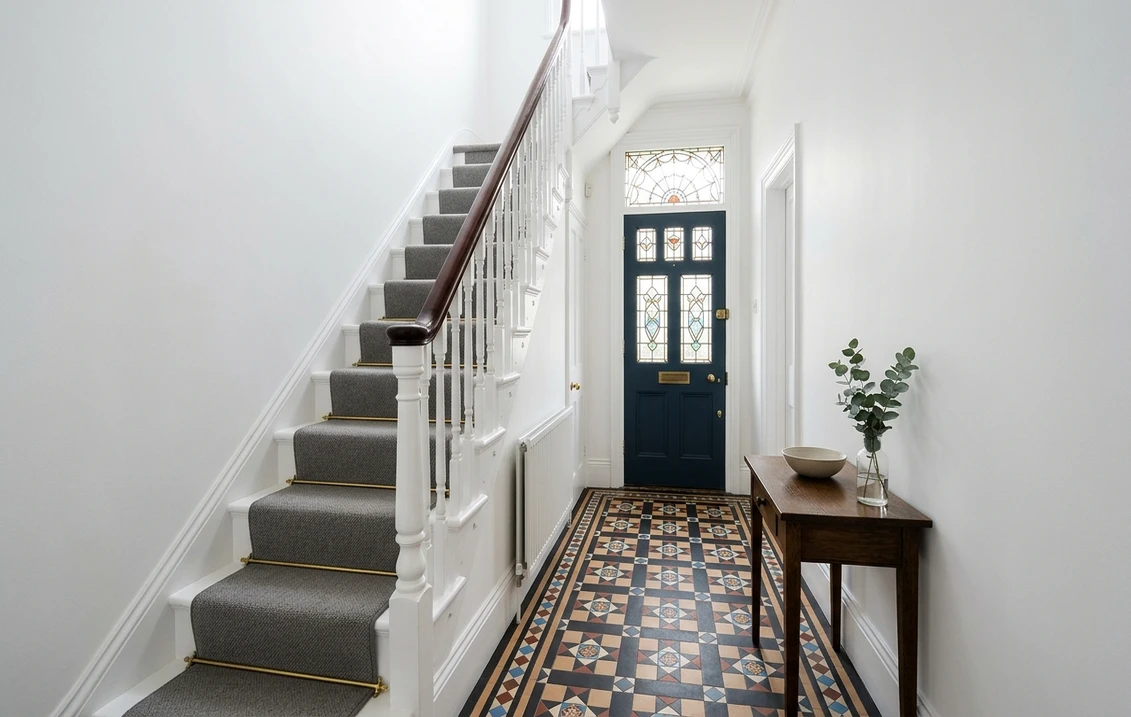
Durable Matt comes in white, magnolia or almost any tinted shade. Upload a photo of your hall or kitchen to the interior paint visualiser and compare a white, a magnolia and a colour on your own walls first.
Try colours on my wallsWhat Johnstone's Trade Acrylic Durable Matt is
Johnstone's Trade is a PPG brand, sold to decorators through Johnstone's Decorating Centres and other stockists. The Acrylic Durable Matt product page describes it for interior walls and woodwork, "including surfaces susceptible to condensation", and calls it a fast-drying, low-odour alternative to traditional eggshell. The figures that matter sit in the technical data sheet linked from the Johnstone's Decorating Centres product page (the PDF we read was last modified in April 2026).
| Item | What Johnstone's states | Where |
|---|---|---|
| Surfaces | New and painted walls and ceilings, fully dry new plaster, plasterboard, brick, block, concrete, cement render, primed or painted timber and metal, radiators | Data sheet |
| Scrub resistance | Class 1, ISO 11998 | Data sheet; NBS listing adds a BSI Kitemark |
| Mould | Mould-resistant formulation; contains a biocide to protect the paint surface from mould degradation | Data sheet |
| Sheen level | 5 to 10% | Data sheet |
| Coverage | About 11 to 13 m² per litre, depending on the surface | Data sheet (13 on the store page, 12 on NBS) |
| Volume solids | 33.6% | Data sheet |
| Film thickness | Wet 83 µm, dry 28 µm | Data sheet |
| Drying | Touch dry in 1 to 2 hours; recoat after 4 hours | Data sheet |
| VOC | Max 1 g/l, against an EU limit of 30 g/l for this category | Data sheet |
| Sizes | 2.5, 5 and 10 litres | Data sheet |
| Colours | White; Magnolia ready mixed; tinted shades via the Johnstone's Tinting System | Store page and data sheet |
Try it on your room
No photo? Try a sample
Two of these numbers check each other. A wet film of 83 µm spread over one square metre uses 0.083 litres, which works out at about 12 m² per litre: the middle of the 11 to 13 range. And 28 µm dry from 83 µm wet is 34% of the film left once the water has gone, in line with the 33.6% volume solids. On our calculations, the sheet is internally consistent. The specifiers' listing on NBS Source gives the same film thickness, rounds the solids to 34% and the coverage to 12 m² per litre, and lists the scrub rating as a BSI Kitemark. One retail listing we read on 11 November 2026 gave a 3 to 4 hour recoat and up to 16 m² per litre instead: go by the data sheet.
Is Johnstone's Acrylic Durable Matt washable? What Class 1 means
Yes. The data sheet says it can withstand daily wear and tear and repeated washing, and backs that with the Class 1 rating, which involves two standards. ISO 11998 is the test: a pad scrubs a painted panel with a cleaning solution, and the result is the thickness of film lost after 200 scrub cycles. BS EN 13300 is the classification for interior wall and ceiling paints that turns the result into five classes, Class 1 being the most resistant and Class 5 the least.
Both standards have moved. BSI lists BS EN 13300:2022 as the current classification, after the 2001 edition was withdrawn in December 2022. For the test, BSI published BS EN ISO 11998:2026 on 31 October 2026, and its page for the 2006 edition shows it withdrawn on 22 October 2026. Both data sheets in this guide were issued before then, so their Class 1 results date from the 2006 method.
Class 1 is a high bar for a matt. The EU Ecolabel criteria for paints, in Commission Decision 2014/312/EU, ask indoor wall and ceiling finishes to reach Class 1 or Class 2 under EN 13300 and EN ISO 11998. What the rating does not measure is scuffing: a scrub test wears the film down with a wet pad, while a scuff is a mark left on the surface by a shoe, a bag or a chair. Johnstone's publishes no scuff figure.
The Johnstone's sheet gives no cleaning method or curing time. For its own matt, the Dulux Trade Diamond Matt data sheet advises a soft cloth and soapy water, warns that scourers may impair the matt finish, and gives 7 days to full durability. In our reading, that caution suits any matt: wait a week before the first wash.
Condensation, damp and mould: what the claim covers
Johnstone's says Durable Matt is suitable for surfaces susceptible to condensation and has mould-resistant properties for damp areas. The data sheet explains how: it contains a biocide to protect the paint surface from mould degradation. That protects the film. It does not dry the room. The government guidance on the health risks of damp and mould in the home (updated 1 April 2026, England) names condensation as one of the most common causes of damp and mould, explains that moisture from showering, drying laundry and cooking builds up when it cannot be removed, and says simply removing surface mould will not prevent it from reappearing.
So the extractor comes first. For new extract fans in England, Table 1.1 of Approved Document F, Volume 1 (2021 edition) sets minimum intermittent extract rates of 30 litres per second for a kitchen with a cooker hood extracting outside, 60 l/s for a kitchen without one, 30 l/s for a utility room and 15 l/s for a bathroom. In an older home they are a useful yardstick. Our anti-mould paint guide sets out the order of work: stop the moisture, kill and clean the mould, then paint.
For a bathroom that steams up daily, Johnstone's also makes a dedicated bathroom emulsion. Our Johnstone's Bathroom Mid Sheen guide covers its 16 ready-mixed colours and drying times, and compares it with the Dulux and Crown bathroom paints.
Walls, ceilings, woodwork and radiators: where to use it and where not
The data sheet's list of surfaces is broad for an emulsion. On walls and ceilings it takes new and previously painted surfaces, fully dry new plaster, plasterboard, brick, block, concrete and cement render. On wood and metal it needs a primed or previously painted surface: bare timber and metal are primed first with a Johnstone's Trade primer, and old gloss is rubbed down with fine waterproof abrasive paper and rinsed. Radiators are named, with one condition: let them cool before painting.
- Good fits on paper: halls, stairs and landings, kitchens, utility rooms, children's rooms and rented homes. One paint for walls, ceiling and radiator also saves a tin.
- Woodwork, with a caveat: Johnstone's offers it as an alternative to eggshell, but a 5 to 10% sheen is still a matt. On skirting, door edges and stair spindles that take knocks, a harder trim finish may wear better; that is our opinion, not a maker's figure. Our utility room paint guide weighs matt against eggshell and satin for a hard-working room.
- Not outside: the sheet says interior use only. Masonry and exterior wood need their own products.
- Not in the cold or damp: nothing below 8°C, air or surface, and not in damp conditions.
- Not over a cheap base coat: the sheet advises against lower-performing coatings, such as contract matts, as a base coat. The durability sits in the whole system, not just the top coat.
- Not over lead: pre-1960s paint on wood and metal may contain harmful lead, the sheet warns, so special precautions apply before sanding.
Johnstone's Durable Matt or Dulux Diamond Matt?
The answer comes from the two data sheets. The Dulux figures are from the Diamond Matt product page and its data sheet 1026, issued in August 2025.
| Published figure | Johnstone's Trade Acrylic Durable Matt | Dulux Trade Diamond Matt |
|---|---|---|
| Scrub rating | Class 1, ISO 11998 | Class 1, ISO 11998; also Type C, BS 7719; "tested up to 10,000 scrubs" |
| Coverage | About 11 to 13 m²/l | Up to 16 m²/l |
| Volume solids | 33.6% | 49% for white (nominal); other colours vary |
| Sheen | 5 to 10% | Matt; no figure published |
| Drying | Touch dry 1 to 2 h; recoat 4 h | Touch dry depends on conditions; recoat 4 to 6 h; full durability after 7 days |
| Minimum temperature | 8°C | 8°C (citing BS 6150) |
| Surfaces | Walls, ceilings, primed or painted wood and metal, radiators | Interior walls and ceilings; not on heated surfaces such as radiators |
| Condensation | Suitable for surfaces susceptible to condensation; biocide against mould | Suitable for kitchens and bathrooms; not where there is heavy and prolonged condensation |
| Stains | No stain claim on the data sheet | Stain Repellent Technology |
| VOC | Max 1 g/l | Max 1 g/l |
| Sizes and ready-mixed | 2.5, 5, 10 l; white; magnolia | 2.5, 5, 10 l; ready-mixed RAL 9010 in 10 l; some dark muted colours not available |
| 10 l white, 11 Nov 2026 | £116.53 (Johnstone's Decorating Centres) | £122.42 for Pure Brilliant White (The Paint Shed) |
The two paints split along clear lines. Dulux publishes more: a second scrub standard, a stain claim, higher solids and a higher coverage figure. But "up to 16" is a ceiling, while "about 11 to 13" is a range, so the real gap may be smaller. Johnstone's is the broader paint: the same tin goes on radiators and on primed woodwork, and it is sold for surfaces prone to condensation, where the Dulux sheet draws a line at heavy and prolonged condensation. On the day we checked, public prices for a 10 litre white were within about £6 of each other, at two different sellers.
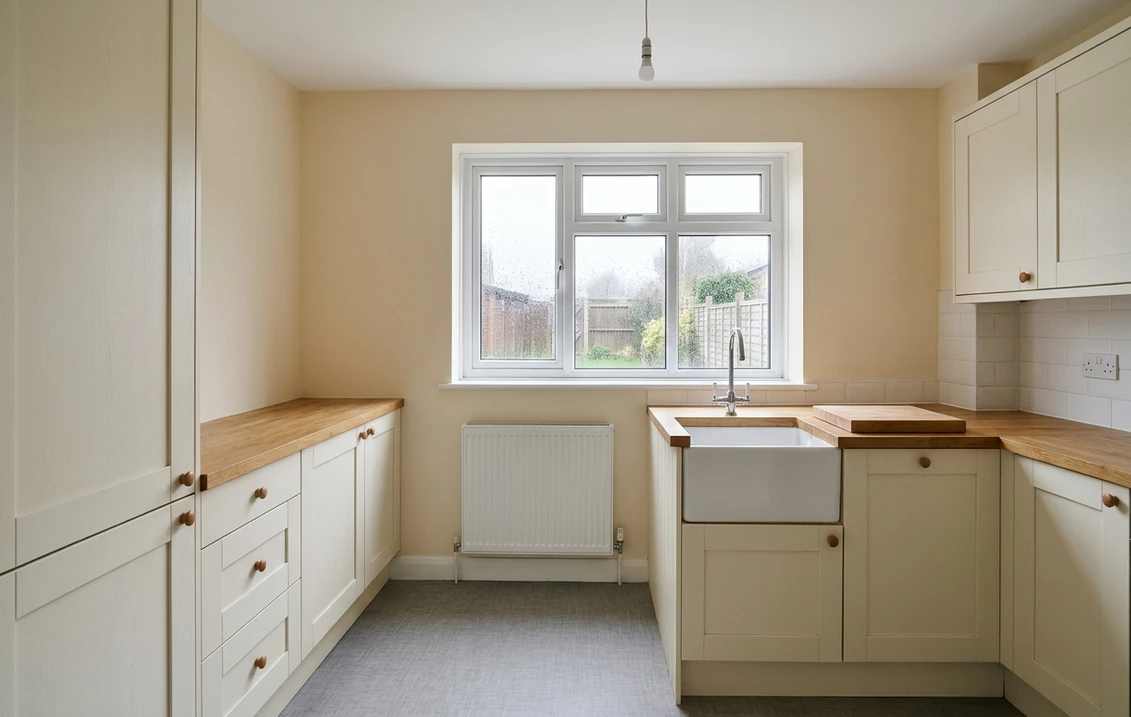
So, Dulux or Johnstone's? For a hall or a family room where marks and stains are the main worry, Diamond Matt's published claims go further. For a kitchen, a utility room or a rented flat where one paint has to cover walls, ceilings and radiators in a room that steams up, Durable Matt's data sheet fits better. That is our reading of two documents, not a test result. For the high-street ranges, our Crown versus Dulux interior comparison covers that ground, and our Dulux kitchen paint guide covers the Dulux side for kitchens.
Brilliant White, Magnolia and tinted colours
Johnstone's Decorating Centres sell Acrylic Durable Matt in three ways: White, the shade people search for as Brilliant White, in 2.5, 5 and 10 litres; Magnolia, ready mixed in 5 and 10 litres; and tinted, mixed to order. The data sheet says it is available in a full colour palette through the Johnstone's Tinting System, and the NBS listing points specifiers to PPG's Voice of Colour palette.
Two warnings from the data sheet matter for tinted paint. If more than one can of a colour goes on the same area, intermix them before use. And over a contrasting colour, further coats may be needed for full obliteration: plan for a third coat. For a hall in particular, our hallway paint colours guide works through light, size and shade before you pick one, and our guide to testing paint colours explains how to judge a tester in your own light.
Johnstone's Acrylic Durable Matt prices in November 2026
These are the prices on the Johnstone's Decorating Centres website on 11 November 2026, for a customer without a trade account. The price per litre is our calculation. Tinted prices depend on the shade and are shown only once a colour is chosen, so they are not listed here.
| Size | White, inc. VAT | Excl. VAT | Per litre inc. VAT | Magnolia, inc. VAT |
|---|---|---|---|---|
| 2.5 l | £45.13 | £37.61 | £18.05 | Not sold in 2.5 l |
| 5 l | £61.32 | £51.10 | £12.26 | £61.32 |
| 10 l | £116.53 | £97.11 | £11.65 | £116.53 |
The 2.5 litre tin costs about half as much again per litre as the 5 litre one. Once a job needs more than 2.5 litres, a single 5 litre tin (£61.32) costs less than two 2.5 litre tins (£90.26), and a 10 litre tin costs £10.08 more than a 5 plus a 2.5 while giving 2.5 litres more. Prices change and stockists set their own.
How much do you need? A worked example for a hall
Take a hall 5 m long and 1.2 m wide with a 2.4 m ceiling. The walls come to 29.8 m², or 25 m² after our allowance of 4.8 m² for three doors; the ceiling adds 6 m², so 31 m² in all. We use the data sheet's range of 11 to 13 m² per litre per coat, and its systems for each kind of surface.
| Starting point | Coats (data sheet) | Litres (our calculation) | Tins and cost, white |
|---|---|---|---|
| Sound painted surfaces, similar colour | At least 2 | 4.8 to 5.6 l | 5 l + 2.5 l, £106.45 (or 5 l alone, £61.32, if the surface takes 13 m²/l) |
| New plaster or bare surfaces | 1 coat thinned up to 20%, then at least 2 | 7.2 to 8.5 l | 10 l, £116.53 |
| Strong colour change | 3, allowing for an extra coat | 7.2 to 8.5 l | 10 l, £116.53 |
The thinned first coat on new plaster uses less paint than a full coat, since up to a fifth of it is water, so the new-plaster figure is on the safe side. Add the radiator and woodwork if they get the same paint.
Applying it: the data sheet's system, step by step
- Prepare. Surfaces clean, dry and free from grease; flaking paint removed; old gloss rubbed down and rinsed. Wear a mask if dry sanding.
- Seal new or absorbent surfaces. One coat thinned with up to 20% clean water, which is up to 200 ml per litre of paint on our reading. Prime bare timber and metal with a Johnstone's Trade primer instead.
- Build the finish. At least two full coats on new or bare surfaces after the sealing coat; one further undiluted coat on absorbent existing finishes; at least two on sound existing paint; more over a contrasting colour.
- Respect the timings. Recoat after 4 hours, at 8°C or above, and ventilate during application and drying.
- Spraying. Airless tips of 0.013 to 0.017 inch at 2,000 to 2,500 psi, with respiratory protection.
- Clean up. Warm soapy water for tools, never into drains; protect tins from frost.
The sheet also asks for the work to follow BS 6150, the code of practice for painting, and BS 8000-12 for decorative wallcoverings and painting. If paint has failed on a wall before, find out why first: our guide to paint bubbling and peeling on walls and ceilings covers new plaster, mist coats and damp.
White, magnolia or a colour in your hall?
Choose the shade on a photo of your own room first. Open the interior paint visualiser, then place each candidate on your walls.
Compare shades on my photoHiring a decorator with Durable Matt
Durable Matt is a trade paint, so if a decorator supplies the materials it may arrive as part of the quote rather than from your own shopping list. Ask which paint and how many coats are priced, and whether radiators and woodwork get the same paint or a trim finish. Our UK interior decorator cost guide, the pillar of this cluster, covers how interior work is priced, and our interior decorating costs breakdown shows where the money goes room by room.
Sources and references
- Johnstone's Trade (PPG), Acrylic Durable Matt product page: uses, condensation, eggshell alternative.
- Johnstone's Trade (PPG), Acrylic Durable Matt technical data sheet: surfaces, scrub class, biocide, sheen, coverage, solids, film, drying, temperature, thinning, systems, spray, VOC, sizes, tinting.
- Johnstone's Decorating Centres, Acrylic Durable Matt product page: colour options, sizes, coverage, prices (11 November 2026).
- NBS Source, Acrylic Durable Matt specification listing: BSI Kitemark, coverage, film thickness, colour palette.
- AkzoNobel, Dulux Trade Diamond Matt product page and data sheet 1026 (issued 08/25): scrub ratings, coverage, solids, drying, radiators, condensation, cleaning, sizes.
- BSI, BS EN 13300:2022 and BS EN ISO 11998:2026: current editions and dates.
- legislation.gov.uk, Commission Decision 2014/312/EU, Annex: Ecolabel wet scrub requirement.
- HM Government, Approved Document F, Volume 1, 2021 edition: Table 1.1 intermittent extract rates.
- GOV.UK, Understanding and addressing the health risks of damp and mould in the home: condensation and mould.
- Our calculations (11 November 2026): coverage from film thickness, prices per litre and the worked example; not test results. The Diamond Matt price was read on The Paint Shed's product page that day.
Frequently asked questions
Is Johnstone's Acrylic Durable Matt any good?
Is Johnstone's Acrylic Durable Matt washable?
Which is better, Dulux or Johnstone's?
Johnstone's Durable Matt or Dulux Diamond Matt?
How far does Johnstone's Acrylic Durable Matt go?
How long does Johnstone's Acrylic Durable Matt take to dry?
Can you use Johnstone's Acrylic Durable Matt on woodwork and radiators?
Trademarks mentioned (Sherwin-Williams, Benjamin Moore, Behr, Caparol, Brillux, Sto, Alpina, Valspar, PPG, Glidden, Dulux, Crown Trade, Sandtex, Farrow & Ball, Johnstone's, Leyland) are property of their respective owners. FacadeColorizer is independent and not affiliated with any of them. Nominative fair use under Lanham Act §1125.