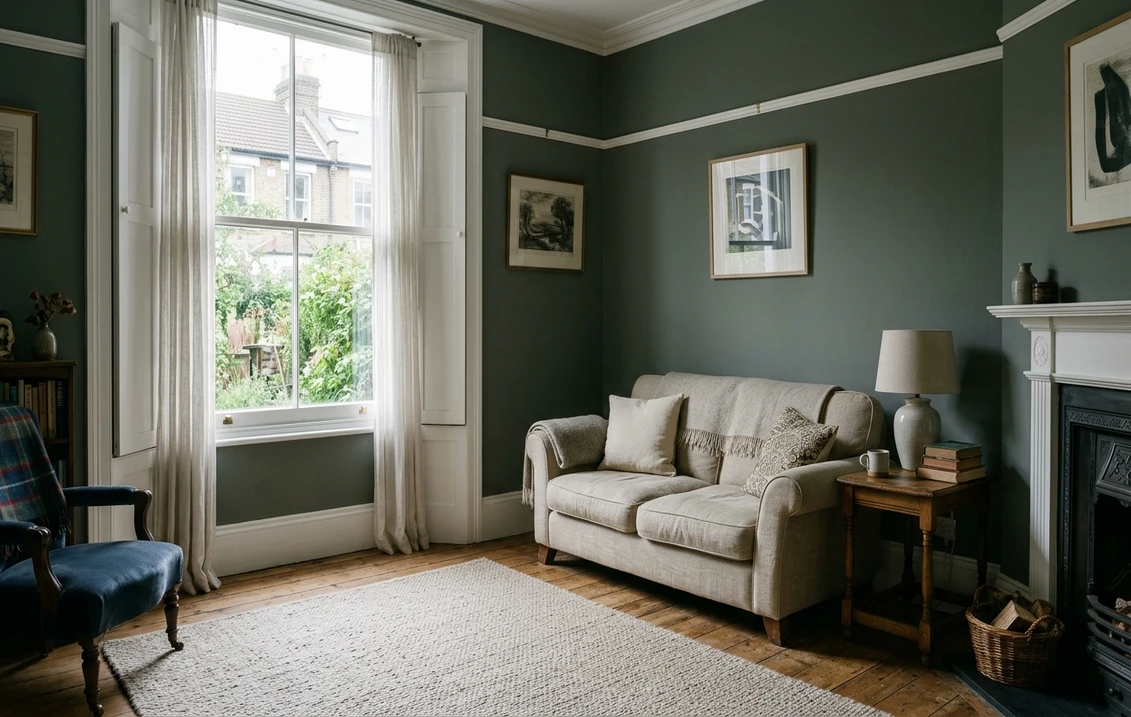
Try it on your room

Farrow & Ball Green Smoke No. 47 is a smoky green blue, a deep and muted colour rather than a pale one, which the maker says was popular in interiors in the late 19th century. It depends on the room more than most colours: north light pulls it towards its cooler, greyer side. Farrow & Ball publishes its swatch as #6F7B71 and does not publish a light reflectance value (LRV) for it, so every lightness figure in this guide is our own calculation from that swatch. This guide covers rooms inside the home, room by room, with the light, the finish, the pairings and the nearest Dulux shades we calculated.
See Green Smoke on your own walls first
Upload a photo of your room and try Green Smoke on its walls before you order sample pots. The interior paint visualiser shows the colour in your own light, so you judge it against your floor, furniture and daylight.
Try Green Smoke on my wallsWhat colour is Farrow & Ball Green Smoke?
Farrow & Ball describes Green Smoke as a smoky green blue. Its colour page says the shade was popular in interiors in the late 19th century, that it has a deep, weathered look outdoors and that it brings a calm, quiet mood inside. Those statements describe how the colour is used rather than how it measures, so for the numbers we start from the swatch on the maker's page, #6F7B71.
We converted that swatch to CIELAB, the colour space that separates lightness (L*) from the green-to-red axis (a*) and the blue-to-yellow axis (b*). For #6F7B71 the values are L* 50.4, a* -6.5 and b* 4.0. The negative a* confirms the green lean. The small positive b* means a slight yellow in the base, which stops the colour turning cold under ordinary light. Chroma, the overall strength of colour, is about 7.6 on our scale, so Green Smoke is a muted colour, and most of its character comes from the grey.
Our relative luminance figure is 18.7 on a scale from 0 (black) to 100 (white). It comes from the screen swatch, not from a reading on painted walls, and it is not an LRV. Use it to rank Green Smoke against other colours, not to compare it with a manufacturer's published light reflectance value.
| Item | Value | Where it comes from |
|---|---|---|
| Name | Green Smoke No. 47 | Farrow & Ball colour page |
| Swatch on the maker's page | #6F7B71 | Farrow & Ball colour page |
| Light reflectance value | Not published | Farrow & Ball colour page |
| Relative luminance (0 to 100) | 18.7 | Our calculation from the swatch |
| CIELAB (L*, a*, b*) | 50.4, -6.5, 4.0 | Our calculation from the swatch |
| Finish for kitchens and bathrooms | Modern Emulsion, 7% sheen | Farrow & Ball colour page (maker's advice) |
Try it on your room
No photo? Try a sample
How light changes Green Smoke
Light moves a colour like Green Smoke more than a pale one, because its interest lies in its grey and green lean. Farrow & Ball's guide on how light affects colour says that northern light tends to bring out the cooler tones within a colour. Farrow & Ball also says its colours are designed to shift in undertone and intensity as the light changes through the day. Dulux's advice for north-facing rooms describes that light as cooler and weaker, and suggests warmer undertones such as pink, gold or yellow, or greys and whites with a subtle warm hint.
| Room faces | What the light does | What it means for Green Smoke (our reading) |
|---|---|---|
| North | Cooler, weaker light, which Farrow & Ball says brings out the cooler tones in a colour | The green and grey come forward. Expect a cooler, flatter colour than the sample card, and check it at the times you use the room. |
| South | Strong, clear light for much of the day, where Dulux says all colours work well | Green Smoke keeps its green and its depth. It can look deeper here than in a north room, so test it in the brightest part of the room. |
| East | Most sun in the morning, then cooler, muted light in the evening (Farrow & Ball) | Fresh at breakfast and greyer after dark. Judge the sample in the evening under your own lamps. |
| West | Cooler mornings and brighter afternoons (Farrow & Ball) | Quiet and cool in the morning, fuller by late afternoon. Look at the sample at both times before you decide. |
For east and west rooms, Dulux suggests cooler shades with blue, green or violet hints for rooms used at the hours when the light is cool. That puts Green Smoke in a suitable family for a morning room or an evening room, but the aspect still decides how far it moves. For a dark or grey-leaning colour, the aspect is the first thing to check.
If a north-facing room reads cold on the sample, the answer is not automatically a deeper green. Dulux recommends warmer undertones for north rooms, so compare Green Smoke with a warmer neighbour before you choose. Our paint colours guide for north-facing rooms sets the same question out across several colours.
Bulbs change the answer as much as the aspect
Farrow & Ball's guide says halogen and incandescent bulbs give a yellow light that makes wall colours look warmer, while cool white bulbs give a bluer light that gives paint a cooler cast. It recommends a neutral white bulb as the one that most accurately replicates daylight. Green Smoke sits between green and blue, so the bulb decides which side shows. A cool bulb brings out the blue; a warm bulb softens the grey and lifts the slight yellow in its base.
In practice, check the sample under the bulbs you use after dark, and read the bulb colour on the packet before you judge it. A room lit by one cool ceiling light will look different from the same room lit by two warm lamps, even in the same daylight. That is a reason to test the sample twice, once by day and once in the evening.
Room by room: where Green Smoke works
Each room below combines the light above with how the room is used. The guides we link to cover the other colours a reader would compare in the same room.
Living rooms and sitting rooms
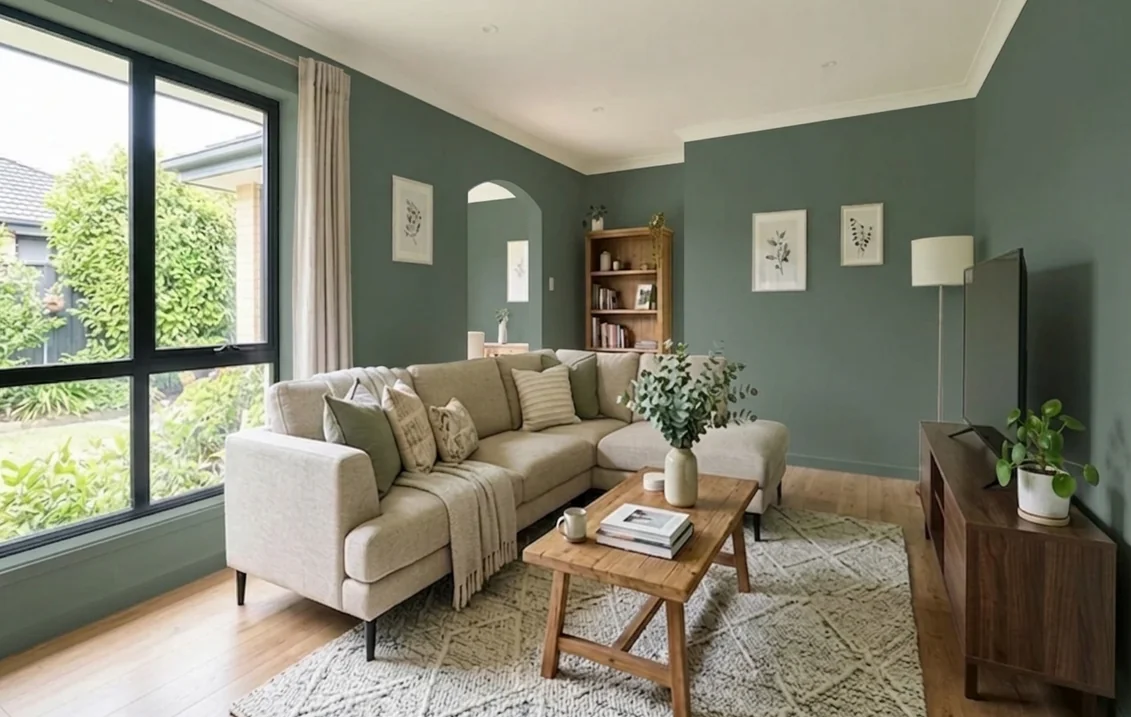
Green Smoke suits a sitting room used mostly in the evening. A deep, calm wall gives a sofa, lamps and books something to sit against. Put it on the wall behind the sofa or on the chimney breast, and keep the ceiling and woodwork lighter so the room does not close in. If the room faces north, sample the colour beside the fabrics before you commit, because the sofa will look different under cool light. Our living room paint colours guide sets other shades beside it for the same kind of room.
Studies and panelled rooms
This is where Green Smoke is most convincing. A deep green grey suits the walls of a study, and it works best when a lighter tone takes the panelling, the ceiling or the shelves. Our Green Smoke study in a Georgian home shows the walls against Wimborne White panelling. That scheme is our own render, not a Farrow & Ball suggestion. For panelling in period houses, our Georgian wainscoting guide covers the same kind of woodwork.
Hallways and stairs
A hallway gets less daylight than a sitting room, so a deep green can look heavy there. Test it against the light you have at the times you walk through the hall, and judge it under the hall lamp as well as by the window. Our hallway paint colours guide sets other options beside it for a narrow space.
Bathrooms and kitchens
Here the finish matters more than the colour. Farrow & Ball says Modern Emulsion has a preservative that protects it from mould, and it calls Modern Emulsion the best finish option for steamy spaces. Choose the finish first and then the shade. Our bathroom paint colours guide covers moisture-resistant options in more depth.
Bedrooms
The maker's colour page describes Green Smoke as calm and serene indoors, which is the quality a bedroom asks for. A bedroom is also a low-traffic room, so the finish question matters less here than in a kitchen or a hall. Keep the strongest green to one wall, and let the bed linen carry the warmer tones.
Which Farrow & Ball finish to choose
Farrow & Ball describes Modern Emulsion as a durable matt finish with a 7% sheen. Its colour page says it is washable, resistant to knocks and scrapes, stain resistant and scuff-proof, and that it contains a preservative against mould. The maker rates its colours as Scrub Class 1, but that rating carries a footnote: it excludes Estate Emulsion. For any wall that gets wiped often, such as a hall, a kitchen or a child's room, Modern Emulsion is the safer choice. Estate Emulsion suits walls that see less contact.
The colour page we read does not name a woodwork finish for Green Smoke, so choose the trim finish from the maker's finish pages and check it against the walls on your sample card. Do not assume that a wall finish is the right finish for skirting and doors.
Pairings, the sample pack and the lighter neighbours
Farrow & Ball says it pairs each colour with a complementary white, hand-picked for its undertones. The Green Smoke page we read does not name that white, so check the pairing on a real sample rather than assume one. The maker also sells a sample selection of three 100 ml pots, Green Smoke with French Gray and Studio Green, which it presents as its favourite greens. That set is a practical way to compare Green Smoke with a lighter grey and a brighter green before you commit.
For a lighter neighbour, sample Farrow & Ball Ammonite. Our Ammonite guide covers it at the same depth. If you are also weighing another UK maker, our Farrow & Ball and Little Greene comparison sets the two ranges side by side.
Nearest Dulux colours (our calculation, not a match)
Readers often ask for a Dulux equivalent. We calculated the colour difference (CIEDE2000, written ΔE2000) between the Green Smoke swatch and the hex values printed on twelve Dulux colour pages. A lower figure means the two swatches look closer on screen. The calculation uses screen values only: it does not measure paint, finish or light, and Farrow & Ball says its colours cannot be matched. Read the table as a shortlist to sample, not as a substitute.
| Dulux colour | Hex on Dulux page | ΔE2000 to #6F7B71 | Relative luminance (our calc) | How it differs |
|---|---|---|---|---|
| Neptune Seas | #627775 | 5.3 | 17.1 | Closest of the twelve; a little cooler and slightly darker |
| Warm Graphite | #7F7B73 | 8.3 | 19.9 | Warmer and greyer, with much less green |
| City Fog | #63655D | 9.1 | 12.8 | Darker and greyer |
| Gooseberry Fool 1 | #787256 | 10.7 | 16.7 | Browner, more olive |
| Fresh Sage | #8AA38B | 14.6 | 33.5 | Lighter and softer, a clear step away |
On the pages we checked, no Dulux colour is close. The nearest, Neptune Seas, is about 5.3 away. We read a difference of around 5 as visible when two swatches sit side by side. That is our judgement, not an industry standard. The lighter sages are more than 14 away, and the warm neutrals Khaki Mists 5, Weathered Pebble and Egyptian Cotton are more than 28 away. We did not include Little Greene or Crown in this table, because we could not read their colour data on our checks.
Paint regulations, water-based finishes and indoor air
The Volatile Organic Compounds in Paints, Varnishes and Vehicle Refinishing Products Regulations 2012, Schedule 2 sets a limit of 30 g/l for interior matt walls and ceilings, measured on the ready-to-use product. Farrow & Ball says all its finishes have been water based since 2010 and carry an A+ rating for indoor air quality. Those are the maker's claims. The 30 g/l figure is the limit the regulation sets, not a measured value for any particular tin of Green Smoke.
How to test Green Smoke before you buy
Order a single sample pot, or the three-pot selection with French Gray and Studio Green. Paint two coats on a card at least A3 in size, with a white border so the old wall colour does not distort the reading. Move the card between the window wall and the darkest corner. Look at it in the morning, in the late afternoon and in the evening under the lamps you use. Then compare it with what stays in the room: the floor, the sofa, the worktop and the woodwork. Our guide to testing paint colours before buying explains how to read a sample across the day.
Green Smoke or a lighter grey in your room?
Compare the candidates on a photo of your own room before you order pots. Start with the interior paint visualiser, then open the tool to test each shade on the walls.
Compare greens on my roomHiring a decorator to paint Green Smoke
Some people hand a deep colour on a tall wall to a decorator. Our UK interior decorator cost guide is the pillar of this cluster and covers what interior decorators charge in the UK. Ask the decorator for a sample on your own wall before the job starts, and agree the finish in writing, so that the finish on the quote is the finish that goes on the wall.
Sources and references
- Farrow & Ball, Green Smoke No. 47 colour page: description, swatch colour #6F7B71, absence of an LRV, Modern Emulsion (7% sheen, mould preservative, scuff and stain resistance), the Scrub Class 1 footnote that excludes Estate Emulsion, and the three-pot sample selection.
- Farrow & Ball, How Light Affects Colour: northern light and cooler tones, the effect of halogen, incandescent, cool white and neutral white bulbs, and the light by aspect.
- Dulux, Best shades for north, south, east or west-facing rooms: the cooler, weaker light of north-facing rooms, the warm undertones it suggests, and the cooler shades suggested for east and west rooms.
- Dulux, colour pages for Neptune Seas, Warm Graphite, City Fog, Gooseberry Fool 1 and Fresh Sage: the hex values used for the colour-difference table.
- legislation.gov.uk, Volatile Organic Compounds in Paints, Varnishes and Vehicle Refinishing Products Regulations 2012, Schedule 2: the 30 g/l limit for interior matt walls and ceilings.
- Our calculations: CIELAB values, relative luminance and CIEDE2000 colour differences, computed from the hex values above on 4 November 2026. They are not LRV values and not a colour match.
Frequently asked questions
Is Farrow and Ball Green Smoke a dark colour?
Does Green Smoke look green or blue?
What is the closest Dulux colour to Green Smoke?
Does Green Smoke work in a north-facing room?
Which Farrow and Ball finish should I use for Green Smoke in a bathroom?
Does Farrow and Ball publish an LRV for Green Smoke?
Trademarks mentioned (Sherwin-Williams, Benjamin Moore, Behr, Caparol, Brillux, Sto, Alpina, Valspar, PPG, Glidden, Dulux, Crown Trade, Sandtex, Farrow & Ball, Johnstone's, Leyland) are property of their respective owners. FacadeColorizer is independent and not affiliated with any of them. Nominative fair use under Lanham Act §1125.