Try it on your room

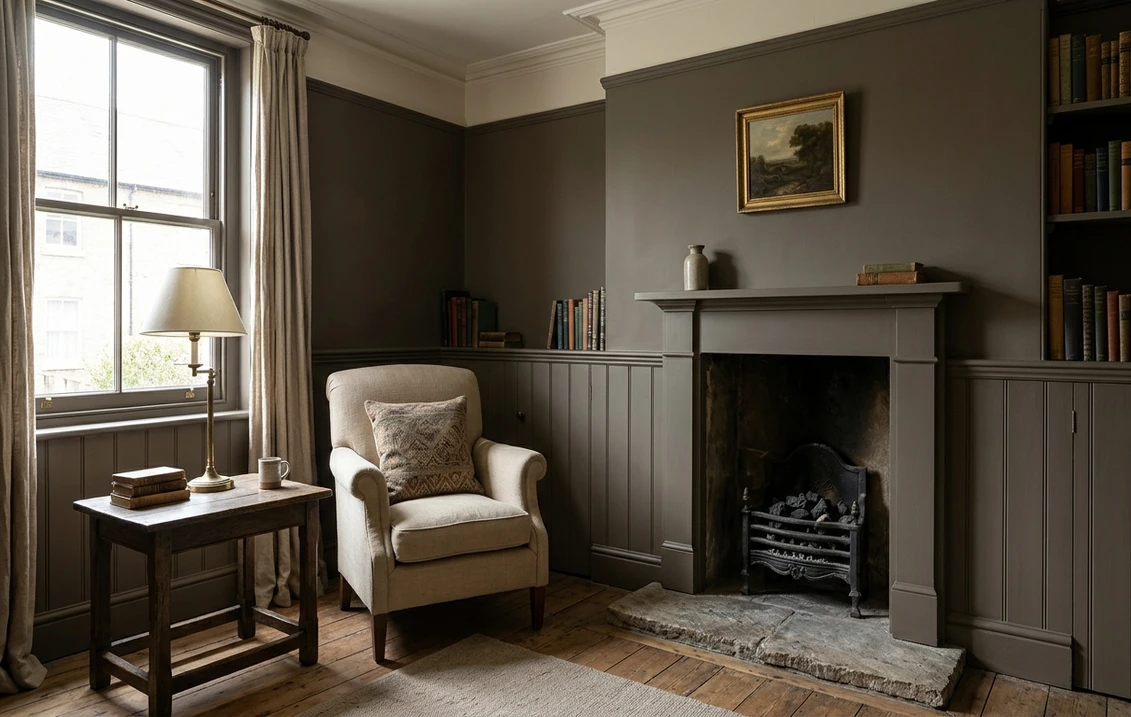
Farrow & Ball Broccoli Brown No. 198 is a dark, muted stone brown. The maker calls it "a quiet dark stone" that sits easily beside weathered wood and flagstone floors. Indoors, it suits painted panelling, a kitchen, a study or a north-facing room, where Farrow & Ball's light guide suggests darker wall colours for a cosy, cocooning feel. The colour page recommends the Dark Tones primer and names Stirabout No. 300 as the complementary white. On 9 November 2026, the maker's UK site sold it at £66 for 2.5 litres of Modern Emulsion and £5.95 for a sample pot. No light reflectance value (LRV) is published, so every lightness figure below is our own calculation.
See Broccoli Brown on your own walls
A dark colour changes a room more than a pale one. Upload a photo of your room to the interior paint visualiser and judge Broccoli Brown next to your floor, your furniture and your own daylight.
Try Broccoli Brown on my wallsWhat colour is Farrow & Ball Broccoli Brown No. 198?
The Broccoli Brown colour page describes a dark, quiet colour that feels reserved and comforting, and files it in the Brown colour group of its shop data. The page does not explain the name, so we do not guess at it. Like the rest of the range, it is made in Dorset, where the page says every tin has been handcrafted since 1946. No hex code is printed beside the name, but each of the seven colour schemes on the page starts from a base swatch coded #827462, the same value our colour library holds for No. 198. It is a screen approximation, and paint will read differently in your light.
| Item | Value | Source |
|---|---|---|
| Primer and undercoat | Dark Tones | Colour page |
| Complementary white | Stirabout No. 300 | Colour page |
| LRV | Not published | Colour page |
| Library swatch | #827462 | Our library |
| Lightness (CIELAB L*) | 49.6 | Our calculation |
| Red to green (a*) / yellow to blue (b*) | 2.4 / 11.9 | Our calculation |
| Relative luminance (0 to 100) | 18.1 | Our calculation; not an LRV |
Try it on your room
No photo? Try a sample
On our figures, Broccoli Brown sits in the middle of the lightness scale: a mid-dark colour, not a near-black. Its chroma of 12.2 is low, which is why it reads as muted stone rather than chocolate, and its small red value against a clearly yellow one puts the hue on the yellow side of brown, short of olive. These are readings of one screen swatch, not measurements of paint.
Broccoli Brown in north, south, east and west-facing rooms
Farrow & Ball's guide on how light affects colour says northern light brings out the cooler tones within a colour. Rather than fight it, it suggests embracing that light with darker wall colours such as Railings or Down Pipe. Broccoli Brown is not one of the two it names, but it is that kind of colour. Dulux's guide to the best shades for north, south, east or west-facing rooms adds that north rooms get cooler light, and less of it, and suggests warmer pink, gold or yellow tones. Our swatch leans yellow, so on our reading it fits that advice better than a blue-grey dark would.
- North: expect a grey stone brown. Check the sample in the flattest afternoon light.
- South: in fine weather, warm light from dawn until dusk, says Farrow & Ball. The brown comes forward, and strong sun also shows the sheen of an eggshell on panelling.
- East: the most sun in the morning, then cooler, muted light. Warmer at breakfast, greyer by evening.
- West: cooler in the morning, brighter in the afternoon. Fuller and browner late in the day.
Bulbs matter as much as the window. The same guide says halogen and incandescent bulbs make wall colours look warmer, cool white bulbs give a cooler cast, and a neutral white bulb most closely matches daylight. Our guide to colours for north-facing rooms compares lighter options if you are weighing a dark wall against a pale one.
Room by room: panelling, kitchens, studies and dark rooms
These notes draw on the maker's description, its light guide and its product advice sheets. Where we give an opinion, we say so.
Panelling and wainscoting
One way to use Broccoli Brown is to paint the panelling and the wall above in the same colour, which Farrow & Ball calls colour drenching. Its advice sheets name Dead Flat, Modern Emulsion, Flat Eggshell and Modern Eggshell as suitable, and say the best results come from one finish on every surface. The Dead Flat sheet describes the most matt finish in the range, 2% sheen, for walls, woodwork and radiators. For panels that take knocks, the Flat Eggshell sheet offers a tougher 20% sheen. The same sheet warns that old paint, especially from before 1990, may contain harmful lead, and that oily woods such as oak and teak need cleaning with methylated spirits before priming. Our Georgian wainscoting and panelling colours guide covers the period side of panelled rooms.
Kitchens
For walls, the Modern Emulsion sheet describes a washable matt finish, 7% sheen, protected against mould and suited to kitchens and bathrooms. For cupboard doors, Flat Eggshell names kitchen cabinets among its uses, and the Modern Eggshell sheet calls that 40% sheen finish the toughest in the range. Two warnings matter more for a dark colour: some darker colours take up to 14 days to reach full hardness, and scuffs can look more visible on them, though a damp microfibre cloth removes them. Try it on your units with kitchen cabinets selected in the tool, and see our kitchen cupboard paint guide for primers and preparation.
Studies and home offices
A study is often used after dark, so the lamps decide this colour more than the window does: a warm lamp pulls it towards soft brown, a cool white panel light towards grey. In our reading, a dark stone wall also makes a calm background for video calls, but check it on your own camera. Our home office paint colours guide sets other options side by side.
Snugs, dining rooms and rooms with little daylight
In a north-facing snug or dining room, the advice to embrace the cooler light with a darker colour applies directly. In our reading, a small room with one small window rarely feels bright whatever the colour, and a dark wall accepts that rather than fighting it. Our snug paint colours guide and dining room paint colours guide cover other choices for those rooms.
Farrow & Ball finishes and UK prices for Broccoli Brown
The colour page lists every finish in which Broccoli Brown is sold, with prices in pounds. Below are the interior finishes as we read them on 9 November 2026, with the sheen from each advice sheet and the maximum coverage per coat from the maker's paint quantity calculator. Prices change, and stockists set their own.
| Finish | Sheen | Prices (9 Nov 2026) | Max. coverage per coat |
|---|---|---|---|
| Estate Emulsion | 2% | 2.5 L £61; 5 L £103 | 70 m² per 5 L |
| Modern Emulsion | 7% | 2.5 L £66; 5 L £111 | 60 m² per 5 L |
| Dead Flat | 2% | 750 ml £34; 2.5 L £81; 5 L £132 | 60 m² per 5 L |
| Flat Eggshell | 20% | 750 ml £36.50; 2.5 L £88; 5 L £141 | 60 m² per 5 L |
| Modern Eggshell | 40% | 750 ml £36.50; 2.5 L £88; 5 L £141 | 60 m² per 5 L |
| Full Gloss | Not read | 750 ml £35; 2.5 L £85 | 30 m² per 2.5 L |
| Casein Distemper | Not read | 2.5 L £82; 5 L £139 | 65 m² per 5 L |
| Sample pot | - | 100 ml £5.95 | - |
The colour page rates all its colours Scrub Class 1, but its footnote excludes Estate Emulsion, Exterior Masonry, Soft Distemper, Casein Distemper and Limewash. The Estate Emulsion sheet gives it Wet Abrasion Class 2, against Class 1 for Modern Emulsion, Dead Flat and both eggshells. For a dark wall in a hall or kitchen, choose a Class 1 finish; Estate Emulsion suits walls that see less contact. On solvents, the sheets give a maximum of 1 g/l VOC for the emulsions and Dead Flat, 2 g/l for Flat Eggshell and 3 g/l for Modern Eggshell. Schedule 2 of the UK VOC in Paints Regulations 2012 sets 30 g/l for water-based interior matt walls and ceilings and 130 g/l for water-based trim paints for wood and metal, so the maker's figures sit well inside both.
How much Broccoli Brown do you need? A worked example
Take a room of 4 m by 3.5 m with walls 2.4 m high: 36 m² of wall, or 32.5 m² after our allowance of 3.5 m² for a door and a window. Farrow & Ball recommends one coat of primer and two of topcoat. Its calculator works out at 12 m² per litre per coat for Modern Emulsion, Dead Flat and the Wall & Ceiling Primer, and 14 m² for Estate Emulsion. The Dark Tones Wall & Ceiling Primer, based on the colour of Down Pipe, cost £21 for 750 ml, £45 for 2.5 L and £78 for 5 L that day.
| Product | Litres (our calculation) | Cheapest tins | Cost |
|---|---|---|---|
| Dark Tones primer, 1 coat | 2.7 L | 2.5 L + 750 ml | £66 |
| Modern Emulsion, 2 coats | 5.4 L | 5 L + 2.5 L | £177 |
| or Dead Flat, 2 coats | 5.4 L | 5 L + 750 ml | £166 |
| or Estate Emulsion, 2 coats | 4.6 L | 5 L | £103 |
With the primer, the walls come to about £243 in Modern Emulsion, £232 in Dead Flat or £169 in Estate Emulsion, before ceiling, woodwork and labour. Treat these as minimums: the calculator gives maximum coverage for one coat, and the advice sheets say darker or stronger colours may need more than two coats. A third coat of Modern Emulsion here would mean two 5 L tins.
What goes with Broccoli Brown: the maker's whites and schemes
The colour page names Stirabout No. 300 as the complementary white: an earthy tone with a hint of underlying grey, hand-picked for its undertone. It then shows seven schemes, each pairing Broccoli Brown with an accent and a trim colour: Dimity with Joa's White, Oxford Stone with London Stone, Setting Plaster with Card Room Green, Beverly with Studio Green, Scallop with Card Room Green, Stirabout with Dimity, and Duster with Dorset Cream. We calculated how far each sits from Broccoli Brown.
| Colour in the maker's schemes | Lightness (L*) | ΔE2000 to Broccoli Brown |
|---|---|---|
| Dimity No. 2008 | 89.9 | 31.4 |
| Dorset Cream No. 68 | 84.5 | 29.0 |
| Stirabout No. 300 | 83.6 | 27.5 |
| Joa's White No. 226 | 83.6 | 27.4 |
| Scallop No. 311 | 81.6 | 26.3 |
| Setting Plaster No. 231 | 79.3 | 25.0 |
| Oxford Stone No. 264 | 78.7 | 24.2 |
| London Stone No. 6 | 67.6 | 16.1 |
| Duster No. 319 | 65.9 | 17.7 |
| Card Room Green No. 79 | 58.4 | 14.1 |
| Beverly No. 310 | 37.3 | 19.0 |
| Studio Green No. 93 | 32.0 | 19.6 |
Against Broccoli Brown's 49.6, the pale neutrals from Oxford Stone to Dimity sit 29 to 40 points lighter, a clear but soft step for a ceiling or the wall above dark panelling. London Stone, Duster and Card Room Green sit 9 to 18 points lighter, so hue does more of the work. Beverly and Studio Green are darker, which makes the green scheme the moodiest; our guide to colours that go with dark green covers that side. For materials, the maker's own examples are weathered wood and flagstone. It does not mention metals; in our reading, brass picks up the yellow side of the base while chrome reads cooler against it.
Broccoli Brown next to its closest Farrow & Ball neighbours
We compared Broccoli Brown with the other 301 Farrow & Ball colours in our library, using the CIEDE2000 formula. Our working rule, not an industry standard, is that a difference of about 5 is easy to see on two swatches side by side.
| Colour | Maker's description (paraphrase) | L* | ΔE2000 |
|---|---|---|---|
| Dauphin No. 54 | Earthy neutral inspired by 19th-century "drabs" | 54.5 | 5.2 |
| Salon Drab No. 290 | Deep chocolate brown | 43.4 | 6.2 |
| Dibber No. 312 | Muddied green | 50.0 | 6.3 |
| Pantalon No. 221 | Changes with the light; pitched for exterior paintwork | 43.5 | 6.6 |
| Wainscot No. 55 | Rich, earthy, upfront warm tones | 44.0 | 7.9 |
| Mouse's Back No. 40 | Grey brown classic | 57.6 | 7.9 |
| London Clay No. 244 | Earthy, loaded with magenta pigment | 44.2 | 7.9 |
For a lighter version of the same mood, Dauphin and Mouse's Back sit 5 to 8 points lighter. For a deeper one, Salon Drab, Pantalon, Wainscot and London Clay sit 5 to 6 points darker, with London Clay pulled towards red. Dibber keeps the lightness and moves towards green. Down Pipe, named in the light guide for north rooms, is 13.5 away: its library swatch is a dark grey, not a brown.
Before you paint: what a dark colour asks of the job
- Primer. Use Dark Tones, and consider a second undiluted coat when the colour change is large, as the sheets advise. White to Broccoli Brown is that kind of change.
- Temperature and timing. Paint between 10°C and 30°C. The sheets give 2 hours to dry and 4 hours before recoating for Modern Emulsion, Dead Flat and the eggshells, 2 hours for Estate Emulsion, and note that darker colours may take longer.
- New plaster. The sheets cite British Standard 6150: a typical drying time of 7 days for every 5 mm of new plaster, then a mist coat diluted with 25% water.
- Batches and touch-ups. Use one batch or intermix tins. The darker the colour and the higher the sheen, the harder a touch-up is to hide, so order for the whole room at once.
- Wet edges. The Flat Eggshell sheet warns that losing the wet edge on darker shades can cause flashing, a halo where two edges meet. Finish each panel section in one go.
How to test Broccoli Brown before you buy
Paint two coats from a sample pot on a card at least A3 in size, with a white border. Move it between the window wall and the darkest corner, and look at it in the morning, late afternoon and evening under your own bulbs. Hold it against the floor, the worktop and the woodwork, which decide whether it reads as warm stone or grey. A small dark sample next to a white wall always looks darker than a fully painted room will. Our guide to testing paint colours explains the method, and our Joa's White guide covers the light taupe used as trim in the first scheme.
Broccoli Brown, Dauphin or Salon Drab in your room?
Compare the candidates on a photo of your own room before you order pots. Start with the interior paint visualiser, then place each colour on the walls.
Compare dark browns on my roomHiring a decorator to paint Broccoli Brown
Patchy coverage, flashing and visible touch-ups all show more on a dark colour. Agree the finish, the primer and the number of coats in writing, and ask for a sample patch on your own wall first. Our UK interior decorator cost guide, the pillar of this cluster, covers how interior work is priced.
Sources and references
- Farrow & Ball, Broccoli Brown No. 198: description, colour group, scheme swatch, no LRV, primer, complementary white, schemes, finishes and prices (9 November 2026), Scrub Class 1 exclusions, Dorset origin.
- Farrow & Ball colour pages for Stirabout, Dauphin, Salon Drab, Dibber, Pantalon, Wainscot, Mouse's Back and London Clay: each colour's description.
- Farrow & Ball, How Light Affects Colour: light by aspect, darker colours for north rooms, bulbs.
- Farrow & Ball, How much paint do I need?: maximum coverage per coat, one coat of primer and two of topcoat.
- Farrow & Ball product advice sheets for Modern Emulsion, Estate Emulsion, Dead Flat, Flat Eggshell and Modern Eggshell: sheen, uses, wet abrasion class, drying, curing, VOC, drenching, lead, oily woods, BS 6150, touch-ups, flashing.
- Farrow & Ball, Wall & Ceiling Primer, Dark Tones: Down Pipe base and prices.
- Dulux, Best shades for north, south, east or west-facing rooms: north-facing light and warm undertones.
- legislation.gov.uk, VOC in Paints Regulations 2012, Schedule 2: 30 g/l and 130 g/l limits on the ready-to-use product.
- Our calculations (9 November 2026): CIELAB values, relative luminance and CIEDE2000 differences from our library swatches, and the worked example. They are not LRVs, not a colour match and not a quote.
Frequently asked questions
What colour is Farrow and Ball Broccoli Brown?
Is Broccoli Brown a warm or a cool colour?
What white goes with Farrow and Ball Broccoli Brown?
How much does Farrow and Ball Broccoli Brown cost in the UK?
Which finish should I use for Broccoli Brown on panelling or kitchen cabinets?
Is Broccoli Brown a good colour for a north-facing room?
Does Farrow and Ball publish an LRV for Broccoli Brown?
Trademarks mentioned (Sherwin-Williams, Benjamin Moore, Behr, Caparol, Brillux, Sto, Alpina, Valspar, PPG, Glidden, Dulux, Crown Trade, Sandtex, Farrow & Ball, Johnstone's, Leyland) are property of their respective owners. FacadeColorizer is independent and not affiliated with any of them. Nominative fair use under Lanham Act §1125.