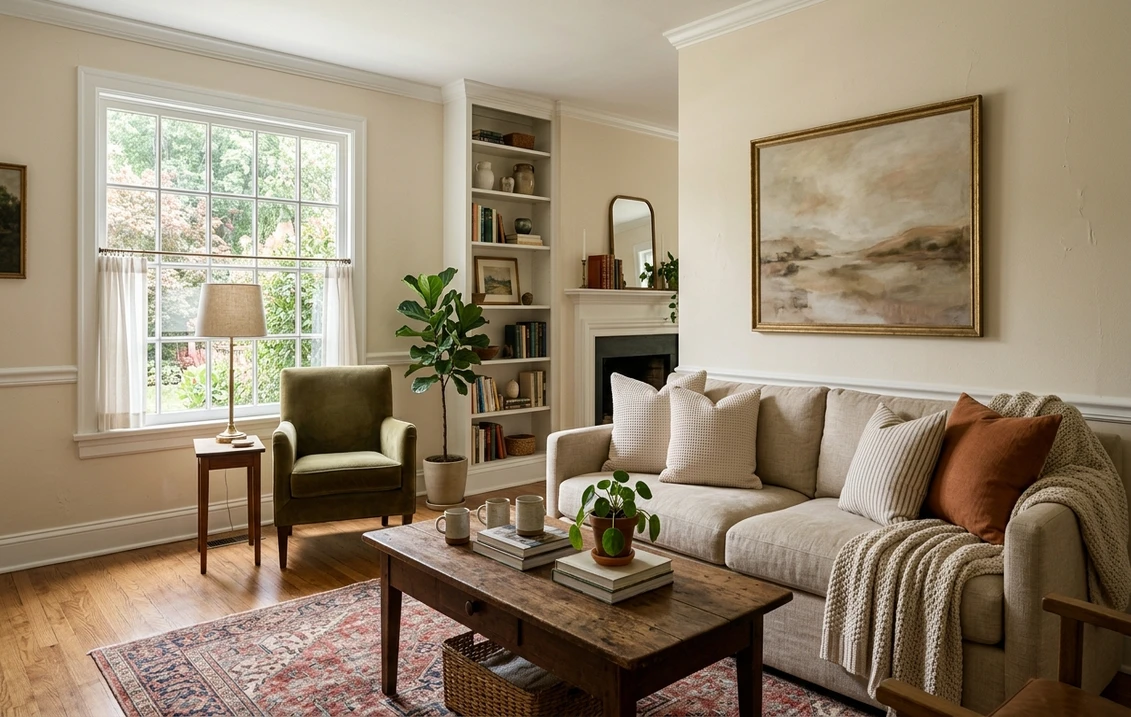
Try it on your room

You hold a chip of Behr Antique White (PWN-43) against a fresh white ceiling and it suddenly looks almost yellow. Against an old cream curtain, the same chip looks crisp. That whiplash is exactly what an antique white is supposed to do: it is not a pure white at all, but a warm, softly aged off-white built to read like sun-mellowed plaster rather than a brand-new paint can. People reach for it when a true white feels cold and a beige feels too heavy, and Antique White is Behr's most reliable answer to that middle ground.
This profile is for the homeowner already leaning toward Behr Antique White: what its undertones actually are, the published LRV, how it behaves by room orientation, the rooms it flatters, the trim that frames it, and how it differs from the near-twins people cross-shop. It is one of the warm whites in our wider Behr interior paint colors guide, and you can see where warm off-whites rank in our best interior paint colors for 2026 roundup.
Upload one photo and preview Behr Antique White under your room's actual light in about 30 seconds, free.
The numbers behind Behr Antique White PWN-43
Start with the published data, because with a warm off-white the LRV and undertone predict the wall far better than the chip in your hand. These figures come from the Behr color tools:
| Spec | Value |
|---|---|
| Behr code | PWN-43 Antique White |
| HEX (screen approximation) | #EDE3D1 |
| RGB approximation | 237, 227, 209 |
| LRV (Light Reflectance Value) | 84 |
| Hue family | Warm off-white, soft yellow-beige base with a faint cream cast |
| Closest Behr cousins | Silky White (PPU7-12), Cotton Knit, Swiss Coffee |
Try it on your house
No photo? Try a sample
Sources: Behr PWN-43 Antique White color data, retrieved 2026; The Spruce paint undertone references.
The LRV of 84 is the number that surprises people. That is a genuinely bright off-white: it reflects nearly as much light as a clean white, so Antique White does not darken a room the way the word "antique" suggests. The warmth lives in the undertone, not in the lightness. That high LRV is why it works as a whole-home color and even as trim, where a deeper cream like a true antique gold (think LRV in the 70s) would start to read distinctly yellow. For where this sits among warmer neutrals, our cream and antique white paint colors guide maps the full range from bright cream down to aged plaster.
The undertones: warm, but watch the yellow
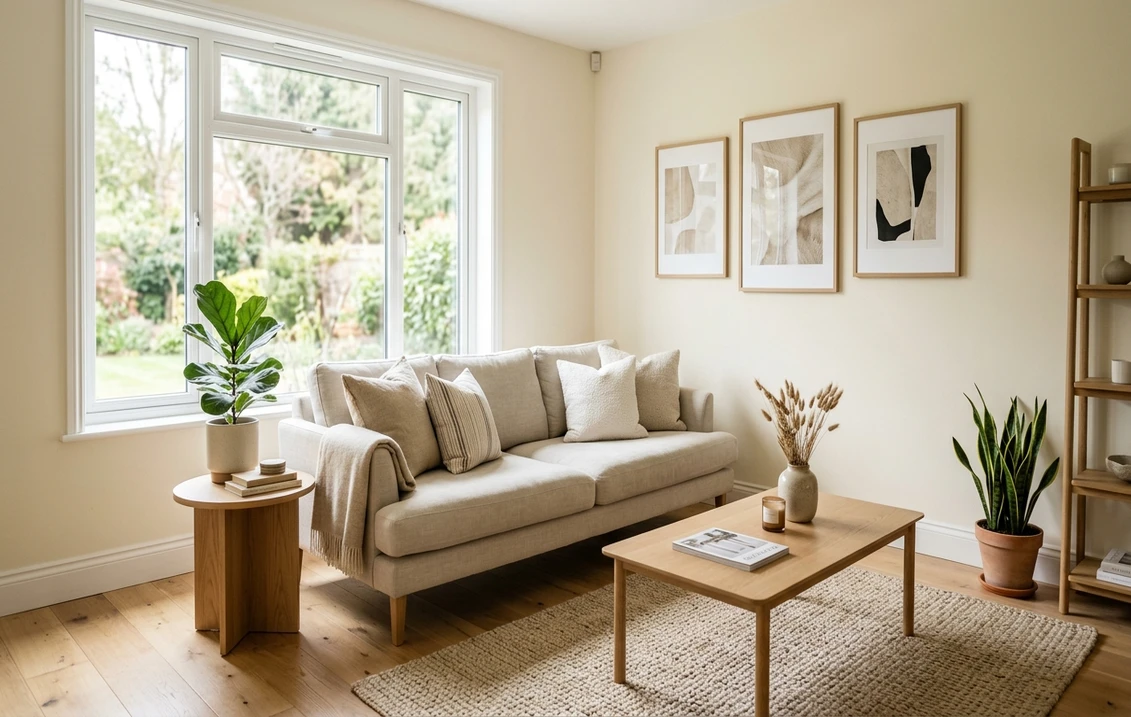
Antique White carries a soft yellow-beige base. It is the dominant undertone and it does not hide: in warm light it reads as a cozy, buttery cream, and that is the look most buyers are after. The secondary note is a whisper of warm gray that keeps it from tipping into full custard, which is what separates a tasteful antique white from a dated "builder beige" yellow.
- The cream read. Under warm light (direct sun or a 2700K bulb), the yellow steps forward and Antique White glows as a soft, inviting cream. The version most people picture and the safest, most flattering use.
- The clean read. Under cool, balanced daylight, the warmth tempers and it settles to a soft, milky off-white, still clearly warmer than a true white but far less yellow.
- The yellow risk. Next to a stark, blue-white trim or under very warm 2700K incandescent in a sun-flooded south room, the yellow can over-assert and start to look dated. The fix is almost always the trim and bulb choice, not the wall color.
Because the warmth is baked in, the direction a room faces changes how buttery Antique White looks, even if it never changes hue the way a color-shifting green would. The interior color families guide explains why warm whites behave this way. Typical behavior across the four Northern Hemisphere orientations:
| Room orientation | Daylight character | How Antique White reads |
|---|---|---|
| South-facing | Warm, abundant midday light | Warmest, most buttery cream; can push yellow if bulbs are also warm |
| West-facing | Cool by day, very warm at sunset | Soft milky off-white by day, glowing golden cream late afternoon |
| East-facing | Warm early sun, neutral later | Buttery in the morning, settling to a clean warm white by afternoon |
| North-facing | Cool, indirect, no direct sun | Its best friend: cool light tames the yellow to a soft, flattering cream |
Sources: American Institute of Architects daylight reference; Behr PWN-43 color data; designer notes on warm off-whites.
The headline: Antique White is one of the few warm whites that actually improves in a north-facing room, where its built-in warmth cancels the cool, dingy cast that flattens crisp whites. If your concern is the opposite, a south room flooding it with warm light, lean on cooler 3000K to 3500K bulbs and a clean, slightly cooler trim to hold the yellow in check.
The rooms Behr Antique White was made for
Antique White earns its keep in spaces where you want warmth and light at the same time, which is most of a home. Its high LRV and cozy undertone make it unusually flexible:
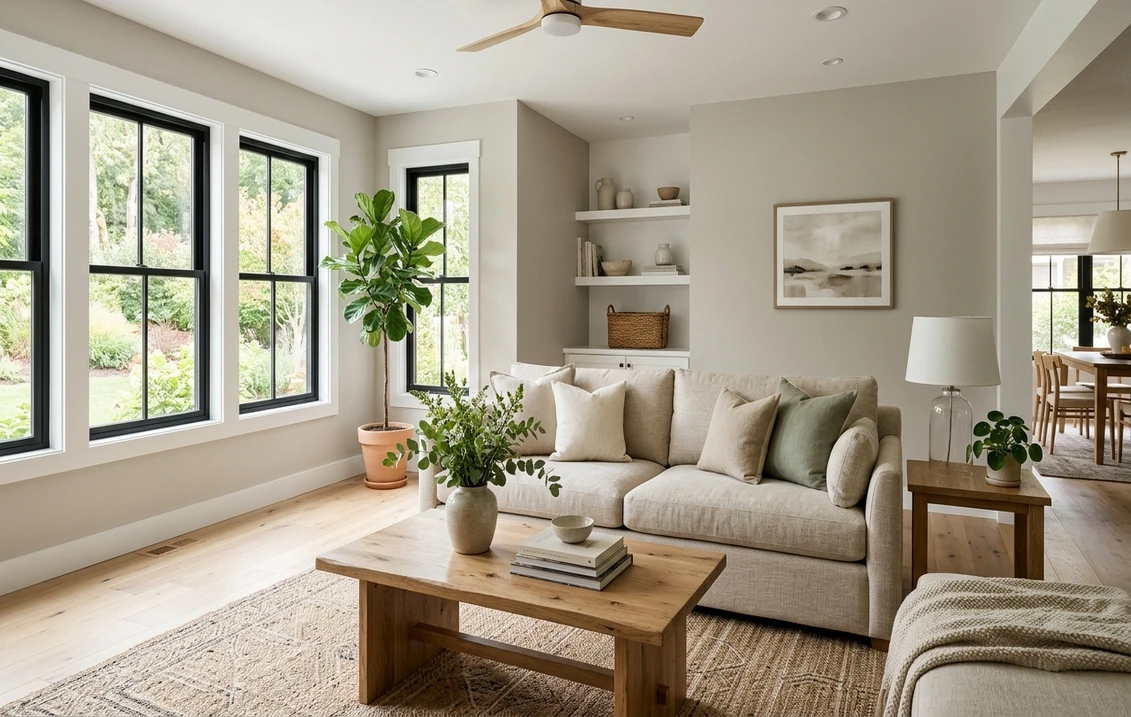
- Living and family rooms: the core use. It wraps a main living space in soft warmth without darkening it, and flatters wood furniture, leather, and warm-toned art.
- Bedrooms: the buttery cream reads restful and enveloping, layering easily under white, cream, or natural-linen bedding and warm wood tones.
- Kitchens and cabinets: a popular cabinet color for cottage and farmhouse kitchens, where the soft cream reads custom against butcher-block and brass. See where it fits in our cream and beige kitchen cabinet colors guide.
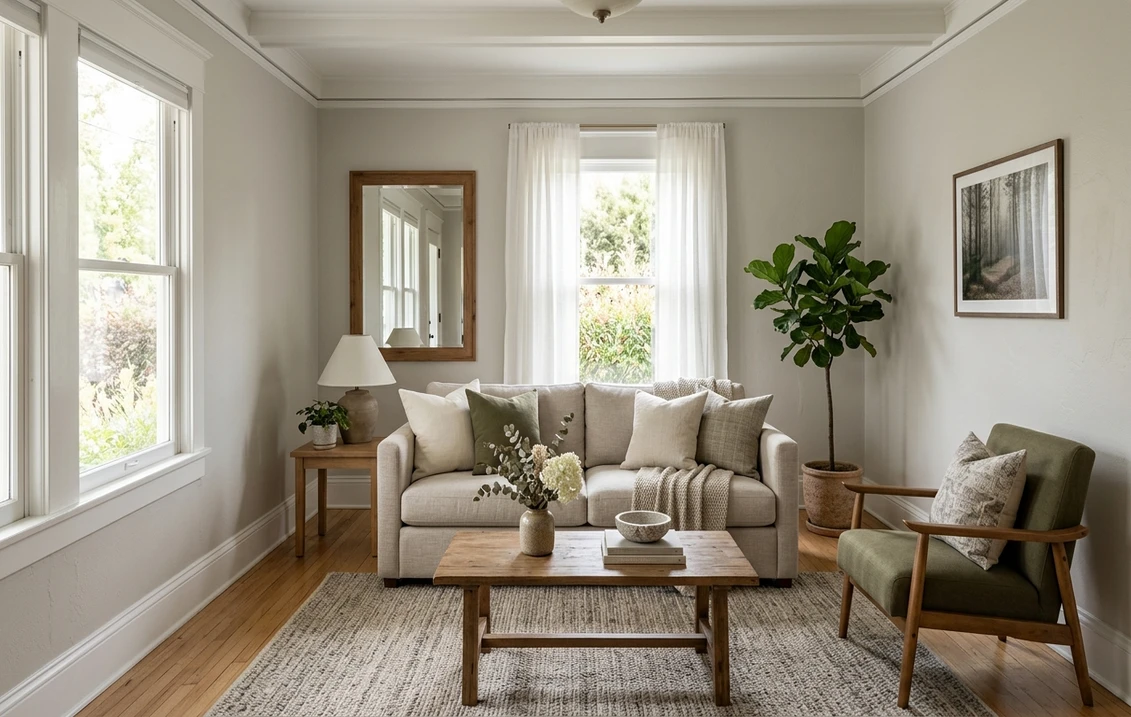
- Traditional and older homes: the aged-plaster quality suits craftsman, colonial, and cottage architecture far better than a modern bright white.
- North-facing rooms generally: the one warm white that genuinely thrives where cool light would make a crisp white look gray.
Where to be careful: a contemporary or minimalist space built around cool grays and blue-whites can make Antique White look out of step, where a cleaner white would suit better. And in a small, sun-flooded south room with warm bulbs, it can tip yellow. Our interior house painting cost guide covers what the repaint should run.
Free AI visualizer: test Antique White in a living room, bedroom, or on cabinets before you buy a sample.
Trim, ceiling, and decor that keep it from going yellow
With a warm off-white, the trim is not a detail; it is what decides whether Antique White reads "rich cream" or "dated yellow." The rule is to stay in the warm family or go deliberately, cleanly white, never a stark blue-white that fights the wall:
- Best all-around trim: Behr Ultra Pure White (the brand's truest white) reads crisp without going icy, framing Antique White cleanly so the wall looks intentional rather than grubby. The safest contrast trim.
- For a softer, tonal scheme: a brighter warm white such as Behr Silky White (PPU7-12) keeps the whole room in the cream family for a quiet, layered look with no hard line.
- Ceiling: a flat white keeps the room feeling open and lets the warm walls do the work. Painting the ceiling in Antique White too gives a soft, enveloping cocoon effect in bedrooms.
- Avoid: a high-blue "designer white" trim, which makes Antique White look yellow and dingy by contrast. The clash is the single most common antique-white regret.
- Decor and finishes: warm woods, brass and aged bronze, terracotta, natural linen, and sage green all flatter it. Cold chrome and cool gray-blue accents drag it toward looking dated.
For deeper coordinating colors in an antique-white scheme, sage green, soft black, and muted navy are its natural partners, and a warm cabinet color flows beautifully alongside it. If you want to compare it against the cleaner, brighter trim white most designers pair with warm walls, our profile of Benjamin Moore White Dove OC-17 shows where a balanced cream-white lands.
Antique White vs the off-whites people cross-shop
Antique White has a few near-twins that trip up shoppers, and knowing the difference saves a wasted sample quart:
- vs Behr Silky White (PPU7-12): the most common in-brand cross-shop, and the key distinction. Silky White is a brighter, cleaner warm white with a much softer undertone; it reads closer to a fresh, milky white. Antique White is noticeably warmer and more golden, with a clear aged-cream character. Choose Silky White for a bright, modern warm white, Antique White when you specifically want that lived-in, plaster glow.
- vs Behr Swiss Coffee: Swiss Coffee is the famous soft, creamy off-white that sits between the two; it is warm but less golden than Antique White, with a faint gray that keeps it modern. Antique White pushes further into yellow-cream. We break Swiss Coffee down in detail in our Swiss Coffee paint guide.
- vs SW West Highland White 7566: the Sherwin-Williams answer to the same brief, and the useful one if you are cross-shopping brands rather than staying inside Behr. West Highland White (LRV 81) carries a similar yellow-cream cast but sets a faint green-gray softener underneath it, which mutes the golden read Antique White leans into. Choose West Highland White for a hazier, less buttery warm white; choose Antique White when you want the cream to be visible.
- vs BM White Dove (OC-17): the most common Benjamin Moore cross-shop. White Dove is a balanced cream-white with a soft warm gray undertone; it is far more restrained than Antique White and rarely reads yellow, which is why it is a designer trim default. Antique White is the warmer, cozier, more obviously aged choice. Pick White Dove for a versatile near-neutral, Antique White for committed warmth.
Worth flagging: several brands sell a color called "Antique White," and they are not interchangeable. Sherwin-Williams Antique White (SW 6119) is a deeper cream-greige at a lower LRV, and Benjamin Moore has its own. If a designer says "Antique White," confirm the brand and code before sampling, because the LRV gap alone can be ten points or more.
How to test Behr Antique White before you commit
A warm off-white is the textbook case where a small fan-deck chip lies. Under cool store light the chip can look almost white, hiding the yellow you will live with at home. The reliable physical method is a large peel-and-stick sample taped beside your existing trim and a sheet of white paper, checked in morning light, mid-afternoon, and after dark under your normal bulbs; the warm-bulb night read is where Antique White goes most golden. The faster, no-paint first pass is a digital visualizer: upload a photo of the room and apply Antique White next to a cleaner warm white (Silky White) to see which way your light pulls it before you buy anything.
Preview Antique White beside a cleaner warm white under your real light, free.
Frequently asked questions
What undertone does Behr Antique White have?
Behr Antique White (PWN-43) has a soft yellow-beige undertone with a whisper of warm gray. The yellow is the dominant note, which is what gives it that buttery, aged-cream glow in warm light. The warm gray keeps it from tipping into a dated custard yellow. In cooler, balanced light it tempers to a soft milky off-white, but it always reads clearly warmer than a true white.
What is the LRV of Behr Antique White?
Behr Antique White has a Light Reflectance Value of about 84, with a hex approximation of #EDE3D1 (RGB 237, 227, 209). That makes it a genuinely bright off-white that reflects nearly as much light as a clean white, so it does not darken a room despite the "antique" name. The warmth lives entirely in the undertone, not in the lightness, which is why it works as a whole-home color and even as trim.
What trim color goes with Behr Antique White?
Behr Ultra Pure White is the safest contrast trim: it reads crisp without going icy, so it frames Antique White cleanly and stops it looking grubby. For a softer, tonal look, a brighter warm white like Behr Silky White (PPU7-12) keeps the whole scheme in the cream family. Avoid a high-blue designer-white trim, which makes Antique White look yellow and dated by contrast.
What is the difference between Behr Antique White and Behr Silky White?
Silky White (PPU7-12) is a brighter, cleaner warm white with a much softer undertone, reading close to a fresh milky white. Antique White (PWN-43) is noticeably warmer and more golden, with a clear aged-cream character. Choose Silky White when you want a bright modern warm white, and Antique White when you specifically want that lived-in, sun-mellowed plaster glow. Their LRVs are similar, but the undertone difference is obvious side by side.
See Behr Antique White under your real light, beside a cleaner warm white, before you buy. One free HD preview plus 3 variations.
Disclaimer: Behr and PWN-43 Antique White are trademarks of Behr Process Corporation. Benjamin Moore and Sherwin-Williams are trademarks of their respective owners. FacadeColorizer is an independent paint visualization service and is not affiliated with, endorsed by, or sponsored by Behr, Benjamin Moore, or Sherwin-Williams. Screen color approximates the manufacturer's sample; always confirm with a physical sample before purchase. Sources: Behr PWN-43 Antique White color data 2026, Behr Silky White PPU7-12 and Swiss Coffee color data, Benjamin Moore White Dove OC-17 color data, The Spruce paint undertone references, and designer notes on warm off-whites.
Trademarks mentioned (Sherwin-Williams, Benjamin Moore, Behr, Caparol, Brillux, Sto, Alpina, Valspar, PPG, Glidden, Dulux, Crown Trade, Sandtex, Farrow & Ball, Johnstone's, Leyland) are property of their respective owners. FacadeColorizer is independent and not affiliated with any of them. Nominative fair use under Lanham Act §1125.