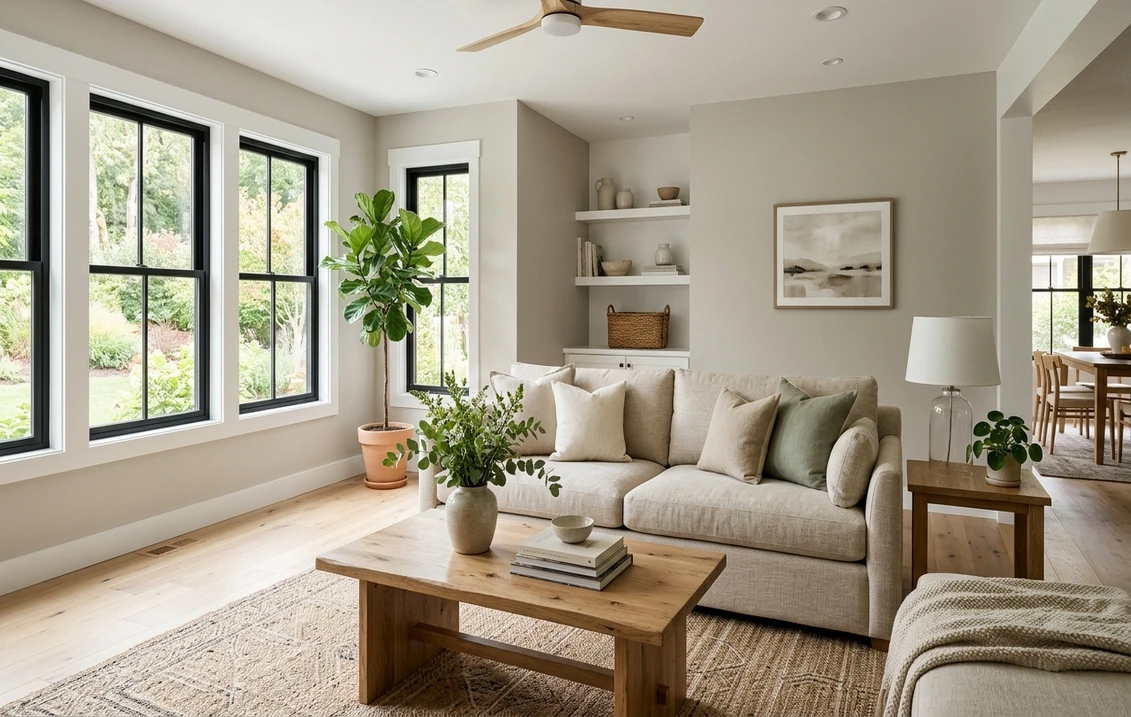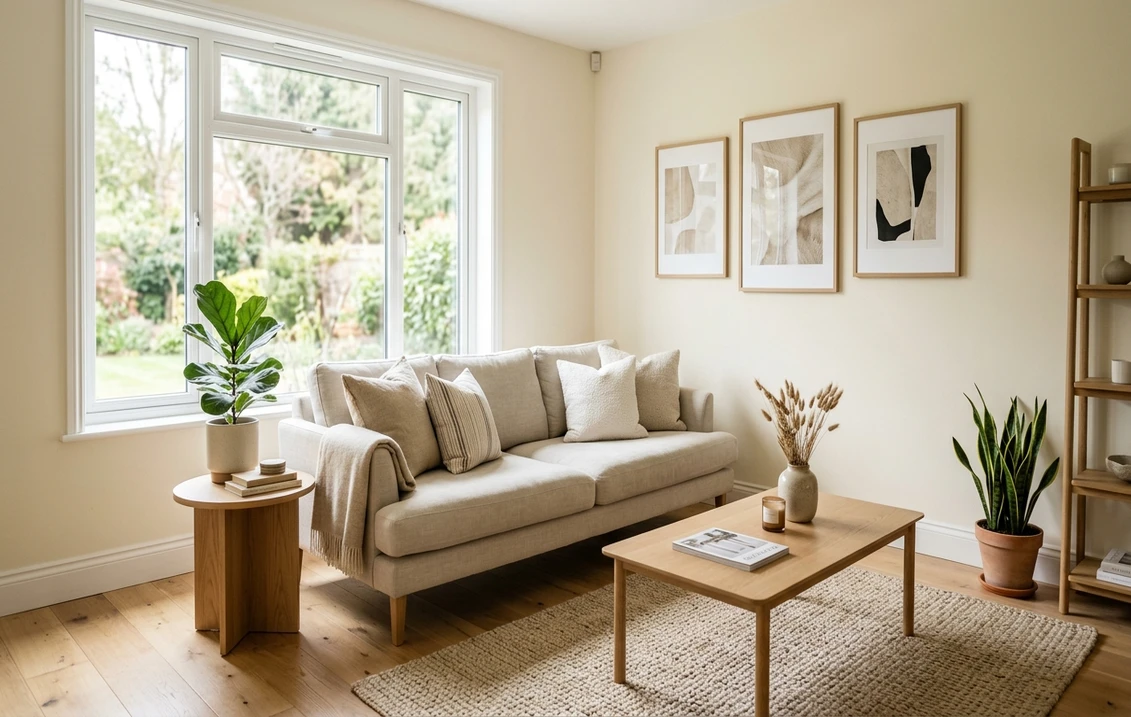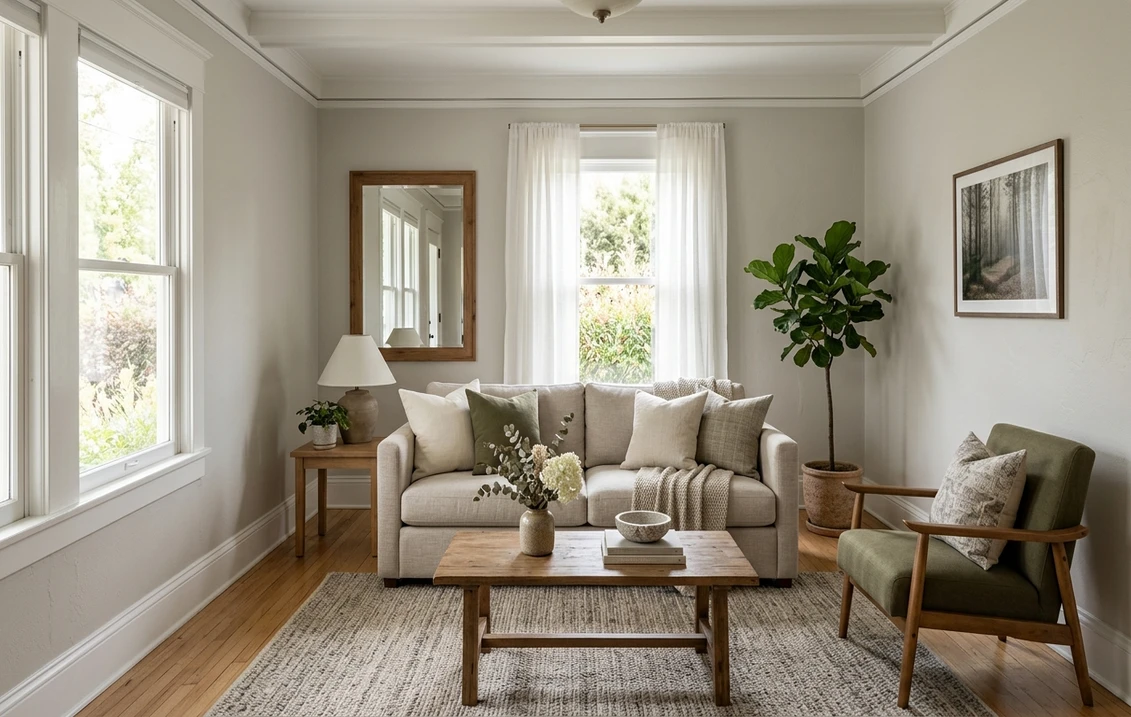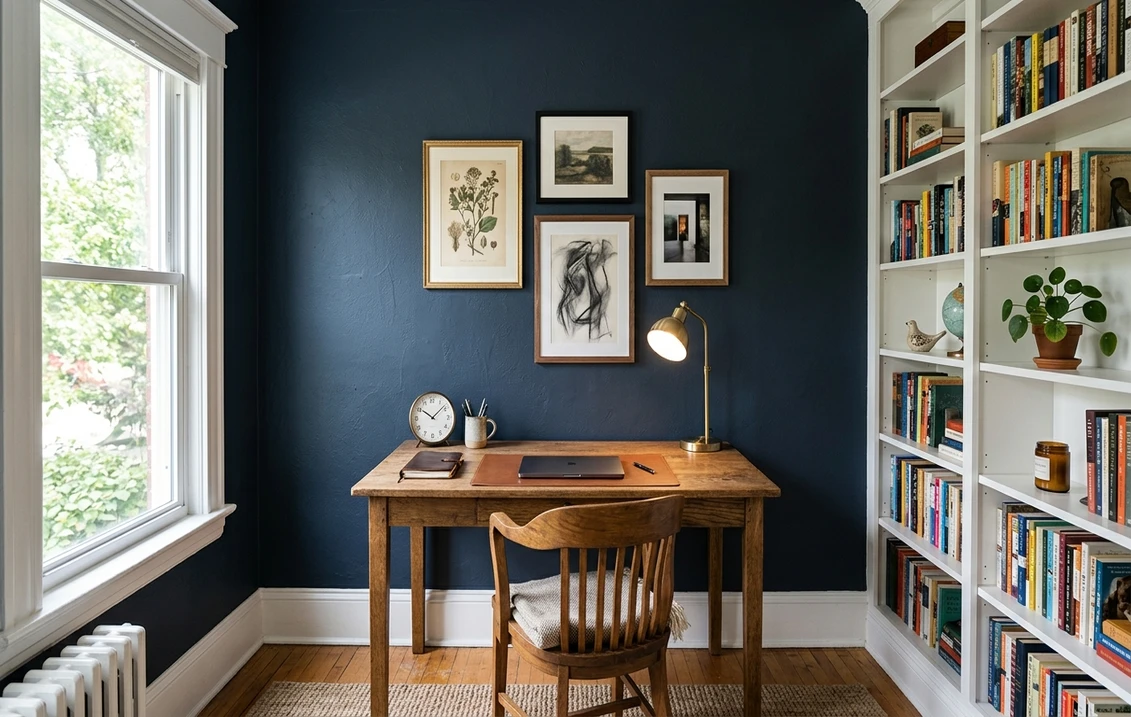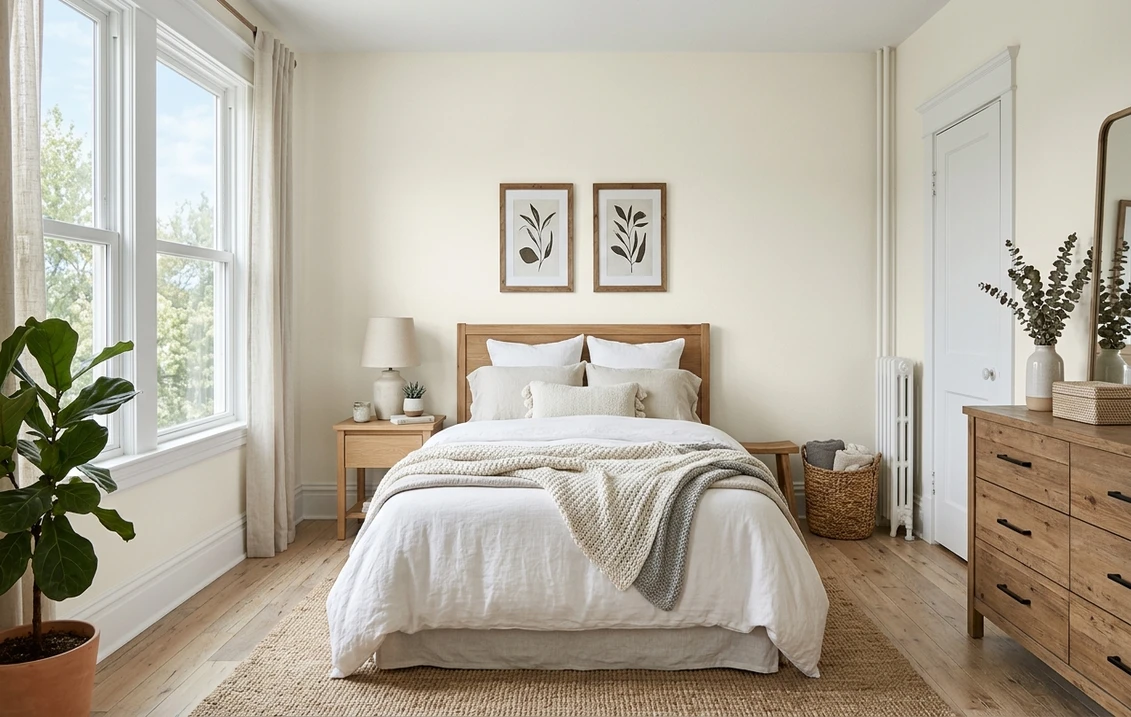
Try it on your room

You brush a sample of Behr Whispering White (1850) onto the hallway, step back, and the relief is immediate: it is a white, a clean and quiet one, with none of the yellow cast that makes a builder white feel tired. That is the whole appeal. Whispering White is one of Behr's softest, freshest near-whites, light enough to bounce daylight around a room but with just enough body to keep flat walls from looking like raw drywall. It is the kind of white people reach for when "bright white" feels too clinical and "creamy white" feels too yellow.
This profile is for the homeowner already leaning toward Whispering White: what its undertone actually does, the published LRV, the rooms it flatters, how it shifts from a north window to a south one, and the trim and decor that keep it crisp. It is one of the soft whites in our wider Behr interior paint colors guide, and you can see how it stacks up among the field in our best white paint for walls roundup.
Upload one photo and preview Behr Whispering White under your room's actual light in about 30 seconds, free.
The numbers behind Whispering White 1850
Start with the published data; with a near-white, these figures predict the wall far better than a tiny fan-deck chip, which always looks whiter than the painted result. These come from Behr's color tools:
| Spec | Value |
|---|---|
| Behr code | 1850 Whispering White |
| HEX (screen approximation) | #EFEDE3 |
| RGB approximation | 239, 237, 227 |
| LRV (Light Reflectance Value) | 80 |
| Hue family | Very soft, fresh white with a faint cool-neutral whisper, the lightest hint of gray-green |
| Closest Behr cousins | Silky White, Dove, Polar Bear |
Try it on your house
No photo? Try a sample
Sources: Behr 1850 Whispering White color data, retrieved 2026; The Spruce paint undertone references. Screen color approximates the manufacturer's sample.
The LRV of 80 is the number that matters most. That is squarely in soft-white territory: bright and reflective enough to open up a small or dim room, but a few points below a true bright white like a pure chalk white (LRV 90+), so it never glares or reads sterile under daylight. In practice, that LRV is why Whispering White feels like a "comfortable" white rather than a stark one. It still has the reach to keep a north-facing room from going gloomy, which is exactly where many soft whites fall apart. For the broader picture of where soft whites sit on the spectrum, our shades of white guide decodes the full range.
The undertone: a cool whisper, not a color
Whispering White is not a bright, blue-white, and it is not a creamy, yellow-white. It sits in the small middle band of near-whites that read as genuinely fresh and clean without picking a warm or cool side hard. If you push it under a bright light next to a pure white, you can see the faintest cool-neutral cast, a whisper of soft gray with the lightest green hint, never enough to call it a gray or a green. That restraint is the point: it is what lets Whispering White look like a clean white in almost any room rather than turning visibly blue or yellow the way more committed whites do.
- Next to bright white: Whispering White looks marginally softer and a touch cooler, which keeps it from feeling clinical.
- Next to a creamy white: it reads cleaner and fresher, with none of the buttery yellow that warm whites lean into.
- On its own, wall to wall: it simply reads as "white," a calm, modern, fresh white, which is why it works as a whole-house color.
Because the undertone is so quiet, the room's light does the heavy lifting. A soft white like this leans on its surroundings far more than a saturated color does, as our interior color families guide explains. Here is how Whispering White typically reads across the four orientations in the Northern Hemisphere:
| Room orientation | Daylight character | How Whispering White reads |
|---|---|---|
| South-facing | Warm, abundant midday light | Warms up slightly to a soft, inviting white, very clean and bright |
| West-facing | Cool by day, very warm at sunset | Neutral-fresh by day, glowing and warm late afternoon |
| East-facing | Warm early sun, neutral later | Bright and warm in the morning, calm clean white by afternoon |
| North-facing | Cool, indirect, no direct sun | Coolest read, the faint gray whisper surfaces, but stays light and fresh |
Sources: American Institute of Architects daylight reference; Behr 1850 color data; designer notes on soft whites.
The practical takeaway: in a south or west room, Whispering White is almost foolproof, the warm light keeps it inviting. In a north-facing room, it stays usable where many whites go dull, but pairing it with warm wood, brass, and 2700K bulbs keeps the cool whisper from tipping into cold. For an even warmer, cozier white in a low-light space, our warm white paint guide covers the creamier options.
The rooms Whispering White was made for
A clean, soft white this versatile earns its keep almost anywhere, but it shines in a few specific roles:
- Whole-house and open plans: the strongest use. Its quiet undertone flows from room to room without clashing, which makes it a safe single color for connected living, dining, and kitchen spaces.
- Trim, doors, and built-ins: bright and clean enough to frame wall colors crisply, especially against soft grays, greiges, and muted greens.
- Kitchens and cabinetry: on white cabinets it reads fresh and modern next to wood counters and stainless, without the yellow that dates a kitchen.
- Bedrooms and bathrooms: calm and restful, it makes small rooms feel larger and pairs cleanly with white tile, chrome, and brushed nickel.
- Ceilings: at LRV 80 it works overhead as a soft white that keeps a room feeling open without the glare of a stark ceiling white.
Where to be careful: in a fully windowless room under warm builder bulbs, even a fresh white can flatten, so add lamp light and warm metals to keep it lively. And in a room flooded with strong reflected color (a bright lawn outside, a saturated rug), the soft undertone will pick that up, which is the case for testing it in place. Planning a repaint? Our interior painting cost guide covers what the job should run.
Free AI visualizer: test Whispering White on walls, trim, or cabinets before you buy a sample.
Trim, ceiling, and decor that keep it crisp
With a soft white, the trick is contrast: you want trim and decor that let the white read as intentional, not as a blank wall. A few reliable directions:
- Trim, two ways: use Whispering White on both walls and trim in the same finish (eggshell walls, semi-gloss trim) for a calm monochrome look, or pair the walls with a slightly brighter white trim to add crispness. Avoid a creamy yellow trim, which fights the fresh undertone.
- Ceiling: a flat white ceiling, either Whispering White itself or a touch brighter, keeps the room feeling open and seamless.
- Wall colors beside it: Whispering White frames soft grays, greiges, sage greens, and dusty blues beautifully, acting as the clean break between them.
- Deeper accents: a charcoal like Behr Cracked Pepper or a soft black on a door or built-in gives the scheme structure and makes the white look deliberate. If that accent is being mixed at a Sherwin-Williams counter rather than Behr, Cyberspace SW 7076 is the same near-black depth with a blue heart: charcoal after dark, visibly blue in daylight, and a cool white like this one is precisely the trim that pushes that blue forward.
- Decor and finishes: warm wood, brass, and natural linen warm it up; chrome, nickel, and cool marble keep it crisp and modern. Both work, so choose the one that matches your light.
If you want to compare Behr's whites and neutrals against the other big brand before you commit, our Behr vs Sherwin-Williams interior comparison covers how their formulas, coverage, and finishes actually wear.
Whispering White vs the whites people cross-shop
Whispering White has a couple of close Behr relatives that shoppers line up against it, and the differences are subtle enough to cause a wrong sample. Here is how to keep them straight:
- vs Behr Silky White: the closest call. Silky White is a hair warmer and creamier, with a softer, slightly more golden glow, where Whispering White stays cleaner and a touch cooler. In a warm south room they look nearly identical; in a north room Whispering White reads fresher and Silky White reads cozier. Choose Silky White if you want a soft white that leans warm, Whispering White if you want one that stays neutral-fresh.
- vs Behr Dove: not really a cross-shop once you see them together. Dove is a clear step grayer, reading as a light greige rather than a white, with visible body on the wall. If you sample both and Dove looks like "a color" and Whispering White looks like "a white," that is exactly right. Pick Dove when you want a soft, warm gray-beige; pick Whispering White when you want the cleanest white that still feels soft.
- vs a bright chalk white: a true bright white (LRV 90+) is crisper and more modern but can read cold and clinical in north light. Whispering White trades a little of that brightness for warmth and comfort, which is why it suits more rooms more of the time.
The pattern across these three Behr whites is simple: Silky White is the warm one, Dove is the gray one, and Whispering White is the clean-but-soft one in the middle. Knowing which lane you want narrows the sampling to one or two cans instead of five. To see how all three sit beside the broader Behr lineup, the Behr interior paint colors guide lays out the full palette, and our best interior paint colors for 2026 roundup shows where soft whites fit a whole-house scheme.
How to test Whispering White before you commit
Whites are the colors where a fan-deck chip lies most: a small chip surrounded by white card always looks whiter and cooler than a whole wall will. The reliable method is a large peel-and-stick or brushed-out sample (Behr sells project samples) taped to at least two walls, one near a window and one on an interior wall, then checked mid-morning, mid-afternoon, and after dark under your normal bulbs. The after-dark check matters most for whites, because a clean daytime white can pick up an unwanted cast under warm builder bulbs. The faster, no-paint first pass is a digital visualizer: upload a photo of the room and apply Whispering White next to a warmer alternative (Silky White) and a grayer one (Dove) to see which way your light pulls each, ruling out the ones that were never going to work before you spend on samples.
Preview Whispering White beside a warmer and a grayer alternative under your real light, free.
Frequently asked questions
Is Behr Whispering White a warm or cool white?
It sits in the middle, reading as a clean, fresh, neutral white with only the faintest cool whisper, a soft gray with the lightest green hint. It is not a warm, creamy yellow-white, and it is not a bright, blue-white. That restraint is why it reads simply as "white" in most rooms, warming up slightly in south light and showing its quiet cool side in north light.
What is the LRV of Behr Whispering White?
Behr Whispering White 1850 has a Light Reflectance Value of about 80, which puts it in soft-white territory. That is bright and reflective enough to open up a small or dim room, but a few points below a true chalk-bright white, so it never glares or reads sterile. The LRV of 80 is why it can hold up even in a north-facing room where many whites go dull.
What is the difference between Behr Whispering White and Silky White?
They are very close. Silky White is a hair warmer and creamier, with a softer golden glow, while Whispering White stays cleaner and slightly cooler. In a warm south-facing room they look nearly identical; the difference shows most in north light, where Whispering White reads fresher and Silky White reads cozier. Choose Silky White for a soft white that leans warm, Whispering White for one that stays neutral-fresh.
Is Behr Whispering White good for a whole house?
Yes, it is one of the better Behr whites for a whole-house or open-plan scheme. Its undertone is quiet enough to flow from room to room without clashing across changing light, and at LRV 80 it stays bright in dim spaces and soft in bright ones. Pair it with warm wood and brass for a cozy feel, or chrome and marble for a crisp, modern one.
See Behr Whispering White under your real light, beside a warmer and a grayer alternative, before you buy.
Disclaimer: Behr and Whispering White 1850 are trademarks of Behr Process Corporation. Sherwin-Williams and Benjamin Moore are trademarks of their respective owners. FacadeColorizer is an independent paint visualization service and is not affiliated with, endorsed by, or sponsored by Behr, Sherwin-Williams, or Benjamin Moore. Screen color approximates the manufacturer's sample; always confirm with a physical sample before purchase. Sources: Behr 1850 Whispering White color data 2026, Behr Silky White and Dove color data, The Spruce paint undertone references, and designer notes on soft whites.
Trademarks mentioned (Sherwin-Williams, Benjamin Moore, Behr, Caparol, Brillux, Sto, Alpina, Valspar, PPG, Glidden, Dulux, Crown Trade, Sandtex, Farrow & Ball, Johnstone's, Leyland) are property of their respective owners. FacadeColorizer is independent and not affiliated with any of them. Nominative fair use under Lanham Act §1125.