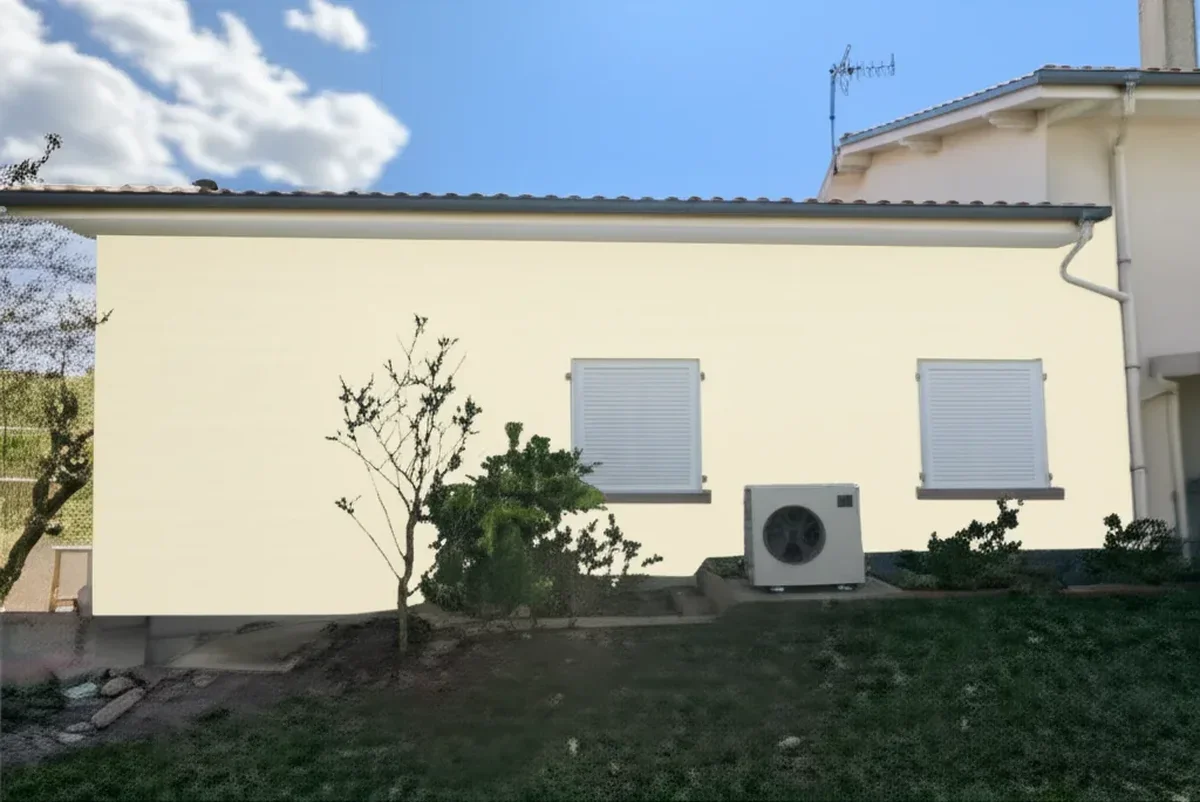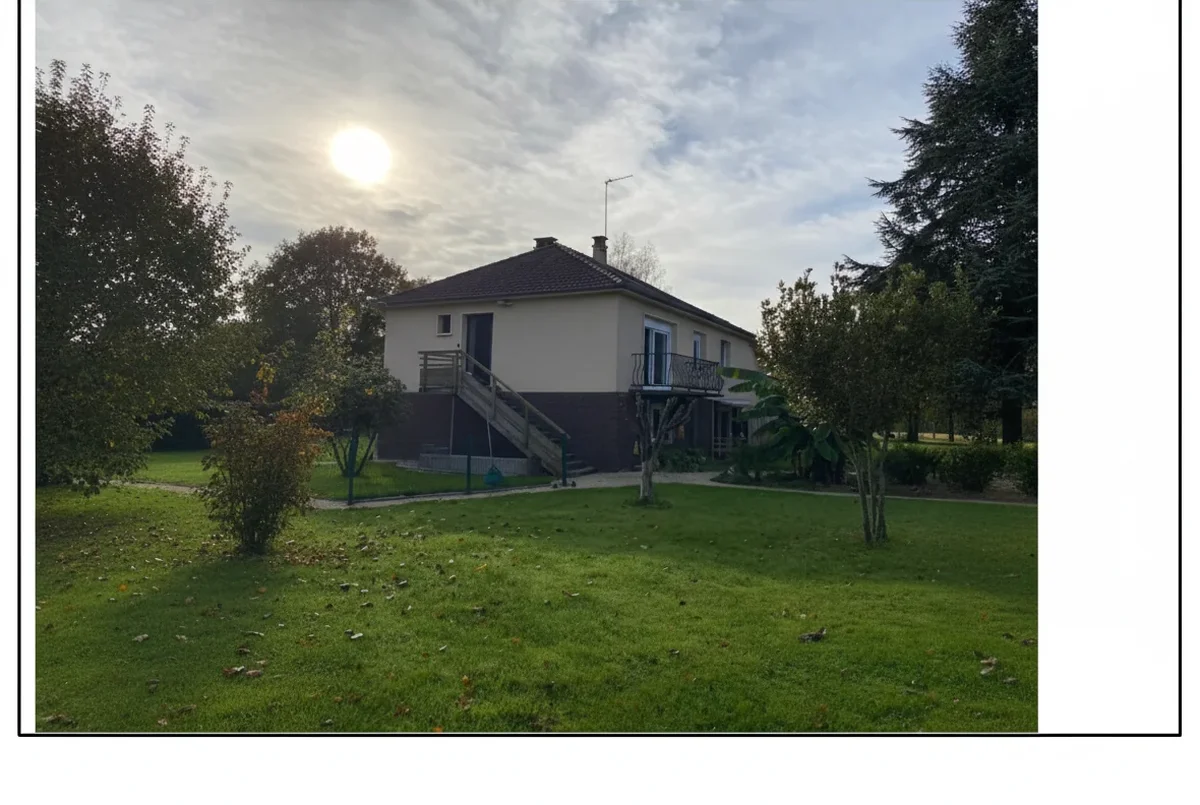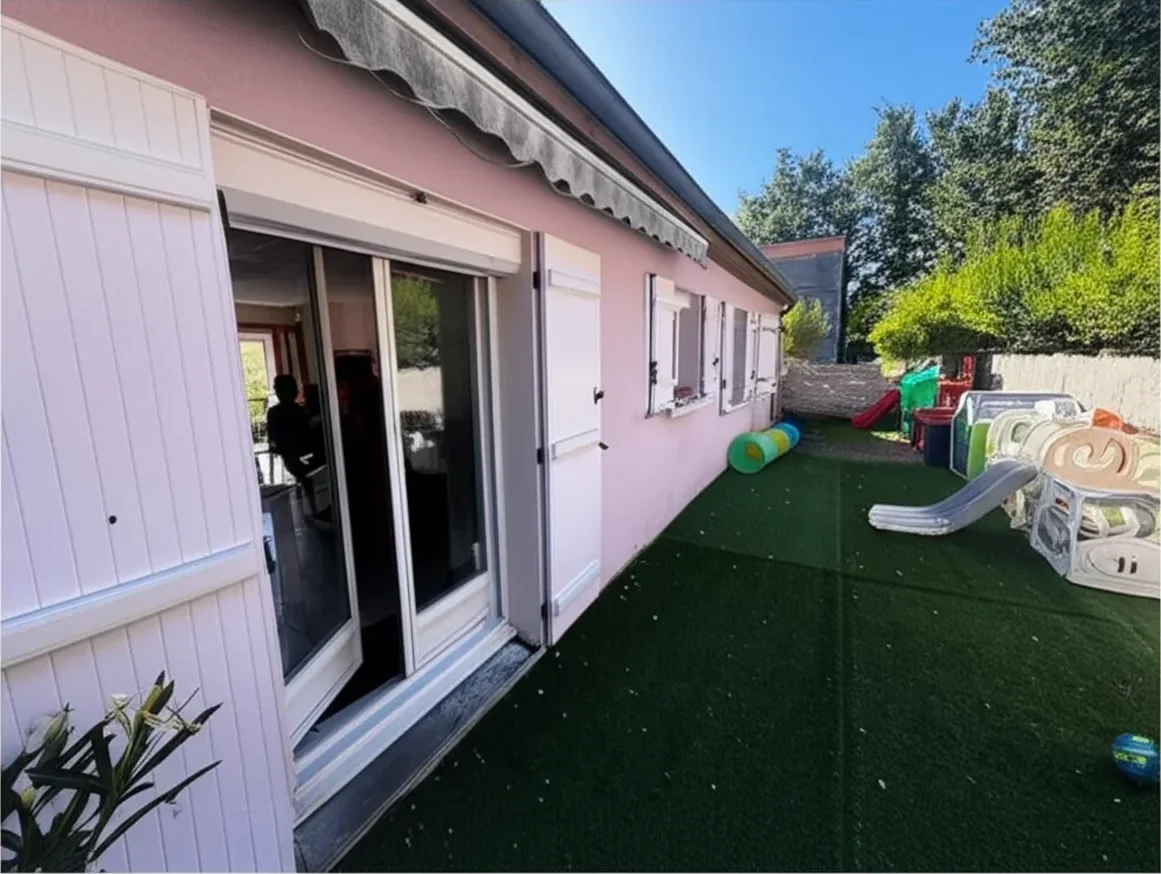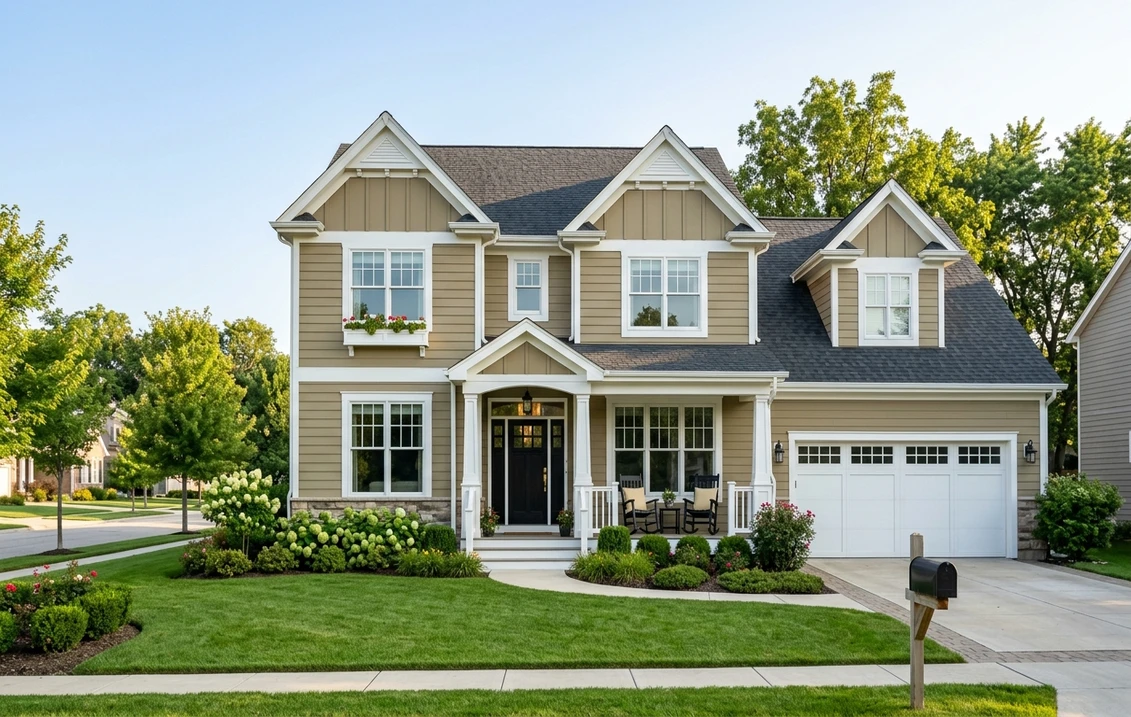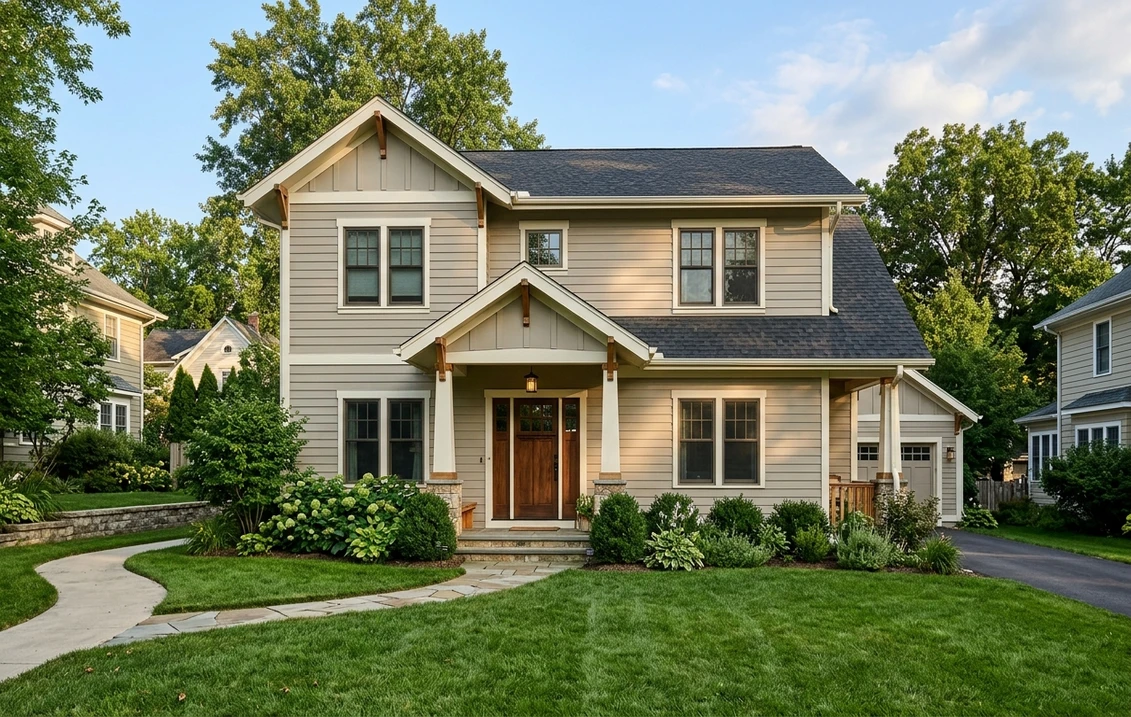

Sherwin-Williams Amazing Gray (SW 7044) is a warm, mid-light greige: a gray with enough beige in it to look soft and earthy on siding, but enough gray to stay calm and modern from the street. Its Light Reflectance Value (LRV) is about 47 and its screen rendering is #BEB5A9 (RGB 190, 181, 169). That puts it a full step deeper than popular light greiges such as Agreeable Gray or Worldly Gray, so it holds its color in strong sun instead of washing out to off-white, while staying light enough that window trim, shadows and porch details still read clearly.
The color name, code, LRV, Neutral color family and its place in the Sherwin-Williams Top 50 Exterior Colors collection come from the official Sherwin-Williams Amazing Gray SW 7044 page and the brand's public color data, read on 23/11/2026. The Delta E 2000 distances to neighboring colors are our own calculations from published screen values, and the pairing advice is our color reasoning. A screen never shows a greige exactly, so always judge Amazing Gray on a painted board outdoors before you order gallons.
Upload one exterior photo and see Amazing Gray on your own siding, stucco or brick before buying samples.
What Amazing Gray SW 7044 really looks like on siding
On a paper chip held indoors, Amazing Gray often looks more beige than gray, because warm bulbs push up its yellow-brown base. Outside, daylight carries more blue, and that cooler light pulls the color back toward the middle. On a full wall in open sun it reads as a soft putty gray with a sandy warmth; on a shaded north wall it settles into a deeper stone gray with a faint green-brown cast. Homeowners who expect a pure gray are sometimes surprised by that earthiness, and homeowners who expect a beige are surprised by how gray it looks at curb distance. That in-between behavior is exactly why it works on so many house styles.
Its strength is depth. Light greiges in the high 50s and low 60s of LRV, such as Agreeable Gray (about 60) and Worldly Gray (about 57), can look almost white on a sunny south elevation. At roughly 47, Amazing Gray keeps visible color in full sun, which helps a craftsman, ranch or farmhouse look finished rather than faded. It stays well above the deep greiges and taupes in the 30s, so it does not make a small house look heavy.
| Attribute | Sherwin-Williams Amazing Gray SW 7044 |
|---|---|
| Color name and code | Amazing Gray, SW 7044 |
| Color family (Sherwin-Williams) | Neutral; listed in the Top 50 Exterior Colors collection |
| Screen hex and RGB (approximate) | #BEB5A9 (RGB 190, 181, 169) |
| Light Reflectance Value (LRV) | About 47 (mid-light) |
| Undertone reading (our analysis) | Warm greige: gray with a sandy beige base, slight green-brown cast in shade |
| Interior and exterior use | Available for both, according to Sherwin-Williams color data |
| Coordinating colors suggested by Sherwin-Williams | Alabaster SW 7008, Shoji White SW 7042 and Carley's Rose SW 9002 |
Try it on your house
- 1Your photoPhoto
- 2Your colorColor
- 3HD render in ~30 sHD render in ~30 s
Your photo is used only to create your preview. JPG, PNG, HEIC (iPhone)
LRV is the share of visible light a painted surface reflects, on a scale from 0 (black) to 100 (pure white). For exteriors, it predicts two practical things: how light or dark the house will look from the street, and how much sun heat the surface absorbs. A mid-range value like 47 is a comfortable compromise for most climates, with one important exception covered below: vinyl siding.
How orientation and surroundings shift Amazing Gray
Greige colors are sensitive to the light that hits them, and the same gallon of Amazing Gray can look like two different colors on two sides of the same house. Before you choose, note which way your main facade faces and what sits around it: lawn, trees, a red brick walk, a white fence. Colored surroundings bounce light back onto siding and tint it.
| Facade orientation | How Amazing Gray SW 7044 tends to read | Practical tip |
|---|---|---|
| South-facing (full sun) | Lightest and warmest: a sandy putty gray | The depth of LRV 47 keeps contrast with white trim; no need to go darker |
| North-facing (cool indirect light) | Deeper stone gray, the green-brown note shows | Use a warm white trim so the facade does not look cold |
| East-facing | Warm and soft in the morning, flatter gray in the afternoon | Judge the front door color in afternoon shade |
| West-facing | Quiet gray in the morning, golden greige at sunset | Avoid very yellow creams on trim, they clash with evening light |
Landscaping matters as much as the compass. Dense green trees and lawns reflect green light onto lower walls, which strengthens the subtle green-brown side of Amazing Gray and can make it look more khaki. Pale gravel, concrete drives and limestone bring out its sandy warmth instead. If your lot is very green, compare it with a slightly cooler neighbor such as Sherwin-Williams Repose Gray on an exterior before deciding.
LRV 47 and vinyl siding: the rule to check first
On wood, fiber cement, stucco and painted brick, an LRV of 47 raises no heat problem. Vinyl is different. Darker colors absorb more sunlight, and standard vinyl panels can soften and distort when they run hot. That is why vinyl siding makers and paint brands publish color limits for repainting vinyl, and why Sherwin-Williams offers its VinylSafe color formulations, designed for darker colors on vinyl. Amazing Gray sits below the light-color range that is usually considered low risk on standard vinyl, so do not assume it is safe in a regular formula.
If your house is vinyl, ask the Sherwin-Williams counter whether Amazing Gray can be made in a VinylSafe formula for the product you plan to use, and read your siding warranty before painting: some manufacturers void coverage if panels are painted darker than the original color. Our guide to Sherwin-Williams VinylSafe paint on vinyl siding explains how the system works and what to verify.
| Exterior surface | Fit for Amazing Gray SW 7044 | Prep and sheen guidance |
|---|---|---|
| Wood lap siding and shingles | Excellent; the warm base flatters wood texture | Spot-prime bare wood and knots with an exterior stain-blocking primer; satin or flat |
| Fiber cement | Excellent; crisp shadow lines | Clean the factory primer, caulk joints, flat or satin to hide seams |
| Stucco and masonry | Very good; reads like natural stone or lime plaster | Use a masonry-compatible exterior acrylic, flat sheen hides trowel marks |
| Vinyl siding | Only after checking the VinylSafe option and the siding warranty | Wash off chalk and mildew, never use high gloss on vinyl |
Which Sherwin-Williams exterior paint for Amazing Gray
A mid-tone greige shows uneven fading more than a white does, so the paint line matters on sunny walls. Emerald Exterior Acrylic Latex is the top of the Sherwin-Williams exterior range and the usual choice when color retention and dirt resistance matter most, for example on a south or west elevation. Duration Exterior is the thicker, high-build option often chosen for weathered wood and textured stucco, and SuperPaint is the mid-priced line. Each product has its own data sheet with spread rate, recoat time and minimum temperature: read it for the exact product and sheen you buy.
For a side-by-side view of the ranges, see our SuperPaint vs Emerald Exterior comparison and our Duration Exterior review. The broader Sherwin-Williams exterior paint guide covers primers and sheens by surface.
Trim, front door, shutter and roof pairings
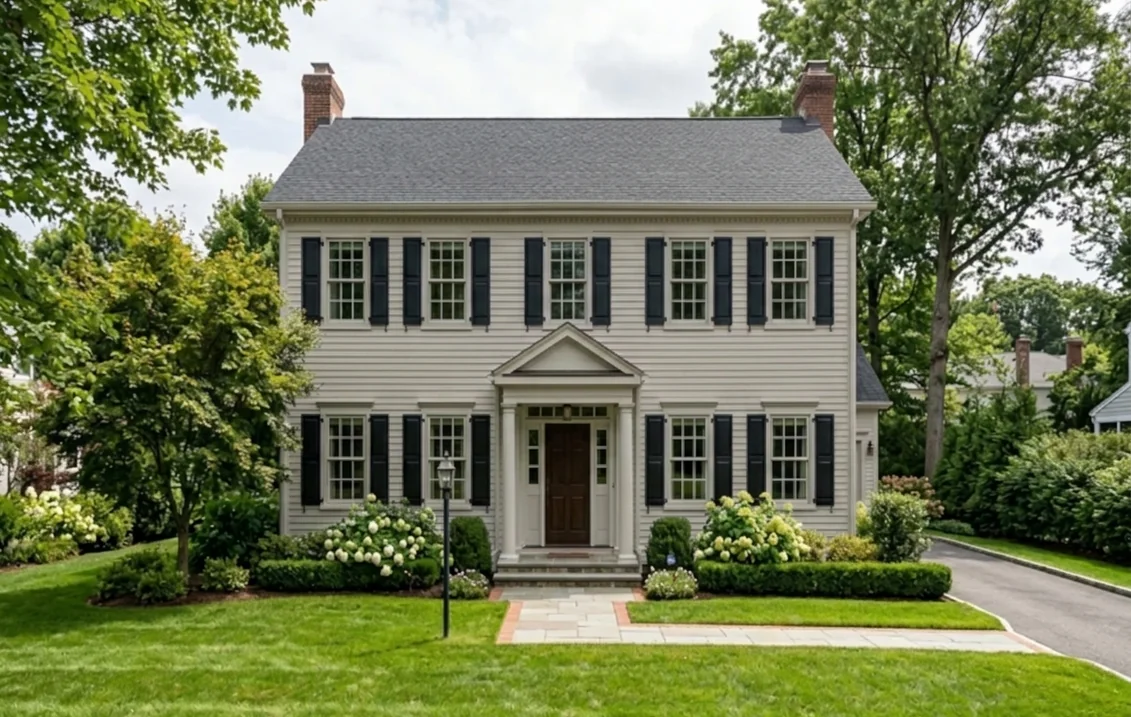
Amazing Gray needs a white that respects its warmth. Sherwin-Williams lists Alabaster SW 7008 and Shoji White SW 7042 as coordinating colors, and both are warm whites: Alabaster is the brighter, creamier option, Shoji White the softer one with a little more beige. A stark blue-white trim tends to make Amazing Gray look muddy by contrast. For the door and shutters, a dark color with depth works better than a bright primary.
| Element | Pairing direction with SW 7044 | Effect on the facade |
|---|---|---|
| Trim (warm and bright) | Alabaster SW 7008 | Clean, classic contrast without turning cold |
| Trim (soft and low contrast) | Shoji White SW 7042 | Quiet, tone-on-tone look for cottages and ranches |
| Front door | Deep green, charcoal, black, stained wood, or a muted rose such as Carley's Rose SW 9002 | Dark doors anchor the greige; the muted rose is the brand's own accent suggestion |
| Shutters | Charcoal, black-green or dark bronze | Frames windows without harsh cartoon contrast |
| Roof | Charcoal or weathered-wood architectural shingles, dark standing seam metal | Charcoal keeps it modern; brown shingles push it toward beige |
Brick and stone matter too. Amazing Gray is comfortable next to gray, tan and buff stone and next to brown or muted red brick. Very orange brick can make its green-brown side stand out; in that case, test it next to the brick before committing. For trim decisions in detail, read our Sherwin-Williams Alabaster exterior guide, and for door ideas see our Sherwin-Williams front door colors.
Closest Sherwin-Williams neighbors and Benjamin Moore matches
We calculated the perceptual color distance (Delta E 2000) between Amazing Gray and nearby colors from published screen values. Under about 1 the difference is very hard to see; between 1 and 2 it shows when two boards sit side by side; above 2 it is clearly visible. The most striking result: Anew Gray SW 7030 is almost identical on screen, so the two are interchangeable for most homeowners and the choice comes down to which one your store or contractor already stocks.
| Color | Screen hex | LRV or luminance | Delta E 2000 to SW 7044 (our calc.) | How it differs |
|---|---|---|---|---|
| SW 7044 Amazing Gray (reference) | #BEB5A9 | LRV about 47 | 0 | Warm mid-light greige |
| SW 7030 Anew Gray | #BFB6AA | LRV about 47 | 0.27 | Practically the same color |
| SW 6072 Versatile Gray | #C1B6AB | LRV about 48 | 1.34 | A touch lighter and rosier |
| SW 7051 Analytical Gray | #BFB6A7 | LRV about 47.5 | 1.38 | Slightly more yellow-beige |
| SW 7043 Worldly Gray | #CEC6BB | LRV about 57 | clearly lighter | The lighter option if 47 feels heavy |
| SW 7045 Intellectual Gray | #A8A093 | LRV about 36 | clearly darker | The deeper option for more presence |
| BM 2108-50 Silver Fox | #B9B2A8 | luminance about 45 (calc.) | 1.41 | Closest Benjamin Moore match, slightly darker and cooler |
| BM 1542 Himalayan Trek | #BEB8AE | luminance about 48 (calc.) | 1.62 | A little lighter and grayer |
| BM AC-34 Cape Hatteras Sand | #BFB9AF | luminance about 49 (calc.) | 1.75 | Lighter, sandier |
Use this table as a shortlist, not as factory equivalents. Two brands use different bases and colorants, so a pair that measures 1.4 on screen can drift apart in flat versus satin or under strong UV. If you like the slightly deeper side, see our Anew Gray SW 7030 exterior guide and our Analytical Gray SW 7051 exterior guide; if you want lighter, read the Worldly Gray SW 7043 exterior guide.
Test the closest Benjamin Moore match on your own house photo, next to Amazing Gray.
Sample board protocol, gallon math and lead-safe prep
A greige chosen from a two-inch chip is the most common exterior regret, because the eye reads a small sample against the old color around it. A simple outdoor protocol avoids that:
- Paint a large board. Two coats of Amazing Gray in your planned sheen on a primed board of about 2 by 2 feet, with a white border so the old siding color does not distort it.
- Look at two sides of the house, three times a day. Place the board against the sunniest and the shadiest wall at morning, midday and late afternoon, and step back to the street.
- Hold it against the fixed parts. Roof edge, window frames, brick or stone, the front walk. Those do not change, so the paint must agree with them.
- Paint one neighbor. A second board in Worldly Gray (lighter) or Intellectual Gray (deeper) shows you quickly whether 47 is the right depth for your house.
To estimate quantity, measure each wall (width times height, plus half base times height for gable triangles), add them, subtract windows and doors, multiply by two coats and divide by the spread rate printed on the product data sheet. Add 10 to 20 percent for rough cedar, deep laps or porous stucco, which absorb more on the first coat.
If the house was built before 1978, check for lead before you scrape or sand. Under the US Environmental Protection Agency's Lead Renovation, Repair and Painting (RRP) Program, paid contractors who disturb paint on pre-1978 homes must be certified and follow lead-safe work practices. If you do the prep yourself, avoid dry sanding and open-flame removal, contain chips on plastic sheeting and keep children and pets away from the work area.
Sources and references
- Sherwin-Williams, Amazing Gray SW 7044: color code, Neutral family, LRV, screen rendering, Top 50 Exterior Colors collection and coordinating colors (read 23/11/2026).
- Sherwin-Williams, Emerald Exterior Acrylic Latex: product page of the brand's top exterior line, with its data sheet for spread rate and application conditions.
- Benjamin Moore, Silver Fox 2108-50: official color page of the closest calculated Benjamin Moore match.
- US Environmental Protection Agency, Lead Renovation, Repair and Painting Program: rules for disturbing paint on homes built before 1978.
Frequently asked questions
Is Sherwin-Williams Amazing Gray SW 7044 gray or beige on a house?
What is the LRV of Amazing Gray SW 7044?
Can I use Amazing Gray on vinyl siding?
What trim color goes with Amazing Gray?
What is the closest Benjamin Moore color to Amazing Gray?
Trademarks mentioned (Sherwin-Williams, Benjamin Moore, Behr, Caparol, Brillux, Sto, Alpina, Valspar, PPG, Glidden, Dulux, Crown Trade, Sandtex, Farrow & Ball, Johnstone's, Leyland) are property of their respective owners. FacadeColorizer is independent and not affiliated with any of them. Nominative fair use under Lanham Act §1125.