Try it on your room

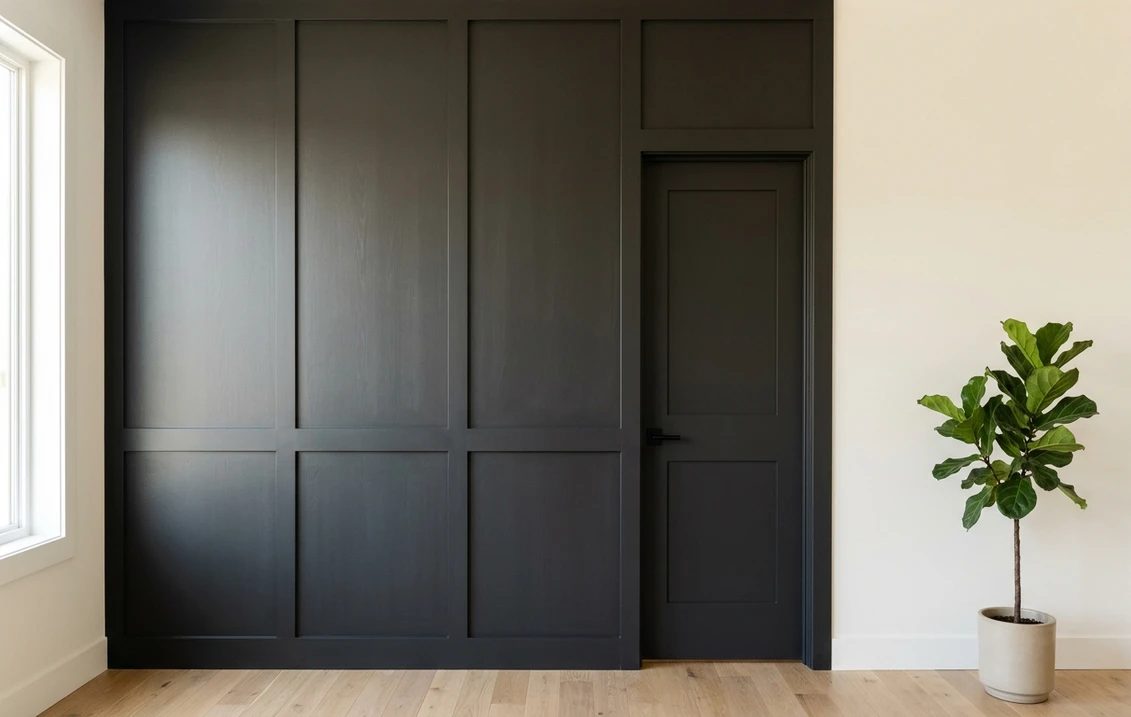
Sherwin-Williams Black Magic (SW 6991) is the black you choose when a true, ink-flat black feels like too much. It is a soft near-black: deep and dramatic from across the room, but step closer in daylight and you can see it is not a stark jet black at all. It has body, the faintest breath of warmth, and a charcoal softness that keeps a black door or feature wall from looking like a hole cut out of the room. Most shoppers land on it after testing the brand's purest black, Tricorn Black, then deciding they want the drama without the hard edge.
This profile covers Black Magic indoors: the published numbers, how it shifts by light and orientation, the rooms it suits, and the trim, hardware, and finishes that make it sing. It sits with the deep neutrals in our wider Sherwin-Williams interior paint colors guide, and you can see how a soft black stacks up against every other family in our best interior paint colors for 2026 roundup.
Upload one photo and preview SW Black Magic under your room's actual light in about 30 seconds, free.
The numbers behind Black Magic SW 6991
Start with the published data; with a black the numbers matter even more than usual, since colors this dark differ by only a point or two of reflectance. These figures come from the Sherwin-Williams color tools:
| Spec | Value |
|---|---|
| SW code | SW 6991 Black Magic |
| HEX (screen approximation) | #323132 |
| RGB approximation | 50, 49, 50 |
| LRV (Light Reflectance Value) | About 5, a soft near-black |
| Hue family | Near-neutral black with the faintest warm cast; not a blue-black, not a stark jet black |
| Closest SW relatives | Tricorn Black (SW 6258), Iron Ore (SW 7069), Cyberspace (SW 7076), Peppercorn (SW 7674) |
Try it on your house
No photo? Try a sample
Sources: Sherwin-Williams SW 6991 Black Magic color data, retrieved 2026; The Spruce paint undertone references.
An LRV around 5 puts Black Magic in near-black territory, but not at the floor: the brand's benchmark true black, Tricorn Black, sits near an LRV of 3. That small gap lets Black Magic keep a soft charcoal depth, so a feature wall reads as a rich, deliberate dark rather than a flat void. The RGB balance tells the rest: red and blue equal, green a hair lower, giving Black Magic a near-neutral, very slightly warm character rather than a cool blue lean. For the whole method of reading numbers like these before you buy a sample, our guide on how to compare paint colors the right way walks through LRV, undertones, and side-by-side testing.
Undertones: a near-neutral black that warms, never cools
Black Magic is close to neutral, so it does not swing the way a mid-tone gray does. Instead it shifts in temperature and in how black it looks: a whisper of warmth over a deep charcoal base, warm in generous light and nearly solid black in the dark, but never cool or blue. Here is how it behaves under the four kinds of light you live with:
- Bright, direct daylight: the softest, most revealing version. You can clearly see it is a charcoal-black rather than a jet black, and the faint warmth shows as a barely-there, sooty softness.
- Warm bulbs (2700K): the warmth steps forward and Black Magic feels rich and enveloping, closer to a very dark warm-charcoal: its coziest read.
- Cool or north light: it reads deepest and most neutral, closest to a true black, with the softness harder to spot: crisp and architectural.
- Dim or evening light: the nuance disappears and Black Magic settles into a near-solid, dramatic black, ideal on a moody dining room or a front-of-house door.
Because it is near-neutral, orientation changes the mood more than the hue, across the four Northern Hemisphere exposures:
| Room orientation | Daylight character | How Black Magic reads |
|---|---|---|
| South-facing | Warm, abundant midday light | Softest, warmest version; the charcoal depth and faint warmth are easiest to see |
| West-facing | Neutral by day, very warm at sunset | Soft charcoal through the day, a rich warm-black glow in late afternoon |
| East-facing | Warm early sun, neutral later | Warm and soft in the morning, more neutral and deeper after midday |
| North-facing | Cool, indirect, no direct sun | Deepest and most neutral; closest to a true black, at its most severe without warm wood or brass nearby |
Sources: American Institute of Architects daylight reference; Sherwin-Williams SW 6991 color data; designer notes on soft blacks.
The rooms Black Magic was made for
A soft black is a confidence color, and Black Magic earns its keep wherever you want depth and contrast without harshness:
- Interior and front doors: the signature use. A single Black Magic door against pale walls is the classic high-impact, low-commitment upgrade. Its softness keeps the door looking rich rather than stark.
- Accent and feature walls: board-and-batten, shaker paneling, or a fireplace wall in Black Magic reads architectural and expensive, with the charcoal depth catching raking light so shadows stay legible.
- Kitchen cabinets and islands: a Black Magic island under warm wood or white counters looks custom and grounded, softer than a true black next to bright white uppers.
- Libraries, studies, and moody dining rooms: paint all four walls (and often the trim) for a cocooning, jewel-box effect that feels intentional, not oppressive. It also makes a strong backdrop for built-ins, where brass hardware and light objects pop against it.
Where to be careful: in a small, windowless room under dim bulbs, Black Magic loses its nuance and reads as a flat solid black, so it needs light or a lighter partner to show its character. On a large north-facing wall with no warm materials nearby it can feel severe, but a little brass, oak, or a warm rug fixes it.
Free AI visualizer: test Black Magic on a door, a feature wall, or cabinets before you buy a sample.
Trim, ceiling, and hardware that make it work
With a soft black, the decision that defines the room is contrast: do you frame it or blend it?
- High-contrast (crisp white trim): Sherwin-Williams Pure White (SW 7005, LRV 84) beside Black Magic is the clean, graphic look, ideal for a black door or a single feature wall, and it makes the soft black read intentional and sharp.
- Tonal (trim in the same color): painting the trim, doors, and walls all Black Magic gives a quiet, enveloping, high-end result, ideal in libraries and dining rooms. Vary the sheen (matte walls, satin trim) so the architecture still reads.
- Ceiling: a flat white ceiling keeps a Black Magic room from feeling low. For a jewel-box in a small study or powder room, taking the ceiling into Black Magic too creates a cocoon, but only with enough lighting.
- Hardware: this is where a soft black shines. Warm brass or unlacquered gold pops against it, matte black keeps it tonal, and polished nickel reads cooler; all three work because Black Magic is near-neutral.
- Decor and finishes: warm woods (white oak, walnut), natural fibers, brass, and stone keep Black Magic from feeling cold; add cool grays only if you want the crisp, modern read rather than the cozy one.
Black Magic vs the colors people cross-shop
Almost nobody samples a black in isolation. Four names dominate the shortlist:
- vs SW Tricorn Black (SW 6258): the head-to-head that matters most. Tricorn Black is the purest, most neutral true black in the line (LRV near 3), reading harder and more absolute, where Black Magic (LRV around 5) stays softer and faintly warmer, keeping a charcoal depth where Tricorn goes to pure ink. Pick Tricorn for the crispest, most graphic black; pick Black Magic for drama with a softer edge. We break the two down room by room in Tricorn Black vs Black Magic: the soft-black duel, and our Tricorn Black exterior guide covers how the purer black behaves outdoors.
- vs SW Iron Ore (SW 7069): the popular step back from true black. Iron Ore is technically a very dark gray, clearly lighter and warmer, so it reads as a soft charcoal rather than a black: choose it when almost-black is the goal. The full breakdown is in our SW Iron Ore undertones and rooms profile.
- vs SW Cyberspace (SW 7076): the moody blue-black. Cyberspace carries a clear navy-blue cast Black Magic does not have, so it is the move for a cool, atmospheric black; Black Magic wins when you want a black that stays neutral and slightly warm. If you want the drama dialed back further still, a soft black-gray like Peppercorn (SW 7674) reads as a deep gray rather than a true black.
How to test Black Magic before you commit
Blacks are the colors people most regret rushing: a fan-deck chip cannot show how a soft black fills a wall, and store lighting flattens the very softness you are buying it for. The reliable method is a large peel-and-stick sample on the actual door or wall, checked mid-morning, mid-afternoon, and after dark under your normal bulbs; the evening check counts most, because a soft black looks warmest under lamplight and near-solid in dim rooms. The faster first pass is digital: upload a photo of your real room and apply Black Magic beside the purer Tricorn Black and the lighter, warmer Iron Ore. Seeing the three side by side under your own light settles in two minutes what sample pots settle in a week.
Preview Black Magic beside a purer black and a softer charcoal under your real light, free.
Frequently asked questions
Is Sherwin-Williams Black Magic a true black?
Not quite, and that is the point. Black Magic (SW 6991) is a soft near-black with an LRV of about 5, so it keeps a charcoal depth and the faintest warmth rather than reading as a stark, flat jet black. In bright daylight you can see it is a soft charcoal-black; in dim light it deepens to a near-solid dramatic black. For the purest, most absolute black, sample Tricorn Black (LRV near 3) instead.
What is the LRV of SW Black Magic?
Black Magic has a Light Reflectance Value of about 5, near-black territory but not the very bottom. For context, the brand's benchmark true black, Tricorn Black, sits near an LRV of 3. That small gap lets Black Magic hold a soft charcoal depth instead of collapsing into a flat void, so a feature wall or door still reads as a rich, deliberate dark.
What is the difference between Black Magic and Tricorn Black?
They are both Sherwin-Williams blacks that behave differently. Tricorn Black (SW 6258) is the purest, most neutral true black in the line (LRV near 3), reading harder, flatter, and more absolute. Black Magic (SW 6991) is a hair lighter at an LRV around 5, softer, and faintly warmer, keeping a charcoal softness. Choose Tricorn for the crispest, most graphic black; choose Black Magic for drama with a softer, warmer edge.
Is Black Magic warm or cool?
Near-neutral, with a whisper of warmth. Its red and blue values are balanced with green a touch lower, so Black Magic stays essentially neutral and leans very slightly warm rather than cool. It is not a blue-black like Cyberspace. Warm bulbs and south light bring the faint warmth forward, while cool north light makes it read deepest and most neutral. Warm woods and brass keep it from feeling cold.
See SW Black Magic under your real light, beside a purer black and a softer charcoal, before you buy.
Disclaimer: Sherwin-Williams and SW 6991 Black Magic are trademarks of The Sherwin-Williams Company. FacadeColorizer is an independent paint visualization service and is not affiliated with, endorsed by, or sponsored by Sherwin-Williams. Screen color approximates the manufacturer's sample; always confirm with a physical sample before purchase. Sources: Sherwin-Williams SW 6991 Black Magic color data 2026, Sherwin-Williams Tricorn Black, Iron Ore, Cyberspace, Peppercorn, and Pure White color data, The Spruce paint undertone references, and designer notes on soft blacks.
Trademarks mentioned (Sherwin-Williams, Benjamin Moore, Behr, Caparol, Brillux, Sto, Alpina, Valspar, PPG, Glidden, Dulux, Crown Trade, Sandtex, Farrow & Ball, Johnstone's, Leyland) are property of their respective owners. FacadeColorizer is independent and not affiliated with any of them. Nominative fair use under Lanham Act §1125.