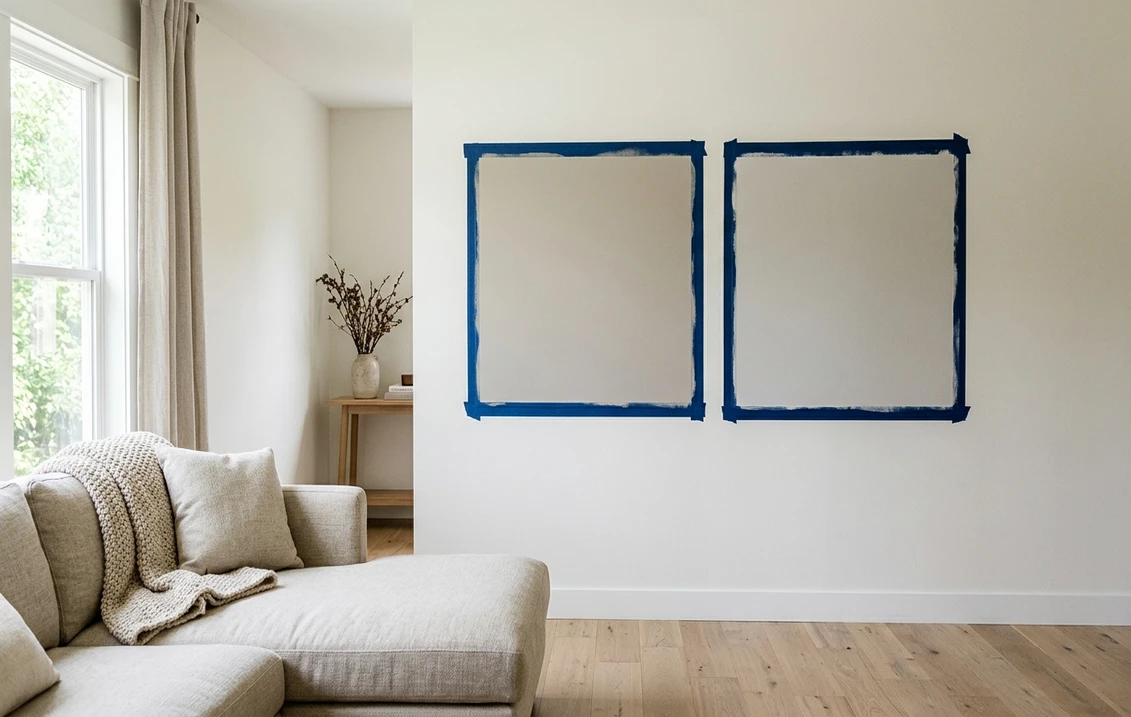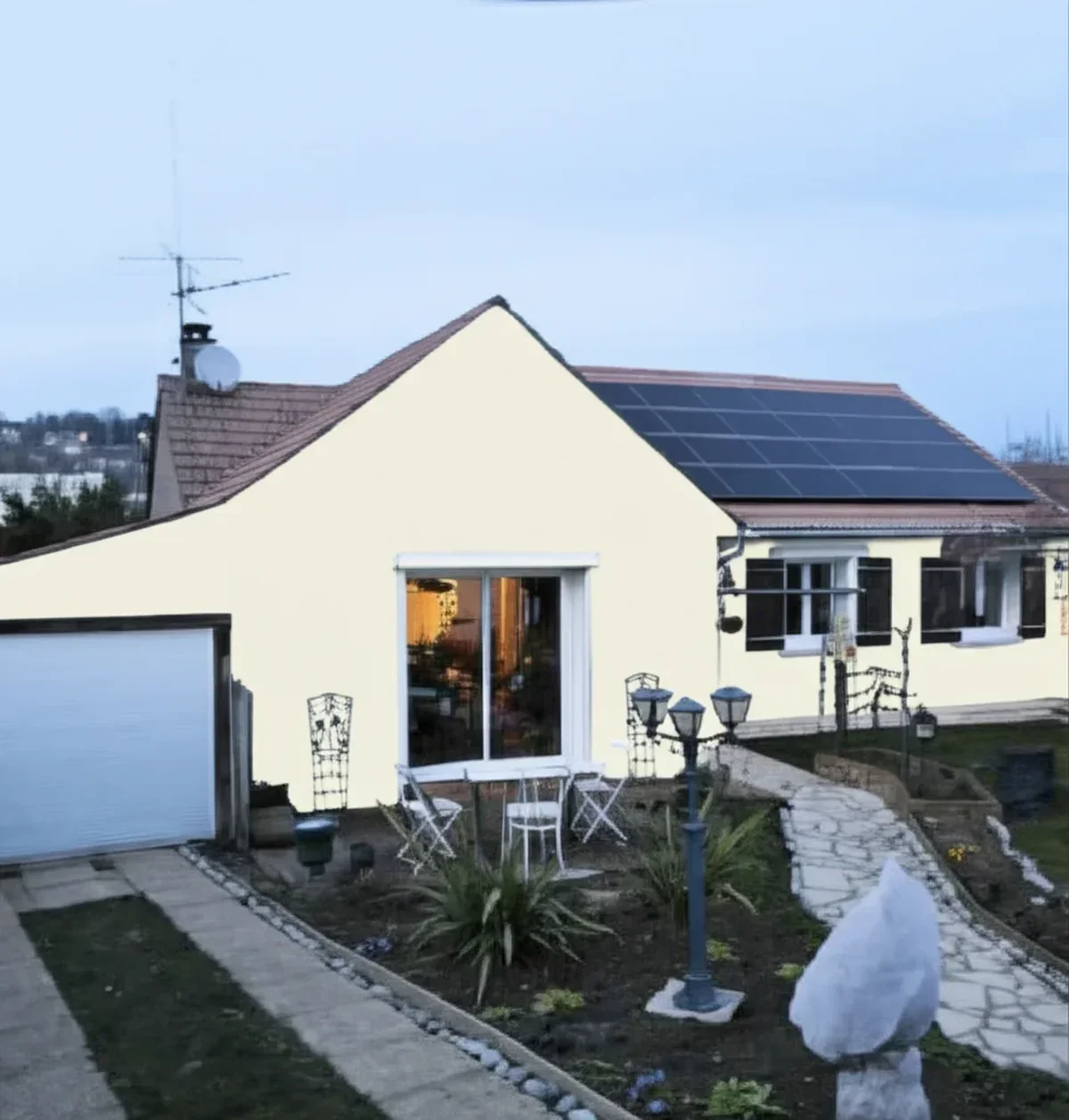
Try it on your house

The verdict in three lines. Tricorn Black SW 6258 (LRV 3) is the true black: about as colorless as a black gets, it holds an inky reading in almost any light and gives the sharpest contrast against white.
Black Magic SW 6991 (LRV about 5) is the soft near-black: a hair lighter and faintly warm, it keeps a charcoal depth so a wall reads rich rather than flat.
This is the closest call in the black bracket. Choose Tricorn Black for the crispest, most graphic black, Black Magic for drama with a softer edge, and let a photo of your own room break the tie.
Sherwin-Williams Tricorn Black (SW 6258) and Black Magic (SW 6991) are the two names a homeowner weighs when they want a real black, not a charcoal that only flirts with it. Both look almost identical on a two-inch chip, and the gap between them is the narrowest in the dark-neutral shortlist: one undertone whisper and two points of reflectance. This head-to-head puts the numbers side by side, plays the duel out room by room, and tells you when each color wins. For the method behind any two-color decision, start with our side-by-side method for comparing paint colors.
The numbers side by side
| Attribute | Tricorn Black SW 6258 | Black Magic SW 6991 |
|---|---|---|
| Family | True neutral black | Soft near-black, faintly warm |
| LRV | 3 | About 5 |
| Approximate hex | #2F2F30 | #323132 |
| Approximate RGB | 47, 47, 48 | 50, 49, 50 |
| Character | As close to colorless as a black gets; no visible cast | Near-neutral with a faint warm charcoal softness; never blue |
| Loves | Doors, window sash, railings, white farmhouse trim, black metal | Feature walls, cabinets, islands, cocooning rooms, warm wood and brass |
| Watch out for | Reads hard up close; shows dust on big sunlit walls | Flattens to a solid black in dim, windowless rooms |
| Overall vibe | Sharp, graphic, absolute | Deep, soft, enveloping |
Try it on your house
No photo? Try a sample
LRV values are the published Sherwin-Williams figures. Hex and RGB are approximate digital renderings; the authoritative reference is a physical Sherwin-Williams chip or peel-and-stick sample.
Two points of LRV is the whole spread, so the duel is settled by character, not depth. In a dim room both read black. The difference shows only in good light: Tricorn Black stays flat and inky at LRV 3, while at about LRV 5 Black Magic lifts into a soft charcoal with a breath of warmth. Against white printer paper, the pillar guide's trick, Tricorn reads as a clean cut-out and Black Magic as a softened charcoal.
Upload one photo, get a photorealistic render, then swap to Black Magic. Free, no signup.
Room by room, exposure by exposure
Because the gap is so small, the winner turns on light level, dose, and nearby finishes rather than any bold undertone. Here is how the duel plays out.
| Situation | Usual winner | Why |
|---|---|---|
| Front door and window sash | Tricorn Black | The true black stays crisp and intentional against any siding or wall color |
| Farmhouse trim and windows on white | Tricorn Black | LRV 3 draws the sharpest graphic line against bright white board and batten |
| Feature or fireplace wall in a lit room | Black Magic | Daylight reveals its charcoal softness, so the wall reads rich, not like a void |
| Kitchen island or cabinets, seen up close | Black Magic | The softer, faintly warm black flatters wood counters and brass at arm's length |
| Matching existing black metal and hardware | Tricorn Black | A neutral true black meets black frames and fixtures cleanly, no near-miss |
| Dim, low-light room | Either | Both collapse to a solid black; pick by sheen and the warmth of nearby finishes |
Outdoors, only Tricorn Black is really a candidate: Black Magic is an interior soft black, while the true black is the proven exterior choice, with orientation and trim pairings in the Tricorn Black exterior guide. And if your real question is how dark to go, the Iron Ore vs Tricorn Black duel sets this true black against a clearly lighter charcoal, a wider gap that is far easier to see than this one.
When to choose Tricorn Black
- You want true black, full stop. Doors, shutters, window sash, and railings: Tricorn Black is the standard-issue black of the Sherwin-Williams deck, neutral enough to read simply as black.
- Maximum contrast is the design. Against bright white trim or siding, LRV 3 draws the sharpest possible line. Black Magic in the same spot reads a half-step softer.
- You are matching existing black finishes. Black window frames, matte-black hardware, and iron fixtures pair cleanly with a true black; beside them, a soft near-black can look like a near miss.
For its full interior breakdown and pairings, see the dedicated Tricorn Black room-by-room profile.
When to choose Black Magic
- You want black drama without the hard edge. On feature walls, paneling, and cabinets, Black Magic gives the dark, grounded look, then softens into a rich charcoal in daylight: the black for people who hesitate at true black.
- Your palette is warm, and seen up close. On islands, built-ins, and interior doors, next to white oak, walnut, brass, or cream trim, Black Magic's faintly warm base reads refined at arm's length where a colorless true black can feel severe.
- You are cocooning a room. Libraries, studies, and moody dining rooms painted out in Black Magic feel enveloping rather than oppressive, because the charcoal softness keeps the walls from going flat void-black.
The full lighting and hardware breakdown lives in the Black Magic undertones and best rooms profile. A fair number of shoppers who get this far actually want the weight of black with a trace of color in it, and the deep navies behave the same way after dark: Hale Navy against Naval puts Benjamin Moore's grayer navy at LRV about 8 next to Sherwin-Williams' Naval at about 4, which slides to an inky near-black once the light drops.
Same wall, both blacks, your actual light. Free render in about 30 seconds.
Frequently asked questions
What is the difference between Tricorn Black and Black Magic?
Depth and edge. Tricorn Black SW 6258 (LRV 3) is a true neutral black with no visible cast, the most absolute black in the line. Black Magic SW 6991 (LRV about 5) is a soft near-black, a hair lighter and faintly warm, keeping a charcoal softness where Tricorn goes flat. Choose Tricorn for graphic contrast, Black Magic for a softer edge.
Is Black Magic darker than Tricorn Black?
No. Tricorn Black is the darker, inkier of the two at LRV 3; Black Magic sits a touch higher at about LRV 5. The two-point gap is subtle, and in dim light both read as a solid black. It shows in good light, where Tricorn stays flat and absolute while Black Magic reveals a soft charcoal depth.
Which black is better for a front door, Tricorn Black or Black Magic?
Tricorn Black in most cases: a true neutral black stays crisp against any siding and matches black hardware with no near-miss. Choose Black Magic if you want the door a shade softer and faintly warmer up close, next to wood and brass. Tricorn also has an exterior guide, where Black Magic is interior only.
Can I use Tricorn Black and Black Magic together?
Only with clear roles, and even then it is tricky. The two are so close that side by side on equal surfaces they look like a batch mismatch, not a deliberate contrast. If you want two darks in one room, pair one of these blacks with a clearly lighter charcoal such as Iron Ore, so the gap reads as intentional depth.
Settle it on your photo
Chips lie, and blacks lie more than most: a two-inch sample cannot show how LRV 3 stays inky while LRV 5 breathes into a soft charcoal in your light. When two colors are this close, only side by side on your own wall settles it, so test both on a photo of your room and let your trim, wood, and metal finishes pick the winner. If the shortlist widens, the 2026 Sherwin-Williams interior color guide maps the rest of the deck.
1 HD render plus 3 free color variations. Start with Tricorn Black, then swap to Black Magic.
Trademark notice. Sherwin-Williams®, Tricorn Black®, Black Magic®, Iron Ore® and Peppercorn® are trademarks of The Sherwin-Williams Company. FacadeColorizer is not affiliated with, endorsed by, or sponsored by The Sherwin-Williams Company. Brand and color names are used for descriptive and editorial purposes only, consistent with nominative fair use. Hex and RGB values are approximate digital renderings; the only authoritative reference is a physical Sherwin-Williams color sample.
Trademarks mentioned (Sherwin-Williams, Benjamin Moore, Behr, Caparol, Brillux, Sto, Alpina, Valspar, PPG, Glidden, Dulux, Crown Trade, Sandtex, Farrow & Ball, Johnstone's, Leyland) are property of their respective owners. FacadeColorizer is independent and not affiliated with any of them. Nominative fair use under Lanham Act §1125.