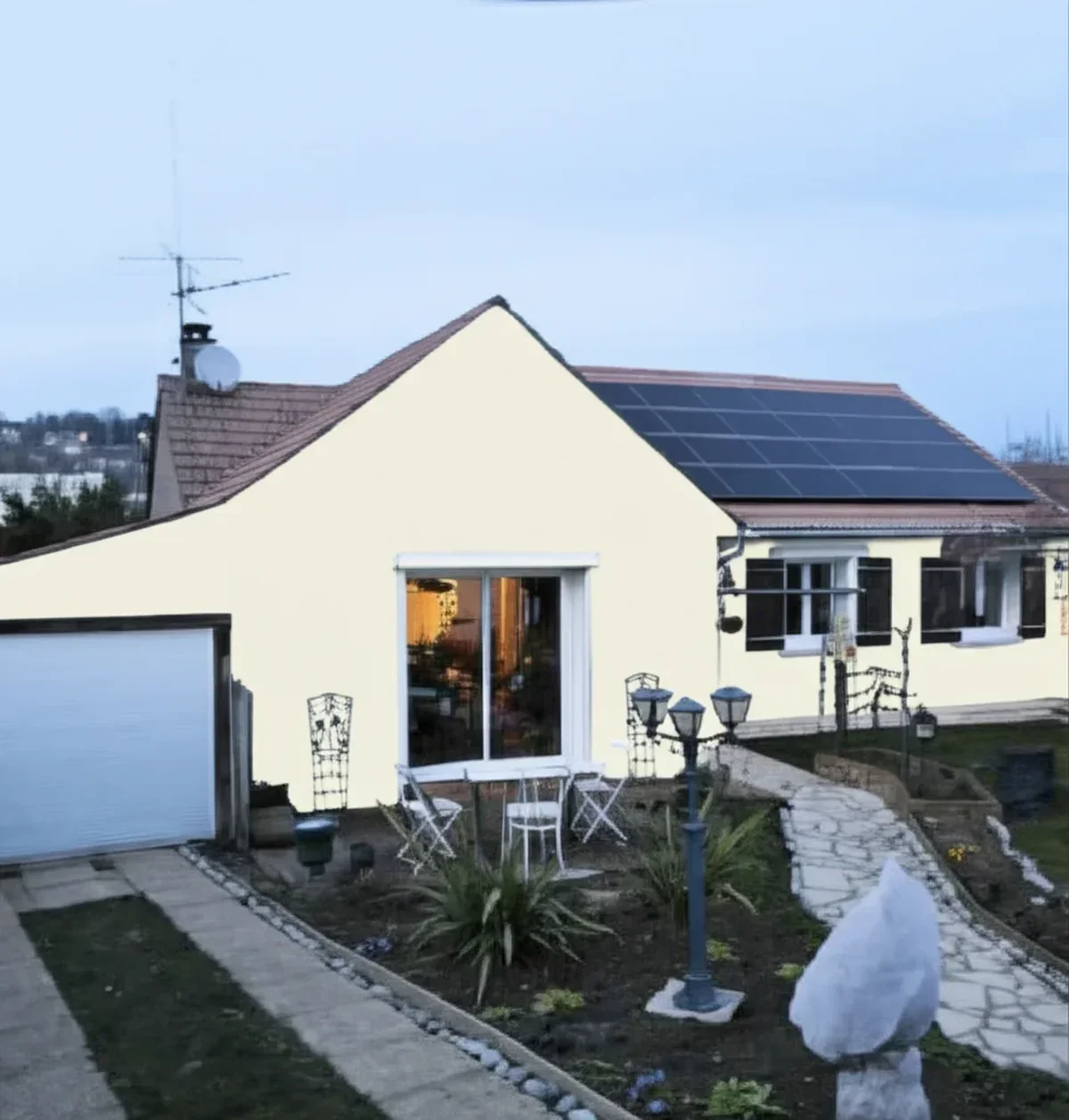
Try it on your house

The verdict in three lines. Benjamin Moore Hale Navy HC-154 (LRV about 8) is the truer navy: it has a warm gray base, but the blue clearly leads, so it reads as blue in most light.
Sherwin-Williams Cyberspace SW 7076 (LRV 6) is the blue-charcoal: nearly as deep, but far grayer, so it slides between navy, charcoal, and near-black as the light changes.
Depth is almost a tie. This duel is decided by hue, not lightness: how loudly you want the blue to speak. The tiebreaker is seeing both on a photo of your own wall.
Hale Navy vs Cyberspace is the cross-brand deep-blue duel shoppers keep landing on: Benjamin Moore's most popular navy against Sherwin-Williams' moodiest blue-charcoal. On a fan-deck chip they look like the same dark blue; on a full wall they part ways fast, because one commits to navy and the other keeps drifting toward charcoal. This head-to-head puts the numbers side by side, walks the duel room by room, and calls each winner. For the method behind any two-color decision, start with our side-by-side method for comparing paint colors.
The numbers side by side
| Attribute | Hale Navy HC-154 (Benjamin Moore) | Cyberspace SW 7076 (Sherwin-Williams) |
|---|---|---|
| Family | Deep traditional navy | Deep blue-charcoal |
| LRV | About 8 | 6 |
| Approximate hex | #434B56 | #44484D |
| Approximate RGB | 67, 75, 86 | 68, 72, 77 |
| Undertone | Warm gray base, but a clear blue lean; reads slate-navy, never purple or teal | Cool blue pigment on a very gray base; the blue barely leads |
| Behavior by light | Stays recognizably navy, deepens to soft charcoal at night | Navy in bright light, charcoal in warm light, near-black when dim |
| Character | Classic, grounded, forgiving | Moody, chameleon, higher drama |
| Typical trim partner | Soft warm white such as White Dove OC-17 | Crisp white such as Pure White for maximum contrast |
Try it on your house
No photo? Try a sample
LRV figures come from manufacturer technical data. Hex and RGB are approximate digital renderings; the authoritative reference is a physical sample.
Read the table and one thing jumps out: these two are almost the same darkness. What differs is where it comes from. Their red channels are nearly identical (67 versus 68) and the greens sit within three points, so the entire visible difference lives in the blue channel: Hale Navy's blue runs about 19 points above its red, while Cyberspace's leads its red by only about 9. Hale Navy commits to blue, Cyberspace hedges toward gray. Each color has its own deep dive here, the Hale Navy HC-154 interior profile and the Cyberspace SW 7076 undertones and rooms guide.
Upload one photo, preview Hale Navy, then swap to Cyberspace in one click. Free, no signup.
Room by room, exposure by exposure
Because both colors are so deep, the winner turns on how much light a room can spare and whether you want the blue obvious or shifting. Here is how it usually plays out.
| Room or exposure | Usual winner | Why |
|---|---|---|
| North-facing or low-light room | Hale Navy | Cool, flat light drains blue first, so Hale Navy keeps reading as navy while Cyberspace can flatten to near-black. |
| Bright south-facing room | Either, pick by intent | Good sun unlocks both. Hale Navy stays classic navy; Cyberspace shows its fullest, most balanced blue-charcoal. |
| Home office or study | Cyberspace | The chameleon depth reads focused, and the near-black shift after dark suits an evening work room. |
| Kitchen island or lower cabinets | Tie, by style | Hale Navy for a softer traditional kitchen; Cyberspace for a moodier blue-black against white uppers and brass. |
| Windowless powder room | Cyberspace | The one small room where the near-black read is a feature; with warm sconces it becomes a jewel box. |
On exteriors, Hale Navy has a long track record on facades: our Hale Navy HC-154 exterior guide covers siding, shutters, and doors. Cyberspace was built for interiors and tends toward a flat charcoal outdoors.
When to choose Hale Navy
- You want the color to read clearly as blue. Hale Navy's wider blue lean says navy in almost any light, where Cyberspace slips toward gray.
- The room is dim, north-facing, or used all day. The stronger blue survives weak light; Cyberspace goes near-black first.
- The style is traditional or transitional. Shaker cabinets, board and batten, Colonial doors: its grounded, weathered navy suits heritage detail.
- You want one navy that also works outside. Hale Navy carries to the front door and siding; Cyberspace does not travel outdoors as well.
For its full undertone breakdown, best rooms, and trim pairings, see the dedicated Hale Navy interior review. If the shortlist is really two navies rather than a navy and a charcoal, the Hale Navy vs Naval duel settles it.
When to choose Cyberspace
- You want a navy that behaves like a charcoal. Cyberspace gives a blue-black that can pass for gray, less committed to color than a true navy.
- The room has real light to spend. Bright daylight or warm lamps let the blue show; that is when it looks richest instead of flat.
- You want maximum drama and mood. The navy-to-charcoal-to-near-black shift is the point in a study, a media room, or a jewel-box powder room.
- You are already color-matched to Sherwin-Williams. If the rest of the project is SW, one deck keeps sheens and touch-ups simple.
The full room-by-room treatment, including how much light it needs before the blue disappears, lives in the Cyberspace room-by-room profile. And if the duel makes you realize you actually want a near-black with no blue at all, SW Iron Ore is the warm soft-black route.
Same wall, both colors, your actual light. Free render in about 30 seconds.
Frequently asked questions
Is Hale Navy or Cyberspace more blue?
Hale Navy. Both are deep and nearly the same darkness, but Hale Navy HC-154 (hex 434B56) has a wider blue lean, so it reads as a true navy in most light. Cyberspace SW 7076 (hex 44484D) is grayer, a blue-charcoal whose blue barely leads, so it slides toward charcoal and near-black. To make the color clearly say blue, pick Hale Navy.
What is the difference between Hale Navy and Cyberspace?
Hue, not depth. Hale Navy (BM HC-154, LRV about 8) is a truer navy with a warm gray base, while Cyberspace (SW 7076, LRV 6) is a blue-charcoal that flips between navy, charcoal, and near-black as the light changes. They sit within a couple of points on lightness, so the divide is how much blue you see, not how dark the wall is.
Which is better for a low-light or north-facing room?
Hale Navy, usually. In cool or dim light both colors deepen, but Cyberspace at LRV 6 loses its blue first and can flatten into a near-black, while Hale Navy keeps reading as navy longer. If the room is bright and you want the moody navy-to-charcoal shift on purpose, Cyberspace is the more dramatic choice. Sample either one on the wall before committing.
Can I use Hale Navy and Cyberspace together in the same house?
Keep them in separate rooms. They are close enough in depth that side by side on connected walls they can look like a mismatched batch rather than a deliberate pairing. A cleaner plan is the truer navy, Hale Navy, in the brighter rooms and the blue-charcoal, Cyberspace, in a moodier well-lit space such as a study or powder room.
Settle it on your photo
Chips lie, screens lie, and a navy this deep changes more between noon and night than almost any other color. The fastest honest answer is to test both on a photo of your actual room and let your trim, floor, and windows pick the winner. Run Hale Navy first, swap to Cyberspace on the same wall, and check both in daylight and after dark.
1 HD render plus 3 free color variations. Start with Hale Navy, swap to Cyberspace in one click.
Trademark notice. Benjamin Moore and Hale Navy are trademarks of Benjamin Moore & Co. Sherwin-Williams, Cyberspace, Naval, and Iron Ore are trademarks of The Sherwin-Williams Company. FacadeColorizer is an independent paint visualization service and is not affiliated with, endorsed by, or sponsored by any paint manufacturer. Brand and product names are used for descriptive and editorial purposes only. Color hex and RGB values are approximate digital renderings; the only authoritative reference is a physical manufacturer sample. LRV figures are drawn from the respective manufacturer technical data.
Trademarks mentioned (Sherwin-Williams, Benjamin Moore, Behr, Caparol, Brillux, Sto, Alpina, Valspar, PPG, Glidden, Dulux, Crown Trade, Sandtex, Farrow & Ball, Johnstone's, Leyland) are property of their respective owners. FacadeColorizer is independent and not affiliated with any of them. Nominative fair use under Lanham Act §1125.